1
New Product
Planning
Group 4
Baal
Pulmano
Romaraog
Victorioso
What is Product Planning?
Product Planning is the ongoing
process of identifying and articulating market
requirements that define a product's feature
set. Product planning is the process of
creating a product idea and following through
on it until the product is introduced to the
market.
3
7 Phases of New Product Planning
Process
1. Idea Generation
The focus in this first stage is on
searching for new product ideas. New product
ideas come from a variety of sources. An
important source of new product ideas are
customers. Fundamentally, customer needs
and wants seem to be the most fertile and
logical place to start looking for new product
ideas. 4
7 Phases of New Product Planning
Process
2. Screening the Ideas
It means critical evaluation of product
ideas generated. After collecting the product
ideas, the next stage is screening of these
ideas. The main object of screening is to
abandon further consideration of those ideas
which are inconsistent with the product
policy of the firm.
5
7 Phases of New Product Planning
Process
3. Concept Testing
What is tested at this stage is the
‘product concept’ itself-whether the
prospective consumers understand the
product idea, whether they are receptive
towards the idea, whether they actually need
such a product and whether they will try out
such a product if it is made available to
them. 6
7 Phases of New Product Planning
Process
4. Business Analysis
This stage is of special importance in
the new product development process.
Estimates of sales, costs and profits are
important components of business analysis
and forecasts of market penetration and
market potential are essential.
7
7 Phases of New Product Planning
Process
5. Product Development
The idea on paper is converted into
product. Product development is the
introduction of new products in the present
markets. New or improved products are
offered by the firm to the market so as to
give better satisfaction to the present
customers.
8
7 Phases of New Product Planning
Process
6. Test Marketing
By test marketing, we mean, what is
likely to happen, by trial and error method
when a product is introduced commercially
into the market. These tests are planned
and conducted in selected geographical
areas, by marketing the new products. The
reactions of consumers are watched.
9
7 Phases of New Product Planning
Process
7. Commercialization
At this stage, production starts,
marketing programme begins to operate and
products flow to the market for sale. It has to
compete with the existing products to secure
maximum share in the market-sales and
profits.
10
Alternative Product
Development Strategies
11
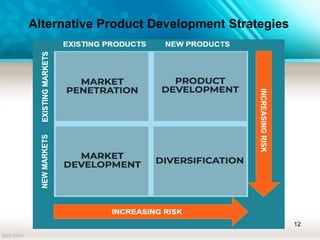
Alternative Product Development Strategies
12
Alternative Product Development Strategies
1. Market Penetration
It refers to concentrating on the current
business and directing resources and efforts
to the profitable growth of a single product,
in a single market, and with a single
technology.
13
Alternative Product Development Strategies
2. Market Development
It consists of selling existing products,
to new customers in related market areas by
adding different channels of distribution or
by changing the content of advertising or the
promotional media.
14
Alternative Product Development Strategies
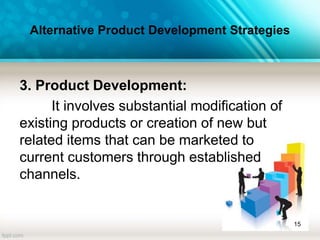
3. Product Development:
It involves substantial modification of
existing products or creation of new but
related items that can be marketed to
current customers through established
channels.
15
Alternative Product Development Strategies
4. Diversification
Is generally considered the most risky
alternative, because it involves both creating
new products and seeking new customers.
Marketers must carefully study the
competition as well as the needs and wants
of people they have not previously served.
16
Product Positioning
Product positioning is the process
marketers use to determine how to best
communicate their products' attributes to
their target customers based on customer
needs, competitive pressures, available
communication channels and carefully
crafted key messages.
17
Cannibalization
refers to a reduction in sales volume,
sales revenue, or market share of one
product as a result of the introduction of a
new product by the same producer.
18
To be continue…
Mid Review
1. It is the process of identifying and
articulating market requirements?
2. There are 4 alternative strategies in
product development, what are they?
3. It refers to reduction of sales revenue or
market share as a result of the
introduction of new product?
19
Click me for
answers
Consumer Adoption Process
1. Awareness Stage
Individual consumer becomes aware of
the innovation. He is aware of either by
discussion with friends, relatives, salesmen,
or dealers. He gets idea about a new
product from various means of advertising
like newspapers, magazines, Internet,
television, outdoor media, etc.
21
Consumer Adoption Process
2. Interest Stage
The consumer becomes interested in
innovation and tries to collect more information.
He collects information from advertising media,
salesmen, dealers, current users, or directly
from company. He tries to know about qualities,
features, functions, risk, producers, brand,
colour, shape, price, incentives, availability,
services, and other relevant aspects. 22
Consumer Adoption Process
3. Evaluation Stage
The consumer considers all the
significant aspects to judge the worth of
innovation. He compares different aspects of
innovation like qualities, features,
performance, price, after-sales services,
etc., with the existing products to arrive at
the decision whether the innovation should
be tried out. 23
Consumer Adoption Process
4. Trial Stage
Consumer is ready to try or test the
new product. He tries out the innovation in a
small scale to get self-experience. He can
buy the product, or can use free samples.
This is an important stage as it determines
whether to buy it.
24
Consumer Adoption Process
5. Adoption Stage
If trial produces satisfactory results,
finally the consumer decides to adopt/buy
the innovation. He decides on quantity, type,
model, dealer, payment, and other issues.
He purchases the product and consumes
individually or jointly with other members.
25
Adopters Categories
Adopters are customers who have
started using or exploring the product
offerings. Now adopter categories can be
defined as dividing these adopters on the
basis of time and level of willingness with
which they tried or will try the
product/service.
26
Adopters Categories
1. Innovators
Innovators are risk takers and they seek changes.
They are the first one to buy a new product. They
try the product in its initial introduction phase.
2. Early adopters
Early adopters are prestige oriented opinion
leaders. They have higher social status, financial
liquidity, education. They use the product during its
late introduction phase of its life cycle. 27
Adopters Categories
3. Early majority
They are the leading segment of the market, about
one third of the target market. Early Majority have
above average social status and are not opinion
leaders. They come into picture during the growth
phase of the product.
4. Late majority
Followers of the early majority, typically sceptical
about an innovation, have below average social status
and little financial liquidity. They are about 36 percent
of the target market. They try the product in its late
growth and maturity phase. 28
Adopters Categories
5. Laggards
Conservative, price conscious segment, aversion
to change-agents. They are oldest and most
traditional. They show their willingness to use the
product in its late maturity phase and diminishing
phase.
29
Diffusion
Diffusion is the process by which a
new idea or new product is accepted by
the market. The rate of diffusion is the
speed with which the new idea spreads from
one consumer to the next.
30
Rate of Adoption Determinants
In particular, 5 characteristics are
especially important in influencing an
innovation’s rate of adoption:
1. Relative Advantage. The relative
advantage refers to the degree to which an
innovation appears superior to existing
products.
31
Rate of Adoption Determinants
2. Compatibility. Compatibility is the degree
to which an innovation fits the values and
experiences of potential consumers.
3. Complexity. The degree to which an
innovation is difficult to understand or to use
is also one of the product characteristics that
influence the adoption rate.
32
1 more page before END
Rate of Adoption Determinants
4. Divisibility. Divisibility refers to the
degree to which an innovation may be tried
on a limited basis.
5. Communicability. Communicability can
slow down adoption significantly. It is the
degree to which the results of using an
innovation can be observed or described to
others. END 33
Final Review
1. Stage where individual Consumer becomes
aware of the innovation.
2. Stage where consumer decide to adopt the
innovation
3. Stage where consumers considers all the
significant aspects to judge the worth of
innovation
4. What are the 5 adopters categories?
34
Click me for
answers
Short Quiz (Identification)
1. It is the process of identifying and articulating
market requirements?
2. It refers to reduction of sales revenue or market
share as a result of the introduction of new
product?
3. What stage where individual Consumer becomes
aware of the innovation?
4. What stage where consumer decide to adopt the
innovation?
5. What stage where consumers considers all the
significant aspects to judge the worth of
innovation? 36
Panuto: Isulat ang false kung tama at true naman kung mali.
6. There are 4 alternative strategies in Product development.
7. Diffusion is the process by which a new idea or
new product is accepted by the market.
8. Divisibility refers to the degree to which an innovation may be
tried on a limited basis.
9. Communicability is the degree to which the results of using
an innovation can be observed or described to others.
10. Complexity is the degree to which an innovation is difficult to
understand.
37
Short Quiz (Bawal ang tamang sagot)
Short Quiz (Enumeration)
11-15. Enumerate the 5 Adopters
Categories.
38
1. Product Planning
2. Cannibalization
3. Awareness
4. Adoption
5. Evaluation
6-10. false
11-15. Innovators, Early adopters, Early
majority, Late majority and Laggards
39
Please wait for
answer key…
Credits nman jan kung kokopya
aba hirap kya nito…
-MISS
(name ko)
40

New product planning

  • 1.
  • 2.
  • 3.
    What is ProductPlanning? Product Planning is the ongoing process of identifying and articulating market requirements that define a product's feature set. Product planning is the process of creating a product idea and following through on it until the product is introduced to the market. 3
  • 4.
    7 Phases ofNew Product Planning Process 1. Idea Generation The focus in this first stage is on searching for new product ideas. New product ideas come from a variety of sources. An important source of new product ideas are customers. Fundamentally, customer needs and wants seem to be the most fertile and logical place to start looking for new product ideas. 4
  • 5.
    7 Phases ofNew Product Planning Process 2. Screening the Ideas It means critical evaluation of product ideas generated. After collecting the product ideas, the next stage is screening of these ideas. The main object of screening is to abandon further consideration of those ideas which are inconsistent with the product policy of the firm. 5
  • 6.
    7 Phases ofNew Product Planning Process 3. Concept Testing What is tested at this stage is the ‘product concept’ itself-whether the prospective consumers understand the product idea, whether they are receptive towards the idea, whether they actually need such a product and whether they will try out such a product if it is made available to them. 6
  • 7.
    7 Phases ofNew Product Planning Process 4. Business Analysis This stage is of special importance in the new product development process. Estimates of sales, costs and profits are important components of business analysis and forecasts of market penetration and market potential are essential. 7
  • 8.
    7 Phases ofNew Product Planning Process 5. Product Development The idea on paper is converted into product. Product development is the introduction of new products in the present markets. New or improved products are offered by the firm to the market so as to give better satisfaction to the present customers. 8
  • 9.
    7 Phases ofNew Product Planning Process 6. Test Marketing By test marketing, we mean, what is likely to happen, by trial and error method when a product is introduced commercially into the market. These tests are planned and conducted in selected geographical areas, by marketing the new products. The reactions of consumers are watched. 9
  • 10.
    7 Phases ofNew Product Planning Process 7. Commercialization At this stage, production starts, marketing programme begins to operate and products flow to the market for sale. It has to compete with the existing products to secure maximum share in the market-sales and profits. 10
  • 11.
  • 12.
  • 13.
    Alternative Product DevelopmentStrategies 1. Market Penetration It refers to concentrating on the current business and directing resources and efforts to the profitable growth of a single product, in a single market, and with a single technology. 13
  • 14.
    Alternative Product DevelopmentStrategies 2. Market Development It consists of selling existing products, to new customers in related market areas by adding different channels of distribution or by changing the content of advertising or the promotional media. 14
  • 15.
    Alternative Product DevelopmentStrategies 3. Product Development: It involves substantial modification of existing products or creation of new but related items that can be marketed to current customers through established channels. 15
  • 16.
    Alternative Product DevelopmentStrategies 4. Diversification Is generally considered the most risky alternative, because it involves both creating new products and seeking new customers. Marketers must carefully study the competition as well as the needs and wants of people they have not previously served. 16
  • 17.
    Product Positioning Product positioningis the process marketers use to determine how to best communicate their products' attributes to their target customers based on customer needs, competitive pressures, available communication channels and carefully crafted key messages. 17
  • 18.
    Cannibalization refers to areduction in sales volume, sales revenue, or market share of one product as a result of the introduction of a new product by the same producer. 18 To be continue…
  • 19.
    Mid Review 1. Itis the process of identifying and articulating market requirements? 2. There are 4 alternative strategies in product development, what are they? 3. It refers to reduction of sales revenue or market share as a result of the introduction of new product? 19 Click me for answers
  • 20.
    Consumer Adoption Process 1.Awareness Stage Individual consumer becomes aware of the innovation. He is aware of either by discussion with friends, relatives, salesmen, or dealers. He gets idea about a new product from various means of advertising like newspapers, magazines, Internet, television, outdoor media, etc. 21
  • 21.
    Consumer Adoption Process 2.Interest Stage The consumer becomes interested in innovation and tries to collect more information. He collects information from advertising media, salesmen, dealers, current users, or directly from company. He tries to know about qualities, features, functions, risk, producers, brand, colour, shape, price, incentives, availability, services, and other relevant aspects. 22
  • 22.
    Consumer Adoption Process 3.Evaluation Stage The consumer considers all the significant aspects to judge the worth of innovation. He compares different aspects of innovation like qualities, features, performance, price, after-sales services, etc., with the existing products to arrive at the decision whether the innovation should be tried out. 23
  • 23.
    Consumer Adoption Process 4.Trial Stage Consumer is ready to try or test the new product. He tries out the innovation in a small scale to get self-experience. He can buy the product, or can use free samples. This is an important stage as it determines whether to buy it. 24
  • 24.
    Consumer Adoption Process 5.Adoption Stage If trial produces satisfactory results, finally the consumer decides to adopt/buy the innovation. He decides on quantity, type, model, dealer, payment, and other issues. He purchases the product and consumes individually or jointly with other members. 25
  • 25.
    Adopters Categories Adopters arecustomers who have started using or exploring the product offerings. Now adopter categories can be defined as dividing these adopters on the basis of time and level of willingness with which they tried or will try the product/service. 26
  • 26.
    Adopters Categories 1. Innovators Innovatorsare risk takers and they seek changes. They are the first one to buy a new product. They try the product in its initial introduction phase. 2. Early adopters Early adopters are prestige oriented opinion leaders. They have higher social status, financial liquidity, education. They use the product during its late introduction phase of its life cycle. 27
  • 27.
    Adopters Categories 3. Earlymajority They are the leading segment of the market, about one third of the target market. Early Majority have above average social status and are not opinion leaders. They come into picture during the growth phase of the product. 4. Late majority Followers of the early majority, typically sceptical about an innovation, have below average social status and little financial liquidity. They are about 36 percent of the target market. They try the product in its late growth and maturity phase. 28


  • 28.
    Adopters Categories 5. Laggards Conservative,price conscious segment, aversion to change-agents. They are oldest and most traditional. They show their willingness to use the product in its late maturity phase and diminishing phase. 29
  • 29.
    Diffusion Diffusion is theprocess by which a new idea or new product is accepted by the market. The rate of diffusion is the speed with which the new idea spreads from one consumer to the next. 30
  • 30.
    Rate of AdoptionDeterminants In particular, 5 characteristics are especially important in influencing an innovation’s rate of adoption: 1. Relative Advantage. The relative advantage refers to the degree to which an innovation appears superior to existing products. 31
  • 31.
    Rate of AdoptionDeterminants 2. Compatibility. Compatibility is the degree to which an innovation fits the values and experiences of potential consumers. 3. Complexity. The degree to which an innovation is difficult to understand or to use is also one of the product characteristics that influence the adoption rate. 32 1 more page before END
  • 32.
    Rate of AdoptionDeterminants 4. Divisibility. Divisibility refers to the degree to which an innovation may be tried on a limited basis. 5. Communicability. Communicability can slow down adoption significantly. It is the degree to which the results of using an innovation can be observed or described to others. END 33
  • 33.
    Final Review 1. Stagewhere individual Consumer becomes aware of the innovation. 2. Stage where consumer decide to adopt the innovation 3. Stage where consumers considers all the significant aspects to judge the worth of innovation 4. What are the 5 adopters categories? 34 Click me for answers
  • 34.
    Short Quiz (Identification) 1.It is the process of identifying and articulating market requirements? 2. It refers to reduction of sales revenue or market share as a result of the introduction of new product? 3. What stage where individual Consumer becomes aware of the innovation? 4. What stage where consumer decide to adopt the innovation? 5. What stage where consumers considers all the significant aspects to judge the worth of innovation? 36
  • 35.
    Panuto: Isulat angfalse kung tama at true naman kung mali. 6. There are 4 alternative strategies in Product development. 7. Diffusion is the process by which a new idea or new product is accepted by the market. 8. Divisibility refers to the degree to which an innovation may be tried on a limited basis. 9. Communicability is the degree to which the results of using an innovation can be observed or described to others. 10. Complexity is the degree to which an innovation is difficult to understand. 37 Short Quiz (Bawal ang tamang sagot)
  • 36.
    Short Quiz (Enumeration) 11-15.Enumerate the 5 Adopters Categories. 38
  • 37.
    1. Product Planning 2.Cannibalization 3. Awareness 4. Adoption 5. Evaluation 6-10. false 11-15. Innovators, Early adopters, Early majority, Late majority and Laggards 39 Please wait for answer key…
  • 38.
    Credits nman jankung kokopya aba hirap kya nito… -MISS (name ko) 40