BASICS – COMMERCIAL
BANKING
Prepared By
NILESH SEN
1
What You Must Learn…..
2
 Meaning
 Definition of Bank
 History of Commercial Banks in India
 Evolution Stages - Indian Banking Sector
 Reform Phases – Indian Banking Sector
 Structure of Indian Banking Sector
 Key Trends – Indian Banking Sector
 Growth Drivers – Indian banking Sector
 Key Opportunities
Meaning of Bank
3
 A Commercial Bank is a profit-seeking business
firm, dealing in money and credit.
 It is a financial institution dealing in money in the
sense that it accepts deposits of money from the
public to keep them in its custody for safety.
 So also, it deals in credit, i.e., it creates credit by
making advances out of the funds received as
deposits to needy people
Contd….
4
 It thus, functions as a mobiliser of saving in the
economy.
 A bank is, therefore like a reservoir into which
flow the savings, the idle surplus money of
households and from which loans are given on
interest to businessmen and others who need them
for investment or productive uses.
Definition of Bank
5
 Walter Leaf “A bank is a person or corporation
which holds itself out to receive from the public,
deposits payable on demand by cheque.”
 Horace White defined a bank, “As a manufacture of
credit and a machine for facilitating exchange.”
 According to Prof. Kinley, “A bank is an
establishment which makes to individuals such
advances of money as may be required and safely
made, and to which individuals entrust money when
not required by them for use.”
Contd….
6
 The Banking Companies Act of India defines Bank as
“A Bank is a financial institution which accepts money
from the public for the purpose of lending or investment
repayable on demand or otherwise withdrawal by
cheques, drafts or order or otherwise”
 Hence bank is a financial institution which –
- Deals in debts and credits
- Accepts deposits and lends money and also
creates money
- Bridges the gap between borrowers and savers
History of Commercial Banks in
India
7
 At the time of independence, there were 645 banks
with more than 4,800 branches in India
 But, with the nationalisation, in July 1969, 14 major
banks were nationalised in first round
 In second round, in 1980, another 6 banks were
nationalised
Contd….
8
 The commercial banking industry in India started
in 1786 with the establishment of the Bank of
Bengal in Calcutta. The Indian Government at that
time established three Presidency banks, viz., the
Bank of Bengal (established in 1809), the Bank of
Bombay (established in 1840) and the Bank of
Madras (established in 1843).
Contd….
9
 In 1921, the three Presidency banks were
amalgamated to form the Imperial Bank of India,
which took up the role of a commercial bank, a
bankers' bank and a banker to the Government.
The Imperial Bank of India was established with
mainly European shareholders. It was only with
the establishment of Reserve Bank of India (RBI)
as the central bank of the country in 1935, that the
quasi-central banking role of the Imperial Bank of
India came to an end.
Contd….
10
 In 1860, the concept of limited liability was
introduced in Indian banking, resulting in the
establishment of joint-stock banks. In 1865, the
Allahabad Bank was established with purely Indian
shareholders. Punjab National Bank came into
being in 1895. Between 1906 and 1913, other
banks like Bank of India, Central Bank of India,
Bank of Baroda, Canara Bank, Indian Bank, and
Bank of Mysore were set up.
Contd….
11
 After independence, the Government of India started
taking steps to encourage the spread of banking in
India. In order to serve the economy in general and
the rural sector in particular, the All India Rural
Credit Survey Committee recommended the creation
of a state-partnered and state-sponsored bank taking
over the Imperial Bank of India and integrating with
it, the former state-owned and state-associate banks.
Contd….
12
 Accordingly, State Bank of India (SBI) was
constituted in 1955. Subsequently in 1959, the State
Bank of India (subsidiary bank) Act was passed,
enabling the SBI to take over eight former state-
associate banks as its subsidiaries.
 To better align the banking system to the needs of
planning and economic policy, it was considered
necessary to have social control over banks.
Contd….
13
 Important question arise –
- Reasons & Objectives for Nationalisation
- Does progressed achieved???
Causes for Nationalisation
 Private ownership of commercial banks and
concentration of economic power
 Urban-bias
 Negligence of agriculture sector
 Violation of norms & Speculative activities
 Negligence for priority sector lending
Contd….
14
Objectives of Nationalisation
 Removal of control by a few
 Provision of adequate credit to agriculture and
small scale industry
 Giving a professional bent to management
 Encouragement to New Class of Entrepreneurs
 Provision of adequate training and services to
bank staff
Contd….
15
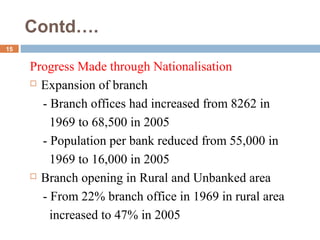
Progress Made through Nationalisation
 Expansion of branch
- Branch offices had increased from 8262 in
1969 to 68,500 in 2005
- Population per bank reduced from 55,000 in
1969 to 16,000 in 2005
 Branch opening in Rural and Unbanked area
- From 22% branch office in 1969 in rural area
increased to 47% in 2005
Contd….
16
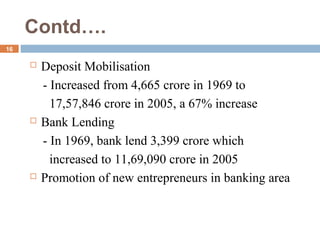
 Deposit Mobilisation
- Increased from 4,665 crore in 1969 to
17,57,846 crore in 2005, a 67% increase
 Bank Lending
- In 1969, bank lend 3,399 crore which
increased to 11,69,090 crore in 2005
 Promotion of new entrepreneurs in banking area
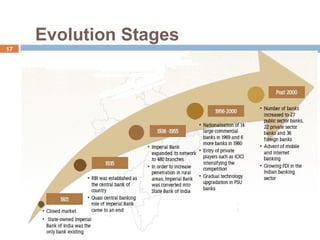
Evolution Stages
17
Reform Phases – Indian Banking
Sector18
 The Government of India appointed a committee
under the Chairmanship of Mr. M. Narasimham
(the former Governor of RBI) in July 1991 to
examine India's financial system and to recommend
improvements in the working of the financial
system.
 This is known as the Committee on Financial
Sector Reforms.
Contd….
19
 This was followed by another committee under him
in 1998. The second committee was asked to look
in to the progress of reforms till 1998 and to lay a
course for further reforms.
 This committee is known as Committee on Banking
Sector Reforms, 1998.
 The Reports of these two committees form the
basis for reforms in the Indian banking sector
Contd….
20
Refer Material – Reforms in Indian Banking Sector
provided to you
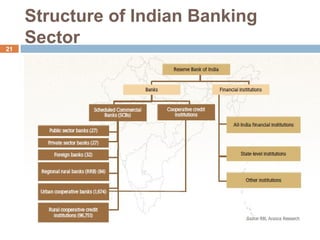
Structure of Indian Banking
Sector21
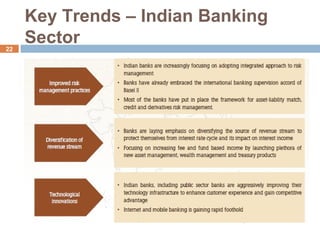
Key Trends – Indian Banking
Sector22
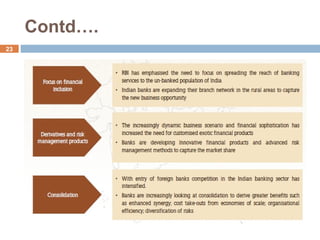
Contd….
23
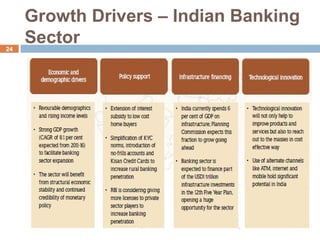
Growth Drivers – Indian Banking
Sector24
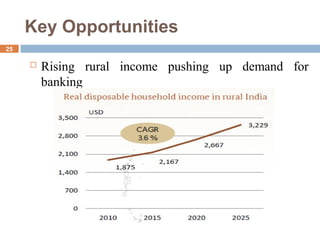
Key Opportunities
25
 Rising rural income pushing up demand for
banking
Contd….
26
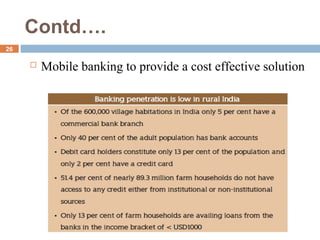
 Mobile banking to provide a cost effective solution
27
Thank you……

Ch 2 basics of cb done

  • 1.
  • 2.
    What You MustLearn….. 2  Meaning  Definition of Bank  History of Commercial Banks in India  Evolution Stages - Indian Banking Sector  Reform Phases – Indian Banking Sector  Structure of Indian Banking Sector  Key Trends – Indian Banking Sector  Growth Drivers – Indian banking Sector  Key Opportunities
  • 3.
    Meaning of Bank 3 A Commercial Bank is a profit-seeking business firm, dealing in money and credit.  It is a financial institution dealing in money in the sense that it accepts deposits of money from the public to keep them in its custody for safety.  So also, it deals in credit, i.e., it creates credit by making advances out of the funds received as deposits to needy people
  • 4.
    Contd…. 4  It thus,functions as a mobiliser of saving in the economy.  A bank is, therefore like a reservoir into which flow the savings, the idle surplus money of households and from which loans are given on interest to businessmen and others who need them for investment or productive uses.
  • 5.
    Definition of Bank 5 Walter Leaf “A bank is a person or corporation which holds itself out to receive from the public, deposits payable on demand by cheque.”  Horace White defined a bank, “As a manufacture of credit and a machine for facilitating exchange.”  According to Prof. Kinley, “A bank is an establishment which makes to individuals such advances of money as may be required and safely made, and to which individuals entrust money when not required by them for use.”
  • 6.
    Contd…. 6  The BankingCompanies Act of India defines Bank as “A Bank is a financial institution which accepts money from the public for the purpose of lending or investment repayable on demand or otherwise withdrawal by cheques, drafts or order or otherwise”  Hence bank is a financial institution which – - Deals in debts and credits - Accepts deposits and lends money and also creates money - Bridges the gap between borrowers and savers
  • 7.
    History of CommercialBanks in India 7  At the time of independence, there were 645 banks with more than 4,800 branches in India  But, with the nationalisation, in July 1969, 14 major banks were nationalised in first round  In second round, in 1980, another 6 banks were nationalised
  • 8.
    Contd…. 8  The commercialbanking industry in India started in 1786 with the establishment of the Bank of Bengal in Calcutta. The Indian Government at that time established three Presidency banks, viz., the Bank of Bengal (established in 1809), the Bank of Bombay (established in 1840) and the Bank of Madras (established in 1843).
  • 9.
    Contd…. 9  In 1921,the three Presidency banks were amalgamated to form the Imperial Bank of India, which took up the role of a commercial bank, a bankers' bank and a banker to the Government. The Imperial Bank of India was established with mainly European shareholders. It was only with the establishment of Reserve Bank of India (RBI) as the central bank of the country in 1935, that the quasi-central banking role of the Imperial Bank of India came to an end.
  • 10.
    Contd…. 10  In 1860,the concept of limited liability was introduced in Indian banking, resulting in the establishment of joint-stock banks. In 1865, the Allahabad Bank was established with purely Indian shareholders. Punjab National Bank came into being in 1895. Between 1906 and 1913, other banks like Bank of India, Central Bank of India, Bank of Baroda, Canara Bank, Indian Bank, and Bank of Mysore were set up.
  • 11.
    Contd…. 11  After independence,the Government of India started taking steps to encourage the spread of banking in India. In order to serve the economy in general and the rural sector in particular, the All India Rural Credit Survey Committee recommended the creation of a state-partnered and state-sponsored bank taking over the Imperial Bank of India and integrating with it, the former state-owned and state-associate banks.
  • 12.
    Contd…. 12  Accordingly, StateBank of India (SBI) was constituted in 1955. Subsequently in 1959, the State Bank of India (subsidiary bank) Act was passed, enabling the SBI to take over eight former state- associate banks as its subsidiaries.  To better align the banking system to the needs of planning and economic policy, it was considered necessary to have social control over banks.
  • 13.
    Contd…. 13  Important questionarise – - Reasons & Objectives for Nationalisation - Does progressed achieved??? Causes for Nationalisation  Private ownership of commercial banks and concentration of economic power  Urban-bias  Negligence of agriculture sector  Violation of norms & Speculative activities  Negligence for priority sector lending
  • 14.
    Contd…. 14 Objectives of Nationalisation Removal of control by a few  Provision of adequate credit to agriculture and small scale industry  Giving a professional bent to management  Encouragement to New Class of Entrepreneurs  Provision of adequate training and services to bank staff
  • 15.
    Contd…. 15 Progress Made throughNationalisation  Expansion of branch - Branch offices had increased from 8262 in 1969 to 68,500 in 2005 - Population per bank reduced from 55,000 in 1969 to 16,000 in 2005  Branch opening in Rural and Unbanked area - From 22% branch office in 1969 in rural area increased to 47% in 2005
  • 16.
    Contd…. 16  Deposit Mobilisation -Increased from 4,665 crore in 1969 to 17,57,846 crore in 2005, a 67% increase  Bank Lending - In 1969, bank lend 3,399 crore which increased to 11,69,090 crore in 2005  Promotion of new entrepreneurs in banking area
  • 17.
  • 18.
    Reform Phases –Indian Banking Sector18  The Government of India appointed a committee under the Chairmanship of Mr. M. Narasimham (the former Governor of RBI) in July 1991 to examine India's financial system and to recommend improvements in the working of the financial system.  This is known as the Committee on Financial Sector Reforms.
  • 19.
    Contd…. 19  This wasfollowed by another committee under him in 1998. The second committee was asked to look in to the progress of reforms till 1998 and to lay a course for further reforms.  This committee is known as Committee on Banking Sector Reforms, 1998.  The Reports of these two committees form the basis for reforms in the Indian banking sector
  • 20.
    Contd…. 20 Refer Material –Reforms in Indian Banking Sector provided to you
  • 21.
    Structure of IndianBanking Sector21
  • 22.
    Key Trends –Indian Banking Sector22
  • 23.
  • 24.
    Growth Drivers –Indian Banking Sector24
  • 25.
    Key Opportunities 25  Risingrural income pushing up demand for banking
  • 26.
    Contd…. 26  Mobile bankingto provide a cost effective solution
  • 27.