Amity Business School
Co-Branding
Presented By:
Tannu Shree – C 61
Amity Business School
Definition
“Two or more well-known brands are combined in an offer”
and each brand’s sponsor expects that the other brand name
will strengthen the brand preference or purchase intention and
hopes to reach a new audience.
- Philip Kotler
2
Amity Business School
Intent
• There are three levels of co-branding: market share, brand
extension, and global branding.
• Level 1 includes joining with another company to penetrate
the market
• Level 2 is working to extend the brand based on the
company's current market share
• Level 3 tries to achieve a global strategy by combining the
two brands
• Wei-Lun Chang, “Roadmap of Co-branding Positions and Strategies,”
Journal of American Academy of Business ,Vol. 15, September, pp. 77-84, 2009.
3
Amity Business School
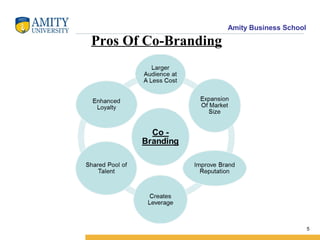
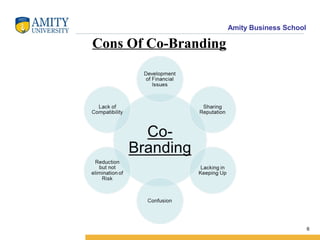
Pros And Cons of Co-Branding
4
Amity Business School
Pros Of Co-Branding
5
Amity Business School
Cons Of Co-Branding
6
Amity Business School
The pros and cons of co-branding show that there is a potential benefit in
introducing new products to an established marketplace, but only when a clear
message has been offered. If both companies can offer a concise message to
both targeted audiences, then it can be one very successful marketing
campaign.
7
Amity Business School
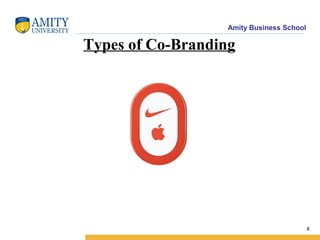
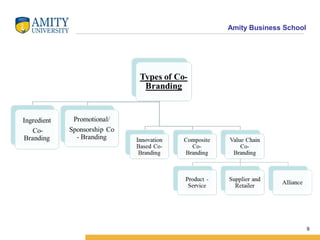
Types of Co-Branding
8
Amity Business School
9
Amity Business School
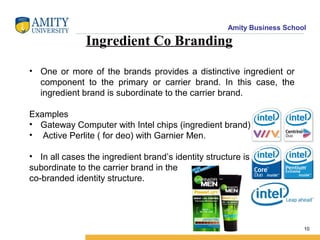
Ingredient Co Branding
• One or more of the brands provides a distinctive ingredient or
component to the primary or carrier brand. In this case, the
ingredient brand is subordinate to the carrier brand.
Examples
• Gateway Computer with Intel chips (ingredient brand)
• Active Perlite ( for deo) with Garnier Men.
• In all cases the ingredient brand’s identity structure is
subordinate to the carrier brand in the
co-branded identity structure.
10
Amity Business School
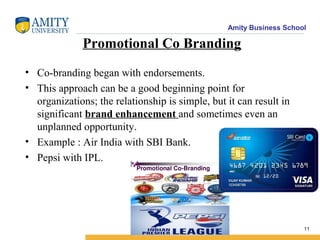
Promotional Co Branding
• Co-branding began with endorsements.
• This approach can be a good beginning point for
organizations; the relationship is simple, but it can result in
significant brand enhancement and sometimes even an
unplanned opportunity.
• Example : Air India with SBI Bank.
• Pepsi with IPL.
11
Amity Business School
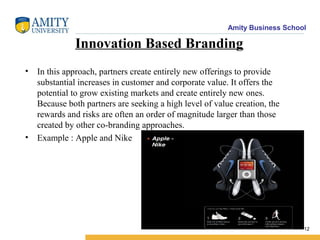
Innovation Based Branding
• In this approach, partners create entirely new offerings to provide
substantial increases in customer and corporate value. It offers the
potential to grow existing markets and create entirely new ones.
Because both partners are seeking a high level of value creation, the
rewards and risks are often an order of magnitude larger than those
created by other co-branding approaches.
• Example : Apple and Nike
12
Amity Business School
Composite Co - Branding
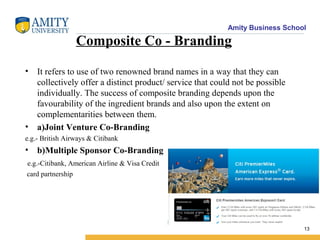
• It refers to use of two renowned brand names in a way that they can
collectively offer a distinct product/ service that could not be possible
individually. The success of composite branding depends upon the
favourability of the ingredient brands and also upon the extent on
complementarities between them.
• a)Joint Venture Co-Branding
e.g.- British Airways & Citibank
• b)Multiple Sponsor Co-Branding
e.g.-Citibank, American Airline & Visa Credit
card partnership
13
Amity Business School
Value Chain Co- Branding
Other players in the value chain can create new experiences for the
consumer, which, in turn, can create a level of customer value and
differentiation not possible with promotional or ingredient co-branding.
There are three types of value-chain co-branding:
1.Product Service Co Branding : This approach allows partners to share
industry-specific competencies while at the same time opening previously
unavailable customer bases.
EXAMPLES TO BE ADDED
14
Amity Business School
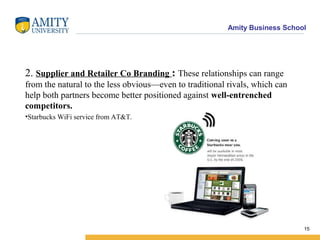
2. Supplier and Retailer Co Branding : These relationships can range
from the natural to the less obvious—even to traditional rivals, which can
help both partners become better positioned against well-entrenched
competitors.
•Starbucks WiFi service from AT&T.
15
Amity Business School
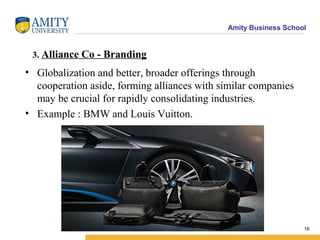
3. Alliance Co - Branding
• Globalization and better, broader offerings through
cooperation aside, forming alliances with similar companies
may be crucial for rapidly consolidating industries.
• Example : BMW and Louis Vuitton.
16
Amity Business School
Winners
At Co - Branding
17
Amity Business School
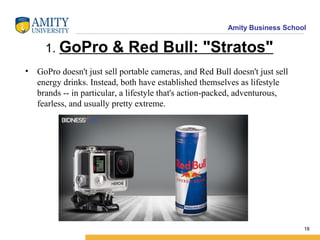
1. GoPro & Red Bull: "Stratos"
• GoPro doesn't just sell portable cameras, and Red Bull doesn't just sell
energy drinks. Instead, both have established themselves as lifestyle
brands -- in particular, a lifestyle that's action-packed, adventurous,
fearless, and usually pretty extreme.
18
Amity Business School
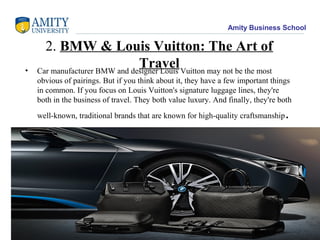
2. BMW & Louis Vuitton: The Art of
Travel• Car manufacturer BMW and designer Louis Vuitton may not be the most
obvious of pairings. But if you think about it, they have a few important things
in common. If you focus on Louis Vuitton's signature luggage lines, they're
both in the business of travel. They both value luxury. And finally, they're both
well-known, traditional brands that are known for high-quality craftsmanship.
19
Amity Business School
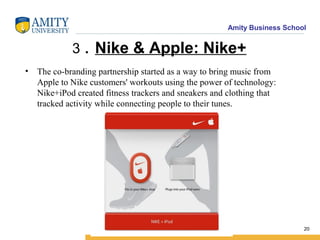
3 . Nike & Apple: Nike+
• The co-branding partnership started as a way to bring music from
Apple to Nike customers' workouts using the power of technology:
Nike+iPod created fitness trackers and sneakers and clothing that
tracked activity while connecting people to their tunes.
20
Amity Business School
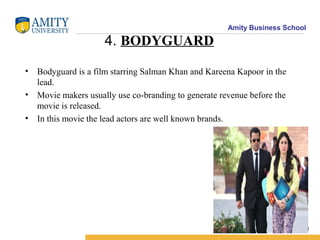
4. BODYGUARD
• Bodyguard is a film starring Salman Khan and Kareena Kapoor in the
lead.
• Movie makers usually use co-branding to generate revenue before the
movie is released.
• In this movie the lead actors are well known brands.
21
Amity Business School
Brands Promoted In The Movie
• AUDI: AUDI SUV Q5 has been used extensively in the movie.
• BLACKBERRY: Blackberry cell phones can be seen being used by
Salman khan in the movie.
• SYMBIOSIS UNIVERSITY: Symbiosis Pune campus has been used.
• SONY VAIO: Kareena Kapoor who is the brand ambassador of Sony
Vaio can be seen using it in the movie.
• TIGER SECURITY SERVICES: Salman khan can be seen wearing
uniform of this company.
22
Amity Business School
Failures
At Co - Branding
23
Amity Business School
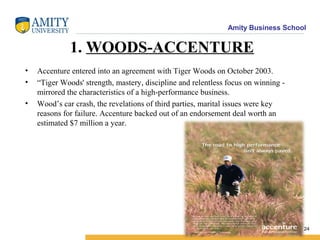
1. WOODS-ACCENTURE
• Accenture entered into an agreement with Tiger Woods on October 2003.
• “Tiger Woods' strength, mastery, discipline and relentless focus on winning -
mirrored the characteristics of a high-performance business.
• Wood’s car crash, the revelations of third parties, marital issues were key
reasons for failure. Accenture backed out of an endorsement deal worth an
estimated $7 million a year.
24
Amity Business School
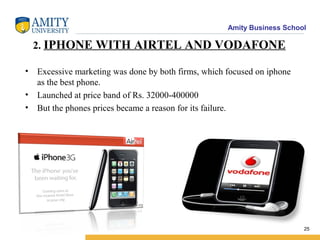
2. IPHONE WITH AIRTEL AND VODAFONE
• Excessive marketing was done by both firms, which focused on iphone
as the best phone.
• Launched at price band of Rs. 32000-400000
• But the phones prices became a reason for its failure.
25
Amity Business School
3. AT&T AND BRITISH
TELECOMMUNICATION
• It was 50-50 joint venture with $10 billion in assets.
• Main focus was to provide global calls at lower rates.
• The decision to end the partnership, had been widely expected as
– rising losses,
– internal squabbles
– increasing competition from rivals
26

Co branding

  • 1.
  • 2.
    Amity Business School Definition “Twoor more well-known brands are combined in an offer” and each brand’s sponsor expects that the other brand name will strengthen the brand preference or purchase intention and hopes to reach a new audience. - Philip Kotler 2
  • 3.
    Amity Business School Intent •There are three levels of co-branding: market share, brand extension, and global branding. • Level 1 includes joining with another company to penetrate the market • Level 2 is working to extend the brand based on the company's current market share • Level 3 tries to achieve a global strategy by combining the two brands • Wei-Lun Chang, “Roadmap of Co-branding Positions and Strategies,” Journal of American Academy of Business ,Vol. 15, September, pp. 77-84, 2009. 3
  • 4.
    Amity Business School ProsAnd Cons of Co-Branding 4
  • 5.
  • 6.
  • 7.
    Amity Business School Thepros and cons of co-branding show that there is a potential benefit in introducing new products to an established marketplace, but only when a clear message has been offered. If both companies can offer a concise message to both targeted audiences, then it can be one very successful marketing campaign. 7
  • 8.
  • 9.
  • 10.
    Amity Business School IngredientCo Branding • One or more of the brands provides a distinctive ingredient or component to the primary or carrier brand. In this case, the ingredient brand is subordinate to the carrier brand. Examples • Gateway Computer with Intel chips (ingredient brand) • Active Perlite ( for deo) with Garnier Men. • In all cases the ingredient brand’s identity structure is subordinate to the carrier brand in the co-branded identity structure. 10
  • 11.
    Amity Business School PromotionalCo Branding • Co-branding began with endorsements. • This approach can be a good beginning point for organizations; the relationship is simple, but it can result in significant brand enhancement and sometimes even an unplanned opportunity. • Example : Air India with SBI Bank. • Pepsi with IPL. 11
  • 12.
    Amity Business School InnovationBased Branding • In this approach, partners create entirely new offerings to provide substantial increases in customer and corporate value. It offers the potential to grow existing markets and create entirely new ones. Because both partners are seeking a high level of value creation, the rewards and risks are often an order of magnitude larger than those created by other co-branding approaches. • Example : Apple and Nike 12
  • 13.
    Amity Business School CompositeCo - Branding • It refers to use of two renowned brand names in a way that they can collectively offer a distinct product/ service that could not be possible individually. The success of composite branding depends upon the favourability of the ingredient brands and also upon the extent on complementarities between them. • a)Joint Venture Co-Branding e.g.- British Airways & Citibank • b)Multiple Sponsor Co-Branding e.g.-Citibank, American Airline & Visa Credit card partnership 13
  • 14.
    Amity Business School ValueChain Co- Branding Other players in the value chain can create new experiences for the consumer, which, in turn, can create a level of customer value and differentiation not possible with promotional or ingredient co-branding. There are three types of value-chain co-branding: 1.Product Service Co Branding : This approach allows partners to share industry-specific competencies while at the same time opening previously unavailable customer bases. EXAMPLES TO BE ADDED 14
  • 15.
    Amity Business School 2.Supplier and Retailer Co Branding : These relationships can range from the natural to the less obvious—even to traditional rivals, which can help both partners become better positioned against well-entrenched competitors. •Starbucks WiFi service from AT&T. 15
  • 16.
    Amity Business School 3.Alliance Co - Branding • Globalization and better, broader offerings through cooperation aside, forming alliances with similar companies may be crucial for rapidly consolidating industries. • Example : BMW and Louis Vuitton. 16
  • 17.
  • 18.
    Amity Business School 1.GoPro & Red Bull: "Stratos" • GoPro doesn't just sell portable cameras, and Red Bull doesn't just sell energy drinks. Instead, both have established themselves as lifestyle brands -- in particular, a lifestyle that's action-packed, adventurous, fearless, and usually pretty extreme. 18
  • 19.
    Amity Business School 2.BMW & Louis Vuitton: The Art of Travel• Car manufacturer BMW and designer Louis Vuitton may not be the most obvious of pairings. But if you think about it, they have a few important things in common. If you focus on Louis Vuitton's signature luggage lines, they're both in the business of travel. They both value luxury. And finally, they're both well-known, traditional brands that are known for high-quality craftsmanship. 19
  • 20.
    Amity Business School 3. Nike & Apple: Nike+ • The co-branding partnership started as a way to bring music from Apple to Nike customers' workouts using the power of technology: Nike+iPod created fitness trackers and sneakers and clothing that tracked activity while connecting people to their tunes. 20
  • 21.
    Amity Business School 4.BODYGUARD • Bodyguard is a film starring Salman Khan and Kareena Kapoor in the lead. • Movie makers usually use co-branding to generate revenue before the movie is released. • In this movie the lead actors are well known brands. 21
  • 22.
    Amity Business School BrandsPromoted In The Movie • AUDI: AUDI SUV Q5 has been used extensively in the movie. • BLACKBERRY: Blackberry cell phones can be seen being used by Salman khan in the movie. • SYMBIOSIS UNIVERSITY: Symbiosis Pune campus has been used. • SONY VAIO: Kareena Kapoor who is the brand ambassador of Sony Vaio can be seen using it in the movie. • TIGER SECURITY SERVICES: Salman khan can be seen wearing uniform of this company. 22
  • 23.
  • 24.
    Amity Business School 1.WOODS-ACCENTURE • Accenture entered into an agreement with Tiger Woods on October 2003. • “Tiger Woods' strength, mastery, discipline and relentless focus on winning - mirrored the characteristics of a high-performance business. • Wood’s car crash, the revelations of third parties, marital issues were key reasons for failure. Accenture backed out of an endorsement deal worth an estimated $7 million a year. 24
  • 25.
    Amity Business School 2.IPHONE WITH AIRTEL AND VODAFONE • Excessive marketing was done by both firms, which focused on iphone as the best phone. • Launched at price band of Rs. 32000-400000 • But the phones prices became a reason for its failure. 25
  • 26.
    Amity Business School 3.AT&T AND BRITISH TELECOMMUNICATION • It was 50-50 joint venture with $10 billion in assets. • Main focus was to provide global calls at lower rates. • The decision to end the partnership, had been widely expected as – rising losses, – internal squabbles – increasing competition from rivals 26

Editor's Notes

  • #3 Source : http://www.brandxpress.net/2006/08/co-brandingdual-branding/
  • #6 1. It costs both brands less to reach a larger audience.In most co-branding arrangements, the brands or companies involved are sharing the marketing costs. This allows them to reach a potentially larger audience while lowering their overall expenses. 2. It increases market size. Co-branding is most effective when two different companies come together for a marketing plan. This allows each natural customer base to be attracted to what the other company has to offer. An example of this would be the co-branding effort of Tim Horton’s with Cold Stone Creamery. 3. It can improve a brand’s reputation. If one brand is really struggling, but the other in a co-branding situation is really successful, then the struggling brand can get a boost to their reputation from this marketing effort. 4. It creates leverage. Small businesses can have a difficult time establishing themselves in a competitive marketplace. By utilizing co-branding, they can begin to leverage their advantages in a world where the larger companies have mature customer relationships in place. This gives them a potential opportunity to legitimately compete. 5. There is a shared pool of talent. Each company or brand can put their best people on this type of project so there is a collaboration. This even saves manpower costs and reduces the need for outsourcing because two teams come together to create one consistent marketing product. 6. Loyal fans feel like they’ve been given more value. People who are loyal to a brand are unlikely to let their preferred products or services go very easily. Without new offerings, however, some loyal fans might start to think about leaving. Co-branding allows a company to introduce new ideas to their most loyal customers without having to actually develop new ideas.
  • #7 1. There are usually financial issues that develop. Co-branding offers profit-sharing agreements and other joint-venture scenarios that can make one brand feel like the other is taking advantage of them. This complex relationship is often government by several legal agreements that take place before the campaign goes live, which means there is the cost of negotiation to consider before this ever gets started. 2. Sharing reputation isn’t always a good thing. A struggling franchise gets a boost from a successful franchise, but the reverse is also true. This can be especially bothersome for successful brands if the combined target demographics begin to see the two companies or brands as one combined brand instead. 3. One company or brand might not be able to keep up. The customer response to a co-branding effort is usually positive from an overall perspective. Sometimes it is so positive that sales surge in unexpected ways. If one brand can keep up with this demand, but the other cannot, then this outcome will drag down the reputation of both demands. 4. It can create confusion. Many consumers like to have competitive products from which they can choose. When there are too many products, however, what tends to happen to the consumer is a feeling of confusion. They lose their confidence. They enjoy the convenience of multiple choices under one campaign, but the confusion drives them over to a completely different brand. 5. Reduced risk doesn’t mean zero risk. There will always be risks involved when marketing new products or services. Being able to combine resources through co-branding can help companies be able to reduce the amount of risk they are taking, but it won’t completely eliminate it. 6. Some cultures just aren’t compatible. Some companies might be a good match from a product or service standpoint, but their internal cultures might not be compatible. Sometimes co-branding just isn’t a good fit, which means it takes time to develop the relationships necessary to understand the full potential of this venture.
  • #19 GoPro doesn't just sell portable cameras, and Red Bull doesn't just sell energy drinks. Instead, both have established themselves as lifestyle brands -- in particular, a lifestyle that's action-packed, adventurous, fearless, and usually pretty extreme. These shared values make them a perfect pairing for co-branding campaigns, especially those surrounding action sports. To make the partnership work, GoPro equips athletes and adventurers from around the world with the tools and funding to capture things like races, stunts, and action sport events on video -- from the athlete's perspective. At the same time, Red Bull uses its experience and reputation to run and sponsor these events. "GoPro camera technology is allowing us to complement the programming by delivering new athlete perspectives that have never been seen before," said Sean Eggert, Red Bull's director of sports marketing. The collaboration allows exclusive GoPro content to enhance both companies' growth. While GoPro and Red Bull have collaborated on many events and projects together, perhaps the biggest collaboration stunt they've done was "Stratos," in which Felix Baumgartner jumped from a space pod more than 24 miles above Earth's surface with a GoPro strapped to his person. Not only did Baumgartner set three world records that day, but he also embodied the value of reimagining human potential that define both GoPro and Red Bull. https://youtu.be/dYw4meRWGd4
  • #20 These shared values are exactly why this co-branding campaign makes so much sense. In their partnership, BMW created a sports car model called the BMW i8, while Louis Vuitton designed an exclusive, four-piece set of suitcases and bags that fit perfectly into the car's rear parcel sh Although the four-piece luggage set goes for a whopping $20,000, the price is right for the target customer, as the BMW i8 starts at $135,700. A price like that kind of makes that luggage set seem like a drop in the bucket. Not only does the luggage fit perfectly size-wise, but its design and appearance fit perfectly with BMW's image: sleek, masculine, and high-quality. Turns out both the luggage and some parts of the car's interior use carbon fiber, strong-yet-light composite material. "This collaboration with BMW i epitomises our shared values of creativity, technological innovation and style," said Patrick-Louis Vuitton, head of special orders at Louis Vuitton. "Our craftsmen have enjoyed the challenge of this very special project, using their ingenuity and attention to detail to create a truly made to measure set of luxury luggage. This is a pure expression of the art of travel.
  • #21 Athletic brand Nike and technology giant Apple have been working together since the early 2000s, when the first line of iPods was released. The partnership has since evolved to become Nike+ -- which uses activity tracking technology built into athletic clothing and gear to sync with Apple iPhone apps to track and record workout data. Tracking transmitters can be built into shoes, armbands, and even basketballs to measure time, distance, heart rate, and calories burned. It's a genius co-branding move that helps both parties provide a better experience to customers -- and with the popularity of fitness tracking technology, Nike+ is ahead of the curve by making it easy for athletes to track while they play.
  • #22 Bodyguard is a film starring Salman Khan and Kareena Kapoor in the lead. The movie released on occasion of Eid. The movie has in the span of 6 days managed to do collection of over Rs. 100cr. Movie makers usually use co-branding to generate revenue before the movie is released. In this movie the lead actors are well known brands.
  • #25 Accenture entered into an agreement with Tiger Woods on October 2003. “Tiger Woods' strength, mastery, discipline and relentless focus on winning - mirrored the characteristics of a high-performance business.  Accenture used Woods to personify its claimed attributes of integrity and high performance. Accenture made the brand building of Tiger Woods an equal part of their own brand building. Wood’s car crash, the revelations of third parties, marital issues were key reasons for failure. Accenture backed out of an endorsement deal worth an estimated $7 million a year. Six year investment ended abruptly on a low, negative note rather than strategically timed graceful separation.
  • #26 Excessive marketing was done by both firms, which focused on iphone as the best phone. Companies anticipated great sales volume and even initiated pre-launch booking process. Launched at price band of Rs. 32000-400000 But the phones prices became a reason for its failure. Main reason being it was already available in the grey market at less than Rs. 27000. Lack of 3G technology at the time being also hampered sales. This caused the potential buyers to purchase the cell from grey market. Damping the expected sales figures. In the early quarters on 2009 – 40000 iphones were imported and only 20000 were sold, the importers were force to offload there imports to Sri Lanka and other countries. Were as Grey market managed to sell around 80000 pieces in the same time fame. Airtel and Vodafone both failed to analyze the pricing expectation of the consumer.
  • #27 Both the telecom giants got together in 1998 to serve as Concert It was 50-50 joint venture with $10 billion in assets Convergence of applications like information like in the Internet, communications, such as fax and voice, long distance, and local, and entertainment  Main focus was to provide global calls at lower rates. They wanted to capture the telecom market which was exploding at that time with developments in technology. Planned to provide telecom services to multinational organizations like global phones with a single number. The decision to end the partnership, had been widely expected as rising losses, internal squabbles increasing competition from rivals Management problems and a corporate culture clash prohibited the desired synergy. A victim of the downturn in tech, collapsing telecom prices and huge debt levels accumulated to pay for new-generation mobile-phone licenses, Concert bled cash and was expected to rack up losses on the order of $800 million this year alone.