INTERNATIONAL
FINANCIAL MARKET
INSTRUMENTS
Presented by:-
NILESH SEN
1
Types
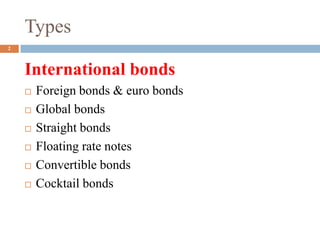
International bonds
 Foreign bonds & euro bonds
 Global bonds
 Straight bonds
 Floating rate notes
 Convertible bonds
 Cocktail bonds
2
Types
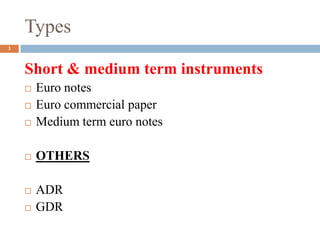
Short & medium term instruments
 Euro notes
 Euro commercial paper
 Medium term euro notes
 OTHERS
 ADR
 GDR
3
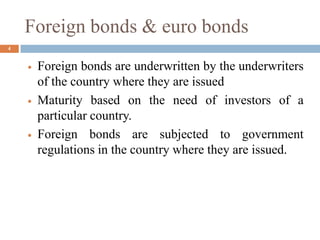
Foreign bonds & euro bonds
 Foreign bonds are underwritten by the underwriters
of the country where they are issued
 Maturity based on the need of investors of a
particular country.
 Foreign bonds are subjected to government
regulations in the country where they are issued.
4
DIFFERENCES
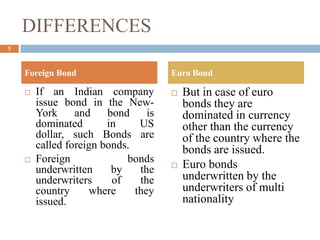
 If an Indian company
issue bond in the New-
York and bond is
dominated in US
dollar, such Bonds are
called foreign bonds.
 Foreign bonds
underwritten by the
underwriters of the
country where they
issued.
 But in case of euro
bonds they are
dominated in currency
other than the currency
of the country where the
bonds are issued.
 Euro bonds
underwritten by the
underwriters of multi
nationality
Foreign Bond Euro Bond
5
DIFFERENCES
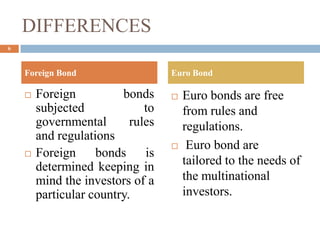
 Foreign bonds
subjected to
governmental rules
and regulations
 Foreign bonds is
determined keeping in
mind the investors of a
particular country.
 Euro bonds are free
from rules and
regulations.
 Euro bond are
tailored to the needs of
the multinational
investors.
Foreign Bond Euro Bond
6
Global bonds
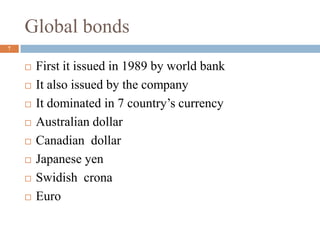
 First it issued in 1989 by world bank
 It also issued by the company
 It dominated in 7 country’s currency
 Australian dollar
 Canadian dollar
 Japanese yen
 Swidish crona
 Euro
7
Global bonds
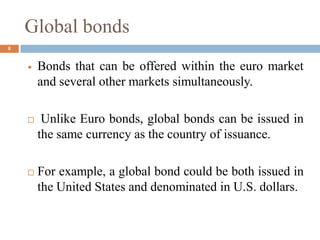
 Bonds that can be offered within the euro market
and several other markets simultaneously.
 Unlike Euro bonds, global bonds can be issued in
the same currency as the country of issuance.
 For example, a global bond could be both issued in
the United States and denominated in U.S. dollars.
8
Features
Eurobonds
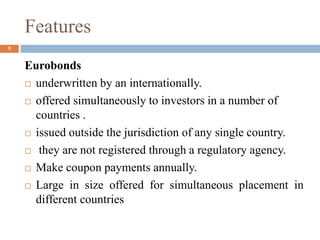
 underwritten by an internationally.
 offered simultaneously to investors in a number of
countries .
 issued outside the jurisdiction of any single country.
 they are not registered through a regulatory agency.
 Make coupon payments annually.
 Large in size offered for simultaneous placement in
different countries
9
Straight bonds
 Interest rate is fixed known as coupon rate
 It is a traditional type of bond
Its varities:-
 -Bullet-redemption bond
 -Rising-coupon bond
 -Zero-coupon bond
 -Currency options
 -Bull and bear bonds.
 -Debt warrant bonds
10
Floating rate notes
 Does not carry fixed rate of interest
 Interest quoted as a premium or discount to a reference
rate(LIBOR)
 Interest rate revised periodically.
 Perpetual FRNs
 Minimax FRN
 Drop lock FRN
 Flip flop FRN
 Mismatch FRN
 Hybrid fixed rate reverse FRN
11
Convertible bonds
 Convertible into equity shares
 Some convertible bonds have detachable warrants
involving acquisition rights
 Automatic convertibility into a specified number of
shares.
12
Cocktail bonds
 Denominated in a mixture of currencies.
 Represent a weighted average of 5 currencies
 Investors get currency diversification risk
 Depreciation offset by appreciation of other.
13
Euro notes
 Like PNs for obtaining short term funds.
 Denominated in any currency other than the
currency of the country where they are issued.
 Documentation facilities are minimum.
 Represent Low cost funding route.
 Investor too prefer them in view of short maturity.
14
Euro commercial notes
 A short-term, debt instrument
 Corporations issue euro commercial papers in
order to tap into the international money markets
for their financing.
 An example of a euro commercial paper is a British
firm issuing debt in U.S. dollars to encourage
investment from dollar-investors in international
money markets.
15
Medium term euro notes
 Longer maturity between 1 year to 5 years.
 Short term euro notes are allowed to roll over.
 Issued to get medium term funds in foreign
currency without any need for redemption and
fresh issue.
 It is not underwritten yet there is provision for
underwriting.
 It carry fixed interest rate
16
ADR’S
 Represents ownership in the shares of a non-U.S.
company that trades in U.S. financial markets
 ADRs carry prices in US dollars,
 pay dividends in US dollars,
 And can be traded like the shares of US-based
companies.
 JPMorgan Citibank
 Deutsche Bank
 Bank of New York Mellon
17
GDR’S
 Global Depository Receipt (GDR) - certificate issued
by international bank, which can be subject of
worldwide circulation on capital markets.
 GDR's are emitted by banks, which purchase shares of
foreign companies and deposit it on the accounts.
 Global Depository Receipt facilitates trade of
shares, especially those from emerging markets.
 Prices of GDR's are often close to values of related
shares.
 Very similar to GDR's are ADR's.
18
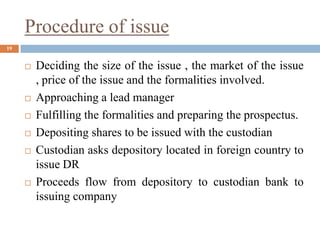
Procedure of issue
 Deciding the size of the issue , the market of the issue
, price of the issue and the formalities involved.
 Approaching a lead manager
 Fulfilling the formalities and preparing the prospectus.
 Depositing shares to be issued with the custodian
 Custodian asks depository located in foreign country to
issue DR
 Proceeds flow from depository to custodian bank to
issuing company
19
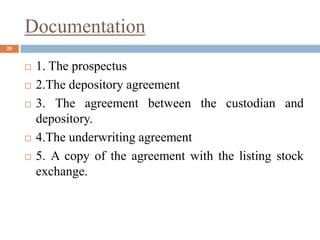
Documentation
 1. The prospectus
 2.The depository agreement
 3. The agreement between the custodian and
depository.
 4.The underwriting agreement
 5. A copy of the agreement with the listing stock
exchange.
20
21

International financial-market-instruments

  • 1.
  • 2.
    Types International bonds  Foreignbonds & euro bonds  Global bonds  Straight bonds  Floating rate notes  Convertible bonds  Cocktail bonds 2
  • 3.
    Types Short & mediumterm instruments  Euro notes  Euro commercial paper  Medium term euro notes  OTHERS  ADR  GDR 3
  • 4.
    Foreign bonds &euro bonds  Foreign bonds are underwritten by the underwriters of the country where they are issued  Maturity based on the need of investors of a particular country.  Foreign bonds are subjected to government regulations in the country where they are issued. 4
  • 5.
    DIFFERENCES  If anIndian company issue bond in the New- York and bond is dominated in US dollar, such Bonds are called foreign bonds.  Foreign bonds underwritten by the underwriters of the country where they issued.  But in case of euro bonds they are dominated in currency other than the currency of the country where the bonds are issued.  Euro bonds underwritten by the underwriters of multi nationality Foreign Bond Euro Bond 5
  • 6.
    DIFFERENCES  Foreign bonds subjectedto governmental rules and regulations  Foreign bonds is determined keeping in mind the investors of a particular country.  Euro bonds are free from rules and regulations.  Euro bond are tailored to the needs of the multinational investors. Foreign Bond Euro Bond 6
  • 7.
    Global bonds  Firstit issued in 1989 by world bank  It also issued by the company  It dominated in 7 country’s currency  Australian dollar  Canadian dollar  Japanese yen  Swidish crona  Euro 7
  • 8.
    Global bonds  Bondsthat can be offered within the euro market and several other markets simultaneously.  Unlike Euro bonds, global bonds can be issued in the same currency as the country of issuance.  For example, a global bond could be both issued in the United States and denominated in U.S. dollars. 8
  • 9.
    Features Eurobonds  underwritten byan internationally.  offered simultaneously to investors in a number of countries .  issued outside the jurisdiction of any single country.  they are not registered through a regulatory agency.  Make coupon payments annually.  Large in size offered for simultaneous placement in different countries 9
  • 10.
    Straight bonds  Interestrate is fixed known as coupon rate  It is a traditional type of bond Its varities:-  -Bullet-redemption bond  -Rising-coupon bond  -Zero-coupon bond  -Currency options  -Bull and bear bonds.  -Debt warrant bonds 10
  • 11.
    Floating rate notes Does not carry fixed rate of interest  Interest quoted as a premium or discount to a reference rate(LIBOR)  Interest rate revised periodically.  Perpetual FRNs  Minimax FRN  Drop lock FRN  Flip flop FRN  Mismatch FRN  Hybrid fixed rate reverse FRN 11
  • 12.
    Convertible bonds  Convertibleinto equity shares  Some convertible bonds have detachable warrants involving acquisition rights  Automatic convertibility into a specified number of shares. 12
  • 13.
    Cocktail bonds  Denominatedin a mixture of currencies.  Represent a weighted average of 5 currencies  Investors get currency diversification risk  Depreciation offset by appreciation of other. 13
  • 14.
    Euro notes  LikePNs for obtaining short term funds.  Denominated in any currency other than the currency of the country where they are issued.  Documentation facilities are minimum.  Represent Low cost funding route.  Investor too prefer them in view of short maturity. 14
  • 15.
    Euro commercial notes A short-term, debt instrument  Corporations issue euro commercial papers in order to tap into the international money markets for their financing.  An example of a euro commercial paper is a British firm issuing debt in U.S. dollars to encourage investment from dollar-investors in international money markets. 15
  • 16.
    Medium term euronotes  Longer maturity between 1 year to 5 years.  Short term euro notes are allowed to roll over.  Issued to get medium term funds in foreign currency without any need for redemption and fresh issue.  It is not underwritten yet there is provision for underwriting.  It carry fixed interest rate 16
  • 17.
    ADR’S  Represents ownershipin the shares of a non-U.S. company that trades in U.S. financial markets  ADRs carry prices in US dollars,  pay dividends in US dollars,  And can be traded like the shares of US-based companies.  JPMorgan Citibank  Deutsche Bank  Bank of New York Mellon 17
  • 18.
    GDR’S  Global DepositoryReceipt (GDR) - certificate issued by international bank, which can be subject of worldwide circulation on capital markets.  GDR's are emitted by banks, which purchase shares of foreign companies and deposit it on the accounts.  Global Depository Receipt facilitates trade of shares, especially those from emerging markets.  Prices of GDR's are often close to values of related shares.  Very similar to GDR's are ADR's. 18
  • 19.
    Procedure of issue Deciding the size of the issue , the market of the issue , price of the issue and the formalities involved.  Approaching a lead manager  Fulfilling the formalities and preparing the prospectus.  Depositing shares to be issued with the custodian  Custodian asks depository located in foreign country to issue DR  Proceeds flow from depository to custodian bank to issuing company 19
  • 20.
    Documentation  1. Theprospectus  2.The depository agreement  3. The agreement between the custodian and depository.  4.The underwriting agreement  5. A copy of the agreement with the listing stock exchange. 20
  • 21.