1
Commercial Banking –
Functions and Other
Important Aspects
Prepared By
NILESH SEN
2
Learning Objectives….
 Definition of Commercial Bank
 Types of Banks
 Functions of Commercial Banks
 Sources of Banks’ Income
 Investment Policy
 Understanding Balance Sheet of Banks
 Unit Banking Vs. Branch Banking
 CBs and Economic Development
Definition of Commercial Bank
 Banking Regulation Act, (BR Act), 1949.
According to Section 5(c) of the BR Act, 'a banking
company is a company which transacts the business
of banking in India.‘
 Further, Section 5(b) of the BR Act defines
banking as, 'accepting, for the purpose of lending or
investment, of deposits of money from the public,
repayable on demand or otherwise, and
withdrawable, by cheque, draft, order or otherwise.'
3
Contd…
 This definition points to the three primary activities
of a commercial bank which distinguish it from the
other financial institutions. These are: (i)
maintaining deposit accounts including current
accounts, (ii) issue and pay cheques, and (iii) collect
cheques for the bank's customers
4
Types of Banks
 Broadly speaking, banks can be classified into
commercial banks and central bank.
 Commercial banks are those which provide
banking services for profit.
 The central bank has the function of controlling
commercial banks and various other economic
activities.
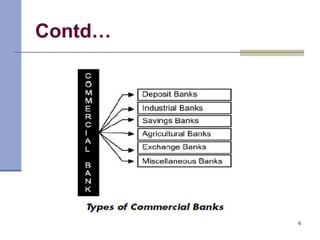
 There are many types of commercial banks such as
deposit banks, industrial banks, savings banks,
agricultural banks, exchange banks, and
miscellaneous banks. 5
Contd…
6
Functions of Commercial
Banks
 Commercial banks have to perform a variety of
functions which are common to both developed and
developing countries. These are known as ‘General
Banking’ functions of the commercial banks.
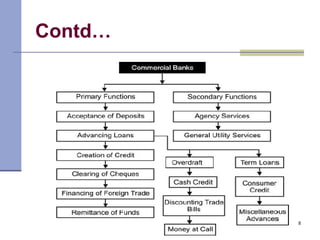
 The modern banks perform a variety of functions.
These can be broadly divided into two categories: (a)
Primary functions and (b) Secondary functions.
7
Contd…
8
Contd…
 Banks also perform certain Agency Functions for
and on behalf of their customers. The agency services
are of immense value to the people at large. The
various agency services rendered by banks are as
follows:
 Collection and Payment of Credit Instruments
 Purchase and Sale of Securities
 Collection of Dividends on Shares
 Acts as Correspondent
 Income-tax Consultancy 9
Contd…
 Execution of Standing Orders
 Acts as Trustee and Executor
General Utility Services
 Locker Facility
 Traveller’s Cheques and Credit Cards
 Letter of Credit
 Collection of Statistics
 Acting Referee
 Underwriting Securities and Merchant Banking
10
Sources of Banks’ Income
 Interest on Loans
 Interest on Investments
 Discounts
 Commission, Brokerage, etc.
 Commercial banks also deal in foreign exchange.
They sell demand drafts, issue letters of credit and
help remittance of funds in foreign countries. They
also act as brokers in foreign exchange. Banks earn
income out of these operations.
11
Investment Policy
 Liquidity
 Profitability
 Safety or Security
 Diversity
 Saleability of Securities
 Stability in the Value of Investments
 Principles of Tax-Exemption of Investments
12
Understanding Balance Sheet
of Banks
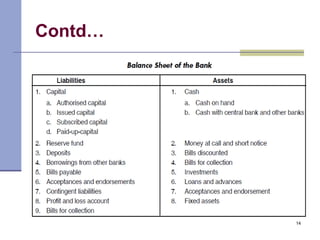
 The balance sheet of a commercial bank is a
statement of its assets and liabilities. Assets are what
others owe the bank, and what the bank owes others
constitutes its liabilities. The business of a bank is
reflected in its balance sheet and hence its financial
position as well. The balance sheet is issued usually
at the end of every financial year of the bank.
13
Contd…
14
Unit Banking Vs. Branch
Banking
 ‘Unit Banking’ means a system of banking under
which banking services are provided by a single
banking organisation. Such a bank has a single office
or place of work. It has its own governing body or
board of directors. It functions independently and is
not controlled by any other individual, firm or body
corporate. It also does not control any other bank.
15
Contd…
 Such banks can become member of the clearing
house and also of the Banker’s Association. Unit
banking system originated and grew in the U.S.A.
Different unit banks in the U.S.A. are linked with
each other and with other financial centres in the
country through “correspondent banks
16
Contd…
Branch Banking System
 It means a system of banking in which a banking
organisation works at more than one place. The main
place of business is called head office and the other
places of business are called branches. The head
office controls and co-ordinates the work at
branches. The day-to-day operations are performed
by the branch manager as per the policies and
directions issued from time to time by the head
office.
17
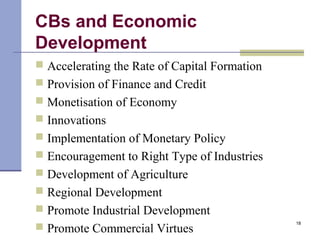
CBs and Economic
Development
 Accelerating the Rate of Capital Formation
 Provision of Finance and Credit
 Monetisation of Economy
 Innovations
 Implementation of Monetary Policy
 Encouragement to Right Type of Industries
 Development of Agriculture
 Regional Development
 Promote Industrial Development
 Promote Commercial Virtues
18

functions and structure

  • 1.
    1 Commercial Banking – Functionsand Other Important Aspects Prepared By NILESH SEN
  • 2.
    2 Learning Objectives….  Definitionof Commercial Bank  Types of Banks  Functions of Commercial Banks  Sources of Banks’ Income  Investment Policy  Understanding Balance Sheet of Banks  Unit Banking Vs. Branch Banking  CBs and Economic Development
  • 3.
    Definition of CommercialBank  Banking Regulation Act, (BR Act), 1949. According to Section 5(c) of the BR Act, 'a banking company is a company which transacts the business of banking in India.‘  Further, Section 5(b) of the BR Act defines banking as, 'accepting, for the purpose of lending or investment, of deposits of money from the public, repayable on demand or otherwise, and withdrawable, by cheque, draft, order or otherwise.' 3
  • 4.
    Contd…  This definitionpoints to the three primary activities of a commercial bank which distinguish it from the other financial institutions. These are: (i) maintaining deposit accounts including current accounts, (ii) issue and pay cheques, and (iii) collect cheques for the bank's customers 4
  • 5.
    Types of Banks Broadly speaking, banks can be classified into commercial banks and central bank.  Commercial banks are those which provide banking services for profit.  The central bank has the function of controlling commercial banks and various other economic activities.  There are many types of commercial banks such as deposit banks, industrial banks, savings banks, agricultural banks, exchange banks, and miscellaneous banks. 5
  • 6.
  • 7.
    Functions of Commercial Banks Commercial banks have to perform a variety of functions which are common to both developed and developing countries. These are known as ‘General Banking’ functions of the commercial banks.  The modern banks perform a variety of functions. These can be broadly divided into two categories: (a) Primary functions and (b) Secondary functions. 7
  • 8.
  • 9.
    Contd…  Banks alsoperform certain Agency Functions for and on behalf of their customers. The agency services are of immense value to the people at large. The various agency services rendered by banks are as follows:  Collection and Payment of Credit Instruments  Purchase and Sale of Securities  Collection of Dividends on Shares  Acts as Correspondent  Income-tax Consultancy 9
  • 10.
    Contd…  Execution ofStanding Orders  Acts as Trustee and Executor General Utility Services  Locker Facility  Traveller’s Cheques and Credit Cards  Letter of Credit  Collection of Statistics  Acting Referee  Underwriting Securities and Merchant Banking 10
  • 11.
    Sources of Banks’Income  Interest on Loans  Interest on Investments  Discounts  Commission, Brokerage, etc.  Commercial banks also deal in foreign exchange. They sell demand drafts, issue letters of credit and help remittance of funds in foreign countries. They also act as brokers in foreign exchange. Banks earn income out of these operations. 11
  • 12.
    Investment Policy  Liquidity Profitability  Safety or Security  Diversity  Saleability of Securities  Stability in the Value of Investments  Principles of Tax-Exemption of Investments 12
  • 13.
    Understanding Balance Sheet ofBanks  The balance sheet of a commercial bank is a statement of its assets and liabilities. Assets are what others owe the bank, and what the bank owes others constitutes its liabilities. The business of a bank is reflected in its balance sheet and hence its financial position as well. The balance sheet is issued usually at the end of every financial year of the bank. 13
  • 14.
  • 15.
    Unit Banking Vs.Branch Banking  ‘Unit Banking’ means a system of banking under which banking services are provided by a single banking organisation. Such a bank has a single office or place of work. It has its own governing body or board of directors. It functions independently and is not controlled by any other individual, firm or body corporate. It also does not control any other bank. 15
  • 16.
    Contd…  Such bankscan become member of the clearing house and also of the Banker’s Association. Unit banking system originated and grew in the U.S.A. Different unit banks in the U.S.A. are linked with each other and with other financial centres in the country through “correspondent banks 16
  • 17.
    Contd… Branch Banking System It means a system of banking in which a banking organisation works at more than one place. The main place of business is called head office and the other places of business are called branches. The head office controls and co-ordinates the work at branches. The day-to-day operations are performed by the branch manager as per the policies and directions issued from time to time by the head office. 17
  • 18.
    CBs and Economic Development Accelerating the Rate of Capital Formation  Provision of Finance and Credit  Monetisation of Economy  Innovations  Implementation of Monetary Policy  Encouragement to Right Type of Industries  Development of Agriculture  Regional Development  Promote Industrial Development  Promote Commercial Virtues 18