Designing Channel
     Systems
Introduction
 Factors that determine the nature of the
 distribution channel
  – Nature of the product or service
  – Location and nature of the customers
  – Nature of competition and distribution
    systems
  – Intensity of distribution required
  – Nature of the markets being targeted
Channel design and planning process
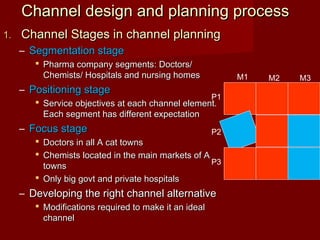
1.   Channel Stages in channel planning
     – Segmentation stage
         Pharma company segments: Doctors/
          Chemists/ Hospitals and nursing homes             M1   M2   M3
     – Positioning stage
                                                       P1
         Service objectives at each channel element.
          Each segment has different expectation
     – Focus stage                                     P2
         Doctors in all A cat towns
         Chemists located in the main markets of A
                                                    P3
          towns
         Only big govt and private hospitals
     – Developing the right channel alternative
         Modifications required to make it an ideal
          channel
Channel design and planning process
2.   Defining the customer needs
     – Lot size
         Toothpaste pack sizes, Wheat flour packs, Motor with horse
          power
     – Waiting time
         Difference of “Desire to purchase”
     – Choice to the consumer
         Variety and assortments
     – Place utility
     – Service support
           Sales support for maintenance and repair
           Installation and training
           Credit
           Home delivery
           Regular service follow ups
Channel design and planning process
 Designing channel objectives
  – Industrial products require direct-marketing by the
    company
  – Consumer products should be available in large no of
    outlets
  – Frozen desert and ice-cream products need cold storage
    facilities
  – Seeds selling will need rural distribution
  – Multi level marketing will require their distributors to
    appoint further distributors
Channel design and planning process
 Channel Alternatives study
  –   Business intermediaries currently available
  –   The no and type of intermediaries required
  –   Any new member to be specially developed
  –   Roles of each channel member
Channel design and planning process
 Cost of channel system
  – Margins of the channel partners
  – Cost of transportation of goods between the co and
    the end user
  – Cost of order booking and execution
  – Cost of stock returns/ date expired stocks taken back
  – Cost of reverse logistics required (getting empties
    back)
Channel design and planning process
 Current intermediaries
  – Ready channel partners may be already available.
    These can be further utilized
      Distributors or redistribution: stockiest of some other
       companies
      C&F agents: can be further utilized for collections and other
       work
      Logistics service providers: will undertake distribution
       activities.
      Manufacturer’s agents, stockiest, guarantors provide
       financial support
      Financial agencies can be used to finance your customers.
Channel design and planning process
 Number of intermediaries
  – Should be adequate for expected coverage of
    the target markets at the same time should
    not be too much to dilute the effort and add to
    the costs.
  – Its not easy to get rid of channel members
Evaluation of Major alternatives
   Cost:
     – Every channel will have different costs associated with
   Ability to manage and control
     – Considering coverage, frequency, productivity, inventory, credit,
       merchandising, distribution, promotions, after-sales-service, pre-
       sales-sales, channel salespeople, stock points
   Adaptability
     – Sensitivity of channel to addition, elimination of products,
       additional service, new territory coverage, generating leads,
       handling price change, stock rationing
   Range and volume to be handled
     – Ability to handle large range of products and volumes.
Selecting channel partners
   Selecting Carrying and Forwarding agent

   Location of the party
    – In or close to main market of the company
   Location of the warehouse
    –   Close to a major market
    –   Outside octroi limits
    –   Should have proper road/ transport access
    –   Labor availability
    –   Utilities support
    –   Connected by phone
   Past experience
    – As a C&FA for a similar company
    – As a transporter should have access to a good warehouse
   History of past business
    –   Should have handled similar but non-competing companies
    –   Ability to maintain confidentiality of transactions
..conti     Selecting channel partners
     Selecting Carrying and Forwarding agent

     Financial strength
       – To handle all operating expenses till re-imbursement
       – Insurance
     IT capability
       – Adequate own hardware
       – Trained staff to handle simple programmes and repairing
          formats
     Flexibility
       – In operating hours daily
       – To handle peak loads
     Transportation facilities
       – Reliability, consistency in source of vehicles
       – Additional volumes to be handled at short notice
     Attitude, commitment
       – To be of the highest order/ positive
       – Willing to expand the business
       – Disciplined
Selecting channel partners
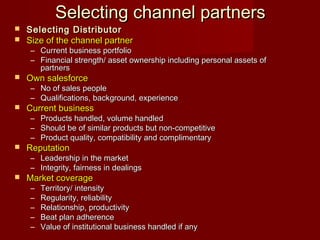
 Selecting Distributor
 Size of the channel partner
    – Current business portfolio
    – Financial strength/ asset ownership including personal assets of
      partners
   Own salesforce
    – No of sales people
    – Qualifications, background, experience
   Current business
    –   Products handled, volume handled
    –   Should be of similar products but non-competitive
    –   Product quality, compatibility and complimentary
   Reputation
    – Leadership in the market
    – Integrity, fairness in dealings
   Market coverage
    –   Territory/ intensity
    –   Regularity, reliability
    –   Relationship, productivity
    –   Beat plan adherence
    –   Value of institutional business handled if any
Selecting channel partners
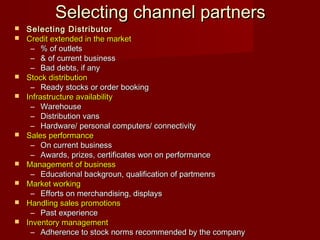
   Selecting Distributor
   Credit extended in the market
     – % of outlets
     – & of current business
     – Bad debts, if any
   Stock distribution
     – Ready stocks or order booking
   Infrastructure availability
     – Warehouse
     – Distribution vans
     – Hardware/ personal computers/ connectivity
   Sales performance
     – On current business
     – Awards, prizes, certificates won on performance
   Management of business
     – Educational backgroun, qualification of partmenrs
   Market working
     – Efforts on merchandising, displays
   Handling sales promotions
     – Past experience
   Inventory management
     – Adherence to stock norms recommended by the company
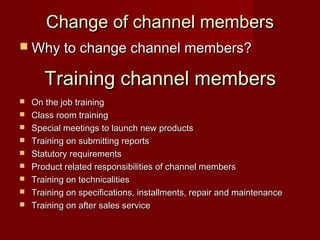
Change of channel members
 Why to change channel members?


       Training channel members
   On the job training
   Class room training
   Special meetings to launch new products
   Training on submitting reports
   Statutory requirements
   Product related responsibilities of channel members
   Training on technicalities
   Training on specifications, installments, repair and maintenance
   Training on after sales service
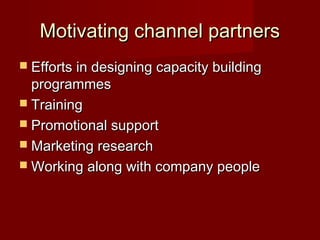
Motivating channel partners
 Efforts in designing capacity building
  programmes
 Training
 Promotional support
 Marketing research
 Working along with company people
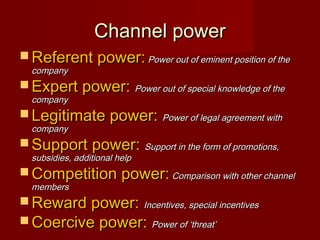
Channel power
 Referent power: Power out of eminent position of the
  company
 Expert power: Power out of special knowledge of the
  company
 Legitimate power: Power of legal agreement with
  company
 Support power: Support in the form of promotions,
  subsidies, additional help
 Competition power: Comparison with other channel
  members
 Reward power: Incentives, special incentives
 Coercive power: Power of ‘threat’
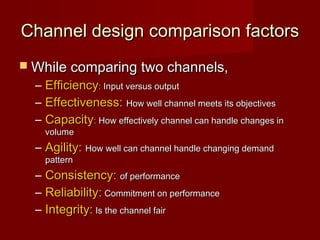
Channel design comparison factors
 While comparing two channels,
  –   Efficiency: Input versus output
  –   Effectiveness: How well channel meets its objectives
  –   Capacity: How effectively channel can handle changes in
      volume
  – Agility: How well can channel handle changing demand
      pattern
  –   Consistency: of performance
  –   Reliability: Commitment on performance
  –   Integrity: Is the channel fair
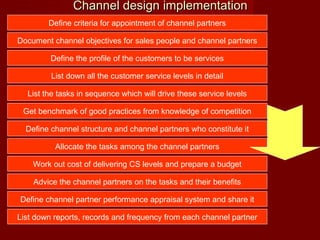
Channel design implementation
        Define criteria for appointment of channel partners

Document channel objectives for sales people and channel partners

         Define the profile of the customers to be services

         List down all the customer service levels in detail

  List the tasks in sequence which will drive these service levels

 Get benchmark of good practices from knowledge of competition

  Define channel structure and channel partners who constitute it

          Allocate the tasks among the channel partners

    Work out cost of delivering CS levels and prepare a budget

    Advice the channel partners on the tasks and their benefits

Define channel partner performance appraisal system and share it

List down reports, records and frequency from each channel partner
 Vertical integration- Owing the channel
 Own the channel or outsource?
 How much of vertical integration?
 Why vertical integration
 Outsourcing distribution
Channel Information System

12-designing-channel-systems

  • 1.
  • 2.
    Introduction  Factors thatdetermine the nature of the distribution channel – Nature of the product or service – Location and nature of the customers – Nature of competition and distribution systems – Intensity of distribution required – Nature of the markets being targeted
  • 3.
    Channel design andplanning process 1. Channel Stages in channel planning – Segmentation stage  Pharma company segments: Doctors/ Chemists/ Hospitals and nursing homes M1 M2 M3 – Positioning stage P1  Service objectives at each channel element. Each segment has different expectation – Focus stage P2  Doctors in all A cat towns  Chemists located in the main markets of A P3 towns  Only big govt and private hospitals – Developing the right channel alternative  Modifications required to make it an ideal channel
  • 4.
    Channel design andplanning process 2. Defining the customer needs – Lot size  Toothpaste pack sizes, Wheat flour packs, Motor with horse power – Waiting time  Difference of “Desire to purchase” – Choice to the consumer  Variety and assortments – Place utility – Service support  Sales support for maintenance and repair  Installation and training  Credit  Home delivery  Regular service follow ups
  • 5.
    Channel design andplanning process  Designing channel objectives – Industrial products require direct-marketing by the company – Consumer products should be available in large no of outlets – Frozen desert and ice-cream products need cold storage facilities – Seeds selling will need rural distribution – Multi level marketing will require their distributors to appoint further distributors
  • 6.
    Channel design andplanning process  Channel Alternatives study – Business intermediaries currently available – The no and type of intermediaries required – Any new member to be specially developed – Roles of each channel member
  • 7.
    Channel design andplanning process  Cost of channel system – Margins of the channel partners – Cost of transportation of goods between the co and the end user – Cost of order booking and execution – Cost of stock returns/ date expired stocks taken back – Cost of reverse logistics required (getting empties back)
  • 8.
    Channel design andplanning process  Current intermediaries – Ready channel partners may be already available. These can be further utilized  Distributors or redistribution: stockiest of some other companies  C&F agents: can be further utilized for collections and other work  Logistics service providers: will undertake distribution activities.  Manufacturer’s agents, stockiest, guarantors provide financial support  Financial agencies can be used to finance your customers.
  • 9.
    Channel design andplanning process  Number of intermediaries – Should be adequate for expected coverage of the target markets at the same time should not be too much to dilute the effort and add to the costs. – Its not easy to get rid of channel members
  • 10.
    Evaluation of Majoralternatives  Cost: – Every channel will have different costs associated with  Ability to manage and control – Considering coverage, frequency, productivity, inventory, credit, merchandising, distribution, promotions, after-sales-service, pre- sales-sales, channel salespeople, stock points  Adaptability – Sensitivity of channel to addition, elimination of products, additional service, new territory coverage, generating leads, handling price change, stock rationing  Range and volume to be handled – Ability to handle large range of products and volumes.
  • 11.
    Selecting channel partners  Selecting Carrying and Forwarding agent  Location of the party – In or close to main market of the company  Location of the warehouse – Close to a major market – Outside octroi limits – Should have proper road/ transport access – Labor availability – Utilities support – Connected by phone  Past experience – As a C&FA for a similar company – As a transporter should have access to a good warehouse  History of past business – Should have handled similar but non-competing companies – Ability to maintain confidentiality of transactions
  • 12.
    ..conti Selecting channel partners  Selecting Carrying and Forwarding agent  Financial strength – To handle all operating expenses till re-imbursement – Insurance  IT capability – Adequate own hardware – Trained staff to handle simple programmes and repairing formats  Flexibility – In operating hours daily – To handle peak loads  Transportation facilities – Reliability, consistency in source of vehicles – Additional volumes to be handled at short notice  Attitude, commitment – To be of the highest order/ positive – Willing to expand the business – Disciplined
  • 13.
    Selecting channel partners Selecting Distributor  Size of the channel partner – Current business portfolio – Financial strength/ asset ownership including personal assets of partners  Own salesforce – No of sales people – Qualifications, background, experience  Current business – Products handled, volume handled – Should be of similar products but non-competitive – Product quality, compatibility and complimentary  Reputation – Leadership in the market – Integrity, fairness in dealings  Market coverage – Territory/ intensity – Regularity, reliability – Relationship, productivity – Beat plan adherence – Value of institutional business handled if any
  • 14.
    Selecting channel partners  Selecting Distributor  Credit extended in the market – % of outlets – & of current business – Bad debts, if any  Stock distribution – Ready stocks or order booking  Infrastructure availability – Warehouse – Distribution vans – Hardware/ personal computers/ connectivity  Sales performance – On current business – Awards, prizes, certificates won on performance  Management of business – Educational backgroun, qualification of partmenrs  Market working – Efforts on merchandising, displays  Handling sales promotions – Past experience  Inventory management – Adherence to stock norms recommended by the company
  • 15.
    Change of channelmembers  Why to change channel members? Training channel members  On the job training  Class room training  Special meetings to launch new products  Training on submitting reports  Statutory requirements  Product related responsibilities of channel members  Training on technicalities  Training on specifications, installments, repair and maintenance  Training on after sales service
  • 16.
    Motivating channel partners Efforts in designing capacity building programmes  Training  Promotional support  Marketing research  Working along with company people
  • 17.
    Channel power  Referentpower: Power out of eminent position of the company  Expert power: Power out of special knowledge of the company  Legitimate power: Power of legal agreement with company  Support power: Support in the form of promotions, subsidies, additional help  Competition power: Comparison with other channel members  Reward power: Incentives, special incentives  Coercive power: Power of ‘threat’
  • 18.
    Channel design comparisonfactors  While comparing two channels, – Efficiency: Input versus output – Effectiveness: How well channel meets its objectives – Capacity: How effectively channel can handle changes in volume – Agility: How well can channel handle changing demand pattern – Consistency: of performance – Reliability: Commitment on performance – Integrity: Is the channel fair
  • 19.
    Channel design implementation Define criteria for appointment of channel partners Document channel objectives for sales people and channel partners Define the profile of the customers to be services List down all the customer service levels in detail List the tasks in sequence which will drive these service levels Get benchmark of good practices from knowledge of competition Define channel structure and channel partners who constitute it Allocate the tasks among the channel partners Work out cost of delivering CS levels and prepare a budget Advice the channel partners on the tasks and their benefits Define channel partner performance appraisal system and share it List down reports, records and frequency from each channel partner
  • 20.
     Vertical integration-Owing the channel  Own the channel or outsource?  How much of vertical integration?  Why vertical integration  Outsourcing distribution
  • 21.