


DEMAND AND SUPPLY FACTORS

UNDERSTANDING CUSTOMER
ADOPTION PROCESS
MEANING
The business dictionary defines the consumer
adoption process as the product adoption
process. This term is also known similarly as the
diffusion of innovations. A company produces a
product or service and announces it to the
market. At that point the consumer adoption
process begins. This is where the consumer

decides to become a new customer and
purchase or reject the product.
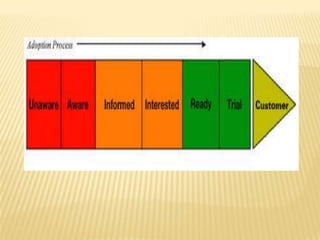
AWARENESS
 The

first stage, Awareness, is most
important and is also where marketers put
a lot of effort and money. If consumers
are not aware that the product or service
exists, how can the company expect the
consumers to buy it?
INTEREST
 The

second stage is Interest. This stage is
when the consumer becomes aware of the
product and searches out information. A
popular of searching out information is
method the internet.
EVALUATION
 In

this stage, the consumer has enough
knowledge about the product and he
considers its relative benefits and
evaluates it in terms of various factors as
cost, competitors’ offering, etc.
TRAIL
This is the stage when the consumer
experiences the product and judges whether
the claims are correct or not. Trials can be
generated by sampling or by the consumer
himself buying the product. Many new
brands aim to reach this stage as soon as
possible.
ADOPTION OR REJECTION
DECISION
This is the stage when the consumer has made
up her mind whether to remain with the
product or switch back to her earlier
product.
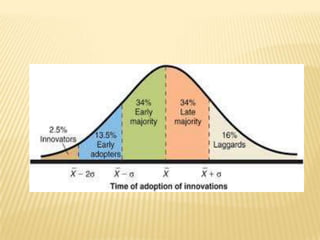
EARLY ADOPTERS


The early adopters are very quick to respond
to new product launches and innovative
offers from the marketers. Such people are
always willing to try new ideas.
EARLY MAJORITY


The early majority keenly observes the
innovators and finds out whether the new
product or innovations offer any value and
have stood the test of times. If the product
proves to be useful and is said to be a good
offer, that is novel and different from other
products- the product will witness a surge in
demand.
LATE MAJORITY


The late majority tends to buy the product
later than the average individual. They are
slow to catch on to the popularity of new
products, services or ideas. Marketing will
still enjoy the advantage of mass
consumption , but it begins to end after a
while.
LAGGARDS


Laggards are not the trendsetters. They do
not even follow the large majority quickly.
They are the last ones to get into the ship.
For marketers, there is a profit to be made
from these consumers.
Demand and supply factors

Demand and supply factors

  • 1.
    DEMAND AND SUPPLYFACTORS UNDERSTANDING CUSTOMER ADOPTION PROCESS
  • 3.
    MEANING The business dictionarydefines the consumer adoption process as the product adoption process. This term is also known similarly as the diffusion of innovations. A company produces a product or service and announces it to the market. At that point the consumer adoption process begins. This is where the consumer decides to become a new customer and purchase or reject the product.
  • 6.
    AWARENESS  The first stage,Awareness, is most important and is also where marketers put a lot of effort and money. If consumers are not aware that the product or service exists, how can the company expect the consumers to buy it?
  • 7.
    INTEREST  The second stageis Interest. This stage is when the consumer becomes aware of the product and searches out information. A popular of searching out information is method the internet.
  • 8.
    EVALUATION  In this stage,the consumer has enough knowledge about the product and he considers its relative benefits and evaluates it in terms of various factors as cost, competitors’ offering, etc.
  • 9.
    TRAIL This is thestage when the consumer experiences the product and judges whether the claims are correct or not. Trials can be generated by sampling or by the consumer himself buying the product. Many new brands aim to reach this stage as soon as possible.
  • 10.
    ADOPTION OR REJECTION DECISION Thisis the stage when the consumer has made up her mind whether to remain with the product or switch back to her earlier product.
  • 13.
    EARLY ADOPTERS  The earlyadopters are very quick to respond to new product launches and innovative offers from the marketers. Such people are always willing to try new ideas.
  • 14.
    EARLY MAJORITY  The earlymajority keenly observes the innovators and finds out whether the new product or innovations offer any value and have stood the test of times. If the product proves to be useful and is said to be a good offer, that is novel and different from other products- the product will witness a surge in demand.
  • 15.
    LATE MAJORITY  The latemajority tends to buy the product later than the average individual. They are slow to catch on to the popularity of new products, services or ideas. Marketing will still enjoy the advantage of mass consumption , but it begins to end after a while.
  • 16.
    LAGGARDS  Laggards are notthe trendsetters. They do not even follow the large majority quickly. They are the last ones to get into the ship. For marketers, there is a profit to be made from these consumers.