ROBERT ESHUN
S.L.T Department
Accra Polytechnic
Chapter 6
Diffraction
2
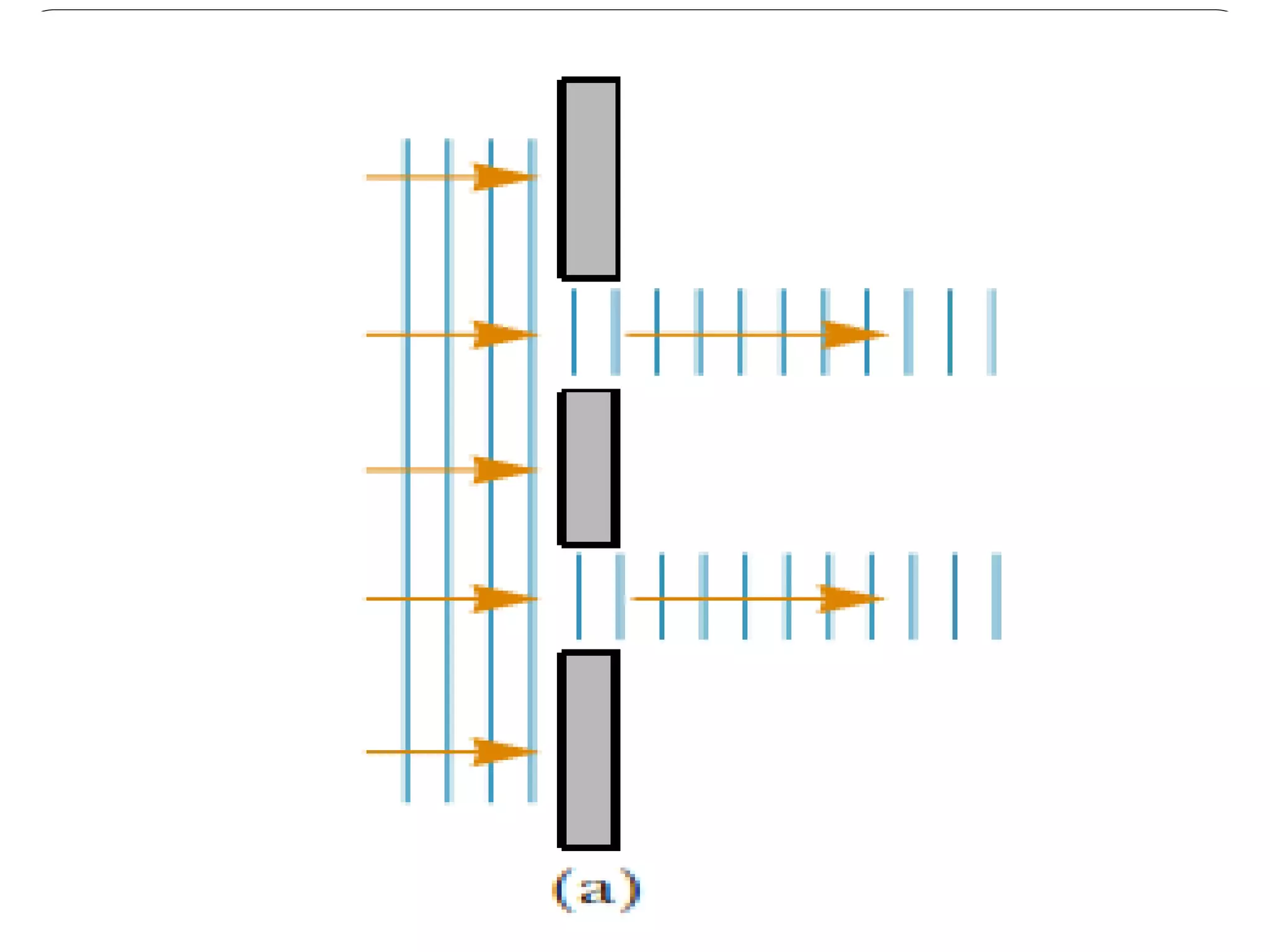
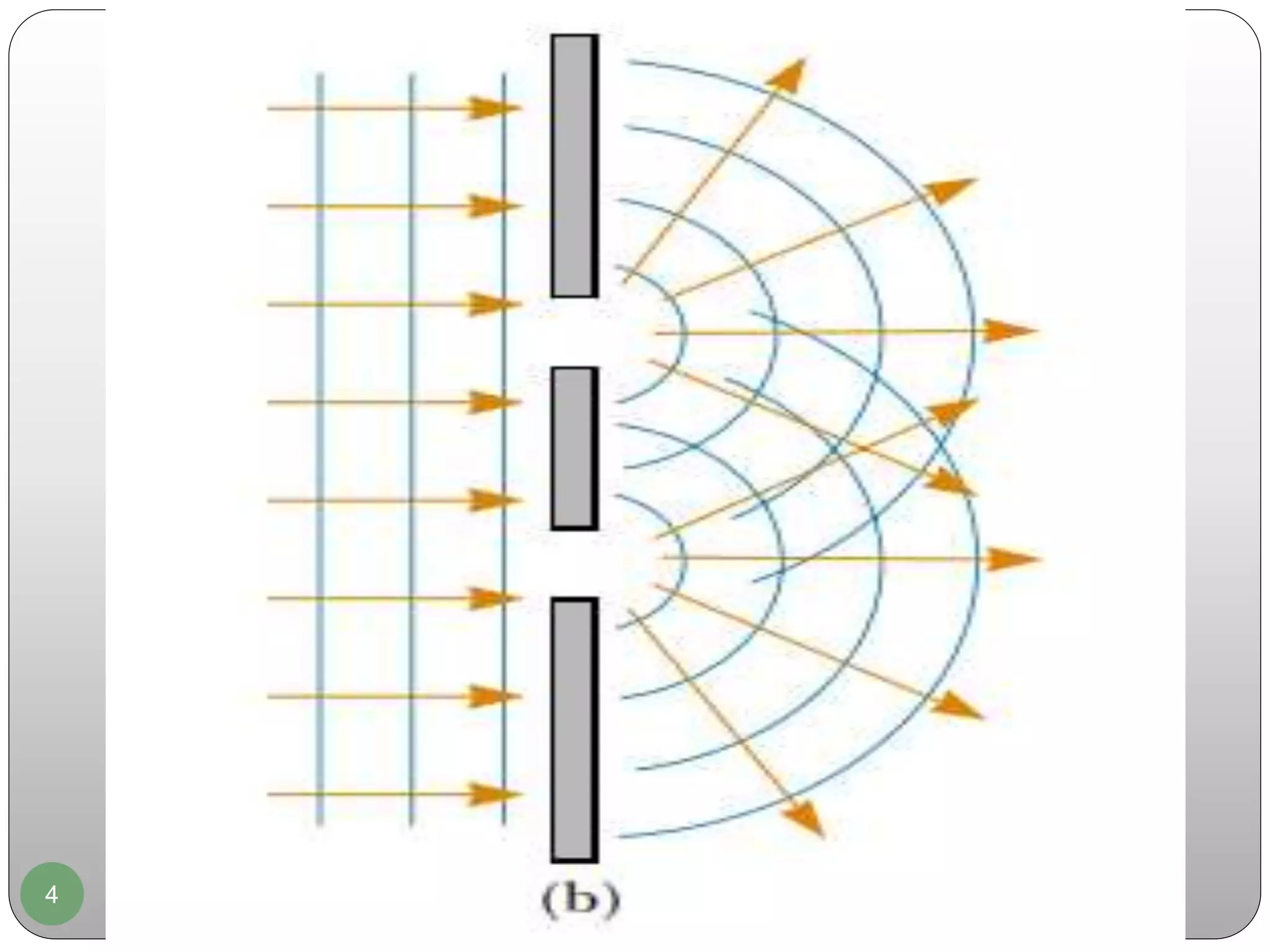
 Diffraction
 The spreading or bending of waves as they pass
through an aperture or round the edge of a barrier.
 The change in direction of waves that occurs when
they pass the edge of an obstacle or through a
narrow opening.
 Diffraction of light takes place only if the size of
an obstacle is comparable to the wavelength of
light.
3
4
5
 Examples
 CD or DVDs: closely spaced tracks act as
diffraction grating to form rainbow pattern seen
when looking at a disk.
 Sound waves: Sound can bend around corners.
Sound can be heard even though a listener may not
be in line of sight of the source.
 TV and radio reception (such as mobile phones):
Diffraction around large hills reduces so people
below the hill are unable to receive the signal.
Telcos set up more transmitters for their customers
to receive the service.
6
 In Fraunhoffer diffraction:
 The source and the screen are far away from each
other.
 Incident wave fronts on the diffracting obstacle are
plane.
 Diffracting obstacle give rise to wave fronts which
are also plane.
 Plane diffracting wave fronts are converged by
means of a convex lens to produce diffraction
pattern.
7
 In Fresnel diffraction:
 Source and screen are not far away from each
other.
 Incident wave fronts are spherical.
 Wave fronts leaving the obstacles are also
spherical.
 Convex lens is not needed to converge the
spherical wave fronts.
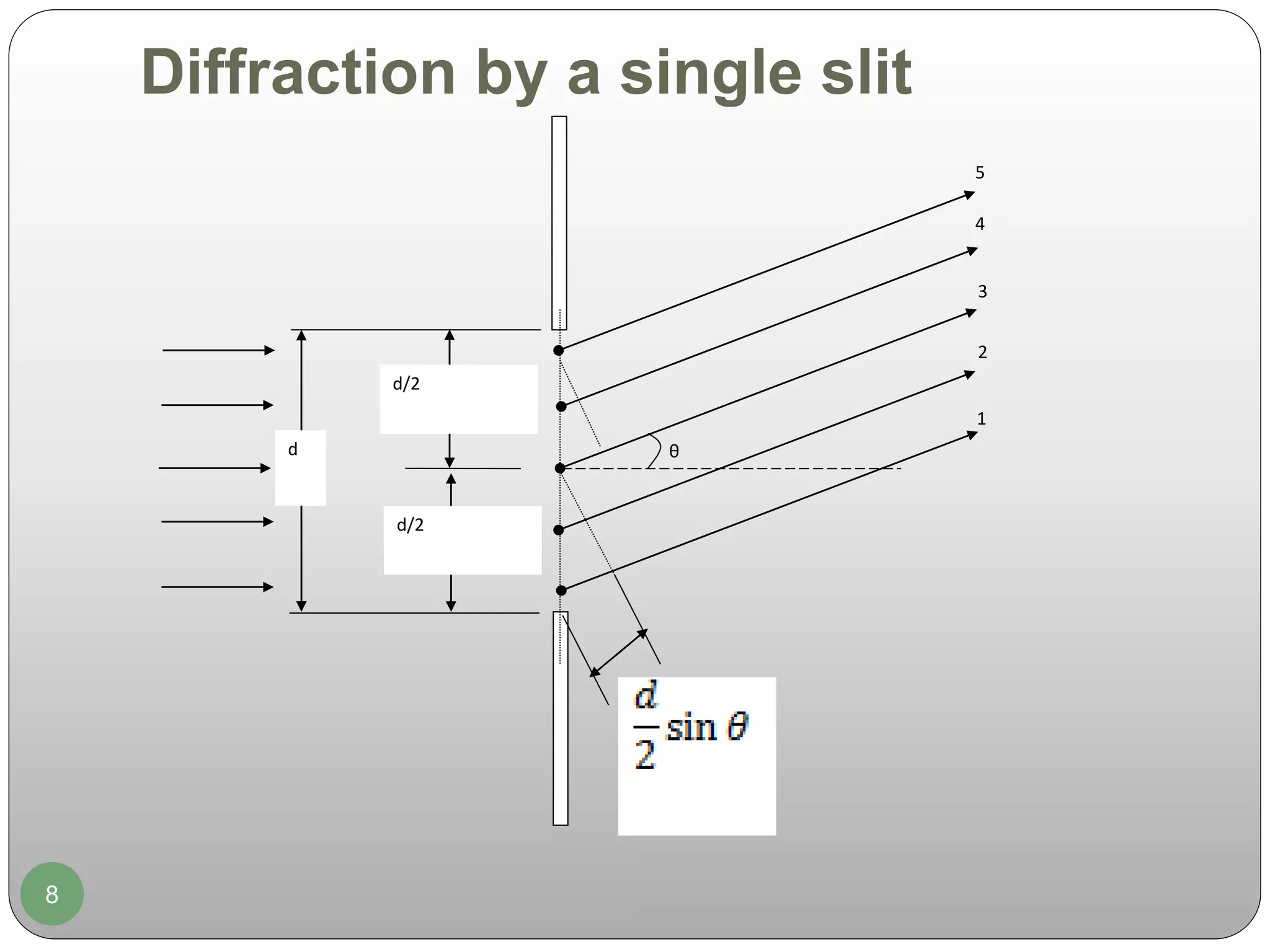
Diffraction by a single slit
8
d
d/2
d/2
θ
1
2
3
4
5
9
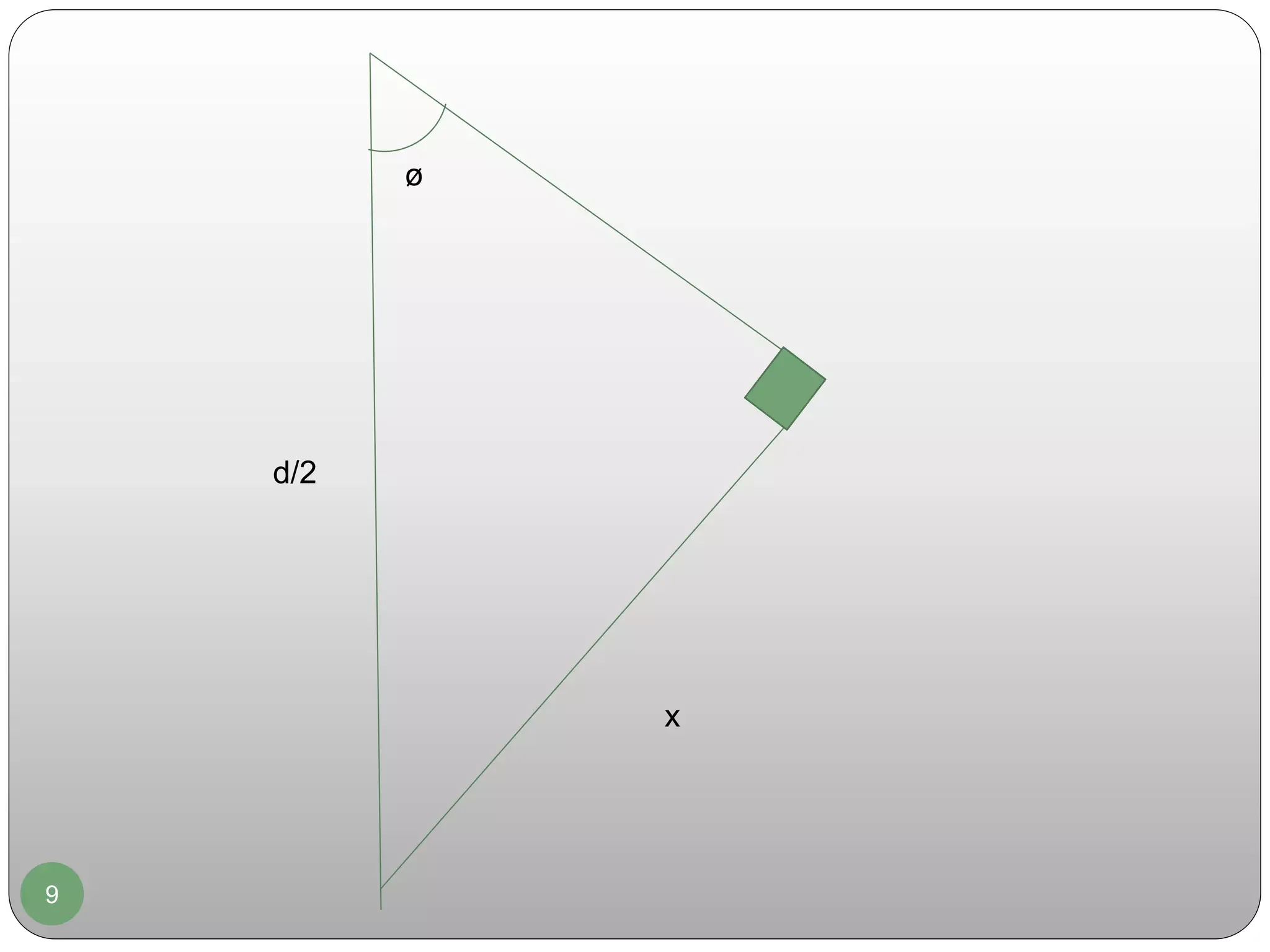
d/2
x
ø
10
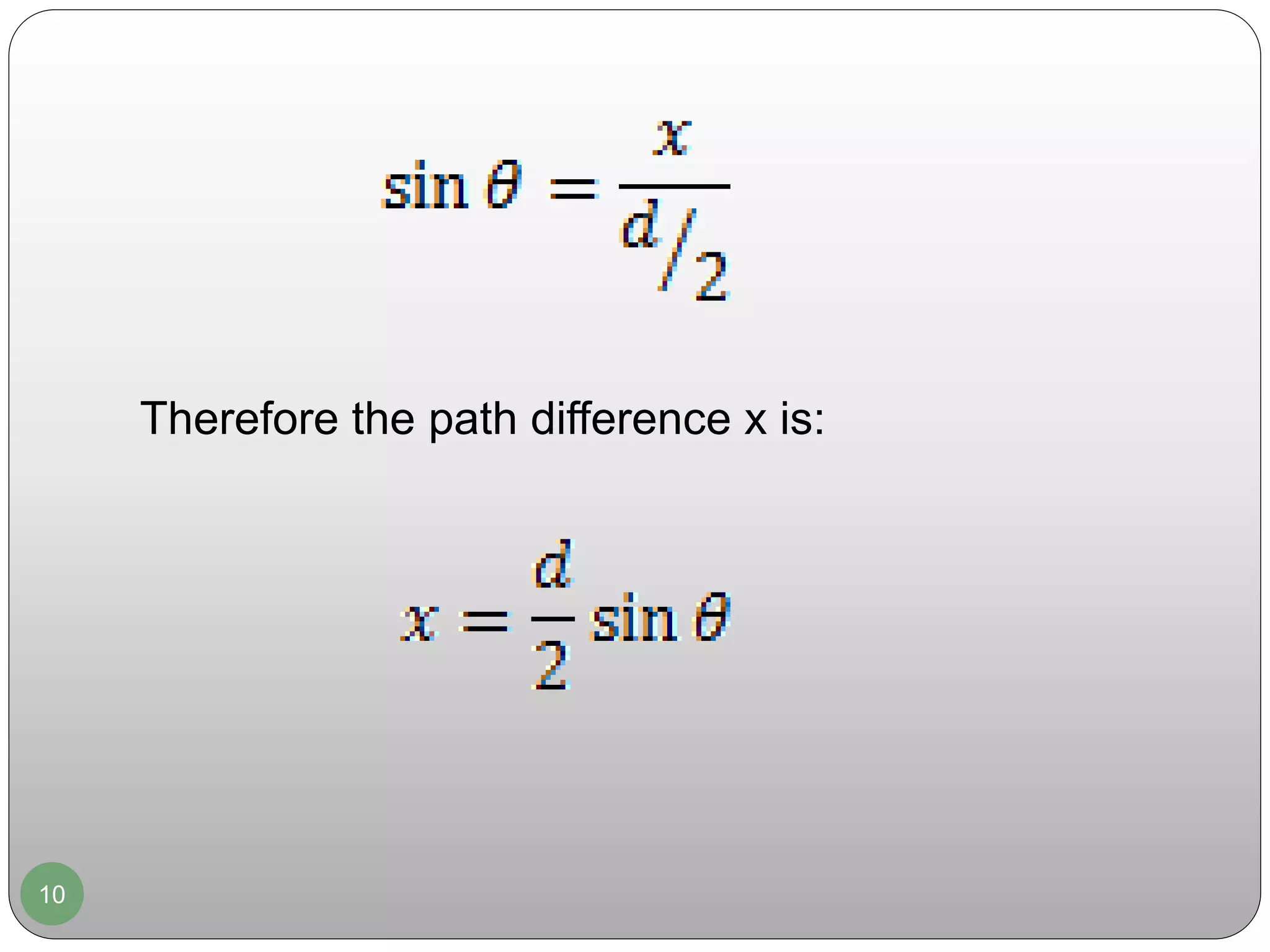
Therefore the path difference x is:
11
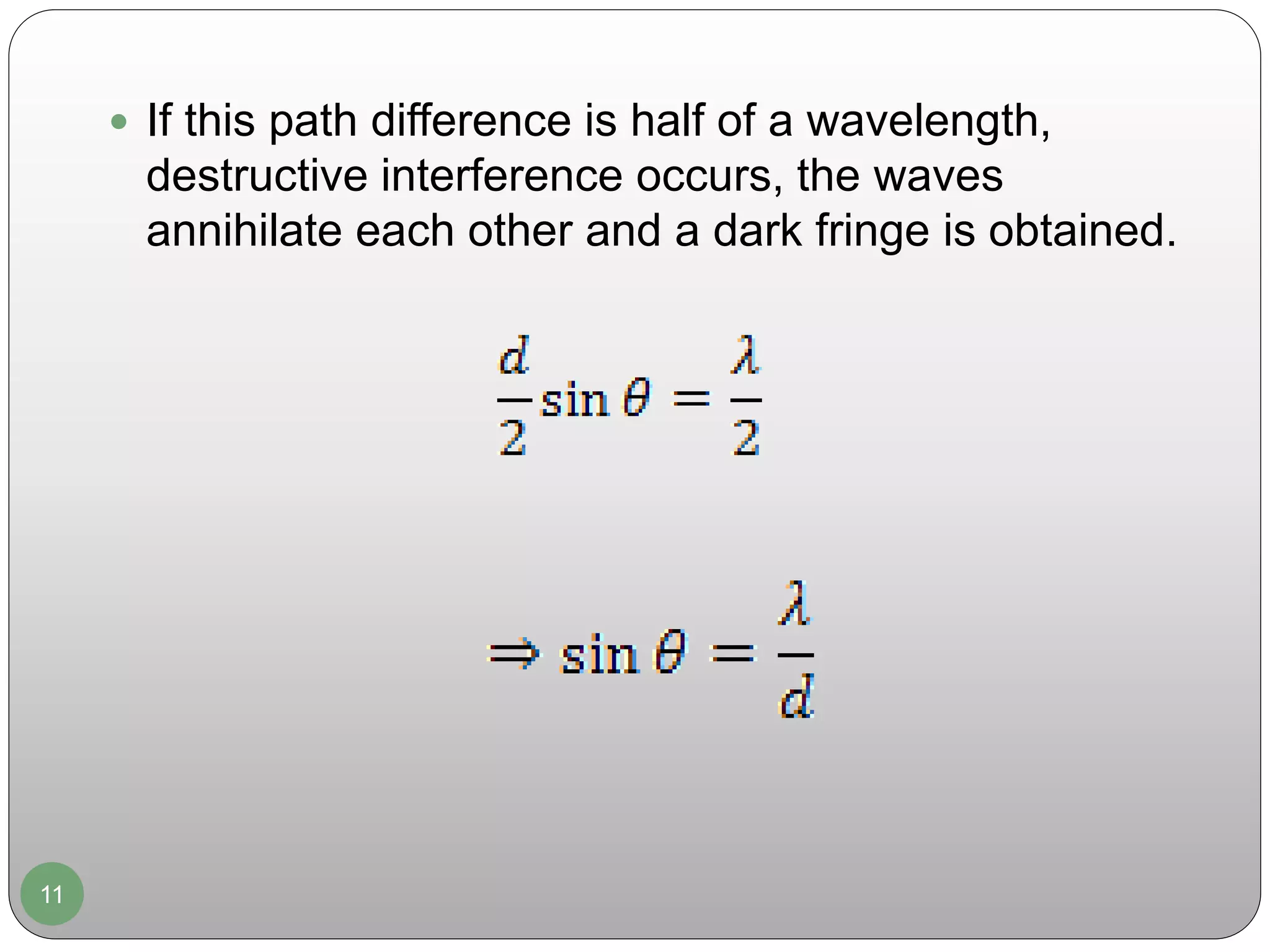
 If this path difference is half of a wavelength,
destructive interference occurs, the waves
annihilate each other and a dark fringe is obtained.
12
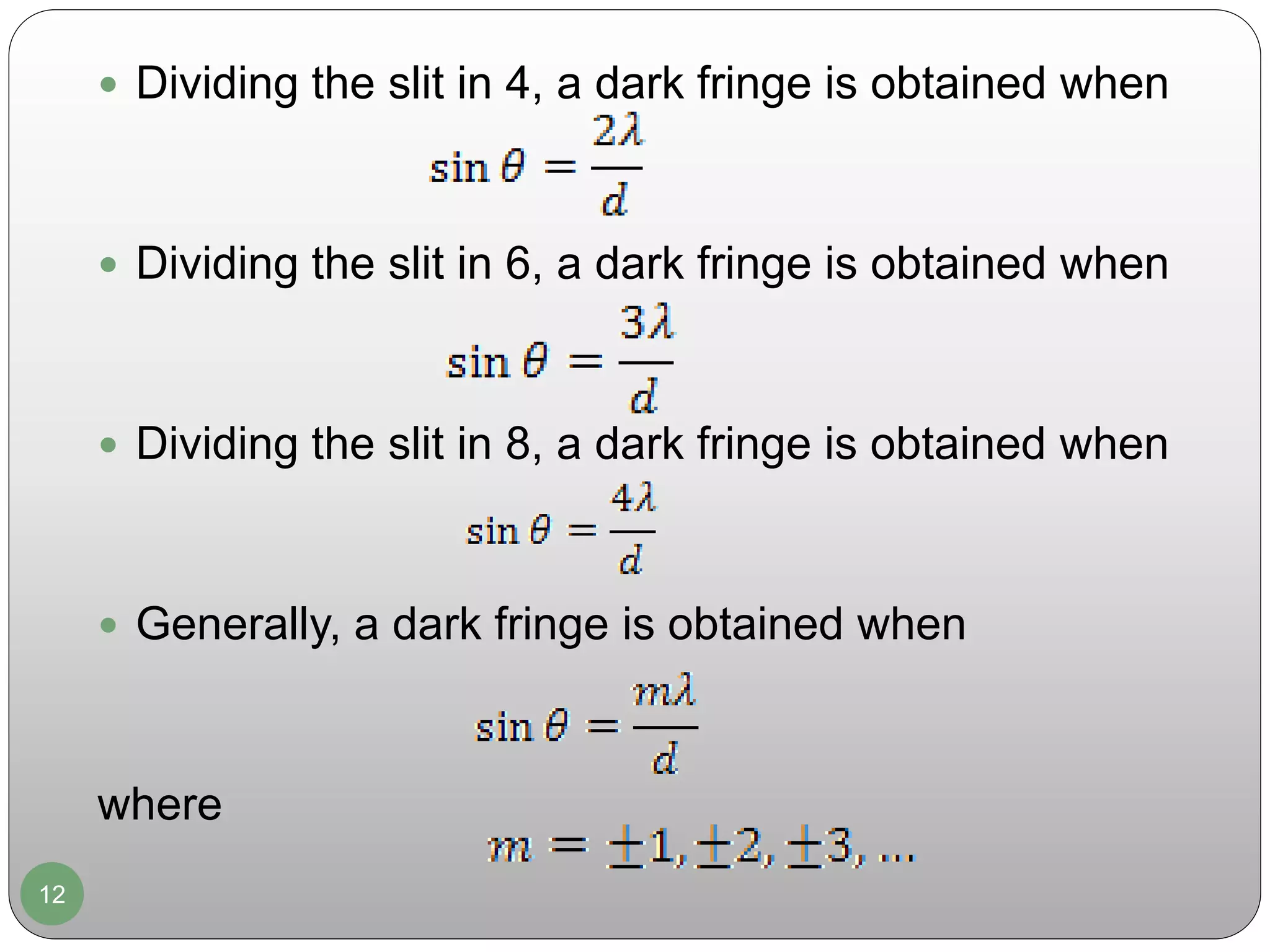
 Dividing the slit in 4, a dark fringe is obtained when
 Dividing the slit in 6, a dark fringe is obtained when
 Dividing the slit in 8, a dark fringe is obtained when
 Generally, a dark fringe is obtained when
where
Diffraction by a circular aperture
(Circular hole)
13
 Airy’s disc - circular disc surrounded by much
fainter concentric circular rings
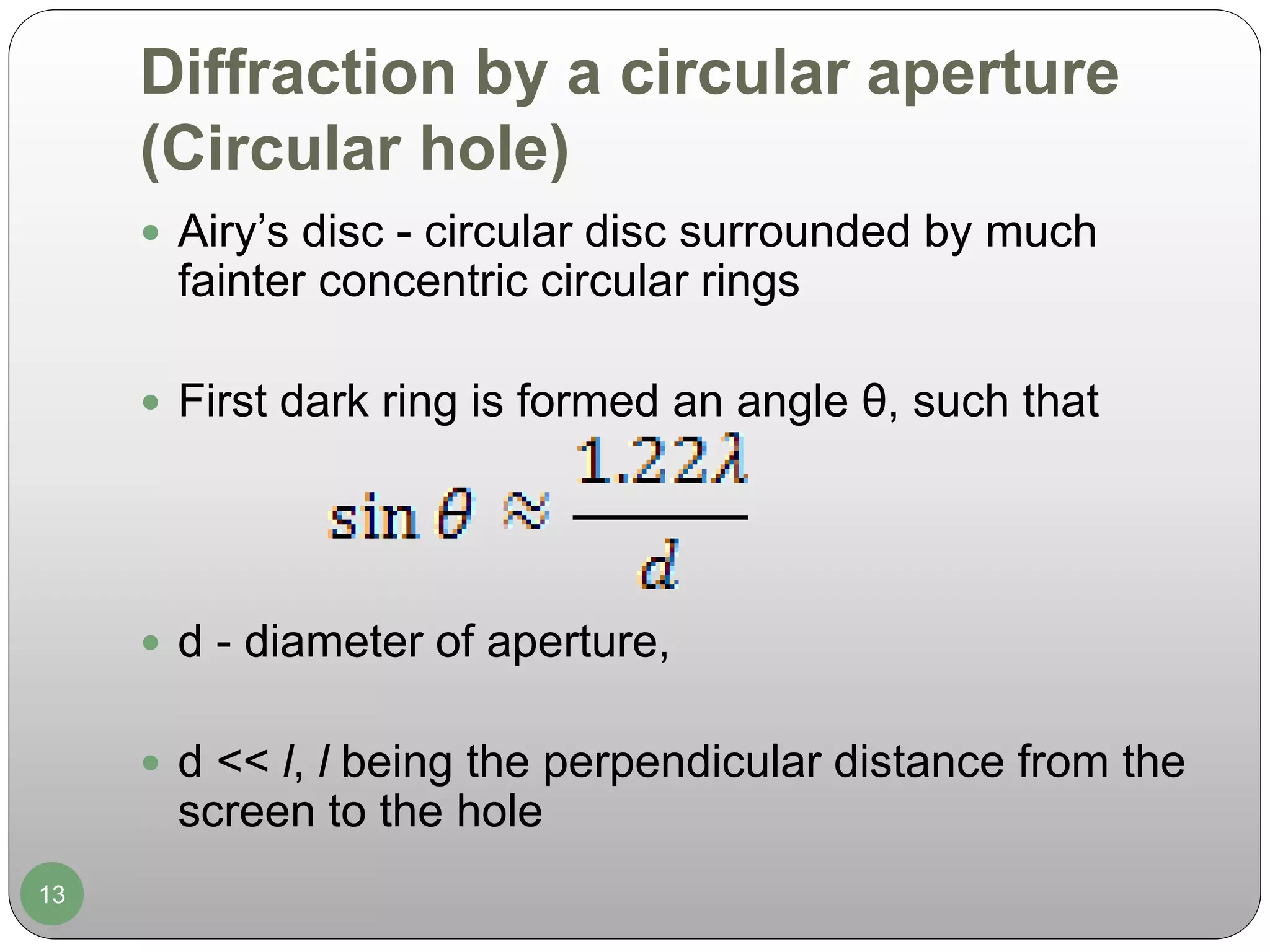
 First dark ring is formed an angle θ, such that
 d - diameter of aperture,
 d << l, l being the perpendicular distance from the
screen to the hole
14
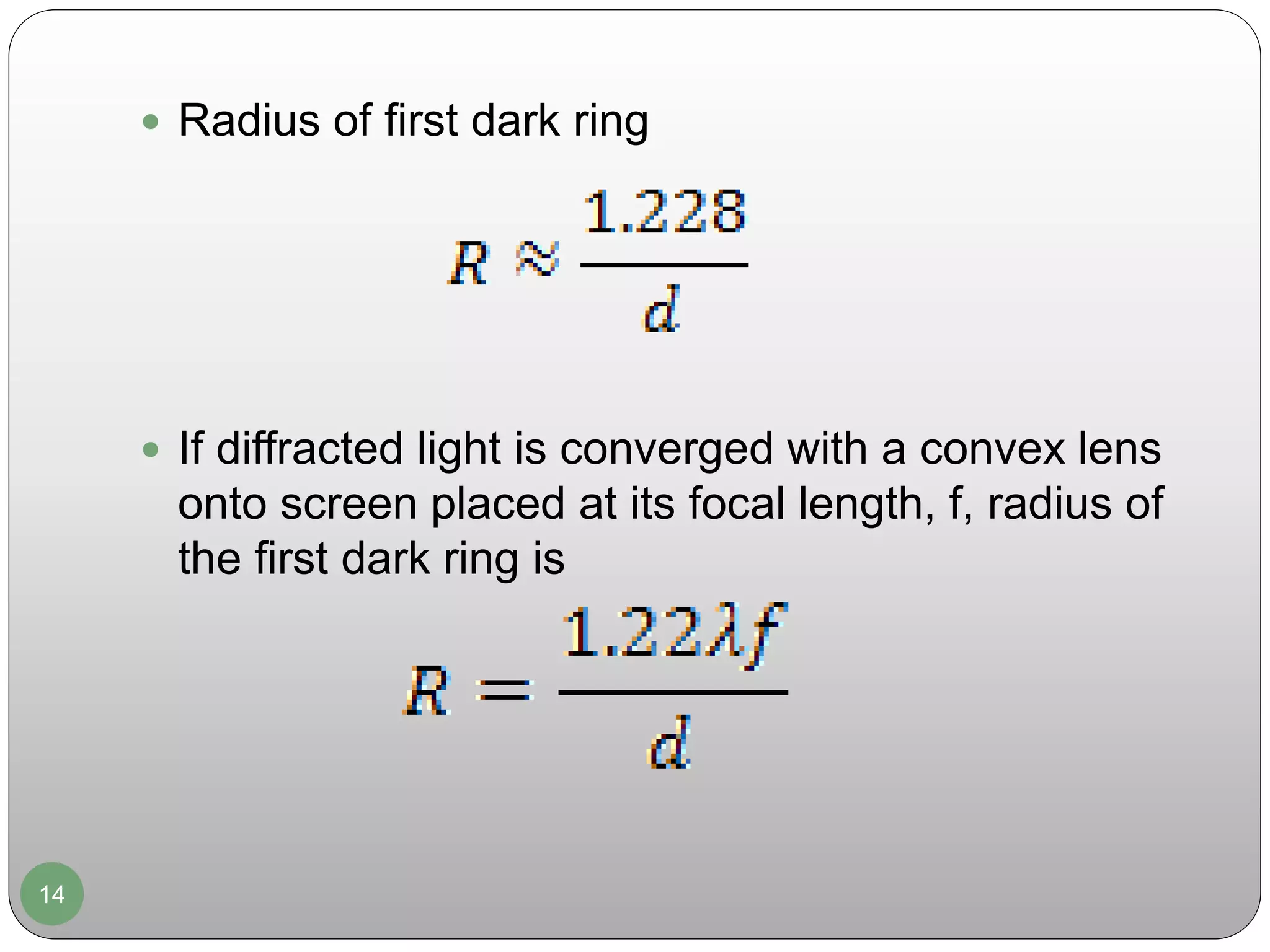
 Radius of first dark ring
 If diffracted light is converged with a convex lens
onto screen placed at its focal length, f, radius of
the first dark ring is

Chapter 6 diffraction

  • 1.
    ROBERT ESHUN S.L.T Department AccraPolytechnic Chapter 6 Diffraction
  • 2.
    2  Diffraction  Thespreading or bending of waves as they pass through an aperture or round the edge of a barrier.  The change in direction of waves that occurs when they pass the edge of an obstacle or through a narrow opening.  Diffraction of light takes place only if the size of an obstacle is comparable to the wavelength of light.
  • 3.
  • 4.
  • 5.
    5  Examples  CDor DVDs: closely spaced tracks act as diffraction grating to form rainbow pattern seen when looking at a disk.  Sound waves: Sound can bend around corners. Sound can be heard even though a listener may not be in line of sight of the source.  TV and radio reception (such as mobile phones): Diffraction around large hills reduces so people below the hill are unable to receive the signal. Telcos set up more transmitters for their customers to receive the service.
  • 6.
    6  In Fraunhofferdiffraction:  The source and the screen are far away from each other.  Incident wave fronts on the diffracting obstacle are plane.  Diffracting obstacle give rise to wave fronts which are also plane.  Plane diffracting wave fronts are converged by means of a convex lens to produce diffraction pattern.
  • 7.
    7  In Fresneldiffraction:  Source and screen are not far away from each other.  Incident wave fronts are spherical.  Wave fronts leaving the obstacles are also spherical.  Convex lens is not needed to converge the spherical wave fronts.
  • 8.
    Diffraction by asingle slit 8 d d/2 d/2 θ 1 2 3 4 5
  • 9.
  • 10.
    10 Therefore the pathdifference x is:
  • 11.
    11  If thispath difference is half of a wavelength, destructive interference occurs, the waves annihilate each other and a dark fringe is obtained.
  • 12.
    12  Dividing theslit in 4, a dark fringe is obtained when  Dividing the slit in 6, a dark fringe is obtained when  Dividing the slit in 8, a dark fringe is obtained when  Generally, a dark fringe is obtained when where
  • 13.
    Diffraction by acircular aperture (Circular hole) 13  Airy’s disc - circular disc surrounded by much fainter concentric circular rings  First dark ring is formed an angle θ, such that  d - diameter of aperture,  d << l, l being the perpendicular distance from the screen to the hole
  • 14.
    14  Radius offirst dark ring  If diffracted light is converged with a convex lens onto screen placed at its focal length, f, radius of the first dark ring is