2.4 Complex Numbers
Chapter 2 Equations and Inequalities
Concepts and Objectives
⚫ Objectives for this section:
⚫ Add and subtract complex numbers.
⚫ Multiply and divide complex numbers.
⚫ Simplify powers of i
Imaginary Numbers
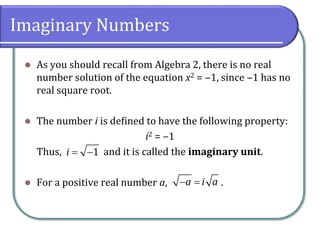
⚫ As you should recall from Algebra 2, there is no real
number solution of the equation x2 = ‒1, since ‒1 has no
real square root.
⚫ The number i is defined to have the following property:
i2 = ‒1
Thus, and it is called the imaginary unit.
⚫ For a positive real number a, .
1
i = −
a i a
− =
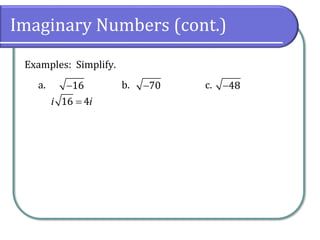
a. b. c.
Imaginary Numbers (cont.)
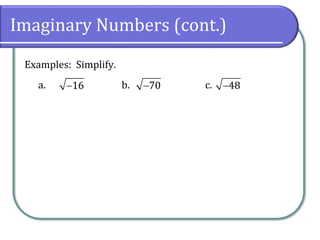
Examples: Simplify.
16
− 70
− 48
−
a. b. c.
Imaginary Numbers (cont.)
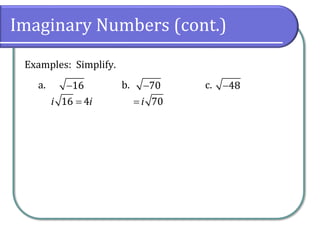
Examples: Simplify.
16
− 70
− 48
−
16 4
i i
=
a. b. c.
Imaginary Numbers (cont.)
Examples: Simplify.
16
− 70
− 48
−
16 4
i i
= 70
i
=
a. b. c.
Imaginary Numbers (cont.)
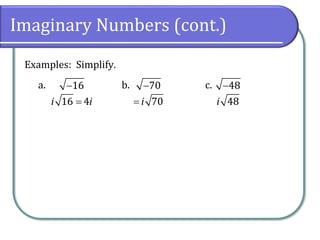
Examples: Simplify.
16
− 70
− 48
−
16 4
i i
= 70
i
= 48
i
a. b. c.
Imaginary Numbers (cont.)
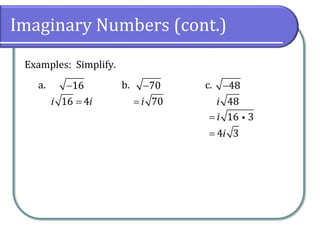
Examples: Simplify.
16
− 70
− 48
−
16 4
i i
= 70
i
= 48
i
= 16 3
i
4 3
i
=
Complex Numbers
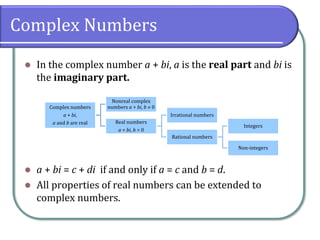
⚫ In the complex number a + bi, a is the real part and bi is
the imaginary part.
⚫ a + bi = c + di if and only if a = c and b = d.
⚫ All properties of real numbers can be extended to
complex numbers.
Complex numbers
a + bi,
a and b are real
Nonreal complex
numbers a + bi, b  0
Real numbers
a + bi, b = 0
Irrational numbers
Rational numbers
Integers
Non-integers
Complex Numbers (cont.)
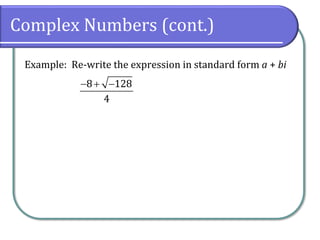
Example: Re-write the expression in standard form a + bi
8 128
4
− + −
Complex Numbers (cont.)
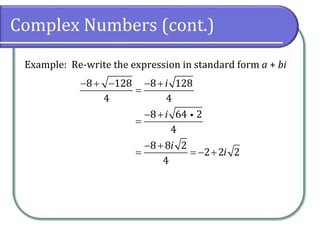
Example: Re-write the expression in standard form a + bi
8 128 8 128
4 4
8 64 2
4
8 8 2
2 2 2
4
i
i
i
i
− + − − +
=
− +
=
− +
= = − +
The Complex Plane
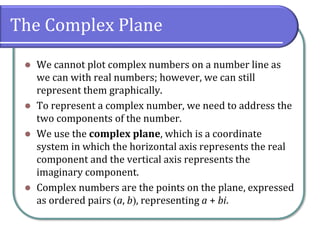
⚫ We cannot plot complex numbers on a number line as
we can with real numbers; however, we can still
represent them graphically.
⚫ To represent a complex number, we need to address the
two components of the number.
⚫ We use the complex plane, which is a coordinate
system in which the horizontal axis represents the real
component and the vertical axis represents the
imaginary component.
⚫ Complex numbers are the points on the plane, expressed
as ordered pairs (a, b), representing a + bi.
The Complex Plane (cont.)
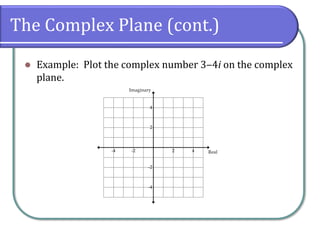
⚫ Example: Plot the complex number 3‒4i on the complex
plane.
The Complex Plane (cont.)
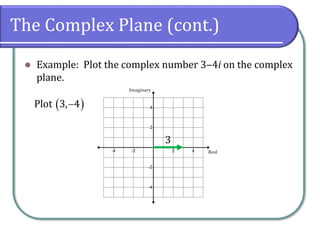
⚫ Example: Plot the complex number 3‒4i on the complex
plane.
3
( )
Plot 3, 4
−
The Complex Plane (cont.)
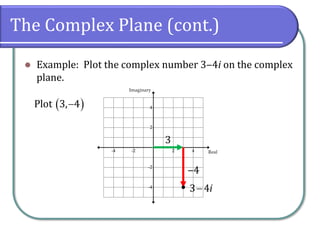
⚫ Example: Plot the complex number 3‒4i on the complex
plane.
3
( )
Plot 3, 4
−
‒4
● 3 4i
−
Complex Number Operations
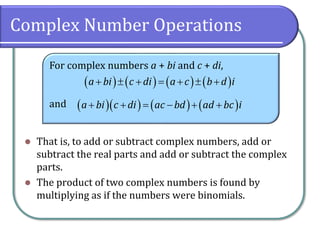
For complex numbers a + bi and c + di,
and
⚫ That is, to add or subtract complex numbers, add or
subtract the real parts and add or subtract the complex
parts.
⚫ The product of two complex numbers is found by
multiplying as if the numbers were binomials.
( ) ( ) ( ) ( )
a bi c di a c b d i
+  + = +  +
( )( ) ( ) ( )
a bi c di ac bd ad bc i
+ + = − + +
Complex Numbers (cont.)
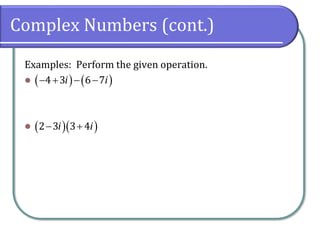
Examples: Perform the given operation.
⚫
⚫
( ) ( )
4 3 6 7
i i
− + − −
( )( )
2 3 3 4
i i
− +
Complex Numbers (cont.)
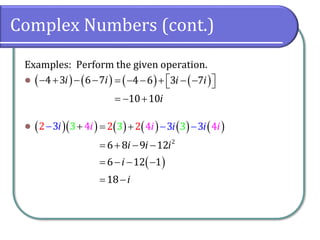
Examples: Perform the given operation.
⚫
⚫
( ) ( )
4 3 6 7
i i
− + − − ( ) ( )
4 6 3 7
10 10
i i
i
 
= − − + − −
 
= − +
( )( )
2 4
3 3
i i
− + ( ) ( ) ( ) ( )
( )
2
6 8 9 12
6 1
4 4
12
1
3
8
2 3 3
2 3 i i
i i
i
i
i
i
i
= +
= + − −
= −
−
=
−
− −
−
Complex Numbers (cont.)
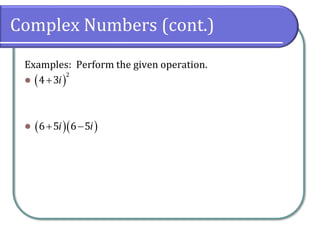
Examples: Perform the given operation.
⚫
⚫
( )
2
4 3i
+
( )( )
6 5 6 5
i i
+ −
Complex Numbers (cont.)
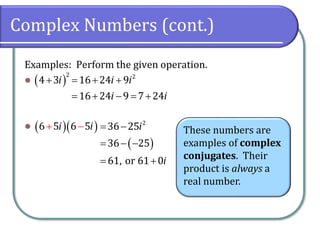
Examples: Perform the given operation.
⚫
⚫
( )
2
4 3i
+ 2
16 24 9
16 24 9 7 24
i i
i i
= + +
= + − = +
( )( )
6 5 6 5
i i
+ −
( )
2
36 25
36 25
61, or 61 0
i
i
= −
= − −
= +
These numbers are
examples of complex
conjugates. Their
product is always a
real number.
Complex Numbers (still cont.)
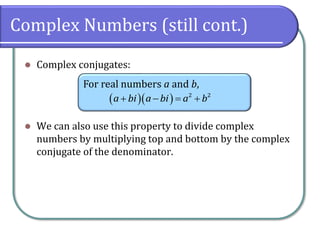
⚫ Complex conjugates:
⚫ We can also use this property to divide complex
numbers by multiplying top and bottom by the complex
conjugate of the denominator.
For real numbers a and b,
( )( ) 2 2
a bi a bi a b
+ − = +
Complex Numbers (still cont.)
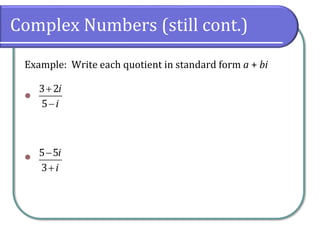
Example: Write each quotient in standard form a + bi
⚫
⚫
3 2
5
i
i
+
−
5 5
3
i
i
−
+
Complex Numbers (still cont.)
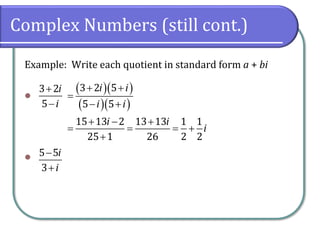
Example: Write each quotient in standard form a + bi
⚫
⚫
3 2
5
i
i
+
−
( )( )
( )( )
3 2 5
5 5
15 13 2 13 13 1 1
25 1 26 2 2
i i
i i
i i
i
+ +
=
− +
+ − +
= = = +
+
5 5
3
i
i
−
+
Complex Numbers (still cont.)
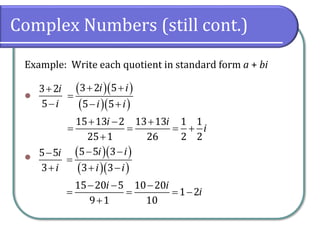
Example: Write each quotient in standard form a + bi
⚫
⚫
3 2
5
i
i
+
−
( )( )
( )( )
3 2 5
5 5
15 13 2 13 13 1 1
25 1 26 2 2
i i
i i
i i
i
+ +
=
− +
+ − +
= = = +
+
5 5
3
i
i
−
+
( )( )
( )( )
5 5 3
3 3
15 20 5 10 20
1 2
9 1 10
i i
i i
i i
i
− −
=
+ −
− − −
= = = −
+
Powers of i
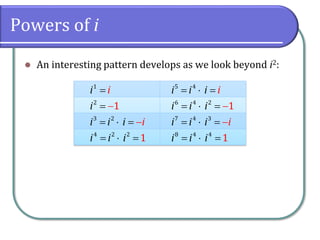
⚫ An interesting pattern develops as we look beyond i2:
1
i i
=
2
1
i = −
3 2
i
i i i
= = −

4 2 2
1
i i i
=  =
5 4
i
i i i
=  =
6 4 2
1
i i i
=  = −
7 4 3
i
i i i
=  = −
8 4 4
1
i i i
=  =
Powers of i (cont.)
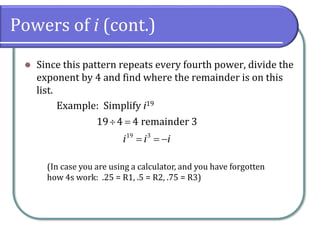
⚫ Since this pattern repeats every fourth power, divide the
exponent by 4 and find where the remainder is on this
list.
Example: Simplify i19
19 3
19 4 4 remainder 3
i i i
 =
= = −
(In case you are using a calculator, and you have forgotten
how 4s work: .25 = R1, .5 = R2, .75 = R3)
Classwork
⚫ College Algebra 2e
⚫ 2.4: 6-14 (even); 2.3: 18-26 (even); 2.2: 36-46 (even)
⚫ 2.4 Classwork Check
⚫ Quiz 2.3

2.4 Complex Numbers

  • 1.
    2.4 Complex Numbers Chapter2 Equations and Inequalities
  • 2.
    Concepts and Objectives ⚫Objectives for this section: ⚫ Add and subtract complex numbers. ⚫ Multiply and divide complex numbers. ⚫ Simplify powers of i
  • 3.
    Imaginary Numbers ⚫ Asyou should recall from Algebra 2, there is no real number solution of the equation x2 = ‒1, since ‒1 has no real square root. ⚫ The number i is defined to have the following property: i2 = ‒1 Thus, and it is called the imaginary unit. ⚫ For a positive real number a, . 1 i = − a i a − =
  • 4.
    a. b. c. ImaginaryNumbers (cont.) Examples: Simplify. 16 − 70 − 48 −
  • 5.
    a. b. c. ImaginaryNumbers (cont.) Examples: Simplify. 16 − 70 − 48 − 16 4 i i =
  • 6.
    a. b. c. ImaginaryNumbers (cont.) Examples: Simplify. 16 − 70 − 48 − 16 4 i i = 70 i =
  • 7.
    a. b. c. ImaginaryNumbers (cont.) Examples: Simplify. 16 − 70 − 48 − 16 4 i i = 70 i = 48 i
  • 8.
    a. b. c. ImaginaryNumbers (cont.) Examples: Simplify. 16 − 70 − 48 − 16 4 i i = 70 i = 48 i = 16 3 i 4 3 i =
  • 9.
    Complex Numbers ⚫ Inthe complex number a + bi, a is the real part and bi is the imaginary part. ⚫ a + bi = c + di if and only if a = c and b = d. ⚫ All properties of real numbers can be extended to complex numbers. Complex numbers a + bi, a and b are real Nonreal complex numbers a + bi, b  0 Real numbers a + bi, b = 0 Irrational numbers Rational numbers Integers Non-integers
  • 10.
    Complex Numbers (cont.) Example:Re-write the expression in standard form a + bi 8 128 4 − + −
  • 11.
    Complex Numbers (cont.) Example:Re-write the expression in standard form a + bi 8 128 8 128 4 4 8 64 2 4 8 8 2 2 2 2 4 i i i i − + − − + = − + = − + = = − +
  • 12.
    The Complex Plane ⚫We cannot plot complex numbers on a number line as we can with real numbers; however, we can still represent them graphically. ⚫ To represent a complex number, we need to address the two components of the number. ⚫ We use the complex plane, which is a coordinate system in which the horizontal axis represents the real component and the vertical axis represents the imaginary component. ⚫ Complex numbers are the points on the plane, expressed as ordered pairs (a, b), representing a + bi.
  • 13.
    The Complex Plane(cont.) ⚫ Example: Plot the complex number 3‒4i on the complex plane.
  • 14.
    The Complex Plane(cont.) ⚫ Example: Plot the complex number 3‒4i on the complex plane. 3 ( ) Plot 3, 4 −
  • 15.
    The Complex Plane(cont.) ⚫ Example: Plot the complex number 3‒4i on the complex plane. 3 ( ) Plot 3, 4 − ‒4 ● 3 4i −
  • 16.
    Complex Number Operations Forcomplex numbers a + bi and c + di, and ⚫ That is, to add or subtract complex numbers, add or subtract the real parts and add or subtract the complex parts. ⚫ The product of two complex numbers is found by multiplying as if the numbers were binomials. ( ) ( ) ( ) ( ) a bi c di a c b d i +  + = +  + ( )( ) ( ) ( ) a bi c di ac bd ad bc i + + = − + +
  • 17.
    Complex Numbers (cont.) Examples:Perform the given operation. ⚫ ⚫ ( ) ( ) 4 3 6 7 i i − + − − ( )( ) 2 3 3 4 i i − +
  • 18.
    Complex Numbers (cont.) Examples:Perform the given operation. ⚫ ⚫ ( ) ( ) 4 3 6 7 i i − + − − ( ) ( ) 4 6 3 7 10 10 i i i   = − − + − −   = − + ( )( ) 2 4 3 3 i i − + ( ) ( ) ( ) ( ) ( ) 2 6 8 9 12 6 1 4 4 12 1 3 8 2 3 3 2 3 i i i i i i i i i = + = + − − = − − = − − − −
  • 19.
    Complex Numbers (cont.) Examples:Perform the given operation. ⚫ ⚫ ( ) 2 4 3i + ( )( ) 6 5 6 5 i i + −
  • 20.
    Complex Numbers (cont.) Examples:Perform the given operation. ⚫ ⚫ ( ) 2 4 3i + 2 16 24 9 16 24 9 7 24 i i i i = + + = + − = + ( )( ) 6 5 6 5 i i + − ( ) 2 36 25 36 25 61, or 61 0 i i = − = − − = + These numbers are examples of complex conjugates. Their product is always a real number.
  • 21.
    Complex Numbers (stillcont.) ⚫ Complex conjugates: ⚫ We can also use this property to divide complex numbers by multiplying top and bottom by the complex conjugate of the denominator. For real numbers a and b, ( )( ) 2 2 a bi a bi a b + − = +
  • 22.
    Complex Numbers (stillcont.) Example: Write each quotient in standard form a + bi ⚫ ⚫ 3 2 5 i i + − 5 5 3 i i − +
  • 23.
    Complex Numbers (stillcont.) Example: Write each quotient in standard form a + bi ⚫ ⚫ 3 2 5 i i + − ( )( ) ( )( ) 3 2 5 5 5 15 13 2 13 13 1 1 25 1 26 2 2 i i i i i i i + + = − + + − + = = = + + 5 5 3 i i − +
  • 24.
    Complex Numbers (stillcont.) Example: Write each quotient in standard form a + bi ⚫ ⚫ 3 2 5 i i + − ( )( ) ( )( ) 3 2 5 5 5 15 13 2 13 13 1 1 25 1 26 2 2 i i i i i i i + + = − + + − + = = = + + 5 5 3 i i − + ( )( ) ( )( ) 5 5 3 3 3 15 20 5 10 20 1 2 9 1 10 i i i i i i i − − = + − − − − = = = − +
  • 25.
    Powers of i ⚫An interesting pattern develops as we look beyond i2: 1 i i = 2 1 i = − 3 2 i i i i = = −  4 2 2 1 i i i =  = 5 4 i i i i =  = 6 4 2 1 i i i =  = − 7 4 3 i i i i =  = − 8 4 4 1 i i i =  =
  • 26.
    Powers of i(cont.) ⚫ Since this pattern repeats every fourth power, divide the exponent by 4 and find where the remainder is on this list. Example: Simplify i19 19 3 19 4 4 remainder 3 i i i  = = = − (In case you are using a calculator, and you have forgotten how 4s work: .25 = R1, .5 = R2, .75 = R3)
  • 27.
    Classwork ⚫ College Algebra2e ⚫ 2.4: 6-14 (even); 2.3: 18-26 (even); 2.2: 36-46 (even) ⚫ 2.4 Classwork Check ⚫ Quiz 2.3