SWINE PRODUCTION AND MANAGEMENT
1. A male pig castrated before reaching sexual
maturity.
A. Boar B. Barrow C. Sire
2. A defect involving the failure of one or both testicles
to descend to the scrotal sac
A. Cryptorchidism B. Hernia C.
Impotent
3. The group of pigs belonging to one farrowing.
A. Litter size B. Flock C. Litter
4. Refers to domesticated swine either sex usually
weigh more than 50 kgs
A. Native B. Hog C. Flock
5. It is the process of increasing feed intake of Dry
sow/ Gilt 10-14 days before breeding
A. Drying B. Flushing C. Adli bitum feeding
TERMINOLOGIES
• Boar
– sexually mature uncastrated male hog usually kept for
breeding
• Castration
– Removal of testicles
• Dam
-female parent/ mother of an any domesticated animal
• Estrus
– The period wherein the female is sexually responsive to the
male
• Farrow
– to give birth
• Farrowing
– The act of giving birth to pigs
TERMINOLOGIES
• Finisher/ Fattener
– Swine fattened for slaughter
• Gilt
– A young female swine usually kept for breeding and not yet
given birth.
• Pig
– A non-ruminant, cloven-footed animal belonging to family
Suidae with a simple stomach, having a snout, large number
of mammary glands, thin skin and heavy bristles. Also called
Swine/Hog.
• Sow
– an adult swine usually kept for breeding and has farrowed at
least once
• Weaning-the act of separating young from its dam
TERMINOLOGIES
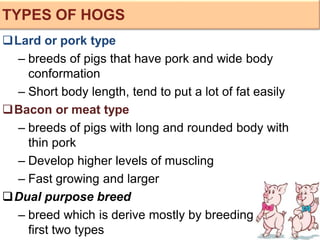
Lard or pork type
– breeds of pigs that have pork and wide body
conformation
– Short body length, tend to put a lot of fat easily
Bacon or meat type
– breeds of pigs with long and rounded body with
thin pork
– Develop higher levels of muscling
– Fast growing and larger
Dual purpose breed
– breed which is derive mostly by breeding the
first two types
TYPES OF HOGS
1. Efficient feed converters and uses
concentrates well
2. Prolific animals and are polytocous
3. Requires small investment (compared to large
ruminant)
4. Can be sold and converted to cash after
weaning
5. Salvage value of culled sows, boars and stags
is high
6. Higher dressing percentage
7. Pork is traditionally accepted as table meat
8. Filipinos are pork eaters
9. Short generation interval between breeding,
raising and harvesting
WHY INVEST TO PIG FARMING?
• Heavy losses due to diseases and parasites
• Feed adulteration and supply is critical
• Wide variation/ fluctuation in prices of inputs, hogs,
feeds, drugs and medicine
• High labor requirement during farrowing time
• Objectionable odor from piggery
• As environmental pollutant
PROBLEMS IN SWINE RAISING
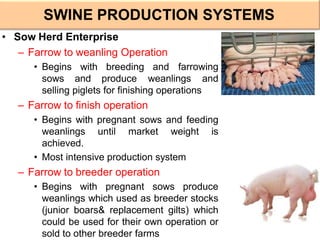
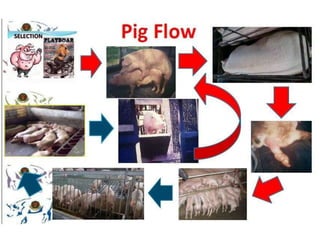
SWINE PRODUCTION SYSTEMS
• Sow Herd Enterprise
– Farrow to weanling Operation
• Begins with breeding and farrowing
sows and produce weanlings and
selling piglets for finishing operations
– Farrow to finish operation
• Begins with pregnant sows and feeding
weanlings until market weight is
achieved.
• Most intensive production system
– Farrow to breeder operation
• Begins with pregnant sows produce
weanlings which used as breeder stocks
(junior boars& replacement gilts) which
could be used for their own operation or
sold to other breeder farms
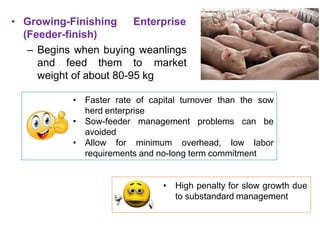
• Growing-Finishing Enterprise
(Feeder-finish)
– Begins when buying weanlings
and feed them to market
weight of about 80-95 kg
• Faster rate of capital turnover than the sow
herd enterprise
• Sow-feeder management problems can be
avoided
• Allow for minimum overhead, low labor
requirements and no-long term commitment
• High penalty for slow growth due
to substandard management
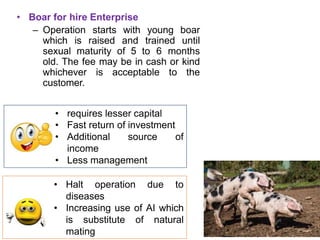
• Boar for hire Enterprise
– Operation starts with young boar
which is raised and trained until
sexual maturity of 5 to 6 months
old. The fee may be in cash or kind
whichever is acceptable to the
customer.
• requires lesser capital
• Fast return of investment
• Additional source of
income
• Less management
• Halt operation due to
diseases
• Increasing use of AI which
is substitute of natural
mating
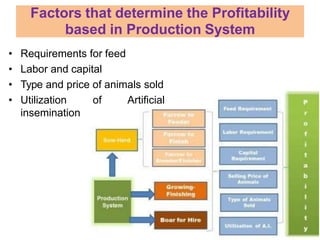
Factors that determine the Profitability
based in Production System
• Requirements for feed
• Labor and capital
• Type and price of animals sold
• Utilization of Artificial
insemination
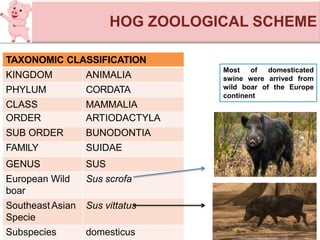
HOG ZOOLOGICAL SCHEME
TAXONOMIC CLASSIFICATION
KINGDOM ANIMALIA
PHYLUM CORDATA
CLASS MAMMALIA
ORDER ARTIODACTYLA
SUB ORDER BUNODONTIA
FAMILY SUIDAE
GENUS SUS
European Wild Sus scrofa
boar
Southeast Asian Sus vittatus
Specie
Subspecies domesticus
Most of domesticated
swine were arrived from
wild boar of the Europe
continent
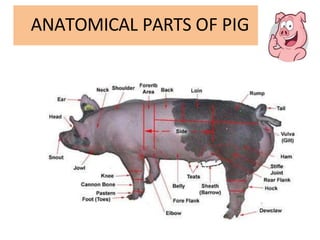
ANATOMICAL PARTS OF PIG
Basis of differentiating Swine Breeds
Breed
– is a group of animals that shares the same traits or
characteristics.
Basis:
• Color: black, white, brown, etc.
• Color combinations: spotted, belted, etc.
• Size of ears
• Position of ears: erect, hanging, ¼ hanging, etc.
• Length and shape of the snout
• Body length
• Weight at maturity
• Backline: straight, swaying, curved, etc.
BREEDS OF SWINE
1. Local/Indigenous breed
– Philippine Native pig
2. Exotic breed
a. Purebreds
b. Synthetic breeds
c. Upgrades
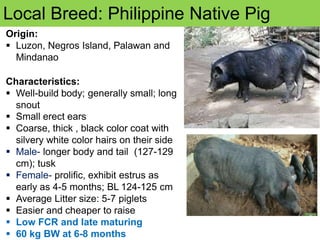
Local Breed: Philippine Native Pig
Origin:
 Luzon, Negros Island, Palawan and
Mindanao
Characteristics:
 Well-build body; generally small; long
snout
 Small erect ears
 Coarse, thick , black color coat with
silvery white color hairs on their side
 Male- longer body and tail (127-129
cm); tusk
 Female- prolific, exhibit estrus as
early as 4-5 months; BL 124-125 cm
 Average Litter size: 5-7 piglets
 Easier and cheaper to raise
 Low FCR and late maturing
 60 kg BW at 6-8 months
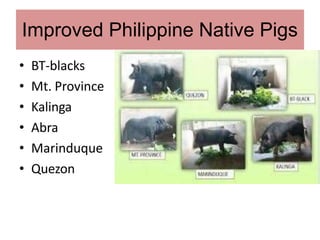
Improved Philippine Native Pigs
• BT-blacks
• Mt. Province
• Kalinga
• Abra
• Marinduque
• Quezon
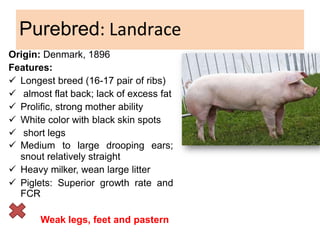
Purebred: Landrace
Origin: Denmark, 1896
Features:
 Longest breed (16-17 pair of ribs)
 almost flat back; lack of excess fat
 Prolific, strong mother ability
 White color with black skin spots
 short legs
 Medium to large drooping ears;
snout relatively straight
 Heavy milker, wean large litter
 Piglets: Superior growth rate and
FCR
Weak legs, feet and pastern
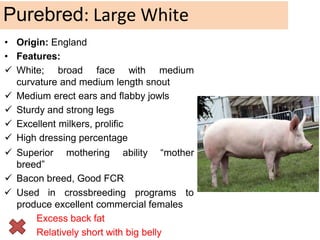
• Origin: England
• Features:
 White; broad face with medium
curvature and medium length snout
 Medium erect ears and flabby jowls
 Sturdy and strong legs
 Excellent milkers, prolific
 High dressing percentage
 Superior mothering ability
breed”
 Bacon breed, Good FCR
“mother
 Used in crossbreeding programs to
produce excellent commercial females
Excess back fat
Relatively short with big belly
Purebred: Large White
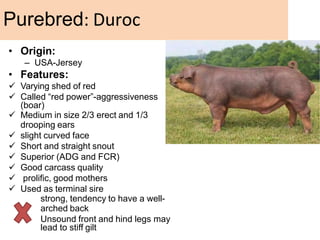
• Origin:
– USA-Jersey
• Features:
 Varying shed of red
 Called “red power”-aggressiveness
(boar)
 Medium in size 2/3 erect and 1/3
drooping ears
 slight curved face
 Short and straight snout
 Superior (ADG and FCR)
 Good carcass quality
 prolific, good mothers
 Used as terminal sire
strong, tendency to have a well-
arched back
Unsound front and hind legs may
lead to stiff gilt
Purebred: Duroc
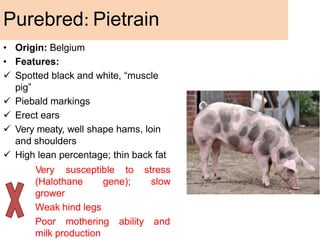
• Origin: Belgium
• Features:
 Spotted black and white, “muscle
pig”
 Piebald markings
 Erect ears
 Very meaty, well shape hams, loin
and shoulders
 High lean percentage; thin back fat
gene);
Very susceptible to stress
slow
(Halothane
grower
Weak hind legs
Poor mothering ability and
milk production
Purebred: Pietrain
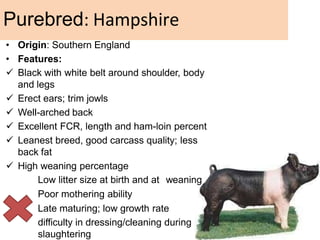
• Origin: Southern England
• Features:
 Black with white belt around shoulder, body
and legs
 Erect ears; trim jowls
 Well-arched back
 Excellent FCR, length and ham-loin percent
 Leanest breed, good carcass quality; less
back fat
 High weaning percentage
Low litter size at birth and at weaning
Poor mothering ability
Late maturing; low growth rate
difficulty in dressing/cleaning during
slaughtering
Purebred: Hampshire
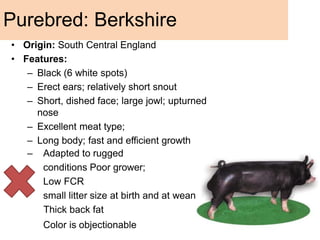
• Origin: South Central England
• Features:
– Black (6 white spots)
– Erect ears; relatively short snout
– Short, dished face; large jowl; upturned
nose
– Excellent meat type;
– Long body; fast and efficient growth
– Adapted to rugged
conditions Poor grower;
Low FCR
small litter size at birth and at weaning
Thick back fat
Color is objectionable
Purebred: Berkshire
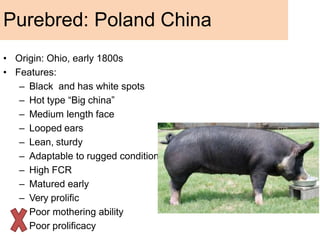
• Origin: Ohio, early 1800s
• Features:
– Black and has white spots
– Hot type “Big china”
– Medium length face
– Looped ears
– Lean, sturdy
– Adaptable to rugged conditions
– High FCR
– Matured early
– Very prolific
– Poor mothering ability
– Poor prolificacy
Purebred: Poland China
Other Pure breeds
• Spotted
• Limousine
• Chester white
• Hereford
• Tamworth
• Large black
• Chinese Pigs
• Meishan
Synthetic breeds
• Nieuw Dalland/TOPIGS
• Hypor
• Seghers
• Camborough
• JSR
• Meat Master
• Babcock
• Cotsworld
• Minnesota
Synthetic breed: TOPIGS
• Developed in Netherland by
TOPIGS breeding company
• Foundation: Pietrain, Largewhite
and Land race
• Fast growth rate, excellent FCR,
high fertility,
• Solid legs, well developed udder,
and stress negative animals
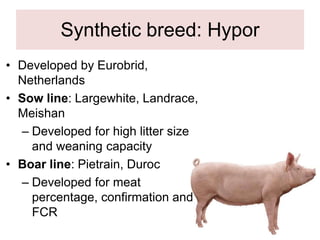
Synthetic breed: Hypor
• Developed by Eurobrid,
Netherlands
• Sow line: Largewhite, Landrace,
Meishan
– Developed for high litter size
and weaning capacity
• Boar line: Pietrain, Duroc
– Developed for meat
percentage, confirmation and
FCR
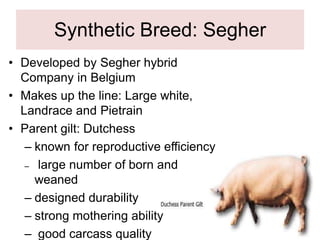
Synthetic Breed: Segher
• Developed by Segher hybrid
Company in Belgium
• Makes up the line: Large white,
Landrace and Pietrain
• Parent gilt: Dutchess
– known for reproductive efficiency
– large number of born and
weaned
– designed durability
– strong mothering ability
– good carcass quality
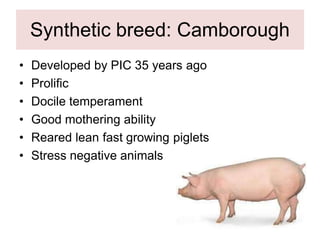
Synthetic breed: Camborough
• Developed by PIC 35 years ago
• Prolific
• Docile temperament
• Good mothering ability
• Reared lean fast growing piglets
• Stress negative animals
Synthetic breed: JSR Healthbred
• Foundation: Large white,
Landrace, Duroc
• Example: JSRDuraGilt
– Hardy, docile, good
mothering ability and good
rebreeding ability
– Suited for outdoor and semi-
intensive systems
Exotic Breed: Upgrades
• Kaman
– Native pig from batangas x Duroc Jersey
• Black diani
– Native pig from batangas x Berkshire
• Berkjala (UPLB 1916)
– Native pig from Jala jala Rizal x Berkshire
Breeding Systems
• It is a systematic way of bringing together superior
genotype to produce the desired products.
Pure breeding
• system of breeding wherein animals of the same breed
are mated to each other to produce pure breeds.
• Goal: is to produce breeding stocks
Out breeding
• is that system where unrelated individuals are mated to
produce the next generation
Outbreeding: Cross breeding
Crossbreeding
• Mating of two animals from different breeds to combine
traits of the two different breeds
• Combine the strengths and weaknesses of two different
breeds to create an animal “hybrid” that is more balanced
for relevant performance traits.
• Used for production of slaughter pigs.
• Why?
 to obtain hybrid vigor or “heterosis”
 to bring together the desirable characteristics of the parental
breeds.
 To produce large litters and high survival rate
 have better FE (2.6) and require lower feed cost per kilogram live
weight gain.
 Produce better carcass quality
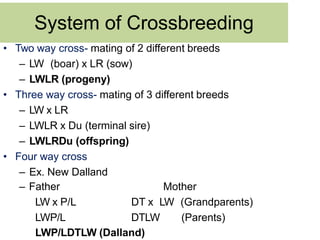
System of Crossbreeding
• Two way cross- mating of 2 different breeds
– LW (boar) x LR (sow)
– LWLR (progeny)
• Three way cross- mating of 3 different breeds
– LW x LR
– LWLR x Du (terminal sire)
– LWLRDu (offspring)
• Four way cross
– Ex. New Dalland
– Father
LW x P/L
LWP/L
Mother
DT x LW (Grandparents)
DTLW (Parents)
LWP/LDTLW (Dalland)
Upgrading
 It is a system of breeding where native breeds
are usually crossed with pure breeds of swine
 To upgrade the characteristics of inferior breed
 Selected female pigs are bred to purebred boar
of the same breed; this procedure is repeated
until offspring approach the characteristics of
purebred
Types of Mating
• Natural mating
– where a boar mounts a sow and introduces his
semen
• Hand Mating
– The supervised person take the boar to the in heat
sow
– Operator knows certain female was bred
• Pen Mating
– The boar runs with the group of sows/gilts
– Less labor intensive, more boar power
Artificial Insemination
• System of mating where semen is deposited to females
genitalia in time conductive to fertilization by artificial means
• Advantages:
– Allow greater degree of choice of sire
– Disease control
– Breeding stock improvement
– Increase number of sows that can be serviced by a boar
– Allow raisers to keep few sows without maintaining a boar
– Infertile boars are immediately detected
– Allow to used aged, crippled yet genetically superior boars
– Reduces breeding cost
• Limitations:
– Use of semen from infected boars will spread
infection faster because of higher number of sows
inseminated
– Needs properly trained technician
– Difficulty in storing diluted semen of boar over a
prolonged period of time
– Additional cost for equipment and laboratory
chemicals
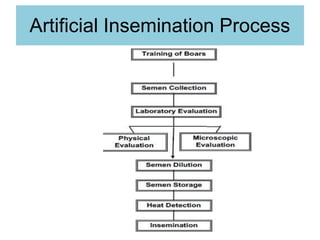
Artificial Insemination Process
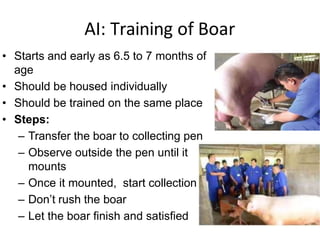
AI: Training of Boar
• Starts and early as 6.5 to 7 months of
age
• Should be housed individually
• Should be trained on the same place
• Steps:
– Transfer the boar to collecting pen
– Observe outside the pen until it
mounts
– Once it mounted, start collection
– Don’t rush the boar
– Let the boar finish and satisfied
• Introduce the boar to dummy immediately
after another boar
• Return boar to its pen and try again next day
• Wet dummy with sow’s urine or boar semen
• Manually stimulate boar penis
• Remember:
– Boar differ in characteristics and attitude
– Always check semen quantity and quality
– Check for any abnormalities
SEMEN COLLECTION
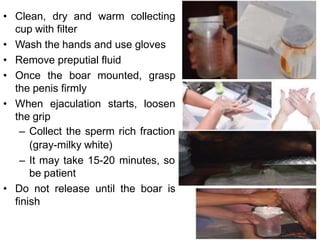
• Clean, dry and warm collecting
cup with filter
• Wash the hands and use gloves
• Remove preputial fluid
• Once the boar mounted, grasp
the penis firmly
• When ejaculation starts, loosen
the grip
– Collect the sperm rich fraction
(gray-milky white)
– It may take 15-20 minutes, so
be patient
• Do not release until the boar is
finish
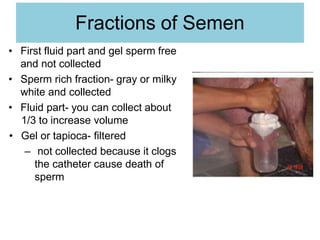
Fractions of Semen
• First fluid part and gel sperm free
and not collected
• Sperm rich fraction- gray or milky
white and collected
• Fluid part- you can collect about
1/3 to increase volume
• Gel or tapioca- filtered
– not collected because it clogs
the catheter cause death of
sperm
Frequency of Collection
• Junior boars (8-12 months)- once a week
• Adult boars (13 months and up)- twice a week
collection with 3-4 days interval
• It affects volume and concentration of semen to
certain extent
• Over-used boars have low semen concentration
and volume
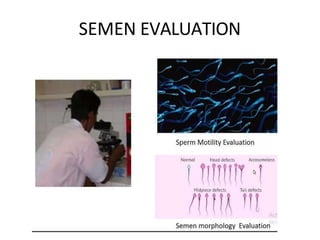
SEMEN EVALUATION
Semen Evaluation
• Need to examine first few ejaculates of new boar and one
sample each month
• It is indispensable tool in A.I
• Two types:
1. Physical evaluation
 Volume/Weight
• Normal boar ejaculates 150-250 ml
• Usual range- 50-500 ml or 50-500 grams (1ml: 1 gram)
 Smell- has little odor
• With preputial fluid- very distinctive odor
Color- vary from grayish-white to creamy white
• Blood contamination- red –brownish color
• Urine- yellowish color
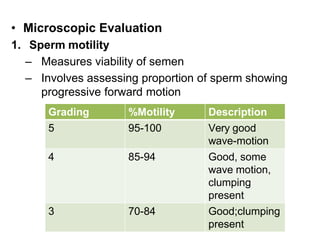
• Microscopic Evaluation
1. Sperm motility
– Measures viability of semen
– Involves assessing proportion of sperm showing
progressive forward motion
Grading %Motility Description
5 95-100 Very good
wave-motion
4 85-94 Good, some
wave motion,
clumping
present
3 70-84 Good;clumping
present
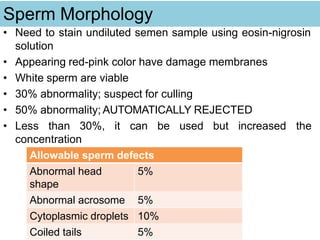
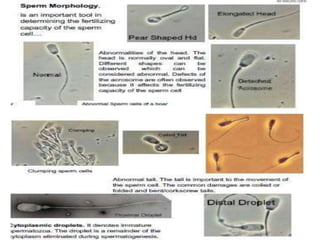
Sperm Morphology
• Need to stain undiluted semen sample using eosin-nigrosin
solution
• Appearing red-pink color have damage membranes
• White sperm are viable
• 30% abnormality; suspect for culling
• 50% abnormality; AUTOMATICALLY REJECTED
• Less than 30%, it can be used but increased the
concentration
Allowable sperm defects
Abnormal head
shape
5%
Abnormal acrosome 5%
Cytoplasmic droplets 10%
Coiled tails 5%
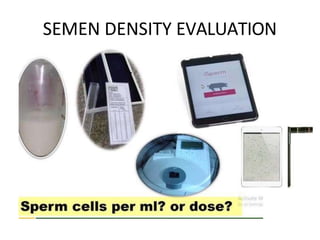
SEMEN DENSITY EVALUATION
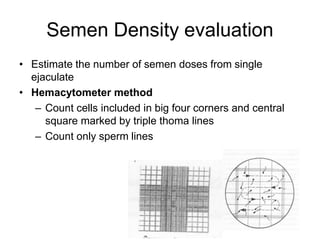
Semen Density evaluation
• Estimate the number of semen doses from single
ejaculate
• Hemacytometer method
– Count cells included in big four corners and central
square marked by triple thoma lines
– Count only sperm lines
• Ocular method
– If semen is used for less than 10
sows, ocular method can be used
– It based on color of sample
– Creamy sample: very
concentrated; watery- less
concentrated
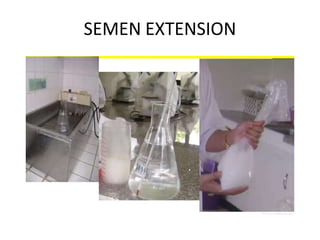
SEMEN EXTENSION
SEMEN EXTENSION
• Why?
– To extend volume of ejaculate so that more doses of
semen are produced
– To provide sperm cells with an environment that
keeps them alive for few days
– used to maintain semen storage life from 3-14 days
• Average total number of sperms per ejaculate is 30-40
billion
• Normal boars it can range 20-120 billion
• Examples of commercial diluents :
– Belthsvilled Thawing solution, Guelph, Kiev or Merck
diluents
– keep viable sperm for 3 days
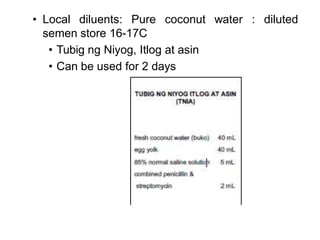
• Local diluents: Pure coconut
semen store 16-17C
• Tubig ng Niyog, Itlog at asin
• Can be used for 2 days
water : diluted
Procedure
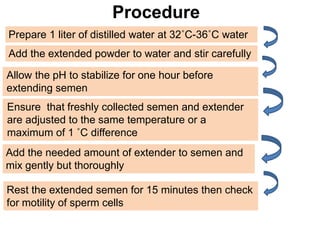
Prepare 1 liter of distilled water at 32˚C-36˚C water
Add the extended powder to water and stir carefully
Allow the pH to stabilize for one hour before
extending semen
Ensure that freshly collected semen and extender
are adjusted to the same temperature or a
maximum of 1 ˚C difference
Add the needed amount of extender to semen and
mix gently but thoroughly
Rest the extended semen for 15 minutes then check
for motility of sperm cells
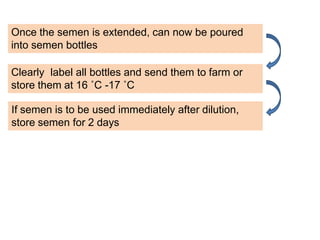
Once the semen is extended, can now be poured
into semen bottles
If semen is to be used immediately after dilution,
store semen for 2 days
Clearly label all bottles and send them to farm or
store them at 16 ˚C -17 ˚C
Storage of Semen
• Store in temperature-controlled cabinet
• Never store in refrigerator 2-8C or greater than
20C
• Shelf of semen can be prolong by storing 16-
17C (lowers metabolism of sperms)
• Used insulated container such as styrofoam box
battery operated
box to transport
with cool packs or
thermostatistically-controlled
semen
HEAT DETECTION
• Timing of insemination is very important factor
affecting fertilization rate and overall success of
AI
• Each day boar should left parade in front of dry
sows/gilts at least 15 minutes to provide
stimulation
• Heat Detection can be done to:
– Gilts
– Dry sows
– 21 and 42 days after insemination
– Repeat breeders
Estrus/Heat
• It is the period of sexual receptivity and
ovulation in a female pig
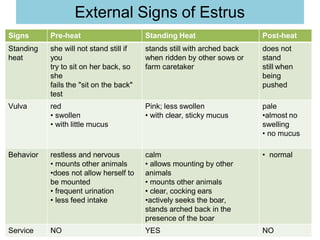
External Signs of Estrus
Signs Pre-heat Standing Heat Post-heat
Standing
heat
she will not stand still if
you
try to sit on her back, so
she
fails the "sit on the back"
test
stands still with arched back
when ridden by other sows or
farm caretaker
does not
stand
still when
being
pushed
Vulva red
• swollen
• with little mucus
Pink; less swollen
• with clear, sticky mucus
pale
•almost no
swelling
• no mucus
Behavior restless and nervous
• mounts other animals
•does not allow herself to
be mounted
• frequent urination
• less feed intake
calm
• allows mounting by other
animals
• mounts other animals
• clear, cocking ears
•actively seeks the boar,
stands arched back in the
presence of the boar
• normal
Service NO YES NO
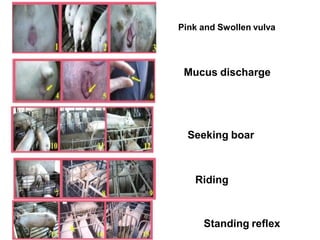
Pink and Swollen vulva
Mucus discharge
Seeking boar
Riding
Standing reflex
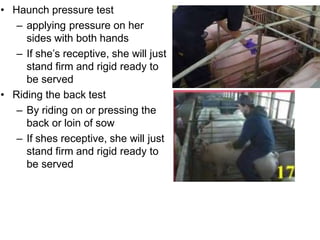
• Haunch pressure test
– applying pressure on her
sides with both hands
– If she’s receptive, she will just
stand firm and rigid ready to
be served
• Riding the back test
– By riding on or pressing the
back or loin of sow
– If shes receptive, she will just
stand firm and rigid ready to
be served
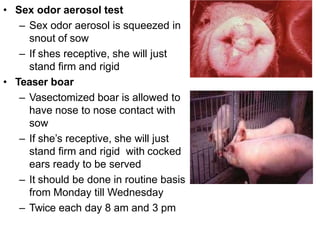
• Sex odor aerosol test
– Sex odor aerosol is squeezed in
snout of sow
– If shes receptive, she will just
stand firm and rigid
• Teaser boar
– Vasectomized boar is allowed to
have nose to nose contact with
sow
– If she’s receptive, she will just
stand firm and rigid with cocked
ears ready to be served
– It should be done in routine basis
from Monday till Wednesday
– Twice each day 8 am and 3 pm
Fertilization and Trans-Uterine Migration
• Mating process takes 15 minutes where 400 ml of fluid can
be inseminated
• Penis spirals towards the vagina and into the cervix where it
screws into folds to become locked
• Travel- 2 hours to arrive at the bottom of fallopian tubes
• Second phase of maturation “capacitation”- 6-8 hours
• Life span of semen- 24 hours
• Life span of unfertilized ova: 10 hours/ 21 hours
• Semen can then be inseminated after 8 hours
• Ovulation starts at least 70% of the length of standing heat
period
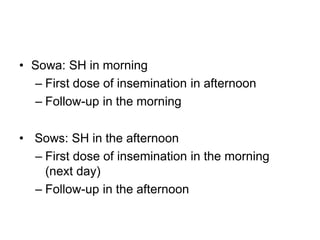
• Sowa: SH in morning
– First dose of insemination in afternoon
– Follow-up in the morning
• Sows: SH in the afternoon
– First dose of insemination in the morning
(next day)
– Follow-up in the afternoon
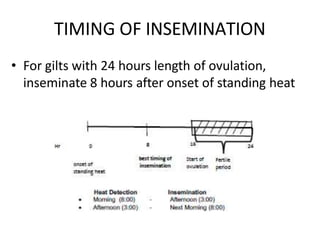
TIMING OF INSEMINATION
• For gilts with 24 hours length of ovulation,
inseminate 8 hours after onset of standing heat
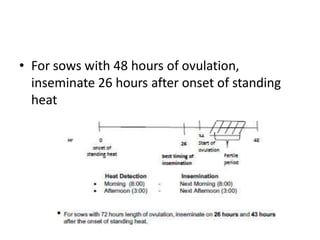
• For sows with 48 hours of ovulation,
inseminate 26 hours after onset of standing
heat
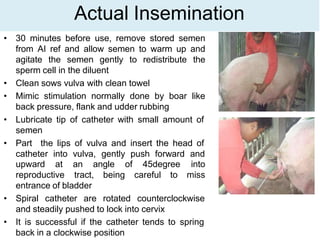
Actual Insemination
• 30 minutes before use, remove stored semen
from AI ref and allow semen to warm up and
agitate the semen gently to redistribute the
sperm cell in the diluent
• Clean sows vulva with clean towel
• Mimic stimulation normally done by boar like
back pressure, flank and udder rubbing
• Lubricate tip of catheter with small amount of
semen
• Part the lips of vulva and insert the head of
catheter into vulva, gently push forward and
upward at an angle of 45degree
reproductive
into
tract, being careful to miss
entrance of bladder
• Spiral catheter are rotated counterclockwise
and steadily pushed to lock into cervix
• It is successful if the catheter tends to spring
back in a clockwise position
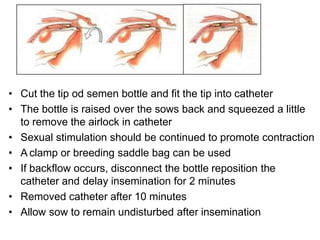
• Cut the tip od semen bottle and fit the tip into catheter
• The bottle is raised over the sows back and squeezed a little
to remove the airlock in catheter
• Sexual stimulation should be continued to promote contraction
• A clamp or breeding saddle bag can be used
• If backflow occurs, disconnect the bottle reposition the
catheter and delay insemination for 2 minutes
• Removed catheter after 10 minutes
• Allow sow to remain undisturbed after insemination
Pregnancy Diagnosis
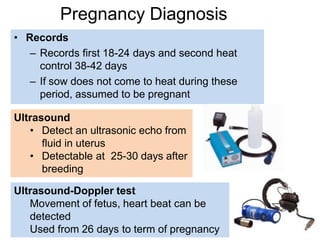
• Records
– Records first 18-24 days and second heat
control 38-42 days
– If sow does not come to heat during these
period, assumed to be pregnant
Ultrasound
• Detect an ultrasonic echo from
fluid in uterus
• Detectable at 25-30 days after
breeding
Ultrasound-Doppler test
Movement of fetus, heart beat can be
detected
Used from 26 days to term of pregnancy
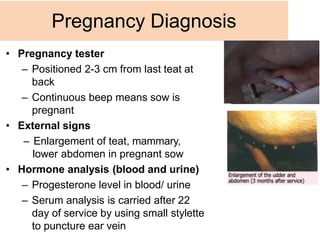
• Pregnancy tester
– Positioned 2-3 cm from last teat at
back
– Continuous beep means sow is
pregnant
• External signs
– Enlargement of teat, mammary,
lower abdomen in pregnant sow
• Hormone analysis (blood and urine)
– Progesterone level in blood/ urine
– Serum analysis is carried after 22
day of service by using small stylette
to puncture ear vein
Pregnancy Diagnosis
• Vaginal biopsy
– Involves removal of small piece of vaginal mucous
membrane using special instrument
– This instrument is inserted to vagina 15-300 mm
pressed into membrane and end manipulated to
cut0off small piece
• Palpation
– Useful method after 30 days of gestation
– Rectal palpation
• Scanner
– Can determine pregnancy stage
Pregnancy Diagnosis
CARE AND MANAGEMENT OF
BOARS
• Selection of Replacement Boars
• Transport of Replacement Boars
• Handling of Replacement Boars
• Assessing of Replacement Boars
• Boar usage
• Feeding of Replacement Stocks
• Housing
• Other considerations
Selection of Boars
• Body confirmation
– Body length, depth and
height should be well-
proportioned
• Best to select boar who
tested for fertility
• Should possess good
muscle development
• BFT not exceed 2 cm at
90 kg LW
Sex character
• Masculinity appearance
• Primary sex organs should be
clearly visible and well-developed
• Testicles are large and equal size
• He has sufficient sex drive to
complete ejaculation
• Capable of producing semen of
sufficient quality and quantity
Age and Weight:
• 5-6 months at time of selection
• 8 months at time of breeding
• 130 kg or more (controlled feeding)
Reproductive soundness
• Number, spacing and presentation of live teats (at
least 12)
Transport of Replacement boar
• Ensure maximum safety to minimize
stress, injury and diseases.
• Avoid stressful condition or disease that
cause high temperature that can lower
fertility or even lead to temporary infertility
which might last for 6-8 weeks
• Well-ventilated truck; use of safe, well-
built loading and unloading
Handling of Replacement Boar
• Acclimatization of new boars at least 1 week
before use and after quarantine period of one
month
• Quarantine
• Blood test
– Brucellosis
– Leptospirosis
• Parasite treatment
• Vaccination
• Introduction to New herd mates
Assessing the Boar as Breeding Stock
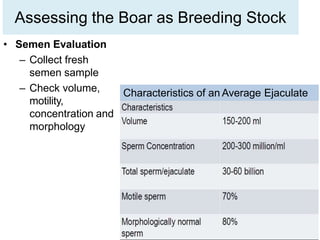
• Semen Evaluation
– Collect fresh
semen sample
– Check volume,
motility,
concentration and
morphology
Characteristics of an Average Ejaculate
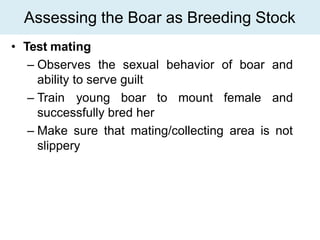
• Test mating
– Observes the sexual behavior of boar and
ability to serve guilt
– Train young boar to mount female and
successfully bred her
– Make sure that mating/collecting area is not
slippery
Assessing the Boar as Breeding Stock
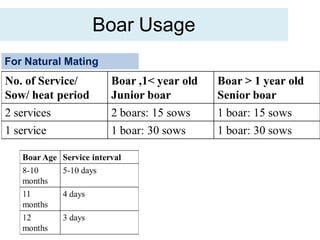
Boar Usage
For Natural Mating
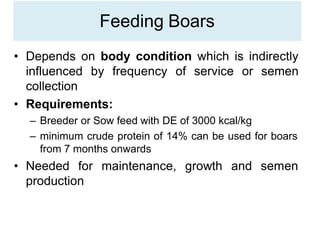
Feeding Boars
• Depends on body condition which is indirectly
influenced by frequency of service or semen
collection
• Requirements:
– Breeder or Sow feed with DE of 3000 kcal/kg
– minimum crude protein of 14% can be used for boars
from 7 months onwards
• Needed for maintenance, growth and semen
production
• Quantity: 2.0 kg/day +- 0.5 kg if thin or fat
– If feed is less than 2.0 kg, give roughage
– Give water ad li bitum
• Giving too much feed to boar might lead to:
– Obesity
– Poor libido
– Too heavy
– Laziness
– Poor service results
– Problems in natural service
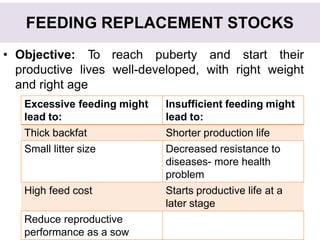
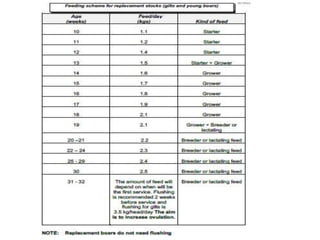
FEEDING REPLACEMENT STOCKS
• Objective: To reach puberty and start their
productive lives well-developed, with right weight
and right age
Excessive feeding might
lead to:
Insufficient feeding might
lead to:
Thick backfat Shorter production life
Small litter size Decreased resistance to
diseases- more health
problem
High feed cost Starts productive life at a
later stage
Reduce reproductive
performance as a sow
Health care
• Deworm every 6 months
• Mange treatment every 6 months
• Vitamin ADE every 6 months
• Vaccination every 6 months
• Always ask for health record of prospective
boars and closely examined
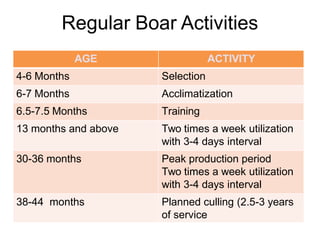
Regular Boar Activities
AGE ACTIVITY
4-6 Months Selection
6-7 Months Acclimatization
6.5-7.5 Months Training
13 months and above Two times a week utilization
with 3-4 days interval
30-36 months Peak production period
Two times a week utilization
with 3-4 days interval
38-44 months Planned culling (2.5-3 years
of service
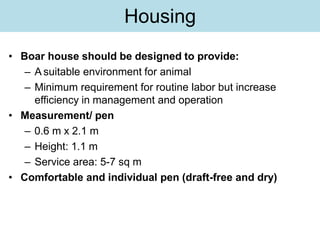
Housing
• Boar house should be designed to provide:
– A suitable environment for animal
– Minimum requirement for routine labor but increase
efficiency in management and operation
• Measurement/ pen
– 0.6 m x 2.1 m
– Height: 1.1 m
– Service area: 5-7 sq m
• Comfortable and individual pen (draft-free and dry)
• Install high and strong partitions and gates
– Height of partition should be 1.2 m
– Can be made of concrete or slatted, either with use of
wood
• Door and alleys
– Width: 0.70 meter
– Alley: 1.2-1.5 meters
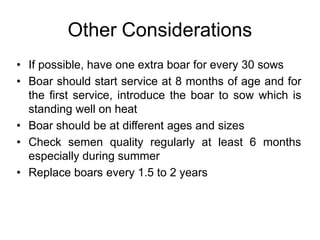
Other Considerations
• If possible, have one extra boar for every 30 sows
• Boar should start service at 8 months of age and for
the first service, introduce the boar to sow which is
standing well on heat
• Boar should be at different ages and sizes
• Check semen quality regularly at least 6 months
especially during summer
• Replace boars every 1.5 to 2 years
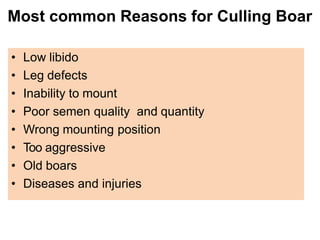
Most common Reasons for Culling Boar
• Low libido
• Leg defects
• Inability to mount
• Poor semen quality and quantity
• Wrong mounting position
• Too aggressive
• Old boars
• Diseases and injuries
Care and Management of Sows and
Gilts
• Management on:
–Breeding time
–Gestation
–Farrowing
–Lactation
Breeding Time
• Need to have proper management to achieve
good reproductive performance
• Breeding sow/gilt intended to be:
– Getting bred
– Pregnant
– Nursing a litter
Empty period between
these period is called
Unproductive days
Aimed to :
• Improved conception rate
• Increase litter size at birth
• Shorten non productive days and weaning to
conception interval
• Selecting Replacement Gilts
– Keep records of parents, birth date and litter
number for future references
– Plan to replace 40-55% annually, if herd age is ≤5
litters
– Select replacement gilts from large healthy
uniform litters
• Pre-service management
– Recommendation at first breeding
• Age: 8 months old
• Weight: 130-135 kg
• Cycled at least twice
• Second heat cycle; second day of heat period
• Exhibiting signs of estrus
• Should have high ovulation rate and higher uterine
space capacity
• Do not bred gilt on 1st estrus
• At 1 year old she will farrow
her 1st litter
• To prevent drop down of
body during lactation
• Pre-service management
– Recommended practices
breeding:
for dry sow before
• Good dry sow should come into heat and be ready
for service within 3-7 days after weaning
• Aim: Shorter lactation period at least 6 weeks;
to shorter weaning to conception interval;
• Always keep her in good health and body condition
• Exposed weaned sow to boar; If not come to heat
10-12 days; induce hormone injection
• Old sows of parity of 8 tend to have longer dry
period
• Advisable to let newly-weaned sows room around
in paddock after weaning
• Don’t feed sows at the day of weaning to easily
dry-off milk
• Allowable weight loss and back fat thickness is 8-
10% of its body weight
•1st litter sows tend to have longer time to return
heat
• Pre-service Management
– Flushing
• Increase daily feed intake
by 3.5-4kgs/day for 10-14
days before service
• Give gestation feed with
14% CP before service
• It is intended for
restricted feeding
program
• Aim to:
– gain weight
– To recondition sow
– Easily dry off milk (dry
sow)
• Higher ovulation rate;
low embryonic
mortality
• Higher litter size
Other practices:
• Physical exercise
• Social contact
• Boar exposure
• Fasting
• Injectable hormones