Housing management of livestock
for better productivity
Dr. Sapunii S Hanah &
Dr. J.K.Chamuah
ICAR-NRC on Mithun-Medziphema Nagaland.
• convert the energy in feed into products that can be utilized by human beings,
 such as milk
 Eggs
 meat
 wool
 hair
 hides and skins
 draught power
 and manure (fertilizer).
Why do animals need shelter
18-02-2016: Dr. S. S. Hanah (Scientist), ICAR-NRC on Yak, Dirang.
• Freedom from hunger and thirst
• Freedom from discomfort
• Freedom from pain, injury and disease
• Freedom to express normal behavior
• Freedom from fear and distress
Five freedom of animals
 Single housing system may not be wholly suitable for all agro-climatic zones in
India
 The most widely prevalent practice in this country is to tie the cows with rope on a
Katcha floor
 scientifically/ for better productivity: 2 type
 loose housing
 The conventional dairy barn.
Type and system of housing for animals:
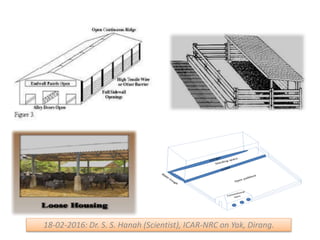
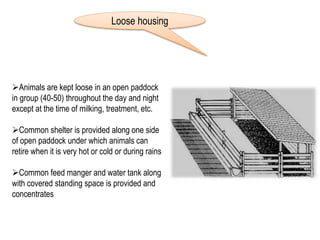
Loose housing
Animals are kept loose in an open paddock
in group (40-50) throughout the day and night
except at the time of milking, treatment, etc.
Common shelter is provided along one side
of open paddock under which animals can
retire when it is very hot or cold or during rains
Common feed manger and water tank along
with covered standing space is provided and
concentrates
Advantage
• Cost of construction is cheaper.
• Future expansion is possible.
• Move freely - sufficient exercise.
• The animal can be kept clean.
• Common feeding and watering
• Oestrus detection is easy.
• less prone to fire hazards to
animals
• At least 10-15 percent more stock
than standard can be
accommodated for shorter period.
Disadvantage
• It is not suitable for temperate
Himalayan region and heavy
rainfall areas.
• It requires more floor space.
• There is competition for feed.
• Attention of individual animal is
not possible.
• A separate milking barn is
needed for milking of animals.
20-07-2022
18-02-2016: Dr. S.S.Hanah (Scientist), ICAR-
NRC on Yak, Dirang.
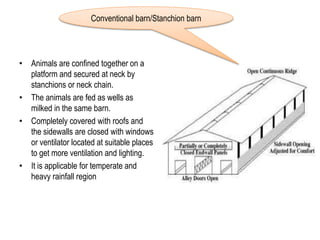
• Animals are confined together on a
platform and secured at neck by
stanchions or neck chain.
• The animals are fed as wells as
milked in the same barn.
• Completely covered with roofs and
the sidewalls are closed with windows
or ventilator located at suitable places
to get more ventilation and lighting.
• It is applicable for temperate and
heavy rainfall region
Conventional barn/Stanchion barn
• The animals and men caring for
animals are less exposed to harsh
environment.
• The animals can be kept clean.
• Diseases are better controlled.
• Individual care can be given.
• Separate milking barn is not required.
• Cost of construction is more.
• Future expansion is difficult.
• Not suitable for hot and humid
climatic conditions
 Generally conventional barn system animal are arranged in a single row if the
numbers of animal are less, say 10 or in a double row if the herd is a large one.
In double row:
 Tail to tail system
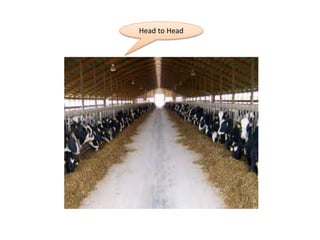
 Head to head system
Ordinarily, not more than 80 to 100 cows should be placed in one building.
Advantage Disadvantage
Head to Head
Advantage
• Study of Time:
 15% - spent in front of the cow
 25% in other parts of the barn and
the milk house
 60% of the time is spent behind the
cows. 'Time spent at the back of the
cows is 4 times more than, the time
spent in front of them.
• In cleaning and milking the cows, the
wide middle alley is of great
advantage.
• Lesser danger of spread of diseases
from animal to animal.
• Cows can always get more fresh air
from outside.
• The manager can inspect a greater
number of milkmen while milking.
• Any sort of minor disease or any
change in the hind quarters of the
animals can be detected quickly and
even automatically.
Tail to Tail
Disadvantage
 Spreading of diseases through digestive
and reproductive system is high
 Drainage channel is not exposed to
sunlight.
Feeding of animals is laborious
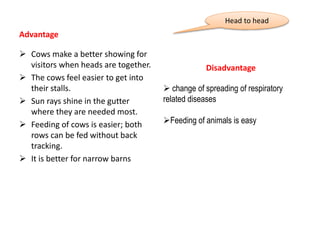
Advantage
 Cows make a better showing for
visitors when heads are together.
 The cows feel easier to get into
their stalls.
 Sun rays shine in the gutter
where they are needed most.
 Feeding of cows is easier; both
rows can be fed without back
tracking.
 It is better for narrow barns
Head to head
Disadvantage
 change of spreading of respiratory
related diseases
Feeding of animals is easy
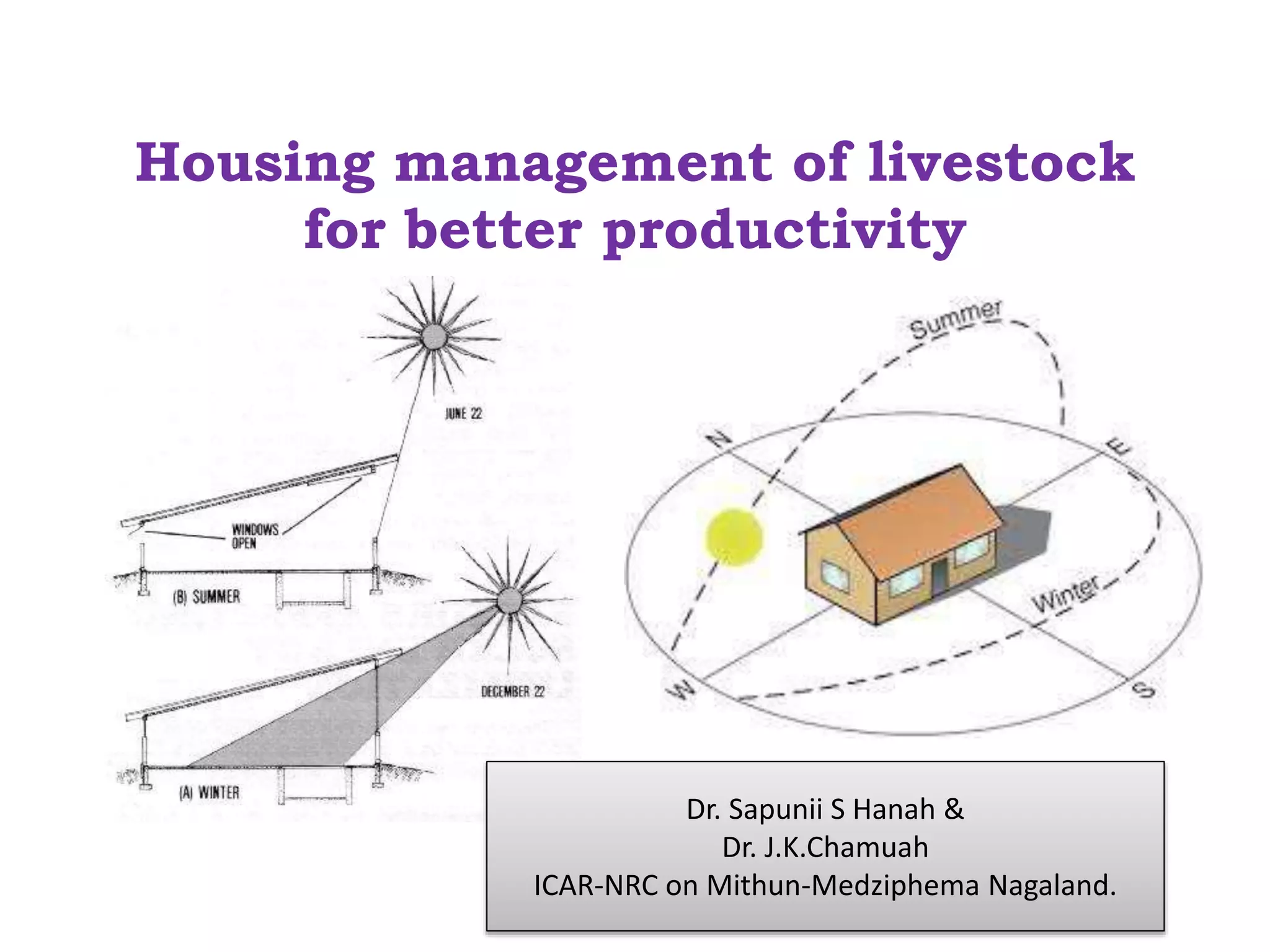
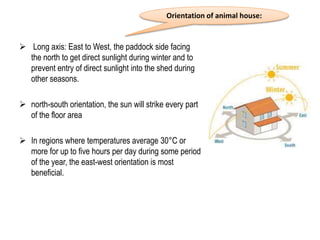
 Long axis: East to West, the paddock side facing
the north to get direct sunlight during winter and to
prevent entry of direct sunlight into the shed during
other seasons.
 north-south orientation, the sun will strike every part
of the floor area
 In regions where temperatures average 30°C or
more for up to five hours per day during some period
of the year, the east-west orientation is most
beneficial.
Orientation of animal house:
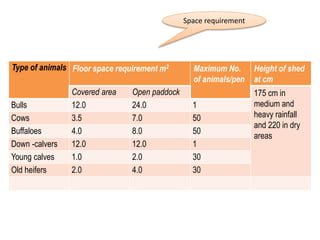
Space requirement
Type of animals Floor space requirement m2 Maximum No.
of animals/pen
Height of shed
at cm
Covered area Open paddock 175 cm in
medium and
heavy rainfall
and 220 in dry
areas
Bulls 12.0 24.0 1
Cows 3.5 7.0 50
Buffaloes 4.0 8.0 50
Down -calvers 12.0 12.0 1
Young calves 1.0 2.0 30
Old heifers 2.0 4.0 30
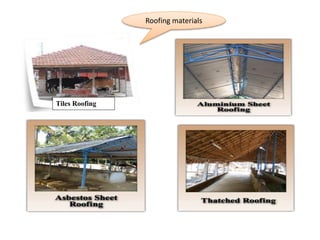
Roofing materials
Tiles Roofing
 Sunlight is the most potent and powerful sanitizer which destroy most of the disease
producing organism.
 Sanitizer: bleaching powder, Iodine and lodophor, sodium carbonate, Washing soda,
Slaked Lime (Calcium hydroxide), Quick Lime (Calcium oxide) and phenol
 Procedure:
• Remove the dung, bedding materials and urine from the floor - shovel and basket
• Empty the water trough and scrape its sides and bottom with the help of a floor brush.
• Wash the water trough with clean water and white wash it with the help of lime mixture
once a week.
• Scrape the floor with a brush and broom and wash with water.
• Clean and disinfect the splashes of dung on the side walls, railing and stanchions.
• Remove the cobwebs periodically with the help of a wall brush.
• Allow adequate sunlight to enter in to the shed.
• Spray insecticides at regular intervals especially during the rainy season (Fly season).
• Whitewash the walls periodically by mixing insecticides to eliminate ticks and mites
living in cracks and crevices.
Sanitation of livestock house
Housing management for better productivity.pptx

Housing management for better productivity.pptx

  • 1.
    Housing management oflivestock for better productivity Dr. Sapunii S Hanah & Dr. J.K.Chamuah ICAR-NRC on Mithun-Medziphema Nagaland.
  • 2.
    • convert theenergy in feed into products that can be utilized by human beings,  such as milk  Eggs  meat  wool  hair  hides and skins  draught power  and manure (fertilizer). Why do animals need shelter
  • 3.
    18-02-2016: Dr. S.S. Hanah (Scientist), ICAR-NRC on Yak, Dirang.
  • 4.
    • Freedom fromhunger and thirst • Freedom from discomfort • Freedom from pain, injury and disease • Freedom to express normal behavior • Freedom from fear and distress Five freedom of animals
  • 5.
     Single housingsystem may not be wholly suitable for all agro-climatic zones in India  The most widely prevalent practice in this country is to tie the cows with rope on a Katcha floor  scientifically/ for better productivity: 2 type  loose housing  The conventional dairy barn. Type and system of housing for animals:
  • 6.
    Loose housing Animals arekept loose in an open paddock in group (40-50) throughout the day and night except at the time of milking, treatment, etc. Common shelter is provided along one side of open paddock under which animals can retire when it is very hot or cold or during rains Common feed manger and water tank along with covered standing space is provided and concentrates
  • 7.
    Advantage • Cost ofconstruction is cheaper. • Future expansion is possible. • Move freely - sufficient exercise. • The animal can be kept clean. • Common feeding and watering • Oestrus detection is easy. • less prone to fire hazards to animals • At least 10-15 percent more stock than standard can be accommodated for shorter period. Disadvantage • It is not suitable for temperate Himalayan region and heavy rainfall areas. • It requires more floor space. • There is competition for feed. • Attention of individual animal is not possible. • A separate milking barn is needed for milking of animals. 20-07-2022 18-02-2016: Dr. S.S.Hanah (Scientist), ICAR- NRC on Yak, Dirang.
  • 8.
    • Animals areconfined together on a platform and secured at neck by stanchions or neck chain. • The animals are fed as wells as milked in the same barn. • Completely covered with roofs and the sidewalls are closed with windows or ventilator located at suitable places to get more ventilation and lighting. • It is applicable for temperate and heavy rainfall region Conventional barn/Stanchion barn
  • 9.
    • The animalsand men caring for animals are less exposed to harsh environment. • The animals can be kept clean. • Diseases are better controlled. • Individual care can be given. • Separate milking barn is not required. • Cost of construction is more. • Future expansion is difficult. • Not suitable for hot and humid climatic conditions  Generally conventional barn system animal are arranged in a single row if the numbers of animal are less, say 10 or in a double row if the herd is a large one. In double row:  Tail to tail system  Head to head system Ordinarily, not more than 80 to 100 cows should be placed in one building. Advantage Disadvantage
  • 10.
  • 11.
    Advantage • Study ofTime:  15% - spent in front of the cow  25% in other parts of the barn and the milk house  60% of the time is spent behind the cows. 'Time spent at the back of the cows is 4 times more than, the time spent in front of them. • In cleaning and milking the cows, the wide middle alley is of great advantage. • Lesser danger of spread of diseases from animal to animal. • Cows can always get more fresh air from outside. • The manager can inspect a greater number of milkmen while milking. • Any sort of minor disease or any change in the hind quarters of the animals can be detected quickly and even automatically. Tail to Tail Disadvantage  Spreading of diseases through digestive and reproductive system is high  Drainage channel is not exposed to sunlight. Feeding of animals is laborious
  • 12.
    Advantage  Cows makea better showing for visitors when heads are together.  The cows feel easier to get into their stalls.  Sun rays shine in the gutter where they are needed most.  Feeding of cows is easier; both rows can be fed without back tracking.  It is better for narrow barns Head to head Disadvantage  change of spreading of respiratory related diseases Feeding of animals is easy
  • 13.
     Long axis:East to West, the paddock side facing the north to get direct sunlight during winter and to prevent entry of direct sunlight into the shed during other seasons.  north-south orientation, the sun will strike every part of the floor area  In regions where temperatures average 30°C or more for up to five hours per day during some period of the year, the east-west orientation is most beneficial. Orientation of animal house:
  • 14.
    Space requirement Type ofanimals Floor space requirement m2 Maximum No. of animals/pen Height of shed at cm Covered area Open paddock 175 cm in medium and heavy rainfall and 220 in dry areas Bulls 12.0 24.0 1 Cows 3.5 7.0 50 Buffaloes 4.0 8.0 50 Down -calvers 12.0 12.0 1 Young calves 1.0 2.0 30 Old heifers 2.0 4.0 30
  • 15.
  • 16.
     Sunlight isthe most potent and powerful sanitizer which destroy most of the disease producing organism.  Sanitizer: bleaching powder, Iodine and lodophor, sodium carbonate, Washing soda, Slaked Lime (Calcium hydroxide), Quick Lime (Calcium oxide) and phenol  Procedure: • Remove the dung, bedding materials and urine from the floor - shovel and basket • Empty the water trough and scrape its sides and bottom with the help of a floor brush. • Wash the water trough with clean water and white wash it with the help of lime mixture once a week. • Scrape the floor with a brush and broom and wash with water. • Clean and disinfect the splashes of dung on the side walls, railing and stanchions. • Remove the cobwebs periodically with the help of a wall brush. • Allow adequate sunlight to enter in to the shed. • Spray insecticides at regular intervals especially during the rainy season (Fly season). • Whitewash the walls periodically by mixing insecticides to eliminate ticks and mites living in cracks and crevices. Sanitation of livestock house