9/14/2020 1
Vidyashree K N
Module 1
By- Vidyashree K N
Assistant Professor
Department of ECE
DSCE
Class and Section : 5th C
Purpose of communication system
 To transport an information-bearing signal from a source
to a user destination via a communication channel.
 Basically, a communication system is of an analog or
digital type.
9/14/2020 2
Vidyashree K N
Why growth of digital communications
is large??
9/14/2020 3
Vidyashree K N
Sources and Signals
 A source of information generates a message
◦ Human voice, television picture, teletype data,
atmospheric temperature, pressure etc.
 The message signal can be of analog or digital.
 Analog to digital conversion is peformed by
combining three basic operations;
◦ Sampling
◦ Quantizing
◦ Encoding
9/14/2020 4
Vidyashree K N
Digital communication system
Fig 1: Block diagram
9/14/2020 5
Vidyashree K N
 Information Source:
◦ Can be classified into Analog information source and discrete
information sources.
◦ Ex for analog: micophone actuated by speech.,
◦ Ex for discrete: Teletype or numerical output of a computer
consists of a sequence of discrete symbols or letters.
 Source Encoder :
◦ Converting the output of whether analog or digital source into a
sequence of binary digits.
 Channel encoder:
◦ Introduce some redundancy in the binary information sequence.
These extra bits do not convey any information but helps the
receiver to detect and / or correct some of the errors in the
information bearing bits.
9/14/2020 6
Vidyashree K N
 Channel:
◦ Provides the electrical connection between the source and
destination.Ex: Pair of wires, Coaxial cable, Optical fibre, Radio
channel, Satellite channel or combination of any of these.
 Modulator:
◦ It operates by keying shifts in the amplitude, frequency or phase of a
sinusoidal carrier wave to the channel encoder output.
◦ The digital modulation techniques are referred to as amplitude- shift
keying, frequency- shift keying or phase-shift keying respectively.
◦ Converts the input bit stream into an electrical waveform suitable
for transmission over the communication channel.
 Detector:
◦ The detector performs demodulation, thereby producing a signal the
follows the time variations in the channel encoder output.
9/14/2020 7
Vidyashree K N
Review of probobality theory
 Deals with result of an experiment whose actual
outcome is not known in advance.
 Mathematical approach used for studying the outcomes
of such experiments is called “ probabality theory”
 Ex: In the example of tossing of a coin, it is impossible
to predict the outcome of the experiment with certainity.
 Hence ‘chance’ of getting an unexpected outcome may
be defined as ‘Probabality’
9/14/2020 8
Vidyashree K N
Information source
• The discrete information source consist of a discrete set
of letters or symbol.
 a message emitted by a source consist of sequence of
symbols
 Every message coming out of the source contains some
information.
 However the information contains by the message varies
from one another. Some message convey more
information than others.
 In order to quantify the information contain in the
message, it is necessary to define a measure of
information.
9/14/2020 9
Vidyashree K N
Discrete Information source
◦ Discrete information source are characterized by
i) Source alphabet
Ex: a teletype having 26 letters of English alphabet plus several
special characters such as full stop, comma etc, along with
numericals.
ii) Symbol rate
◦ Rate at which the teletype produces characters. Ex- if the teletype
operates at the speed of 10 characters/sec, then symbol rate is said to
be 10 symbols/sec.
iii)Source alphabet probobalities; and iv) probobalistic
dependence of symbols in a sequence
◦ Structural properties of symbol sequences can be characterized by
probobality of occurance of individual symbols.
9/14/2020 10
Vidyashree K N
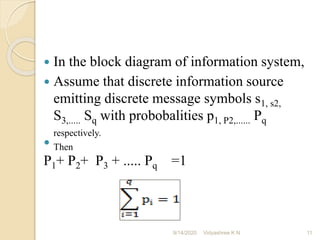
 In the block diagram of information system,
 Assume that discrete information source
emitting discrete message symbols s1, s2,
S3,..... Sq with probobalities p1, P2,...... Pq
respectively.
 Then
P1+ P2+ P3 + ..... Pq =1
9/14/2020 11
Vidyashree K N
Measure of information
 Let Sk be a symbol choosen for transmission at any
instant of time with probobality equal to Pk .
 Then amount of information of message is given by
◦ Ik = log (1/ Pk )
◦ If base of logarithm is 2, units are Bits,
◦ If base of logarithm is 10, units are Hartleys or
Decits
◦ If base of logarithm is e , units are NATS
9/14/2020 12
Vidyashree K N
Concept of amount of information
Example:
To know weather at chennai( peak winter time)
1. Sun will rise in east on the day of trip.
2. It will be a very cold day.
3. There will be snowfall on that particular day in chennai.
Conclusion: The message associated with an event least
likely to occur contains more information.
9/14/2020 13
Vidyashree K N
Discrete memoryless source
 A source in which symbols emitted during
successive signalling intervals are statistically
independent.
9/14/2020 14
Vidyashree K N
Entropy
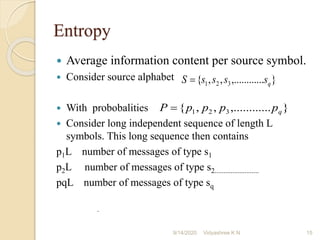
 Average information content per source symbol.
 Consider source alphabet
 With probobalities
 Consider long independent sequence of length L
symbols. This long sequence then contains
p1L number of messages of type s1
p2L number of messages of type s2.........................
pqL number of messages of type sq
.
}
...
,.........
,
,
{ 3
2
1 q
s
s
s
s
S =
}
...
,.........
,
,
{ 3
2
1 q
p
p
p
p
P =
9/14/2020 15
Vidyashree K N
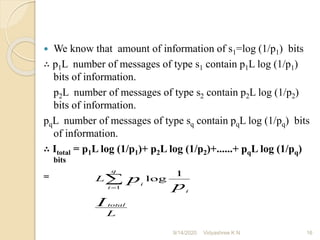
 We know that amount of information of s1=log (1/p1) bits
∴ p1L number of messages of type s1 contain p1L log (1/p1)
bits of information.
p2L number of messages of type s2 contain p2L log (1/p2)
bits of information.
pqL number of messages of type sq contain pqL log (1/pq) bits
of information.
∴ Itotal = p1L log (1/p1)+ p2L log (1/p2)+......+ pqL log (1/pq)
bits
=
L
L
I
p
p
total
i
q
i
i
1
log
1

=
9/14/2020 16
Vidyashree K N
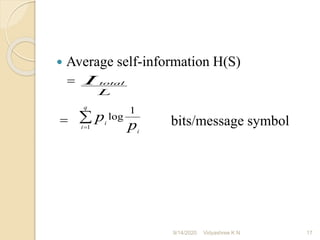
 Average self-information H(S)
=
= bits/message symbol
L
I total
p
p
i
q
i
i
1
log
1

=
9/14/2020 17
Vidyashree K N
Information Rate
 Let us suppose that the symbols are emitted by the
source at a fixed time rate “rs”symbols/sec
 The average information rate Rs in bits/sec is
defined as the product of the average information
content per symbol( H(S)) and the message
symbol rate rs
∴ Rs = rs H(S) bits/sec or BPS
9/14/2020 18
Vidyashree K N
Numericals
 1]Consider a binary source with source alphabet S= {s1, s2}
with probobalities P={1/256, 255/256}.Find a)self-
information of each message b)entropy.
9/14/2020 19
Vidyashree K N
2]Consider a binary source with source alphabet S1= {s3, s4}
with probobalities
Pl={7/16, 9/16}.Find
a)self-information of each message
b)Entropy
3]Consider a binary source with source alphabet S11= {s5, s6}
with probobalities
Pll={1/2, 1/2}.Find a)self-information of each message
b)entropy
4]Consider a binary source with source alphabet S= {s1, s2, s3}
with probobalities
P={1/2, 1/4, 1/4}.Find a)self-information of each message
b)entropy of source S
9/14/2020 20
Vidyashree K N
5] The collector voltage of certain circuit is to lie between -5 and -12 volts.
The voltage can take on only these values -5,-6,-7,-9,-11,-12 volts with
respective probobalities 1/6, 1/3,1/12,1/12,1/6,1/6. This voltage is recorded
with a pen recorder. Determine the average self-information associated with the
record in terms of bits/level.
6] A discrete source emits one of six symbols once every m-sec. The symbol
probobalities are 1/2, ¼, 1/8, 1/16, 1/32 and 1/32 respectively. Find the source
entropy and information rate.
7]Find relationship between Hartleys, Nats, and bits.
8] The output of an information source consists of 150 symbols, 32 of which
occur with a probobality of 1/64 and the remaining 118 occur with a
probobality of 1/236. The source emits 2000 symbols/sec. Assuming that the
symbols are choosen independently , find the average information rate of this
source.
[ note: The solution pdf is attached in google classroom, and also solved during
online classes]
9/14/2020 21
Vidyashree K N
9] A code is composed of dots and dashes. Assuming that
a dash is 3 times as long as a dot and has one-third the
probobality of occurence. Calculate
(i) The information in a dot and dash
(ii) The entroy of dot-dash code
(iii) The average rate of information if a dot lasts for 10 m-
sc and this time is allowed between symbols.
9/14/2020 22
Vidyashree K N
9/14/2020 23
Vidyashree K N
9/14/2020 24
Vidyashree K N
9/14/2020 25
Vidyashree K N
Source Encoding
 Source coding converts each symbols into codewords.
 Is the process by which the output of an information source
is converted into a r-ray sequence.
 ‘r’ is the number of different symbols used in this
transformation process.
 If r=2, then the output is a binary sequence,
 r=3, then the output is a ternary sequence,
 r=4, then the output is quaternary sequence
9/14/2020 26
Vidyashree K N
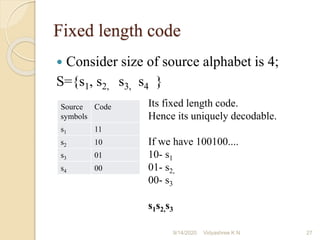
Fixed length code
 Consider size of source alphabet is 4;
S={s1, s2, s3, s4 }
Source
symbols
Code
s1 11
s2 10
s3 01
s4 00
Its fixed length code.
Hence its uniquely decodable.
If we have 100100....
10- s1
01- s2,
00- s3
s1s2,s3
9/14/2020 27
Vidyashree K N
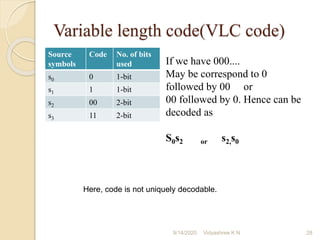
Variable length code(VLC code)
Source
symbols
Code No. of bits
used
s0 0 1-bit
s1 1 1-bit
s2 00 2-bit
s3 11 2-bit
If we have 000....
May be correspond to 0
followed by 00 or
00 followed by 0. Hence can be
decoded as
S0s2 or s2,s0
Here, code is not uniquely decodable.
9/14/2020 28
Vidyashree K N
Variable length code(VLC code)
Source
symbols
Code No. of bits
used
s0 1 1-bit
s1 01 2-bit
s2 001 3-bit
s3 000 3-bit
If we have 1001....
Can be decoded as
S0s2
Here, code is uniquely decodable
.
VLC code is prefix-free code
Also known as instantaneous code
9/14/2020 29
Vidyashree K N
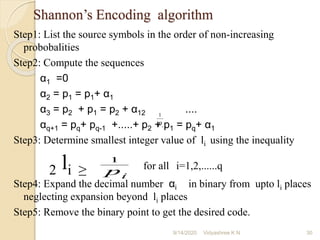
Shannon’s Encoding algorithm
Step1: List the source symbols in the order of non-increasing
probobalities
Step2: Compute the sequences
α1 =0
α2 = p1 = p1+ α1
α3 = p2 + p1 = p2 + α12 ....
αq+1 = pq+ pq-1 +.....+ p2 + p1 = pq+ α1
Step3: Determine smallest integer value of li using the inequality
2 li ≥ for all i=1,2,......q
Step4: Expand the decimal number αi in binary from upto li places
neglecting expansion beyond li places
Step5: Remove the binary point to get the desired code.
pi
1
pi
1
9/14/2020 30
Vidyashree K N
1]Construct Shannon’s binary code for the following message symbols
S={s1, s2, s3, s4 } with probobalities P=( 0.4,0.3,0.2,0.1)
Solution:
Step1; 0.4>0.3>0.2>0.1
Step2: α1 =0
α2 = p1 =0.4
α3 = p2 + α2 = 0.3+0.4=0.7
α4 = p3 +α3 = 0.2+0.7=0.9
α5 = p4 +α4 =0.1+0.9=1
Step3: The smallest integer value of li is found using 2li ≥ 1/ pi for all i=1,2,...5
For i=1; 2l1 ≥ 1/o.4
2l1 ≥ 2.5 ; hence l1= 2
For i=2; 2 l2 ≥ 1/o.3
≥ 3.333 ; hence l2= 2
9/14/2020 31
Vidyashree K N
For i=3; 2 l3 ≥ 1/o.2
≥ 5 ; hence l3= 3
For i=4; 2 l4 ≥ 1/o.1
≥ 10 ; hence l4= 4
Step4: The decimal numbers αi are expanded in binary
form upto li places.
9/14/2020 32
Vidyashree K N
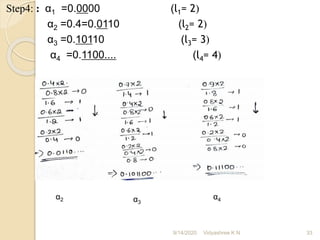
Step4: : α1 =0.0000 (l1= 2)
α2 =0.4=0.0110 (l2= 2)
α3 =0.10110 (l3= 3)
α4 =0.1100.... (l4= 4)
α2 α3
α4
9/14/2020 33
Vidyashree K N
Source
symbols
Pi αi αi in
binary
li Code
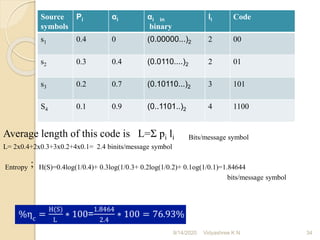
s1 0.4 0 (0.00000...)2 2 00
s2 0.3 0.4 (0.0110....)2 2 01
s3 0.2 0.7 (0.10110...)2 3 101
S4 0.1 0.9 (0..1101..)2 4 1100
Average length of this code is L=Σ pi li Bits/message symbol
L= 2x0.4+2x0.3+3x0.2+4x0.1= 2.4 binits/message symbol
Entropy ; H(S)=0.4log(1/0.4)+ 0.3log(1/0.3+ 0.2log(1/0.2)+ 0.1og(1/0.1)=1.84644
bits/message symbol
9/14/2020 34
Vidyashree K N
2]Construct Shannon’s binary code for the following message
symbols S={s1, s2, s3, s4 } with probobalities P=( 3/8,1/16, 3/16, ¼,
1/8). Obtain code efficiency and redundancy
step1; 3/8>1/4>3/16>1/8>1/16
Step2: : α1 =0
α2 = p1 =3/8=0.375
α3 = p2 + α2 = (1/4) +(3/8)=0.625
α4 = p3 +α3 =(3/16)+0.625=0.8125
α5 = p4 +α4 =(1/8)+0.8125=0.9375
Step3: The smallest integer value of li is found using 2li ≥ 1/ pi
for all i=1,2,...5
For i=1; 2l1 ≥ 1/(3/8)
2l1 ≥ 2.66 ; hence l1= 2
9/14/2020 35
Vidyashree K N
For i=2; 2l2 ≥ 1/(1/4)
2l1 ≥ 4 ; hence l1= 2
For i=3; 2 l3 ≥ 1/(3/16)
≥ 5.33 ; hence l3= 3
For i=4; 2 l4 ≥ 1/(1/8)
≥ 8 ; hence l4= 3
For i=5; 2 l5 ≥ 1/(1/16)
≥ 16 ; hence l4= 4
∴ li values are 2,2,3,3,4
9/14/2020 36
Vidyashree K N
Step4: : The decimal numbers αi are expanded in binary form upto li
places.
α1 =0.00
α2 =0.01
α3 =0.101
α4 =0.110
α5 =0.1111
9/14/2020 37
Vidyashree K N
9/14/2020 38
Vidyashree K N
9/14/2020 39
Vidyashree K N
 Redundancy? Example
 Entropy ? significance
9/14/2020 40
Vidyashree K N
3] O.4, 0.25, 0.15, 0.12, 0.08
Solution:
Step1; 0.4>0.25>0.15>0.12>0.08
Step2: α1 =0
α2 = p1 =0.4
α3 = p2 + α2 = 0.25+0.4=0.65
α4 = p3 +α3 = 0.15+0.65=0.8
α5 = p4 +α4 =0.8+0.12=0.92
α6 = p5 +α5 =0.08+0.92=1
Step3: The smallest integer value of li is found using 2li ≥ 1/ pi for all i=1,2,...5
For i=1; 2l1 ≥ 1/o.4
2l1 ≥ 2.5 ; hence l1= 2
For i=2; 2 l2 ≥ 1/o.25
≥ 4 ; hence l2= 2
9/14/2020 41
Vidyashree K N
For i=3; 2 l3 ≥ 1/o.15
≥ 6.67 ; hence l3= 3
For i=4; 2 l4 ≥ 1/0.12
≥ 8.33 ; hence l4= 4
For i=5; 2 l5 ≥ 1/0.08
≥ 12.5 ; hence l5= 4
Step4: The decimal numbers αi are expanded in binary
form upto li places.
9/14/2020 42
Vidyashree K N
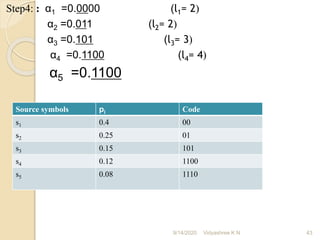
Step4: : α1 =0.0000 (l1= 2)
α2 =0.011 (l2= 2)
α3 =0.101 (l3= 3)
α4 =0.1100 (l4= 4)
α5 =0.1100
Source symbols pi Code
s1 0.4 00
s2 0.25 01
s3 0.15 101
s4 0.12 1100
s5 0.08 1110
9/14/2020 43
Vidyashree K N
4]A source emits an independent
sequence of symbols from an
alphabet consisting of five symbols
A, B,C,D and E with probobalities of
¼ , 1/8, 1/8, 3/16, and 5/16
respectively. Find the shanon code
for each symbol and efficiency of the
coding scheme.
9/14/2020 44
Vidyashree K N
4]Solution:
Step1; p1 p2 p3 p4 p5
5/16 ¼ 3/16 1/8 1/8
E A D B C
Step2: α1 =0
α2 = p1 =5/16=0.3125
α3 = p2 + α2 =0.5625
α4 = p3 +α3 = 0.75
α5 = p4 +α4 =0.875
α6 = p5 +α5 =1
Step3: The smallest integer value of li is found using 2li ≥ 1/ pi for all i=1,2,...6
For i=1; 2l1 ≥ 1/(5/16)
2l1 ≥ 3.2 ; hence l1= 2
For i=2; 2 l2 ≥ 1/(1/4)
≥ 4 ; hence l 29/14/2020 45
Vidyashree K N
For i=3; 2 l3 ≥ 1/(3/16)
≥ 5.33 ; hence l3= 3
For i=4; 2 l4 ≥ 1/(1/8)
≥ 8 ; hence l4= 3
For i=5; 2 l5 ≥ 1/(1/8)
≥ 8 ; hence l5= 3
Step4: The decimal numbers αi are expanded in binary
form upto li places.
9/14/2020 46
Vidyashree K N
Step4: : α1 =0.000 (l1= 2)
α2 =0.3125
0.3125 X 2= 0.625 with carry 0
0.625 x 2= 0.25 with carry 1
0.25x 2 = 0.5 with carry 0
=(0.010)2
α3 =0.100 (l3= 3)
α4 =0.11 (l4= 3)
α5 =0.111 (l5=3 )
Source symbols Code length
E 00 2
A 01 2
D 100 3
B 110 3
C 111 3
9/14/2020 47
Vidyashree K N
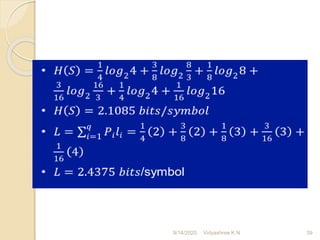
L=Σ pi li = (5/16) (2)+(1/4)(2)+ (3/16)(3)+
(1/8)3 +(1/8)3= 2.4375 binits/ message symbol
H(S)= Σ pi log (1/pi )
= 2.2272 bits/message symbol
nc = H(S)/L x 100%
91.37%
Rnc = 1- nc = 8.628
9/14/2020 48
Vidyashree K N
Homework problem
 5]The source emits the messages consisting of two
symbols each. These messages and their
probobalities are given in table. Design source
encoder using shanon encoding algorithm and also
find encoder efficiency.
Message M1 Probobality Pi
AA 9/32
AC 3/32
CC 1/16
CB 3/32
CA 3/32
BC 3/32
BB 9/32
9/14/2020 49
Vidyashree K N
Huffman coding
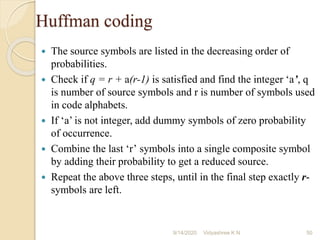
 The source symbols are listed in the decreasing order of
probabilities.
 Check if q = r + a(r-1) is satisfied and find the integer ‘a’, q
is number of source symbols and r is number of symbols used
in code alphabets.
 If ‘a’ is not integer, add dummy symbols of zero probability
of occurrence.
 Combine the last ‘r’ symbols into a single composite symbol
by adding their probability to get a reduced source.
 Repeat the above three steps, until in the final step exactly r-
symbols are left.
9/14/2020 50
Vidyashree K N
Cont...
 The last source with ‘r’ symbols are encoded with ‘r’
different codes 0,1,2,3,….r-1
 In binary coding the last source are encoded with 0 and
1
 As we pass from source to source working backward,
decomposition of one code word each time is done in
order to form 2 new code words.
 This procedure is repeated till we assign the code words
to all the source symbols of alphabet of source ‘s’
discarding the dummy symbols.
9/14/2020 51
Vidyashree K N
➢ q=r + α(r-1) ;
4=2+α(1) => α=2 € Z
1] Construct Huffman code for symbols having {1/2, 1/4 ,
1/8, 1/8 }.
CODE Source
symbols
Pi 1ST
reduction
2nd reduction
s1 0.5 0.5 0.5
s2 0.25 0.25 0.5
s3 0.125 0.25
s4 0.125
9/14/2020 52
Vidyashree K N
CODE Source
symbols
Pi 1ST reduction 2nd reduction
[0] s1 0.5 0.5 0.5
[10] s2 0.25 0.25 0.5
[110] s3 0.125 0.25
[111] s4 0.125
9/14/2020 53
Vidyashree K N
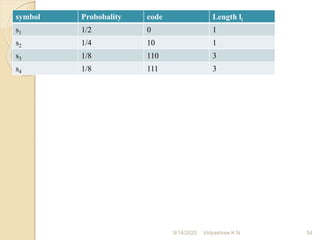
symbol Probobality code Length li
s1 1/2 0 1
s2 1/4 10 1
s3 1/8 110 3
s4 1/8 111 3
9/14/2020 54
Vidyashree K N
➢ q=r + α(r-1) ;
4=2+α(1) => α=2 € Z
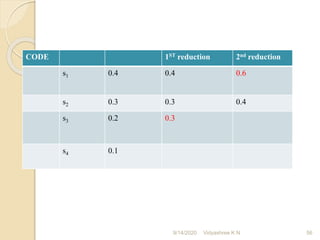
2]Construct Huffman code for symbols having {0.4, 0.3 ,
0.2, 0.1}. Find efficiency and redundancy
CODE Source
symbols
Pi 1ST
reduction
2nd reduction
0.4 0.4 0.6
S2 0.3 0.3 0.4
S3 0.2 0.3
S4 0.1
9/14/2020 55
Vidyashree K N
CODE 1ST reduction 2nd reduction
s1 0.4 0.4 0.6
s2 0.3 0.3 0.4
s3 0.2 0.3
s4 0.1
9/14/2020 56
Vidyashree K N
CODE 1ST reduction 2nd reduction
1 S1 0.4 0.4 0.6 [0]
00 S2 0.3 0.3 [00] 0.4 [1]
010 S3 0.2 [010] 0.3 [01]
011 S4 0.1 [011]
9/14/2020 57
Vidyashree K N
symbol Probobality code length
s1 0.4 1 1
s2 0.3 00 2
s3 0.2 010 3
s4 0.1 011 3
L=Σ pi li = (0.4) (1)+(0.3)(2)+ (0.2)(3)+ (0.1)3
= 1.9 binits/ message symbol
H(S)= Σ pi log (1/pi )
= 0.4 log(1/0.4)+0.3 log(1/0.3)+0.2 log(1/0.2)+0.1 log(1/0.1)
= 1.846 bits/message symbol
nc = (H(S) / L )
=97.15 %
Rnc = 1- nc = 2.85 %
9/14/2020 58
Vidyashree K N
 3] Given the messages x1 , x2 , x3 , x4 ,
x5, x6 with respective probobalities of
0.4,0.2, 0.1, 0.07 and 0.03, construct a
binary code by applying Huffman
encoding procedure. Determine the
efficiency and redundancy of the code so
formed.
9/14/2020 59
Vidyashree K N
code symbol Probobaliti
es
1st
reduction
2nd
reduction
3rd
reduction
4thre
ductio
n
1 x1 0.4 0.4 0.4 0.4 0.6
01 x2 0.2 0.2 0.2 0.4 0.4
000 x3 0.2 0.2 0.2 0.2
0010 x4 0.1 0.1 0.2
00110 x5 0.07 0.1
00111 x6 0.03
9/14/2020 60
Vidyashree K N
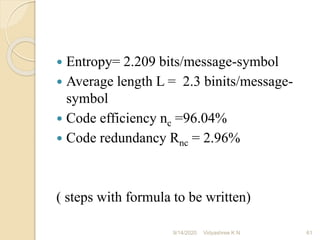
 Entropy= 2.209 bits/message-symbol
 Average length L = 2.3 binits/message-
symbol
 Code efficiency nc =96.04%
 Code redundancy Rnc = 2.96%
( steps with formula to be written)
9/14/2020 61
Vidyashree K N

Module 1 till huffman coding5c-converted.pdf

  • 1.
    9/14/2020 1 Vidyashree KN Module 1 By- Vidyashree K N Assistant Professor Department of ECE DSCE Class and Section : 5th C
  • 2.
    Purpose of communicationsystem  To transport an information-bearing signal from a source to a user destination via a communication channel.  Basically, a communication system is of an analog or digital type. 9/14/2020 2 Vidyashree K N
  • 3.
    Why growth ofdigital communications is large?? 9/14/2020 3 Vidyashree K N
  • 4.
    Sources and Signals A source of information generates a message ◦ Human voice, television picture, teletype data, atmospheric temperature, pressure etc.  The message signal can be of analog or digital.  Analog to digital conversion is peformed by combining three basic operations; ◦ Sampling ◦ Quantizing ◦ Encoding 9/14/2020 4 Vidyashree K N
  • 5.
    Digital communication system Fig1: Block diagram 9/14/2020 5 Vidyashree K N
  • 6.
     Information Source: ◦Can be classified into Analog information source and discrete information sources. ◦ Ex for analog: micophone actuated by speech., ◦ Ex for discrete: Teletype or numerical output of a computer consists of a sequence of discrete symbols or letters.  Source Encoder : ◦ Converting the output of whether analog or digital source into a sequence of binary digits.  Channel encoder: ◦ Introduce some redundancy in the binary information sequence. These extra bits do not convey any information but helps the receiver to detect and / or correct some of the errors in the information bearing bits. 9/14/2020 6 Vidyashree K N
  • 7.
     Channel: ◦ Providesthe electrical connection between the source and destination.Ex: Pair of wires, Coaxial cable, Optical fibre, Radio channel, Satellite channel or combination of any of these.  Modulator: ◦ It operates by keying shifts in the amplitude, frequency or phase of a sinusoidal carrier wave to the channel encoder output. ◦ The digital modulation techniques are referred to as amplitude- shift keying, frequency- shift keying or phase-shift keying respectively. ◦ Converts the input bit stream into an electrical waveform suitable for transmission over the communication channel.  Detector: ◦ The detector performs demodulation, thereby producing a signal the follows the time variations in the channel encoder output. 9/14/2020 7 Vidyashree K N
  • 8.
    Review of probobalitytheory  Deals with result of an experiment whose actual outcome is not known in advance.  Mathematical approach used for studying the outcomes of such experiments is called “ probabality theory”  Ex: In the example of tossing of a coin, it is impossible to predict the outcome of the experiment with certainity.  Hence ‘chance’ of getting an unexpected outcome may be defined as ‘Probabality’ 9/14/2020 8 Vidyashree K N
  • 9.
    Information source • Thediscrete information source consist of a discrete set of letters or symbol.  a message emitted by a source consist of sequence of symbols  Every message coming out of the source contains some information.  However the information contains by the message varies from one another. Some message convey more information than others.  In order to quantify the information contain in the message, it is necessary to define a measure of information. 9/14/2020 9 Vidyashree K N
  • 10.
    Discrete Information source ◦Discrete information source are characterized by i) Source alphabet Ex: a teletype having 26 letters of English alphabet plus several special characters such as full stop, comma etc, along with numericals. ii) Symbol rate ◦ Rate at which the teletype produces characters. Ex- if the teletype operates at the speed of 10 characters/sec, then symbol rate is said to be 10 symbols/sec. iii)Source alphabet probobalities; and iv) probobalistic dependence of symbols in a sequence ◦ Structural properties of symbol sequences can be characterized by probobality of occurance of individual symbols. 9/14/2020 10 Vidyashree K N
  • 11.
     In theblock diagram of information system,  Assume that discrete information source emitting discrete message symbols s1, s2, S3,..... Sq with probobalities p1, P2,...... Pq respectively.  Then P1+ P2+ P3 + ..... Pq =1 9/14/2020 11 Vidyashree K N
  • 12.
    Measure of information Let Sk be a symbol choosen for transmission at any instant of time with probobality equal to Pk .  Then amount of information of message is given by ◦ Ik = log (1/ Pk ) ◦ If base of logarithm is 2, units are Bits, ◦ If base of logarithm is 10, units are Hartleys or Decits ◦ If base of logarithm is e , units are NATS 9/14/2020 12 Vidyashree K N
  • 13.
    Concept of amountof information Example: To know weather at chennai( peak winter time) 1. Sun will rise in east on the day of trip. 2. It will be a very cold day. 3. There will be snowfall on that particular day in chennai. Conclusion: The message associated with an event least likely to occur contains more information. 9/14/2020 13 Vidyashree K N
  • 14.
    Discrete memoryless source A source in which symbols emitted during successive signalling intervals are statistically independent. 9/14/2020 14 Vidyashree K N
  • 15.
    Entropy  Average informationcontent per source symbol.  Consider source alphabet  With probobalities  Consider long independent sequence of length L symbols. This long sequence then contains p1L number of messages of type s1 p2L number of messages of type s2......................... pqL number of messages of type sq . } ... ,......... , , { 3 2 1 q s s s s S = } ... ,......... , , { 3 2 1 q p p p p P = 9/14/2020 15 Vidyashree K N
  • 16.
     We knowthat amount of information of s1=log (1/p1) bits ∴ p1L number of messages of type s1 contain p1L log (1/p1) bits of information. p2L number of messages of type s2 contain p2L log (1/p2) bits of information. pqL number of messages of type sq contain pqL log (1/pq) bits of information. ∴ Itotal = p1L log (1/p1)+ p2L log (1/p2)+......+ pqL log (1/pq) bits = L L I p p total i q i i 1 log 1  = 9/14/2020 16 Vidyashree K N
  • 17.
     Average self-informationH(S) = = bits/message symbol L I total p p i q i i 1 log 1  = 9/14/2020 17 Vidyashree K N
  • 18.
    Information Rate  Letus suppose that the symbols are emitted by the source at a fixed time rate “rs”symbols/sec  The average information rate Rs in bits/sec is defined as the product of the average information content per symbol( H(S)) and the message symbol rate rs ∴ Rs = rs H(S) bits/sec or BPS 9/14/2020 18 Vidyashree K N
  • 19.
    Numericals  1]Consider abinary source with source alphabet S= {s1, s2} with probobalities P={1/256, 255/256}.Find a)self- information of each message b)entropy. 9/14/2020 19 Vidyashree K N
  • 20.
    2]Consider a binarysource with source alphabet S1= {s3, s4} with probobalities Pl={7/16, 9/16}.Find a)self-information of each message b)Entropy 3]Consider a binary source with source alphabet S11= {s5, s6} with probobalities Pll={1/2, 1/2}.Find a)self-information of each message b)entropy 4]Consider a binary source with source alphabet S= {s1, s2, s3} with probobalities P={1/2, 1/4, 1/4}.Find a)self-information of each message b)entropy of source S 9/14/2020 20 Vidyashree K N
  • 21.
    5] The collectorvoltage of certain circuit is to lie between -5 and -12 volts. The voltage can take on only these values -5,-6,-7,-9,-11,-12 volts with respective probobalities 1/6, 1/3,1/12,1/12,1/6,1/6. This voltage is recorded with a pen recorder. Determine the average self-information associated with the record in terms of bits/level. 6] A discrete source emits one of six symbols once every m-sec. The symbol probobalities are 1/2, ¼, 1/8, 1/16, 1/32 and 1/32 respectively. Find the source entropy and information rate. 7]Find relationship between Hartleys, Nats, and bits. 8] The output of an information source consists of 150 symbols, 32 of which occur with a probobality of 1/64 and the remaining 118 occur with a probobality of 1/236. The source emits 2000 symbols/sec. Assuming that the symbols are choosen independently , find the average information rate of this source. [ note: The solution pdf is attached in google classroom, and also solved during online classes] 9/14/2020 21 Vidyashree K N
  • 22.
    9] A codeis composed of dots and dashes. Assuming that a dash is 3 times as long as a dot and has one-third the probobality of occurence. Calculate (i) The information in a dot and dash (ii) The entroy of dot-dash code (iii) The average rate of information if a dot lasts for 10 m- sc and this time is allowed between symbols. 9/14/2020 22 Vidyashree K N
  • 23.
  • 24.
  • 25.
  • 26.
    Source Encoding  Sourcecoding converts each symbols into codewords.  Is the process by which the output of an information source is converted into a r-ray sequence.  ‘r’ is the number of different symbols used in this transformation process.  If r=2, then the output is a binary sequence,  r=3, then the output is a ternary sequence,  r=4, then the output is quaternary sequence 9/14/2020 26 Vidyashree K N
  • 27.
    Fixed length code Consider size of source alphabet is 4; S={s1, s2, s3, s4 } Source symbols Code s1 11 s2 10 s3 01 s4 00 Its fixed length code. Hence its uniquely decodable. If we have 100100.... 10- s1 01- s2, 00- s3 s1s2,s3 9/14/2020 27 Vidyashree K N
  • 28.
    Variable length code(VLCcode) Source symbols Code No. of bits used s0 0 1-bit s1 1 1-bit s2 00 2-bit s3 11 2-bit If we have 000.... May be correspond to 0 followed by 00 or 00 followed by 0. Hence can be decoded as S0s2 or s2,s0 Here, code is not uniquely decodable. 9/14/2020 28 Vidyashree K N
  • 29.
    Variable length code(VLCcode) Source symbols Code No. of bits used s0 1 1-bit s1 01 2-bit s2 001 3-bit s3 000 3-bit If we have 1001.... Can be decoded as S0s2 Here, code is uniquely decodable . VLC code is prefix-free code Also known as instantaneous code 9/14/2020 29 Vidyashree K N
  • 30.
    Shannon’s Encoding algorithm Step1:List the source symbols in the order of non-increasing probobalities Step2: Compute the sequences α1 =0 α2 = p1 = p1+ α1 α3 = p2 + p1 = p2 + α12 .... αq+1 = pq+ pq-1 +.....+ p2 + p1 = pq+ α1 Step3: Determine smallest integer value of li using the inequality 2 li ≥ for all i=1,2,......q Step4: Expand the decimal number αi in binary from upto li places neglecting expansion beyond li places Step5: Remove the binary point to get the desired code. pi 1 pi 1 9/14/2020 30 Vidyashree K N
  • 31.
    1]Construct Shannon’s binarycode for the following message symbols S={s1, s2, s3, s4 } with probobalities P=( 0.4,0.3,0.2,0.1) Solution: Step1; 0.4>0.3>0.2>0.1 Step2: α1 =0 α2 = p1 =0.4 α3 = p2 + α2 = 0.3+0.4=0.7 α4 = p3 +α3 = 0.2+0.7=0.9 α5 = p4 +α4 =0.1+0.9=1 Step3: The smallest integer value of li is found using 2li ≥ 1/ pi for all i=1,2,...5 For i=1; 2l1 ≥ 1/o.4 2l1 ≥ 2.5 ; hence l1= 2 For i=2; 2 l2 ≥ 1/o.3 ≥ 3.333 ; hence l2= 2 9/14/2020 31 Vidyashree K N
  • 32.
    For i=3; 2l3 ≥ 1/o.2 ≥ 5 ; hence l3= 3 For i=4; 2 l4 ≥ 1/o.1 ≥ 10 ; hence l4= 4 Step4: The decimal numbers αi are expanded in binary form upto li places. 9/14/2020 32 Vidyashree K N
  • 33.
    Step4: : α1=0.0000 (l1= 2) α2 =0.4=0.0110 (l2= 2) α3 =0.10110 (l3= 3) α4 =0.1100.... (l4= 4) α2 α3 α4 9/14/2020 33 Vidyashree K N
  • 34.
    Source symbols Pi αi αiin binary li Code s1 0.4 0 (0.00000...)2 2 00 s2 0.3 0.4 (0.0110....)2 2 01 s3 0.2 0.7 (0.10110...)2 3 101 S4 0.1 0.9 (0..1101..)2 4 1100 Average length of this code is L=Σ pi li Bits/message symbol L= 2x0.4+2x0.3+3x0.2+4x0.1= 2.4 binits/message symbol Entropy ; H(S)=0.4log(1/0.4)+ 0.3log(1/0.3+ 0.2log(1/0.2)+ 0.1og(1/0.1)=1.84644 bits/message symbol 9/14/2020 34 Vidyashree K N
  • 35.
    2]Construct Shannon’s binarycode for the following message symbols S={s1, s2, s3, s4 } with probobalities P=( 3/8,1/16, 3/16, ¼, 1/8). Obtain code efficiency and redundancy step1; 3/8>1/4>3/16>1/8>1/16 Step2: : α1 =0 α2 = p1 =3/8=0.375 α3 = p2 + α2 = (1/4) +(3/8)=0.625 α4 = p3 +α3 =(3/16)+0.625=0.8125 α5 = p4 +α4 =(1/8)+0.8125=0.9375 Step3: The smallest integer value of li is found using 2li ≥ 1/ pi for all i=1,2,...5 For i=1; 2l1 ≥ 1/(3/8) 2l1 ≥ 2.66 ; hence l1= 2 9/14/2020 35 Vidyashree K N
  • 36.
    For i=2; 2l2≥ 1/(1/4) 2l1 ≥ 4 ; hence l1= 2 For i=3; 2 l3 ≥ 1/(3/16) ≥ 5.33 ; hence l3= 3 For i=4; 2 l4 ≥ 1/(1/8) ≥ 8 ; hence l4= 3 For i=5; 2 l5 ≥ 1/(1/16) ≥ 16 ; hence l4= 4 ∴ li values are 2,2,3,3,4 9/14/2020 36 Vidyashree K N
  • 37.
    Step4: : Thedecimal numbers αi are expanded in binary form upto li places. α1 =0.00 α2 =0.01 α3 =0.101 α4 =0.110 α5 =0.1111 9/14/2020 37 Vidyashree K N
  • 38.
  • 39.
  • 40.
     Redundancy? Example Entropy ? significance 9/14/2020 40 Vidyashree K N
  • 41.
    3] O.4, 0.25,0.15, 0.12, 0.08 Solution: Step1; 0.4>0.25>0.15>0.12>0.08 Step2: α1 =0 α2 = p1 =0.4 α3 = p2 + α2 = 0.25+0.4=0.65 α4 = p3 +α3 = 0.15+0.65=0.8 α5 = p4 +α4 =0.8+0.12=0.92 α6 = p5 +α5 =0.08+0.92=1 Step3: The smallest integer value of li is found using 2li ≥ 1/ pi for all i=1,2,...5 For i=1; 2l1 ≥ 1/o.4 2l1 ≥ 2.5 ; hence l1= 2 For i=2; 2 l2 ≥ 1/o.25 ≥ 4 ; hence l2= 2 9/14/2020 41 Vidyashree K N
  • 42.
    For i=3; 2l3 ≥ 1/o.15 ≥ 6.67 ; hence l3= 3 For i=4; 2 l4 ≥ 1/0.12 ≥ 8.33 ; hence l4= 4 For i=5; 2 l5 ≥ 1/0.08 ≥ 12.5 ; hence l5= 4 Step4: The decimal numbers αi are expanded in binary form upto li places. 9/14/2020 42 Vidyashree K N
  • 43.
    Step4: : α1=0.0000 (l1= 2) α2 =0.011 (l2= 2) α3 =0.101 (l3= 3) α4 =0.1100 (l4= 4) α5 =0.1100 Source symbols pi Code s1 0.4 00 s2 0.25 01 s3 0.15 101 s4 0.12 1100 s5 0.08 1110 9/14/2020 43 Vidyashree K N
  • 44.
    4]A source emitsan independent sequence of symbols from an alphabet consisting of five symbols A, B,C,D and E with probobalities of ¼ , 1/8, 1/8, 3/16, and 5/16 respectively. Find the shanon code for each symbol and efficiency of the coding scheme. 9/14/2020 44 Vidyashree K N
  • 45.
    4]Solution: Step1; p1 p2p3 p4 p5 5/16 ¼ 3/16 1/8 1/8 E A D B C Step2: α1 =0 α2 = p1 =5/16=0.3125 α3 = p2 + α2 =0.5625 α4 = p3 +α3 = 0.75 α5 = p4 +α4 =0.875 α6 = p5 +α5 =1 Step3: The smallest integer value of li is found using 2li ≥ 1/ pi for all i=1,2,...6 For i=1; 2l1 ≥ 1/(5/16) 2l1 ≥ 3.2 ; hence l1= 2 For i=2; 2 l2 ≥ 1/(1/4) ≥ 4 ; hence l 29/14/2020 45 Vidyashree K N
  • 46.
    For i=3; 2l3 ≥ 1/(3/16) ≥ 5.33 ; hence l3= 3 For i=4; 2 l4 ≥ 1/(1/8) ≥ 8 ; hence l4= 3 For i=5; 2 l5 ≥ 1/(1/8) ≥ 8 ; hence l5= 3 Step4: The decimal numbers αi are expanded in binary form upto li places. 9/14/2020 46 Vidyashree K N
  • 47.
    Step4: : α1=0.000 (l1= 2) α2 =0.3125 0.3125 X 2= 0.625 with carry 0 0.625 x 2= 0.25 with carry 1 0.25x 2 = 0.5 with carry 0 =(0.010)2 α3 =0.100 (l3= 3) α4 =0.11 (l4= 3) α5 =0.111 (l5=3 ) Source symbols Code length E 00 2 A 01 2 D 100 3 B 110 3 C 111 3 9/14/2020 47 Vidyashree K N
  • 48.
    L=Σ pi li= (5/16) (2)+(1/4)(2)+ (3/16)(3)+ (1/8)3 +(1/8)3= 2.4375 binits/ message symbol H(S)= Σ pi log (1/pi ) = 2.2272 bits/message symbol nc = H(S)/L x 100% 91.37% Rnc = 1- nc = 8.628 9/14/2020 48 Vidyashree K N
  • 49.
    Homework problem  5]Thesource emits the messages consisting of two symbols each. These messages and their probobalities are given in table. Design source encoder using shanon encoding algorithm and also find encoder efficiency. Message M1 Probobality Pi AA 9/32 AC 3/32 CC 1/16 CB 3/32 CA 3/32 BC 3/32 BB 9/32 9/14/2020 49 Vidyashree K N
  • 50.
    Huffman coding  Thesource symbols are listed in the decreasing order of probabilities.  Check if q = r + a(r-1) is satisfied and find the integer ‘a’, q is number of source symbols and r is number of symbols used in code alphabets.  If ‘a’ is not integer, add dummy symbols of zero probability of occurrence.  Combine the last ‘r’ symbols into a single composite symbol by adding their probability to get a reduced source.  Repeat the above three steps, until in the final step exactly r- symbols are left. 9/14/2020 50 Vidyashree K N
  • 51.
    Cont...  The lastsource with ‘r’ symbols are encoded with ‘r’ different codes 0,1,2,3,….r-1  In binary coding the last source are encoded with 0 and 1  As we pass from source to source working backward, decomposition of one code word each time is done in order to form 2 new code words.  This procedure is repeated till we assign the code words to all the source symbols of alphabet of source ‘s’ discarding the dummy symbols. 9/14/2020 51 Vidyashree K N
  • 52.
    ➢ q=r +α(r-1) ; 4=2+α(1) => α=2 € Z 1] Construct Huffman code for symbols having {1/2, 1/4 , 1/8, 1/8 }. CODE Source symbols Pi 1ST reduction 2nd reduction s1 0.5 0.5 0.5 s2 0.25 0.25 0.5 s3 0.125 0.25 s4 0.125 9/14/2020 52 Vidyashree K N
  • 53.
    CODE Source symbols Pi 1STreduction 2nd reduction [0] s1 0.5 0.5 0.5 [10] s2 0.25 0.25 0.5 [110] s3 0.125 0.25 [111] s4 0.125 9/14/2020 53 Vidyashree K N
  • 54.
    symbol Probobality codeLength li s1 1/2 0 1 s2 1/4 10 1 s3 1/8 110 3 s4 1/8 111 3 9/14/2020 54 Vidyashree K N
  • 55.
    ➢ q=r +α(r-1) ; 4=2+α(1) => α=2 € Z 2]Construct Huffman code for symbols having {0.4, 0.3 , 0.2, 0.1}. Find efficiency and redundancy CODE Source symbols Pi 1ST reduction 2nd reduction 0.4 0.4 0.6 S2 0.3 0.3 0.4 S3 0.2 0.3 S4 0.1 9/14/2020 55 Vidyashree K N
  • 56.
    CODE 1ST reduction2nd reduction s1 0.4 0.4 0.6 s2 0.3 0.3 0.4 s3 0.2 0.3 s4 0.1 9/14/2020 56 Vidyashree K N
  • 57.
    CODE 1ST reduction2nd reduction 1 S1 0.4 0.4 0.6 [0] 00 S2 0.3 0.3 [00] 0.4 [1] 010 S3 0.2 [010] 0.3 [01] 011 S4 0.1 [011] 9/14/2020 57 Vidyashree K N
  • 58.
    symbol Probobality codelength s1 0.4 1 1 s2 0.3 00 2 s3 0.2 010 3 s4 0.1 011 3 L=Σ pi li = (0.4) (1)+(0.3)(2)+ (0.2)(3)+ (0.1)3 = 1.9 binits/ message symbol H(S)= Σ pi log (1/pi ) = 0.4 log(1/0.4)+0.3 log(1/0.3)+0.2 log(1/0.2)+0.1 log(1/0.1) = 1.846 bits/message symbol nc = (H(S) / L ) =97.15 % Rnc = 1- nc = 2.85 % 9/14/2020 58 Vidyashree K N
  • 59.
     3] Giventhe messages x1 , x2 , x3 , x4 , x5, x6 with respective probobalities of 0.4,0.2, 0.1, 0.07 and 0.03, construct a binary code by applying Huffman encoding procedure. Determine the efficiency and redundancy of the code so formed. 9/14/2020 59 Vidyashree K N
  • 60.
    code symbol Probobaliti es 1st reduction 2nd reduction 3rd reduction 4thre ductio n 1x1 0.4 0.4 0.4 0.4 0.6 01 x2 0.2 0.2 0.2 0.4 0.4 000 x3 0.2 0.2 0.2 0.2 0010 x4 0.1 0.1 0.2 00110 x5 0.07 0.1 00111 x6 0.03 9/14/2020 60 Vidyashree K N
  • 61.
     Entropy= 2.209bits/message-symbol  Average length L = 2.3 binits/message- symbol  Code efficiency nc =96.04%  Code redundancy Rnc = 2.96% ( steps with formula to be written) 9/14/2020 61 Vidyashree K N