REED SOLOMON CODE
AND CONVOLUTION
CODE
REED SOLOMON
CODE
CONTENTS
 Introduction
 Properties of RS code
 RS Encoder
 RS Decoder
 Software Implementation
 Advantages
 Disadvantages
 Applications
INTRODUCTION
 Reed–Solomon codes are an important group of error-correcting codes introduced
by Irving S. Reed and Gustave Solomon in 1960.
 RS codes operate on the information by dividing the message stream into blocks of
data, adding redundancy per block depending only on the current inputs.
 It is capable to correct both burst errors (where a series of bits in the codeword are
received in error) and erasures.
PROPERTIES OF RS CODE
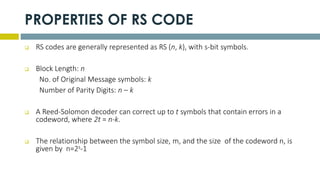
 RS codes are generally represented as RS (n, k), with s-bit symbols.
 Block Length: n
No. of Original Message symbols: k
Number of Parity Digits: n – k
 A Reed-Solomon decoder can correct up to t symbols that contain errors in a
codeword, where 2t = n-k.
 The relationship between the symbol size, m, and the size of the codeword n, is
given by n=2s-1
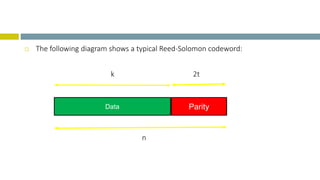
 The following diagram shows a typical Reed-Solomon codeword:
k 2t
n
Data Parity
Example:-
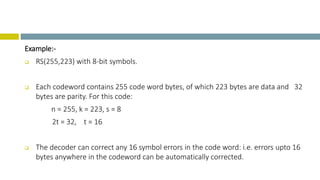
 RS(255,223) with 8-bit symbols.
 Each codeword contains 255 code word bytes, of which 223 bytes are data and 32
bytes are parity. For this code:
n = 255, k = 223, s = 8
2t = 32, t = 16
 The decoder can correct any 16 symbol errors in the code word: i.e. errors upto 16
bytes anywhere in the codeword can be automatically corrected.
 Given a symbol size s, the maximum codeword length (n) for a Reed-Solomon code
is n = 2s – 1
 For example, the maximum length of a code with 8-bit symbols (s=8) is 255 bytes.
 Reed-Solomon codes may be shortened by (conceptually) making a number of data
symbols zero at the encoder, not transmitting them, and then re-inserting them at
the decoder.
 Example: The (255,223) code described above can be shortened to (200,168). The
encoder takes a block of 168 data bytes, (conceptually) adds 55 zero bytes, creates
a (255,223) codeword and transmits only the 168 data bytes and 32 parity bytes.
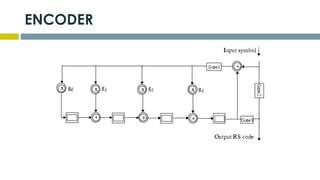
ENCODER
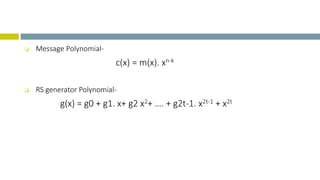
 Message Polynomial-
c(x) = m(x). xn-k
 RS generator Polynomial-
g(x) = g0 + g1. x+ g2 x2+ …. + g2t-1. x2t-1 + x2t
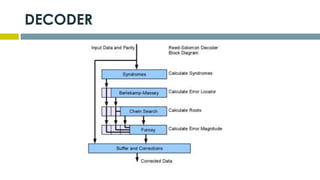
DECODER
SOFTWARE IMPLEMENTATION
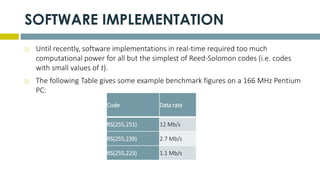
 Until recently, software implementations in real-time required too much
computational power for all but the simplest of Reed-Solomon codes (i.e. codes
with small values of t).
 The following Table gives some example benchmark figures on a 166 MHz Pentium
PC:
Code Data rate
RS(255,251) 12 Mb/s
RS(255,239) 2.7 Mb/s
RS(255,223) 1.1 Mb/s
ADVANTAGES
 Reed-Solomon codes are most widely used to correcting burst errors.
 Coding gain is very high.
 The Coding rate is very high for Reed Solomon code so it is suitable for many
applications including storage and transmission.
DISADVANTAGES
 Unlike BCH codes , RS Codes does not perform considerably well in BPSK
modulation schemes.
 Bit Error Ratio(BER) for Reed-Solomon Codes is not as good as BCH codes.
APPLICATIONS
 Data Storage
 Bar Code
 Satellite Broadcasting
 Spread-Spectrum System
 Ultra Wideband(UWB)
CONVOLUTION CODE
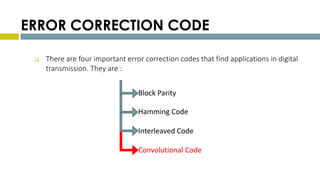
ERROR CORRECTION CODE
 There are four important error correction codes that find applications in digital
transmission. They are :
18
Block Parity
Hamming Code
Interleaved Code
Convolutional Code
INTRODUCTION
 Convolutional codes are introduced in 1955 by Elias.
 Convolution coding is a popular error-correcting coding method used in
digital communications. A message is convoluted, and then transmitted
into a noisy channel.
 This convolution operation encodes some redundant information into
the transmitted signal.
19
CONVOLUTIONAL ENCODER
 Convolutional encoding of data is accomplished using a shift register
and associated combinatorial logic that performs modulo-two addition.
 A shift register is merely a chain of flip-flops.
PARAMETERS OF CONVOLUTION ENCODER
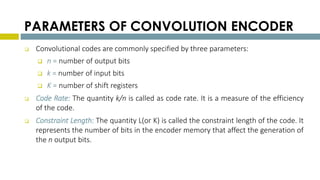
 Convolutional codes are commonly specified by three parameters:
 n = number of output bits
 k = number of input bits
 K = number of shift registers
 Code Rate: The quantity k/n is called as code rate. It is a measure of the efficiency
of the code.
 Constraint Length: The quantity L(or K) is called the constraint length of the code. It
represents the number of bits in the encoder memory that affect the generation of
the n output bits.
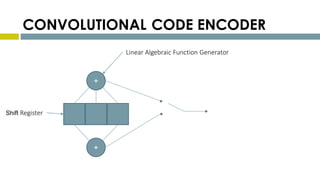
CONVOLUTIONAL CODE ENCODER
+
+
Shift Register
Linear Algebraic Function Generator
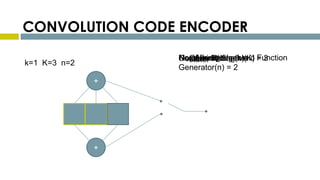
CONVOLUTION CODE ENCODER
+
+
Constraint Length (K) = 3Code Rate = k/nNo of input bits (k)= 1state = K-1state = 2k=1 K=3 n=2
No of linear Algebraic Function
Generator(n) = 2
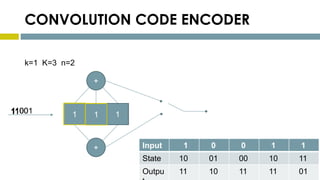
CONVOLUTION CODE ENCODER
+
0 0 0
+
11001
k=1 K=3 n=2
Input 1 0 0 1 1
State 10 01 00 10 11
Outpu 11 10 11 11 01
1 1 111100110111 1
REPRESENTATION OF CONVOLUTION CODES
 State Diagram
 Tree Diagram
 Trellis Diagram
STATE DIAGRAM
 Contents of shift registers make up "state" of code:
 Most recent input is most significant bit of state.
 Oldest input is least significant bit of state.
 (this convention is sometimes reverse)
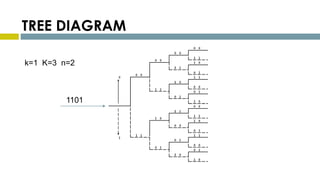
TREE DIAGRAM
1101
k=1 K=3 n=2
TRELLIS DIAGRAM REPRESENTATION
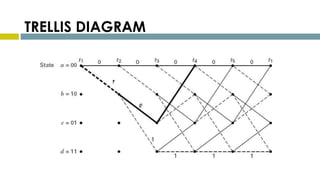
 The trellis diagram is basically a redrawing of the state diagram. It
shows all possible state transitions at each time step. Then we connect
each state to the next state.
 There are only two choices possible at each state. These are
determined by the arrival of either a 0 or a 1 bit.
 The arrows show the input bit.
 The arrows going upwards represent a 0 bit and going downwards
represent a 1 bit.
TRELLIS DIAGRAM
DIFFERENCE BETWEEN BLOCK CODE AND CONVOLUTION
CODE
 The difference between block codes and convolution codes is the encoding
principle.
 In the block codes, the information bits are followed by the parity bits while in
convolution codes the information bits are spread along the sequence.
 The block codes can be applied only for the block of data whereas convolution
coding can be applied to a continuous data stream as well as to blocks of data.
ADVANTAGES
 Convolution coding is a popular error-correcting coding method used in digital
communications.
 The convolution operation encodes some redundant information into the
transmitted signal.
 It is simple and has good performance with low implementation cost.
FACTORS AND PROPERTIES
 The performance of a convolutional code depends on the coding rate and the
constraint length.
 Longer constraint length K
More powerful code
More coding gain
 Smaller coding rate R=k/n
More powerful code due to extra redundancy
Less bandwidth efficiency
THANK YOU
E047 E048 E049 E050 E056 E058CREATED

Reed Soloman and convolution codes

  • 1.
    REED SOLOMON CODE ANDCONVOLUTION CODE
  • 2.
  • 3.
    CONTENTS  Introduction  Propertiesof RS code  RS Encoder  RS Decoder  Software Implementation  Advantages  Disadvantages  Applications
  • 4.
    INTRODUCTION  Reed–Solomon codesare an important group of error-correcting codes introduced by Irving S. Reed and Gustave Solomon in 1960.  RS codes operate on the information by dividing the message stream into blocks of data, adding redundancy per block depending only on the current inputs.  It is capable to correct both burst errors (where a series of bits in the codeword are received in error) and erasures.
  • 5.
    PROPERTIES OF RSCODE  RS codes are generally represented as RS (n, k), with s-bit symbols.  Block Length: n No. of Original Message symbols: k Number of Parity Digits: n – k  A Reed-Solomon decoder can correct up to t symbols that contain errors in a codeword, where 2t = n-k.  The relationship between the symbol size, m, and the size of the codeword n, is given by n=2s-1
  • 6.
     The followingdiagram shows a typical Reed-Solomon codeword: k 2t n Data Parity
  • 7.
    Example:-  RS(255,223) with8-bit symbols.  Each codeword contains 255 code word bytes, of which 223 bytes are data and 32 bytes are parity. For this code: n = 255, k = 223, s = 8 2t = 32, t = 16  The decoder can correct any 16 symbol errors in the code word: i.e. errors upto 16 bytes anywhere in the codeword can be automatically corrected.
  • 8.
     Given asymbol size s, the maximum codeword length (n) for a Reed-Solomon code is n = 2s – 1  For example, the maximum length of a code with 8-bit symbols (s=8) is 255 bytes.  Reed-Solomon codes may be shortened by (conceptually) making a number of data symbols zero at the encoder, not transmitting them, and then re-inserting them at the decoder.
  • 9.
     Example: The(255,223) code described above can be shortened to (200,168). The encoder takes a block of 168 data bytes, (conceptually) adds 55 zero bytes, creates a (255,223) codeword and transmits only the 168 data bytes and 32 parity bytes.
  • 10.
  • 11.
     Message Polynomial- c(x)= m(x). xn-k  RS generator Polynomial- g(x) = g0 + g1. x+ g2 x2+ …. + g2t-1. x2t-1 + x2t
  • 12.
  • 13.
    SOFTWARE IMPLEMENTATION  Untilrecently, software implementations in real-time required too much computational power for all but the simplest of Reed-Solomon codes (i.e. codes with small values of t).  The following Table gives some example benchmark figures on a 166 MHz Pentium PC: Code Data rate RS(255,251) 12 Mb/s RS(255,239) 2.7 Mb/s RS(255,223) 1.1 Mb/s
  • 14.
    ADVANTAGES  Reed-Solomon codesare most widely used to correcting burst errors.  Coding gain is very high.  The Coding rate is very high for Reed Solomon code so it is suitable for many applications including storage and transmission.
  • 15.
    DISADVANTAGES  Unlike BCHcodes , RS Codes does not perform considerably well in BPSK modulation schemes.  Bit Error Ratio(BER) for Reed-Solomon Codes is not as good as BCH codes.
  • 16.
    APPLICATIONS  Data Storage Bar Code  Satellite Broadcasting  Spread-Spectrum System  Ultra Wideband(UWB)
  • 17.
  • 18.
    ERROR CORRECTION CODE There are four important error correction codes that find applications in digital transmission. They are : 18 Block Parity Hamming Code Interleaved Code Convolutional Code
  • 19.
    INTRODUCTION  Convolutional codesare introduced in 1955 by Elias.  Convolution coding is a popular error-correcting coding method used in digital communications. A message is convoluted, and then transmitted into a noisy channel.  This convolution operation encodes some redundant information into the transmitted signal. 19
  • 20.
    CONVOLUTIONAL ENCODER  Convolutionalencoding of data is accomplished using a shift register and associated combinatorial logic that performs modulo-two addition.  A shift register is merely a chain of flip-flops.
  • 21.
    PARAMETERS OF CONVOLUTIONENCODER  Convolutional codes are commonly specified by three parameters:  n = number of output bits  k = number of input bits  K = number of shift registers  Code Rate: The quantity k/n is called as code rate. It is a measure of the efficiency of the code.  Constraint Length: The quantity L(or K) is called the constraint length of the code. It represents the number of bits in the encoder memory that affect the generation of the n output bits.
  • 22.
    CONVOLUTIONAL CODE ENCODER + + ShiftRegister Linear Algebraic Function Generator
  • 23.
    CONVOLUTION CODE ENCODER + + ConstraintLength (K) = 3Code Rate = k/nNo of input bits (k)= 1state = K-1state = 2k=1 K=3 n=2 No of linear Algebraic Function Generator(n) = 2
  • 24.
    CONVOLUTION CODE ENCODER + 00 0 + 11001 k=1 K=3 n=2 Input 1 0 0 1 1 State 10 01 00 10 11 Outpu 11 10 11 11 01 1 1 111100110111 1
  • 25.
    REPRESENTATION OF CONVOLUTIONCODES  State Diagram  Tree Diagram  Trellis Diagram
  • 26.
    STATE DIAGRAM  Contentsof shift registers make up "state" of code:  Most recent input is most significant bit of state.  Oldest input is least significant bit of state.  (this convention is sometimes reverse)
  • 27.
  • 28.
    TRELLIS DIAGRAM REPRESENTATION The trellis diagram is basically a redrawing of the state diagram. It shows all possible state transitions at each time step. Then we connect each state to the next state.  There are only two choices possible at each state. These are determined by the arrival of either a 0 or a 1 bit.  The arrows show the input bit.  The arrows going upwards represent a 0 bit and going downwards represent a 1 bit.
  • 29.
  • 30.
    DIFFERENCE BETWEEN BLOCKCODE AND CONVOLUTION CODE  The difference between block codes and convolution codes is the encoding principle.  In the block codes, the information bits are followed by the parity bits while in convolution codes the information bits are spread along the sequence.  The block codes can be applied only for the block of data whereas convolution coding can be applied to a continuous data stream as well as to blocks of data.
  • 31.
    ADVANTAGES  Convolution codingis a popular error-correcting coding method used in digital communications.  The convolution operation encodes some redundant information into the transmitted signal.  It is simple and has good performance with low implementation cost.
  • 32.
    FACTORS AND PROPERTIES The performance of a convolutional code depends on the coding rate and the constraint length.  Longer constraint length K More powerful code More coding gain  Smaller coding rate R=k/n More powerful code due to extra redundancy Less bandwidth efficiency
  • 33.
    THANK YOU E047 E048E049 E050 E056 E058CREATED

Editor's Notes

  • #28 The tree diagram representation shows all possible information and encoded sequences for the convolutional encoder. In the tree diagram, a solid line represents input information bit 0 and a dashed line represents input information bit 1. The corresponding output encoded bits are shown on the branches of the tree. An input information sequence defines a specific path through the tree diagram from left to right.
  • #34 Created by