






Wireless Network
(Cellular network
architecture and
HTTP.)
Hello!
I am Abdulla Al Moin
My Id: 192-15-2838
Section: PC-B
Dept. of Computer Science & Engineering
Daffodil International University
2
Submitted To,
Ms. Fatema Tuj Johora
Lecturer
Dept. of Computer Science Enginreeing
Under Course: CSE313 (Computer Networks)
Daffodil International University
3
Index
4
1. Introduction
2. Need of Wireless Network
3. How Wireless Networks Work
4. Type of Network
5. Comparison of Wired & Wireless
6. Cellular Network Architecture: An overview
7. Advantage
8. Disadvantage
9. Applications
10. Conclusions
1. Introduction
Let’s start with the first set of slides
What is a wireless network?
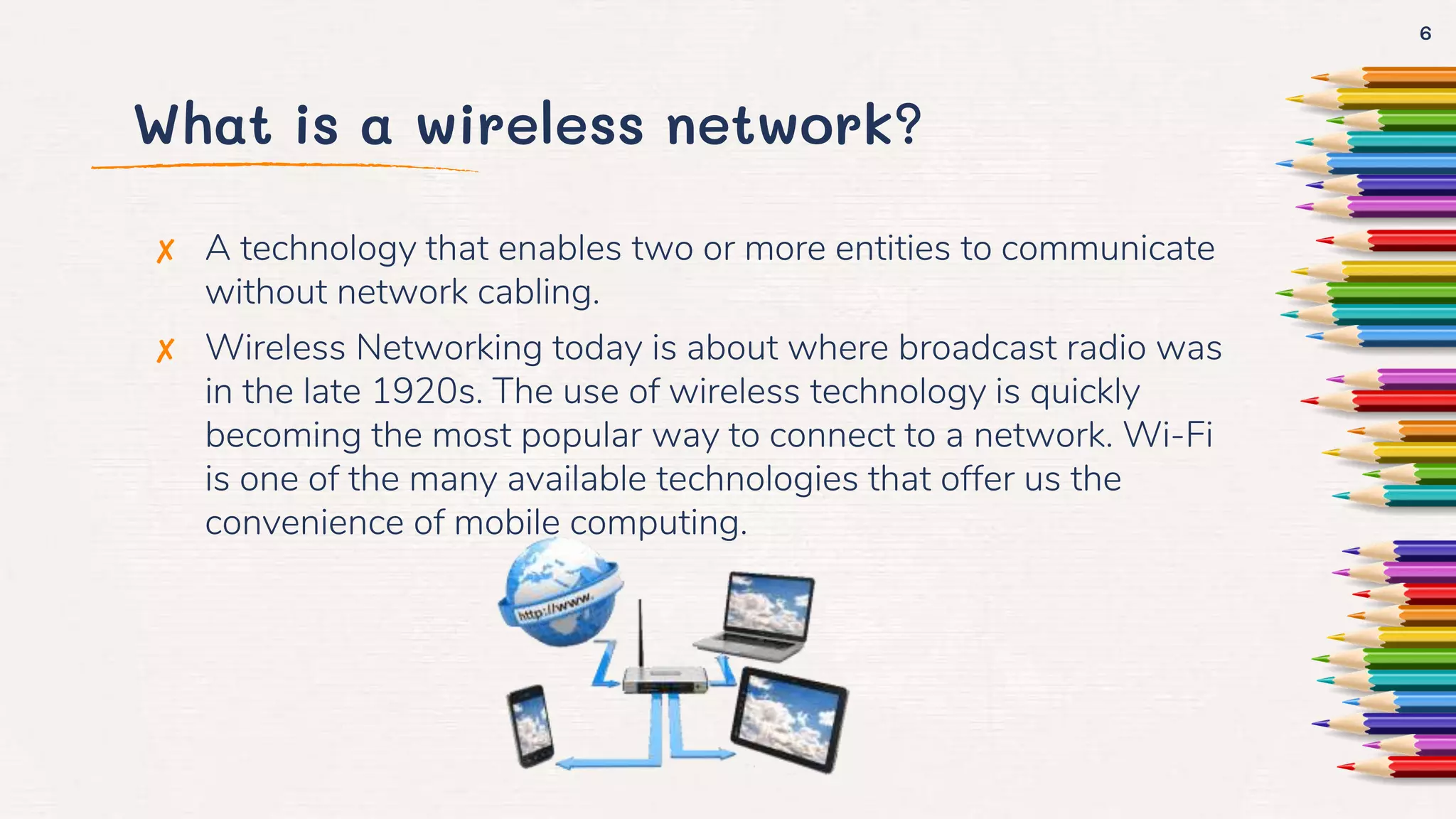
✘ A technology that enables two or more entities to communicate
without network cabling.
✘ Wireless Networking today is about where broadcast radio was
in the late 1920s. The use of wireless technology is quickly
becoming the most popular way to connect to a network. Wi-Fi
is one of the many available technologies that offer us the
convenience of mobile computing.
6
2. Needs of wireless
network
Needs of wireless network
✘ Mobile communication is needed.
✘ Communication must take place in a terrain that makes wired
communication difficult or impossible.
✘ A communication system must be deployed quickly.
✘ Communication facilities must be installed at low initial cost.
✘ The same information must be broadcast to many locations.
8
3. How Wireless
Networks Work
How Wireless Networks Work
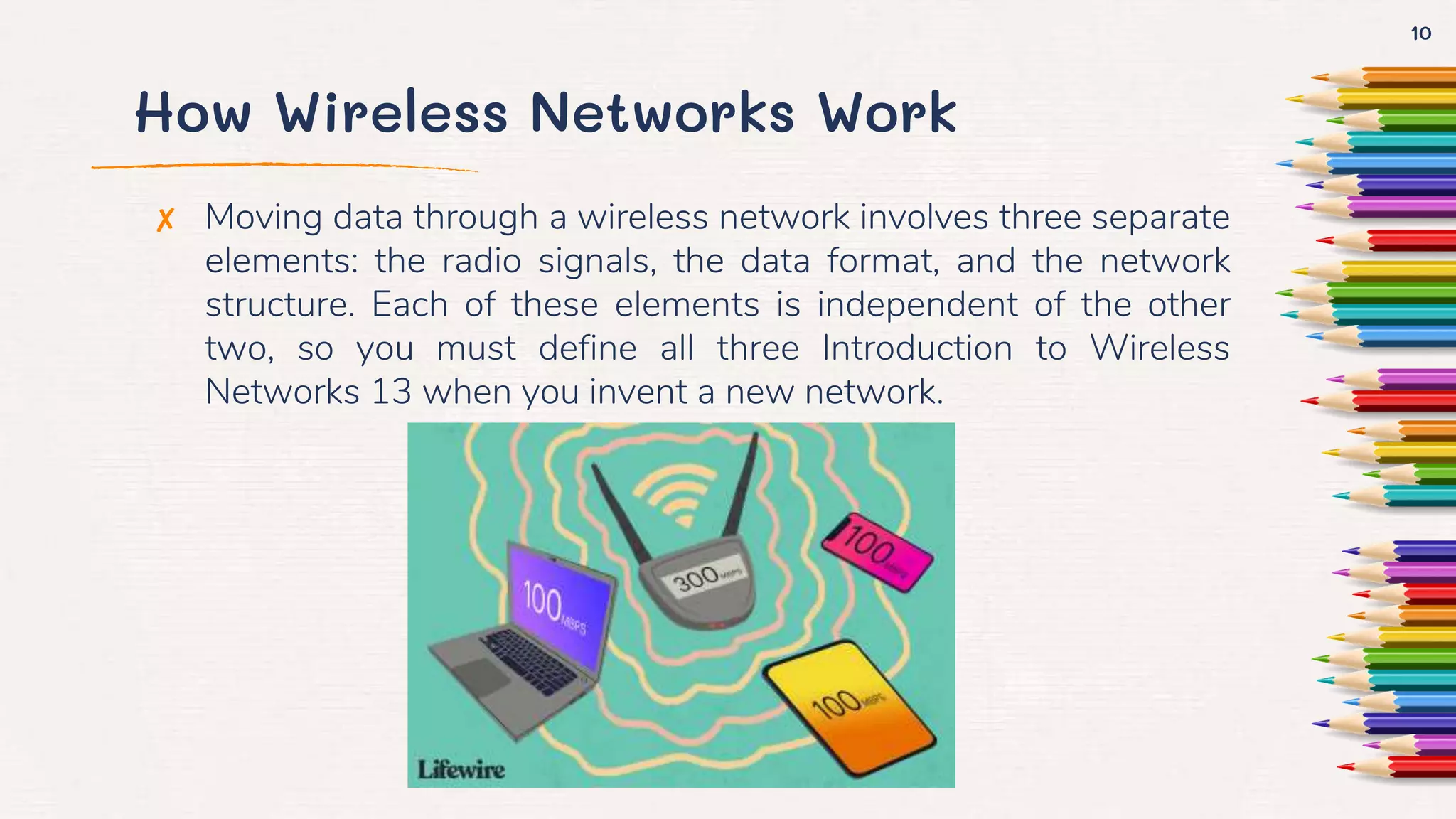
✘ Moving data through a wireless network involves three separate
elements: the radio signals, the data format, and the network
structure. Each of these elements is independent of the other
two, so you must define all three Introduction to Wireless
Networks 13 when you invent a new network.
10
How Wireless Networks Work
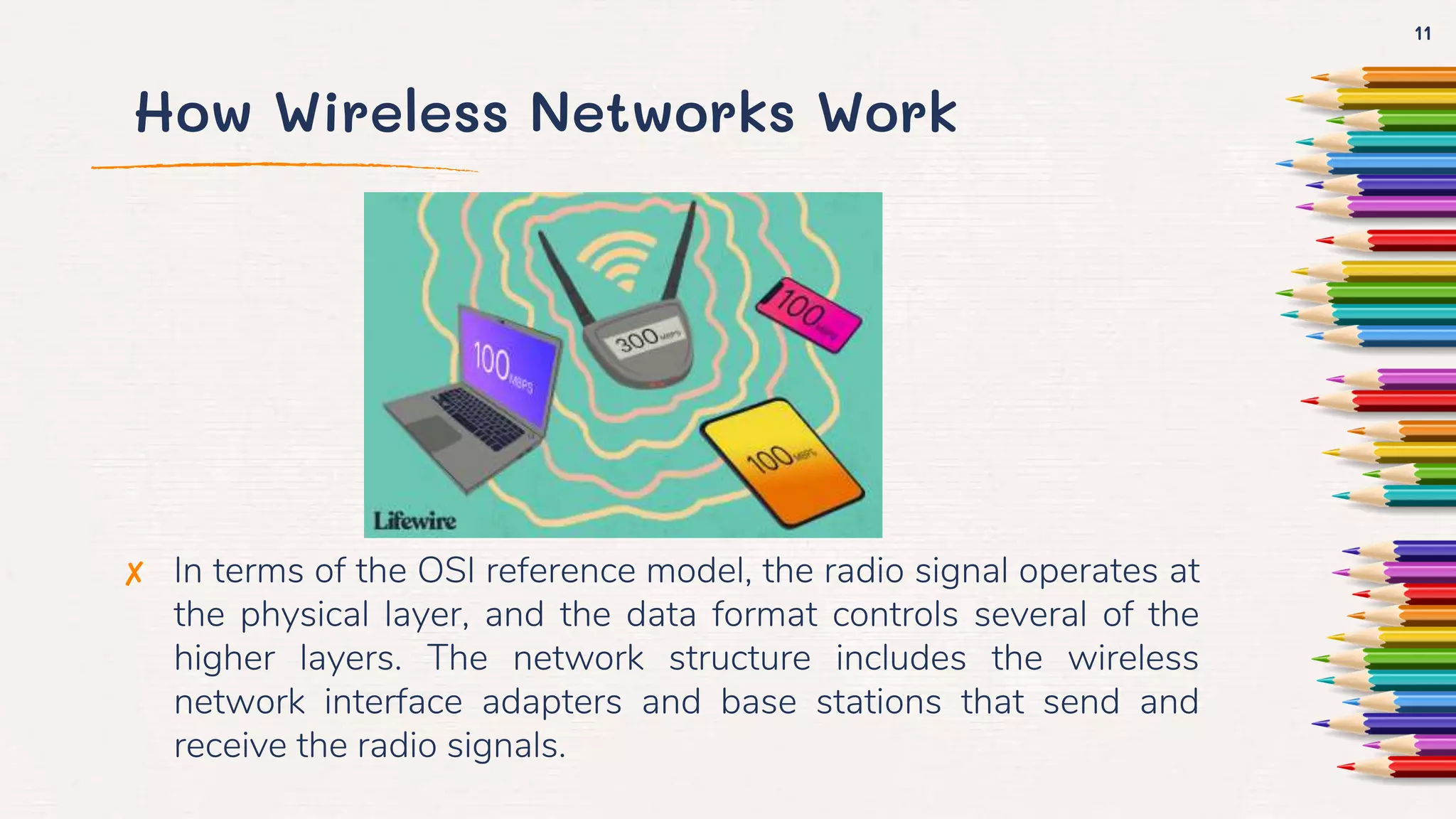
✘ In terms of the OSI reference model, the radio signal operates at
the physical layer, and the data format controls several of the
higher layers. The network structure includes the wireless
network interface adapters and base stations that send and
receive the radio signals.
11
4. Types of Wireless
Network
Types of Network
✘ WLANS: Wireless Local Area Networks WLANS allow users in
a local area, such as a university campus or library, to form a
network or gain access to the internet.
✘ WPANS: Wireless Personal Area Networks The two current
technologies for wireless personal area networks are Infra Red
(IR) and Bluetooth (IEEE 802.15). IR requires a direct line of site
and the range is less.
13
Types of Network
✘ WMANS: Wireless Metropolitan Area Networks This
technology allows the connection of multiple networks in a
metropolitan area such as different buildings in a city.
14
5. Comparison of Wired &
Wireless Network
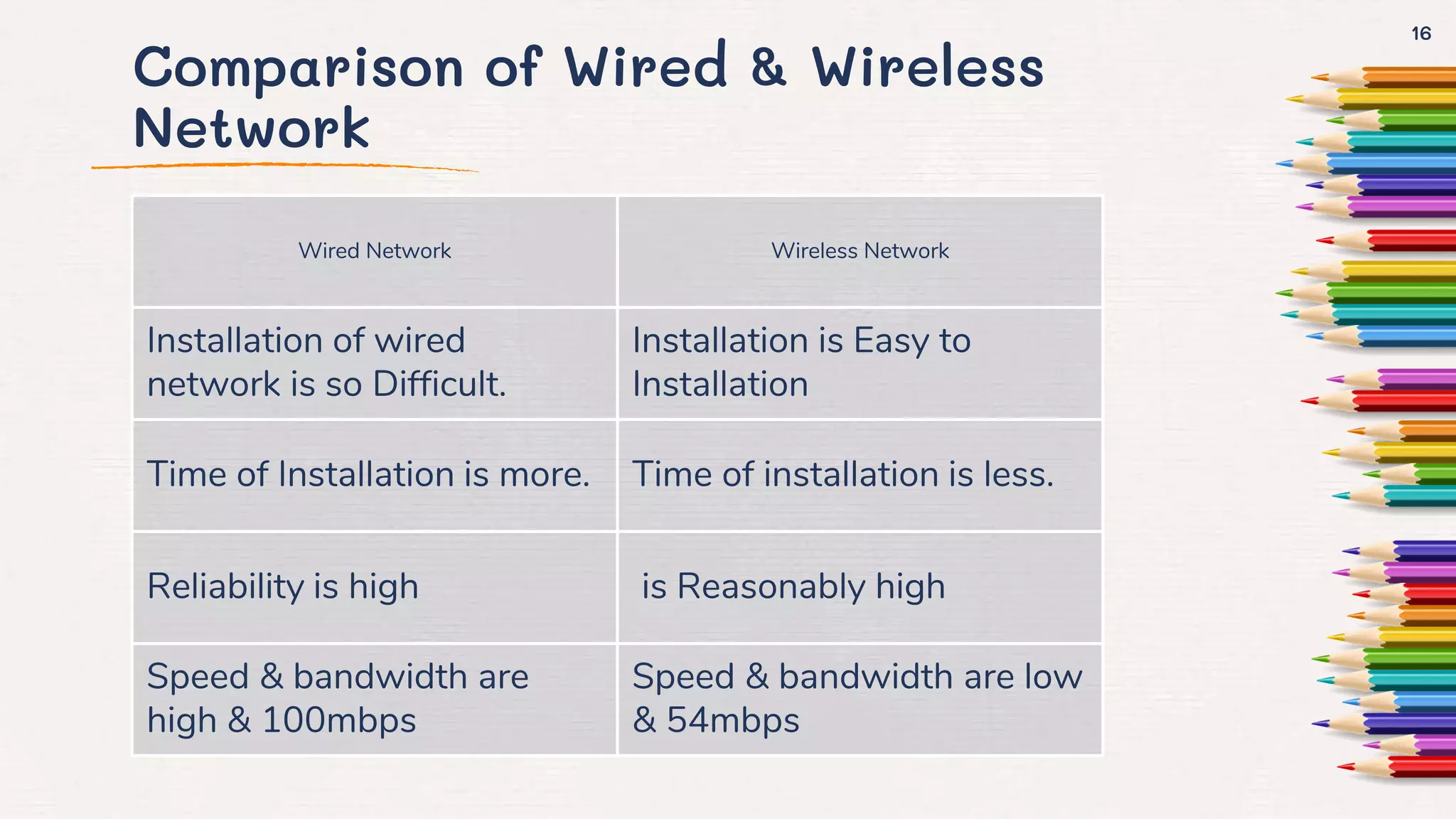
Comparison of Wired & Wireless
Network
16
Wired Network Wireless Network
Installation of wired
network is so Difficult.
Installation is Easy to
Installation
Time of Installation is more. Time of installation is less.
Reliability is high is Reasonably high
Speed & bandwidth are
high & 100mbps
Speed & bandwidth are low
& 54mbps
6. Cellular Network
Architecture: An overview
17
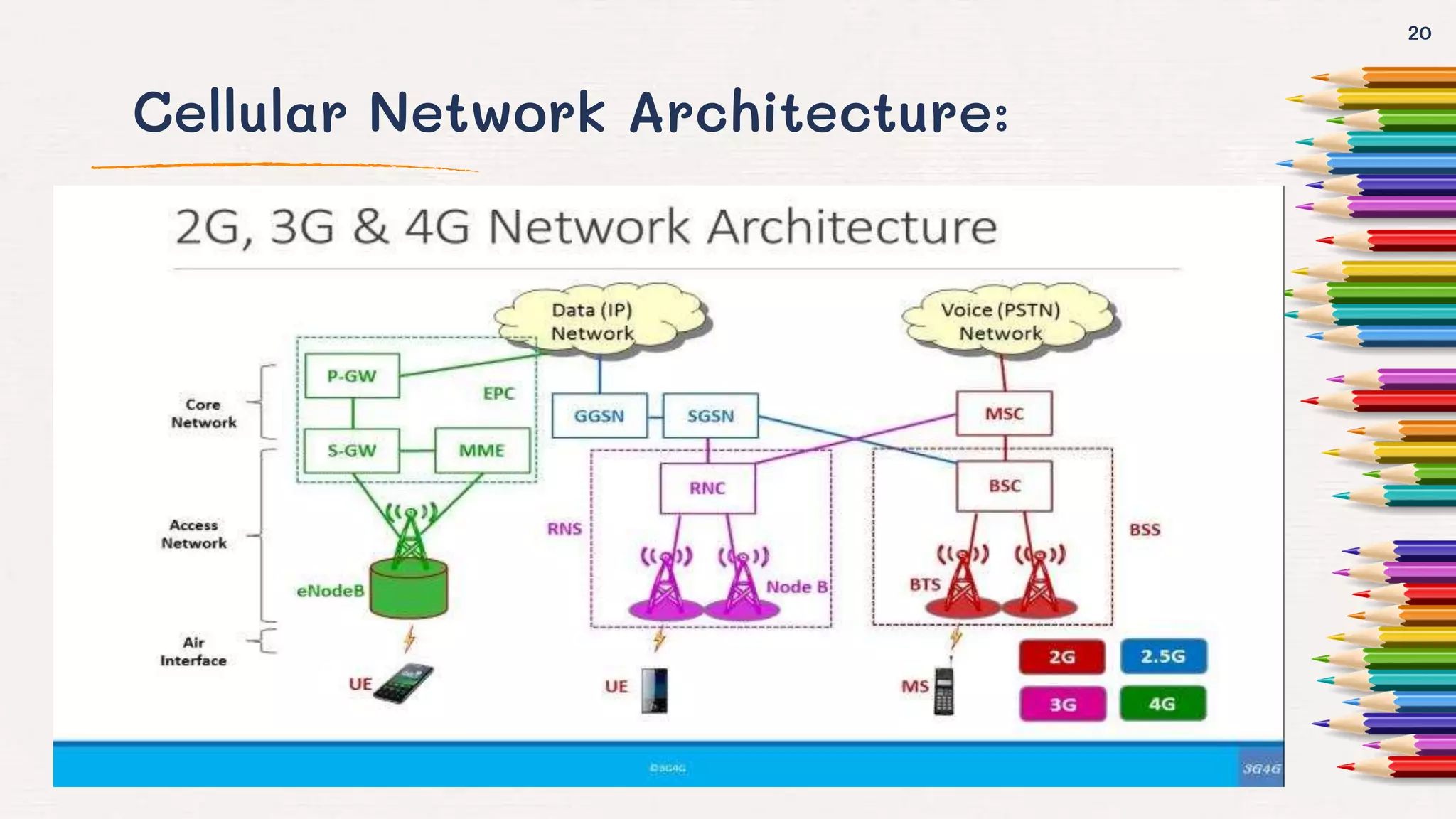
Cellular Network Architecture:
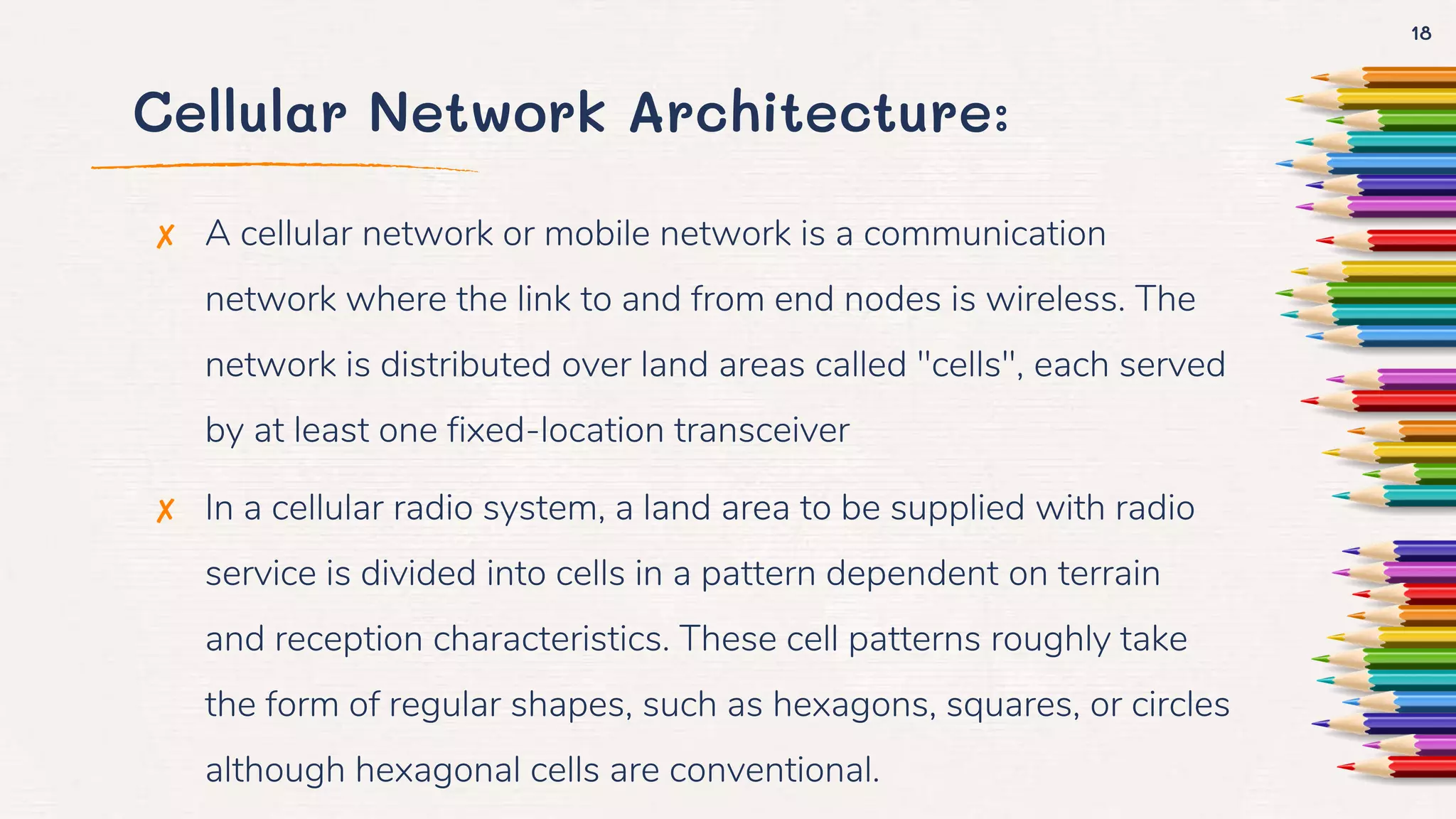
✘ A cellular network or mobile network is a communication
network where the link to and from end nodes is wireless. The
network is distributed over land areas called "cells", each served
by at least one fixed-location transceiver
✘ In a cellular radio system, a land area to be supplied with radio
service is divided into cells in a pattern dependent on terrain
and reception characteristics. These cell patterns roughly take
the form of regular shapes, such as hexagons, squares, or circles
although hexagonal cells are conventional.
18
Cellular Network Architecture:
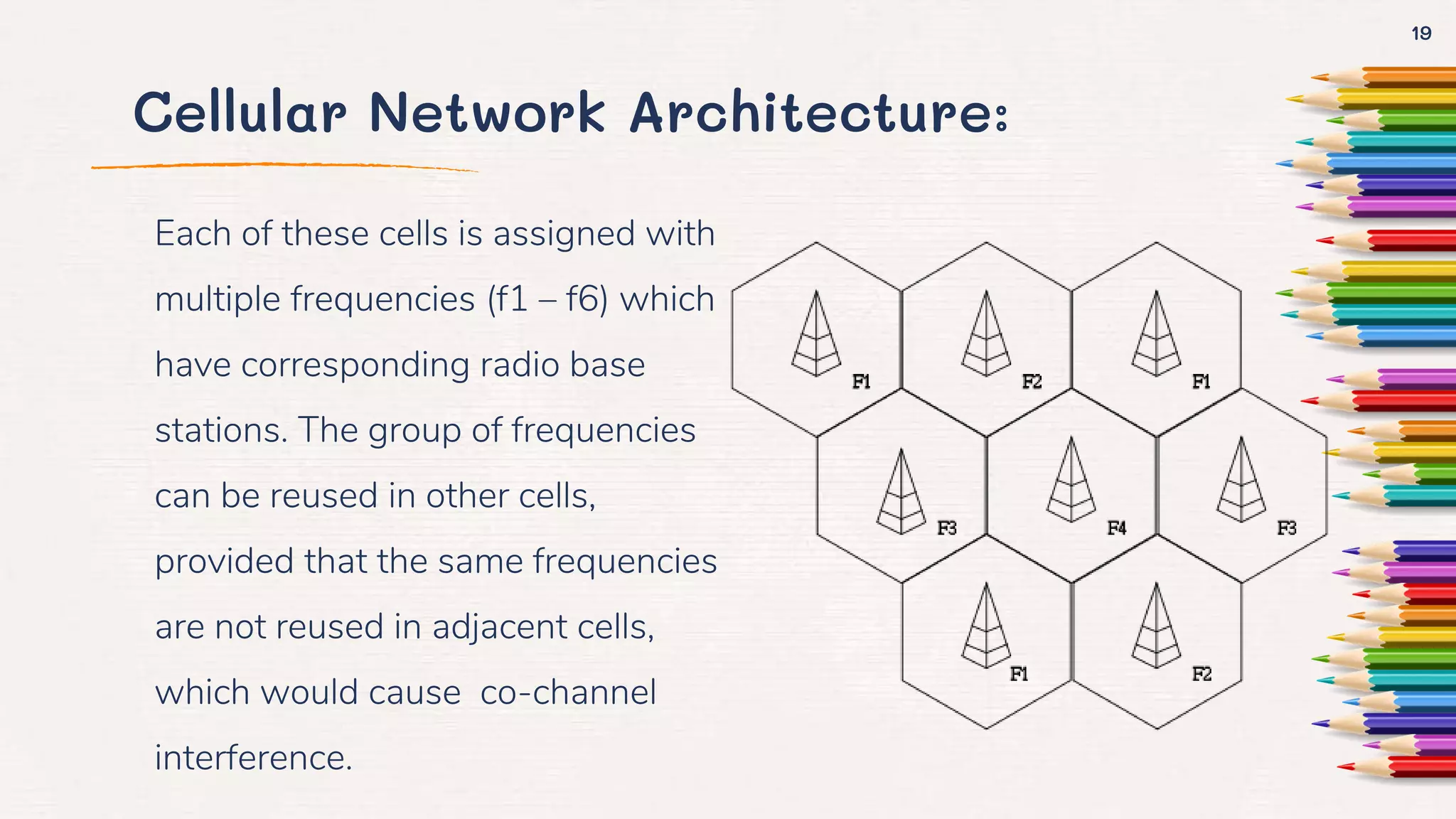
Each of these cells is assigned with
multiple frequencies (f1 – f6) which
have corresponding radio base
stations. The group of frequencies
can be reused in other cells,
provided that the same frequencies
are not reused in adjacent cells,
which would cause co-channel
interference.
19
Cellular Network Architecture:
20
7’8 Advantages &
Disadvantages of wireless
network
Advantages:
✘ Speed.
✘ Cost.
✘ Centralized Software Management.
✘ Resource Sharing.
✘ Electronic Mail.
✘ Flexible Access.
✘ Workgroup Computing.
22
Disadvantages:
✘ Server faults stop applications being available
✘ Network faults can cause loss of data.
✘ Network fault could lead to loss of resources
✘ User work dependent upon network
23
9. Application of wireless
network
Applications:
✘ Cable replacement for peripherals
✘ Mobile extension of wired networks
✘ Fixed wireless between homes and businesses and the Internet
✘ Mobile access to the Internet from outdoor areas
25
10. Conclusion
In high-density urban area there may
be multiple networks like MPLS, Metro
Ethernet, fiber networks, ADSL.
There may WiMAX is a technology for
providing high speed access to rural
areas. It can provide Copyright to
IJIRCCE DSL like speeds.
27
28
Thanks!
Any questions?
You can find me at:
abdullah15-2838@diu.edu.bd
29
Video Links:
https://drive.google.com/file/d/17fG7eG8usfCZE-
SwIyuVt8a9k_QNexQn/view?usp=sharing

Wireless network (cellular network architecture and http.)

  • 1.
  • 2.
    Hello! I am AbdullaAl Moin My Id: 192-15-2838 Section: PC-B Dept. of Computer Science & Engineering Daffodil International University 2
  • 3.
    Submitted To, Ms. FatemaTuj Johora Lecturer Dept. of Computer Science Enginreeing Under Course: CSE313 (Computer Networks) Daffodil International University 3
  • 4.
    Index 4 1. Introduction 2. Needof Wireless Network 3. How Wireless Networks Work 4. Type of Network 5. Comparison of Wired & Wireless 6. Cellular Network Architecture: An overview 7. Advantage 8. Disadvantage 9. Applications 10. Conclusions
  • 5.
    1. Introduction Let’s startwith the first set of slides
  • 6.
    What is awireless network? ✘ A technology that enables two or more entities to communicate without network cabling. ✘ Wireless Networking today is about where broadcast radio was in the late 1920s. The use of wireless technology is quickly becoming the most popular way to connect to a network. Wi-Fi is one of the many available technologies that offer us the convenience of mobile computing. 6
  • 7.
    2. Needs ofwireless network
  • 8.
    Needs of wirelessnetwork ✘ Mobile communication is needed. ✘ Communication must take place in a terrain that makes wired communication difficult or impossible. ✘ A communication system must be deployed quickly. ✘ Communication facilities must be installed at low initial cost. ✘ The same information must be broadcast to many locations. 8
  • 9.
  • 10.
    How Wireless NetworksWork ✘ Moving data through a wireless network involves three separate elements: the radio signals, the data format, and the network structure. Each of these elements is independent of the other two, so you must define all three Introduction to Wireless Networks 13 when you invent a new network. 10
  • 11.
    How Wireless NetworksWork ✘ In terms of the OSI reference model, the radio signal operates at the physical layer, and the data format controls several of the higher layers. The network structure includes the wireless network interface adapters and base stations that send and receive the radio signals. 11
  • 12.
    4. Types ofWireless Network
  • 13.
    Types of Network ✘WLANS: Wireless Local Area Networks WLANS allow users in a local area, such as a university campus or library, to form a network or gain access to the internet. ✘ WPANS: Wireless Personal Area Networks The two current technologies for wireless personal area networks are Infra Red (IR) and Bluetooth (IEEE 802.15). IR requires a direct line of site and the range is less. 13
  • 14.
    Types of Network ✘WMANS: Wireless Metropolitan Area Networks This technology allows the connection of multiple networks in a metropolitan area such as different buildings in a city. 14
  • 15.
    5. Comparison ofWired & Wireless Network
  • 16.
    Comparison of Wired& Wireless Network 16 Wired Network Wireless Network Installation of wired network is so Difficult. Installation is Easy to Installation Time of Installation is more. Time of installation is less. Reliability is high is Reasonably high Speed & bandwidth are high & 100mbps Speed & bandwidth are low & 54mbps
  • 17.
  • 18.
    Cellular Network Architecture: ✘A cellular network or mobile network is a communication network where the link to and from end nodes is wireless. The network is distributed over land areas called "cells", each served by at least one fixed-location transceiver ✘ In a cellular radio system, a land area to be supplied with radio service is divided into cells in a pattern dependent on terrain and reception characteristics. These cell patterns roughly take the form of regular shapes, such as hexagons, squares, or circles although hexagonal cells are conventional. 18
  • 19.
    Cellular Network Architecture: Eachof these cells is assigned with multiple frequencies (f1 – f6) which have corresponding radio base stations. The group of frequencies can be reused in other cells, provided that the same frequencies are not reused in adjacent cells, which would cause co-channel interference. 19
  • 20.
  • 21.
  • 22.
    Advantages: ✘ Speed. ✘ Cost. ✘Centralized Software Management. ✘ Resource Sharing. ✘ Electronic Mail. ✘ Flexible Access. ✘ Workgroup Computing. 22
  • 23.
    Disadvantages: ✘ Server faultsstop applications being available ✘ Network faults can cause loss of data. ✘ Network fault could lead to loss of resources ✘ User work dependent upon network 23
  • 24.
    9. Application ofwireless network
  • 25.
    Applications: ✘ Cable replacementfor peripherals ✘ Mobile extension of wired networks ✘ Fixed wireless between homes and businesses and the Internet ✘ Mobile access to the Internet from outdoor areas 25
  • 26.
  • 27.
    In high-density urbanarea there may be multiple networks like MPLS, Metro Ethernet, fiber networks, ADSL. There may WiMAX is a technology for providing high speed access to rural areas. It can provide Copyright to IJIRCCE DSL like speeds. 27
  • 28.
    28 Thanks! Any questions? You canfind me at: abdullah15-2838@diu.edu.bd
  • 29.