


Diarrhea in HIV infected
patients
Shima Ghavimi , PGY2
Department of Internal Medicine
 24 y/o AAF with PMH of congenital AIDS came with generalized body pain and
diarrhea.
 Diarrhea is watery, 3 times a day, non-bloody.
 Denies recent antibiotic use, recent travel, or sick contacts.
 CD4 count on march 27th was 30.
 Diarrhea can cause significant morbidity in HIV-infected patients .
 Etiology could be from infectious to malignancy
 Prior to the use of HAART in the United States chronic diarrhea was
responsible for 17% of new AIDS diagnosis reported to CDC.
 The use of HAART itself (particularly nelfinavir and ritonavir) can also lead to
medication-induced diarrhea and is a leading diagnostic consideration .When
an infectious etiology is not ascertained, then HIV associated enteropathy
needs to be considered.
 Diarrheal disease in HIV-infected individuals is frequently caused by infectious
agents but may also be due to infiltrative diseases, such as lymphoma or
Kaposi's sarcoma (KS).
 Routine enteric pathogens with sufficient virulence to cause disease in
healthy hosts will cause diarrhea in HIV-infected individuals with intact or
compromised immunologic function.
 Less virulent pathogens, which appear to require immune compromise to
establish disease, are more common in advanced HIV or AIDS.
 For example, the enteroaggregative Escherichia coli (EAEC) that can cause
persistent diarrhea in children in the developing world, have limited potential
cause of diarrhea in volunteers and have been associated with persistent
diarrhea in HIV-infected adults in the United States and Switzerland.
 Cryptosporidium parvum, which can cause severe diarrheal disease in both
immunocompetent and immunocompromised individuals, will become
persistent in AIDS patients with CD4 counts <180 cells/micro.
 But with more preserved CD4 count they will have more self-limited illness.
 Microsporidial organism such as Enterocytozoon bieneusi and Encephalitozoon
intestinalis rarely can cause diarrhea in immunocompetent but can cause
severe malabsorption and persistent diarrhea in HIV-infected patients.
 Rarely, intestinal spirochetosis due to Brachyspira pilosicoli can cause
abdominal pain, rectal discharge and bleeding in HIV-infected patients.
 Mycobacterium avium complex (MAC) is associated with lung infections in
immunocompetent patients with chronic lung disease, but can cause
disseminated disease with bowel infiltration and malabsorption in patients
with severe immune compromise

 HIV infection of the gastrointestinal tract is also well documented although it
is not clear if the mechanism is direct infection of the enterocyte or infection
of the lymphoid tissue of the gastrointestinal tract with dysregulation of local
cytokine production.
History:
 The duration of symptoms, frequency and characteristics of stool, amount
and pace of weight loss, and other abdominal or constitutional symptoms is
very important.
 Medication history, recent changes in medications, status of HIV disease,
route of acquisition of HIV disease and other opportunistic illnesses or co-
morbid illnesses .
 Since HIV is currently better suppressed by HAART ,they might have non-HIV
related co-morbid conditions. Thus, it is important to ask about a family
history of inflammatory bowel disease that might lead to alternative
diagnoses for diarrheal symptom
Small vs Large Bowel :
 Small bowel diarrhea is usually watery and of large volume; it may be
associated with small bowel symptoms such as bloating, gas, cramping, and
potentially profound weight loss. Some patients with involvement of the
terminal ileum may present with malabsorption of D-xylose or vitamin B12.
 large bowel diarrhea is characterized by frequent, small volume, often
painful stools. The pain associated with these illnesses is not related to the
region of the gut but to the type of pathogens that cause disease in the colon.
 Patients with a history of unprotected receptive anal intercourse prior to the
development of severe tenesmus, dyschezia and urgency, localizes the
process to the anorectum.
Symptoms:
 Chronicity of symptoms as well as most recent CD4 count must be
determined.
 patients with CD4 cell counts <100 cells/micro are at risk for opportunistic
infections which are typically chronic, such as Cryptosporidium, MAC, CMV,
Isospora, or Microsporidium.
 Upper or mid-abdominal cramps, bloating, and nausea suggest gastric or small
bowel involvement, or both, which would be more common in MAC,
Cryptosporidium, Giardia, or Isospora belli infections.
 Severe watery diarrhea resulting in dehydration, electrolyte disturbances,
and weight loss, suggests intestinal cryptosporidiosis.
 Hematochezia, tenesmus, and lower abdominal cramps usually imply colonic
infection caused by opportunistic pathogens such as CMV, or less commonly
HSV, or bacterial infections, such as Salmonella, Yersinia, Shigella or
Campylobacter.
 Lower GIB has been uncommonly associated with Kaposi's sarcoma and
Bartonella infection.
 Weight loss accompanying chronic diarrhea may suggest an opportunistic
infection, infiltrative disease, or presence of malabsorption or small bowel
overgrowth syndrome.
Exposure:
 travel history (Entamoeba, Giardia), sexual exposures, food associations
(lactose intolerance) or other significant past medical history (eg, chronic
pancreatitis).
 history of unprotected receptive anal intercourse may suggest sexual
transmission of Herpes simplex virus (HSV), Neisseria gonorrhea, Chlamydia,
or occasionally Entamoebae.
 In patients on HAART, medication-induced diarrhea should be strongly
considered, particularly when diarrhea is the sole presenting symptom
 Drugs associated with frequent diarrhea include nelfinavir and ritonavir;
other agents include mainly protease inhibitors (ie, lopinavir,
fosamprenavir, and atazanavir).
 Diarrhea associated with bloating, nausea, and mild abdominal pain may be
related to mitochondrial toxicity of chronic nucleoside analogue therapy.
 C-diff also is an important cause of diarrhea in HIV-infected patients
especially with recent antibiotic exposure
Physical exam:
 Height and weight nutritional status.
 ●Orthostatic blood pressure degree of volume depletion.
 ●The skin and mucous membranes underlying micronutrient deficiencies, which could also
accompany a small bowel process.
 ●Fever in an immunosuppressed host possibility of opportunistic infections such as CMV,
MAC, and other pathogens.
 ●Hepatosplenomegaly systemic infiltrative process, such as MAC, histoplasmosis, or
lymphoma.
 ●Abdominal tenderness possibility of an abdominal abscess, colitis, or biliary tract or
pancreatic disease.
 ●Perirectal tenderness  anorectal infection from gonorrhea or Chlamydia or
lymphogranuloma venereum.
 ●Guaiac positive stools in a patient with advanced immunosuppression mucosal disease
such as CMV or HSV proctitis.
 A full physical examination, including ophthalmologic evaluation in the
patient with advanced immunosuppression, is important since there may be
other clues as to the etiology of diarrhea, such as concomitant retinitis and
colitis from CMV infection
Stool exam:
 for culture of bacteria, C. difficile toxin assay, and examination for ova and
parasites .
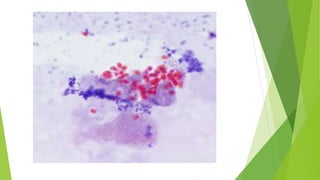
 An acid-fast smear should also be requested to look for Cryptosporidium,
Isospora, and Cyclospora.
 In patients with CD4 counts <100 cells/microL, the possibility of
Microsporidium should also be investigated via trichrome staining of a stool
specimen.
 If disseminated MAC infection is a diagnostic consideration, blood should also
be obtained in fungal isolator tubes for culture.
Endoscopy:
 In patients with advanced immunocompromise and either persistent diarrhea
or diarrhea with fever, more extensive workup is reasonable, with small bowel
biopsies looking for MAC, lymphoma, or microsporidiosis.
 In patients with colitis and negative stool examinations, colonoscopy and
biopsy looking for CMV or other inflammatory enteridites should be
considered.
 A history of guaiac positive stools + weight loss may be a presenting symptom
of Kaposi's sarcoma, which can be seen as vascular mucosal lesions on
endoscopy. Skin lesions are usually present with disseminated Kaposi's
sarcoma.
 The decision to perform upper or lower endoscopy first is suggested by the
symptoms.
 Classic features of colitis (cramps, fecal leukocytes, bloody stool and/or
fever) suggests lower endoscopy.
 Symptoms suggesting enteritis (watery high volume diarrhea without fever or
fecal leukocytes) would suggest proceeding with upper endoscopy as the
initial test.
Imaging:
 Generally is not helpful
 Most disorders need mucosal bioposy
 CT scan may show evidence of
 ●Colitis (CMV, HSV, Clostridium difficile)
 ●Abdominal adenopathy or hepatosplenomegaly (MAC, tuberculosis,
histoplasmosis, lymphoma).
 ●Biliary tract disease
 If stool evaluation and flexible sigmoidoscopy are nondiagnostic, some
clinicians prefer empiric antibiotic therapy with a quinolone and
metronidazole to treat possible small bowel overgrowth, culture-negative
Campylobacter, or Giardia.
 This strategy has not been recommended as it can cause additional adverse
effects
 If a particular antiretroviral medication is the cause (ie, ritonavir),
alternative medications should be substituted, whenever possible.
 If chronic diarrhea continues without a diagnosis, symptomatic therapy with
an antimotility drug (eg, loperamide or diphenoxylate with atropine
[Lomotil]) can be initiated.
 An alternative to an antimotility agent is crofelemer, a botanical agent that
blocks chloride secretion.
 Crofelemer was approved by the FDA in 2012 for noninfectious diarrhea in
HIV-infected patients receiving antiretroviral
 Zinc deficiency, which is commonly found in HIV-infected patients, has been
associated with pathogen negative diarrhea.
 However, a randomized controlled trial of dietary zinc supplementation had
no significant effect on the duration or remission of diarrhea in HIV-infected
adults.
diarrhea

diarrhea

  • 1.
    Diarrhea in HIVinfected patients Shima Ghavimi , PGY2 Department of Internal Medicine
  • 2.
     24 y/oAAF with PMH of congenital AIDS came with generalized body pain and diarrhea.  Diarrhea is watery, 3 times a day, non-bloody.  Denies recent antibiotic use, recent travel, or sick contacts.  CD4 count on march 27th was 30.
  • 3.
     Diarrhea cancause significant morbidity in HIV-infected patients .  Etiology could be from infectious to malignancy  Prior to the use of HAART in the United States chronic diarrhea was responsible for 17% of new AIDS diagnosis reported to CDC.
  • 4.
     The useof HAART itself (particularly nelfinavir and ritonavir) can also lead to medication-induced diarrhea and is a leading diagnostic consideration .When an infectious etiology is not ascertained, then HIV associated enteropathy needs to be considered.  Diarrheal disease in HIV-infected individuals is frequently caused by infectious agents but may also be due to infiltrative diseases, such as lymphoma or Kaposi's sarcoma (KS).
  • 5.
     Routine entericpathogens with sufficient virulence to cause disease in healthy hosts will cause diarrhea in HIV-infected individuals with intact or compromised immunologic function.  Less virulent pathogens, which appear to require immune compromise to establish disease, are more common in advanced HIV or AIDS.  For example, the enteroaggregative Escherichia coli (EAEC) that can cause persistent diarrhea in children in the developing world, have limited potential cause of diarrhea in volunteers and have been associated with persistent diarrhea in HIV-infected adults in the United States and Switzerland.
  • 6.
     Cryptosporidium parvum,which can cause severe diarrheal disease in both immunocompetent and immunocompromised individuals, will become persistent in AIDS patients with CD4 counts <180 cells/micro.  But with more preserved CD4 count they will have more self-limited illness.
  • 7.
     Microsporidial organismsuch as Enterocytozoon bieneusi and Encephalitozoon intestinalis rarely can cause diarrhea in immunocompetent but can cause severe malabsorption and persistent diarrhea in HIV-infected patients.  Rarely, intestinal spirochetosis due to Brachyspira pilosicoli can cause abdominal pain, rectal discharge and bleeding in HIV-infected patients.
  • 8.
     Mycobacterium aviumcomplex (MAC) is associated with lung infections in immunocompetent patients with chronic lung disease, but can cause disseminated disease with bowel infiltration and malabsorption in patients with severe immune compromise   HIV infection of the gastrointestinal tract is also well documented although it is not clear if the mechanism is direct infection of the enterocyte or infection of the lymphoid tissue of the gastrointestinal tract with dysregulation of local cytokine production.
  • 9.
    History:  The durationof symptoms, frequency and characteristics of stool, amount and pace of weight loss, and other abdominal or constitutional symptoms is very important.  Medication history, recent changes in medications, status of HIV disease, route of acquisition of HIV disease and other opportunistic illnesses or co- morbid illnesses .  Since HIV is currently better suppressed by HAART ,they might have non-HIV related co-morbid conditions. Thus, it is important to ask about a family history of inflammatory bowel disease that might lead to alternative diagnoses for diarrheal symptom
  • 10.
    Small vs LargeBowel :  Small bowel diarrhea is usually watery and of large volume; it may be associated with small bowel symptoms such as bloating, gas, cramping, and potentially profound weight loss. Some patients with involvement of the terminal ileum may present with malabsorption of D-xylose or vitamin B12.  large bowel diarrhea is characterized by frequent, small volume, often painful stools. The pain associated with these illnesses is not related to the region of the gut but to the type of pathogens that cause disease in the colon.
  • 11.
     Patients witha history of unprotected receptive anal intercourse prior to the development of severe tenesmus, dyschezia and urgency, localizes the process to the anorectum.
  • 12.
    Symptoms:  Chronicity ofsymptoms as well as most recent CD4 count must be determined.  patients with CD4 cell counts <100 cells/micro are at risk for opportunistic infections which are typically chronic, such as Cryptosporidium, MAC, CMV, Isospora, or Microsporidium.  Upper or mid-abdominal cramps, bloating, and nausea suggest gastric or small bowel involvement, or both, which would be more common in MAC, Cryptosporidium, Giardia, or Isospora belli infections.
  • 13.
     Severe waterydiarrhea resulting in dehydration, electrolyte disturbances, and weight loss, suggests intestinal cryptosporidiosis.  Hematochezia, tenesmus, and lower abdominal cramps usually imply colonic infection caused by opportunistic pathogens such as CMV, or less commonly HSV, or bacterial infections, such as Salmonella, Yersinia, Shigella or Campylobacter.
  • 14.
     Lower GIBhas been uncommonly associated with Kaposi's sarcoma and Bartonella infection.  Weight loss accompanying chronic diarrhea may suggest an opportunistic infection, infiltrative disease, or presence of malabsorption or small bowel overgrowth syndrome.
  • 15.
    Exposure:  travel history(Entamoeba, Giardia), sexual exposures, food associations (lactose intolerance) or other significant past medical history (eg, chronic pancreatitis).  history of unprotected receptive anal intercourse may suggest sexual transmission of Herpes simplex virus (HSV), Neisseria gonorrhea, Chlamydia, or occasionally Entamoebae.  In patients on HAART, medication-induced diarrhea should be strongly considered, particularly when diarrhea is the sole presenting symptom
  • 16.
     Drugs associatedwith frequent diarrhea include nelfinavir and ritonavir; other agents include mainly protease inhibitors (ie, lopinavir, fosamprenavir, and atazanavir).  Diarrhea associated with bloating, nausea, and mild abdominal pain may be related to mitochondrial toxicity of chronic nucleoside analogue therapy.
  • 17.
     C-diff alsois an important cause of diarrhea in HIV-infected patients especially with recent antibiotic exposure
  • 18.
    Physical exam:  Heightand weight nutritional status.  ●Orthostatic blood pressure degree of volume depletion.  ●The skin and mucous membranes underlying micronutrient deficiencies, which could also accompany a small bowel process.  ●Fever in an immunosuppressed host possibility of opportunistic infections such as CMV, MAC, and other pathogens.  ●Hepatosplenomegaly systemic infiltrative process, such as MAC, histoplasmosis, or lymphoma.  ●Abdominal tenderness possibility of an abdominal abscess, colitis, or biliary tract or pancreatic disease.  ●Perirectal tenderness  anorectal infection from gonorrhea or Chlamydia or lymphogranuloma venereum.  ●Guaiac positive stools in a patient with advanced immunosuppression mucosal disease such as CMV or HSV proctitis.
  • 19.
     A fullphysical examination, including ophthalmologic evaluation in the patient with advanced immunosuppression, is important since there may be other clues as to the etiology of diarrhea, such as concomitant retinitis and colitis from CMV infection
  • 20.
    Stool exam:  forculture of bacteria, C. difficile toxin assay, and examination for ova and parasites .  An acid-fast smear should also be requested to look for Cryptosporidium, Isospora, and Cyclospora.  In patients with CD4 counts <100 cells/microL, the possibility of Microsporidium should also be investigated via trichrome staining of a stool specimen.  If disseminated MAC infection is a diagnostic consideration, blood should also be obtained in fungal isolator tubes for culture.
  • 22.
    Endoscopy:  In patientswith advanced immunocompromise and either persistent diarrhea or diarrhea with fever, more extensive workup is reasonable, with small bowel biopsies looking for MAC, lymphoma, or microsporidiosis.  In patients with colitis and negative stool examinations, colonoscopy and biopsy looking for CMV or other inflammatory enteridites should be considered.  A history of guaiac positive stools + weight loss may be a presenting symptom of Kaposi's sarcoma, which can be seen as vascular mucosal lesions on endoscopy. Skin lesions are usually present with disseminated Kaposi's sarcoma.
  • 23.
     The decisionto perform upper or lower endoscopy first is suggested by the symptoms.  Classic features of colitis (cramps, fecal leukocytes, bloody stool and/or fever) suggests lower endoscopy.  Symptoms suggesting enteritis (watery high volume diarrhea without fever or fecal leukocytes) would suggest proceeding with upper endoscopy as the initial test.
  • 24.
    Imaging:  Generally isnot helpful  Most disorders need mucosal bioposy  CT scan may show evidence of  ●Colitis (CMV, HSV, Clostridium difficile)  ●Abdominal adenopathy or hepatosplenomegaly (MAC, tuberculosis, histoplasmosis, lymphoma).  ●Biliary tract disease
  • 25.
     If stoolevaluation and flexible sigmoidoscopy are nondiagnostic, some clinicians prefer empiric antibiotic therapy with a quinolone and metronidazole to treat possible small bowel overgrowth, culture-negative Campylobacter, or Giardia.  This strategy has not been recommended as it can cause additional adverse effects
  • 26.
     If aparticular antiretroviral medication is the cause (ie, ritonavir), alternative medications should be substituted, whenever possible.  If chronic diarrhea continues without a diagnosis, symptomatic therapy with an antimotility drug (eg, loperamide or diphenoxylate with atropine [Lomotil]) can be initiated.  An alternative to an antimotility agent is crofelemer, a botanical agent that blocks chloride secretion.  Crofelemer was approved by the FDA in 2012 for noninfectious diarrhea in HIV-infected patients receiving antiretroviral
  • 27.
     Zinc deficiency,which is commonly found in HIV-infected patients, has been associated with pathogen negative diarrhea.  However, a randomized controlled trial of dietary zinc supplementation had no significant effect on the duration or remission of diarrhea in HIV-infected adults.