
DEFINITION
• Abnormally liquid or unformed stools
,>2-3 times/day.
• Stools weighing >200 gm/day
CLASSIFICATION
• Acute - <2 wks
• Persistent - 2-4 wks, and
• Chronic - >4 wks
Causes of Chronic Diarrhoea
➢ Secretory causes
• Exogenous stimulant laxatives
• Chronic ethanol ingestion
• Drugs and toxins
• Endogenous laxatives (dihydroxy bile
acids)
• Idiopathic secretory diarrhea
• Certain bacterial infections
• Bowel resection
• Partial bowel obstruction or fecal
impaction
• Hormone-producing tumors
(carcinoid, VIPoma, medullary
cancer of thyroid, mastocytosis,
gastrinoma, colorectal villous
adenoma)
• Addison's disease
• Congenital electrolyte absorption
defects
➢ Osmotic causes
• Osmotic laxatives
(Mg2+ , PO4–3, SO4–2)
• Lactase and di-saccharidase def.
• Non-absorbable carbohydrates
(sorbitol, lactulose, PEG)
➢ Steatorrheal causes
• Intraluminal maldigestion
(pancreatic exocrine insufficiency,
bacterial overgrowth, bariatric surgery,
liver disease)
• Mucosal malabsorption
(celiac sprue, Whipple's disease,
infections, abetalipoproteinemia,
ischemia)
• Postmucosal obstruction
(1° or 2° lymphatic obstruction)
➢ Inflammatory causes
• IBD
• Lymphocytic and collagenous colitis
• Immune-related mucosal disease (1°
or 2° immunodeficiencies, food
allergy, eosinophilic gastroenteritis,
graft-vs-host disease)
• Infections (invasive bacteria,
viruses, and parasites)
• Radiation injury
• Gastrointestinal malignancies
➢ Dysmotile causes
• Irritable bowel syndrome (including
postinfectious IBS)
• Visceral neuromyopathies
• Hyperthyroidism
• Drugs (prokinetic agents) Postvagotomy
➢ Factitial causes
• Munchausen
• Eating disorders
➢ Iatrogenic causes
• Cholecystectomy
• Ileal resection
• Bariatric surgery
• Vagotomy, fundoplication
Secretory diarrhoeas-
• derangements in fluid and
electrolyte transport .
• watery, large-volume, painless and
persist with fasting.
• Medications- most common secretory
causes
• stimulant laxatives [e.g., senna,
cascara, bisacodyl, ricinoleic acid
(castor oil)].
• Chronic ethanol consumption
Bowel Resection, Mucosal Disease, or
Entero-colic Fistula
• Inadequate surface for reabsorption
of secreted fluids and electrolyte
• Worsen with eating.
Idiopathic secretory diarrhea
• With disease (e.g., Crohn's ileitis) or
resection of <100 cm of terminal
ileum, di-hydroxy bile acids may
escape absorption and stimulate
colonic secretion (cholorrheic
diarrhoea).
• Bile acids are functionally
malabsorbed from a
normal-appearing terminal ileum.
• Reduced -ve feedback regulation of bile
acid synthesis by FGF-19 produced by
enterocytes- increase bile-acid synthesis
s- bile acid diarrhoea.
• 40% of unexplained chronic diarrhea.
Hormones
• Metastatic gastrointestinal carcinoid
tumors or, rarely, primary bronchial
carcinoids
• carcinoid syndrome -episodic flushing,
wheezing, dyspnea, and right-sided
valvular heart disease, Pellagra like skin
lesions.
• serotonin, histamine, prostaglandins, and
various kinins.
• Gastrinoma- most typically presents
with refractory peptic ulcers,
diarrhea (1/3rd
) ,only clinical
manifestation in 10%.
• VIPoma- watery diarrhea,
hypokalemia, achlorhydria syndrome
(pancreatic cholera)
• VIP, PP, secretin, gastrin, GIP ,
neurotensin, calcitonin, and PG.
• Often massive,volumes >3 L/d; (20
L/d)
• Dehydration; neuromuscular
dysfunction from associated
hypokalemia, hypomagnesemia, or
hypercalcemia; flushing; and
hyperglycemia
• Medullary carcinoma of the
thyroid-calcitonin, other secretory
peptides, or PGs.
Congenital Defects in Ion Absorption
• Defective Cl–/HCO3– exchange (congenital
chloridorrhea) with alkalosis (mutated DRA
[down-regulated in adenoma] gene)
• Defective Na+/H+ exchange (congential
sodium diarrhea)with acidosis ( mutation in
the NHE3 [sodium-hydrogen exchanger]
gene)
• Adrenocortical insufficiency-diarrhoea
accompanied by skin hyperpigmentation.
Osmotic Causes
• Poorly absorbable, osmotically active
solutes
• draw enough fluid into the lumen to
exceed the reabsorptive capacity of the
colon- increase fecal water output.
• ceases with fasting or with
discontinuation of the causative agent.
Osmotic Laxatives
• Mg-containing antacids, health
supplements, or laxatives
• stool osmotic gap (>50 mosmol/L):
serum osmolarity (typically 290
mosmol/kg)-[2 x (fecal sodium +
potassium concentration)].
Carbohydrate Malabsorption
• Acquired or congenital defects in
brush-border disaccharidases and
other enzymes
• Osmotic diarrhea with a low pH.
• Lactase deficiency -One of the most
common causes of chronic diarrhea in
adults
Steatorrheal Causes
• stool fat - > 7 g/d
• Fat malabsorption -greasy,
foul-smelling, difficult-to-flush, wt
loss and nutritional def.
• rapid-transit diarrhea -up to 14 g/d
• small intestinal ds - 15–25 g/d and
• pancreatic exocrine insufficiency -
>32g/d
Intraluminal Maldigestion
• Pancreatic exocrine insufficiency, Chronic
pancreatitis, cystic fibrosis; pancreatic
duct obstruction; and, somatostatinoma.
• Bacterial overgrowth -deconjugate bile
acids and alter micelle formation,
impairing fat digestion.
• Cirrhosis or biliary obstruction - deficient
intraluminal bile acid conc.
Mucosal Malabsorption
• Celiac disease(enteropathies)-villous
atrophy and crypt hyperplasia ,prox small
bowel, fatty diarrhea with multiple
nutritional deficiencies .
• Tropical sprue -similar histologic and
clinical syndrome , residents of or
travelers to tropical climates
• Whipple's disease-histiocytic infiltration of
the small-bowel mucosa,young or
middle-aged men.
• Abetalipoproteinemia - defect of
chylomicron formation, children,
,acanthocytic erythrocytes, ataxia, and
retinitis pigmentosa.
Postmucosal Lymphatic Obstruction
• Congenital intestinal lymphangiectasia
or acquired lymphatic obstruction
secondary to trauma, tumor, cardiac
disease or infection,
• Fat malabsorption with enteric losses of
protein (often causing edema) and
lymphocytopenia. Carbohydrate and
amino acid absorption are preserved.
Inflammatory Causes
• Pain, fever, bleeding, or other manifestations of
inflammation.
• Idiopathic Inflammatory Bowel Disease
• CD and UC- among the mc organic causes of
chronic diarrhea in adults, mild to fulminant
and life-threatening.
• Microscopic colitis(lymphocytic and
collagenous colitis), typically responds to
anti-inflammatory drugs (e.g., bismuth), to the
opioid agonist loperamide, or to budesonide.
Primary or Secondary Forms of
Immunodeficiency
• Prolonged infectious diarrhea (selective
IgA def. or common variable
hypogammaglobulinemia)
• Giardiasis, bacterial overgrowth, or
sprue.
Eosinophilic Gastroenteritis
• Atopic history, Charcot-Leyden crystals,
and peripheral eosinophilia in 50–75% of
patients.
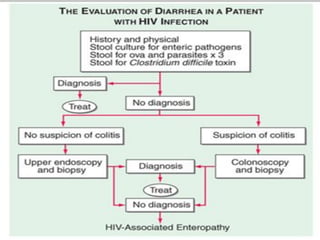
Chronic diarrhoea in HIV
➢ Protozoa-Cryptosporidia, microsporidia, and
Isospora belli -most common .
• Cryptosporidium- self-limited or intermittent
diarrheal,life threatening. CD4+ T cell <300/L -
1% per year.
• crampy abdominal pain(75%), nausea and
vomiting(25%) .
• stool examination or biopsy of the small
intestine.
• noninflammatory, oocysts that stain with
acid-fast dyes.
• Microsporidia -small, unicellular,
obligate, intracellular, cytoplasm of
enteric cells(Enterocytozoon
bieneusi).
• Abdominal pain, malabsorption,
diarrhea, and cholangitis.
• Chromotrope-based stains, stool
samples by light microscopy.
• Definitive diagnosis
-electron-microscopic examination of
a stool specimen, intestinal aspirate,
or intestinal biopsy specimen.
• I. belli- cysts are large, acid-fast +ve
that can be differentiated from those
of cryptosporidia on the basis of size,
shape, and number of sporocysts.
➢ Bacteria - Salmonella, Shigella, and
Campylobacter
• Homosexual men and are often
more severe.
• Untreated HIV -a 20-fold increased
risk of infection with S.
typhimurium.
➢ Fungal infections- Histoplasmosis,
coccidioidomycosis, and penicilliosis
➢ CMV colitis- 5–10% of patients with
AIDS.
• Diarrhea(nonbloody), abdominal pain,
weight loss, and anorexia.
• Diagnosis -endoscopy and biopsy.
• Endoscopy-Multiple mucosal ulcerations
and biopsies reveal characteristic
intranuclear and cytoplasmic inclusion
bodies.
HIV enteropathy
• Pts with HIV infection -chronic diarrheal
syndrome for which no etiologic agent
other than HIV can be identified.
• Direct result of HIV infection in the GI
tract.
• Histologic examination of small bowel-
low-grade mucosal atrophy ,decrease in
mitotic figures, suggesting a
hyporegenerative state.
Other Causes
Radiation enterocolitis, chronic
graft-versus-host disease, Behçt's
syndrome, and Cronkhite-Canada
syndrome.
Dysmotility Causes
Diabetic diarrhea- peripheral and generalized
autonomic neuropathies.
IBS (10% point prevalence, 1–2% -incidence)
• disturbed intestinal and colonic motor and
sensory responses to various stimuli.
• Stool frequency typically cease at night,
alternate with constipation, accompanied
by abdominal pain relieved with
defecation, and rarely weight loss.
Factitial Causes
• Munchausen syndrome (deception or
self-injury for secondary gain) or Eating
disorders
• Covertly self-administer laxatives alone or
in combination with other medications
(e.g., diuretics) or surreptitiously add
water or urine to stool.
• Women, h/o of psychiatric illness.
HISTORY
AGE
➢ Young patients
• Inflammatory Bowel Disease
• Tuberculosis
• Functional bowel disorder (Irritable bowel)
➢ Older patients
• Colon Cancer
• Diverticulitis
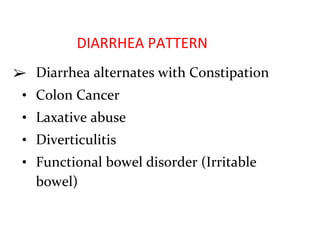
DIARRHEA PATTERN
➢ Diarrhea alternates with Constipation
• Colon Cancer
• Laxative abuse
• Diverticulitis
• Functional bowel disorder (Irritable
bowel)
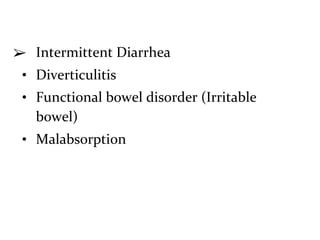
➢ Intermittent Diarrhea
• Diverticulitis
• Functional bowel disorder (Irritable
bowel)
• Malabsorption
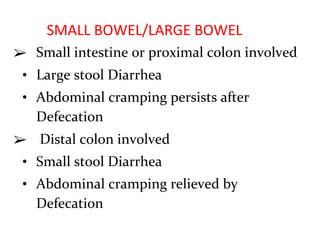
SMALL BOWEL/LARGE BOWEL
➢ Small intestine or proximal colon involved
• Large stool Diarrhea
• Abdominal cramping persists after
Defecation
➢ Distal colon involved
• Small stool Diarrhea
• Abdominal cramping relieved by
Defecation
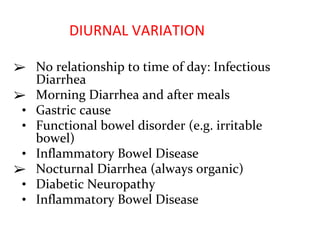
DIURNAL VARIATION
➢ No relationship to time of day: Infectious
Diarrhea
➢ Morning Diarrhea and after meals
• Gastric cause
• Functional bowel disorder (e.g. irritable
bowel)
• Inflammatory Bowel Disease
➢ Nocturnal Diarrhea (always organic)
• Diabetic Neuropathy
• Inflammatory Bowel Disease
WEIGHT LOSS
➢ Despite normal appetite
• Hyperthyroidism
• Malabsorption
• Associated with fever
• Inflammatory Bowel Disease
➢ Weight loss prior to Diarrhea onset
• Pancreatic Cancer
• Tuberculosis
• Diabetes Mellitus
• Hyperthyroidism
• Malabsorption
STOOL CHARACTERISTICS
➢ Water: Chronic Watery Diarrhea
➢ Blood, pus or mucus: Chronic
Inflammatory Diarrhea
➢ Foul, bulky, greasy stools: Chronic Fatty
Diarrhea
MEDICATION AND DIETARY INTAKE
➢ Drug induced diarrhea
➢ Food borne illness
➢ Waterborne illness
➢ High fructose corn syrup
➢ Excessive sorbitol or mannitol
➢ Excessive coffee or other caffeine
TRAVEL
➢Traveler’s diarrhea
➢Infectious diarrhea
ASSOCIATED SYMPTOMS
➢ Abdominal pain
➢ Alternating constipation
➢ Tenesmus
➢ Unintentional wt. loss
➢ Fever
PAST MEDICAL HISTORY
➢ Childhood
diarrhea-resolves-re-emergence in
adulthood– celiac disease
➢ Uncontrolled diabetes
➢ Pelvic radiotherapy
PAST SURGICAL HISTORY
➢ Jejunoileal bypass
➢ Gastrectomy with vagotomy
➢ Bowel resection
➢ Cholecystectomy
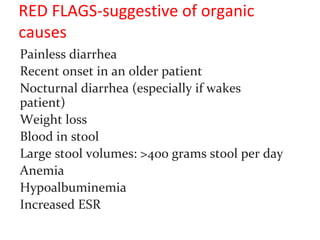
RED FLAGS-suggestive of organic
causes
Painless diarrhea
Recent onset in an older patient
Nocturnal diarrhea (especially if wakes
patient)
Weight loss
Blood in stool
Large stool volumes: >400 grams stool per day
Anemia
Hypoalbuminemia
Increased ESR
PHYSICAL EXAMINATION
GPE
➢ General appearance and mental status
➢ Vital signs
➢ Body weight
➢ Orthostasis- volume depletion,autonomic
dysfunction
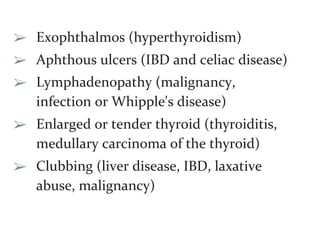
➢ Exophthalmos (hyperthyroidism)
➢ Aphthous ulcers (IBD and celiac disease)
➢ Lymphadenopathy (malignancy,
infection or Whipple's disease)
➢ Enlarged or tender thyroid (thyroiditis,
medullary carcinoma of the thyroid)
➢ Clubbing (liver disease, IBD, laxative
abuse, malignancy)
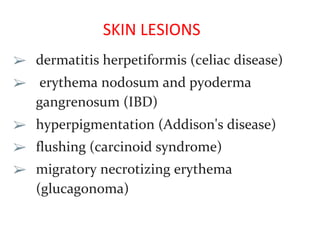
SKIN LESIONS
➢ dermatitis herpetiformis (celiac disease)
➢ erythema nodosum and pyoderma
gangrenosum (IBD)
➢ hyperpigmentation (Addison's disease)
➢ flushing (carcinoid syndrome)
➢ migratory necrotizing erythema
(glucagonoma)
SYSTEMIC EXAMINATION
➢ Wheezing and right-sided heart
murmurs (carcinoid syndrome)
➢ Arthritis
• IBD,
• Whipple's disease
ABDOMINAL EXAMINATION
➢ Surgical scars
➢ Abdominal tenderness
➢ Masses
➢ Hepatosplenomegaly
➢ Borborgymus on auscultation
• Malabsorption
• Bacterial overgrowth,
• Obstruction, or rapid intestinal transit.
PERINEAL AND RECTAL
EXAMINATION
➢ Signs of incontinence –
• skin changes from chronic irritation,
• gaping anus,
• weak sphincter tone.
➢ Crohn's disease
• perianal skin tags
• Ulcers
• Fissures
• Abscesses
• Fistulas
• Stenoses.
➢ Fecal impaction or masses might be
noted.
INVESTIGATIONS
BLOOD TESTS
• CBC
• TSH ,T3,T4
• Serum electrolytes
• Serum albumin
• ELISA for HIV
• Antiendomysial antibodies,
Anti-tTG-Celiac ds
• pANCA, ASCA - IBD
STOOL EVALUATION
• Stool pH (<6 in carbohydrate
malabsorption )
• Fecal electrolytes (Fecal sodium and
osmolar gap)
• Differentiates chronic watery diarrhea
category
• Fecal occult blood test
• Fecal leukocytes
•Fecal fat (abnormal if >7 grams/24 hours)
•Stool ova and parasites (2-3 samples)
•Giardia lamblia antigen
• Indicated for diarrhea >7 days and >10
stools/day
•Clostridium difficle toxin
• Indicated if recent antibiotics or
hospitalization
•Consider testing stools for laxative abuse
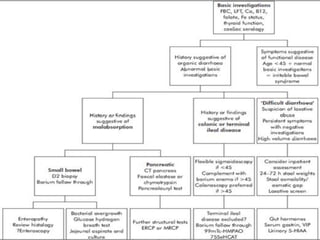
ENDOSCOPY
•PROCTOSIGMOIDOSCOPY
TREATMENT
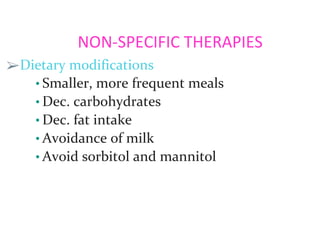
NON-SPECIFIC THERAPIES
➢Dietary modifications
• Smaller, more frequent meals
• Dec. carbohydrates
• Dec. fat intake
• Avoidance of milk
• Avoid sorbitol and mannitol
➢No good evidence to support use of bulking
agents
➢Bismuth subsalicylate (i.e., Pepto-Bismol )
➢opioids and opioid agonists
• Loperamide- first line therapy
• diphenoxylate-atropine (Lomotil )
• Codeine and other narcotics – for
refractory cases
SPECIFIC THERAPIES
➢Clonidine-
• Diabetic diarrhea
• moderate and severe diarrhea-
predominant IBS
➢Somatostatin
• Refractory diarrhea
• AIDS,
• post chemotherapy,
• GVHD,
• and hormone secreting tumors
➢Bile acid binders (ie, cholestyramine)
➢Pancreatic enzyme supplementation
➢Antimicrobials –empiric fluoroquinolones
therapy

Chronic diarrhoea

  • 1.
    DEFINITION • Abnormally liquidor unformed stools ,>2-3 times/day. • Stools weighing >200 gm/day
  • 2.
    CLASSIFICATION • Acute -<2 wks • Persistent - 2-4 wks, and • Chronic - >4 wks
  • 3.
    Causes of ChronicDiarrhoea ➢ Secretory causes • Exogenous stimulant laxatives • Chronic ethanol ingestion • Drugs and toxins • Endogenous laxatives (dihydroxy bile acids)
  • 4.
    • Idiopathic secretorydiarrhea • Certain bacterial infections • Bowel resection • Partial bowel obstruction or fecal impaction
  • 5.
    • Hormone-producing tumors (carcinoid,VIPoma, medullary cancer of thyroid, mastocytosis, gastrinoma, colorectal villous adenoma) • Addison's disease • Congenital electrolyte absorption defects
  • 6.
    ➢ Osmotic causes •Osmotic laxatives (Mg2+ , PO4–3, SO4–2) • Lactase and di-saccharidase def. • Non-absorbable carbohydrates (sorbitol, lactulose, PEG)
  • 7.
    ➢ Steatorrheal causes •Intraluminal maldigestion (pancreatic exocrine insufficiency, bacterial overgrowth, bariatric surgery, liver disease) • Mucosal malabsorption (celiac sprue, Whipple's disease, infections, abetalipoproteinemia, ischemia)
  • 8.
    • Postmucosal obstruction (1°or 2° lymphatic obstruction)
  • 9.
    ➢ Inflammatory causes •IBD • Lymphocytic and collagenous colitis • Immune-related mucosal disease (1° or 2° immunodeficiencies, food allergy, eosinophilic gastroenteritis, graft-vs-host disease)
  • 10.
    • Infections (invasivebacteria, viruses, and parasites) • Radiation injury • Gastrointestinal malignancies
  • 11.
    ➢ Dysmotile causes •Irritable bowel syndrome (including postinfectious IBS) • Visceral neuromyopathies • Hyperthyroidism • Drugs (prokinetic agents) Postvagotomy ➢ Factitial causes • Munchausen • Eating disorders
  • 12.
    ➢ Iatrogenic causes •Cholecystectomy • Ileal resection • Bariatric surgery • Vagotomy, fundoplication
  • 14.
    Secretory diarrhoeas- • derangementsin fluid and electrolyte transport . • watery, large-volume, painless and persist with fasting.
  • 15.
    • Medications- mostcommon secretory causes • stimulant laxatives [e.g., senna, cascara, bisacodyl, ricinoleic acid (castor oil)]. • Chronic ethanol consumption
  • 16.
    Bowel Resection, MucosalDisease, or Entero-colic Fistula • Inadequate surface for reabsorption of secreted fluids and electrolyte • Worsen with eating.
  • 17.
    Idiopathic secretory diarrhea •With disease (e.g., Crohn's ileitis) or resection of <100 cm of terminal ileum, di-hydroxy bile acids may escape absorption and stimulate colonic secretion (cholorrheic diarrhoea). • Bile acids are functionally malabsorbed from a normal-appearing terminal ileum.
  • 18.
    • Reduced -vefeedback regulation of bile acid synthesis by FGF-19 produced by enterocytes- increase bile-acid synthesis s- bile acid diarrhoea. • 40% of unexplained chronic diarrhea.
  • 19.
    Hormones • Metastatic gastrointestinalcarcinoid tumors or, rarely, primary bronchial carcinoids • carcinoid syndrome -episodic flushing, wheezing, dyspnea, and right-sided valvular heart disease, Pellagra like skin lesions. • serotonin, histamine, prostaglandins, and various kinins.
  • 20.
    • Gastrinoma- mosttypically presents with refractory peptic ulcers, diarrhea (1/3rd ) ,only clinical manifestation in 10%. • VIPoma- watery diarrhea, hypokalemia, achlorhydria syndrome (pancreatic cholera) • VIP, PP, secretin, gastrin, GIP , neurotensin, calcitonin, and PG.
  • 21.
    • Often massive,volumes>3 L/d; (20 L/d) • Dehydration; neuromuscular dysfunction from associated hypokalemia, hypomagnesemia, or hypercalcemia; flushing; and hyperglycemia • Medullary carcinoma of the thyroid-calcitonin, other secretory peptides, or PGs.
  • 22.
    Congenital Defects inIon Absorption • Defective Cl–/HCO3– exchange (congenital chloridorrhea) with alkalosis (mutated DRA [down-regulated in adenoma] gene) • Defective Na+/H+ exchange (congential sodium diarrhea)with acidosis ( mutation in the NHE3 [sodium-hydrogen exchanger] gene) • Adrenocortical insufficiency-diarrhoea accompanied by skin hyperpigmentation.
  • 24.
    Osmotic Causes • Poorlyabsorbable, osmotically active solutes • draw enough fluid into the lumen to exceed the reabsorptive capacity of the colon- increase fecal water output. • ceases with fasting or with discontinuation of the causative agent.
  • 25.
    Osmotic Laxatives • Mg-containingantacids, health supplements, or laxatives • stool osmotic gap (>50 mosmol/L): serum osmolarity (typically 290 mosmol/kg)-[2 x (fecal sodium + potassium concentration)].
  • 26.
    Carbohydrate Malabsorption • Acquiredor congenital defects in brush-border disaccharidases and other enzymes • Osmotic diarrhea with a low pH. • Lactase deficiency -One of the most common causes of chronic diarrhea in adults
  • 28.
    Steatorrheal Causes • stoolfat - > 7 g/d • Fat malabsorption -greasy, foul-smelling, difficult-to-flush, wt loss and nutritional def. • rapid-transit diarrhea -up to 14 g/d • small intestinal ds - 15–25 g/d and • pancreatic exocrine insufficiency - >32g/d
  • 29.
    Intraluminal Maldigestion • Pancreaticexocrine insufficiency, Chronic pancreatitis, cystic fibrosis; pancreatic duct obstruction; and, somatostatinoma. • Bacterial overgrowth -deconjugate bile acids and alter micelle formation, impairing fat digestion. • Cirrhosis or biliary obstruction - deficient intraluminal bile acid conc.
  • 30.
    Mucosal Malabsorption • Celiacdisease(enteropathies)-villous atrophy and crypt hyperplasia ,prox small bowel, fatty diarrhea with multiple nutritional deficiencies . • Tropical sprue -similar histologic and clinical syndrome , residents of or travelers to tropical climates
  • 31.
    • Whipple's disease-histiocyticinfiltration of the small-bowel mucosa,young or middle-aged men. • Abetalipoproteinemia - defect of chylomicron formation, children, ,acanthocytic erythrocytes, ataxia, and retinitis pigmentosa.
  • 32.
    Postmucosal Lymphatic Obstruction •Congenital intestinal lymphangiectasia or acquired lymphatic obstruction secondary to trauma, tumor, cardiac disease or infection, • Fat malabsorption with enteric losses of protein (often causing edema) and lymphocytopenia. Carbohydrate and amino acid absorption are preserved.
  • 34.
    Inflammatory Causes • Pain,fever, bleeding, or other manifestations of inflammation. • Idiopathic Inflammatory Bowel Disease • CD and UC- among the mc organic causes of chronic diarrhea in adults, mild to fulminant and life-threatening. • Microscopic colitis(lymphocytic and collagenous colitis), typically responds to anti-inflammatory drugs (e.g., bismuth), to the opioid agonist loperamide, or to budesonide.
  • 35.
    Primary or SecondaryForms of Immunodeficiency • Prolonged infectious diarrhea (selective IgA def. or common variable hypogammaglobulinemia) • Giardiasis, bacterial overgrowth, or sprue. Eosinophilic Gastroenteritis • Atopic history, Charcot-Leyden crystals, and peripheral eosinophilia in 50–75% of patients.
  • 36.
    Chronic diarrhoea inHIV ➢ Protozoa-Cryptosporidia, microsporidia, and Isospora belli -most common . • Cryptosporidium- self-limited or intermittent diarrheal,life threatening. CD4+ T cell <300/L - 1% per year. • crampy abdominal pain(75%), nausea and vomiting(25%) . • stool examination or biopsy of the small intestine. • noninflammatory, oocysts that stain with acid-fast dyes.
  • 37.
    • Microsporidia -small,unicellular, obligate, intracellular, cytoplasm of enteric cells(Enterocytozoon bieneusi). • Abdominal pain, malabsorption, diarrhea, and cholangitis. • Chromotrope-based stains, stool samples by light microscopy. • Definitive diagnosis -electron-microscopic examination of a stool specimen, intestinal aspirate, or intestinal biopsy specimen.
  • 38.
    • I. belli-cysts are large, acid-fast +ve that can be differentiated from those of cryptosporidia on the basis of size, shape, and number of sporocysts.
  • 39.
    ➢ Bacteria -Salmonella, Shigella, and Campylobacter • Homosexual men and are often more severe. • Untreated HIV -a 20-fold increased risk of infection with S. typhimurium. ➢ Fungal infections- Histoplasmosis, coccidioidomycosis, and penicilliosis
  • 40.
    ➢ CMV colitis-5–10% of patients with AIDS. • Diarrhea(nonbloody), abdominal pain, weight loss, and anorexia. • Diagnosis -endoscopy and biopsy. • Endoscopy-Multiple mucosal ulcerations and biopsies reveal characteristic intranuclear and cytoplasmic inclusion bodies.
  • 41.
    HIV enteropathy • Ptswith HIV infection -chronic diarrheal syndrome for which no etiologic agent other than HIV can be identified. • Direct result of HIV infection in the GI tract. • Histologic examination of small bowel- low-grade mucosal atrophy ,decrease in mitotic figures, suggesting a hyporegenerative state.
  • 42.
    Other Causes Radiation enterocolitis,chronic graft-versus-host disease, Behçt's syndrome, and Cronkhite-Canada syndrome.
  • 44.
    Dysmotility Causes Diabetic diarrhea-peripheral and generalized autonomic neuropathies. IBS (10% point prevalence, 1–2% -incidence) • disturbed intestinal and colonic motor and sensory responses to various stimuli. • Stool frequency typically cease at night, alternate with constipation, accompanied by abdominal pain relieved with defecation, and rarely weight loss.
  • 46.
    Factitial Causes • Munchausensyndrome (deception or self-injury for secondary gain) or Eating disorders • Covertly self-administer laxatives alone or in combination with other medications (e.g., diuretics) or surreptitiously add water or urine to stool. • Women, h/o of psychiatric illness.
  • 48.
  • 49.
    AGE ➢ Young patients •Inflammatory Bowel Disease • Tuberculosis • Functional bowel disorder (Irritable bowel) ➢ Older patients • Colon Cancer • Diverticulitis
  • 50.
    DIARRHEA PATTERN ➢ Diarrheaalternates with Constipation • Colon Cancer • Laxative abuse • Diverticulitis • Functional bowel disorder (Irritable bowel)
  • 51.
    ➢ Intermittent Diarrhea •Diverticulitis • Functional bowel disorder (Irritable bowel) • Malabsorption
  • 52.
    SMALL BOWEL/LARGE BOWEL ➢Small intestine or proximal colon involved • Large stool Diarrhea • Abdominal cramping persists after Defecation ➢ Distal colon involved • Small stool Diarrhea • Abdominal cramping relieved by Defecation
  • 53.
    DIURNAL VARIATION ➢ Norelationship to time of day: Infectious Diarrhea ➢ Morning Diarrhea and after meals • Gastric cause • Functional bowel disorder (e.g. irritable bowel) • Inflammatory Bowel Disease ➢ Nocturnal Diarrhea (always organic) • Diabetic Neuropathy • Inflammatory Bowel Disease
  • 54.
    WEIGHT LOSS ➢ Despitenormal appetite • Hyperthyroidism • Malabsorption • Associated with fever • Inflammatory Bowel Disease
  • 55.
    ➢ Weight lossprior to Diarrhea onset • Pancreatic Cancer • Tuberculosis • Diabetes Mellitus • Hyperthyroidism • Malabsorption
  • 56.
    STOOL CHARACTERISTICS ➢ Water:Chronic Watery Diarrhea ➢ Blood, pus or mucus: Chronic Inflammatory Diarrhea ➢ Foul, bulky, greasy stools: Chronic Fatty Diarrhea
  • 57.
    MEDICATION AND DIETARYINTAKE ➢ Drug induced diarrhea ➢ Food borne illness ➢ Waterborne illness ➢ High fructose corn syrup ➢ Excessive sorbitol or mannitol ➢ Excessive coffee or other caffeine
  • 58.
  • 59.
    ASSOCIATED SYMPTOMS ➢ Abdominalpain ➢ Alternating constipation ➢ Tenesmus ➢ Unintentional wt. loss ➢ Fever
  • 60.
    PAST MEDICAL HISTORY ➢Childhood diarrhea-resolves-re-emergence in adulthood– celiac disease ➢ Uncontrolled diabetes ➢ Pelvic radiotherapy
  • 61.
    PAST SURGICAL HISTORY ➢Jejunoileal bypass ➢ Gastrectomy with vagotomy ➢ Bowel resection ➢ Cholecystectomy
  • 62.
    RED FLAGS-suggestive oforganic causes Painless diarrhea Recent onset in an older patient Nocturnal diarrhea (especially if wakes patient) Weight loss Blood in stool Large stool volumes: >400 grams stool per day Anemia Hypoalbuminemia Increased ESR
  • 63.
  • 64.
    GPE ➢ General appearanceand mental status ➢ Vital signs ➢ Body weight ➢ Orthostasis- volume depletion,autonomic dysfunction
  • 65.
    ➢ Exophthalmos (hyperthyroidism) ➢Aphthous ulcers (IBD and celiac disease) ➢ Lymphadenopathy (malignancy, infection or Whipple's disease) ➢ Enlarged or tender thyroid (thyroiditis, medullary carcinoma of the thyroid) ➢ Clubbing (liver disease, IBD, laxative abuse, malignancy)
  • 66.
    SKIN LESIONS ➢ dermatitisherpetiformis (celiac disease) ➢ erythema nodosum and pyoderma gangrenosum (IBD) ➢ hyperpigmentation (Addison's disease) ➢ flushing (carcinoid syndrome) ➢ migratory necrotizing erythema (glucagonoma)
  • 67.
    SYSTEMIC EXAMINATION ➢ Wheezingand right-sided heart murmurs (carcinoid syndrome) ➢ Arthritis • IBD, • Whipple's disease
  • 68.
    ABDOMINAL EXAMINATION ➢ Surgicalscars ➢ Abdominal tenderness ➢ Masses ➢ Hepatosplenomegaly ➢ Borborgymus on auscultation • Malabsorption • Bacterial overgrowth, • Obstruction, or rapid intestinal transit.
  • 69.
    PERINEAL AND RECTAL EXAMINATION ➢Signs of incontinence – • skin changes from chronic irritation, • gaping anus, • weak sphincter tone.
  • 70.
    ➢ Crohn's disease •perianal skin tags • Ulcers • Fissures • Abscesses • Fistulas • Stenoses. ➢ Fecal impaction or masses might be noted.
  • 71.
  • 72.
    BLOOD TESTS • CBC •TSH ,T3,T4 • Serum electrolytes • Serum albumin • ELISA for HIV • Antiendomysial antibodies, Anti-tTG-Celiac ds • pANCA, ASCA - IBD
  • 73.
    STOOL EVALUATION • StoolpH (<6 in carbohydrate malabsorption ) • Fecal electrolytes (Fecal sodium and osmolar gap) • Differentiates chronic watery diarrhea category • Fecal occult blood test • Fecal leukocytes
  • 74.
    •Fecal fat (abnormalif >7 grams/24 hours) •Stool ova and parasites (2-3 samples) •Giardia lamblia antigen • Indicated for diarrhea >7 days and >10 stools/day •Clostridium difficle toxin • Indicated if recent antibiotics or hospitalization •Consider testing stools for laxative abuse
  • 75.
  • 78.
  • 79.
    NON-SPECIFIC THERAPIES ➢Dietary modifications •Smaller, more frequent meals • Dec. carbohydrates • Dec. fat intake • Avoidance of milk • Avoid sorbitol and mannitol
  • 80.
    ➢No good evidenceto support use of bulking agents ➢Bismuth subsalicylate (i.e., Pepto-Bismol ) ➢opioids and opioid agonists • Loperamide- first line therapy • diphenoxylate-atropine (Lomotil ) • Codeine and other narcotics – for refractory cases
  • 81.
    SPECIFIC THERAPIES ➢Clonidine- • Diabeticdiarrhea • moderate and severe diarrhea- predominant IBS
  • 82.
    ➢Somatostatin • Refractory diarrhea •AIDS, • post chemotherapy, • GVHD, • and hormone secreting tumors
  • 83.
    ➢Bile acid binders(ie, cholestyramine) ➢Pancreatic enzyme supplementation ➢Antimicrobials –empiric fluoroquinolones therapy