
APPROACH to
DIARRHEA
DR.Bilal Natiq Nuaman,MD
C.A.B.M. , F.I.B.M.S. , D.I.M. , M.B.Ch.B.
Lecturer in Al-Iraqia Medical College
2017
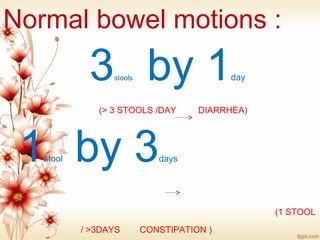
Normal bowel motions :
3stools by 1day
(> 3 STOOLS /DAY DIARRHEA)
1stool by 3days
(1 STOOL
/ >3DAYS CONSTIPATION )
DIARRHEA
Diarrheal diseases represent one of the
five leading causes of death worldwide.
Diarrhea is both a symptom and a sign.
As a symptom, diarrhea is most often
reported as a decrease in stool
consistency and an increase in stool
volume.
As a sign, diarrhea is defined as a stool
weight (i.e., water content) that exceeds
200 g in 24 hours.
classifications of diarrhea
Acute diarrhea vs.
Chronic diarrhea
ACUTE DIARRHEA
Diarrhea lasting < 2 weeks
• Acute diarrhea is an extremely common
presenting problem, and mostly due to
infectious causes.
• It is self-limited, No evaluation is necessary
unless the stools are bloody and fever or
infection is suspected (e.g., from travel
history or a common source outbreak). If
these conditions exist, do not treat with
antimotility agents.
• Begin the evaluation with stool studies for
bacterial pathogens, ova, and parasites and
proctosigmoidoscopy.
Acute diarrhea
Classified into:
1- watery diarrhea Vs. bloody
diarrhea
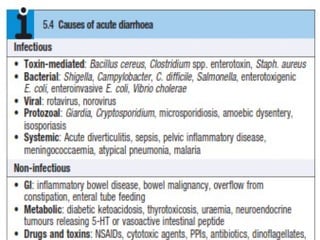
2-Infectious diarrhea Vs. non
infectious diarrhea
Food poisoning
• Symptoms that begin within six hours
suggest ingestion of a preformed toxin of
Staphylococcus aureus or Bacillus cereus
• Symptoms that begin at 8 to 16 hours
suggest infection with Clostridium
perfringens
• Symptoms that begin at more than 16 hours
can result from viral or bacterial infection (eg,
E. coli).
Infectious acute diarrhea is usually
associated with abdominal colicky pain,
urgency, tenesmus,nausea and
vomiting, watery stools, with or without
blood or mucus.
Systemic symptoms such as fever and
myalgia may be present.
In severe cases of diarrhea, urgency of
defecation and fecal incontinence is a
common event.
Tenesmus :
A sensation of incomplete evacuation
often accompanied by abnormally
frequent desire to defecate with
involuntary painful straining , but little
bowel movement.
• Causes of tenesmus
1-inflammatory bowel disease
2-colorecteal cancer
3-amebiasis
4- shigellosis
5-diverticular disease
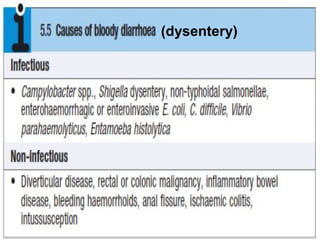
(dysentery)
Fecal urgency:
the sudden, almost uncontrollable, need to
defecate.
Fecal incontinence :
complete inability to control the bowel
movements, resulting in the involuntary
passage of stool.
History should include recent consumption
of unsanitary food or water (raw or poorly
cooked foods such as eggs, meat, shellfish,
dairy products, fruits and vegetables, or
foods that may have been improperly
handled or stored)
EXCLUDE FOOD POISONING
Important features in history of acute diarrhea:
• Stool characteristics-frequency, consistency,
quantity, bloody, mucus-filled , purulent.
• Presence of dysentery—fever, tenesmus ,
blood, mucus, or both;
• Symptoms of dehydration—thirst , lethargy,
postural giddiness, decreased urination; and
• Presence of associated symptoms—nausea,
vomiting, abdominal cramps, and significant
upper or lower gastrointestinal bleeding (coffee
ground hematemesis,melena, hematochezia).
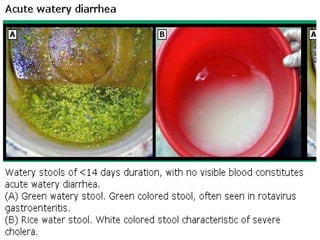
• Cholera may present very suddenly
with vomiting and acute watery
diarrhea with a “rice-water” appearance
of stool; but cholera not associated
with frank abdominal pain, tenesmus,
or Fever.
• shigellosis is typically characterized by
acute bloody diarrhea with or without
mucous associated with abdominal
cramps and tenesmus along with fever
and anorexia.
Indications for diagnostic evaluation  
• Profuse watery diarrhea with signs of hypovolemia
• Passage of many small volume stools containing 
blood and mucus
• Bloody diarrhea
• Temperature ≥38.5ºC (101.3ºF)
• Passage of ≥6 unformed stools per 24 hours or a 
duration of illness >48 hours
• Severe abdominal pain
• Hospitalized patients or recent use of antibiotics
• Diarrhea in the elderly (≥70 years of age)
• Systemic illness with diarrhea, especially in 
pregnant women
Complications of acute diarrheal diseases
1-Hypovolemia and electrolyte imbalances 
(cholera). 
2-Bacteremia (Non typhoidal Salmonella  )
3-Hemolytic-uremic syndrome- triad of acute 
renal failure, microangiopathic hemolytic 
anemia, and thrombocytopenia 
(enterohemorrhagic Escherichia coli (EHEC))
4-Guillain-Barré syndrome-ascending 
symmetrical paralysis (Campylobacter)
5-Reactive arthritis (formerly Reiter syndrome).
6-  Rectal prolapse, toxic megacolon (Shigella)
treatment
• Watery diarrhea  — Antimicrobial therapy 
is not typically indicated for the treatment 
of acute watery diarrhea in adults, as most 
cases resolve spontaneously. An 
important exception is the treatment of 
severe cholera (doxycyclin,azithromycin, 
ciprofloxacin)
• Bloody diarrhea  — adults with bloody 
diarrhea should be treated promptly with 
an antimicrobial that is effective against 
Shigella.(ciprofloxacin)
Chronic diarrhea
Diarrhea lasting >4 weeks
•  most cases of chronic diarrhea are 
noninfectious—IBS being the leading
cause of chronic diarrhea
• Differentiate organic diarrhea from 
functional diarrhea.
• IBS (Irritable Bowel Syndrome)-
Recurrent abdominal pain associated 
with chronic diarrhea and improved 
with defecation
• Large volume diarrhea, bloody 
stools, nocturnal diarrhea, and 
greasy stools are not associated 
with IBS and suggest an organic 
disease.
• Functional diarrhea  —  continuous 
or recurrent passage of watery 
stools without abdominal pain or 
discomfort 
Medical history: 
AIDS, diabetes, cirrhosis, sickle cell disease,
cancer, endocrine – thyroid disease.
previous surgery (surgery for peptic ulcer, 
cholecystectomy, and ileal resection), 
irradiation, 
Typical features of chronic diarrhea :
• Nocturnal diarrhea—autonomic neuropathy, 
e.g. diabetes mellitus;
• Diarrhea alternating with constipation -TB 
abdomen, laxative abuse, diverticulosis, 
carcinoma of colon;
• Chronic bloody or melanotic stools with weight 
loss - IBD, colonic malignancy;
• Pale, bulky, greasy, frothy, foul-smelling stools, 
which float in toilet, and associated with 
nutritional deficiency, weight loss- 
malabsorption syndrome.
Chronic diarrhea
classified into:
1-Organic vs. Functional diarrhea
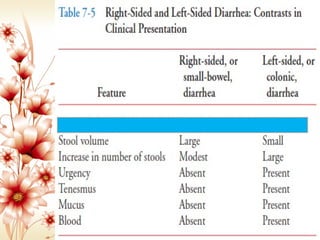
2-Small bowel (right sided) vs.
Colonic diarrhea (left sided)
3-Osmotic vs. Secretory
• Osmotic diarrhea small
volume , responds to fasting
• Secretory diarrhea large
volume ,not responds to
fasting
L 5 approach to diarhea

L 5 approach to diarhea

  • 1.
    APPROACH to DIARRHEA DR.Bilal NatiqNuaman,MD C.A.B.M. , F.I.B.M.S. , D.I.M. , M.B.Ch.B. Lecturer in Al-Iraqia Medical College 2017
  • 2.
    Normal bowel motions: 3stools by 1day (> 3 STOOLS /DAY DIARRHEA) 1stool by 3days (1 STOOL / >3DAYS CONSTIPATION )
  • 3.
    DIARRHEA Diarrheal diseases representone of the five leading causes of death worldwide. Diarrhea is both a symptom and a sign. As a symptom, diarrhea is most often reported as a decrease in stool consistency and an increase in stool volume. As a sign, diarrhea is defined as a stool weight (i.e., water content) that exceeds 200 g in 24 hours.
  • 4.
    classifications of diarrhea Acutediarrhea vs. Chronic diarrhea
  • 5.
    ACUTE DIARRHEA Diarrhea lasting< 2 weeks • Acute diarrhea is an extremely common presenting problem, and mostly due to infectious causes. • It is self-limited, No evaluation is necessary unless the stools are bloody and fever or infection is suspected (e.g., from travel history or a common source outbreak). If these conditions exist, do not treat with antimotility agents. • Begin the evaluation with stool studies for bacterial pathogens, ova, and parasites and proctosigmoidoscopy.
  • 6.
    Acute diarrhea Classified into: 1-watery diarrhea Vs. bloody diarrhea 2-Infectious diarrhea Vs. non infectious diarrhea
  • 9.
    Food poisoning • Symptomsthat begin within six hours suggest ingestion of a preformed toxin of Staphylococcus aureus or Bacillus cereus • Symptoms that begin at 8 to 16 hours suggest infection with Clostridium perfringens • Symptoms that begin at more than 16 hours can result from viral or bacterial infection (eg, E. coli).
  • 10.
    Infectious acute diarrheais usually associated with abdominal colicky pain, urgency, tenesmus,nausea and vomiting, watery stools, with or without blood or mucus. Systemic symptoms such as fever and myalgia may be present. In severe cases of diarrhea, urgency of defecation and fecal incontinence is a common event.
  • 11.
    Tenesmus : A sensationof incomplete evacuation often accompanied by abnormally frequent desire to defecate with involuntary painful straining , but little bowel movement. • Causes of tenesmus 1-inflammatory bowel disease 2-colorecteal cancer 3-amebiasis 4- shigellosis 5-diverticular disease
  • 12.
  • 13.
    Fecal urgency: the sudden,almost uncontrollable, need to defecate. Fecal incontinence : complete inability to control the bowel movements, resulting in the involuntary passage of stool.
  • 14.
    History should includerecent consumption of unsanitary food or water (raw or poorly cooked foods such as eggs, meat, shellfish, dairy products, fruits and vegetables, or foods that may have been improperly handled or stored) EXCLUDE FOOD POISONING
  • 15.
    Important features inhistory of acute diarrhea: • Stool characteristics-frequency, consistency, quantity, bloody, mucus-filled , purulent. • Presence of dysentery—fever, tenesmus , blood, mucus, or both; • Symptoms of dehydration—thirst , lethargy, postural giddiness, decreased urination; and • Presence of associated symptoms—nausea, vomiting, abdominal cramps, and significant upper or lower gastrointestinal bleeding (coffee ground hematemesis,melena, hematochezia).
  • 16.
    • Cholera maypresent very suddenly with vomiting and acute watery diarrhea with a “rice-water” appearance of stool; but cholera not associated with frank abdominal pain, tenesmus, or Fever. • shigellosis is typically characterized by acute bloody diarrhea with or without mucous associated with abdominal cramps and tenesmus along with fever and anorexia.
  • 18.
    Indications for diagnosticevaluation   • Profuse watery diarrhea with signs of hypovolemia • Passage of many small volume stools containing  blood and mucus • Bloody diarrhea • Temperature ≥38.5ºC (101.3ºF) • Passage of ≥6 unformed stools per 24 hours or a  duration of illness >48 hours • Severe abdominal pain • Hospitalized patients or recent use of antibiotics • Diarrhea in the elderly (≥70 years of age) • Systemic illness with diarrhea, especially in  pregnant women
  • 19.
    Complications of acutediarrheal diseases 1-Hypovolemia and electrolyte imbalances  (cholera).  2-Bacteremia (Non typhoidal Salmonella  ) 3-Hemolytic-uremic syndrome- triad of acute  renal failure, microangiopathic hemolytic  anemia, and thrombocytopenia  (enterohemorrhagic Escherichia coli (EHEC)) 4-Guillain-Barré syndrome-ascending  symmetrical paralysis (Campylobacter) 5-Reactive arthritis (formerly Reiter syndrome). 6-  Rectal prolapse, toxic megacolon (Shigella)
  • 20.
    treatment • Watery diarrhea — Antimicrobial therapy  is not typically indicated for the treatment  of acute watery diarrhea in adults, as most  cases resolve spontaneously. An  important exception is the treatment of  severe cholera (doxycyclin,azithromycin,  ciprofloxacin) • Bloody diarrhea  — adults with bloody  diarrhea should be treated promptly with  an antimicrobial that is effective against  Shigella.(ciprofloxacin)
  • 21.
  • 22.
    • IBS (IrritableBowel Syndrome)- Recurrent abdominal pain associated  with chronic diarrhea and improved  with defecation • Large volume diarrhea, bloody  stools, nocturnal diarrhea, and  greasy stools are not associated  with IBS and suggest an organic  disease. • Functional diarrhea  —  continuous  or recurrent passage of watery  stools without abdominal pain or  discomfort 
  • 23.
  • 24.
    Typical features ofchronic diarrhea : • Nocturnal diarrhea—autonomic neuropathy,  e.g. diabetes mellitus; • Diarrhea alternating with constipation -TB  abdomen, laxative abuse, diverticulosis,  carcinoma of colon; • Chronic bloody or melanotic stools with weight  loss - IBD, colonic malignancy; • Pale, bulky, greasy, frothy, foul-smelling stools,  which float in toilet, and associated with  nutritional deficiency, weight loss-  malabsorption syndrome.
  • 25.
    Chronic diarrhea classified into: 1-Organicvs. Functional diarrhea 2-Small bowel (right sided) vs. Colonic diarrhea (left sided) 3-Osmotic vs. Secretory
  • 28.
    • Osmotic diarrheasmall volume , responds to fasting • Secretory diarrhea large volume ,not responds to fasting