Anxiety Disorder
By: Shima Ghavimi, MD
PGY-1
According to ACP
Studies show that 60% of patients with panic
and anxiety disorders are treated by primary care
physicians. That means you have a tremendous
opportunity to help these patients and make a
major difference in their lives.
 90% of all cases have been undiagnosed.
Generalized Anxiety Disorder
Life time prevalence of GAD in American
adults is 5 %
Excessive worry and anxiety that is difficult to
control
Symptoms occurs more days than not for at
least 6 months and are bout a number of events
And activities
GAD
3 or more of the following symptoms:
Restlessness or feeling keyed up or on edge, easily
fatigued, difficulty concentrating, irritability, muscle
tension, sleep disturbance
Causes significant stress or impairment
Risk Factors
Female
Older age
Positive family history
Less strong risk factors:
Increase in stress, history of physical and
emotional trauma and smoking
The prevalence of chronic medical illness
including lung disease , DM , heart disease ,
HTN, arthritis is greater among those with
anxiety
Is A/W being divorced or separated
Blacks, Latino and Asian have decreased risk of
GAD.
GAD and depression
According to DMS-IV a patient with diagnosed
depression can only be diagnosed with anxiety
once depression has undergone remission
Therefore when managing a patient with
depression and anxiety we first treat the
depression as anxiety often improves with
treatment of depression.
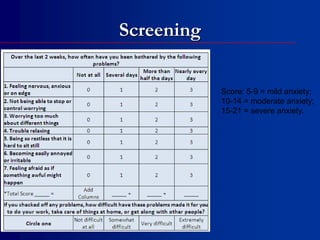
Screening
Score: 5-9 = mild anxiety;
10-14 = moderate anxiety;
15-21 = severe anxiety.
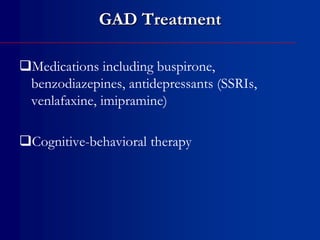
GAD Treatment
Medications including buspirone,
benzodiazepines, antidepressants (SSRIs,
venlafaxine, imipramine)
Cognitive-behavioral therapy
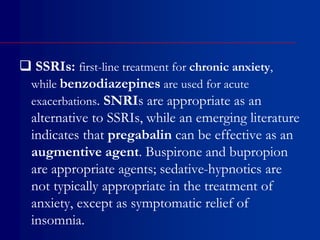
 SSRIs: first-line treatment for chronic anxiety,
while benzodiazepines are used for acute
exacerbations. SNRIs are appropriate as an
alternative to SSRIs, while an emerging literature
indicates that pregabalin can be effective as an
augmentive agent. Buspirone and bupropion
are appropriate agents; sedative-hypnotics are
not typically appropriate in the treatment of
anxiety, except as symptomatic relief of
insomnia.
A patient comes to you for discussion of treatment for
GAD. She recently became dissatisfied with the care
provided by her psychiatrist and would like to change
her regimen under your care. She is on an SSRI, but
finds that her anxiety symptoms are not sufficiently
controlled. In addition, she has numerous episodes of
acute anxiety exacerbation. Which of the following
might be possible additions or alternations to her
regimen?
a) Augmenting SSRI with bupropion or
pregabalin
b) Adding a benzodiazepine
c) Switching from an SSRI to an SNRI
d) Increasing the dose of SSRI
e) All of the above
a) Augmenting SSRI with bupropion or
pregabalin
b) Adding a benzodiazepine
c) Switching from an SSRI to an SNRI
d) Increasing the dose of SSRI
e) All of the above
Refrences:
ACP Manual on Anxiety Disorder, 2015.
Anxiety Disorders Association of America. Anxiety
disorders. Retrieved on April 28, 2009 from
http://www.adaa.org/GettingHelp/Briefoverview.asp
National Institute of Mental Health. (2008). The
Numbers Count: Mental disorders in America.
Retrieved on September 1, 2008, from
http://www.nimh.nih.gov/health/publications/the-
numbers-count-mental-disorders-in-
america.shtml#Anxiety

Anxiety disorder

  • 1.
    Anxiety Disorder By: ShimaGhavimi, MD PGY-1
  • 2.
    According to ACP Studiesshow that 60% of patients with panic and anxiety disorders are treated by primary care physicians. That means you have a tremendous opportunity to help these patients and make a major difference in their lives.  90% of all cases have been undiagnosed.
  • 3.
  • 4.
    Generalized Anxiety Disorder Lifetime prevalence of GAD in American adults is 5 % Excessive worry and anxiety that is difficult to control Symptoms occurs more days than not for at least 6 months and are bout a number of events And activities
  • 5.
    GAD 3 or moreof the following symptoms: Restlessness or feeling keyed up or on edge, easily fatigued, difficulty concentrating, irritability, muscle tension, sleep disturbance Causes significant stress or impairment
  • 6.
    Risk Factors Female Older age Positivefamily history Less strong risk factors: Increase in stress, history of physical and emotional trauma and smoking
  • 7.
    The prevalence ofchronic medical illness including lung disease , DM , heart disease , HTN, arthritis is greater among those with anxiety Is A/W being divorced or separated Blacks, Latino and Asian have decreased risk of GAD.
  • 8.
    GAD and depression Accordingto DMS-IV a patient with diagnosed depression can only be diagnosed with anxiety once depression has undergone remission Therefore when managing a patient with depression and anxiety we first treat the depression as anxiety often improves with treatment of depression.
  • 9.
    Screening Score: 5-9 =mild anxiety; 10-14 = moderate anxiety; 15-21 = severe anxiety.
  • 13.
    GAD Treatment Medications includingbuspirone, benzodiazepines, antidepressants (SSRIs, venlafaxine, imipramine) Cognitive-behavioral therapy
  • 14.
     SSRIs: first-linetreatment for chronic anxiety, while benzodiazepines are used for acute exacerbations. SNRIs are appropriate as an alternative to SSRIs, while an emerging literature indicates that pregabalin can be effective as an augmentive agent. Buspirone and bupropion are appropriate agents; sedative-hypnotics are not typically appropriate in the treatment of anxiety, except as symptomatic relief of insomnia.
  • 15.
    A patient comesto you for discussion of treatment for GAD. She recently became dissatisfied with the care provided by her psychiatrist and would like to change her regimen under your care. She is on an SSRI, but finds that her anxiety symptoms are not sufficiently controlled. In addition, she has numerous episodes of acute anxiety exacerbation. Which of the following might be possible additions or alternations to her regimen?
  • 16.
    a) Augmenting SSRIwith bupropion or pregabalin b) Adding a benzodiazepine c) Switching from an SSRI to an SNRI d) Increasing the dose of SSRI e) All of the above
  • 17.
    a) Augmenting SSRIwith bupropion or pregabalin b) Adding a benzodiazepine c) Switching from an SSRI to an SNRI d) Increasing the dose of SSRI e) All of the above
  • 18.
    Refrences: ACP Manual onAnxiety Disorder, 2015. Anxiety Disorders Association of America. Anxiety disorders. Retrieved on April 28, 2009 from http://www.adaa.org/GettingHelp/Briefoverview.asp National Institute of Mental Health. (2008). The Numbers Count: Mental disorders in America. Retrieved on September 1, 2008, from http://www.nimh.nih.gov/health/publications/the- numbers-count-mental-disorders-in- america.shtml#Anxiety