cdc.gov/parasites/crypto/


   Angie Bain
Stephanie Hood
   Protozoan
   Phylum: Apicomplexa
   Class: Sporozoasida
   Order: Eucoccidiida
   Family Cryptosporiidae
   Genus: Criptosporidium                    waterfilterreview.com


   Species: parvum, muris, meleagridis, felis, etc.
   Recognized in mice in 1907
   Reported in humans in 1976
       Immunocompetent child
       Immunosuppressed adult
   Recognized globally in 1980s
    and 1990s
                                            www.nap.edu
       AIDS patients
                                    Ernest Edward Tyzzer
       Outbreak among veterinary
        students
   Cryptosporidium is a
    spore producing parasite
    found in the intestine of
    infected people and
    animals.
   Cryptosporidium spp. is     landesbioscience.com

    the most common cause
    of Cryptosporidiosis.
   Infection
     Ingesting food or drinks
      contaminated with fecal
      material
     Swallowing recreational
      water contaminated with              secretsofsoa.com
      Cryptosporidium
     Not washing hands
     Sexual practices leading
      to oral exposure with
      fecal material


                                 victorystore.com
   Buries into intestinal
    lining of the gut
       Goes through Life Cycle
   Alters osmotic pressure
       Diarrhea
   Atrophy of intestinal villi
       Alters uptake of fluids,
        electrolytes, and nutrients
       Malabsorption syndrome
                                      CDC DPDx Library
   Symptoms (2 to 10 days after
    infection and can last up to
    30 days)
     Diarrhea
     Stomach cramps                        treehugger.com

     Dehydration
     Nausea
     Vomiting
     Fever
     Weight loss
     Sometimes no symptoms are
      seen
                                   bathroomscalereview.com
   White Blood Cells
    Phagocytize Parasites
     Segmented neutrophils
     Macrophages
     Lymphocytes
     Eosinophils
                              labmed.hallym.ac.kr
   CD4+ T cells
       Early infection
   CD8+ T cells
       Elimination
   CD154 and CD40
       Stimulate nitric oxide
       IFN-γ, IL-12
       T cell response
       Apoptosis
   Other Cytokines
   TNF-α, IL-1β, IL-2, IL-
    4, IL-10, IL-15, etc.
   Patients with AIDS
       Decreased CD4+ count     Ashton-Rickardt, 2004
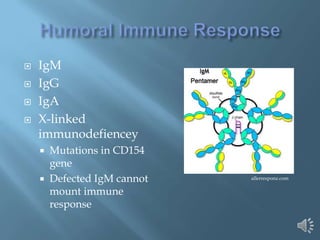
   IgM
   IgG
   IgA
   X-linked
    immunodefiencey
       Mutations in CD154
        gene
       Defected IgM cannot   allerresponz.com


        mount immune
        response
   Specimen Source
       Multiple Stool Specimens
   Diagnostic Techniques
       Wet Mount
       Modified Acid Fast Stain
       Direct Fluorescent Antibody (DFA)
        Assay
   Detection Methods
       Safranin Stain
       Trichrome Stain
       Enzyme Immunoassay (EIA)            savethecanyoncall.com
       Polymerase Chain Reaction (PCR)
       Rapid Immunochromatographic
        cartridge Assays
   Visualization of Oocysts
       4 to 6 µm
   Bight-Field Microscopy
   Differential Interference
    contrast (DIC)
   High Sensitivity and               CDC DPDx Library


    Specificity                 Wet Mount Slide
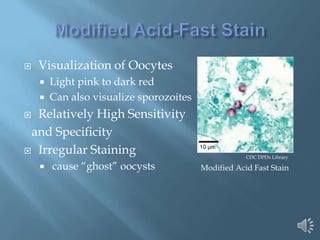
   Visualization of Oocytes
       Light pink to dark red
       Can also visualize sporozoites
 Relatively High Sensitivity
 and Specificity
 Irregular Staining
                                                     CDC DPDx Library

       cause “ghost” oocysts            Modified Acid Fast Stain
   Fluorescence microscope
   “Gold Standard”
       High sensitivity and
        specificity
   Does not provide
    archievable stained slide
   Requires special equipment             CDC DPDx Library

                                   Fluorescent Stain
                                 Auramine Rhodamine
   Safranin stain
     Oocysts stain a bright red
      orange
     Not widely used because
      oocysts may not stain properly
    Trichrome Stain
                                         CDC DPDx Library

                                       Safranin Stain
       Oocysts may appear unstained
   Lowest sensitivity and
    specificity among all tests
   Can detect Oocysts, but
    Cryptosporidium should be
    confirmed by diagnostic                CDC DPDx Library
    techniques                         Trichrome Stain
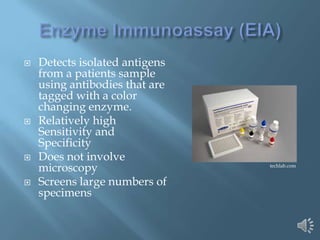
   Detects isolated antigens
    from a patients sample
    using antibodies that are
    tagged with a color
    changing enzyme.
   Relatively high
    Sensitivity and
    Specificity
   Does not involve
    microscopy                  techlab.com


   Screens large numbers of
    specimens
   Separates DNA
    fragments based on
    size
   435 bp
   High Sensitivity and
    Specificity

                           CDC DPDx Library
   Detects isolated antigens
    from sample using
    antibodies. A positive test
    is indicated by a colored
    bar.
    Variable Sensitivity and
                                  alibaba.com

    Specificity
   Some Assays Have Been
    Recalled
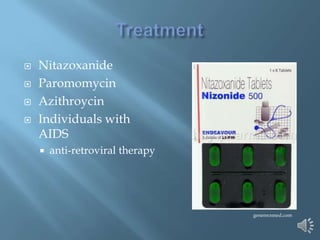
   Nitazoxanide
   Paromomycin
   Azithroycin
   Individuals with
    AIDS
       anti-retroviral therapy


                                  generecsmed.com
   Ashton-Rickardt, P.G. A license to remember. Nat. Immunol.
    5, 1097-1098 (2004).
   Beach, M.J. And Johnston, S. P. Manufacturer's recall of rapid
    cartridge assay kits on the basis of false-positive Cryptosporidium
    antigen tests — Colorado. MMWR. 53, 198-199 (2004).
   CDC. http://www.cdc.gov/parasites/crypto/. Accessed
    September 22, 2011
   Dillingham, R. A., Aldo, A. A., and Guerrant, R. L.
    Cryptosporidiosis: epidemiology and impact. Microb. Infect.
    4, 1059-1066 (2002).
   Mahon, C.R., Lehman, D.C., and Manuselis, G. Textbook of
    Diagnostic Microbiology. 4th Ed. Elsevier (2011)
   Riggs, M. W. Recent Advances in cryptosporidiosis: the immune
    response. Microb. Infect. 4, 1067-1080 (2002).
   Stevens, C.D. Clinical Immunology & Serology: A Laboratory
    Perspective. 3rd Ed. F.A. Davis Company (2010).
   Tzipori, S. and Honorine, W. Cryptosporidiosis:
    biology, pathogenesis and disease. Microb. Infect. 4, 1047-1058
    (2002).

Cryptosporidium presentation

  • 1.
    cdc.gov/parasites/crypto/ Angie Bain Stephanie Hood
  • 2.
    Protozoan  Phylum: Apicomplexa  Class: Sporozoasida  Order: Eucoccidiida  Family Cryptosporiidae  Genus: Criptosporidium waterfilterreview.com  Species: parvum, muris, meleagridis, felis, etc.
  • 3.
    Recognized in mice in 1907  Reported in humans in 1976  Immunocompetent child  Immunosuppressed adult  Recognized globally in 1980s and 1990s www.nap.edu  AIDS patients Ernest Edward Tyzzer  Outbreak among veterinary students
  • 4.
    Cryptosporidium is a spore producing parasite found in the intestine of infected people and animals.  Cryptosporidium spp. is landesbioscience.com the most common cause of Cryptosporidiosis.
  • 5.
    Infection  Ingesting food or drinks contaminated with fecal material  Swallowing recreational water contaminated with secretsofsoa.com Cryptosporidium  Not washing hands  Sexual practices leading to oral exposure with fecal material victorystore.com
  • 6.
    Buries into intestinal lining of the gut  Goes through Life Cycle  Alters osmotic pressure  Diarrhea  Atrophy of intestinal villi  Alters uptake of fluids, electrolytes, and nutrients  Malabsorption syndrome CDC DPDx Library
  • 7.
    Symptoms (2 to 10 days after infection and can last up to 30 days)  Diarrhea  Stomach cramps treehugger.com  Dehydration  Nausea  Vomiting  Fever  Weight loss  Sometimes no symptoms are seen bathroomscalereview.com
  • 8.
    White Blood Cells Phagocytize Parasites  Segmented neutrophils  Macrophages  Lymphocytes  Eosinophils labmed.hallym.ac.kr
  • 9.
    CD4+ T cells  Early infection  CD8+ T cells  Elimination  CD154 and CD40  Stimulate nitric oxide  IFN-γ, IL-12  T cell response  Apoptosis  Other Cytokines  TNF-α, IL-1β, IL-2, IL- 4, IL-10, IL-15, etc.  Patients with AIDS  Decreased CD4+ count Ashton-Rickardt, 2004
  • 10.
    IgM  IgG  IgA  X-linked immunodefiencey  Mutations in CD154 gene  Defected IgM cannot allerresponz.com mount immune response
  • 11.
    Specimen Source  Multiple Stool Specimens  Diagnostic Techniques  Wet Mount  Modified Acid Fast Stain  Direct Fluorescent Antibody (DFA) Assay  Detection Methods  Safranin Stain  Trichrome Stain  Enzyme Immunoassay (EIA) savethecanyoncall.com  Polymerase Chain Reaction (PCR)  Rapid Immunochromatographic cartridge Assays
  • 12.
    Visualization of Oocysts  4 to 6 µm  Bight-Field Microscopy  Differential Interference contrast (DIC)  High Sensitivity and CDC DPDx Library Specificity Wet Mount Slide
  • 13.
    Visualization of Oocytes  Light pink to dark red  Can also visualize sporozoites  Relatively High Sensitivity and Specificity  Irregular Staining CDC DPDx Library  cause “ghost” oocysts Modified Acid Fast Stain
  • 14.
    Fluorescence microscope  “Gold Standard”  High sensitivity and specificity  Does not provide archievable stained slide  Requires special equipment CDC DPDx Library Fluorescent Stain Auramine Rhodamine
  • 15.
    Safranin stain  Oocysts stain a bright red orange  Not widely used because oocysts may not stain properly Trichrome Stain CDC DPDx Library  Safranin Stain  Oocysts may appear unstained  Lowest sensitivity and specificity among all tests  Can detect Oocysts, but Cryptosporidium should be confirmed by diagnostic CDC DPDx Library techniques Trichrome Stain
  • 16.
    Detects isolated antigens from a patients sample using antibodies that are tagged with a color changing enzyme.  Relatively high Sensitivity and Specificity  Does not involve microscopy techlab.com  Screens large numbers of specimens
  • 17.
    Separates DNA fragments based on size  435 bp  High Sensitivity and Specificity CDC DPDx Library
  • 18.
    Detects isolated antigens from sample using antibodies. A positive test is indicated by a colored bar. Variable Sensitivity and alibaba.com  Specificity  Some Assays Have Been Recalled
  • 19.
    Nitazoxanide  Paromomycin  Azithroycin  Individuals with AIDS  anti-retroviral therapy generecsmed.com
  • 20.
    Ashton-Rickardt, P.G. A license to remember. Nat. Immunol. 5, 1097-1098 (2004).  Beach, M.J. And Johnston, S. P. Manufacturer's recall of rapid cartridge assay kits on the basis of false-positive Cryptosporidium antigen tests — Colorado. MMWR. 53, 198-199 (2004).  CDC. http://www.cdc.gov/parasites/crypto/. Accessed September 22, 2011  Dillingham, R. A., Aldo, A. A., and Guerrant, R. L. Cryptosporidiosis: epidemiology and impact. Microb. Infect. 4, 1059-1066 (2002).  Mahon, C.R., Lehman, D.C., and Manuselis, G. Textbook of Diagnostic Microbiology. 4th Ed. Elsevier (2011)  Riggs, M. W. Recent Advances in cryptosporidiosis: the immune response. Microb. Infect. 4, 1067-1080 (2002).  Stevens, C.D. Clinical Immunology & Serology: A Laboratory Perspective. 3rd Ed. F.A. Davis Company (2010).  Tzipori, S. and Honorine, W. Cryptosporidiosis: biology, pathogenesis and disease. Microb. Infect. 4, 1047-1058 (2002).