Bundled tube
structural system
By
Umer Farooq
Presentation
on
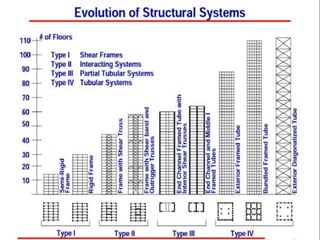
 One of the most efficient structural systems against
heavy wind loads is the bundled tube structural system
 The first person to implement the bundled tube
structural system was Fazlur Rahman Khan from
Dhaka, Bangladesh with the design of the DeWitt-
Chestnut Apartments in Chicago, Illinois.
Bundled tube structural system
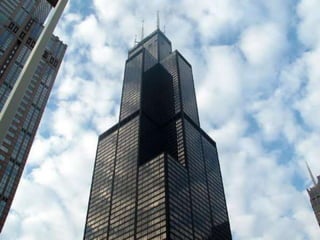
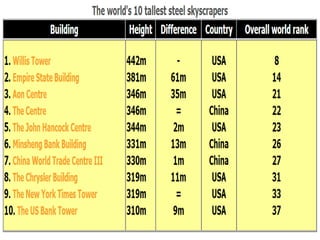
The landmark and iconic building that uses the
bundled tube structural system is the Willis Tower
(formerly known as the Sears Tower)
Fazlur Rahman Khan
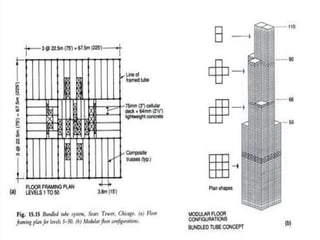
A bundled tube typically consists of a number of
individual tubes interconnected to form a multicell
tube, in which the frames in the lateral load
direction resist the shears, while the flange frames
carry most of the overturning moments.
A Bundled Tube Structure
 No interior columns
 110 stories
 1,469′-0″ in height
 Tallest building until 1996
 Each structural tube = 75′-0″ x 75′-0″
 Completed in 1974
The Willis Tower in Chicago used this design, employing
nine tubes of varying height to achieve its distinct
appearance. It consists of exterior framed tube stiffened
by interior frames to reduce the effect of shear lag in the
exterior columns.
Details on the Sears Tower:
Bundled Tube
Structural
System and
how it effects
the floor plan
Advantages of Bundled tube system
 Sufficient lateral stiffness
 Building acts as a unified system of stiffened tubes
 Aesthetically appealing
 The interaction between the individual tubes and the
belt trusses at mechanical levels allows the building
to attain its extreme height
 These trusses take the gravity loads from above and
redistribute them evenly onto the tubes below
The bundle tube design was not only highly efficient in
economic terms, but it was also "innovative in its
potential for versatile formulation of architectural space.
Efficient towers no longer had to be box-like; the tube-
units could take on various shapes and could be
bundled together in different sorts of groupings.
The bundled tube structure meant that "buildings no
longer need be boxlike in appearance: they could
become sculpture
 Bundled Tube Structural System
 Bundled Tube Structural System
 Bundled Tube Structural System

Bundled Tube Structural System

  • 1.
  • 4.
     One ofthe most efficient structural systems against heavy wind loads is the bundled tube structural system  The first person to implement the bundled tube structural system was Fazlur Rahman Khan from Dhaka, Bangladesh with the design of the DeWitt- Chestnut Apartments in Chicago, Illinois. Bundled tube structural system
  • 5.
    The landmark andiconic building that uses the bundled tube structural system is the Willis Tower (formerly known as the Sears Tower) Fazlur Rahman Khan
  • 6.
    A bundled tubetypically consists of a number of individual tubes interconnected to form a multicell tube, in which the frames in the lateral load direction resist the shears, while the flange frames carry most of the overturning moments. A Bundled Tube Structure
  • 7.
     No interiorcolumns  110 stories  1,469′-0″ in height  Tallest building until 1996  Each structural tube = 75′-0″ x 75′-0″  Completed in 1974 The Willis Tower in Chicago used this design, employing nine tubes of varying height to achieve its distinct appearance. It consists of exterior framed tube stiffened by interior frames to reduce the effect of shear lag in the exterior columns. Details on the Sears Tower:
  • 9.
    Bundled Tube Structural System and howit effects the floor plan
  • 13.
    Advantages of Bundledtube system  Sufficient lateral stiffness  Building acts as a unified system of stiffened tubes  Aesthetically appealing  The interaction between the individual tubes and the belt trusses at mechanical levels allows the building to attain its extreme height  These trusses take the gravity loads from above and redistribute them evenly onto the tubes below
  • 14.
    The bundle tubedesign was not only highly efficient in economic terms, but it was also "innovative in its potential for versatile formulation of architectural space. Efficient towers no longer had to be box-like; the tube- units could take on various shapes and could be bundled together in different sorts of groupings. The bundled tube structure meant that "buildings no longer need be boxlike in appearance: they could become sculpture