NAVODAYA DENTAL COLLEGE
DEPARTMENT OF PEDODONTICS
STAFF NAME – Dr VINOD KUMAR
Professor and Head of department
TOPIC NAME –Diagnosis of pulp pathology
INTRODUCTION
• D ental pulp may be defined as, “ a special organ with a
unique environment of the unyielding dentin surrounding a
resistant,resilient soft tissue of mesenchymal origin
reinforced with a ground substance.”
• It has a close relationship between its peripheral
cells,the odontoblasts a n d the dentin thereby making it a
functional entity sometimes refered to as „pulp-dentin
complex‟.
• The dental pulp is a delicate connective tissue
liberally interspersed with tiny blood
vessels,lymphatics,nerves, & undifferentiated CT cells.
• The enclosure of the pulp tissue within the rigid
calcified walls of dentin precludes the excessive
swelling of tissue that occur in hyperemic phases of
inflammation in other tissues.
• Pulpal injury  frequently irreversible & painful
DIAGNOSTIC PROCEDURES
• Diagnosis is the process of identifying a medical condition
or disease by proper evaluation of signs & sypmtoms &
from the results of various diagnostic procedures.
• Diagnostic procedure should follow a consistent & logical
order & include review of medical & dental histories
,radiographic examination & clinical examination.
• Pulp is the essence of the tooth. It is the structure that makes
the tooth vital.
• A n understanding of the possible underlying pathological
process ,combined with a n exact assessment of pain history
& appropriate clinical tests should aid the practitioner in
determining the nature of the pulpal inflammation.
• Operative diagnosis  there a r e instances when a final
diagnosis can be reached only on direct evaluation of
pulp tissue & decission about treatment can be made
accordingly.
eg:
• History
• Recollecting -1st step towards establishing a diagnosis.
• M a y not determine treatment but may influence modification in
treatment modalities as according to the person‟s health
status.
• Detailed history of pain
• Extra-Oral Examination
• For localized swelling,changes in color or bruises,abrasions,cuts or
scars & similar signs of disease,trauma or previous T/t.
• Enlarged lymphnodes important in denoting spread of infection.
• Intra-Oral Examination
• Examination of oral mucosa for any abnormality
• Carious lesions ,discolorations & other obvious abnormalities asstd
with the teethshould be noted.
• Coronal Evaluation
 by using a mouth mirror & explorer a n d possibly a fiber optic light
source.
Suspected tooth carefully & thoroughly examined for
caries,defective restoration,discoloration,enamel loss or defects that
allow direct passage of stimuli to pulp.
• Pulpal Evaluation
Clinical condition of the pulp evaluated by thermal
stimuli,percussion,palpation & vitality tests.
• Pulpal Evaluation + History+ R/G findings Diagnosis
• The various pulpal evaluation methods are:
i) Pulp testing
ii) Percussion
iii) Radiographs
Dental Pulp Testing
• A useful & essential diagnostic aid in endodontics
• A n investigation that provide valuable diagnosis &
treatment planning information.
• Help in the assessment of pulp health based on its
qualitative sendory response.
• 3 types
Pulp vitality testing assessment of pulp‟s blood supply
eg: Laser Doppler
Flowmetry Pulse
oximetry
Pulp sensibility testing assessment of pulp‟s sensory
response.
eg: Thermal & electric pulp testing
Pulp sensitivity condition of pulp being very responsive to
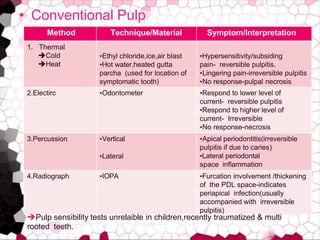
• Conventional Pulp
Testing
Method Technique/Material Symptom/Interpretation
1. Thermal
Cold
Heat
•Ethyl chloride,ice,air blast
•Hot water,heated gutta
parcha (used for location of
symptomatic tooth)
•Hypersensitivity/subsiding
pain- reversible pulpitis.
•Lingering pain-irreversible pulpitis
•No response-pulpal necrosis
2.Electirc •Odontometer •Respond to lower level of
current- reversible pulpitis
•Respond to higher level of
current- Irreversible
•No response-necrosis
3.Percussion •Vertical
•Lateral
•Apical periodontitis(irreversible
pulpitis if due to caries)
•Lateral periodontal
space inflammation
4.Radiograph •IOPA •Furcation involvement /thickening
of the PDL space-indicates
periapical infection(usually
accompanied with irreversible
pulpitis)
Pulp sensibility tests unrelaible in children,recently traumatized & multi
rooted teeth.
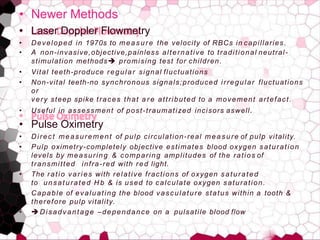
• Newer Methods
• Laser Doppler Flowmetry
• Developed in 1970s to measure the velocity of RBCs in capillaries.
• A non-invasive,objective,painless alternative to traditional neutral-
stimulation methods promising test for children.
• Vital teeth-produce regular signal fluctuations
• Non-vital teeth-no synchronous signals;produced irregular fluctuations
or
very steep spike traces that a r e attributed to a movement artefact.
• Useful in assessment of post-traumatized incisors aswell.
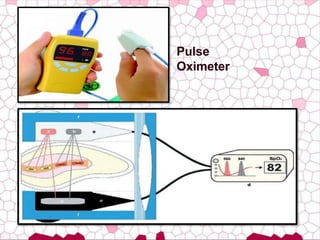
• Pulse Oximetry
• Direct measurement of pulp circulation-real measure of pulp vitality.
• Pulp oximetry-completely objective estimates blood oxygen saturation
levels by measuring & comparing amplitudes of the ratios of
transmitted infra-red with red light.
• The ratio varies with relative fractions of oxygen saturated
to unsaturated H b & is used to calculate oxygen saturation.
• Capable of evaluating the blood vasculature status within a tooth &
therefore pulp vitality.
• Disadvantage –dependance on a pulsatile blood flow
• Duel Wavelength Spectrometry
• Measures blood oxygenation change within the capillary bed
of dental tissue & tus not dependent on a pulsatile blood flow.
• Hughes Probeye Camera
• Used in detecting temperature change a s small a s 0.1 C
,hence
,been used to test pulp vitality experimentally.
Odontomet
er
Laser Doppler
Flowmeter
Pulse
Oximeter

Diagnosis of Pulp Pathologies.pptx

  • 1.
    NAVODAYA DENTAL COLLEGE DEPARTMENTOF PEDODONTICS STAFF NAME – Dr VINOD KUMAR Professor and Head of department TOPIC NAME –Diagnosis of pulp pathology
  • 2.
    INTRODUCTION • D entalpulp may be defined as, “ a special organ with a unique environment of the unyielding dentin surrounding a resistant,resilient soft tissue of mesenchymal origin reinforced with a ground substance.” • It has a close relationship between its peripheral cells,the odontoblasts a n d the dentin thereby making it a functional entity sometimes refered to as „pulp-dentin complex‟. • The dental pulp is a delicate connective tissue liberally interspersed with tiny blood vessels,lymphatics,nerves, & undifferentiated CT cells. • The enclosure of the pulp tissue within the rigid calcified walls of dentin precludes the excessive swelling of tissue that occur in hyperemic phases of inflammation in other tissues. • Pulpal injury  frequently irreversible & painful
  • 3.
    DIAGNOSTIC PROCEDURES • Diagnosisis the process of identifying a medical condition or disease by proper evaluation of signs & sypmtoms & from the results of various diagnostic procedures. • Diagnostic procedure should follow a consistent & logical order & include review of medical & dental histories ,radiographic examination & clinical examination. • Pulp is the essence of the tooth. It is the structure that makes the tooth vital. • A n understanding of the possible underlying pathological process ,combined with a n exact assessment of pain history & appropriate clinical tests should aid the practitioner in determining the nature of the pulpal inflammation. • Operative diagnosis  there a r e instances when a final diagnosis can be reached only on direct evaluation of pulp tissue & decission about treatment can be made accordingly. eg:
  • 4.
    • History • Recollecting-1st step towards establishing a diagnosis. • M a y not determine treatment but may influence modification in treatment modalities as according to the person‟s health status. • Detailed history of pain • Extra-Oral Examination • For localized swelling,changes in color or bruises,abrasions,cuts or scars & similar signs of disease,trauma or previous T/t. • Enlarged lymphnodes important in denoting spread of infection. • Intra-Oral Examination • Examination of oral mucosa for any abnormality • Carious lesions ,discolorations & other obvious abnormalities asstd with the teethshould be noted. • Coronal Evaluation  by using a mouth mirror & explorer a n d possibly a fiber optic light source. Suspected tooth carefully & thoroughly examined for caries,defective restoration,discoloration,enamel loss or defects that allow direct passage of stimuli to pulp. • Pulpal Evaluation Clinical condition of the pulp evaluated by thermal stimuli,percussion,palpation & vitality tests.
  • 5.
    • Pulpal Evaluation+ History+ R/G findings Diagnosis • The various pulpal evaluation methods are: i) Pulp testing ii) Percussion iii) Radiographs Dental Pulp Testing • A useful & essential diagnostic aid in endodontics • A n investigation that provide valuable diagnosis & treatment planning information. • Help in the assessment of pulp health based on its qualitative sendory response. • 3 types Pulp vitality testing assessment of pulp‟s blood supply eg: Laser Doppler Flowmetry Pulse oximetry Pulp sensibility testing assessment of pulp‟s sensory response. eg: Thermal & electric pulp testing Pulp sensitivity condition of pulp being very responsive to
  • 6.
    • Conventional Pulp Testing MethodTechnique/Material Symptom/Interpretation 1. Thermal Cold Heat •Ethyl chloride,ice,air blast •Hot water,heated gutta parcha (used for location of symptomatic tooth) •Hypersensitivity/subsiding pain- reversible pulpitis. •Lingering pain-irreversible pulpitis •No response-pulpal necrosis 2.Electirc •Odontometer •Respond to lower level of current- reversible pulpitis •Respond to higher level of current- Irreversible •No response-necrosis 3.Percussion •Vertical •Lateral •Apical periodontitis(irreversible pulpitis if due to caries) •Lateral periodontal space inflammation 4.Radiograph •IOPA •Furcation involvement /thickening of the PDL space-indicates periapical infection(usually accompanied with irreversible pulpitis) Pulp sensibility tests unrelaible in children,recently traumatized & multi rooted teeth.
  • 7.
    • Newer Methods •Laser Doppler Flowmetry • Developed in 1970s to measure the velocity of RBCs in capillaries. • A non-invasive,objective,painless alternative to traditional neutral- stimulation methods promising test for children. • Vital teeth-produce regular signal fluctuations • Non-vital teeth-no synchronous signals;produced irregular fluctuations or very steep spike traces that a r e attributed to a movement artefact. • Useful in assessment of post-traumatized incisors aswell. • Pulse Oximetry • Direct measurement of pulp circulation-real measure of pulp vitality. • Pulp oximetry-completely objective estimates blood oxygen saturation levels by measuring & comparing amplitudes of the ratios of transmitted infra-red with red light. • The ratio varies with relative fractions of oxygen saturated to unsaturated H b & is used to calculate oxygen saturation. • Capable of evaluating the blood vasculature status within a tooth & therefore pulp vitality. • Disadvantage –dependance on a pulsatile blood flow
  • 8.
    • Duel WavelengthSpectrometry • Measures blood oxygenation change within the capillary bed of dental tissue & tus not dependent on a pulsatile blood flow. • Hughes Probeye Camera • Used in detecting temperature change a s small a s 0.1 C ,hence ,been used to test pulp vitality experimentally. Odontomet er Laser Doppler Flowmeter
  • 9.