Correct treatment begins with a correct
diagnosis. Diagnostic procedures should
follow a consistent, logical order that
includes comprehensive medical and dental
history, radiographic
examination,extraoral and intraoral clinical
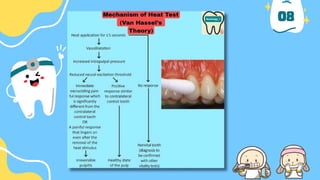
examination including histopathological
examination to arrive at the final diagnosis
when required.
01
1. Visual and tactile inspection
(a) Hard tissues
(b) Soft tissues
. (i) Gingiva
(ii) Periodontium
2 Percussion
3. Palpation
4. Mobility and depressibility
5.Bite test
6. Radiography
(a) Intraoral periapical radiographs
(b) Bitewing radiographs
(c) Cone beam computed tomography (
CBCT)
02
7. Assessment of pulp vitality
(a) Neural sensibility tests
. (i) Thermal tests
(ii) Heat testing
. (iii) Cold testing
. (iv) Electric pulp test ( EPT)
. (v) Anesthetic test
. (vi) Test cavity
(b) Pulp Vascularity tests
(i) Pulse oximetry
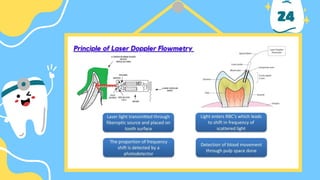
. (ii) Laser Doppler flowmetry
. (iii) Recent technologies
. *Dual wavelength spectrophotometry
*Thermography
. *Crown surface temperature
*Transmitted light photoplethysmography
03
04
Accurate diagnosis of true histologic
status of pulp is of importance for
treatment planning
Indirectly done by assessing neural
sensitivity of pulp
More accurate method is to assess
Vascularity of pulp
Most common methods clinically
employed assess neural sensitivity
ASSESSMENT
OF PULP
VITALITY
05
Indirectly tells about vitality status of pulp. Works on the principle
of stimulating neural fibres in pulp
Materials used:
Electric heat carrier
Hot gutta-percha stick (>65.5°C)
Hot water under rubber dam isolation
Hot burnisher
Hot compound
Dry rubber polishing wheel
06
Area to be tested is isolated, dried , a suitable lubricant
like Vaseline is applied.
Heat is directed to exposed surface of tooth and
patient's response is noted.
Heat is applied to occlusobuccal third of exposed crown.
If no response , hot substance can be moved to central
portion of crown or closer to cervical margin.
Remove immediately if response occurs.
Avoid excessive heat or prolonged application of heat to
tooth.
Method
07
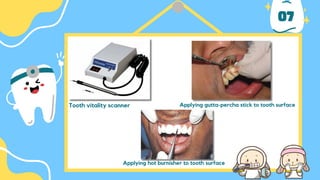
Tooth vitality scanner Applying gutta-percha stick to tooth surface
Applying hot burnisher to tooth surface
08
09
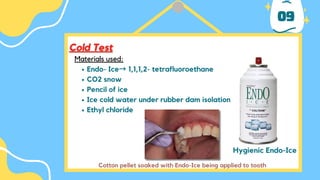
Materials used:
Endo- Ice→1,1,1,2- tetrafluoroethane
CO2 snow
Pencil of ice
Ice cold water under rubber dam isolation
Ethyl chloride
Hygienic Endo-Ice
Cotton pellet soaked with Endo-Ice being applied to tooth
10
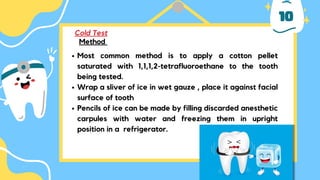
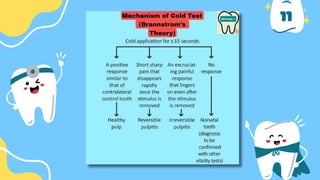
Most common method is to apply a cotton pellet
saturated with 1,1,1,2-tetrafluoroethane to the tooth
being tested.
Wrap a sliver of ice in wet gauze , place it against facial
surface of tooth
Pencils of ice can be made by filling discarded anesthetic
carpules with water and freezing them in upright
position in a refrigerator.
Cold Test
Method
11
12
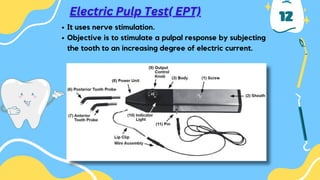
It uses nerve stimulation.
Objective is to stimulate a pulpal response by subjecting
the tooth to an increasing degree of electric current.
13
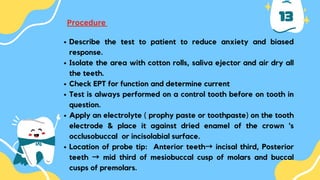
Procedure
Describe the test to patient to reduce anxiety and biased
response.
Isolate the area with cotton rolls, saliva ejector and air dry all
the teeth.
Check EPT for function and determine current
Test is always performed on a control tooth before on tooth in
question.
Apply an electrolyte ( prophy paste or toothpaste) on the tooth
electrode & place it against dried enamel of the crown 's
occlusobuccal or incisolabial surface.
Location of probe tip: Anterior teeth→ incisal third, Posterior
teeth → mid third of mesiobuccal cusp of molars and buccal
cusps of premolars.
14
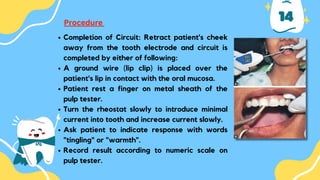
Completion of Circuit: Retract patient's cheek
away from the tooth electrode and circuit is
completed by either of following:
A ground wire (lip clip) is placed over the
patient's lip in contact with the oral mucosa.
Patient rest a finger on metal sheath of the
pulp tester.
Turn the rheostat slowly to introduce minimal
current into tooth and increase current slowly.
Ask patient to indicate response with words
"tingling" or "warmth".
Record result according to numeric scale on
pulp tester.
Procedure
15
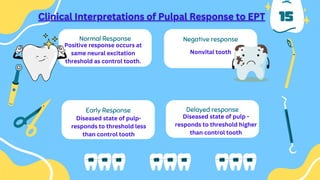
Normal Response Negative response
Delayed response
Early Response
Positive response occurs at
same neural excitation
threshold as control tooth.
Nonvital tooth
Diseased state of pulp-
responds to threshold less
than control tooth
Diseased state of pulp -
responds to threshold higher
than control tooth
16
Gangrenous necrotic pulp
present
Multirooted teeth in which
pulp is partially necrotic,
some fibers still vital in
one or more root canals.
Extensive calcification in
pulp tissue or dentin
Tooth with increased
reparative dentin &
diminished pulp cavity
Fibrotic pulp
Teeth with extensive
restorations & pulp
protecting base
Recently traumatized teeth
Recently erupted teeth with
incomplete root formation
Sedative medication taken
by patient
Patients with high pain
threshold
False positive response False negative response
17
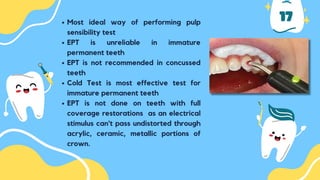
Most ideal way of performing pulp
sensibility test
EPT is unreliable in immature
permanent teeth
EPT is not recommended in concussed
teeth
Cold Test is most effective test for
immature permanent teeth
EPT is not done on teeth with full
coverage restorations as an electrical
stimulus can't pass undistorted through
acrylic, ceramic, metallic portions of
crown.
18
It is restricted to patients who are in pain at the time of test when
usual tests have failed to identify the tooth.
Objective is to anesthetize one tooth at a time until the pain
disappears and is localized to a specific tooth.
Using either infiltration or intra ligament injection, inject the most
posterior tooth in area suspected of being the cause of pain.
19
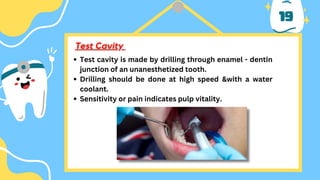
Test cavity is made by drilling through enamel - dentin
junction of an unanesthetized tooth.
Drilling should be done at high speed &with a water
coolant.
Sensitivity or pain indicates pulp vitality.
20
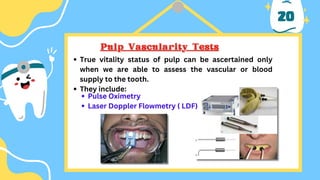
True vitality status of pulp can be ascertained only
when we are able to assess the vascular or blood
supply to the tooth.
They include:
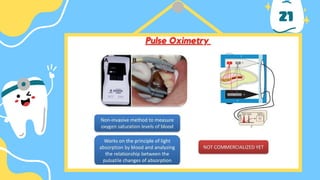
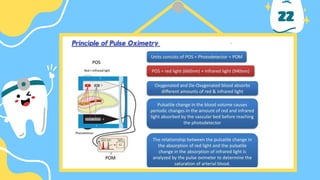
Pulse Oximetry
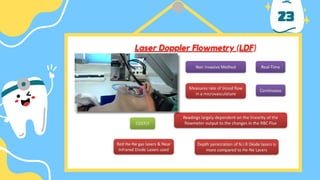
Laser Doppler Flowmetry ( LDF)
21
22
23
24
25
Pulp tests are used during diagnostic phase to detect the status of the
pulp.It is recommended to use more than one test and compare the
results to get a definitive diagnosis . Pulp tests are not 100% accurate.
False negative and false positive result are possible in some cases, as
described previously. New technologies depend on oxygen level and
pulse rate of pulp capillaries and other techniques are invented to
provide very accurate results
26
Pulpal diagnostic methods used in Dentistry

Pulpal diagnostic methods used in Dentistry

  • 2.
    Correct treatment beginswith a correct diagnosis. Diagnostic procedures should follow a consistent, logical order that includes comprehensive medical and dental history, radiographic examination,extraoral and intraoral clinical examination including histopathological examination to arrive at the final diagnosis when required. 01
  • 3.
    1. Visual andtactile inspection (a) Hard tissues (b) Soft tissues . (i) Gingiva (ii) Periodontium 2 Percussion 3. Palpation 4. Mobility and depressibility 5.Bite test 6. Radiography (a) Intraoral periapical radiographs (b) Bitewing radiographs (c) Cone beam computed tomography ( CBCT) 02
  • 4.
    7. Assessment ofpulp vitality (a) Neural sensibility tests . (i) Thermal tests (ii) Heat testing . (iii) Cold testing . (iv) Electric pulp test ( EPT) . (v) Anesthetic test . (vi) Test cavity (b) Pulp Vascularity tests (i) Pulse oximetry . (ii) Laser Doppler flowmetry . (iii) Recent technologies . *Dual wavelength spectrophotometry *Thermography . *Crown surface temperature *Transmitted light photoplethysmography 03
  • 5.
    04 Accurate diagnosis oftrue histologic status of pulp is of importance for treatment planning Indirectly done by assessing neural sensitivity of pulp More accurate method is to assess Vascularity of pulp Most common methods clinically employed assess neural sensitivity ASSESSMENT OF PULP VITALITY
  • 6.
    05 Indirectly tells aboutvitality status of pulp. Works on the principle of stimulating neural fibres in pulp Materials used: Electric heat carrier Hot gutta-percha stick (>65.5°C) Hot water under rubber dam isolation Hot burnisher Hot compound Dry rubber polishing wheel
  • 7.
    06 Area to betested is isolated, dried , a suitable lubricant like Vaseline is applied. Heat is directed to exposed surface of tooth and patient's response is noted. Heat is applied to occlusobuccal third of exposed crown. If no response , hot substance can be moved to central portion of crown or closer to cervical margin. Remove immediately if response occurs. Avoid excessive heat or prolonged application of heat to tooth. Method
  • 8.
    07 Tooth vitality scannerApplying gutta-percha stick to tooth surface Applying hot burnisher to tooth surface
  • 9.
  • 10.
    09 Materials used: Endo- Ice→1,1,1,2-tetrafluoroethane CO2 snow Pencil of ice Ice cold water under rubber dam isolation Ethyl chloride Hygienic Endo-Ice Cotton pellet soaked with Endo-Ice being applied to tooth
  • 11.
    10 Most common methodis to apply a cotton pellet saturated with 1,1,1,2-tetrafluoroethane to the tooth being tested. Wrap a sliver of ice in wet gauze , place it against facial surface of tooth Pencils of ice can be made by filling discarded anesthetic carpules with water and freezing them in upright position in a refrigerator. Cold Test Method
  • 12.
  • 13.
    12 It uses nervestimulation. Objective is to stimulate a pulpal response by subjecting the tooth to an increasing degree of electric current.
  • 14.
    13 Procedure Describe the testto patient to reduce anxiety and biased response. Isolate the area with cotton rolls, saliva ejector and air dry all the teeth. Check EPT for function and determine current Test is always performed on a control tooth before on tooth in question. Apply an electrolyte ( prophy paste or toothpaste) on the tooth electrode & place it against dried enamel of the crown 's occlusobuccal or incisolabial surface. Location of probe tip: Anterior teeth→ incisal third, Posterior teeth → mid third of mesiobuccal cusp of molars and buccal cusps of premolars.
  • 15.
    14 Completion of Circuit:Retract patient's cheek away from the tooth electrode and circuit is completed by either of following: A ground wire (lip clip) is placed over the patient's lip in contact with the oral mucosa. Patient rest a finger on metal sheath of the pulp tester. Turn the rheostat slowly to introduce minimal current into tooth and increase current slowly. Ask patient to indicate response with words "tingling" or "warmth". Record result according to numeric scale on pulp tester. Procedure
  • 16.
    15 Normal Response Negativeresponse Delayed response Early Response Positive response occurs at same neural excitation threshold as control tooth. Nonvital tooth Diseased state of pulp- responds to threshold less than control tooth Diseased state of pulp - responds to threshold higher than control tooth
  • 17.
    16 Gangrenous necrotic pulp present Multirootedteeth in which pulp is partially necrotic, some fibers still vital in one or more root canals. Extensive calcification in pulp tissue or dentin Tooth with increased reparative dentin & diminished pulp cavity Fibrotic pulp Teeth with extensive restorations & pulp protecting base Recently traumatized teeth Recently erupted teeth with incomplete root formation Sedative medication taken by patient Patients with high pain threshold False positive response False negative response
  • 18.
    17 Most ideal wayof performing pulp sensibility test EPT is unreliable in immature permanent teeth EPT is not recommended in concussed teeth Cold Test is most effective test for immature permanent teeth EPT is not done on teeth with full coverage restorations as an electrical stimulus can't pass undistorted through acrylic, ceramic, metallic portions of crown.
  • 19.
    18 It is restrictedto patients who are in pain at the time of test when usual tests have failed to identify the tooth. Objective is to anesthetize one tooth at a time until the pain disappears and is localized to a specific tooth. Using either infiltration or intra ligament injection, inject the most posterior tooth in area suspected of being the cause of pain.
  • 20.
    19 Test cavity ismade by drilling through enamel - dentin junction of an unanesthetized tooth. Drilling should be done at high speed &with a water coolant. Sensitivity or pain indicates pulp vitality.
  • 21.
    20 True vitality statusof pulp can be ascertained only when we are able to assess the vascular or blood supply to the tooth. They include: Pulse Oximetry Laser Doppler Flowmetry ( LDF)
  • 22.
  • 23.
  • 24.
  • 25.
  • 26.
    25 Pulp tests areused during diagnostic phase to detect the status of the pulp.It is recommended to use more than one test and compare the results to get a definitive diagnosis . Pulp tests are not 100% accurate. False negative and false positive result are possible in some cases, as described previously. New technologies depend on oxygen level and pulse rate of pulp capillaries and other techniques are invented to provide very accurate results
  • 27.