APPROVED BY: PRESENTED BY
DR DIVYA JAGGI DR. ANKITA DADWAL
MDS 2ND YR
1/34
RESECTIVE OSSEOUS SURGERY
CONTENTS
2/34
 Introduction
 Bone destruction patterns
 Resective osseous surgery
 Objectives
 Osteoplasty and Ostectomy
 Techniques
 Contraindications
 Advantages And Disadvantages
 conclusion
 References
NORMALALVEOLAR BONE
MORPHOLOGY
3/34
MORPHOLOGICALLY DESCRIPTIVE
TERMS
4/34
BONE DESTRUCTION PATTERNS IN
PERIODONTAL DISEASE
5/34
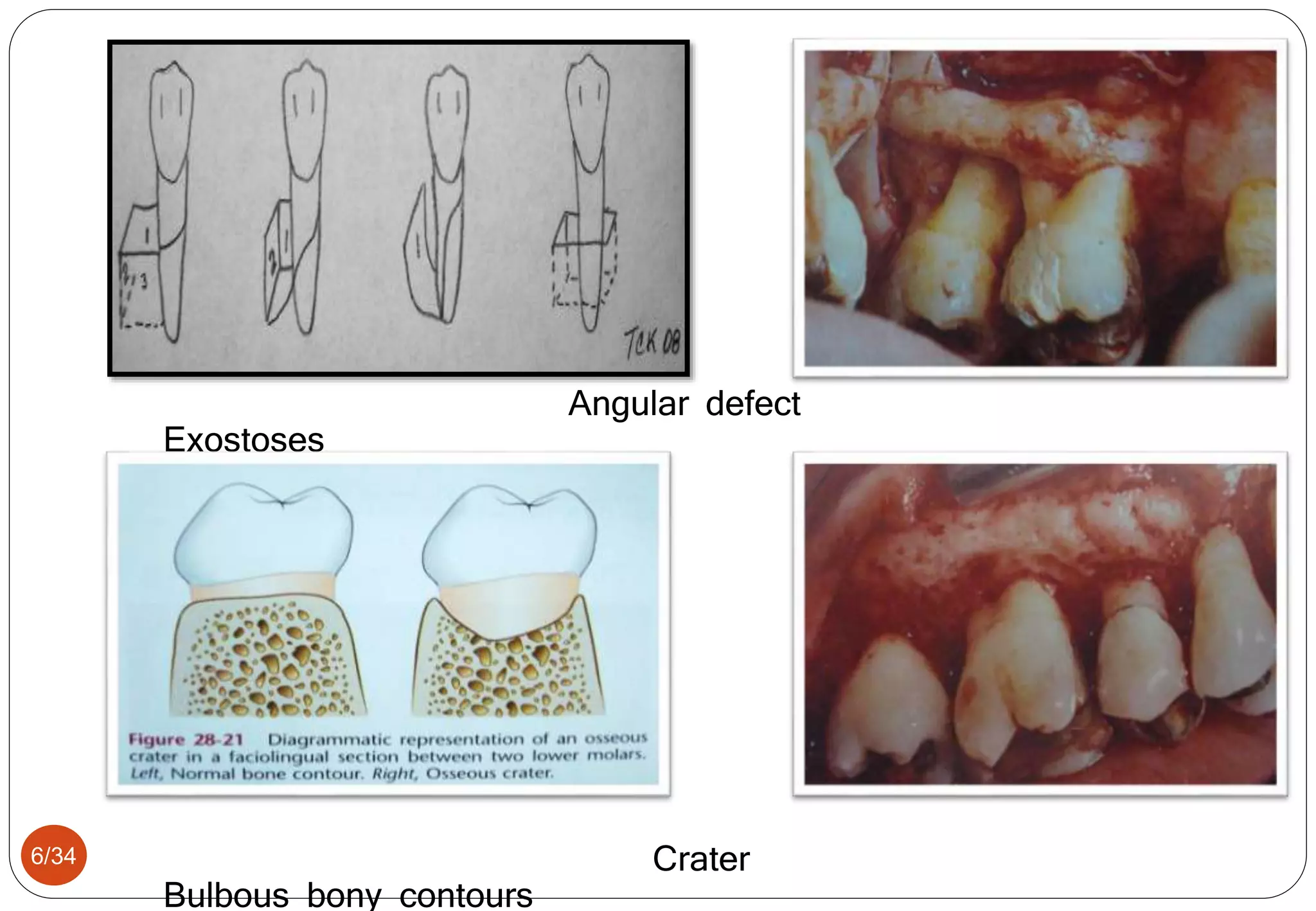
 Horizontal defects
 Vertical or angular defects
 Osseous craters
 Reversed architecture
 Bony ledges
 Furcation involvements
 Exostoses
 Bulbous bone contours
6/34
Angular defect
Exostoses
Crater
Bulbous bony contours
7/34
 Ledge
Reverse Architecture
RESECTIVE OSSEOUS SURGERY
8/34
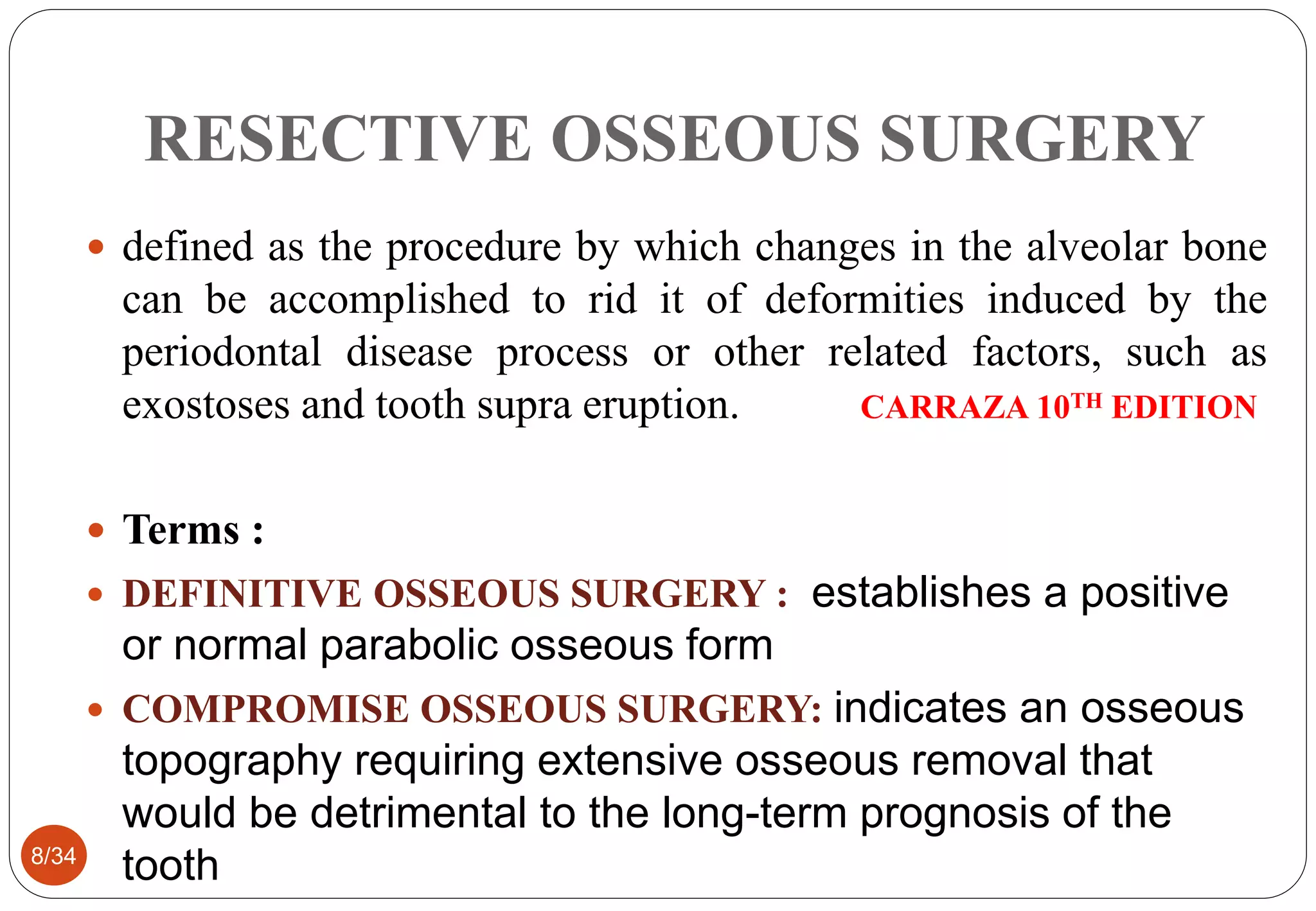
 defined as the procedure by which changes in the alveolar bone
can be accomplished to rid it of deformities induced by the
periodontal disease process or other related factors, such as
exostoses and tooth supra eruption. CARRAZA 10TH EDITION
 Terms :
 DEFINITIVE OSSEOUS SURGERY : establishes a positive
or normal parabolic osseous form
 COMPROMISE OSSEOUS SURGERY: indicates an osseous
topography requiring extensive osseous removal that
would be detrimental to the long-term prognosis of the
tooth
OBJECTIVES
9/34
 Elimination of periodontal pocket and creation of physiological
parabolic contour.
 This contour will maintain physiologic gingival architecture.
 Regeneration of periodontal apparatus destroyed by periodontal
disease.
 Create environment suitable to restorative and prosthodontic
treatment.
EXAMINATION AND TREATMENT
PLANNING
10/34
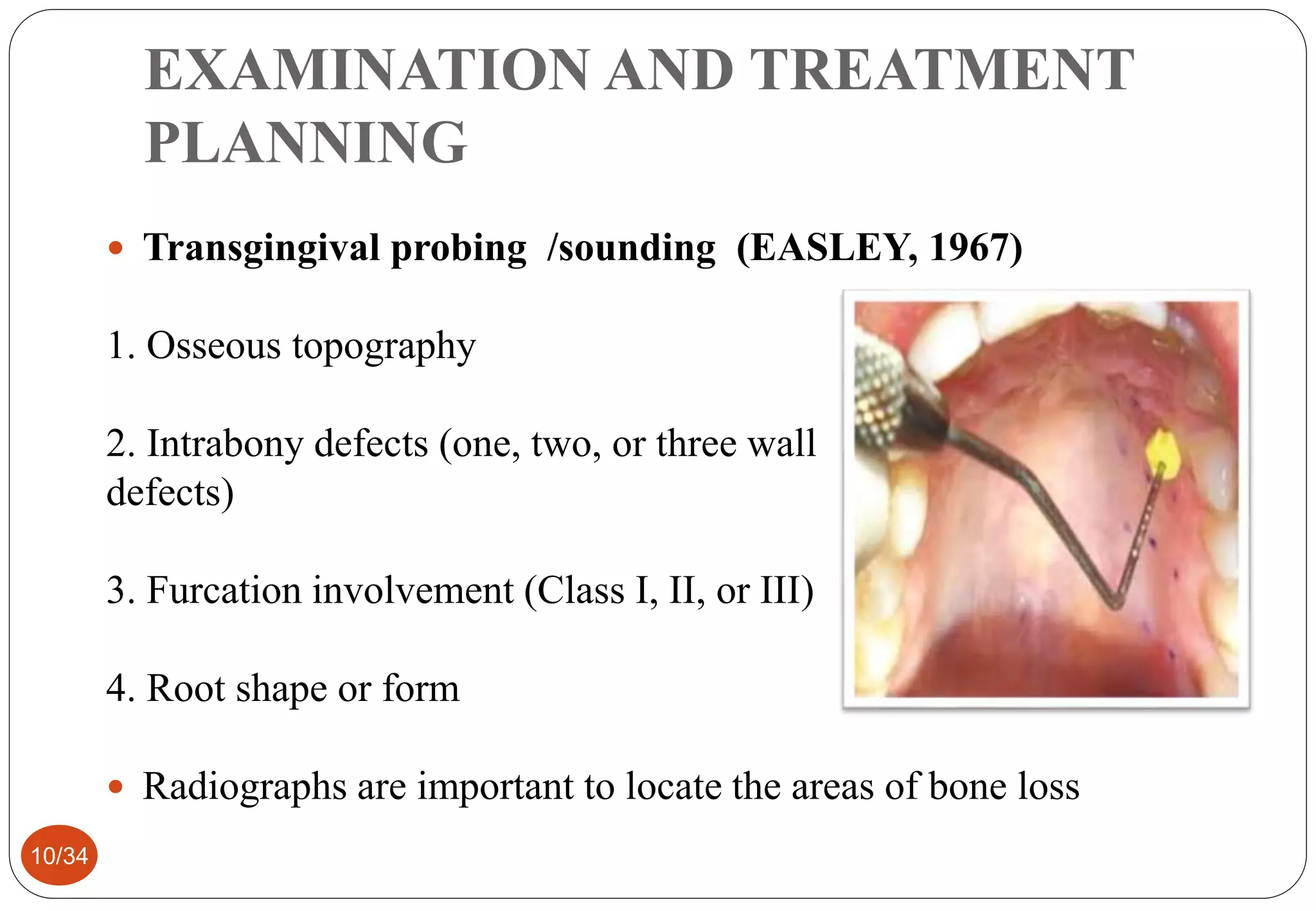
 Transgingival probing /sounding (EASLEY, 1967)
1. Osseous topography
2. Intrabony defects (one, two, or three wall
defects)
3. Furcation involvement (Class I, II, or III)
4. Root shape or form
 Radiographs are important to locate the areas of bone loss
TERMINOLOGY OF OSSEOUS SURGERY
11/34
 Tissue management
 Procedures used to correct osseous defects have been classified in
two groups:
 OSTEOPLASTY: defined as a plastic procedure by which
nonsupporting bone is reshaped to achieve a physiologic gingival
and osseous contour.
 OSTECTOMY: is the plastic removal of radicular and
interradicular supporting bone to eliminate osseous deformities.
FRIEDMAN 1955
ARMAMENTARIUM
12/34
 A number of rotary and hand instruments have been used for osseous
resective surgery.
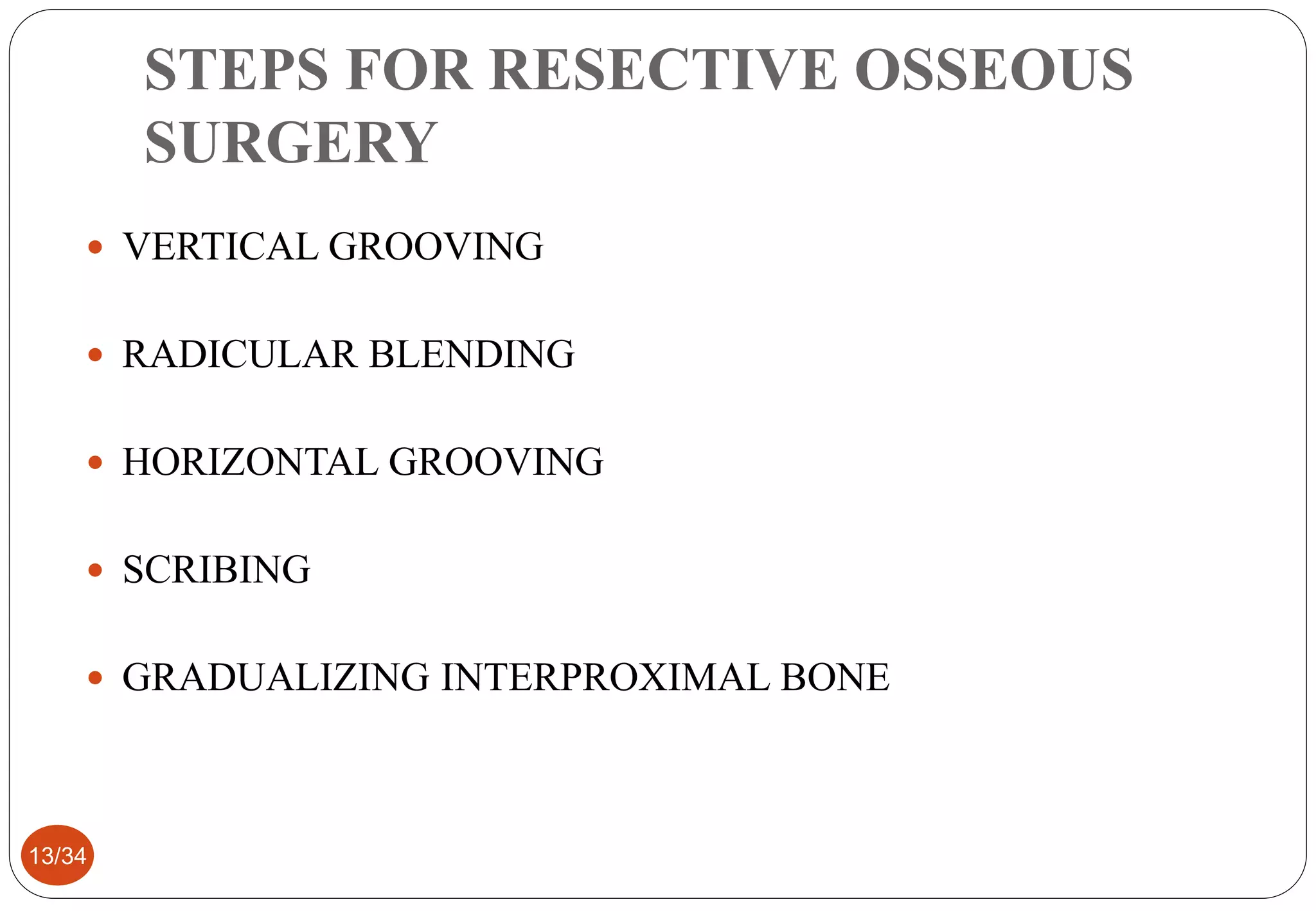
STEPS FOR RESECTIVE OSSEOUS
SURGERY
13/34
 VERTICAL GROOVING
 RADICULAR BLENDING
 HORIZONTAL GROOVING
 SCRIBING
 GRADUALIZING INTERPROXIMAL BONE
OSTEOPLASTY:
14/34
 It is a plastic procedure by which non supporting bone is reshaped
to achieve a physiological gingival and osseous contours.
INDICATIONS
 Pocket elimination
 Tori reduction
 Intra bony defects adjacent to edentulous ridges
 Incipient furcation involvement
 Thick heavy ledges and exostoses
 Shallow osseous craters
 Small intra bony defects
15/34
 Osteoplasty includes the techniques of grooving or festooning
(ochsenbein, 1958) and radicular blending (carranza, 1984).
 These grooves are carried to the line angles of adjacent
teeth.
 Using a round no. 6, 8 or 10 bur in a high speed
handpiece with copious amounts of water, the grooves
are cut
16/34
17/34
18/34
OSTECTOMY
19/34
It is the plastic removal of radicular and interradicular supporting
bone to eliminate osseous deformities.
INDICATIONS
 Sufficient bone remaining for establishing physiologic contours
without attachment compromise
 No esthetic or anatomic limitations
 Interdental craters
 Intrabony defects not amenable to regeneration
 Horizontal bone loss with irregular marginal bone height
 Moderate to advanced furcation involvements and hemisepta.
CONTRAINDICATIONS
20/34
 Areas of insufficient remaining attachment or where ostectomy
might unfavourably alter the prognosis of the adjacent teeth
 Anatomic limitations (prominent external oblique ridge , zygomatic
arch)
 Esthetic limitations (anteriorly , high smile line)
ADVANTAGES :
 Predictable pocket elimination
 Establishment of physiologic gingival and osseous architecture
 Establishment of a favorable prosthetic environment
21/34
 Ostectomy is done by the technique of spheroiding or
parabolizing.
 Parabolizing is the removal of supporting bone to produce a
positive gingival and osseous architecture.
 This can be achieved by:
-Horizontal grooving
-Scribing
-Hand instrumentation
22/34
23/34
MANAGEMENT OF DEEP CRATERS
24
MANAGEMENT OF EDENTULOUS
RIDGE
25/34
BASIC RULES OF OSSEOUS
SURGERY
26/34
 Rule-1 A full-thickness mucoperiosteal flap should be raised.
 Rule- 2a. The scalloping of the flap should anticipate the final
underlying osseous contour, which is more prominent anteriorly
and decreases posteriorly.
 Rule -2b. The scalloping of the flap should reflect the patient’s
own healthy gingival architecture.
 Rule-2c. The degree of tissue and bone scalloping is reduced, as
the interproximal area becomes broader as a result of bone loss.
27/34
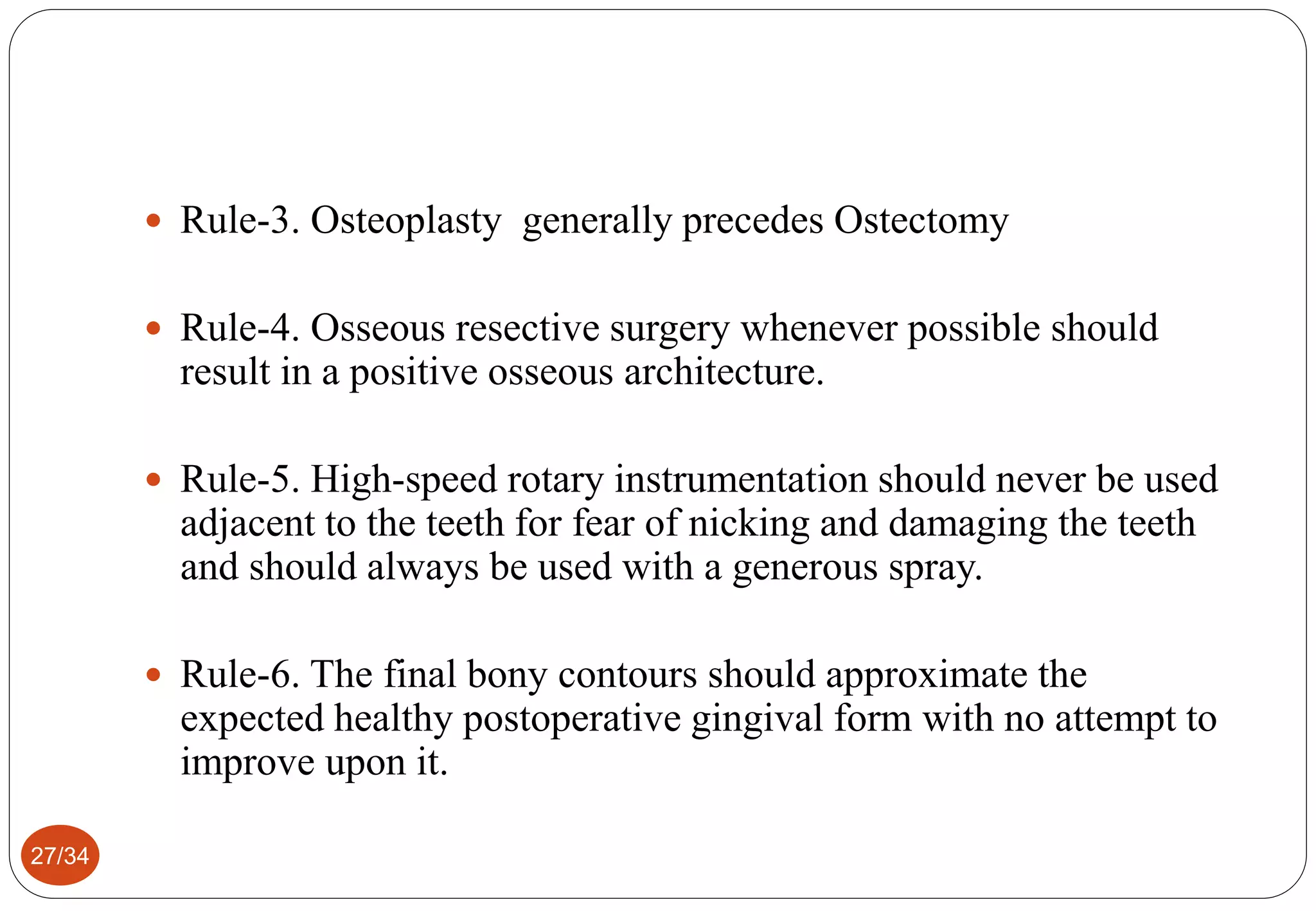
 Rule-3. Osteoplasty generally precedes Ostectomy
 Rule-4. Osseous resective surgery whenever possible should
result in a positive osseous architecture.
 Rule-5. High-speed rotary instrumentation should never be used
adjacent to the teeth for fear of nicking and damaging the teeth
and should always be used with a generous spray.
 Rule-6. The final bony contours should approximate the
expected healthy postoperative gingival form with no attempt to
improve upon it.
CONTRAINDICATIONS
28/34
 Position of the external oblique line in the mandibular molar area and
maxillary sinus, which is very close to the osseous defect and root
proximity.
 A periodontal pocket of more than 8mm exists after initial therapy.
 The bottom of osseous defect extends apically against multiple tooth–
root trunks.
 The deep intrabony defect is more than 3-4mm or the bottom of the
osseous defect is more than one half of the root length from the cemento
enamel junction.
 Extended tooth mobility.
ADVANTAGES
29/34
 Reliable
 Short term (8-12 weeks)
 Obtain gingiva-alveolar bone morphology that facilitates easy
maintenance
DISADVANTAGES
30/36
 Attachment loss
 Root exposure
 Compromising esthetics
 Strong possibility of hypersensitivity
 Strong possibility of root surface caries
 Possibility of phonetic impediment
FLAP PLACEMENT AND CLOSURE
31/34
 Flap may be replaced to their original level to cover the new
bony margin or they may be apically positioned.
 Replacing the flap in the areas that previously had pockets may
result initially in greater post operative pocket depth, although
a selective recession may diminish the depth over time.
 Sutures should be placed with minimal tension to coadapt the
flaps, prevent their separation and maintain the position of the
flaps
32/34
CONCLUSION
33/34
 The results from osseous resective surgery are technique sensitive. It
has limited use in treating cases with very deep intrabony or
hemiseptal defects, which should be treated with a different surgical
approach. If osseous resective surgery is used in advanced lesions, a
compromise in the amount of probing depth reduction should be
expected.
REFERENCES
34/34
 Carranza 10th edition, resective osseous surgery, pg no 950-967.
 Cohen 4th edition
 Rose and mealey, Resective osseous surgery, pg no 502-552.
 Grant, periodontal osseous resection, pg no 838.
 Prichard, Periodontal osseous surgery, pg no-437.
 Soft tissue regrowth following Fiber Retention Osseous Resective
Surgery or Osseous Resective Surgery. A multilevel analysis,
Francesco Cairo, JCP 2015.
35

RESECTIVE OSSEOUS SURGERY

  • 1.
    APPROVED BY: PRESENTEDBY DR DIVYA JAGGI DR. ANKITA DADWAL MDS 2ND YR 1/34 RESECTIVE OSSEOUS SURGERY
  • 2.
    CONTENTS 2/34  Introduction  Bonedestruction patterns  Resective osseous surgery  Objectives  Osteoplasty and Ostectomy  Techniques  Contraindications  Advantages And Disadvantages  conclusion  References
  • 3.
  • 4.
  • 5.
    BONE DESTRUCTION PATTERNSIN PERIODONTAL DISEASE 5/34  Horizontal defects  Vertical or angular defects  Osseous craters  Reversed architecture  Bony ledges  Furcation involvements  Exostoses  Bulbous bone contours
  • 6.
  • 7.
  • 8.
    RESECTIVE OSSEOUS SURGERY 8/34 defined as the procedure by which changes in the alveolar bone can be accomplished to rid it of deformities induced by the periodontal disease process or other related factors, such as exostoses and tooth supra eruption. CARRAZA 10TH EDITION  Terms :  DEFINITIVE OSSEOUS SURGERY : establishes a positive or normal parabolic osseous form  COMPROMISE OSSEOUS SURGERY: indicates an osseous topography requiring extensive osseous removal that would be detrimental to the long-term prognosis of the tooth
  • 9.
    OBJECTIVES 9/34  Elimination ofperiodontal pocket and creation of physiological parabolic contour.  This contour will maintain physiologic gingival architecture.  Regeneration of periodontal apparatus destroyed by periodontal disease.  Create environment suitable to restorative and prosthodontic treatment.
  • 10.
    EXAMINATION AND TREATMENT PLANNING 10/34 Transgingival probing /sounding (EASLEY, 1967) 1. Osseous topography 2. Intrabony defects (one, two, or three wall defects) 3. Furcation involvement (Class I, II, or III) 4. Root shape or form  Radiographs are important to locate the areas of bone loss
  • 11.
    TERMINOLOGY OF OSSEOUSSURGERY 11/34  Tissue management  Procedures used to correct osseous defects have been classified in two groups:  OSTEOPLASTY: defined as a plastic procedure by which nonsupporting bone is reshaped to achieve a physiologic gingival and osseous contour.  OSTECTOMY: is the plastic removal of radicular and interradicular supporting bone to eliminate osseous deformities. FRIEDMAN 1955
  • 12.
    ARMAMENTARIUM 12/34  A numberof rotary and hand instruments have been used for osseous resective surgery.
  • 13.
    STEPS FOR RESECTIVEOSSEOUS SURGERY 13/34  VERTICAL GROOVING  RADICULAR BLENDING  HORIZONTAL GROOVING  SCRIBING  GRADUALIZING INTERPROXIMAL BONE
  • 14.
    OSTEOPLASTY: 14/34  It isa plastic procedure by which non supporting bone is reshaped to achieve a physiological gingival and osseous contours. INDICATIONS  Pocket elimination  Tori reduction  Intra bony defects adjacent to edentulous ridges  Incipient furcation involvement  Thick heavy ledges and exostoses  Shallow osseous craters  Small intra bony defects
  • 15.
    15/34  Osteoplasty includesthe techniques of grooving or festooning (ochsenbein, 1958) and radicular blending (carranza, 1984).  These grooves are carried to the line angles of adjacent teeth.  Using a round no. 6, 8 or 10 bur in a high speed handpiece with copious amounts of water, the grooves are cut
  • 16.
  • 17.
  • 18.
  • 19.
    OSTECTOMY 19/34 It is theplastic removal of radicular and interradicular supporting bone to eliminate osseous deformities. INDICATIONS  Sufficient bone remaining for establishing physiologic contours without attachment compromise  No esthetic or anatomic limitations  Interdental craters  Intrabony defects not amenable to regeneration  Horizontal bone loss with irregular marginal bone height  Moderate to advanced furcation involvements and hemisepta.
  • 20.
    CONTRAINDICATIONS 20/34  Areas ofinsufficient remaining attachment or where ostectomy might unfavourably alter the prognosis of the adjacent teeth  Anatomic limitations (prominent external oblique ridge , zygomatic arch)  Esthetic limitations (anteriorly , high smile line) ADVANTAGES :  Predictable pocket elimination  Establishment of physiologic gingival and osseous architecture  Establishment of a favorable prosthetic environment
  • 21.
    21/34  Ostectomy isdone by the technique of spheroiding or parabolizing.  Parabolizing is the removal of supporting bone to produce a positive gingival and osseous architecture.  This can be achieved by: -Horizontal grooving -Scribing -Hand instrumentation
  • 22.
  • 23.
  • 24.
  • 25.
  • 26.
    BASIC RULES OFOSSEOUS SURGERY 26/34  Rule-1 A full-thickness mucoperiosteal flap should be raised.  Rule- 2a. The scalloping of the flap should anticipate the final underlying osseous contour, which is more prominent anteriorly and decreases posteriorly.  Rule -2b. The scalloping of the flap should reflect the patient’s own healthy gingival architecture.  Rule-2c. The degree of tissue and bone scalloping is reduced, as the interproximal area becomes broader as a result of bone loss.
  • 27.
    27/34  Rule-3. Osteoplastygenerally precedes Ostectomy  Rule-4. Osseous resective surgery whenever possible should result in a positive osseous architecture.  Rule-5. High-speed rotary instrumentation should never be used adjacent to the teeth for fear of nicking and damaging the teeth and should always be used with a generous spray.  Rule-6. The final bony contours should approximate the expected healthy postoperative gingival form with no attempt to improve upon it.
  • 28.
    CONTRAINDICATIONS 28/34  Position ofthe external oblique line in the mandibular molar area and maxillary sinus, which is very close to the osseous defect and root proximity.  A periodontal pocket of more than 8mm exists after initial therapy.  The bottom of osseous defect extends apically against multiple tooth– root trunks.  The deep intrabony defect is more than 3-4mm or the bottom of the osseous defect is more than one half of the root length from the cemento enamel junction.  Extended tooth mobility.
  • 29.
    ADVANTAGES 29/34  Reliable  Shortterm (8-12 weeks)  Obtain gingiva-alveolar bone morphology that facilitates easy maintenance
  • 30.
    DISADVANTAGES 30/36  Attachment loss Root exposure  Compromising esthetics  Strong possibility of hypersensitivity  Strong possibility of root surface caries  Possibility of phonetic impediment
  • 31.
    FLAP PLACEMENT ANDCLOSURE 31/34  Flap may be replaced to their original level to cover the new bony margin or they may be apically positioned.  Replacing the flap in the areas that previously had pockets may result initially in greater post operative pocket depth, although a selective recession may diminish the depth over time.  Sutures should be placed with minimal tension to coadapt the flaps, prevent their separation and maintain the position of the flaps
  • 32.
  • 33.
    CONCLUSION 33/34  The resultsfrom osseous resective surgery are technique sensitive. It has limited use in treating cases with very deep intrabony or hemiseptal defects, which should be treated with a different surgical approach. If osseous resective surgery is used in advanced lesions, a compromise in the amount of probing depth reduction should be expected.
  • 34.
    REFERENCES 34/34  Carranza 10thedition, resective osseous surgery, pg no 950-967.  Cohen 4th edition  Rose and mealey, Resective osseous surgery, pg no 502-552.  Grant, periodontal osseous resection, pg no 838.  Prichard, Periodontal osseous surgery, pg no-437.  Soft tissue regrowth following Fiber Retention Osseous Resective Surgery or Osseous Resective Surgery. A multilevel analysis, Francesco Cairo, JCP 2015.
  • 35.

Editor's Notes

  • #7 are those that occur in oblique direction, leaving a hollowed out trough in the bone alongside the root. The base of the defect is located apical to the surrounding bone.
  • #8 are bony enlargements caused by exostoses , adaptation to function or buttressing bone formation.
  • #9 OSSEOUS SURGERY IS OF 2 TYPES: ADDITIVE OSSEOUS SURGERY SUBSTRACTIVE OSSEOUS SURGERY
  • #12 Treatment of osseous deformities involves the use of a full-thickness, inverse-beveled, mucoperiosteal Flap. All granulation tissue and residual connective tissue fibers must be removed prior to osseous surgery. Small bony defects are often hidden or obscured by residual. Plaque, calculus, softened cementum, and remnants of the junctional epithelium are all removed from the root surface
  • #13 Ronguer Carbide round burs. Diamond bur Schluger and sugarman Back action chisel Oschenbein chisel
  • #24 Scribing is the technique by which high speed rotatory instrumentation is used to outline on the radicular bone , that bone which is to be removed by hand instrumentation. This provides a visual outline that facilitates the use of hand chisels for final bone removal.