Diagnostic
1. Routine Dental Tests:
2. Routine Medical Tests:
3. Additional Tests:
4. Referral
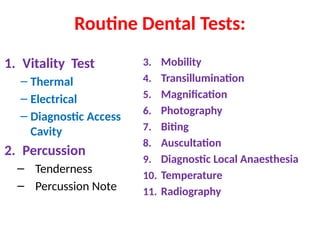
Routine Dental Tests:
1. Vitality Test
– Thermal
– Electrical
– Diagnostic Access
Cavity
2. Percussion
– Tenderness
– Percussion Note
3. Mobility
4. Transillumination
5. Magnification
6. Photography
7. Biting
8. Auscultation
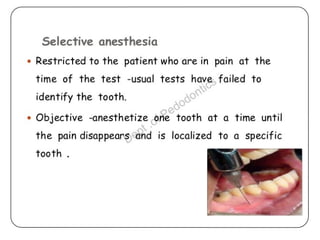
9. Diagnostic Local Anaesthesia
10. Temperature
11. Radiography
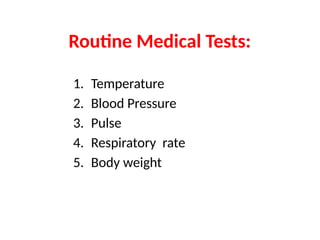
Routine Medical Tests:
1. Temperature
2. Blood Pressure
3. Pulse
4. Respiratory rate
5. Body weight
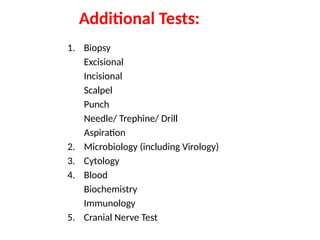
Additional Tests:
1. Biopsy
Excisional
Incisional
Scalpel
Punch
Needle/ Trephine/ Drill
Aspiration
2. Microbiology (including Virology)
3. Cytology
4. Blood
Biochemistry
Immunology
5. Cranial Nerve Test
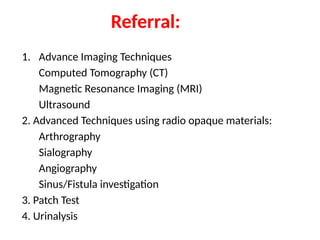
Referral:
1. Advance Imaging Techniques
Computed Tomography (CT)
Magnetic Resonance Imaging (MRI)
Ultrasound
2. Advanced Techniques using radio opaque materials:
Arthrography
Sialography
Angiography
Sinus/Fistula investigation
3. Patch Test
4. Urinalysis
Routine Dental Tests:
1. Vitality Test
– Thermal
– Electrical
– Diagnostic Access
Cavity
2. Percussion
– Tenderness
– Percussion Note
3. Mobility
4. Transillumination
5. Magnification
6. Photography
7. Biting
8. Auscultation
9. Diagnostic Local Anaesthesia
10. Temperature
11. Radiography
Vitality Test:
• These are used to determine the vitality or non vitality of the
dental pulp
• Vitality test may also provide a rough guide to states of
inflammatory change of the pulp
• Vitality test results do not correlate well with the histological
changes occurring within the pulp.
• Testing should begin on a normal, healthy tooth, rather than a
painful tooth likely to provide an exaggerated response, to
allow the patients fear.
• Testing stimuli should be applied to normal enamel of the
crown of the tooth, avoiding any restorations and soft tissues;
The Following vitality tests are described
 Thermal
 Electrical
 Diagnostic access cavity, without
anesthesia.
Thermal Vitality Tests:
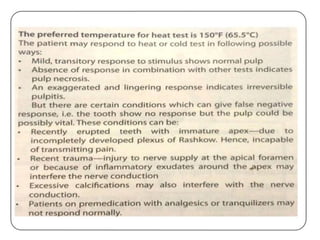
• A healthy tooth with a vital, non inflamed pulp
can usually be stimulated within a
temperature range of some 20-50 C without
pain.
• Teeth with inflamed pulps (Pulpitis) may react
with severe pain on temperature stimulation
even within the above range.
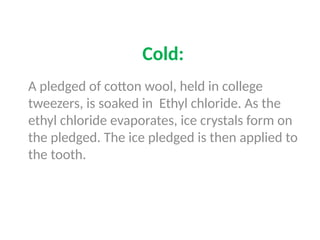
Cold:
A pledged of cotton wool, held in college
tweezers, is soaked in Ethyl chloride. As the
ethyl chloride evaporates, ice crystals form on
the pledged. The ice pledged is then applied to
the tooth.
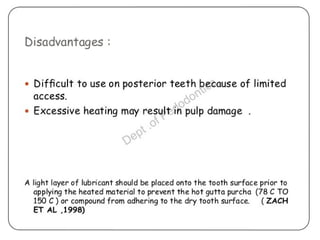
Heat:
A gutta percha stick is heated in a flame until
the tip softens. The hot tip is then applied to
the tooth. If the tooth is previously lightly
vaslined, the softens gutta percha will not
adhere to the tooth.
Electrical Vitality Test
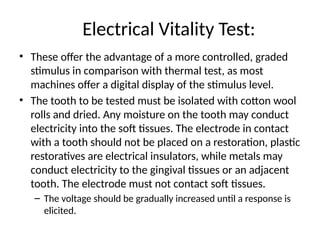
Electrical Vitality Test:
• These offer the advantage of a more controlled, graded
stimulus in comparison with thermal test, as most
machines offer a digital display of the stimulus level.
• The tooth to be tested must be isolated with cotton wool
rolls and dried. Any moisture on the tooth may conduct
electricity into the soft tissues. The electrode in contact
with a tooth should not be placed on a restoration, plastic
restoratives are electrical insulators, while metals may
conduct electricity to the gingival tissues or an adjacent
tooth. The electrode must not contact soft tissues.
– The voltage should be gradually increased until a response is
elicited.
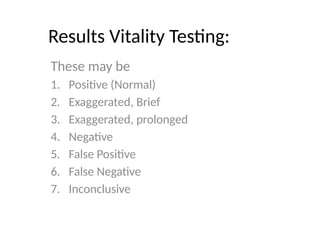
Results Vitality Testing:
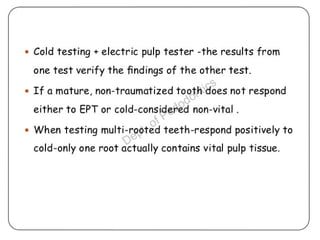
These may be
1. Positive (Normal)
2. Exaggerated, Brief
3. Exaggerated, prolonged
4. Negative
5. False Positive
6. False Negative
7. Inconclusive
Positive (Normal)
• The test tooth responds in a similar way and to a similar
level of stimulation to the other healthy teeth.
• This results suggest that the pulp is vital and not inflamed.
Exaggerated , Brief:
• The test tooth responds more severely than other healthy
teeth and/or to a lower level of stimulation.
• The painful response last for less than some 15 seconds
after removal of the stimulus.
• The tooth may respond more to cold than heat stimulation.
Results
• This results suggest that the pulp is vital but inflamed;
Hyperaemia
• The pulpitis may be reversible if the cause is eliminated.
• Alternatively, Dentin may simply be exposed as a result of a
Crack, Caries, Leaking restoration or exposed and sensitive
root dentine.
Exaggerated, Prolonged:
The test tooth responds more severely than other healthy teeth
and/or to a lower level of stimulation.
The painful response lasts for more than 15 seconds and
occasionally minutes or even hours, after removal of the stimulus.
The response to heat and electrical stimulation may be greater
than to cold. Indeed cold may reduce the pain.
Results:
This results suggest that the pulp is vital but inflamed, eg. acute pulpitis.
The pulpitis is likely to be Irreversible .
Note: A very gradual reaction to heat but not to cold or electric
stimulation, leading ultimately to an exaggerated response, may
indicate Chronic pulpitis.
Negative:
• The test tooth does not respond to stimulation
but healthy tooth do.
Results:
This results suggest that the pulp is non-vital and
may be necrotic, or that the root canals are
sclerosed.
False Positive:
•The test teeth responds normally but subsequent
events prove the Pulpal condition to be abnormal.
Results:
In Multi Rooted Teeth: Vital tissue remains in one root
but the remaining pulp is necrotic.
•In a Root Canal Filled with Pus: conducts stimuli.
•In a Root Canal Filled with Gas: Heat causes expansion.
•A frightened pt or a patient with a low pain
threshold may report a painful response even before
the stimulus is applied to the tooth.
False Negative:
• The test tooth does not respond to stimulation
but subsequent events prove the pulp to be vital.
Result:
• If the pulp is well insulated from thermal and
electrical stimuli eg. Plastic restoration, secondary
dentine
• If the nerve supply to the pulp is damaged, eg:
Trauma.
• In patient with a high pain threshold
With faulty technique or equipment
Inconclusive:
• All teeth give exaggerated responses or, conversely,
no teeth respond!
• If the results of two tests (e.g. Heat and cold) are
inconclusive, add a third test (e.g. electric ). If
doubt still exists, consider cutting a diagnostic
access cavity, without local anesthesia.
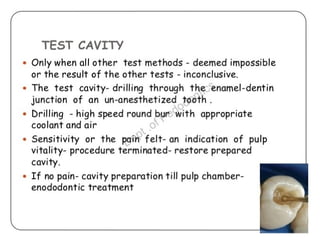
Diagnostic access cavity, without
anesthesia.
Diagnostic Access Cavity without Local Anesthesia:
• Cutting a small cavity in the suspect tooth without
anesthesia is probably the most reliable vitality test.
• If the pulp is vital, a response is usually elicited as
the dentine is entered.
• Since this test is destructive, it should be
considered only as a last resort.
Percussion Tests:
•These are conducted by gently tapping a tooth with the tip of a dental
mirror handle.
•Two characteristics are noted:
Tenderness to percussion
A dull percussion note
•Both characteristics denote inflammation of the periodontal ligament.
•Greater tenderness to percussion in an apical direction suggest apical
periodontitis.
•Greater tenderness to percussion in a lateral direction suggests acute
periodontitis of gingival origin (Lateral Periodontitis).
•Testing should begin on a healthy tooth.
•Percussion testing must be conducted with great care since teeth with
periodontitis may be exquisitely tender.
Mobility:
• Tooth mobility is assessed by use of two instrument handles
---one placed buccal and the other lingual on the tooth.
• Alternatively a finger may substitute for one of the
instruments.
Increased Mobility is caused by:
• Reduced Bone Support:
Periodontal disease
Bony cyst
Neoplasm
• Abscess or inflammation of the periodontal ligament:
Acute periodontitis
Periodontitis of gingival origin
Occlusal trauma
Acute trauma
• Crown or Root fracture
• Fracture of supporting bone.
Transillumination Test:
• A dedicated light source is needed.
• Alternatively, A composite curing light may be
employed.
Transillumination is useful in the diagnosis of:
• Tooth cracks
• Interproximal caries in anterior teeth
• Interproximal caries in posterior teeth, where
there is sufficient access.
Radiography:
• Indication of Bitewing X-Ray:
- Crowns of teeth
- Caries, particularly interproximal lesions
- restorations
- Alveolar bone height
- Extension of fissure caries into dentine (if the
lesion is large)
• Periapical:
- Root and surrounding bone
Radiography:
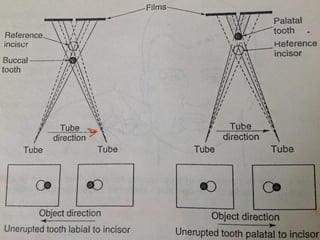
• Parallax Technique:
- Two periapical films, exposed at slightly
different anteroposterior angulation for the
assesment of buccolingual position of unerupted
tooth, particularly maxillary canines.
- The most Palatal tooth appears to move in the
same direction as the tube is is moved.
- The most Buccal tooth appears to move in the
opposite direction to the tube.
Radiography:
• Pan Oral/ Orthopantomogram/OPG
- General view of teeth, Jaws, Temporomandibular
joints, maxillary sinuses etc. Detail in the midline is
obscured by superimposition of the cervical spine.
– Lateral Oblique: General view, as OPG. May be used
where panoral/OPG facilities are not available.
– Maxillary Anterior Occlusal: Roots of maxillary
anterior teeth
– Mandibular Occlusal: Calcification in the floor of the
mouth, including submandibular gland and duct,
Buccolingual displacement of mandibular fractures.
Radiography:
• Transpharyngeal: Temporomandibular joint
• Occipitomental View (OMV) / PNS: Maxillary
sinuses, Facial & skull bones.
• Postero-anterior and lateral skull: Skull and
facial bones. Useful in Orthodontic assesment.
Diagnostic procedure orTests for pulp pathology.pptx

  • 1.
  • 2.
    1. Routine DentalTests: 2. Routine Medical Tests: 3. Additional Tests: 4. Referral
  • 3.
    Routine Dental Tests: 1.Vitality Test – Thermal – Electrical – Diagnostic Access Cavity 2. Percussion – Tenderness – Percussion Note 3. Mobility 4. Transillumination 5. Magnification 6. Photography 7. Biting 8. Auscultation 9. Diagnostic Local Anaesthesia 10. Temperature 11. Radiography
  • 4.
    Routine Medical Tests: 1.Temperature 2. Blood Pressure 3. Pulse 4. Respiratory rate 5. Body weight
  • 5.
    Additional Tests: 1. Biopsy Excisional Incisional Scalpel Punch Needle/Trephine/ Drill Aspiration 2. Microbiology (including Virology) 3. Cytology 4. Blood Biochemistry Immunology 5. Cranial Nerve Test
  • 6.
    Referral: 1. Advance ImagingTechniques Computed Tomography (CT) Magnetic Resonance Imaging (MRI) Ultrasound 2. Advanced Techniques using radio opaque materials: Arthrography Sialography Angiography Sinus/Fistula investigation 3. Patch Test 4. Urinalysis
  • 7.
  • 8.
    Routine Dental Tests: 1.Vitality Test – Thermal – Electrical – Diagnostic Access Cavity 2. Percussion – Tenderness – Percussion Note 3. Mobility 4. Transillumination 5. Magnification 6. Photography 7. Biting 8. Auscultation 9. Diagnostic Local Anaesthesia 10. Temperature 11. Radiography
  • 9.
    Vitality Test: • Theseare used to determine the vitality or non vitality of the dental pulp • Vitality test may also provide a rough guide to states of inflammatory change of the pulp • Vitality test results do not correlate well with the histological changes occurring within the pulp. • Testing should begin on a normal, healthy tooth, rather than a painful tooth likely to provide an exaggerated response, to allow the patients fear. • Testing stimuli should be applied to normal enamel of the crown of the tooth, avoiding any restorations and soft tissues;
  • 10.
    The Following vitalitytests are described  Thermal  Electrical  Diagnostic access cavity, without anesthesia.
  • 11.
  • 12.
    • A healthytooth with a vital, non inflamed pulp can usually be stimulated within a temperature range of some 20-50 C without pain. • Teeth with inflamed pulps (Pulpitis) may react with severe pain on temperature stimulation even within the above range.
  • 18.
    Cold: A pledged ofcotton wool, held in college tweezers, is soaked in Ethyl chloride. As the ethyl chloride evaporates, ice crystals form on the pledged. The ice pledged is then applied to the tooth.
  • 19.
    Heat: A gutta perchastick is heated in a flame until the tip softens. The hot tip is then applied to the tooth. If the tooth is previously lightly vaslined, the softens gutta percha will not adhere to the tooth.
  • 22.
  • 25.
    Electrical Vitality Test: •These offer the advantage of a more controlled, graded stimulus in comparison with thermal test, as most machines offer a digital display of the stimulus level. • The tooth to be tested must be isolated with cotton wool rolls and dried. Any moisture on the tooth may conduct electricity into the soft tissues. The electrode in contact with a tooth should not be placed on a restoration, plastic restoratives are electrical insulators, while metals may conduct electricity to the gingival tissues or an adjacent tooth. The electrode must not contact soft tissues. – The voltage should be gradually increased until a response is elicited.
  • 26.
    Results Vitality Testing: Thesemay be 1. Positive (Normal) 2. Exaggerated, Brief 3. Exaggerated, prolonged 4. Negative 5. False Positive 6. False Negative 7. Inconclusive
  • 27.
    Positive (Normal) • Thetest tooth responds in a similar way and to a similar level of stimulation to the other healthy teeth. • This results suggest that the pulp is vital and not inflamed.
  • 28.
    Exaggerated , Brief: •The test tooth responds more severely than other healthy teeth and/or to a lower level of stimulation. • The painful response last for less than some 15 seconds after removal of the stimulus. • The tooth may respond more to cold than heat stimulation. Results • This results suggest that the pulp is vital but inflamed; Hyperaemia • The pulpitis may be reversible if the cause is eliminated. • Alternatively, Dentin may simply be exposed as a result of a Crack, Caries, Leaking restoration or exposed and sensitive root dentine.
  • 29.
    Exaggerated, Prolonged: The testtooth responds more severely than other healthy teeth and/or to a lower level of stimulation. The painful response lasts for more than 15 seconds and occasionally minutes or even hours, after removal of the stimulus. The response to heat and electrical stimulation may be greater than to cold. Indeed cold may reduce the pain. Results: This results suggest that the pulp is vital but inflamed, eg. acute pulpitis. The pulpitis is likely to be Irreversible . Note: A very gradual reaction to heat but not to cold or electric stimulation, leading ultimately to an exaggerated response, may indicate Chronic pulpitis.
  • 30.
    Negative: • The testtooth does not respond to stimulation but healthy tooth do. Results: This results suggest that the pulp is non-vital and may be necrotic, or that the root canals are sclerosed.
  • 31.
    False Positive: •The testteeth responds normally but subsequent events prove the Pulpal condition to be abnormal. Results: In Multi Rooted Teeth: Vital tissue remains in one root but the remaining pulp is necrotic. •In a Root Canal Filled with Pus: conducts stimuli. •In a Root Canal Filled with Gas: Heat causes expansion. •A frightened pt or a patient with a low pain threshold may report a painful response even before the stimulus is applied to the tooth.
  • 32.
    False Negative: • Thetest tooth does not respond to stimulation but subsequent events prove the pulp to be vital. Result: • If the pulp is well insulated from thermal and electrical stimuli eg. Plastic restoration, secondary dentine • If the nerve supply to the pulp is damaged, eg: Trauma. • In patient with a high pain threshold With faulty technique or equipment
  • 33.
    Inconclusive: • All teethgive exaggerated responses or, conversely, no teeth respond! • If the results of two tests (e.g. Heat and cold) are inconclusive, add a third test (e.g. electric ). If doubt still exists, consider cutting a diagnostic access cavity, without local anesthesia.
  • 34.
    Diagnostic access cavity,without anesthesia.
  • 36.
    Diagnostic Access Cavitywithout Local Anesthesia: • Cutting a small cavity in the suspect tooth without anesthesia is probably the most reliable vitality test. • If the pulp is vital, a response is usually elicited as the dentine is entered. • Since this test is destructive, it should be considered only as a last resort.
  • 46.
    Percussion Tests: •These areconducted by gently tapping a tooth with the tip of a dental mirror handle. •Two characteristics are noted: Tenderness to percussion A dull percussion note •Both characteristics denote inflammation of the periodontal ligament. •Greater tenderness to percussion in an apical direction suggest apical periodontitis. •Greater tenderness to percussion in a lateral direction suggests acute periodontitis of gingival origin (Lateral Periodontitis). •Testing should begin on a healthy tooth. •Percussion testing must be conducted with great care since teeth with periodontitis may be exquisitely tender.
  • 47.
    Mobility: • Tooth mobilityis assessed by use of two instrument handles ---one placed buccal and the other lingual on the tooth. • Alternatively a finger may substitute for one of the instruments.
  • 48.
    Increased Mobility iscaused by: • Reduced Bone Support: Periodontal disease Bony cyst Neoplasm • Abscess or inflammation of the periodontal ligament: Acute periodontitis Periodontitis of gingival origin Occlusal trauma Acute trauma • Crown or Root fracture • Fracture of supporting bone.
  • 49.
    Transillumination Test: • Adedicated light source is needed. • Alternatively, A composite curing light may be employed. Transillumination is useful in the diagnosis of: • Tooth cracks • Interproximal caries in anterior teeth • Interproximal caries in posterior teeth, where there is sufficient access.
  • 58.
    Radiography: • Indication ofBitewing X-Ray: - Crowns of teeth - Caries, particularly interproximal lesions - restorations - Alveolar bone height - Extension of fissure caries into dentine (if the lesion is large) • Periapical: - Root and surrounding bone
  • 59.
    Radiography: • Parallax Technique: -Two periapical films, exposed at slightly different anteroposterior angulation for the assesment of buccolingual position of unerupted tooth, particularly maxillary canines. - The most Palatal tooth appears to move in the same direction as the tube is is moved. - The most Buccal tooth appears to move in the opposite direction to the tube.
  • 61.
    Radiography: • Pan Oral/Orthopantomogram/OPG - General view of teeth, Jaws, Temporomandibular joints, maxillary sinuses etc. Detail in the midline is obscured by superimposition of the cervical spine. – Lateral Oblique: General view, as OPG. May be used where panoral/OPG facilities are not available. – Maxillary Anterior Occlusal: Roots of maxillary anterior teeth – Mandibular Occlusal: Calcification in the floor of the mouth, including submandibular gland and duct, Buccolingual displacement of mandibular fractures.
  • 62.
    Radiography: • Transpharyngeal: Temporomandibularjoint • Occipitomental View (OMV) / PNS: Maxillary sinuses, Facial & skull bones. • Postero-anterior and lateral skull: Skull and facial bones. Useful in Orthodontic assesment.