HVDC LIGHT TRANSMISSION
Submitted by :
ASHUTOSH KUMAR
40196204915
CONTENTS
• BEGINNING
• HISTORY OF HVDC TRANSMISSION
• CONPONENT & DIAGRAM
• HOW DOES IT WORKS
• COMPARISION OF HVAC & HVDC
• ADVANTAGES/DISADVANTAGES
• APPLICATIONS
• CONCLUSION
BEGINNING
1. Full form of HVDC is High Voltage Direct Current.
2. Uses direct current for transmission of electrical
power.
3. Should be used over long distance.
4. Can be used underwater.
HISTORY
 Firstly HVDC b/w Swedish and Gotland in 1954. it is
based on the mercury arc valves
 The latest technology introduced to HVDC application
by ABB in 1990s, uses semiconductor chip called
Insulated gate bipolar transistor (IGBT) lie at the heart
of modern HVDC converters.
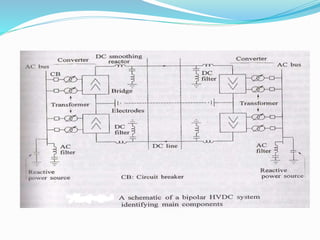
COMPONENTS OF HVDC
TRANSMISSION SYSTEMS
• Converters
• Smoothing reactors
• Harmonic filters
• Reactive power supplies
• Electrodes
• DC lines
• AC circuit breakers
CONVERTERS
 Perform AC/DC (rectifier) and DC/AC (inverter)
conversion use IGBT
 Consist of bridges and transformers
DC SMOOTHING REACTORS
 Decrease harmonics in voltages and currents in DC lines.
 Prevent current from being discontinuous
AC HARMONIC FILTERS
 Used to reduce harmonics (in voltages and currents) caused by
converters which generate harmonics,
 Hence prevent from interference with any communication
system.
REACTIVE POWER SUPPLIES
 Converter may consume reactive power of about 50%/
more of active power.
 Reactive power is, therefore, provided near
converter.
 For a strong AC power system, this reactive power is
provided by a shunt capacitor.
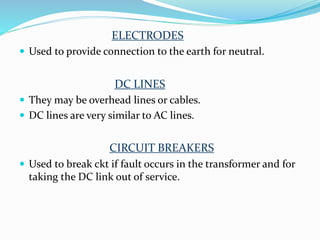
ELECTRODES
 Used to provide connection to the earth for neutral.
DC LINES
 They may be overhead lines or cables.
 DC lines are very similar to AC lines.
CIRCUIT BREAKERS
 Used to break ckt if fault occurs in the transformer and for
taking the DC link out of service.
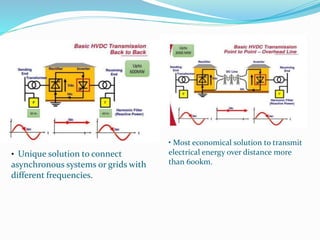
• Unique solution to connect
asynchronous systems or grids with
different frequencies.
• Most economical solution to transmit
electrical energy over distance more
than 600km.
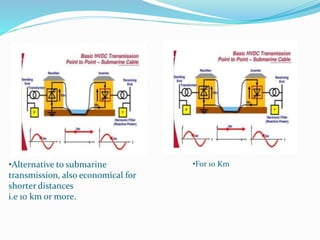
•Alternative to submarine
transmission, also economical for
shorter distances
i.e 10 km or more.
•For 10 Km
COMPARISION OF HVAC AND HVDC
 HVAC transmission is having several limitations like
line length , uncontrolled power flow, over/low voltages
during lightly / over loaded conditions, stability
problems, fault isolation etc.
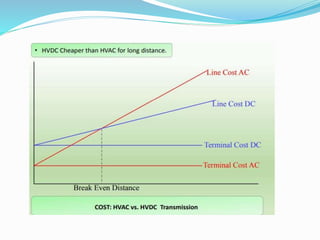
 The advantage of HVDC is the ability to transmit large
amounts of power over long distances with lower capital
costs and with lower losses than AC.
 HVDC transmission allows efficient use of energy
sources remote from load centers. Depending on voltage
level and construction details, losses are quoted as about
3% per 1,000 km.
 Power transmission and stabilization between
unsynchronized AC distribution systems
 Asynchronous operation possible between regions
having different electrical parameters .
 Facilitate power transmission between different
countries that use AC at differing voltages and/or
frequencies
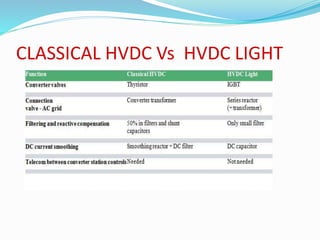
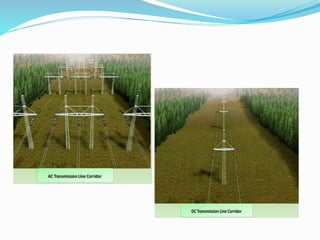
CLASSICAL HVDC Vs HVDC LIGHT
ADVANTAGES
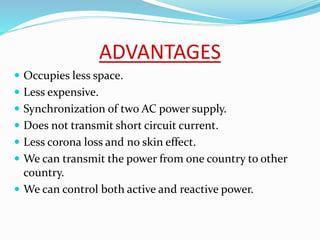
 Occupies less space.
 Less expensive.
 Synchronization of two AC power supply.
 Does not transmit short circuit current.
 Less corona loss and no skin effect.
 We can transmit the power from one country to other
country.
 We can control both active and reactive power.
DISADVANTAGES
 Complexity of control.
 Inability to use transformers to change voltage level.
 High cost of conventional equipment.
 The difficulty of breaking DC current which result in
high cost of DC currents.
Application of HVDC in INDIA
 Rihand-Delhi and chandrapur-padghe were the first long
distance HVDC project in INDIA.
 Rihand-Delhi (Singrauli) thermal power complex with a
combined power generation of several thousand MW was
put in to service. It cover a distance of 814km.
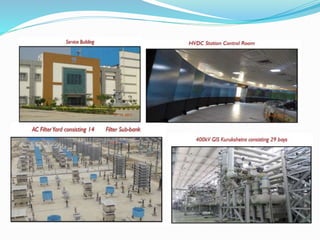
 800kv HVDC champa to kurukshetra with Dedicated
metallic return conductor in place of Conventional
Ground Electrode
d
CONCLUSION
 Recent studies indicate that HVDC system are very
reliable.
 Very large investments in e.g. in china and India shows
that high voltage direct current will very important in
the future ,especially in big, new industries countries.
BIBLIOGRAPHY
 GOOGLE.COM
 WIKIPEDIA.COM
 A COURSE IN POWER SYSTEM BY J.B. GUPTA
THANK YOU

HVDC TRANSMISSION LINE PPT

  • 1.
    HVDC LIGHT TRANSMISSION Submittedby : ASHUTOSH KUMAR 40196204915
  • 2.
    CONTENTS • BEGINNING • HISTORYOF HVDC TRANSMISSION • CONPONENT & DIAGRAM • HOW DOES IT WORKS • COMPARISION OF HVAC & HVDC • ADVANTAGES/DISADVANTAGES • APPLICATIONS • CONCLUSION
  • 3.
    BEGINNING 1. Full formof HVDC is High Voltage Direct Current. 2. Uses direct current for transmission of electrical power. 3. Should be used over long distance. 4. Can be used underwater.
  • 4.
    HISTORY  Firstly HVDCb/w Swedish and Gotland in 1954. it is based on the mercury arc valves  The latest technology introduced to HVDC application by ABB in 1990s, uses semiconductor chip called Insulated gate bipolar transistor (IGBT) lie at the heart of modern HVDC converters.
  • 5.
    COMPONENTS OF HVDC TRANSMISSIONSYSTEMS • Converters • Smoothing reactors • Harmonic filters • Reactive power supplies • Electrodes • DC lines • AC circuit breakers
  • 6.
    CONVERTERS  Perform AC/DC(rectifier) and DC/AC (inverter) conversion use IGBT  Consist of bridges and transformers DC SMOOTHING REACTORS  Decrease harmonics in voltages and currents in DC lines.  Prevent current from being discontinuous
  • 7.
    AC HARMONIC FILTERS Used to reduce harmonics (in voltages and currents) caused by converters which generate harmonics,  Hence prevent from interference with any communication system. REACTIVE POWER SUPPLIES  Converter may consume reactive power of about 50%/ more of active power.  Reactive power is, therefore, provided near converter.  For a strong AC power system, this reactive power is provided by a shunt capacitor.
  • 8.
    ELECTRODES  Used toprovide connection to the earth for neutral. DC LINES  They may be overhead lines or cables.  DC lines are very similar to AC lines. CIRCUIT BREAKERS  Used to break ckt if fault occurs in the transformer and for taking the DC link out of service.
  • 10.
    • Unique solutionto connect asynchronous systems or grids with different frequencies. • Most economical solution to transmit electrical energy over distance more than 600km.
  • 11.
    •Alternative to submarine transmission,also economical for shorter distances i.e 10 km or more. •For 10 Km
  • 16.
    COMPARISION OF HVACAND HVDC  HVAC transmission is having several limitations like line length , uncontrolled power flow, over/low voltages during lightly / over loaded conditions, stability problems, fault isolation etc.  The advantage of HVDC is the ability to transmit large amounts of power over long distances with lower capital costs and with lower losses than AC.  HVDC transmission allows efficient use of energy sources remote from load centers. Depending on voltage level and construction details, losses are quoted as about 3% per 1,000 km.
  • 17.
     Power transmissionand stabilization between unsynchronized AC distribution systems  Asynchronous operation possible between regions having different electrical parameters .  Facilitate power transmission between different countries that use AC at differing voltages and/or frequencies
  • 18.
  • 21.
    ADVANTAGES  Occupies lessspace.  Less expensive.  Synchronization of two AC power supply.  Does not transmit short circuit current.  Less corona loss and no skin effect.  We can transmit the power from one country to other country.  We can control both active and reactive power.
  • 22.
    DISADVANTAGES  Complexity ofcontrol.  Inability to use transformers to change voltage level.  High cost of conventional equipment.  The difficulty of breaking DC current which result in high cost of DC currents.
  • 23.
    Application of HVDCin INDIA  Rihand-Delhi and chandrapur-padghe were the first long distance HVDC project in INDIA.  Rihand-Delhi (Singrauli) thermal power complex with a combined power generation of several thousand MW was put in to service. It cover a distance of 814km.  800kv HVDC champa to kurukshetra with Dedicated metallic return conductor in place of Conventional Ground Electrode
  • 24.
  • 26.
    CONCLUSION  Recent studiesindicate that HVDC system are very reliable.  Very large investments in e.g. in china and India shows that high voltage direct current will very important in the future ,especially in big, new industries countries.
  • 27.
    BIBLIOGRAPHY  GOOGLE.COM  WIKIPEDIA.COM A COURSE IN POWER SYSTEM BY J.B. GUPTA
  • 28.

Editor's Notes

  • #2 HVDC TRANSMISSION SYSTEM