Growth & Development
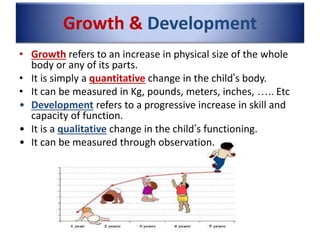
• Growth refers to an increase in physical size of the whole
body or any of its parts.
• It is simply a quantitative change in the child’s body.
• It can be measured in Kg, pounds, meters, inches, ….. Etc
• Development refers to a progressive increase in skill and
capacity of function.
• It is a qualitative change in the child’s functioning.
• It can be measured through observation.
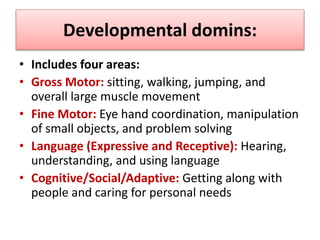
Developmental domins:
• Includes four areas:
• Gross Motor: sitting, walking, jumping, and
overall large muscle movement
• Fine Motor: Eye hand coordination, manipulation
of small objects, and problem solving
• Language (Expressive and Receptive): Hearing,
understanding, and using language
• Cognitive/Social/Adaptive: Getting along with
people and caring for personal needs
Important notes
• We will assess two ages; infant and older
children.
• Be a good observer.
 during assessment of development: say ?
• 'Demonstrated' is better than 'can' or 'cannot'. It
means that the parents cannot correct you?
• Remember you are only assessing the child over
a few minutes. We will decide on today the child
can not demonstrate? And not; he can not ?
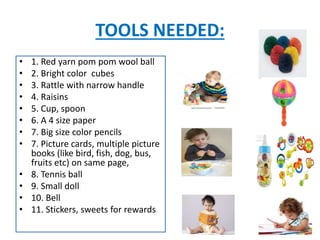
TOOLS NEEDED:
• 1. Red yarn pom pom wool ball
• 2. Bright color cubes
• 3. Rattle with narrow handle
• 4. Raisins
• 5. Cup, spoon
• 6. A 4 size paper
• 7. Big size color pencils
• 7. Picture cards, multiple picture
books (like bird, fish, dog, bus,
fruits etc) on same page,
• 8. Tennis ball
• 9. Small doll
• 10. Bell
• 11. Stickers, sweets for rewards
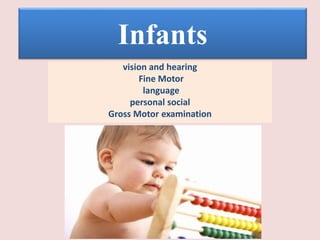
vision and hearing
Fine Motor
language
personal social
Gross Motor examination
Infants
Developmental domins:
• Include following areas:
• If child is on mum’s lap(most of the time) can do :
• -1st vision and hearing,
• -2nd Fine Motor,
• -3rd language
• -4th personal social,
• -5th Gross Motor examination
• Do not separate for Gross Motor assessment.
• Bigger kids can examine on chair.
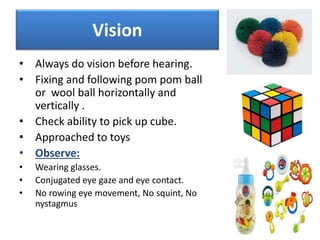
Vision
• Always do vision before hearing.
• Fixing and following pom pom ball
or wool ball horizontally and
vertically .
• Check ability to pick up cube.
• Approached to toys
• Observe:
• Wearing glasses.
• Conjugated eye gaze and eye contact.
• No rowing eye movement, No squint, No
nystagmus
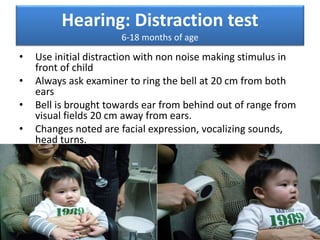
Hearing: Distraction test
6-18 months of age
• Use initial distraction with non noise making stimulus in
front of child
• Always ask examiner to ring the bell at 20 cm from both
ears
• Bell is brought towards ear from behind out of range from
visual fields 20 cm away from ears.
• Changes noted are facial expression, vocalizing sounds,
head turns.
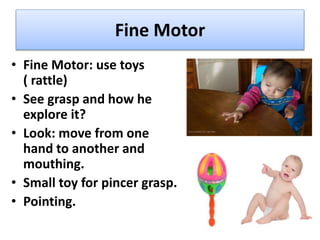
Fine Motor
• Fine Motor: use toys
( rattle)
• See grasp and how he
explore it?
• Look: move from one
hand to another and
mouthing.
• Small toy for pincer grasp.
• Pointing.
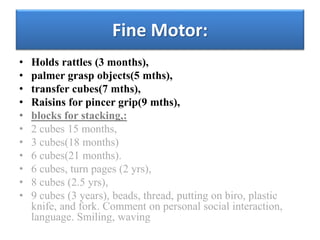
Fine Motor:
• Holds rattles (3 months),
• palmer grasp objects(5 mths),
• transfer cubes(7 mths),
• Raisins for pincer grip(9 mths),
• blocks for stacking,:
• 2 cubes 15 months,
• 3 cubes(18 months)
• 6 cubes(21 months).
• 6 cubes, turn pages (2 yrs),
• 8 cubes (2.5 yrs),
• 9 cubes (3 years), beads, thread, putting on biro, plastic
knife, and fork. Comment on personal social interaction,
language. Smiling, waving
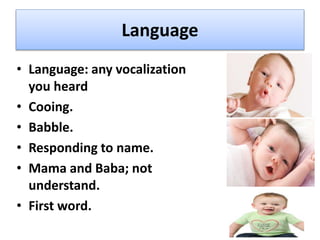
Language
• Language: any vocalization
you heard
• Cooing.
• Babble.
• Responding to name.
• Mama and Baba; not
understand.
• First word.
Speech and Language:
• Cooing ( 2mths),
• responds to human voice (4 mths),
• Babbling (6mths),
• Mamma, dada (9mths),
• 2 words plus mama, dada(12 mths),
• Jargon, points (15mths),
• 10 words and says his name, points to 3 body parts, one picture
(18mths),
• 2-3 word phrase, name 3 objects, 4 body parts, says no(2 yrs),
• know name, age sex (2.5yrs),
• preposition, count 1-10, 2 colours (3 yrs),
• Name 3 colours,
• Converses (4 years)
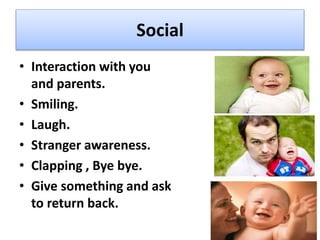
Social
• Interaction with you
and parents.
• Smiling.
• Laugh.
• Stranger awareness.
• Clapping , Bye bye.
• Give something and ask
to return back.
Personal social Development Chronologically
1. Focus on faces(4 weeks),
2. social smile(6 weeks),
3. excited with toys(4 months),
4. stranger anxiety, (6 months),
5. responds to No, imitates, (8 months),
6. clapping, bye bye, bang blocks (10 months),
7. picture books( 12 months),
8. kiss mirror (13 months),
9. points(15 months),
10. Body parts(21 months)
• 180 degree flip examination.
• Supine: Note posture, abnormal tone and power,
involuntary movements with CP. paucity of movements
for hemiplegia.
• Pull to sit: head lag. Sitting: Head and trunk control.
Back is straight or rounded.
• Weight bearing: scissoring, hypotonia, advanced
weight bearing (CP)
• Ventral suspension: Describe posture, low tone,
increase extensor tone.
• Prone: Observe ability to raise head, trunk above
horizontal,
Gross Motor: posture & movement
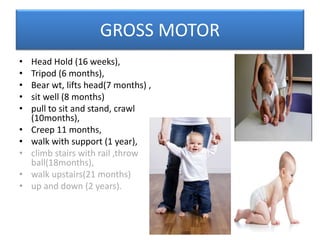
GROSS MOTOR
• Head Hold (16 weeks),
• Tripod (6 months),
• Bear wt, lifts head(7 months) ,
• sit well (8 months)
• pull to sit and stand, crawl
(10months),
• Creep 11 months,
• walk with support (1 year),
• climb stairs with rail ,throw
ball(18months),
• walk upstairs(21 months)
• up and down (2 years).
Gross Motor
Fine Motor
Language
Cognitive/Social/Adaptive
Older children
Developmental domins:
• Includes four areas:
• Gross Motor: sitting, walking, jumping, and
overall large muscle movement
• Fine Motor: Eye hand coordination, manipulation
of small objects, and problem solving
• Language (Expressive and Receptive): Hearing,
understanding, and using language
• Cognitive/Social/Adaptive: Getting along with
people and caring for personal needs
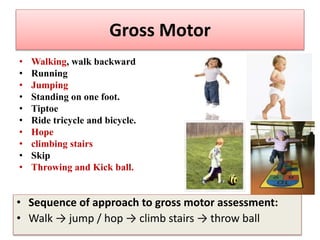
• Walking, walk backward
• Running
• Jumping
• Standing on one foot.
• Tiptoe
• Ride tricycle and bicycle.
• Hope
• climbing stairs
• Skip
• Throwing and Kick ball.
Gross Motor
• Sequence of approach to gross motor assessment:
• Walk → jump / hop → climb stairs → throw ball
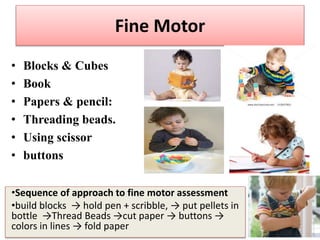
Fine Motor
• Blocks & Cubes
• Book
• Papers & pencil:
• Threading beads.
• Using scissor
• buttons
•Sequence of approach to fine motor assessment
•build blocks → hold pen + scribble, → put pellets in
bottle →Thread Beads →cut paper → buttons →
colors in lines → fold paper
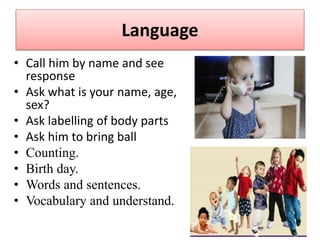
Language
• Call him by name and see
response
• Ask what is your name, age,
sex?
• Ask labelling of body parts
• Ask him to bring ball
• Counting.
• Birth day.
• Words and sentences.
• Vocabulary and understand.
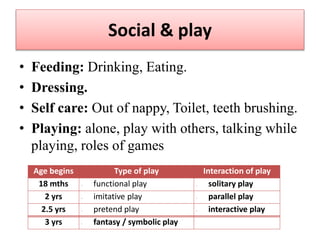
Social & play
• Feeding: Drinking, Eating.
• Dressing.
• Self care: Out of nappy, Toilet, teeth brushing.
• Playing: alone, play with others, talking while
playing, roles of games
Age begins Type of play Interaction of play
18 mths ▪ functional play ▪ solitary play
2 yrs ▪ imitative play ▪ parallel play
2.5 yrs ▪ pretend play ▪ interactive play
3 yrs ▪ fantasy / symbolic play
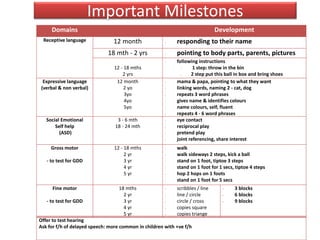
Important Milestones
Domains Development
Receptive language 12 month ▪ responding to their name
18 mth - 2 yrs ▪ pointing to body parts, parents, pictures
12 - 18 mths
2 yrs
▪ following instructions
- 1 step: throw in the bin
- 2 step put this ball in box and bring shoes
Expressive language
(verbal & non verbal)
12 month
2 yo
3yo
4yo
5yo
▪ mama & papa, pointing to what they want
▪ linking words, naming 2 - cat, dog
▪ repeats 3 word phrases
▪ gives name & identifies colours
▪ name colours, self, fluent
▪ repeats 4 - 6 word phrases
Social Emotional
Self help
(ASD)
3 - 6 mth
18 - 24 mth
▪ eye contact
▪ reciprocal play
▪ pretend play
▪ joint referencing, share interest
Gross motor
- to test for GDD
12 - 18 mths
2 yr
3 yr
4 yr
5 yr
▪ walk
▪ walk sideways 2 steps, kick a ball
▪ stand on 1 foot, tiptoe 3 steps
▪ stand on 1 foot for 1 secs, tiptoe 4 steps
▪ hop 2 hops on 1 foots
▪ stand on 1 foot for 5 secs
Fine motor
- to test for GDD
18 mths
2 yr
3 yr
4 yr
5 yr
▪ scribbles / line
▪ line / circle
▪ circle / cross
▪ copies square
▪ copies triange
▪ 3 blocks
▪ 6 blocks
▪ 9 blocks
Offer to test hearing
Ask for f/h of delayed speech: more common in children with +ve f/h
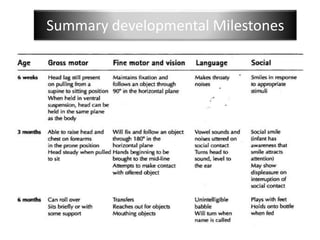
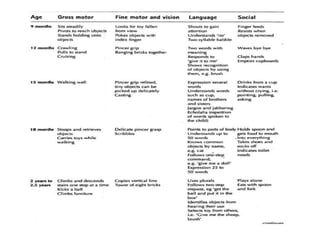
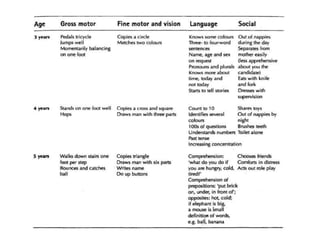
Summary developmental Milestones
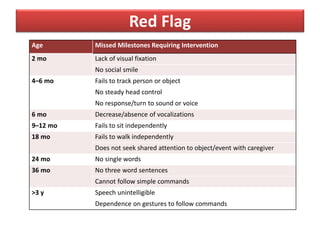
Red Flag
Age Missed Milestones Requiring Intervention
2 mo Lack of visual fixation
No social smile
4–6 mo Fails to track person or object
No steady head control
No response/turn to sound or voice
6 mo Decrease/absence of vocalizations
9–12 mo Fails to sit independently
18 mo Fails to walk independently
Does not seek shared attention to object/event with caregiver
24 mo No single words
36 mo No three word sentences
Cannot follow simple commands
>3 y Speech unintelligible
Dependence on gestures to follow commands
In general:
• The single most common presenting concern was
speech and language delay.
• The most common clinical developmental
diagnosis was autism spectrum disorder.
• Global developmental delay.
• ADHD
• Learning Disabilities
• Cognitive impairment
• CP
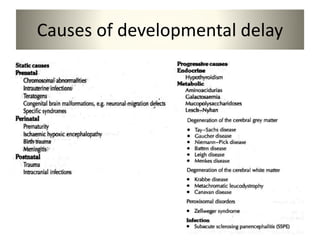
Causes of developmental delay
Developmental examination for the
Short Case examination
• It is important when assessing development to
make comments under the four main
headings:
• Gross motor
• Fine motor and vision
• Speech and hearing (language)
• Social
Approach
• Begin by introducing yourself to parents, hand
Wash etc. 1st only look see, play…and
examine.
• Inform examiner about your approach either:
- live commentary or
- Summarize after full examination
• Generates a pass/fail score in four
development domains
Inspect
• Look for clues; Look for feeding equipment,
nappy bag, the toys they have brought
• Is the child well?
• Does the child look dysmorphic?
• Are there any obvious neurological
abnormalities?
Assessment
• Pitch in at around the age you think the child is,
i.e. if they look around 18 months do not start
asking them to copy circles, etc
• Assess each of the four developmental
categories.
• Once you have demonstrated they can do one
level push up to the next level until they are not
able to perform the task.
• For example: if you have demonstrated the child
can copy a square do not ask them to copy a
circle, instead see if they can copy a triangle.
• Keep control of the situation. If the child is
playing already, WATCH. You may be able to
complete the whole assessment by observation
alone
• If the child is already sitting use the opportunity
to assess language, social and finemotor
development.
• Do not disrupt the child to do gross motor tests .
you may well have difficulty settling him again
and in the older child gross motor gives you the
least additional information. Leave it to the end.
Assessment
• Use the parents if the child is shy or
apprehensive, e.g. ask the parents to draw a
circle for the child to copy or test the child
about colours, numbers, stories, etc.
• If the child does not co-operate do not panic.
You can still get clues from observing.
Assessment
Presentation
• Summarize any relevant clinical findings, e.g. this girl
looks ill, has IV line, etc, which may be affecting your
assessment. If the child looks dysmorphic then say so
• This child has a developmental age of X because:
 Gross motor -I have demonstrated that they can do this
but not that
 Fine motor -I have demonstrated, etc
• 'Demonstrated' is better than 'can' or 'cannot'. It
means that the parents cannot correct you by saying
'yes he can'!
• Remember you are only assessing the child over a few
minutes.
• If you have a developmental discrepancy
between the four areas then present this, e.g.
this child has a developmental age of 4 in
gross- and fine-motor skills but a
developmental level of 2 years in speech and
language and social skills.
• Follow this by saying what you would like to
do next, e.g. I would like to formally test his
hearing to exclude a hearing problem.
Presentation
Approach to child with
Developmental Delay
History
• A good history is essential to help determine the cause and
appropriate investigations.
• Information is required on Perinatal , Birth history,
Gestational age, Post natal; HIE, CP , prematurity.
• Family history may give the strongest clue to a
chromosomal disorder.
• Enquire about previous pregnancy losses.
• Presence of medical problems associated with
Developmental Delay.
• Assess if any medical problems like Neurologic, myopathy,
dystrophy ,
• Genetic, syndromes particularly Fragile X, Prader willi
• Metabolic disorder
• Endocrine exclude Hypothyroidism
Examination
• A thorough examination is essential.
• Neurodegenerative conditions affecting the
grey matter tend to present with dementia
and seizures.
• Conditions affecting the white matter tend to
present with spasticity, cortical deafness and
blindness.
Inspect for:
• Sex of child- X-linked conditions such as fragile X,
Menkes, Hunter, Lesch-Nyhan syndromes.
• Age of the child:
 First 6 months - Tay-Sachs disease, Leigh disease,
infantile spasms, tuberose sclerosis
 Toddlers- infantile metachromatic
leukodystrophy, mucopolysaccharidoses, infantile
Gaucher, Krabbe disease
 Older children- juvenile Batten disease, SSPE,
Wilson disease, Huntington chorea
• Dysmorphic features - Down syndrome,
mucopolysaccharidoses
• Neurocutaneous signs- ataxia telangiectasia,
Sturge-Weber syndrome, incontinentia
pigmenti, tuberose sclerosis
• Extrapyramidal movements- cerebral palsy,
Wilson disease, Huntington chorea
• Tremor- Wilson disease, Friedreich's ataxia,
metachromatic leukodystrophy
Inspect for:
Note growth of child
• Large head -Alexander, Canavan, Tay-Sachs
syndromes, mucopolysaccharidoses
• Small head- cerebral palsy, autosomal
recessive microcephaly, Rubinstein-Taybi,
Smith-Lemli-Opitz, Cornelia de Lange
syndromes
• Growth pattern (e.g. faltering growth with
metabolic disease, gigantism with Soto
syndrome)
Systematic examination
• Eyes - corneal clouding, cataract, cherry-red spot, optic
atrophy
• Neurological examination including gait, scoliosis,
tremor, extrapyramidal movements, tone, power and
reflexes of limbs
• Associated system involvement (e.g. cardiac
abnormalities, organomegaly in metabolic disease)
• Genitalia
• Hearing and vision should be checked
Further assessment often involves input from other
professionals of the child development team, e.g.
speech and language therapists and physiotherapist.
Investigations
• A thorough history and examination may lead
to targeted investigations, e.g. a specific
genetic test or metabolic test.
• For approximately 40% of cases no cause is
found.
• The two most useful investigations are genetic
studies and brain imaging.
• If no specific diagnosis is suggested then consider:
Blood tests
• Chromosomal analysis
• Thyroid function tests
• TORCH serology in infants (TORCH, toxoplasmosis,
other (congenital syphilis and viruses), rubella,
cytomegalovirus and herpes simplex virus)
• Plasma amino acids
• Ammonia
• Lactate
• White cell enzymes
Investigations
Urine tests
• Urinary organic acids
• Urinary amino acids
• Urinary mucopolysaccharidoses
Brain imaging
• This will identify congenital brain abnormalities
and diagnose degenerative conditions such as the
leukodystrophies and grey matter abnormalities.
EEG
• This will identify SSPE, Batten disease
Investigations
Management
 This is multidisciplinary. The precise make-up of the team
depends on local resources. It can include:
• Community paediatrician
• Speech and language therapist
• Physiotherapist
• Occupational therapist
• Child psychologist/psychiatrist
• Play therapist
• Pre-school therapist, e.g. portage
• Nursery teachers
• Health visitors
• Social workers
THANKS FOR YOUR
ATTENTION

Developmental milestones for postgraduate students

  • 2.
    Growth & Development •Growth refers to an increase in physical size of the whole body or any of its parts. • It is simply a quantitative change in the child’s body. • It can be measured in Kg, pounds, meters, inches, ….. Etc • Development refers to a progressive increase in skill and capacity of function. • It is a qualitative change in the child’s functioning. • It can be measured through observation.
  • 3.
    Developmental domins: • Includesfour areas: • Gross Motor: sitting, walking, jumping, and overall large muscle movement • Fine Motor: Eye hand coordination, manipulation of small objects, and problem solving • Language (Expressive and Receptive): Hearing, understanding, and using language • Cognitive/Social/Adaptive: Getting along with people and caring for personal needs
  • 4.
    Important notes • Wewill assess two ages; infant and older children. • Be a good observer.  during assessment of development: say ? • 'Demonstrated' is better than 'can' or 'cannot'. It means that the parents cannot correct you? • Remember you are only assessing the child over a few minutes. We will decide on today the child can not demonstrate? And not; he can not ?
  • 5.
    TOOLS NEEDED: • 1.Red yarn pom pom wool ball • 2. Bright color cubes • 3. Rattle with narrow handle • 4. Raisins • 5. Cup, spoon • 6. A 4 size paper • 7. Big size color pencils • 7. Picture cards, multiple picture books (like bird, fish, dog, bus, fruits etc) on same page, • 8. Tennis ball • 9. Small doll • 10. Bell • 11. Stickers, sweets for rewards
  • 6.
    vision and hearing FineMotor language personal social Gross Motor examination Infants
  • 7.
    Developmental domins: • Includefollowing areas: • If child is on mum’s lap(most of the time) can do : • -1st vision and hearing, • -2nd Fine Motor, • -3rd language • -4th personal social, • -5th Gross Motor examination • Do not separate for Gross Motor assessment. • Bigger kids can examine on chair.
  • 8.
    Vision • Always dovision before hearing. • Fixing and following pom pom ball or wool ball horizontally and vertically . • Check ability to pick up cube. • Approached to toys • Observe: • Wearing glasses. • Conjugated eye gaze and eye contact. • No rowing eye movement, No squint, No nystagmus
  • 9.
    Hearing: Distraction test 6-18months of age • Use initial distraction with non noise making stimulus in front of child • Always ask examiner to ring the bell at 20 cm from both ears • Bell is brought towards ear from behind out of range from visual fields 20 cm away from ears. • Changes noted are facial expression, vocalizing sounds, head turns.
  • 10.
    Fine Motor • FineMotor: use toys ( rattle) • See grasp and how he explore it? • Look: move from one hand to another and mouthing. • Small toy for pincer grasp. • Pointing.
  • 11.
    Fine Motor: • Holdsrattles (3 months), • palmer grasp objects(5 mths), • transfer cubes(7 mths), • Raisins for pincer grip(9 mths), • blocks for stacking,: • 2 cubes 15 months, • 3 cubes(18 months) • 6 cubes(21 months). • 6 cubes, turn pages (2 yrs), • 8 cubes (2.5 yrs), • 9 cubes (3 years), beads, thread, putting on biro, plastic knife, and fork. Comment on personal social interaction, language. Smiling, waving
  • 12.
    Language • Language: anyvocalization you heard • Cooing. • Babble. • Responding to name. • Mama and Baba; not understand. • First word.
  • 13.
    Speech and Language: •Cooing ( 2mths), • responds to human voice (4 mths), • Babbling (6mths), • Mamma, dada (9mths), • 2 words plus mama, dada(12 mths), • Jargon, points (15mths), • 10 words and says his name, points to 3 body parts, one picture (18mths), • 2-3 word phrase, name 3 objects, 4 body parts, says no(2 yrs), • know name, age sex (2.5yrs), • preposition, count 1-10, 2 colours (3 yrs), • Name 3 colours, • Converses (4 years)
  • 14.
    Social • Interaction withyou and parents. • Smiling. • Laugh. • Stranger awareness. • Clapping , Bye bye. • Give something and ask to return back.
  • 15.
    Personal social DevelopmentChronologically 1. Focus on faces(4 weeks), 2. social smile(6 weeks), 3. excited with toys(4 months), 4. stranger anxiety, (6 months), 5. responds to No, imitates, (8 months), 6. clapping, bye bye, bang blocks (10 months), 7. picture books( 12 months), 8. kiss mirror (13 months), 9. points(15 months), 10. Body parts(21 months)
  • 16.
    • 180 degreeflip examination. • Supine: Note posture, abnormal tone and power, involuntary movements with CP. paucity of movements for hemiplegia. • Pull to sit: head lag. Sitting: Head and trunk control. Back is straight or rounded. • Weight bearing: scissoring, hypotonia, advanced weight bearing (CP) • Ventral suspension: Describe posture, low tone, increase extensor tone. • Prone: Observe ability to raise head, trunk above horizontal, Gross Motor: posture & movement
  • 17.
    GROSS MOTOR • HeadHold (16 weeks), • Tripod (6 months), • Bear wt, lifts head(7 months) , • sit well (8 months) • pull to sit and stand, crawl (10months), • Creep 11 months, • walk with support (1 year), • climb stairs with rail ,throw ball(18months), • walk upstairs(21 months) • up and down (2 years).
  • 18.
  • 19.
    Developmental domins: • Includesfour areas: • Gross Motor: sitting, walking, jumping, and overall large muscle movement • Fine Motor: Eye hand coordination, manipulation of small objects, and problem solving • Language (Expressive and Receptive): Hearing, understanding, and using language • Cognitive/Social/Adaptive: Getting along with people and caring for personal needs
  • 20.
    • Walking, walkbackward • Running • Jumping • Standing on one foot. • Tiptoe • Ride tricycle and bicycle. • Hope • climbing stairs • Skip • Throwing and Kick ball. Gross Motor • Sequence of approach to gross motor assessment: • Walk → jump / hop → climb stairs → throw ball
  • 21.
    Fine Motor • Blocks& Cubes • Book • Papers & pencil: • Threading beads. • Using scissor • buttons •Sequence of approach to fine motor assessment •build blocks → hold pen + scribble, → put pellets in bottle →Thread Beads →cut paper → buttons → colors in lines → fold paper
  • 22.
    Language • Call himby name and see response • Ask what is your name, age, sex? • Ask labelling of body parts • Ask him to bring ball • Counting. • Birth day. • Words and sentences. • Vocabulary and understand.
  • 23.
    Social & play •Feeding: Drinking, Eating. • Dressing. • Self care: Out of nappy, Toilet, teeth brushing. • Playing: alone, play with others, talking while playing, roles of games Age begins Type of play Interaction of play 18 mths ▪ functional play ▪ solitary play 2 yrs ▪ imitative play ▪ parallel play 2.5 yrs ▪ pretend play ▪ interactive play 3 yrs ▪ fantasy / symbolic play
  • 24.
    Important Milestones Domains Development Receptivelanguage 12 month ▪ responding to their name 18 mth - 2 yrs ▪ pointing to body parts, parents, pictures 12 - 18 mths 2 yrs ▪ following instructions - 1 step: throw in the bin - 2 step put this ball in box and bring shoes Expressive language (verbal & non verbal) 12 month 2 yo 3yo 4yo 5yo ▪ mama & papa, pointing to what they want ▪ linking words, naming 2 - cat, dog ▪ repeats 3 word phrases ▪ gives name & identifies colours ▪ name colours, self, fluent ▪ repeats 4 - 6 word phrases Social Emotional Self help (ASD) 3 - 6 mth 18 - 24 mth ▪ eye contact ▪ reciprocal play ▪ pretend play ▪ joint referencing, share interest Gross motor - to test for GDD 12 - 18 mths 2 yr 3 yr 4 yr 5 yr ▪ walk ▪ walk sideways 2 steps, kick a ball ▪ stand on 1 foot, tiptoe 3 steps ▪ stand on 1 foot for 1 secs, tiptoe 4 steps ▪ hop 2 hops on 1 foots ▪ stand on 1 foot for 5 secs Fine motor - to test for GDD 18 mths 2 yr 3 yr 4 yr 5 yr ▪ scribbles / line ▪ line / circle ▪ circle / cross ▪ copies square ▪ copies triange ▪ 3 blocks ▪ 6 blocks ▪ 9 blocks Offer to test hearing Ask for f/h of delayed speech: more common in children with +ve f/h
  • 25.
  • 28.
    Red Flag Age MissedMilestones Requiring Intervention 2 mo Lack of visual fixation No social smile 4–6 mo Fails to track person or object No steady head control No response/turn to sound or voice 6 mo Decrease/absence of vocalizations 9–12 mo Fails to sit independently 18 mo Fails to walk independently Does not seek shared attention to object/event with caregiver 24 mo No single words 36 mo No three word sentences Cannot follow simple commands >3 y Speech unintelligible Dependence on gestures to follow commands
  • 29.
    In general: • Thesingle most common presenting concern was speech and language delay. • The most common clinical developmental diagnosis was autism spectrum disorder. • Global developmental delay. • ADHD • Learning Disabilities • Cognitive impairment • CP
  • 30.
  • 31.
    Developmental examination forthe Short Case examination • It is important when assessing development to make comments under the four main headings: • Gross motor • Fine motor and vision • Speech and hearing (language) • Social
  • 32.
    Approach • Begin byintroducing yourself to parents, hand Wash etc. 1st only look see, play…and examine. • Inform examiner about your approach either: - live commentary or - Summarize after full examination • Generates a pass/fail score in four development domains
  • 33.
    Inspect • Look forclues; Look for feeding equipment, nappy bag, the toys they have brought • Is the child well? • Does the child look dysmorphic? • Are there any obvious neurological abnormalities?
  • 34.
    Assessment • Pitch inat around the age you think the child is, i.e. if they look around 18 months do not start asking them to copy circles, etc • Assess each of the four developmental categories. • Once you have demonstrated they can do one level push up to the next level until they are not able to perform the task. • For example: if you have demonstrated the child can copy a square do not ask them to copy a circle, instead see if they can copy a triangle.
  • 35.
    • Keep controlof the situation. If the child is playing already, WATCH. You may be able to complete the whole assessment by observation alone • If the child is already sitting use the opportunity to assess language, social and finemotor development. • Do not disrupt the child to do gross motor tests . you may well have difficulty settling him again and in the older child gross motor gives you the least additional information. Leave it to the end. Assessment
  • 36.
    • Use theparents if the child is shy or apprehensive, e.g. ask the parents to draw a circle for the child to copy or test the child about colours, numbers, stories, etc. • If the child does not co-operate do not panic. You can still get clues from observing. Assessment
  • 37.
    Presentation • Summarize anyrelevant clinical findings, e.g. this girl looks ill, has IV line, etc, which may be affecting your assessment. If the child looks dysmorphic then say so • This child has a developmental age of X because:  Gross motor -I have demonstrated that they can do this but not that  Fine motor -I have demonstrated, etc • 'Demonstrated' is better than 'can' or 'cannot'. It means that the parents cannot correct you by saying 'yes he can'! • Remember you are only assessing the child over a few minutes.
  • 38.
    • If youhave a developmental discrepancy between the four areas then present this, e.g. this child has a developmental age of 4 in gross- and fine-motor skills but a developmental level of 2 years in speech and language and social skills. • Follow this by saying what you would like to do next, e.g. I would like to formally test his hearing to exclude a hearing problem. Presentation
  • 39.
    Approach to childwith Developmental Delay
  • 40.
    History • A goodhistory is essential to help determine the cause and appropriate investigations. • Information is required on Perinatal , Birth history, Gestational age, Post natal; HIE, CP , prematurity. • Family history may give the strongest clue to a chromosomal disorder. • Enquire about previous pregnancy losses. • Presence of medical problems associated with Developmental Delay. • Assess if any medical problems like Neurologic, myopathy, dystrophy , • Genetic, syndromes particularly Fragile X, Prader willi • Metabolic disorder • Endocrine exclude Hypothyroidism
  • 41.
    Examination • A thoroughexamination is essential. • Neurodegenerative conditions affecting the grey matter tend to present with dementia and seizures. • Conditions affecting the white matter tend to present with spasticity, cortical deafness and blindness.
  • 42.
    Inspect for: • Sexof child- X-linked conditions such as fragile X, Menkes, Hunter, Lesch-Nyhan syndromes. • Age of the child:  First 6 months - Tay-Sachs disease, Leigh disease, infantile spasms, tuberose sclerosis  Toddlers- infantile metachromatic leukodystrophy, mucopolysaccharidoses, infantile Gaucher, Krabbe disease  Older children- juvenile Batten disease, SSPE, Wilson disease, Huntington chorea
  • 43.
    • Dysmorphic features- Down syndrome, mucopolysaccharidoses • Neurocutaneous signs- ataxia telangiectasia, Sturge-Weber syndrome, incontinentia pigmenti, tuberose sclerosis • Extrapyramidal movements- cerebral palsy, Wilson disease, Huntington chorea • Tremor- Wilson disease, Friedreich's ataxia, metachromatic leukodystrophy Inspect for:
  • 44.
    Note growth ofchild • Large head -Alexander, Canavan, Tay-Sachs syndromes, mucopolysaccharidoses • Small head- cerebral palsy, autosomal recessive microcephaly, Rubinstein-Taybi, Smith-Lemli-Opitz, Cornelia de Lange syndromes • Growth pattern (e.g. faltering growth with metabolic disease, gigantism with Soto syndrome)
  • 45.
    Systematic examination • Eyes- corneal clouding, cataract, cherry-red spot, optic atrophy • Neurological examination including gait, scoliosis, tremor, extrapyramidal movements, tone, power and reflexes of limbs • Associated system involvement (e.g. cardiac abnormalities, organomegaly in metabolic disease) • Genitalia • Hearing and vision should be checked Further assessment often involves input from other professionals of the child development team, e.g. speech and language therapists and physiotherapist.
  • 46.
    Investigations • A thoroughhistory and examination may lead to targeted investigations, e.g. a specific genetic test or metabolic test. • For approximately 40% of cases no cause is found. • The two most useful investigations are genetic studies and brain imaging.
  • 47.
    • If nospecific diagnosis is suggested then consider: Blood tests • Chromosomal analysis • Thyroid function tests • TORCH serology in infants (TORCH, toxoplasmosis, other (congenital syphilis and viruses), rubella, cytomegalovirus and herpes simplex virus) • Plasma amino acids • Ammonia • Lactate • White cell enzymes Investigations
  • 48.
    Urine tests • Urinaryorganic acids • Urinary amino acids • Urinary mucopolysaccharidoses Brain imaging • This will identify congenital brain abnormalities and diagnose degenerative conditions such as the leukodystrophies and grey matter abnormalities. EEG • This will identify SSPE, Batten disease Investigations
  • 49.
    Management  This ismultidisciplinary. The precise make-up of the team depends on local resources. It can include: • Community paediatrician • Speech and language therapist • Physiotherapist • Occupational therapist • Child psychologist/psychiatrist • Play therapist • Pre-school therapist, e.g. portage • Nursery teachers • Health visitors • Social workers
  • 50.