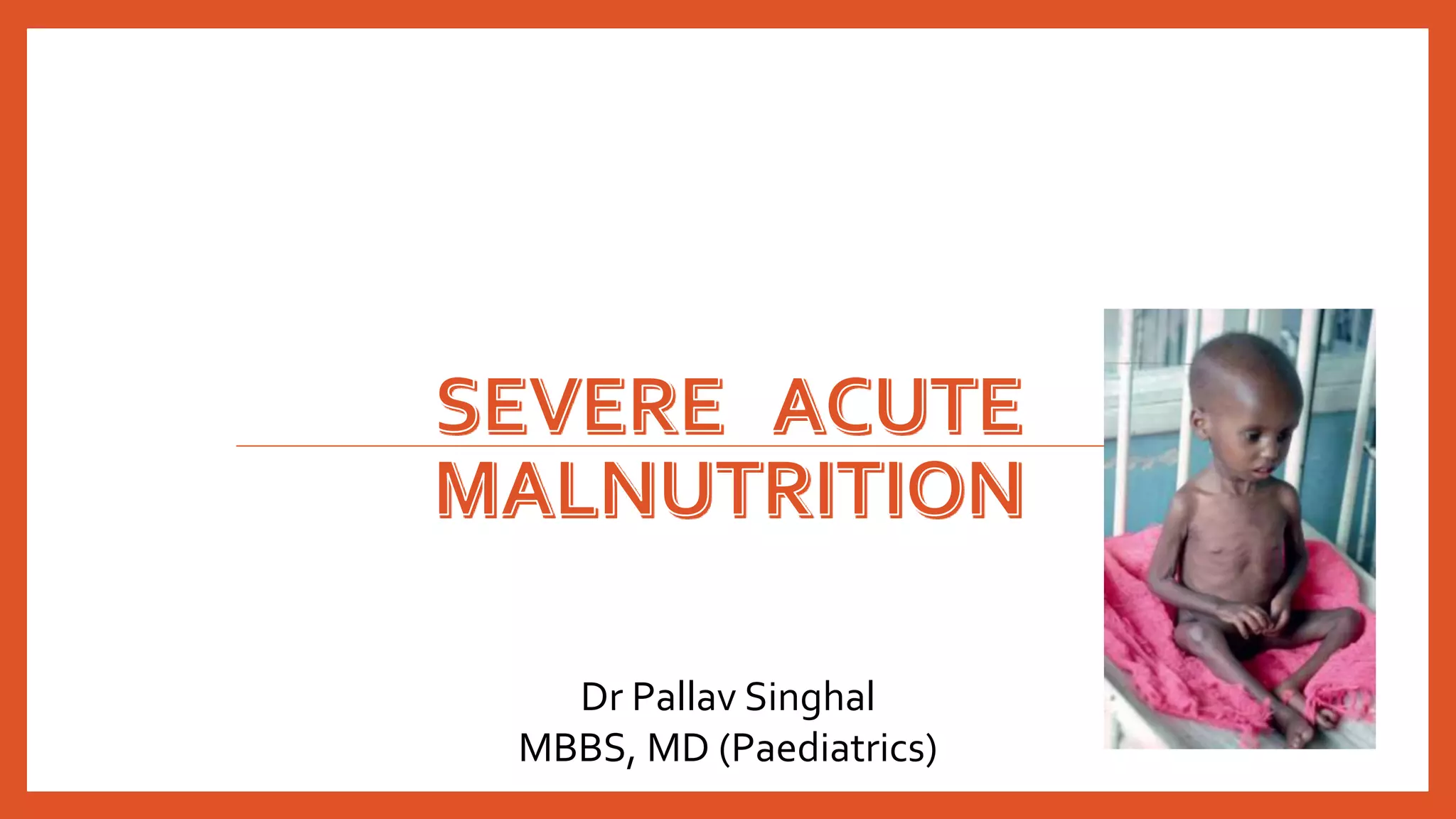
Dr Pallav Singhal
MBBS, MD (Paediatrics)
Introduction
โ€ข Childhood undernutrition a major global health problem.
โ€ข Affects 8.1 million under-five children in India [1].
โ€ข Nearly 0.6 million deaths and 24.6 million DALYs (disability adjusted life years) are
attributed to this condition.
โ€ข Diarrhea and pneumonia accounts for half the under-five deaths in India, and
malnutrition is believed to contribute to 61% of diarrheal deaths and 53%
pneumonia deaths (2).
1. International Institute for Population Sciences. National Family Health Survey 3, 2005-2006. Mumbai India:
International Institute of Population Science; 200
2. Black RE,Allen LH, Bhutta ZA, de Onis M, Ezzati M, Mathers C, et al. Maternal and Child undernutrition: global
and regional exposures and health consequences. Lancet. 2008; 371: 243-60.
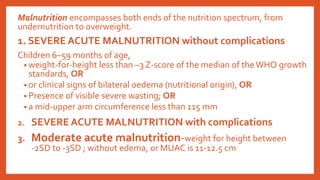
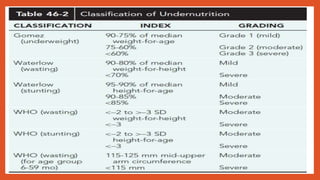
Malnutrition encompasses both ends of the nutrition spectrum, from
undernutrition to overweight.
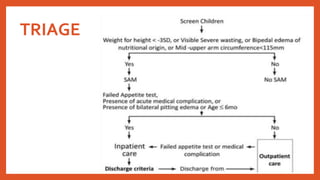
1. SEVERE ACUTE MALNUTRITION without complications
Children 6โ€“59 months of age,
โ€ข weight-for-height less than โ€“3 Z-score of the median of the WHO growth
standards, OR
โ€ข or clinical signs of bilateral oedema (nutritional origin), OR
โ€ข Presence of visible severe wasting; OR
โ€ข a mid-upper arm circumference less than 115 mm
2. SEVERE ACUTE MALNUTRITION with complications
3. Moderate acute malnutrition-weight for height between
-2SD to -3SD ; without edema, or MUAC is 11-12.5 cm
SAM vs PEM
โ€ข Name protein-energy malnutrition is avoided, as it oversimplifies the complex
multideficiency etiology.
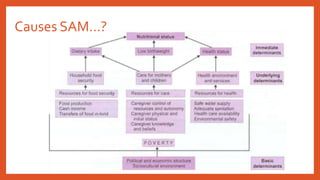
Causes SAMโ€ฆ?
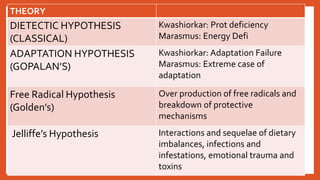
THEORY
DIETECTIC HYPOTHESIS
(CLASSICAL)
Kwashiorkar: Prot deficiency
Marasmus: Energy Defi
ADAPTATION HYPOTHESIS
(GOPALANโ€™S)
Kwashiorkar: Adaptation Failure
Marasmus: Extreme case of
adaptation
Free Radical Hypothesis
(Goldenโ€™s)
Over production of free radicals and
breakdown of protective
mechanisms
Jelliffeโ€™s Hypothesis Interactions and sequelae of dietary
imbalances, infections and
infestations, emotional trauma and
toxins
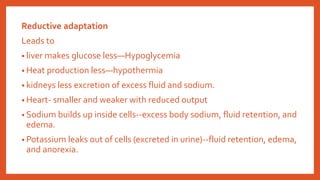
Reductive adaptation
Leads to
โ€ข liver makes glucose lessโ€”Hypoglycemia
โ€ข Heat production lessโ€”hypothermia
โ€ข kidneys less excretion of excess fluid and sodium.
โ€ข Heart- smaller and weaker with reduced output
โ€ข Sodium builds up inside cells--excess body sodium, fluid retention, and
edema.
โ€ข Potassium leaks out of cells (excreted in urine)--fluid retention, edema,
and anorexia.
โ€ขGut-less gastric acid and enzymes, motility reduced--Digestion
and absorption are impaired.
โ€ขCell replication and repair are reduced
โ€ขRed cell mass is reduced, releasing iron..
INITIAL ASSESSMENT
HISTORY
โ€ข The usual diet (before the current illness)
โ€ข Evidence of any chronic illness:
โ€ข presence of diarrhea (duration, watery /bloody)
โ€ข vomiting, loss of appetite, cough
โ€ข Contact with tuberculosis
DIETARY HISTORY
24 Hour Dietary recall
โ€ข Recall food and drink intake last 24 hour.
โ€ข Pre-morbid intake and current intake
โ€ข Freq of cereals/ pulses/ milk and products/ fruits and veg/ meat
products.
โ€ข Calc of calorie from breast: DO NOT calculate if usual feeding
going on( on demand feeds)
Examination
โ€ขSigns of dehydration
โ€ขShock (cold hands, slow capillary refill, weak and rapid
pulse)
โ€ขSevere palmar pallor
โ€ขEye signs of vitaminA deficiency
โ€ขsigns of infections
โ€ขSkin infection or pneumonia, signs of HIV infection, fever.
โ€ขHypothermia (rectal temperature <95.9ยฐF)
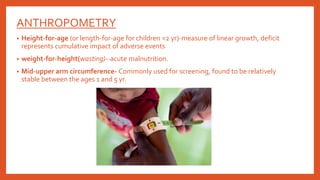
ANTHROPOMETRY
โ€ข Height-for-age (or length-for-age for children <2 yr)-measure of linear growth, deficit
represents cumulative impact of adverse events
โ€ข weight-for-height(wasting)--acute malnutrition.
โ€ข Mid-upper arm circumference- Commonly used for screening, found to be relatively
stable between the ages 1 and 5 yr.
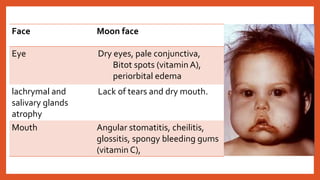
Face Moon face
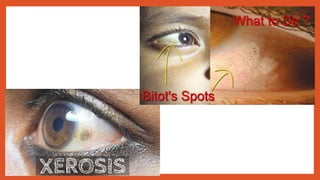
Eye Dry eyes, pale conjunctiva,
Bitot spots (vitamin A),
periorbital edema
lachrymal and
salivary glands
atrophy
Lack of tears and dry mouth.
Mouth Angular stomatitis, cheilitis,
glossitis, spongy bleeding gums
(vitamin C),
Teeth Enamel mottling, delayed eruption
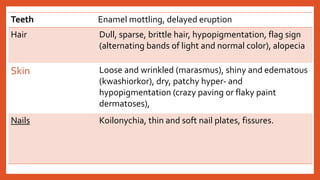
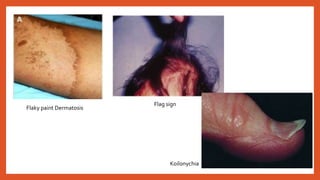
Hair Dull, sparse, brittle hair, hypopigmentation, flag sign
(alternating bands of light and normal color), alopecia
Skin Loose and wrinkled (marasmus), shiny and edematous
(kwashiorkor), dry, patchy hyper- and
hypopigmentation (crazy paving or flaky paint
dermatoses),
Nails Koilonychia, thin and soft nail plates, fissures.
Flaky paint Dermatosis
Flag sign
Koilonychia
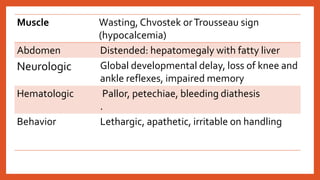
Muscle Wasting, Chvostek orTrousseau sign
(hypocalcemia)
Abdomen Distended: hepatomegaly with fatty liver
Neurologic Global developmental delay, loss of knee and
ankle reflexes, impaired memory
Hematologic Pallor, petechiae, bleeding diathesis
.
Behavior Lethargic, apathetic, irritable on handling
TRIAGE
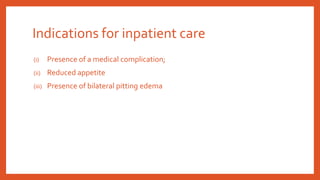
Indications for inpatient care
(i) Presence of a medical complication;
(ii) Reduced appetite
(iii) Presence of bilateral pitting edema
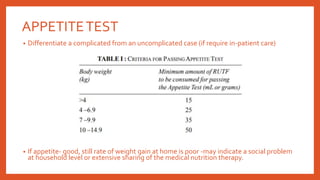
โ€ข Differentiate a complicated from an uncomplicated case (if require in-patient care)
โ€ข If appetite- good, still rate of weight gain at home is poor -may indicate a social problem
at household level or extensive sharing of the medical nutrition therapy.
APPETITETEST
RUTF
โ€ข RUTF- mixture of milk powder, vegetable oil, sugar, peanut butter, and powdered
vitamins and minerals,
โ€ข Powdered ingredients embedded in lipid rich paste..-energy dense
โ€ข Resists microbial contamination ..(very low water activity).
โ€ข Stored at room temp and tropical conditions for 3-4 months
โ€ข is energy-dense food providing 5.5Kcal/g.
โ€ข Equivalent in formulation to F 100
โ€ข Practical to use- where cooking fuel and facilities are limiting
โ€ข Continue to receive other foods and brestfeeding during medical nutrition therapy
with RUTF
Daily amount of RUTF to be consumed
โ€ข 3-4.9 kg: 105-130 g;
โ€ข 5-6.9 kg: 200-260 g;
โ€ข 7-9.9 kg: 260-400 g and
โ€ข 10-14.9 kg: 400-460 g.
โ€ข To given along with plenty of water in 2-3 hourly feeds.
A typical recipe for Ready to UseTherapeutic Food (Local Production)
% weight
Full fat milk powder 30
Sugar 28
Oil 15
Peanut butter 25
MineralVitamin Mix 1.6
Oxidation of the fatty acids, vitamin A and C, is the main factor limiting the storage life of
RUTF
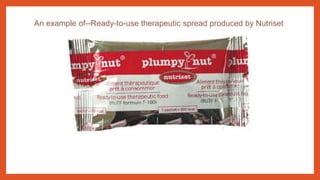
An example of--Ready-to-use therapeutic spread produced by Nutriset
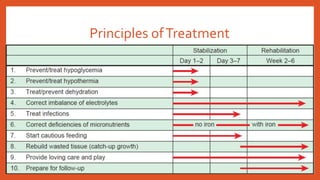
Principles ofTreatment
PHASES
1. Stabilization phase
2. rehabilitation phase(catch-up growth).
*Pushing ahead too quickly risk--โ€œrefeeding syndrome.โ€
*Donโ€™t treat edema with diuretic
*Donโ€™t give high-protein diet in early phase of treatment.
Emergency Management
SHOCK (Lethargic/ unconscious/ cold hands/ slow capillary refill/
weak fast pulse)
โ€ข 10D (5 mL/kg)
โ€ข IV fluid(Ringer lactate with 5% dextrose, (N /2) with 5% dextrose or Ringer lactate
alone at 15 mL/kg over 1 hr
โ€ข If signs of Improvement, repeat IV 15 mL/kg for 1 more hr.Then oral or nasogastric
rehydration.
โ€ข If does not improve after 1 h of intravenous therapy, a blood transfusion (10 mL/kg
slowly over at least 3 h) given.
Emergency treatment of severe anemia
Hb <4 g/ dl or between 4 and 6 g/ dl with respiratory distress
Give BT with whole blood 10 ml/kg over 3 hr
Lasix given at starting of BT.
Hypoglycemia
If conscious(asymptomatic):
โ€ข 10D(50 mL), or a feed, or 1 teaspoon sugar under the tongue-whichever is
quickest
If Unconscius(symptomatic)
โ€ข 10D (5 mL/kg) by IV
โ€ข Feed every 2 hr for at least the first day. Initially 1/4 of feed every 30 min
โ€ข Keep warm
โ€ข Start broad-spectrum antibiotics
Hypothermia--axillary <35ยฐC (95ยฐF); rectal <35.5ยฐC (95.9ยฐF)
โ€ข Actively rewarm
โ€ข Feed
โ€ข Skin-to-skin contact/ dress warmed clothes, cover head, wrap in warmed
blanket
โ€ข In case of severe hypothermia (rectal temperatureโ€ฆwarm humidified oxygen
followed immediately by 5 ml/kg of 10% dextrose IV or 50 ml of 10% dextrose
by nasogastric route.
โ€ข Stop rewarming-rectal temperature 36.5ยฐC (97.7ยฐF)
Dehydration
โ€ข Do not give IV fluids unless in shock
โ€ข Give ReSoMal 5 mL/kg every 30 min for first 2 hr orally or NG tube
5-10 mL/kg in alternate hours for up to 10 hr.
โ€ข STOP--signs of overload (pulse rate increases by 25 beats/min
and respiratory rate by 5 breaths/min; increasing edema;
engorged jugular veins)
โ€ข Stop when rehydrated.
โ€ข Standard WHO low-osmolarity oral rehydration solution (75 mmol/L
sodium) should not-- used for oral or nasogastric rehydration in severe
acute malnutrition in dehydration or severe dehydration.
โ€ข ReSoMal or half-strength standard WHO low-osmolarity oral
rehydration solution should be given
โ€ข To prepare ReSoMal
Dissolve one sachet of standardWHO low-osmolarity oral rehydration
solution in 2 L water (instead of 1 L).
Add 40 mL of mineral mix solution (5), and 50 g of sugar
5. WHO. The treatment of diarrhoea: manual for physicians and other senior health workers. Geneva, World
Health Organization; 2005 (http://www.who.int/maternal_child_adolescent/documents/9241593180/en/).
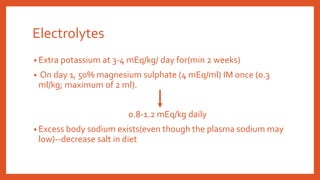
Electrolytes
โ€ข Extra potassium at 3-4 mEq/kg/ day for(min 2 weeks)
โ€ข On day 1, 50% magnesium sulphate (4 mEq/ml) IM once (0.3
ml/kg; maximum of 2 ml).
0.8-1.2 mEq/kg daily
โ€ข Excess body sodium exists(even though the plasma sodium may
low)--decrease salt in diet
Infections
โ€ข If no complications--Oral cotrimoxazole (5 mg/kg 12 hourly of
trimethoprim) or oral amoxicillin for 5 days
โ€ข If complications- Gentamicin (7.5 mg/kg IV or IM) or amikacin
(15-20 mg/kg IV or IM) once daily for 7 days
โ€ข Ampicillin (50 mg/kg/dose IV or IM) every 6 hr for 2 days,
oral amoxicillin (25-40 mg/kg) every 8 hr for 5 days.
โ€ข If no improvement within 48 hr--IV cefotaxime (100-150
mg/kg/day 6-8 hourly) or ceftriaxone (50-75 mg/kg/day 12
hourly).
Correct micronutrient deficiencies
โ€ขTwice RDA--vitamins and minerals be used.
โ€ขIron avoided, promoting free radical generation and
bacterial proliferation..Addedโ€”gaining weight and good
appetite.
โ€ขVitaminA, given to all severely malnourished..
day 0 at 50,000 IU, 100,000 IU and 200,000 IU for infants
0-5 month, 6-12 months and children > 1 yr
On day 1 and 14..IF SIGNS of xerophthalmia.
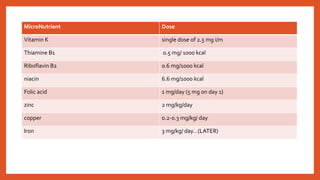
MicroNutrient Dose
Vitamin K single dose of 2.5 mg i/m
Thiamine B1 0.5 mg/ 1000 kcal
Riboflavin B2 0.6 mg/1000 kcal
niacin 6.6 mg/1000 kcal
Folic acid 1 mg/day (5 mg on day 1)
zinc 2 mg/kg/day
copper 0.2-0.3 mg/kg/ day
Iron 3 mg/kg/ dayโ€ฆ(LATER)
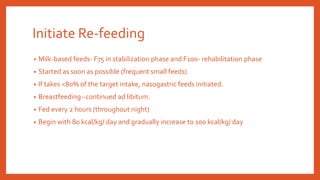
Initiate Re-feeding
โ€ข Milk-based feeds- F75 in stabilization phase and F100- rehabilitation phase
โ€ข Started as soon as possible (frequent small feeds).
โ€ข If takes <80% of the target intake, nasogastric feeds initiated.
โ€ข Breastfeeding--continued ad libitum.
โ€ข Fed every 2 hours (throughout night)
โ€ข Begin with 80 kcal/kg/ day and gradually increase to 100 kcal/kg/ day
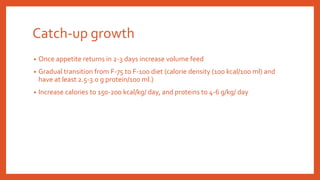
Catch-up growth
โ€ข Once appetite returns in 2-3 days increase volume feed
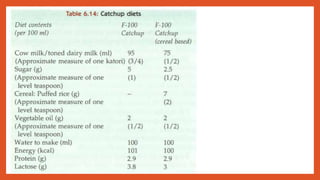
โ€ข Gradual transition from F-75 to F-100 diet (calorie density (100 kcal/100 ml) and
have at least 2.5-3.0 g protein/100 ml.)
โ€ข Increase calories to 150-200 kcal/kg/ day, and proteins to 4-6 g/kg/ day
Starter diets
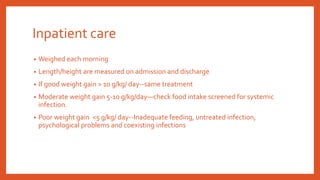
Inpatient care
โ€ข Weighed each morning
โ€ข Length/height are measured on admission and discharge
โ€ข If good weight gain > 10 g/kg/ day--same treatment
โ€ข Moderate weight gain 5-10 g/kg/dayโ€”check food intake screened for systemic
infection.
โ€ข Poor weight gain <5 g/kg/ day--Inadequate feeding, untreated infection,
psychological problems and coexisting infections
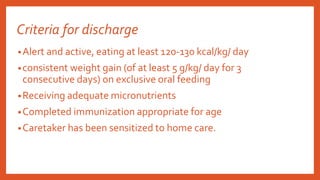
Criteria for discharge
โ€ขAlert and active, eating at least 120-130 kcal/kg/ day
โ€ขconsistent weight gain (of at least 5 g/kg/ day for 3
consecutive days) on exclusive oral feeding
โ€ขReceiving adequate micronutrients
โ€ขCompleted immunization appropriate for age
โ€ขCaretaker has been sensitized to home care.
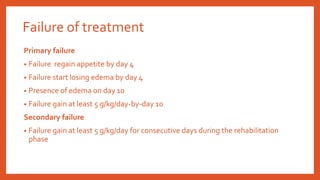
Failure of treatment
Primary failure
โ€ข Failure regain appetite by day 4
โ€ข Failure start losing edema by day 4
โ€ข Presence of edema on day 10
โ€ข Failure gain at least 5 g/kg/day-by-day 10
Secondary failure
โ€ข Failure gain at least 5 g/kg/day for consecutive days during the rehabilitation
phase
Refeeding syndrome
โ€ข Can complicate the acute nutritional rehabilitation
โ€ข May follow overly aggressive enteral or parenteral nutrition
Excessive carbohydrates
Increase in serum insulin levels
Hypokalemia, hypophosphatemia(is hallmark), hypomagnesemia.
โ€ข Phosphate โ‰ค0.5 mmol/L--weakness, rhabdomyolysis, neutrophil
dysfunction, cardiorespiratory failure, arrhythmias, seizures, altered
level of consciousness, or sudden death.
Pseudotumor cerebri
โ€ขtransient rise of intracranial tension
โ€ขbenign and self limiting.
Nutritional recovery syndrome
Sequence of events due high quantity of proteins during rehabilitation,
possibly due--endocrine disturbance(ex estrogen) produced by the recovering
pituitary gland
Presents as
(i) abdominal distention,
(ii) Increasing hepatomegaly
(iii) Ascites
(iv) Hypertrichosis
(v) Parotid swelling
(vi) Gynecomastia
(vii) Eosinophilia
(viii) splenomegaly.
THANKYOU

Severe acute malnutrition

  • 1.
    Dr Pallav Singhal MBBS,MD (Paediatrics)
  • 2.
    Introduction โ€ข Childhood undernutritiona major global health problem. โ€ข Affects 8.1 million under-five children in India [1]. โ€ข Nearly 0.6 million deaths and 24.6 million DALYs (disability adjusted life years) are attributed to this condition. โ€ข Diarrhea and pneumonia accounts for half the under-five deaths in India, and malnutrition is believed to contribute to 61% of diarrheal deaths and 53% pneumonia deaths (2). 1. International Institute for Population Sciences. National Family Health Survey 3, 2005-2006. Mumbai India: International Institute of Population Science; 200 2. Black RE,Allen LH, Bhutta ZA, de Onis M, Ezzati M, Mathers C, et al. Maternal and Child undernutrition: global and regional exposures and health consequences. Lancet. 2008; 371: 243-60.
  • 4.
    Malnutrition encompasses bothends of the nutrition spectrum, from undernutrition to overweight. 1. SEVERE ACUTE MALNUTRITION without complications Children 6โ€“59 months of age, โ€ข weight-for-height less than โ€“3 Z-score of the median of the WHO growth standards, OR โ€ข or clinical signs of bilateral oedema (nutritional origin), OR โ€ข Presence of visible severe wasting; OR โ€ข a mid-upper arm circumference less than 115 mm 2. SEVERE ACUTE MALNUTRITION with complications 3. Moderate acute malnutrition-weight for height between -2SD to -3SD ; without edema, or MUAC is 11-12.5 cm
  • 6.
    SAM vs PEM โ€ขName protein-energy malnutrition is avoided, as it oversimplifies the complex multideficiency etiology.
  • 7.
  • 9.
    THEORY DIETECTIC HYPOTHESIS (CLASSICAL) Kwashiorkar: Protdeficiency Marasmus: Energy Defi ADAPTATION HYPOTHESIS (GOPALANโ€™S) Kwashiorkar: Adaptation Failure Marasmus: Extreme case of adaptation Free Radical Hypothesis (Goldenโ€™s) Over production of free radicals and breakdown of protective mechanisms Jelliffeโ€™s Hypothesis Interactions and sequelae of dietary imbalances, infections and infestations, emotional trauma and toxins
  • 10.
    Reductive adaptation Leads to โ€ขliver makes glucose lessโ€”Hypoglycemia โ€ข Heat production lessโ€”hypothermia โ€ข kidneys less excretion of excess fluid and sodium. โ€ข Heart- smaller and weaker with reduced output โ€ข Sodium builds up inside cells--excess body sodium, fluid retention, and edema. โ€ข Potassium leaks out of cells (excreted in urine)--fluid retention, edema, and anorexia.
  • 11.
    โ€ขGut-less gastric acidand enzymes, motility reduced--Digestion and absorption are impaired. โ€ขCell replication and repair are reduced โ€ขRed cell mass is reduced, releasing iron..
  • 13.
    INITIAL ASSESSMENT HISTORY โ€ข Theusual diet (before the current illness) โ€ข Evidence of any chronic illness: โ€ข presence of diarrhea (duration, watery /bloody) โ€ข vomiting, loss of appetite, cough โ€ข Contact with tuberculosis
  • 14.
    DIETARY HISTORY 24 HourDietary recall โ€ข Recall food and drink intake last 24 hour. โ€ข Pre-morbid intake and current intake โ€ข Freq of cereals/ pulses/ milk and products/ fruits and veg/ meat products. โ€ข Calc of calorie from breast: DO NOT calculate if usual feeding going on( on demand feeds)
  • 15.
    Examination โ€ขSigns of dehydration โ€ขShock(cold hands, slow capillary refill, weak and rapid pulse) โ€ขSevere palmar pallor โ€ขEye signs of vitaminA deficiency โ€ขsigns of infections โ€ขSkin infection or pneumonia, signs of HIV infection, fever. โ€ขHypothermia (rectal temperature <95.9ยฐF)
  • 16.
    ANTHROPOMETRY โ€ข Height-for-age (orlength-for-age for children <2 yr)-measure of linear growth, deficit represents cumulative impact of adverse events โ€ข weight-for-height(wasting)--acute malnutrition. โ€ข Mid-upper arm circumference- Commonly used for screening, found to be relatively stable between the ages 1 and 5 yr.
  • 18.
    Face Moon face EyeDry eyes, pale conjunctiva, Bitot spots (vitamin A), periorbital edema lachrymal and salivary glands atrophy Lack of tears and dry mouth. Mouth Angular stomatitis, cheilitis, glossitis, spongy bleeding gums (vitamin C),
  • 20.
    Teeth Enamel mottling,delayed eruption Hair Dull, sparse, brittle hair, hypopigmentation, flag sign (alternating bands of light and normal color), alopecia Skin Loose and wrinkled (marasmus), shiny and edematous (kwashiorkor), dry, patchy hyper- and hypopigmentation (crazy paving or flaky paint dermatoses), Nails Koilonychia, thin and soft nail plates, fissures.
  • 21.
  • 22.
    Muscle Wasting, ChvostekorTrousseau sign (hypocalcemia) Abdomen Distended: hepatomegaly with fatty liver Neurologic Global developmental delay, loss of knee and ankle reflexes, impaired memory Hematologic Pallor, petechiae, bleeding diathesis . Behavior Lethargic, apathetic, irritable on handling
  • 23.
  • 24.
    Indications for inpatientcare (i) Presence of a medical complication; (ii) Reduced appetite (iii) Presence of bilateral pitting edema
  • 25.
    โ€ข Differentiate acomplicated from an uncomplicated case (if require in-patient care) โ€ข If appetite- good, still rate of weight gain at home is poor -may indicate a social problem at household level or extensive sharing of the medical nutrition therapy. APPETITETEST
  • 26.
    RUTF โ€ข RUTF- mixtureof milk powder, vegetable oil, sugar, peanut butter, and powdered vitamins and minerals, โ€ข Powdered ingredients embedded in lipid rich paste..-energy dense โ€ข Resists microbial contamination ..(very low water activity). โ€ข Stored at room temp and tropical conditions for 3-4 months โ€ข is energy-dense food providing 5.5Kcal/g. โ€ข Equivalent in formulation to F 100 โ€ข Practical to use- where cooking fuel and facilities are limiting โ€ข Continue to receive other foods and brestfeeding during medical nutrition therapy with RUTF
  • 27.
    Daily amount ofRUTF to be consumed โ€ข 3-4.9 kg: 105-130 g; โ€ข 5-6.9 kg: 200-260 g; โ€ข 7-9.9 kg: 260-400 g and โ€ข 10-14.9 kg: 400-460 g. โ€ข To given along with plenty of water in 2-3 hourly feeds.
  • 28.
    A typical recipefor Ready to UseTherapeutic Food (Local Production) % weight Full fat milk powder 30 Sugar 28 Oil 15 Peanut butter 25 MineralVitamin Mix 1.6 Oxidation of the fatty acids, vitamin A and C, is the main factor limiting the storage life of RUTF
  • 29.
    An example of--Ready-to-usetherapeutic spread produced by Nutriset
  • 31.
  • 32.
    PHASES 1. Stabilization phase 2.rehabilitation phase(catch-up growth). *Pushing ahead too quickly risk--โ€œrefeeding syndrome.โ€ *Donโ€™t treat edema with diuretic *Donโ€™t give high-protein diet in early phase of treatment.
  • 33.
    Emergency Management SHOCK (Lethargic/unconscious/ cold hands/ slow capillary refill/ weak fast pulse) โ€ข 10D (5 mL/kg) โ€ข IV fluid(Ringer lactate with 5% dextrose, (N /2) with 5% dextrose or Ringer lactate alone at 15 mL/kg over 1 hr โ€ข If signs of Improvement, repeat IV 15 mL/kg for 1 more hr.Then oral or nasogastric rehydration. โ€ข If does not improve after 1 h of intravenous therapy, a blood transfusion (10 mL/kg slowly over at least 3 h) given.
  • 34.
    Emergency treatment ofsevere anemia Hb <4 g/ dl or between 4 and 6 g/ dl with respiratory distress Give BT with whole blood 10 ml/kg over 3 hr Lasix given at starting of BT.
  • 35.
    Hypoglycemia If conscious(asymptomatic): โ€ข 10D(50mL), or a feed, or 1 teaspoon sugar under the tongue-whichever is quickest If Unconscius(symptomatic) โ€ข 10D (5 mL/kg) by IV โ€ข Feed every 2 hr for at least the first day. Initially 1/4 of feed every 30 min โ€ข Keep warm โ€ข Start broad-spectrum antibiotics
  • 36.
    Hypothermia--axillary <35ยฐC (95ยฐF);rectal <35.5ยฐC (95.9ยฐF) โ€ข Actively rewarm โ€ข Feed โ€ข Skin-to-skin contact/ dress warmed clothes, cover head, wrap in warmed blanket โ€ข In case of severe hypothermia (rectal temperatureโ€ฆwarm humidified oxygen followed immediately by 5 ml/kg of 10% dextrose IV or 50 ml of 10% dextrose by nasogastric route. โ€ข Stop rewarming-rectal temperature 36.5ยฐC (97.7ยฐF)
  • 37.
    Dehydration โ€ข Do notgive IV fluids unless in shock โ€ข Give ReSoMal 5 mL/kg every 30 min for first 2 hr orally or NG tube 5-10 mL/kg in alternate hours for up to 10 hr. โ€ข STOP--signs of overload (pulse rate increases by 25 beats/min and respiratory rate by 5 breaths/min; increasing edema; engorged jugular veins) โ€ข Stop when rehydrated.
  • 38.
    โ€ข Standard WHOlow-osmolarity oral rehydration solution (75 mmol/L sodium) should not-- used for oral or nasogastric rehydration in severe acute malnutrition in dehydration or severe dehydration. โ€ข ReSoMal or half-strength standard WHO low-osmolarity oral rehydration solution should be given โ€ข To prepare ReSoMal Dissolve one sachet of standardWHO low-osmolarity oral rehydration solution in 2 L water (instead of 1 L). Add 40 mL of mineral mix solution (5), and 50 g of sugar 5. WHO. The treatment of diarrhoea: manual for physicians and other senior health workers. Geneva, World Health Organization; 2005 (http://www.who.int/maternal_child_adolescent/documents/9241593180/en/).
  • 39.
    Electrolytes โ€ข Extra potassiumat 3-4 mEq/kg/ day for(min 2 weeks) โ€ข On day 1, 50% magnesium sulphate (4 mEq/ml) IM once (0.3 ml/kg; maximum of 2 ml). 0.8-1.2 mEq/kg daily โ€ข Excess body sodium exists(even though the plasma sodium may low)--decrease salt in diet
  • 40.
    Infections โ€ข If nocomplications--Oral cotrimoxazole (5 mg/kg 12 hourly of trimethoprim) or oral amoxicillin for 5 days โ€ข If complications- Gentamicin (7.5 mg/kg IV or IM) or amikacin (15-20 mg/kg IV or IM) once daily for 7 days โ€ข Ampicillin (50 mg/kg/dose IV or IM) every 6 hr for 2 days, oral amoxicillin (25-40 mg/kg) every 8 hr for 5 days. โ€ข If no improvement within 48 hr--IV cefotaxime (100-150 mg/kg/day 6-8 hourly) or ceftriaxone (50-75 mg/kg/day 12 hourly).
  • 41.
    Correct micronutrient deficiencies โ€ขTwiceRDA--vitamins and minerals be used. โ€ขIron avoided, promoting free radical generation and bacterial proliferation..Addedโ€”gaining weight and good appetite. โ€ขVitaminA, given to all severely malnourished.. day 0 at 50,000 IU, 100,000 IU and 200,000 IU for infants 0-5 month, 6-12 months and children > 1 yr On day 1 and 14..IF SIGNS of xerophthalmia.
  • 42.
    MicroNutrient Dose Vitamin Ksingle dose of 2.5 mg i/m Thiamine B1 0.5 mg/ 1000 kcal Riboflavin B2 0.6 mg/1000 kcal niacin 6.6 mg/1000 kcal Folic acid 1 mg/day (5 mg on day 1) zinc 2 mg/kg/day copper 0.2-0.3 mg/kg/ day Iron 3 mg/kg/ dayโ€ฆ(LATER)
  • 43.
    Initiate Re-feeding โ€ข Milk-basedfeeds- F75 in stabilization phase and F100- rehabilitation phase โ€ข Started as soon as possible (frequent small feeds). โ€ข If takes <80% of the target intake, nasogastric feeds initiated. โ€ข Breastfeeding--continued ad libitum. โ€ข Fed every 2 hours (throughout night) โ€ข Begin with 80 kcal/kg/ day and gradually increase to 100 kcal/kg/ day
  • 44.
    Catch-up growth โ€ข Onceappetite returns in 2-3 days increase volume feed โ€ข Gradual transition from F-75 to F-100 diet (calorie density (100 kcal/100 ml) and have at least 2.5-3.0 g protein/100 ml.) โ€ข Increase calories to 150-200 kcal/kg/ day, and proteins to 4-6 g/kg/ day
  • 45.
  • 47.
    Inpatient care โ€ข Weighedeach morning โ€ข Length/height are measured on admission and discharge โ€ข If good weight gain > 10 g/kg/ day--same treatment โ€ข Moderate weight gain 5-10 g/kg/dayโ€”check food intake screened for systemic infection. โ€ข Poor weight gain <5 g/kg/ day--Inadequate feeding, untreated infection, psychological problems and coexisting infections
  • 48.
    Criteria for discharge โ€ขAlertand active, eating at least 120-130 kcal/kg/ day โ€ขconsistent weight gain (of at least 5 g/kg/ day for 3 consecutive days) on exclusive oral feeding โ€ขReceiving adequate micronutrients โ€ขCompleted immunization appropriate for age โ€ขCaretaker has been sensitized to home care.
  • 49.
    Failure of treatment Primaryfailure โ€ข Failure regain appetite by day 4 โ€ข Failure start losing edema by day 4 โ€ข Presence of edema on day 10 โ€ข Failure gain at least 5 g/kg/day-by-day 10 Secondary failure โ€ข Failure gain at least 5 g/kg/day for consecutive days during the rehabilitation phase
  • 51.
    Refeeding syndrome โ€ข Cancomplicate the acute nutritional rehabilitation โ€ข May follow overly aggressive enteral or parenteral nutrition Excessive carbohydrates Increase in serum insulin levels Hypokalemia, hypophosphatemia(is hallmark), hypomagnesemia. โ€ข Phosphate โ‰ค0.5 mmol/L--weakness, rhabdomyolysis, neutrophil dysfunction, cardiorespiratory failure, arrhythmias, seizures, altered level of consciousness, or sudden death.
  • 52.
    Pseudotumor cerebri โ€ขtransient riseof intracranial tension โ€ขbenign and self limiting.
  • 53.
    Nutritional recovery syndrome Sequenceof events due high quantity of proteins during rehabilitation, possibly due--endocrine disturbance(ex estrogen) produced by the recovering pituitary gland Presents as (i) abdominal distention, (ii) Increasing hepatomegaly (iii) Ascites (iv) Hypertrichosis (v) Parotid swelling (vi) Gynecomastia (vii) Eosinophilia (viii) splenomegaly.
  • 54.

Editor's Notes

  • #3ย , contributing to childhood morbidity, mortality, y, impaired intellectual development, suboptimal adult work capacity, and increased risk of diseases in adulthood. scientific evidence exists on synergism between under nutrition and child mortality due to common childhood morbidities including diarrhea, acute respiratory infections, malaria and measles.
  • #5ย โ€œuncomplicatedโ€. Child should be (i) alert, (ii) have good appetite, (iii) clinically assessed to be well (absence of general danger signs such as cough and difficult/fast breathing, cold to touch and severe dehydration), and, absence of severe anaemia (iv) living in a conducive home environment Complicated cases - Many advanced cases of SAM are complicated by concurrent infective illness, particularly acute respiratory infection, diarrhoea and gram-negative septicaemia. Some of them have severe electrolyte imbalance. MAM have a three-fold increased risk of mortality, increased risk of infections and impaired physical and cognitive development (Black et al., 2008).
  • #6ย strong epidemiological evidence that low weight-for-height, weight-for-length or mid-upper arm circumference are highly associated with a 5โ€“20-fold increased risk of mortality..11 Determination of SAM on the basis of Z-scores using WHO Growth charts is considered statistically more appropriate than cut-offs based on percentage weightdeficit of the median
  • #8ย if complementary foods are of low nutrient density and have low bioavailability of micronutrients. In addition, childrenโ€™s nutritional status will be further compromised if complementary foods are introduced too early or too late, or are contaminated. Infection..pneumonia, diarrhea. Infections can lead to profound nutrient deficits and imbalances: For example, amino acids are diverted to form acute-phase proteins and there are losses throughdiarrhea of potassium, magnesium, vitamin A, and zinc, by chronic infections such as HIV. a, the prevalence of HIV in children with severe acute malnutrition was 29% and these children were more likely to die than malnourished children who were not infected with HIV . The foods eaten by children from the low-income group are mostly cereal-based and lack important micronutrients such as zinc, iron, vitamins A, B2, folic acid etc
  • #10ย . Low serum iron causes increased production of free O2 radicals These oxides (free O2 radicals) are normally buffered by protein and mopped up by anti-oxidants such as โ€ข Vitamins A,C,E โ€ข Glutathione:-Defc causes toxic accum of free O2 radicals โ€ข Zinc. โ€ข Selenium
  • #11ย Reductive adaptation to conserve energy and prolong life. Fat stores- mobilized to provide energy. Later protein in muscle, skin, gastrointestinal tract Energy conserved by reducing physical activity and growth, reducing basal metabolism and reducing inflammatory and immune responses. Na build up bcz leaky cell membranes and reduced activity of the sodium/potassium pump,
  • #12ย ,gut motility dec-- and bacteria may colonize the stomach and small intestine, damaging the mucosa and deconjugating bile salts unbound iron promotes pathogen growth and formation of free radicals
  • #15ย Characteristics ideat compli diet..timely, adq, properly fed, safe, conmsistency, locally availabl
  • #17ย Age independent indices Name of index Kanawati and McLaren Mid-arm circumference/head circumference (cm) Rao and Singh Weight (in kg) x 100/height2 (in cm) Dugdale Weight (in kg)/height16 (in cm) Quaker arm circumference measuring stick (Quac stick) --Mid-arm circumference that would be expected for a given height J elilfe ratio Head circumference/chest circumference
  • #19ย โ€ขAtrophy of sweat and sebaceous glands leads to excessive dryness of the skin. โ€ขHyperpigmentation, erythema, duskiness of exposed areas โ€“ niacin def โ€ขCracking and fissuring of hyper pigmented โ€ขGeneralized hypopigmentation due to stretching of the skin by the edema.
  • #21ย Hair: Keratin synthesis impaired coz of cysteine and methionine def , thus brittle hair easily pulled off /breaksย . Periods of good nutrition alternating with poor nutrition- flag sign โ€ขUlcerations due defi zn flaky paint dermatosis could be a skin manifestation ofย niacinย deficiency..
  • #23ย Beta LP def โ€“ accumulation of TG in the liver โ€“ fatty liver โ€“ Hepatomegally.ย 
  • #27ย developed in the 1990s by research scientist Andre Briend and Nutriset Peanut butter changes the physical properties of the food to a viscous liquid product instead of a powder RUTF mc used spread form RUTF is a homogenous mixture of lipid rich and water-soluble foods. The lipids exist as a viscous liquid, and small particles of protein, carbohydrate, vitamins and minerals are mixed throughout this liquid. In order to achieve a homogenous mixture, a specific mixing procedure must be followed. The lipid elements of RUTF are first stirred and often heated; the powdered ingredients are then slowly added to the lipids during vigorous stirring. Once all the powdered ingredients are added, the entire mixture is stirred at higher speeds for several minutes water containing foods cannot be used for preparing RUTF recipes, which precludes the use of mineral rich foods such as meat, organ meat, leaves, fruit and vegetables, unless dried beforehand The daily amount of RUTF to be consumed varies according to body weight as follows: 3-4.9 kg: 105-130 g; 5-6.9 kg: 200-260 g; 7-9.9 kg: 260-400 g and 10-14.9 kg: 400-460 g. This amount is to be given along with plenty of water in 2-3 hourly feeds.
  • #29ย Veg oil.. soy oil, cottonseed oil, rapeseed oil and corn oil Aflatoxin contamination: This toxin is produced by an aspergillus species of fungus, which contaminates the peanuts after they have been harvested, but before they have been ground into peanut butter. Alternative soy based spread, highly fortified with iron and minerals, was tested to prevent anemia and stunting in a few hundreds Saharawi children aged 3-6 years and found well accepted and effectiveโ€ฆ Chickpea-based and riceโ€“lentil-based RUTF were well accepted by children with SAM.
  • #31ย USUAL DIET .. including breastfeeding;
  • #33ย Stabilization--repair cellular function, correct fluid and electrolyte imbalance, restore homeostasis, and prevent death from the interlinked triad of hypoglycemia, hypothermia, and infection.
  • #36ย Hypoglycemia, hypothermia and infection generally occur as a triad
  • #37ย Heat--heat (e.g. heater; transwarmer mattress; incandescent lamp)
  • #38ย rehydrated (3 or more signs of hydration: less thirsty, passing urine, skin pinch less slow, eyes less sunken, moist mouth, tears, less lethargic, improved pulse and respiratory rate).
  • #39ย ย ReSoMal using standard WHO low-osmolarity oral rehydration solution) should not be given if children are suspected of having cholera or have profuse watery diarrhoea
  • #40ย severe hypokalemia and clinically manifest with weakness of abdominal, skeletal and even respiratory muscles. This may mimic flaccid paralysis. E lectrocardiography may show ST depression, T waves inversion and presence of U waves. If serum potassium is <2 mEq/1 or <3.5 mEq/1 with ECG changes, correction should be started at 0.3-0.5 mEq/kg/hr infusion of potassium chloride in intravenous fluids,
  • #41ย The most common sites for infection are the skin, the alimentary tract, the respiratory tract (including the ears, nose and throat) and the urinary tract. Majority of the infections and septicemia are caused by gram-negative organisms. Therefore, all severely malnourished children should be assumed to have a serious infection Role of antibiotic in umcmplicated SAM
  • #42ย Vitamin A deficiency is not an infrequent association and is an important cause of blindness caused by keratomalacia
  • #43ย Vitamin B12 - 2.5 MCG Vitamin B1 - 2.25 MG Vitamin B2 - 2.5 MG Vitamin B6 - 1 MG Iodine - 50 MCG Vitamin A - 2500 IU Vitamin C - 40 MG Vitamin E - 7.5 IU Selenium - 10 MCG Riboflavin - 10 MG Vitamin D - 200 IU Manganese - 0.8 MG Zinc - 1 MG Chromium - Chromic - 8 MCG Vitamin B3 - 22.5 MG Molybdenum - 8 MCG Pantothenic Acid - 2.5 MG
  • #45ย t rapid catch up growth during nutrition rehabilitation of severely malnourished children may be associated with disproportionately higher amounts of body fat deposition.