WHAT IS DEVELOPMENTAL MILESTONES?
A DEVELOPMENTAL MILESTONE IS AN ABILITY THAT MOST CHILDREN
ACHIEVE BY A CERTAIN AGE. THESE MILESTONES CAN INVOLVE PHYSICAL,
SOCIAL, EMOTIONAL, COGNITIVE, AND COMMUNICATION SKILLS SUCH AS
WALKING, SHARING WITH OTHERS, EXPRESSING EMOTIONS,
RECOGNIZING FAMILIAR SOUNDS, AND TALKING.
WHAT IS DEVELOPMENT?
DEVELOPMENT IS THE PROCESS OF FUNCTIONAL OR PHYSIOLOGICAL
MATURATION OF AN INDIVIDUAL.
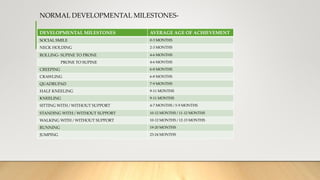
NORMAL DEVELOPMENTAL MILESTONES-
DEVELOPMENTAL MILESTONES AVERAGE AGE OF ACHIEVEMENT
SOCIAL SMILE 0-3 MONTHS
NECK HOLDING 2-3 MONTHS
ROLLING- SUPINE TO PRONE 4-6 MONTHS
PRONE TO SUPINE 4-6 MONTHS
CREEPING 6-8 MONTHS
CRAWLING 6-8 MONTHS
QUADRUPAD 7-9 MONTHS
HALF KNEELING 9-11 MONTHS
KNEELING 9-11 MONTHS
SITTING WITH / WITHOUT SUPPORT 4-7 MONTHS / 5-9 MONTHS
STANDING WITH / WITHOUT SUPPORT 10-12 MONTHS / 11-12 MONTHS
WALKING WITH / WITHOUT SUPPORT 10-12 MONTHS / 12-15 MONTHS
RUNNING 19-20 MONTHS
JUMPING 23-24 MONTHS
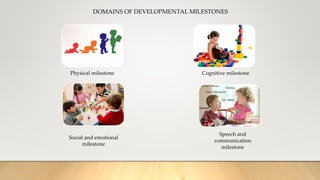
Physical milestone Cognitive milestone
Social and emotional
milestone
Speech and
communication
milestone
DOMAINS OF DEVELOPMENTAL MILESTONES
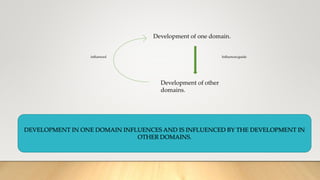
Development of one domain.
Development of other
domains.
Influences/guideinfluenced
DEVELOPMENT IN ONE DOMAIN INFLUENCES AND IS INFLUENCED BY THE DEVELOPMENT IN
OTHER DOMAINS.
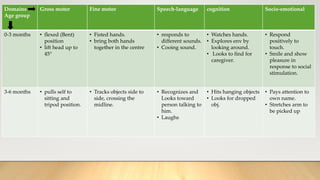
Domains
Age group
Gross motor Fine motor Speech-language cognition Socio-emotional
0-3 months • flexed (Bent)
position
• lift head up to
45°
• Fisted hands.
• bring both hands
together in the centre
• responds to
different sounds.
• Cooing sound.
• Watches hands.
• Explores env by
looking around.
• Looks to find for
caregiver.
• Respond
positively to
touch.
• Smile and show
pleasure in
response to social
stimulation.
3-6 months • pulls self to
sitting and
tripod position.
• Tracks objects side to
side, crossing the
midline.
• Recognizes and
Looks toward
person talking to
him.
• Laughs
• Hits hanging objects
• Looks for dropped
obj.
• Pays attention to
own name.
• Stretches arm to
be picked up
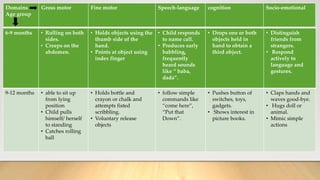
Domains
Age group
Gross motor Fine motor Speech-language cognition Socio-emotional
6-9 months • Rolling on both
sides.
• Creeps on the
abdomen.
• Holds objects using the
thumb side of the
hand.
• Points at object using
index finger
• Child responds
to name call.
• Produces early
babbling,
frequently
heard sounds
like “ baba,
dada”.
• Drops one or both
objects held in
hand to obtain a
third object.
• Distinguish
friends from
strangers.
• Respond
actively to
language and
gestures.
9-12 months • able to sit up
from lying
position
• Child pulls
himself/ herself
to standing
• Catches rolling
ball
• Holds bottle and
crayon or chalk and
attempts fisted
scribbling.
• Voluntary release
objects
• follow simple
commands like
“come here”,
“Put that
Down”.
• Pushes button of
switches, toys,
gadgets.
• Shows interest in
picture books.
• Claps hands and
waves good-bye.
• Hugs doll or
animal.
• Mimic simple
actions
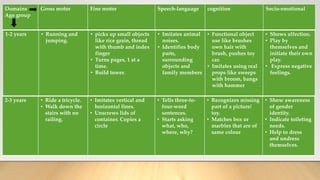
2-3 years • Ride a tricycle.
• Walk down the
stairs with no
railing.
• Imitates vertical and
horizontal lines.
• Unscrews lids of
container. Copies a
circle
• Tells three-to-
four-word
sentences.
• Starts asking
what, who,
where, why?
• Recognizes missing
part of a picture/
toy.
• Matches box or
marbles that are of
same colour
• Show awareness
of gender
identity.
• Indicate toileting
needs.
• Help to dress
and undress
themselves.
1-2 years • Running and
jumping.
• picks up small objects
like rice grain, thread
with thumb and index
finger
• Turns pages, 1 at a
time.
• Build tower.
• Imitates animal
noises.
• Identifies body
parts,
surrounding
objects and
family members
• Functional object
use like brushes
own hair with
brush, pushes toy
car.
• Imitates using real
props like sweeps
with broom, bangs
with hammer
• Shows affection.
• Play by
themselves and
initiate their own
play.
• Express negative
feelings.
Domains
Age group
Gross motor Fine motor Speech-language cognition Socio-emotional
Domains
Age group
Gross motor Fine motor Speech-language cognition Socio-emotional
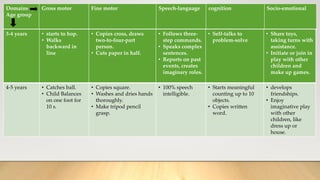
3-4 years • starts to hop.
• Walks
backward in
line
• Copies cross, draws
two-to-four-part
person.
• Cuts paper in half.
• Follows three-
step commands.
• Speaks complex
sentences.
• Reports on past
events, creates
imaginary roles.
• Self-talks to
problem-solve
• Share toys,
taking turns with
assistance.
• Initiate or join in
play with other
children and
make up games.
4-5 years • Catches ball.
• Child Balances
on one foot for
10 s.
• Copies square.
• Washes and dries hands
thoroughly.
• Make tripod pencil
grasp.
• 100% speech
intelligible.
• Starts meaningful
counting up to 10
objects.
• Copies written
word.
• develops
friendships.
• Enjoy
imaginative play
with other
children, like
dress up or
house.
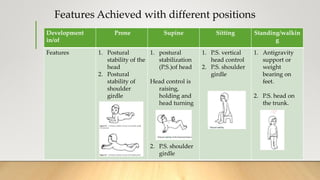
Development
in/of
Prone Supine Sitting Standing/walkin
g
Features 1. Postural
stability of the
head
2. Postural
stability of
shoulder
girdle
1. postural
stabilization
(P.S.)of head
Head control is
raising,
holding and
head turning
2. P.S. shoulder
girdle
1. P.S. vertical
head control
2. P.S. shoulder
girdle
1. Antigravity
support or
weight
bearing on
feet.
2. P.S. head on
the trunk.
Features Achieved with different positions
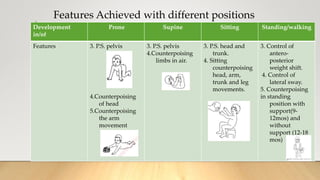
Development
in/of
Prone Supine Sitting Standing/walking
Features 3. P.S. pelvis
4.Counterpoising
of head
5.Counterpoising
the arm
movement
3. P.S. pelvis
4.Counterpoising
limbs in air.
3. P.S. head and
trunk.
4. Sitting
counterpoising
head, arm,
trunk and leg
movements.
3. Control of
antero-
posterior
weight shift.
4. Control of
lateral sway.
5. Counterpoising
in standing
position with
support(9-
12mos) and
without
support (12-18
mos)
Features Achieved with different positions
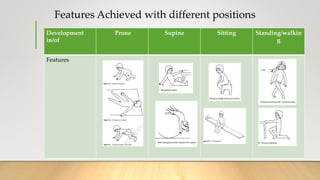
Development
in/of
Prone Supine Sitting Standing/walkin
g
Features
Features Achieved with different positions
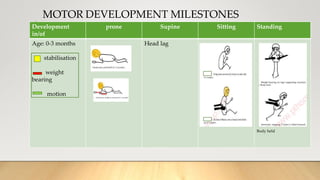
MOTOR DEVELOPMENT MILESTONES
Development
in/of
prone Supine Sitting Standing
Age: 0-3 months
stabilisation
weight
bearing
motion
Head lag
Body held
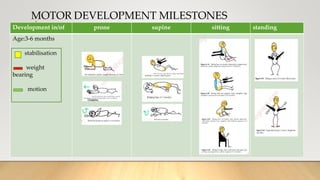
MOTOR DEVELOPMENT MILESTONES
Development in/of prone supine sitting standing
Age:3-6 months
stabilisation
weight
bearing
motion
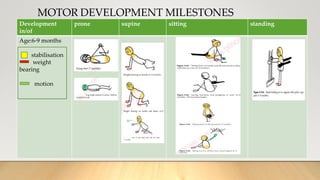
MOTOR DEVELOPMENT MILESTONES
Development
in/of
prone supine sitting standing
Age:6-9 months
stabilisation
weight
bearing
motion
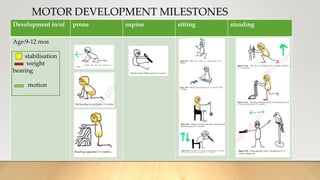
MOTOR DEVELOPMENT MILESTONES
Development in/of prone supine sitting standing
Age:9-12 mos
stabilisation
weight
bearing
motion
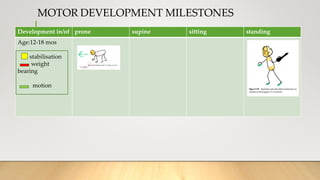
MOTOR DEVELOPMENT MILESTONES
Development in/of prone supine sitting standing
Age:12-18 mos
stabilisation
weight
bearing
motion
Developmental Milestones

Developmental Milestones

  • 1.
    WHAT IS DEVELOPMENTALMILESTONES? A DEVELOPMENTAL MILESTONE IS AN ABILITY THAT MOST CHILDREN ACHIEVE BY A CERTAIN AGE. THESE MILESTONES CAN INVOLVE PHYSICAL, SOCIAL, EMOTIONAL, COGNITIVE, AND COMMUNICATION SKILLS SUCH AS WALKING, SHARING WITH OTHERS, EXPRESSING EMOTIONS, RECOGNIZING FAMILIAR SOUNDS, AND TALKING. WHAT IS DEVELOPMENT? DEVELOPMENT IS THE PROCESS OF FUNCTIONAL OR PHYSIOLOGICAL MATURATION OF AN INDIVIDUAL.
  • 2.
    NORMAL DEVELOPMENTAL MILESTONES- DEVELOPMENTALMILESTONES AVERAGE AGE OF ACHIEVEMENT SOCIAL SMILE 0-3 MONTHS NECK HOLDING 2-3 MONTHS ROLLING- SUPINE TO PRONE 4-6 MONTHS PRONE TO SUPINE 4-6 MONTHS CREEPING 6-8 MONTHS CRAWLING 6-8 MONTHS QUADRUPAD 7-9 MONTHS HALF KNEELING 9-11 MONTHS KNEELING 9-11 MONTHS SITTING WITH / WITHOUT SUPPORT 4-7 MONTHS / 5-9 MONTHS STANDING WITH / WITHOUT SUPPORT 10-12 MONTHS / 11-12 MONTHS WALKING WITH / WITHOUT SUPPORT 10-12 MONTHS / 12-15 MONTHS RUNNING 19-20 MONTHS JUMPING 23-24 MONTHS
  • 3.
    Physical milestone Cognitivemilestone Social and emotional milestone Speech and communication milestone DOMAINS OF DEVELOPMENTAL MILESTONES
  • 4.
    Development of onedomain. Development of other domains. Influences/guideinfluenced DEVELOPMENT IN ONE DOMAIN INFLUENCES AND IS INFLUENCED BY THE DEVELOPMENT IN OTHER DOMAINS.
  • 5.
    Domains Age group Gross motorFine motor Speech-language cognition Socio-emotional 0-3 months • flexed (Bent) position • lift head up to 45° • Fisted hands. • bring both hands together in the centre • responds to different sounds. • Cooing sound. • Watches hands. • Explores env by looking around. • Looks to find for caregiver. • Respond positively to touch. • Smile and show pleasure in response to social stimulation. 3-6 months • pulls self to sitting and tripod position. • Tracks objects side to side, crossing the midline. • Recognizes and Looks toward person talking to him. • Laughs • Hits hanging objects • Looks for dropped obj. • Pays attention to own name. • Stretches arm to be picked up
  • 6.
    Domains Age group Gross motorFine motor Speech-language cognition Socio-emotional 6-9 months • Rolling on both sides. • Creeps on the abdomen. • Holds objects using the thumb side of the hand. • Points at object using index finger • Child responds to name call. • Produces early babbling, frequently heard sounds like “ baba, dada”. • Drops one or both objects held in hand to obtain a third object. • Distinguish friends from strangers. • Respond actively to language and gestures. 9-12 months • able to sit up from lying position • Child pulls himself/ herself to standing • Catches rolling ball • Holds bottle and crayon or chalk and attempts fisted scribbling. • Voluntary release objects • follow simple commands like “come here”, “Put that Down”. • Pushes button of switches, toys, gadgets. • Shows interest in picture books. • Claps hands and waves good-bye. • Hugs doll or animal. • Mimic simple actions
  • 7.
    2-3 years •Ride a tricycle. • Walk down the stairs with no railing. • Imitates vertical and horizontal lines. • Unscrews lids of container. Copies a circle • Tells three-to- four-word sentences. • Starts asking what, who, where, why? • Recognizes missing part of a picture/ toy. • Matches box or marbles that are of same colour • Show awareness of gender identity. • Indicate toileting needs. • Help to dress and undress themselves. 1-2 years • Running and jumping. • picks up small objects like rice grain, thread with thumb and index finger • Turns pages, 1 at a time. • Build tower. • Imitates animal noises. • Identifies body parts, surrounding objects and family members • Functional object use like brushes own hair with brush, pushes toy car. • Imitates using real props like sweeps with broom, bangs with hammer • Shows affection. • Play by themselves and initiate their own play. • Express negative feelings. Domains Age group Gross motor Fine motor Speech-language cognition Socio-emotional
  • 8.
    Domains Age group Gross motorFine motor Speech-language cognition Socio-emotional 3-4 years • starts to hop. • Walks backward in line • Copies cross, draws two-to-four-part person. • Cuts paper in half. • Follows three- step commands. • Speaks complex sentences. • Reports on past events, creates imaginary roles. • Self-talks to problem-solve • Share toys, taking turns with assistance. • Initiate or join in play with other children and make up games. 4-5 years • Catches ball. • Child Balances on one foot for 10 s. • Copies square. • Washes and dries hands thoroughly. • Make tripod pencil grasp. • 100% speech intelligible. • Starts meaningful counting up to 10 objects. • Copies written word. • develops friendships. • Enjoy imaginative play with other children, like dress up or house.
  • 9.
    Development in/of Prone Supine SittingStanding/walkin g Features 1. Postural stability of the head 2. Postural stability of shoulder girdle 1. postural stabilization (P.S.)of head Head control is raising, holding and head turning 2. P.S. shoulder girdle 1. P.S. vertical head control 2. P.S. shoulder girdle 1. Antigravity support or weight bearing on feet. 2. P.S. head on the trunk. Features Achieved with different positions
  • 10.
    Development in/of Prone Supine SittingStanding/walking Features 3. P.S. pelvis 4.Counterpoising of head 5.Counterpoising the arm movement 3. P.S. pelvis 4.Counterpoising limbs in air. 3. P.S. head and trunk. 4. Sitting counterpoising head, arm, trunk and leg movements. 3. Control of antero- posterior weight shift. 4. Control of lateral sway. 5. Counterpoising in standing position with support(9- 12mos) and without support (12-18 mos) Features Achieved with different positions
  • 11.
    Development in/of Prone Supine SittingStanding/walkin g Features Features Achieved with different positions
  • 12.
    MOTOR DEVELOPMENT MILESTONES Development in/of proneSupine Sitting Standing Age: 0-3 months stabilisation weight bearing motion Head lag Body held
  • 13.
    MOTOR DEVELOPMENT MILESTONES Developmentin/of prone supine sitting standing Age:3-6 months stabilisation weight bearing motion
  • 14.
    MOTOR DEVELOPMENT MILESTONES Development in/of pronesupine sitting standing Age:6-9 months stabilisation weight bearing motion
  • 15.
    MOTOR DEVELOPMENT MILESTONES Developmentin/of prone supine sitting standing Age:9-12 mos stabilisation weight bearing motion
  • 16.
    MOTOR DEVELOPMENT MILESTONES Developmentin/of prone supine sitting standing Age:12-18 mos stabilisation weight bearing motion