Development of

Face
Nose
Prof. Mohamed Autifi
Development of the face







The face develops from 5 mesenchymal
prominences (swellings or processes) that
appear in the 4th week.
One Frontonasal prominence (formed by
proliferation of mesenchyme and ectoderm
ventral to the forebrain).
Two maxillary swellings (from 1st pharyngeal
arch).
Two mandibular swellings (from 1st pharyngeal
arch).
Prof. Mohamed Autifi
Development of the face


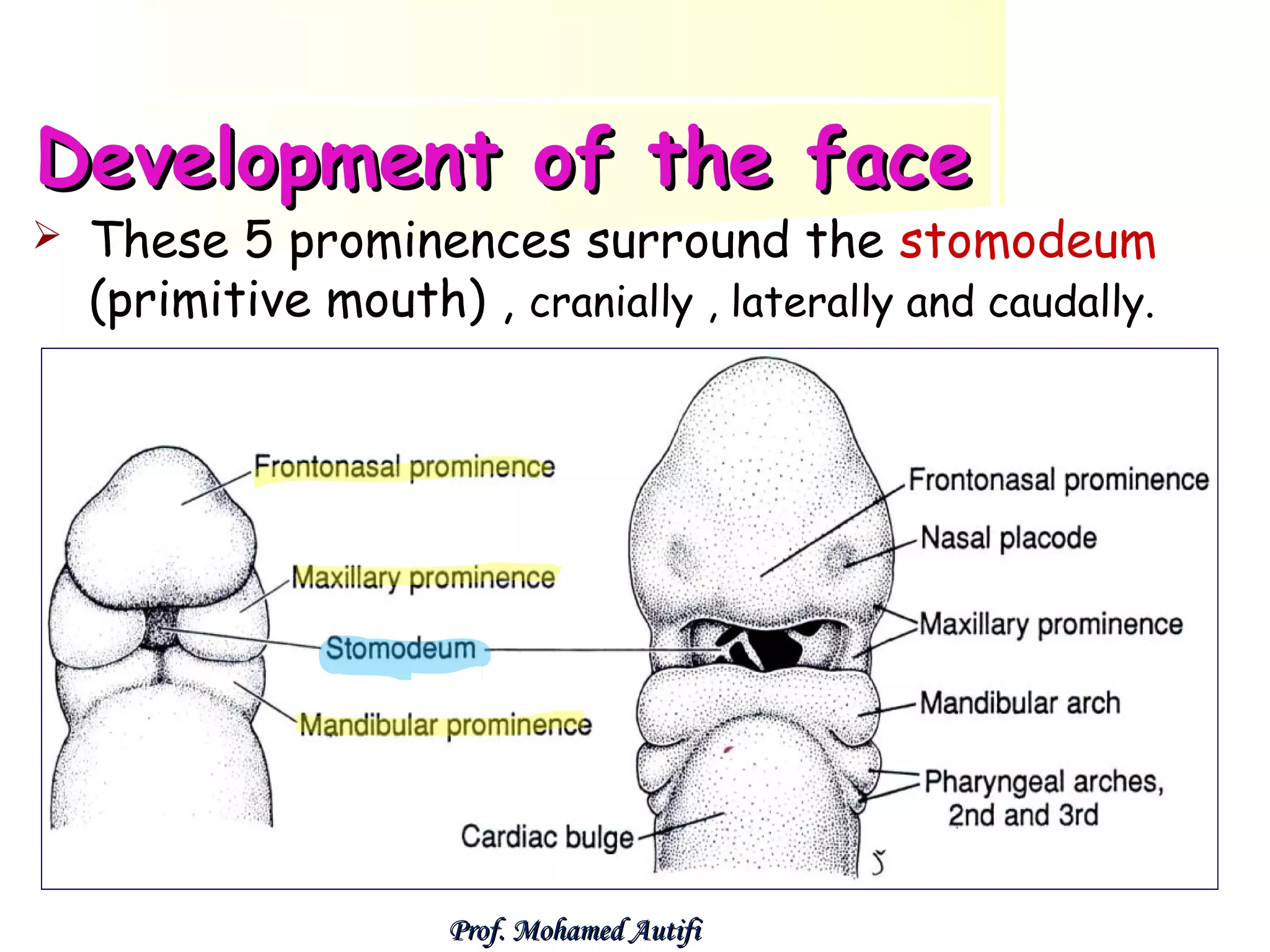
These 5 prominences surround the stomodeum
(primitive mouth) , cranially , laterally and caudally.

Prof. Mohamed Autifi
Mouth:
Primitive oral cavity: develops from:
a)An ectodermal depression between frontonasal

prominence and the first pharyngeal arch: the
stomodeum. Its floor is closed by the buccopharyngeal
membrane.
b)An endormal part: is the cranial end of the pharynx.
The buccal membrane degenerates during the 4 th week,
i.e. the 2 parts continue together.

Prof. Mohamed Autifi
Lips & gingivae:
They develop as a linear ectodermal thickenings
around the stomodeum  labiogingival laminae.
They grow into mesenchyme, then degenerate
forming labiogingival grooves separating lips
from gingivae.
A small area of laminae persists in median plane
forming frenulum of the lip.

Prof. Mohamed Autifi
Salivary glands:
Appear as epithelial buds from oral cavity.
Parotid gland: The first to appear, early in 6th week, from oral
ectoderm, near angle of stomodeum. It forms a tube, extends into
cheek’s mesoderm.
Its Proximal part forming the parotid duct;
Its distal end breaks to form the glandular alveoli.
Capsule & connective septae develop from surrounding mesoderm.
 The duct opening is carried to open inside the cheek.

Submandibular gland: Appear late in 6th week, from an endodermal
bud in floor of stomodeum (alveolo- lingual groove).
Develops in same way as parotid gland.

Sublingual gland: appear in 8th week, from multiple endodermal buds
in the alveolo-lingual groove.

Prof. Mohamed Autifi
I. Frontonasal process





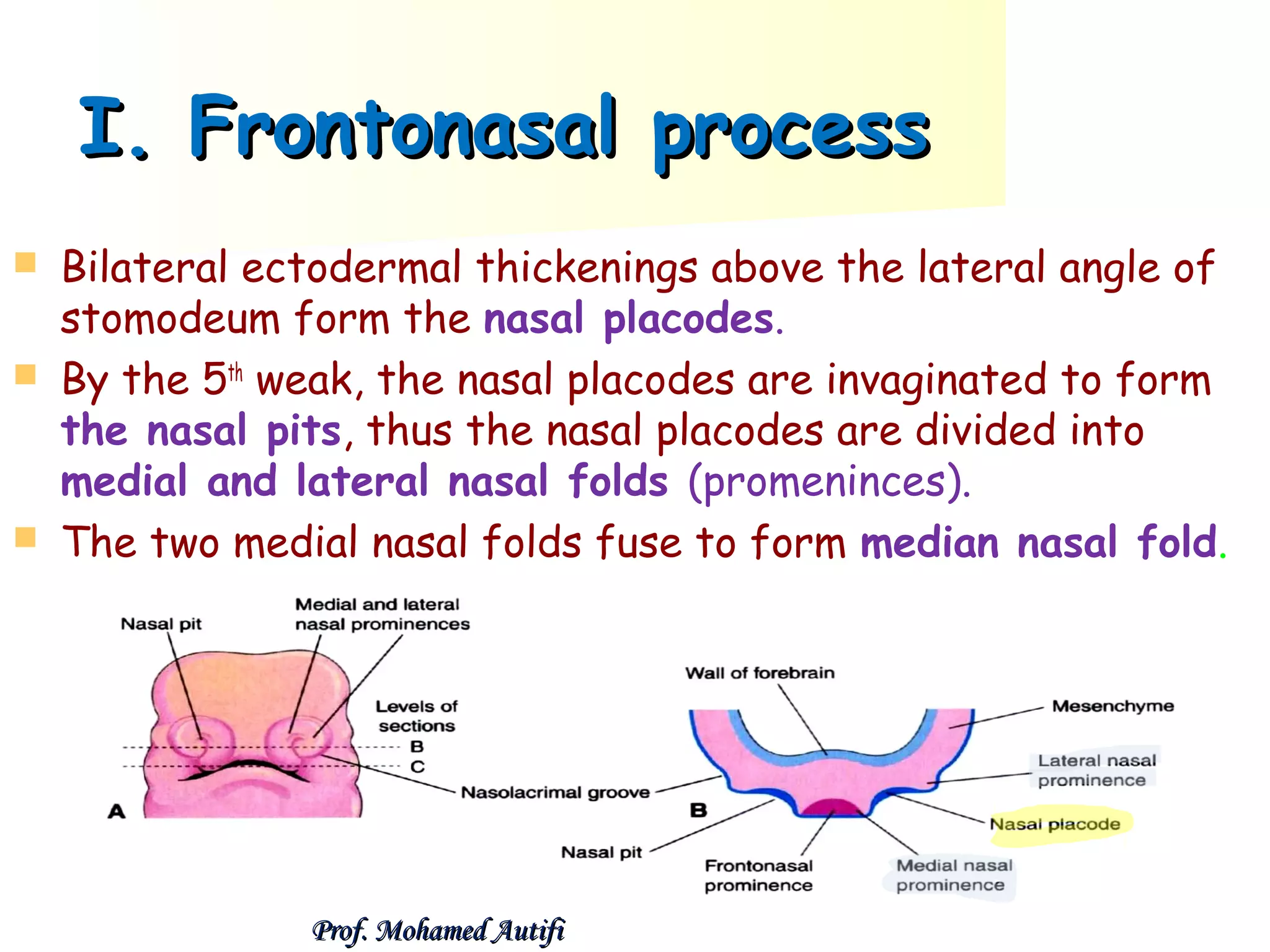
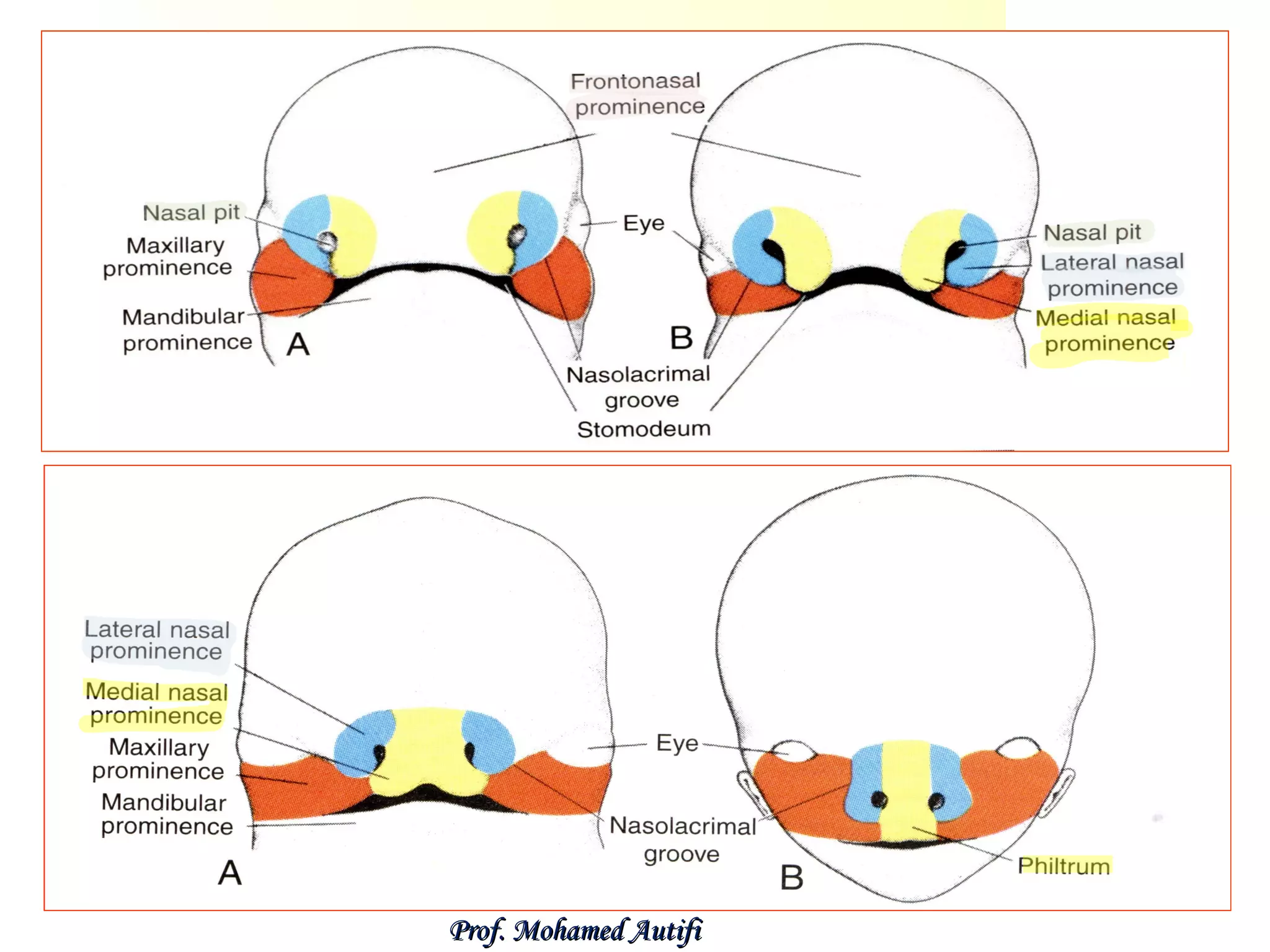
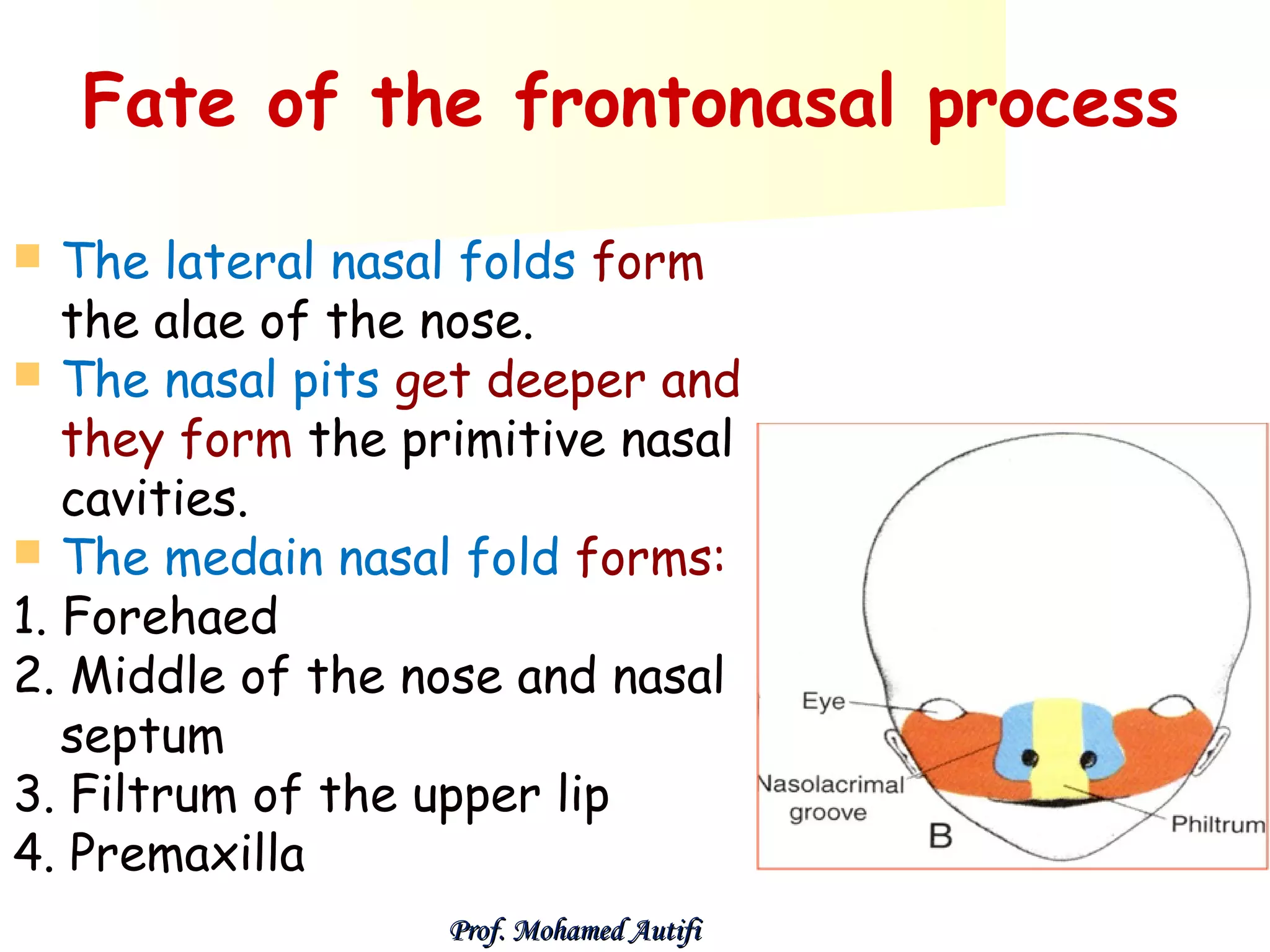
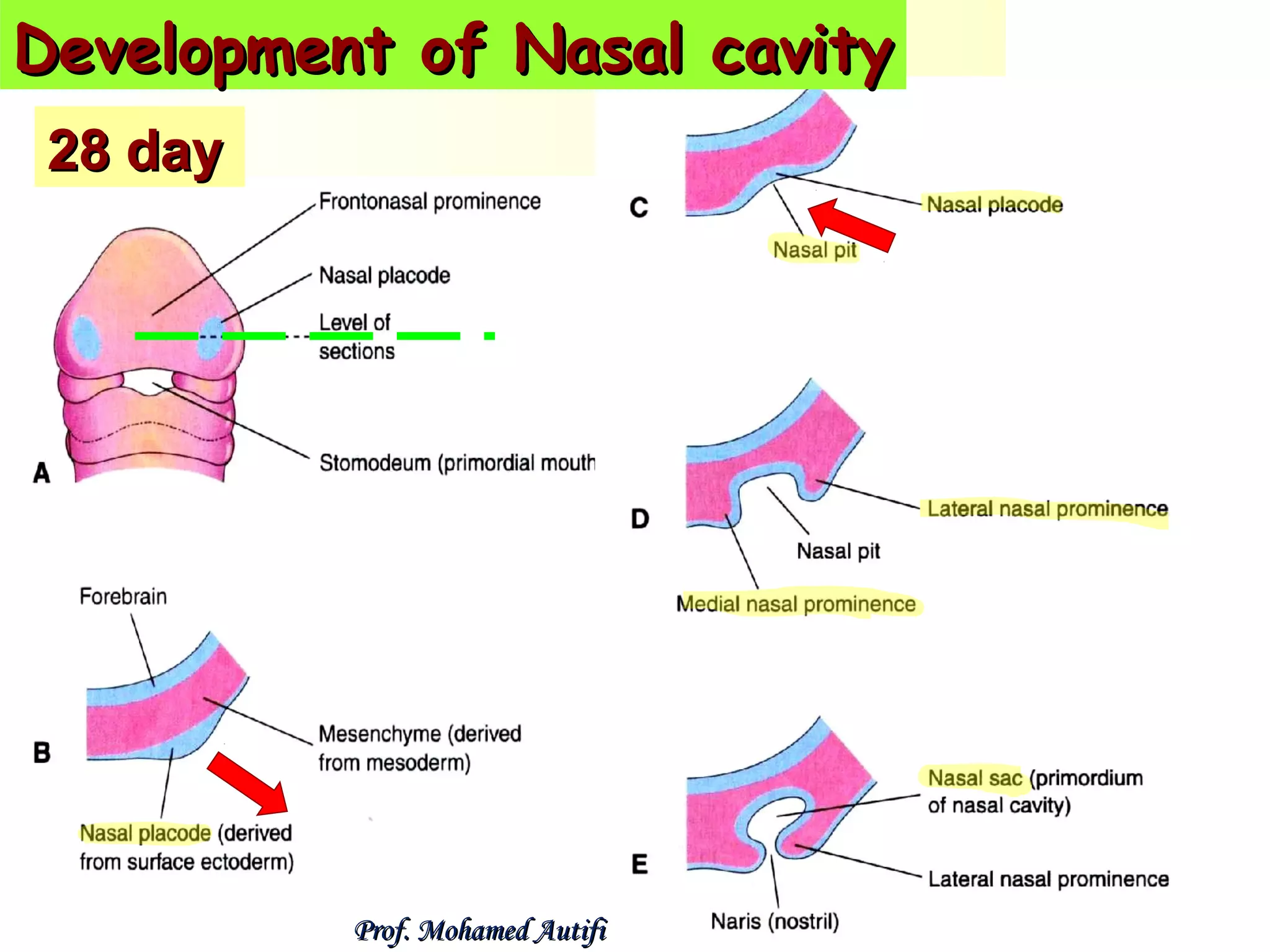
Bilateral ectodermal thickenings above the lateral angle of
stomodeum form the nasal placodes.
By the 5th weak, the nasal placodes are invaginated to form
the nasal pits, thus the nasal placodes are divided into
medial and lateral nasal folds (promeninces).
The two medial nasal folds fuse to form median nasal fold.

Prof. Mohamed Autifi
Fate of the frontonasal process
The lateral nasal folds form
the alae of the nose.
 The nasal pits get deeper and
they form the primitive nasal
cavities.
 The medain nasal fold forms:
1. Forehaed
2. Middle of the nose and nasal
septum
3. Filtrum of the upper lip
4. Premaxilla


Prof. Mohamed Autifi
II. Maxillary processes



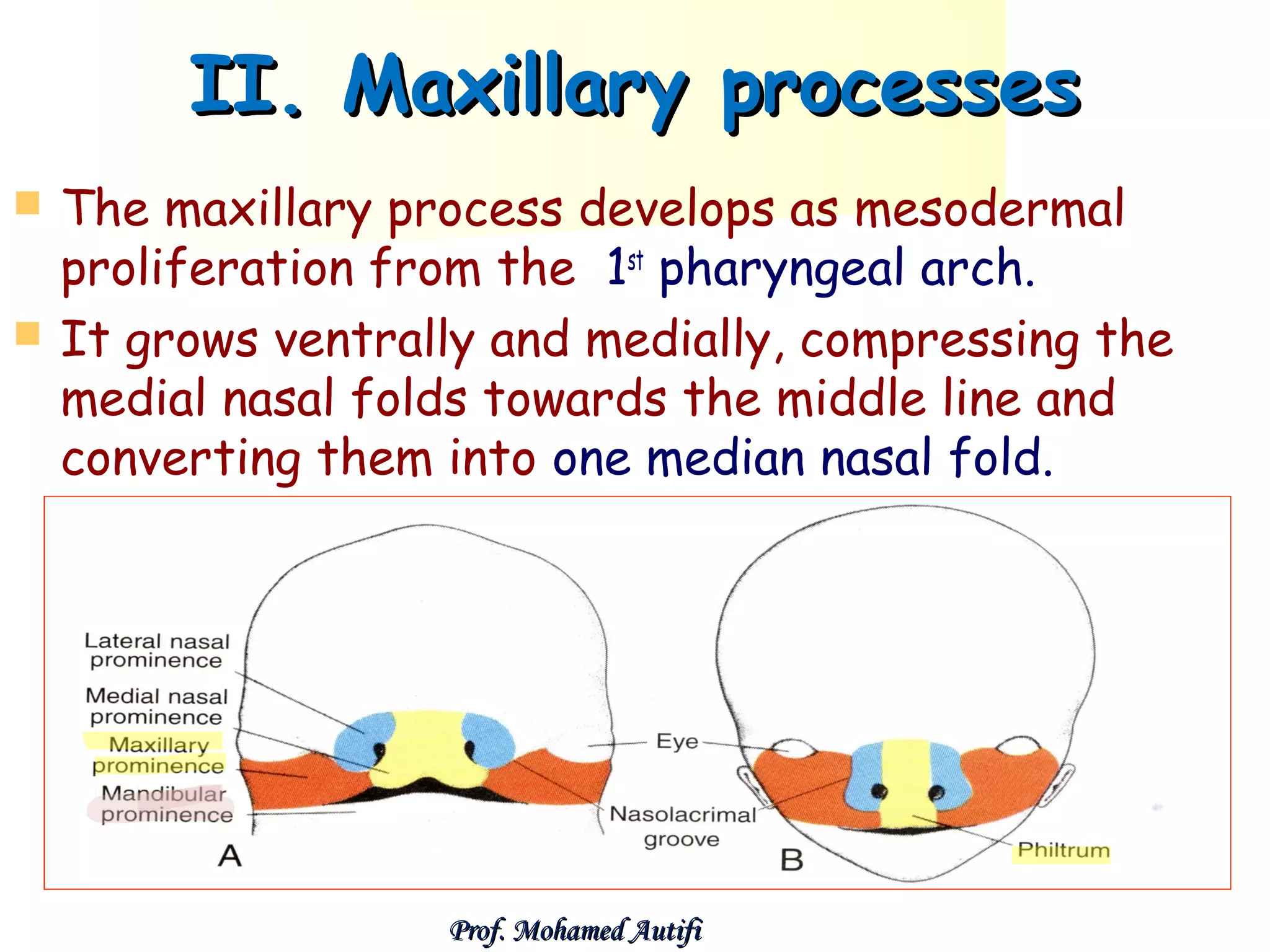
The maxillary process develops as mesodermal
proliferation from the 1st pharyngeal arch.
It grows ventrally and medially, compressing the
medial nasal folds towards the middle line and
converting them into one median nasal fold.

Prof. Mohamed Autifi
II. Maxillary processes



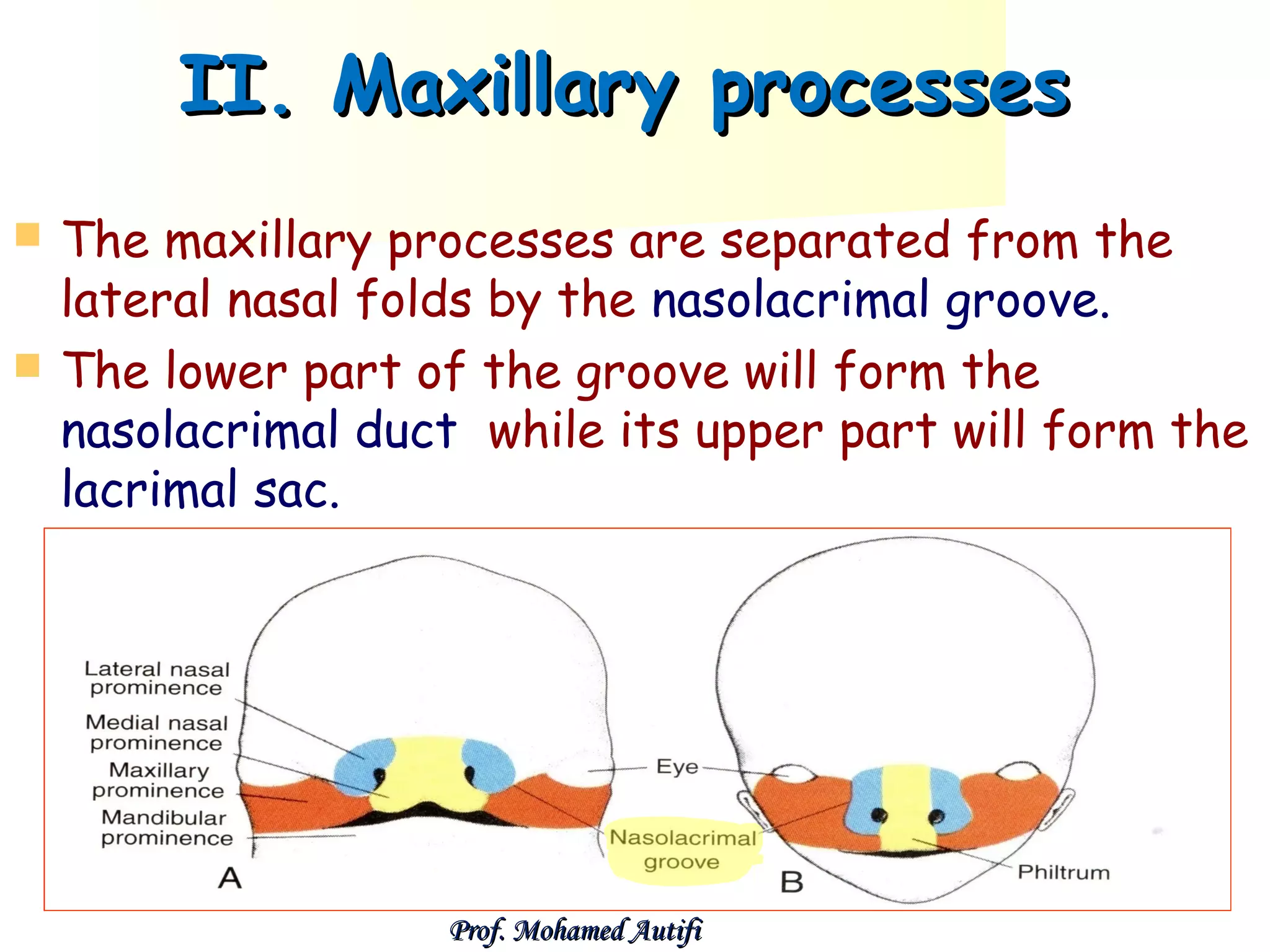
The maxillary processes are separated from the
lateral nasal folds by the nasolacrimal groove.
The lower part of the groove will form the
nasolacrimal duct while its upper part will form the
lacrimal sac.

Prof. Mohamed Autifi
II. Maxillary processes
A

palatine shelf arises from the medial
aspects of each maxillary process.

 Both

shelves are approximated towards
each other and fuse together and with
the premaxilla forming the hard and
soft palate. Thus the nasal cavity
becomes separated from the oral cavity.
Prof. Mohamed Autifi
Fate of maxillary processes
1. Cheeks
2. Upper lip except the filtrum
3. Palate except the premaxilla

Prof. Mohamed Autifi

Frnotnasal
process
III. The mandibular processes
 Develop

from the mesenchyme of the 1st
pharyngeal arch.

 Fate

:

1. Lower jaw
2. Lower lip
3. Floor of the mouth
Prof. Mohamed Autifi
Development
Of
Nasal cavities

Prof. Mohamed Autifi
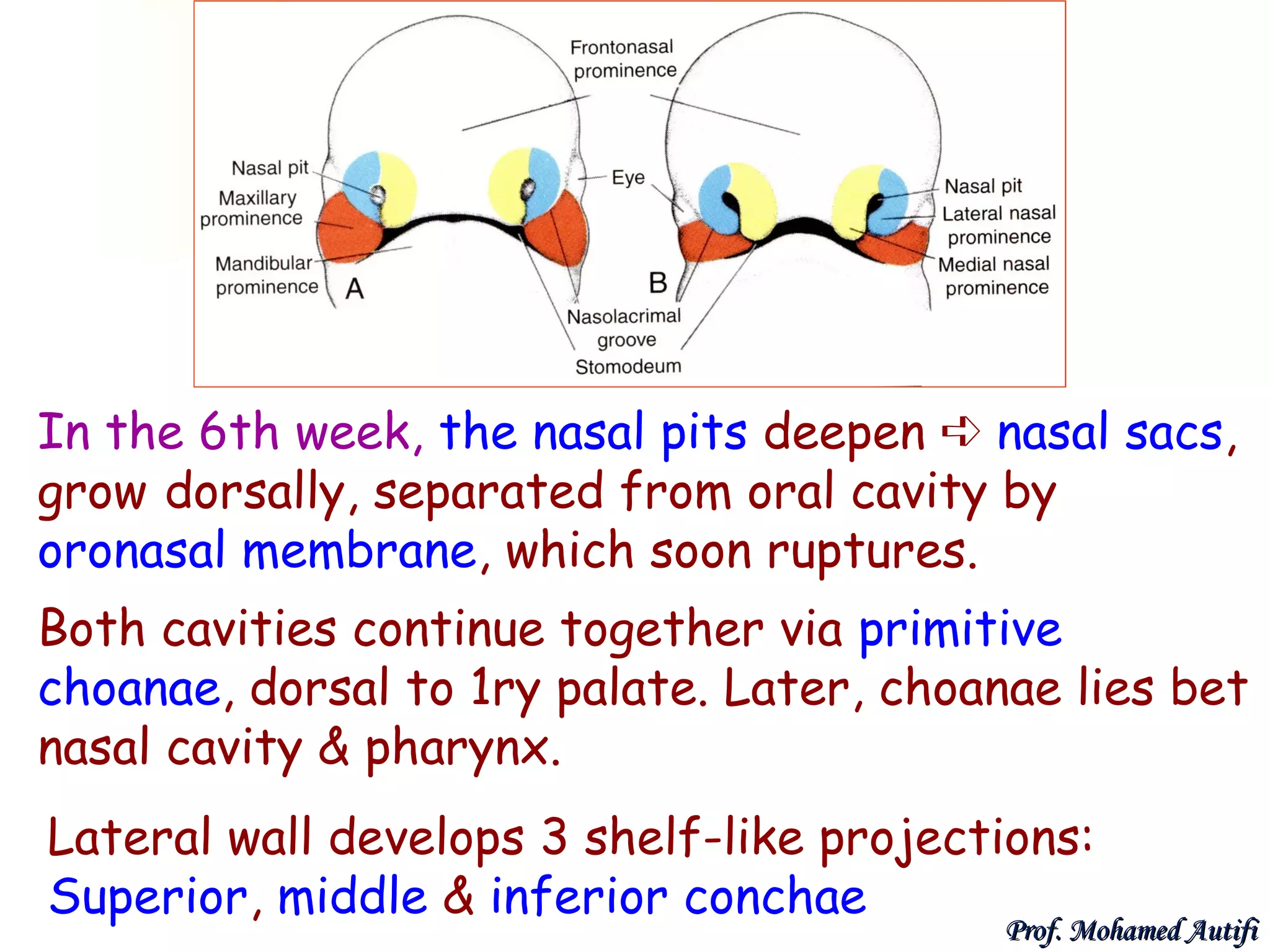
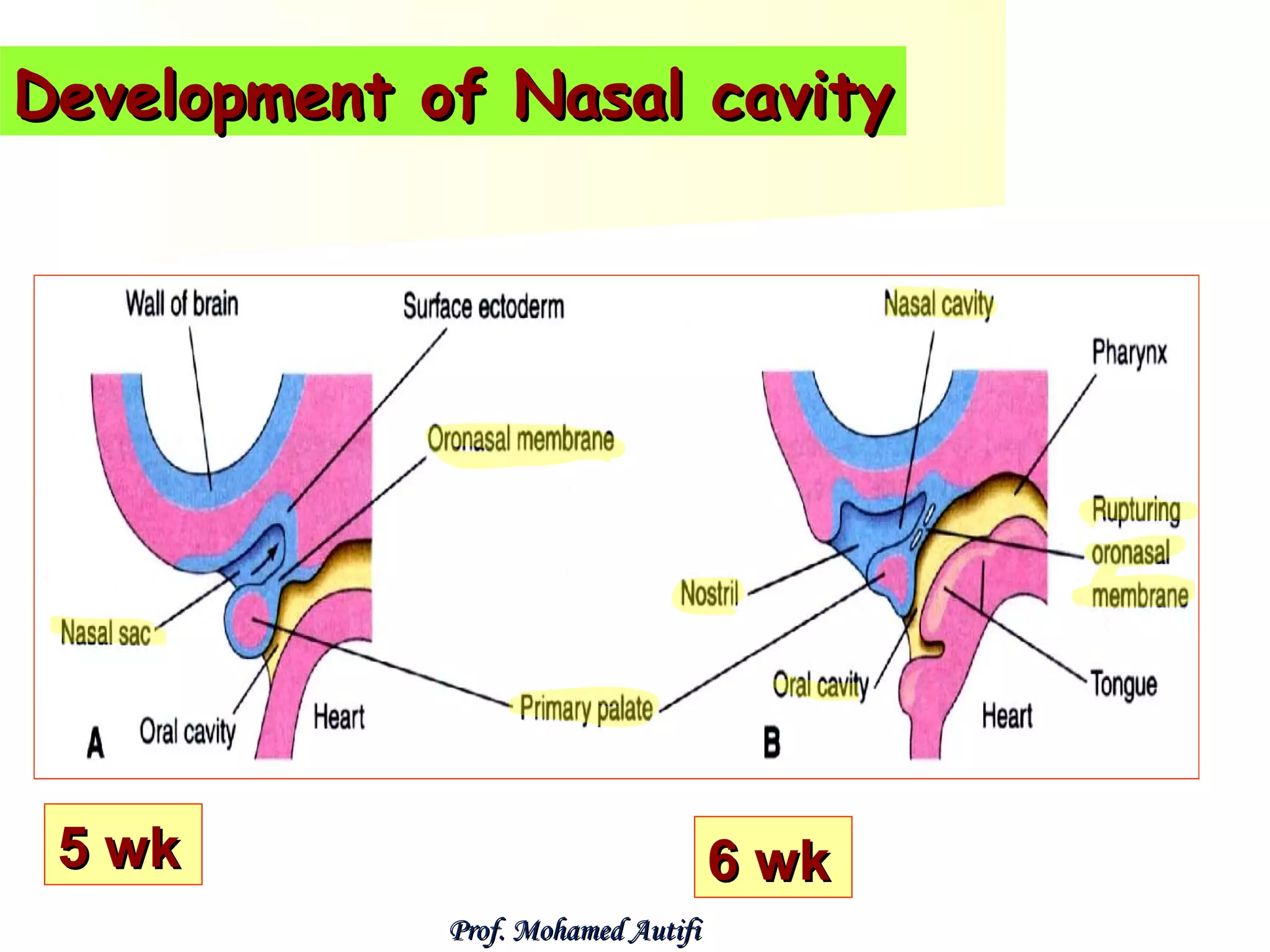
In the 6th week, the nasal pits deepen ➪ nasal sacs,
grow dorsally, separated from oral cavity by
oronasal membrane, which soon ruptures.
Both cavities continue together via primitive
choanae, dorsal to 1ry palate. Later, choanae lies bet
nasal cavity & pharynx.
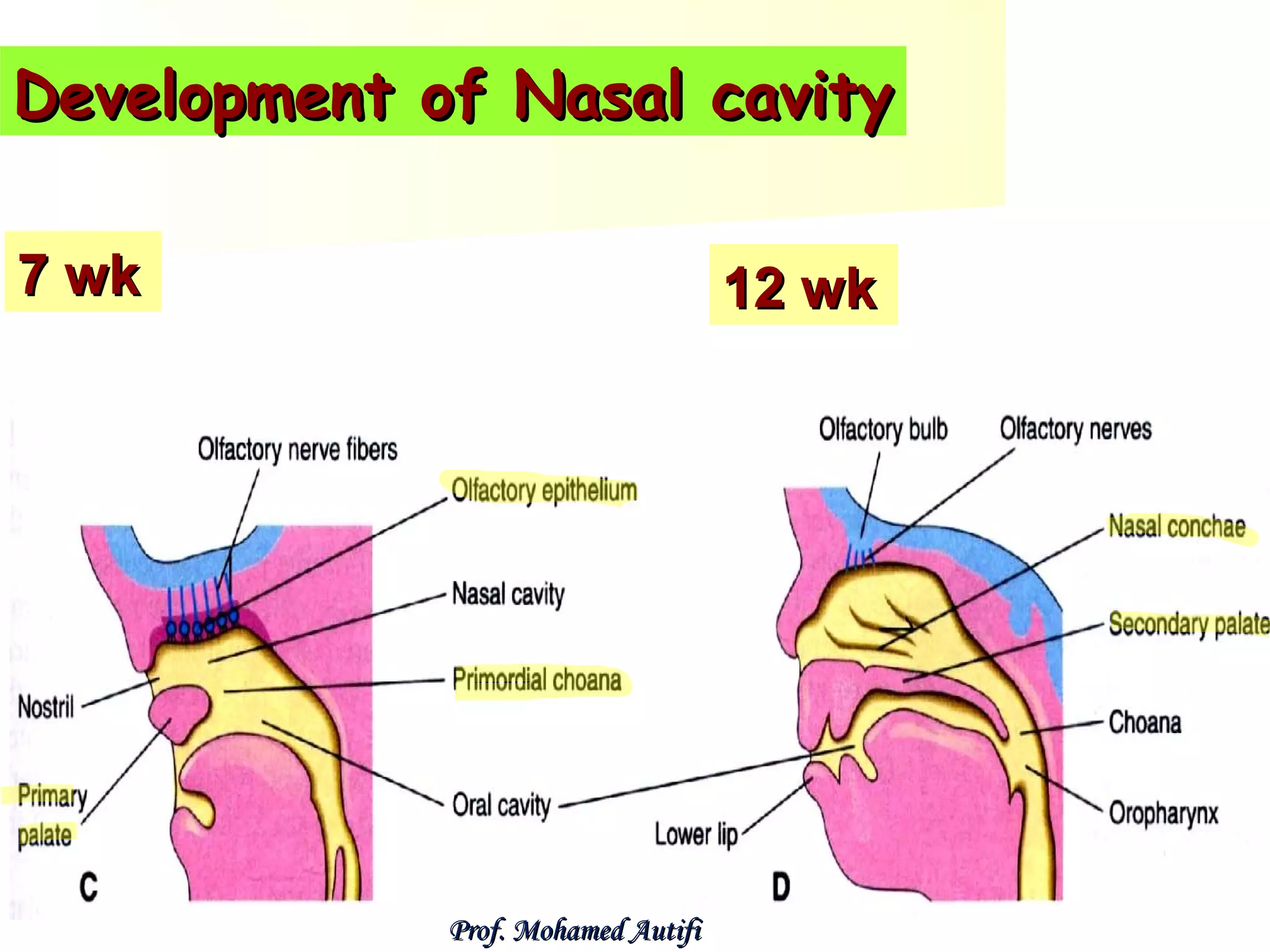
Lateral wall develops 3 shelf-like projections:
Superior, middle & inferior conchae

Prof. Mohamed Autifi
Development of Nasal cavity
28 day

Prof. Mohamed Autifi
Development of Nasal cavity

5 wk

6 wk
Prof. Mohamed Autifi
Development of Nasal cavity
7 wk

12 wk

Prof. Mohamed Autifi
In the roof of each cavity, the ectoderm shows
thickened patch, olfactory epithelium, forming
receptor cells, they are ciliated bipolar neurons.
Their axons form the olfactory nerves.

Paranasal air sinuses:
-They develop after birth, except maxillary

sinus which appears late in foetal life.
-They develop as diverticula of lateral nasal walls,
extend into their bones.
-They reach mature size during puberty.
Prof. Mohamed Autifi
Development
Of
Palate

Prof. Mohamed Autifi
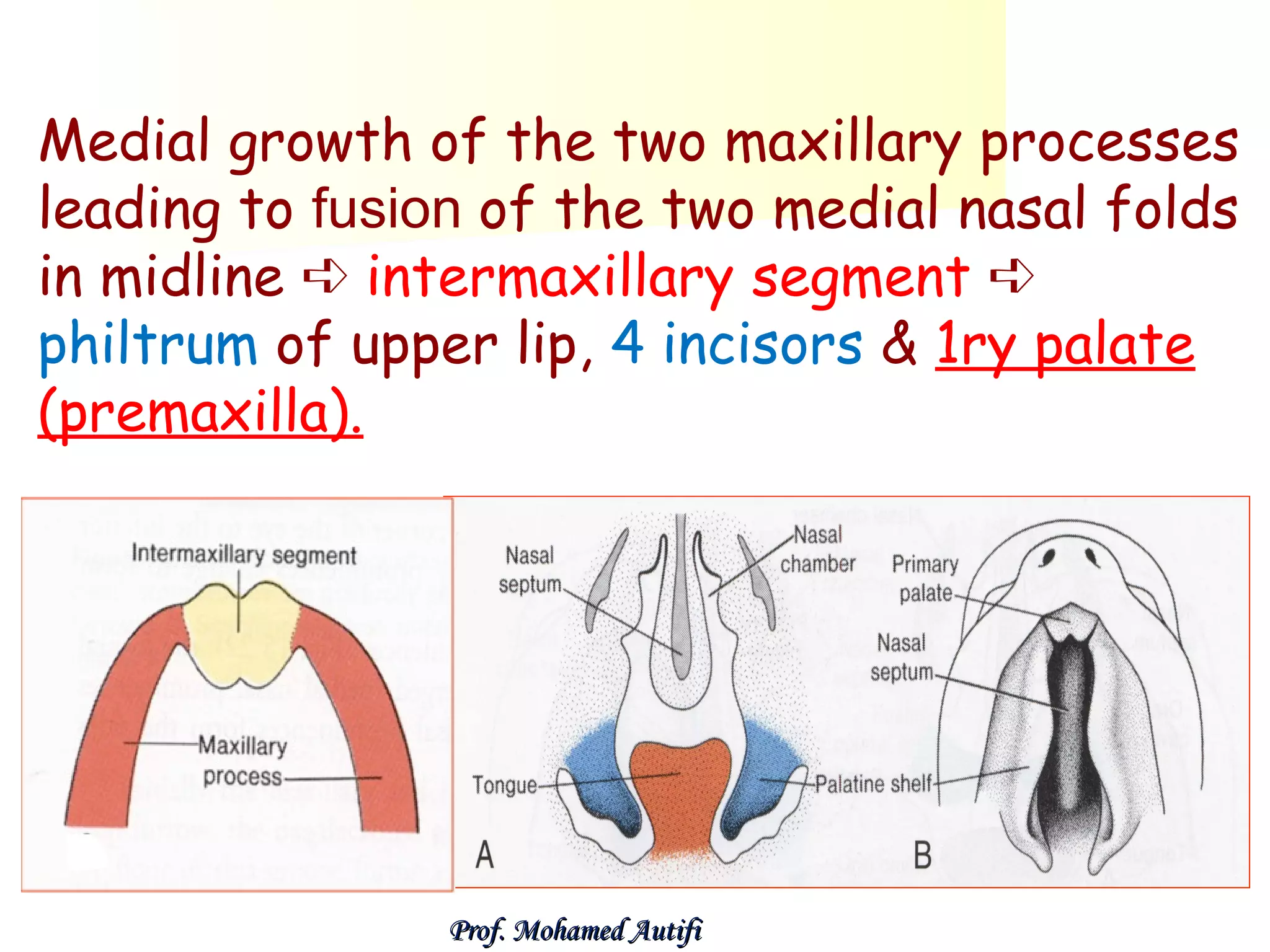
Medial growth of the two maxillary processes
leading to fusion of the two medial nasal folds
in midline ➪ intermaxillary segment ➪
philtrum of upper lip, 4 incisors & 1ry palate
(premaxilla).

Prof. Mohamed Autifi
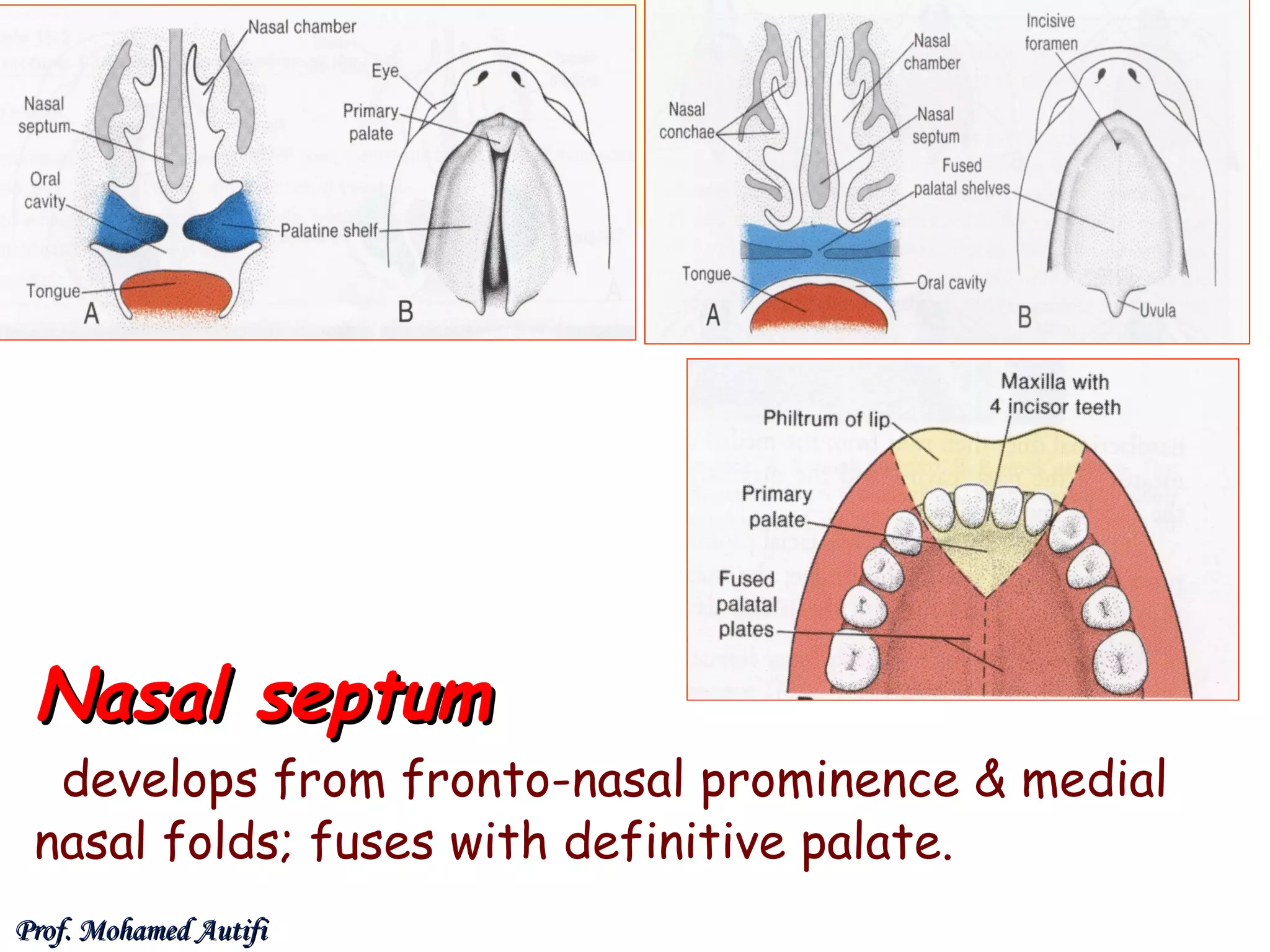
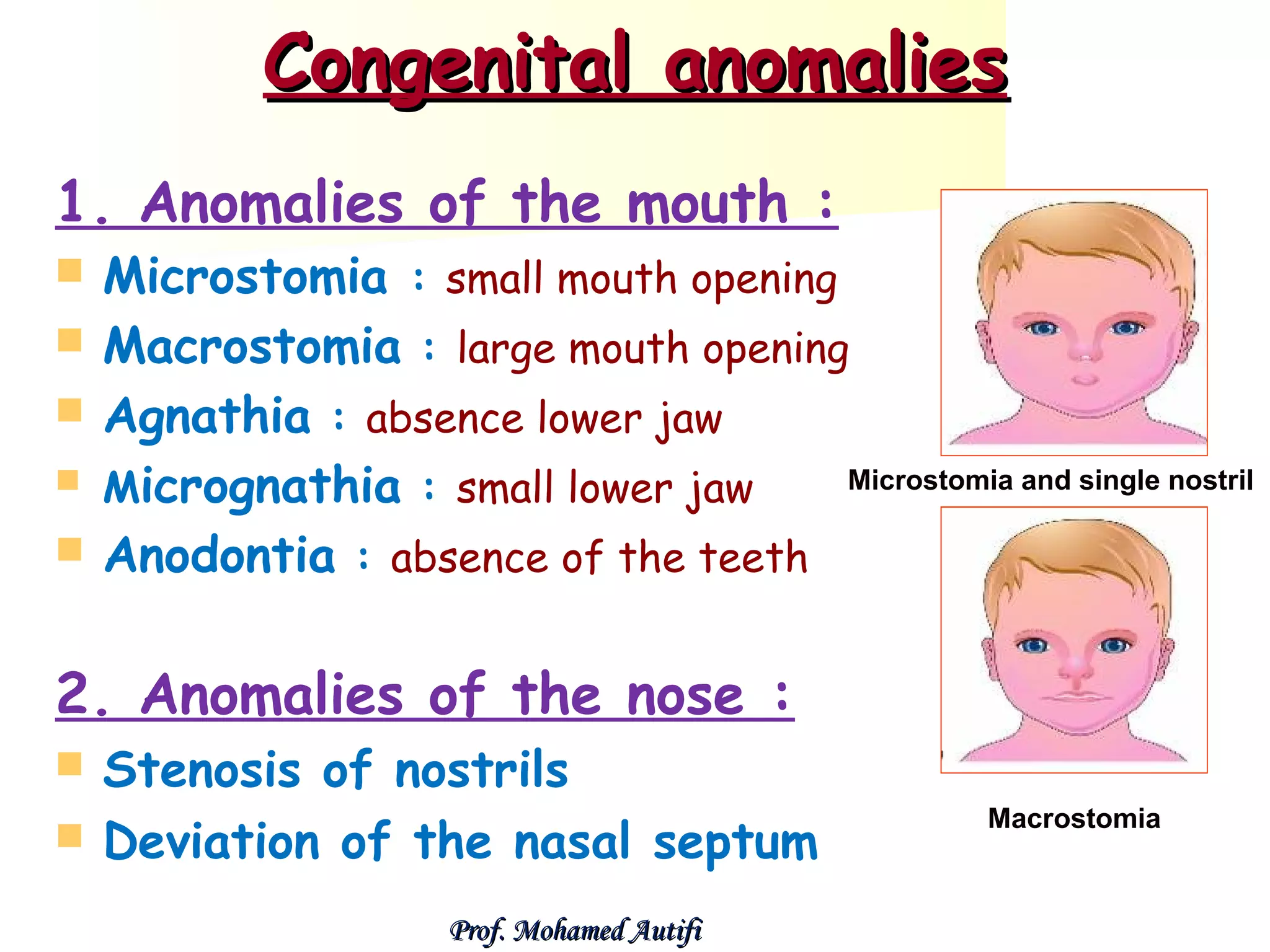
Early in 6th week, Two medial outgrowths
from maxillary processes called, palatine
shelves, fuse along palatine raphe forming
Secondary palate. It fuses with the 1ry
palate at the incisive foramen ➪ definitive
palate.
Anterior part of definitive palate ➪ hard
palate, while post part ➪ soft palate

Prof. Mohamed Autifi
Nasal septum

develops from fronto-nasal prominence & medial
nasal folds; fuses with definitive palate.
Prof. Mohamed Autifi
Congenital anomalies
1. Anomalies of the mouth :







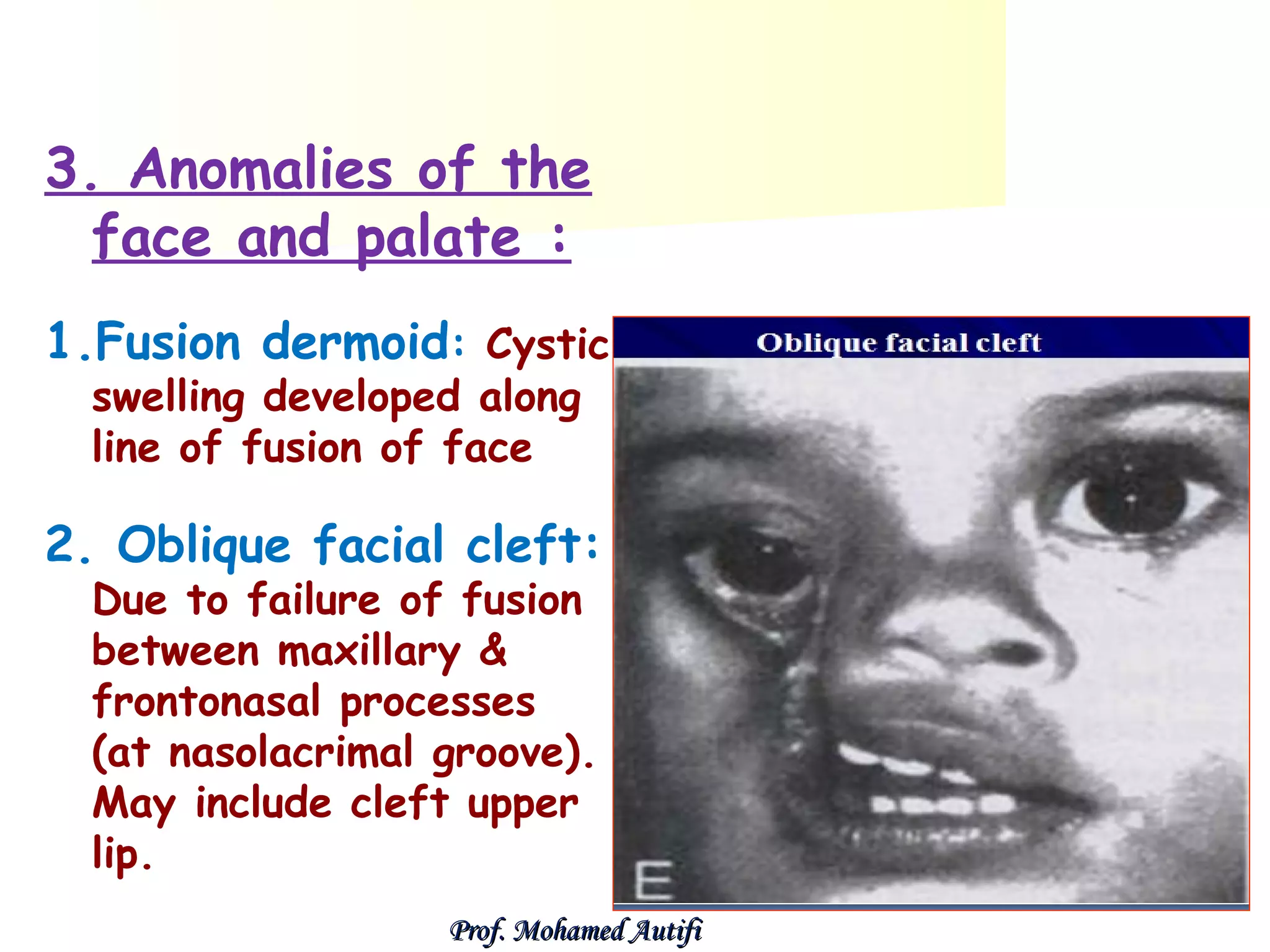
Microstomia : small mouth opening
Macrostomia : large mouth opening
Agnathia : absence lower jaw
Microstomia and single nostril
Micrognathia : small lower jaw
Anodontia : absence of the teeth

2. Anomalies of the nose :



Stenosis of nostrils
Deviation of the nasal septum
Prof. Mohamed Autifi

Macrostomia
3. Anomalies of the
face and palate :
1.Fusion dermoid: Cystic
swelling developed along
line of fusion of face

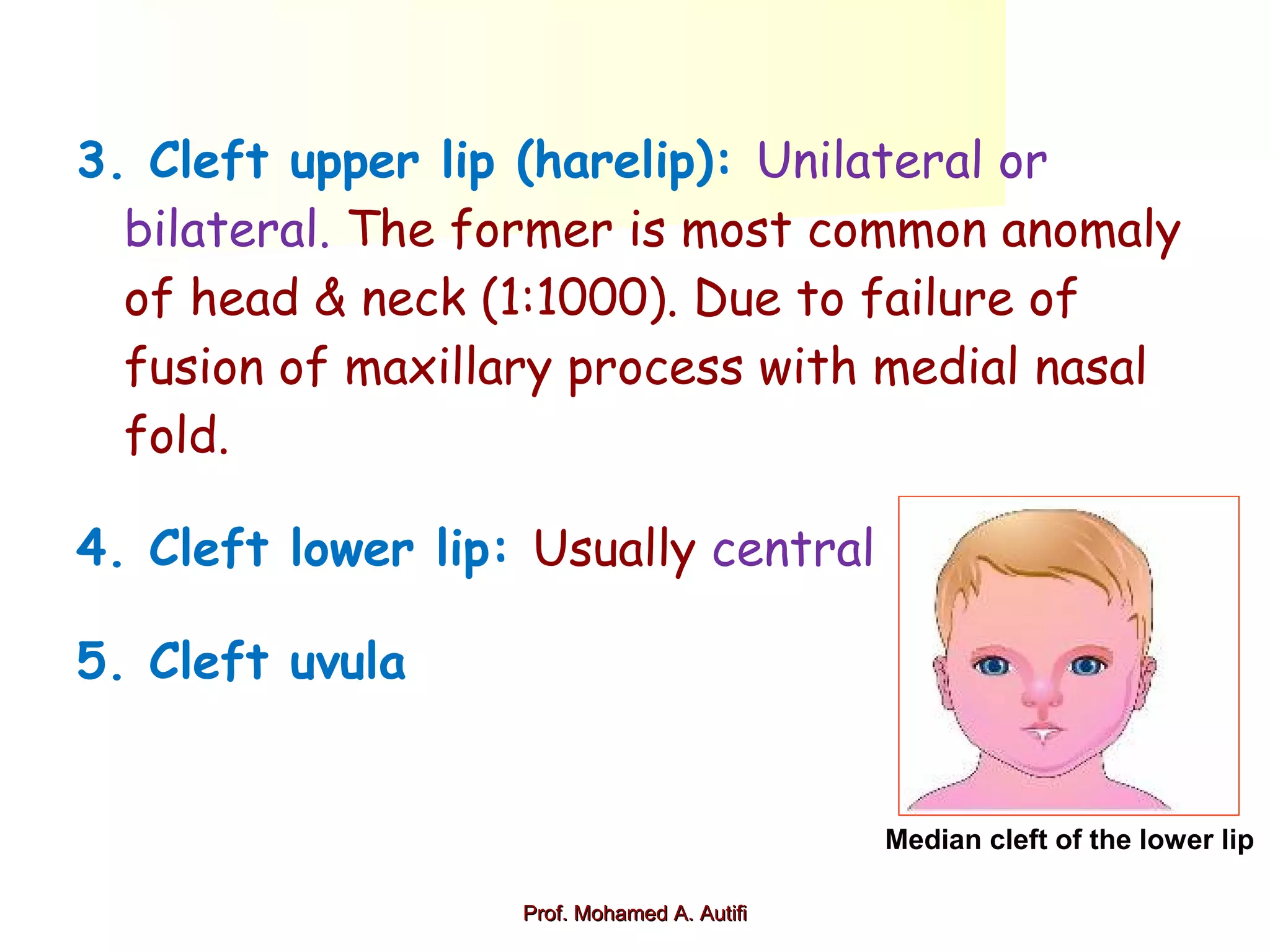
2. Oblique facial cleft:
Due to failure of fusion
between maxillary &
frontonasal processes
(at nasolacrimal groove).
May include cleft upper
lip.

Prof. Mohamed Autifi
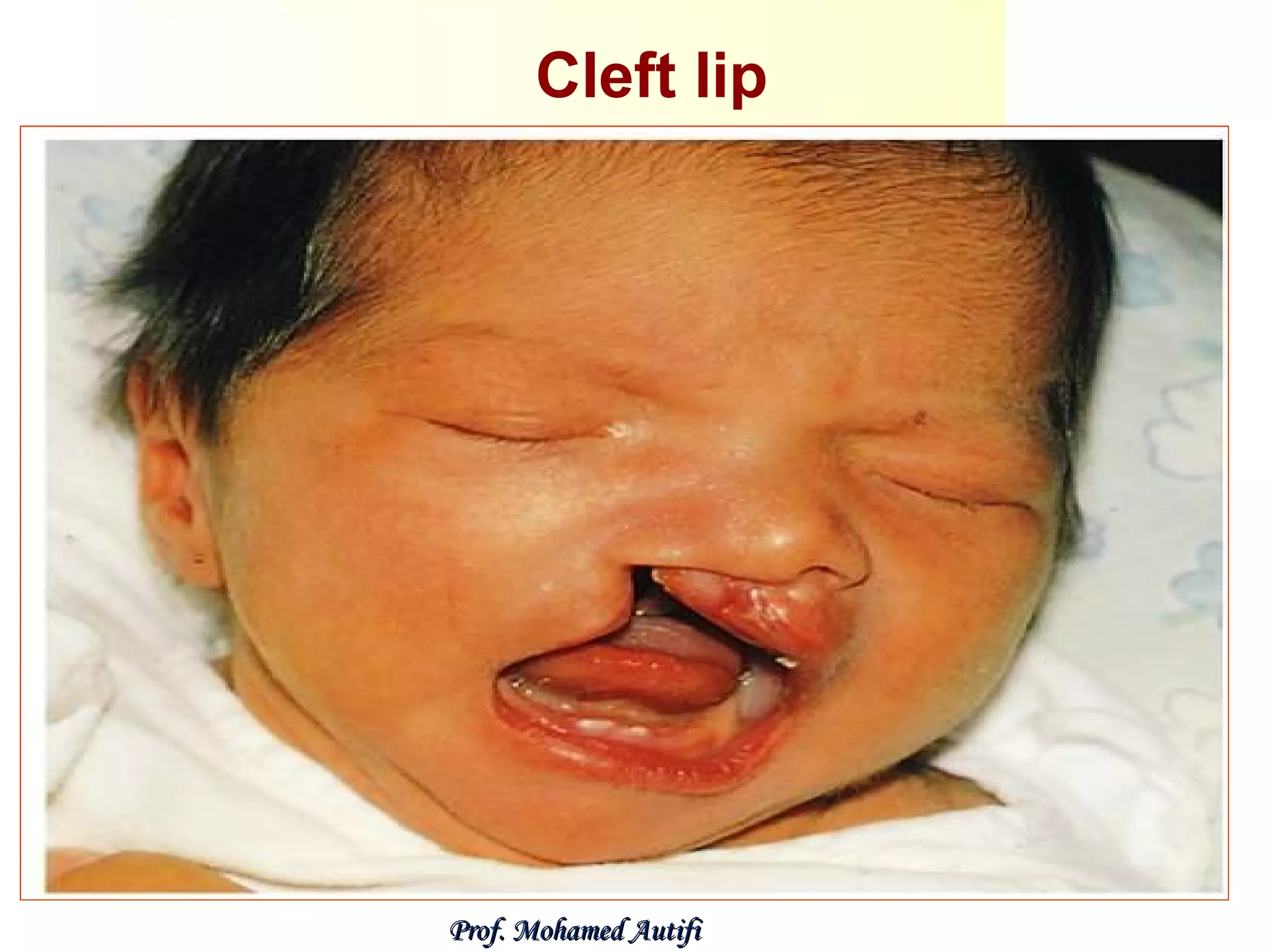
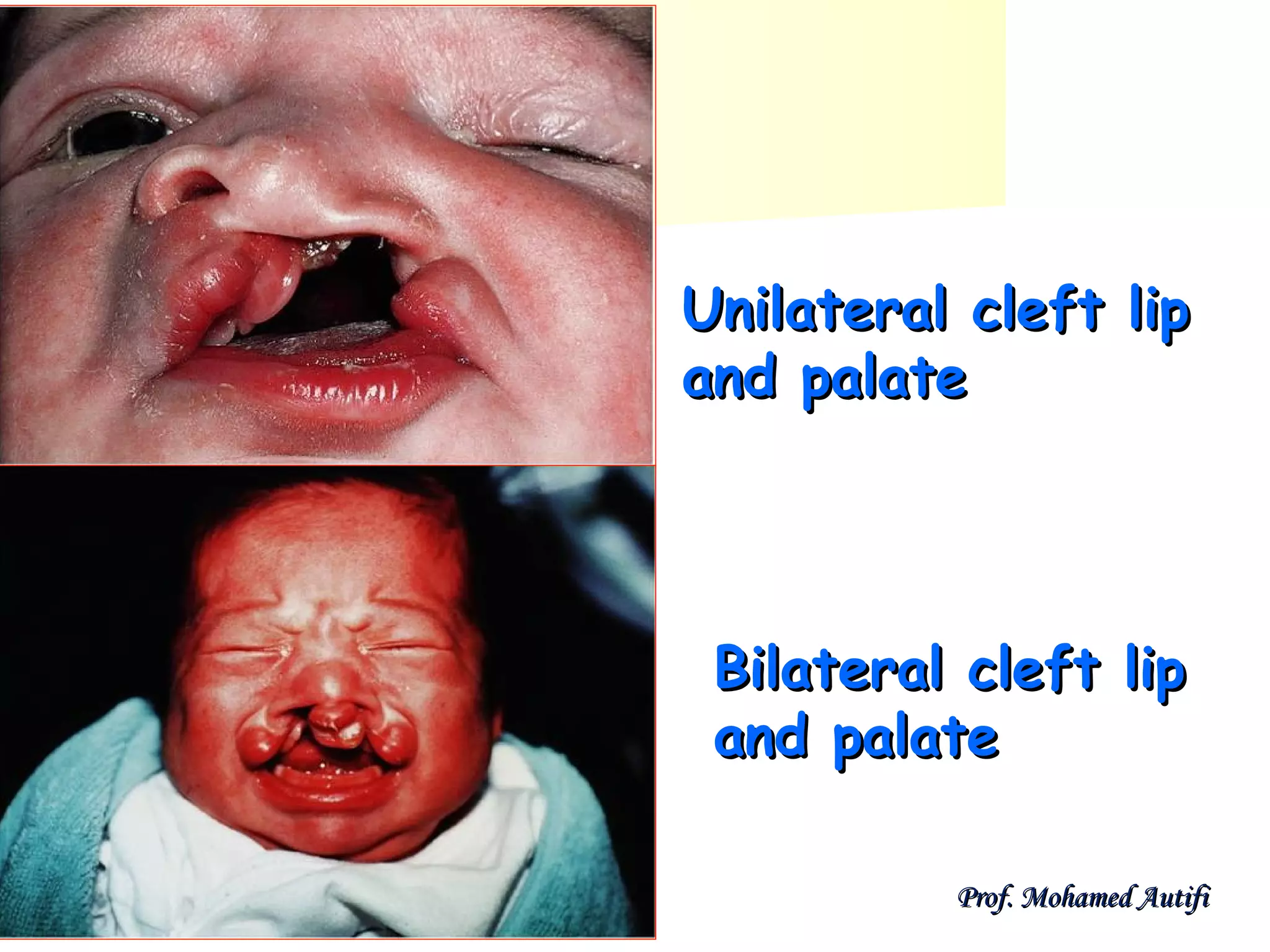
3. Cleft upper lip (harelip): Unilateral or
bilateral. The former is most common anomaly
of head & neck (1:1000). Due to failure of
fusion of maxillary process with medial nasal
fold.
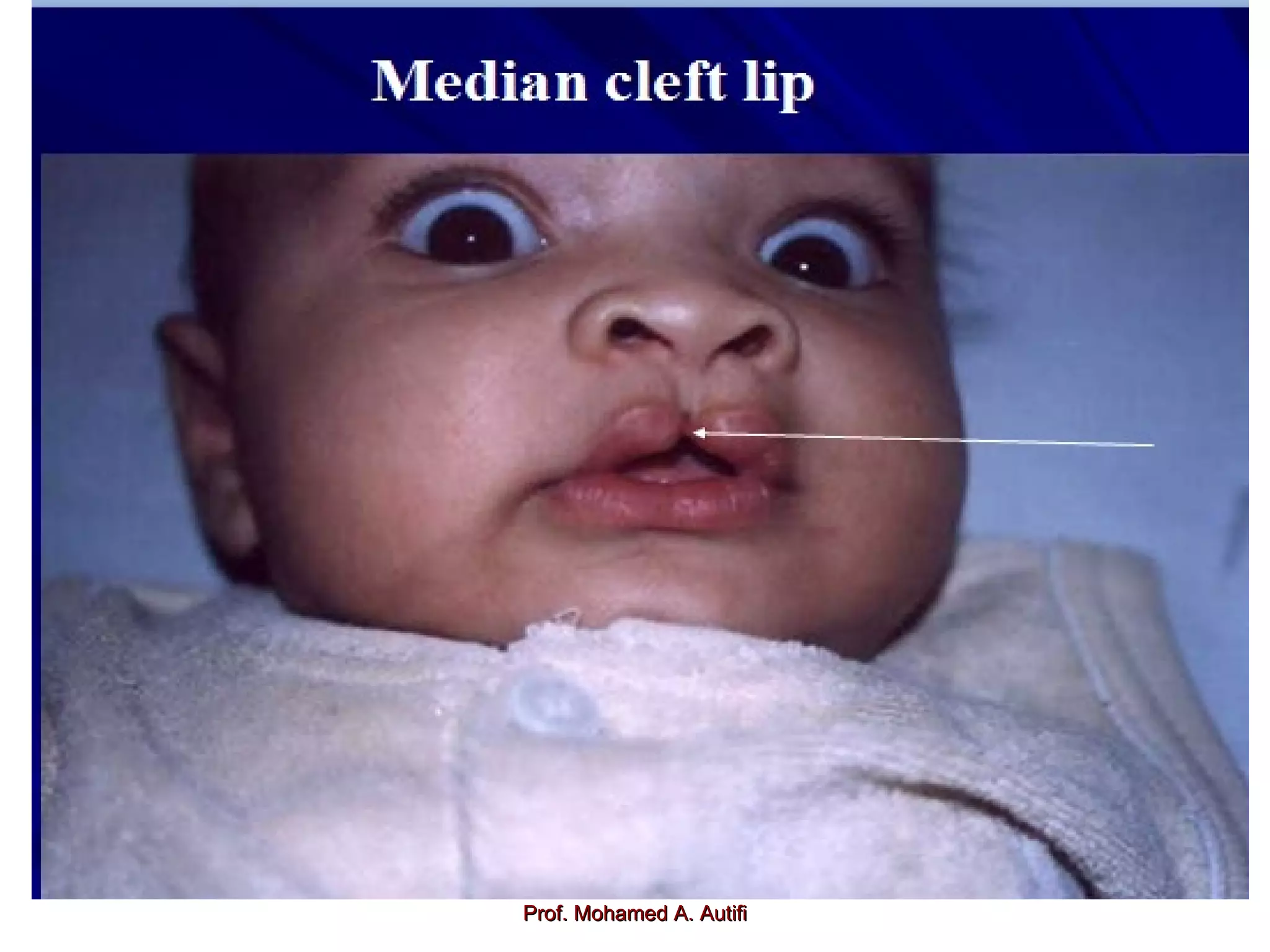
4. Cleft lower lip: Usually central
5. Cleft uvula

Median cleft of the lower lip
Prof. Mohamed A. Autifi
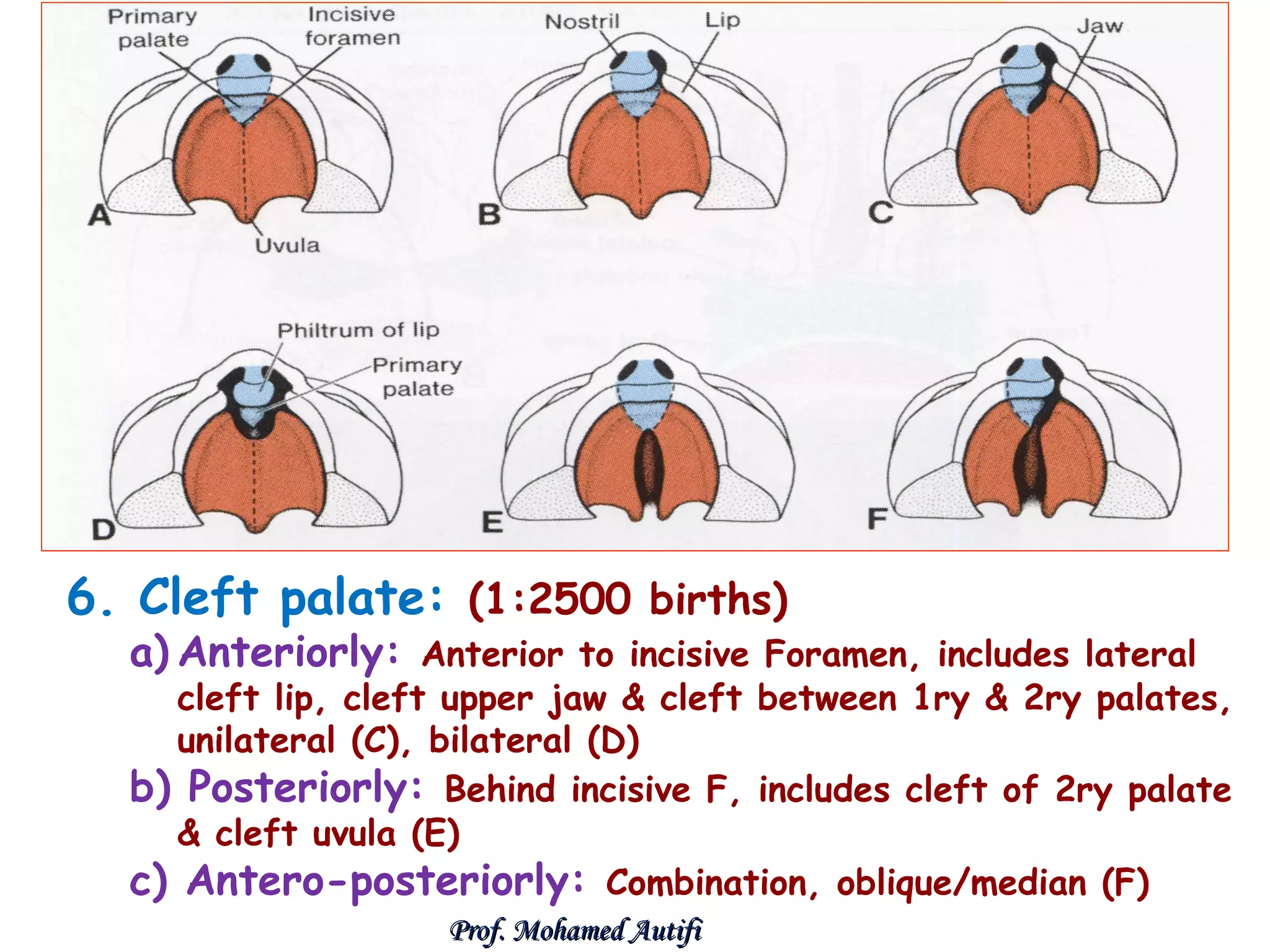
6. Cleft palate: (1:2500 births)

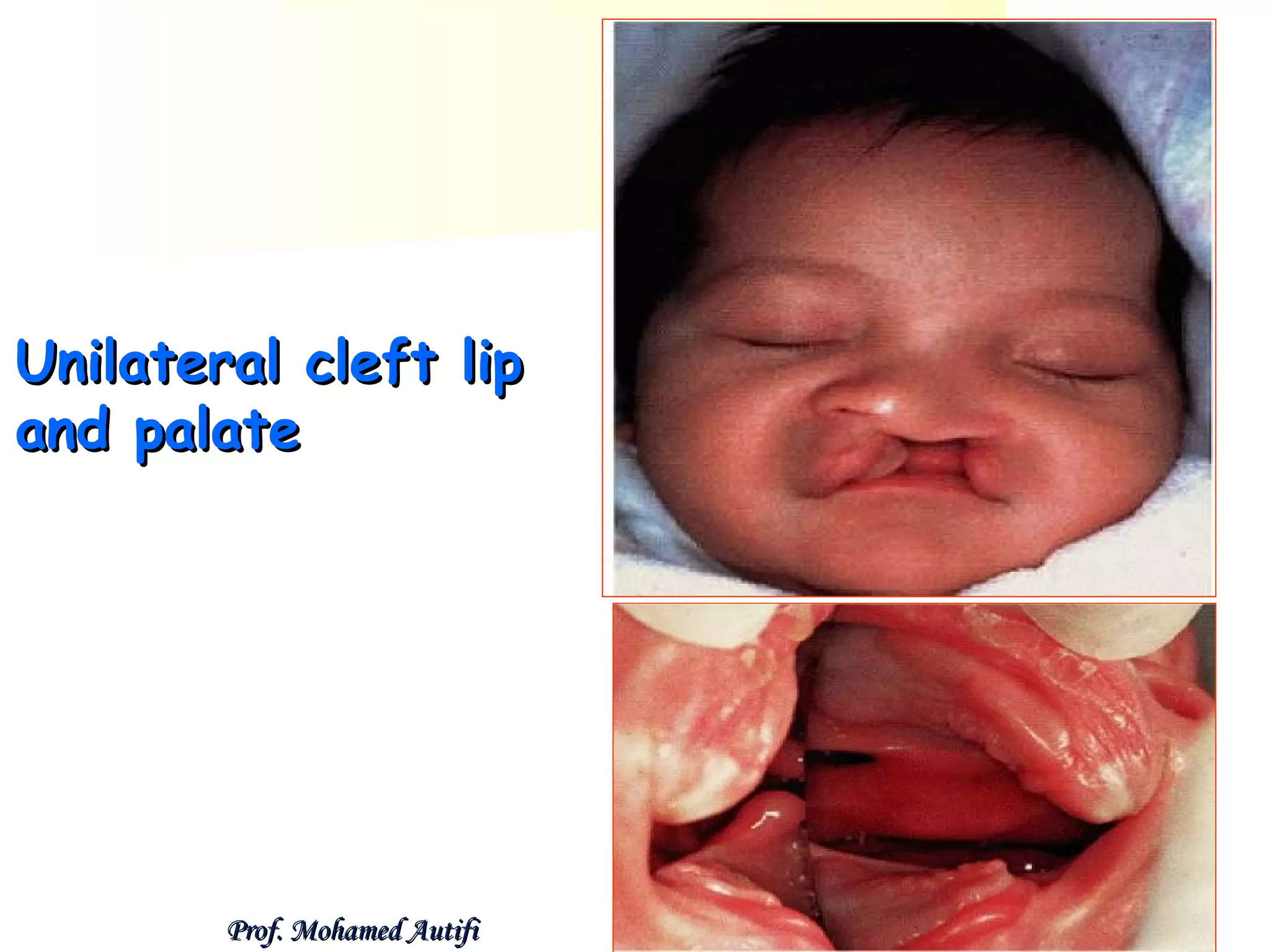
a) Anteriorly: Anterior to incisive Foramen, includes lateral

cleft lip, cleft upper jaw & cleft between 1ry & 2ry palates,
unilateral (C), bilateral (D)
b) Posteriorly: Behind incisive F, includes cleft of 2ry palate
& cleft uvula (E)
c) Antero-posteriorly: Combination, oblique/median (F)
Prof. Mohamed Autifi
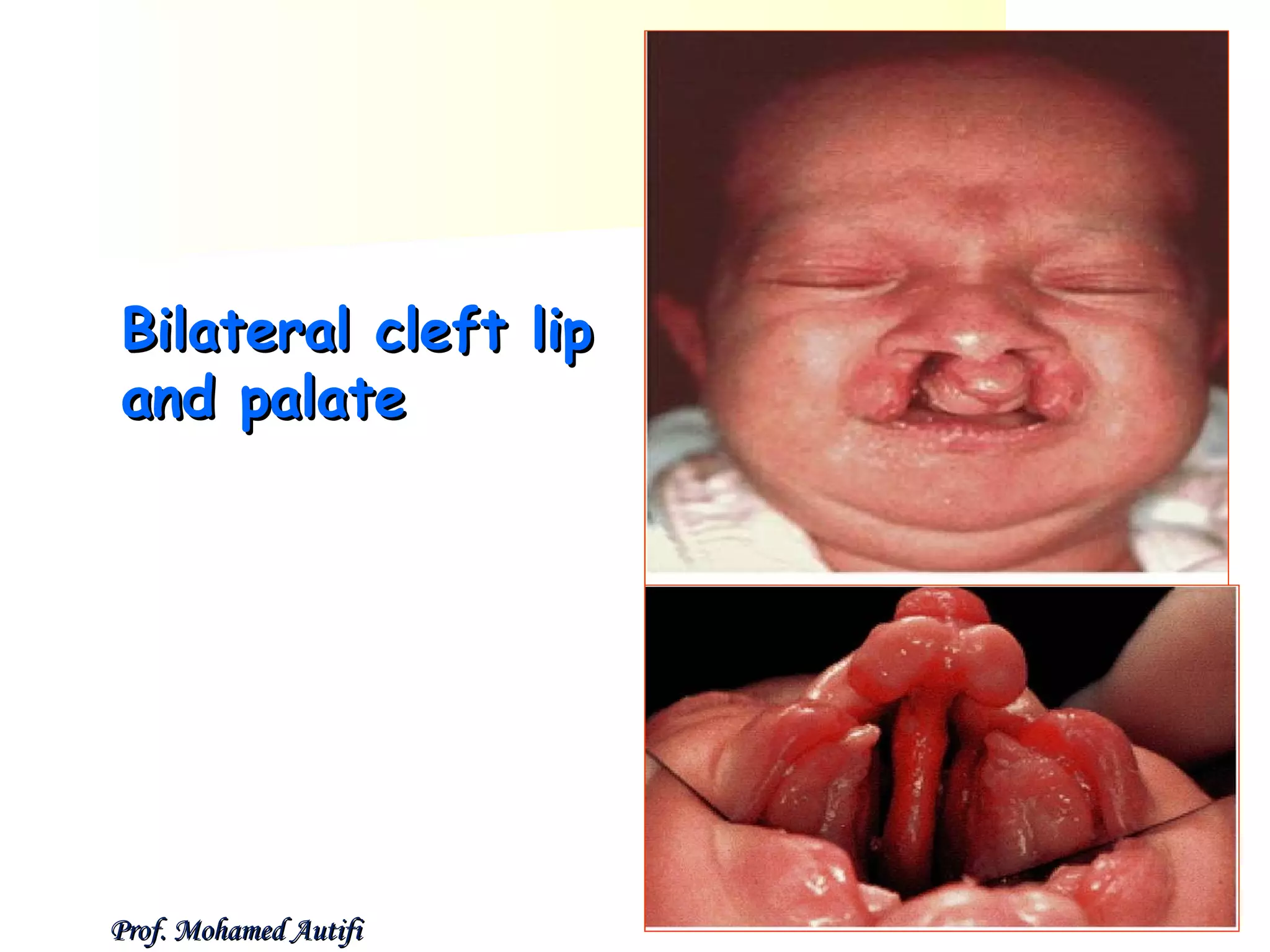
Cleft lip

Prof. Mohamed Autifi
Unilateral cleft lip
and palate

Prof. Mohamed Autifi
Prof. Mohamed A. Autifi
Bilateral cleft lip
and palate

Prof. Mohamed Autifi
Unilateral cleft lip
and palate

Bilateral cleft lip
and palate
Prof. Mohamed Autifi
Development
of

Pituitary gland
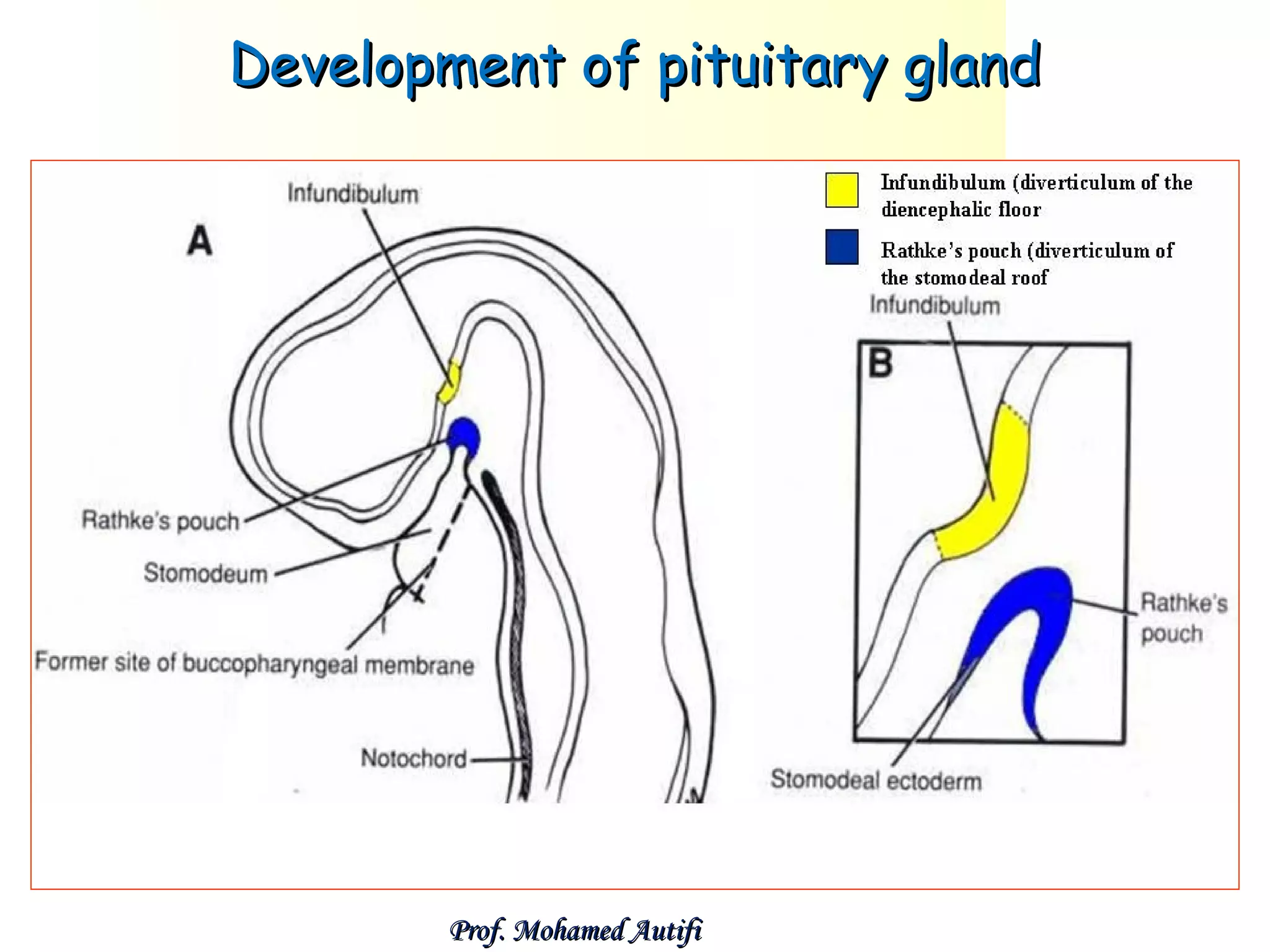
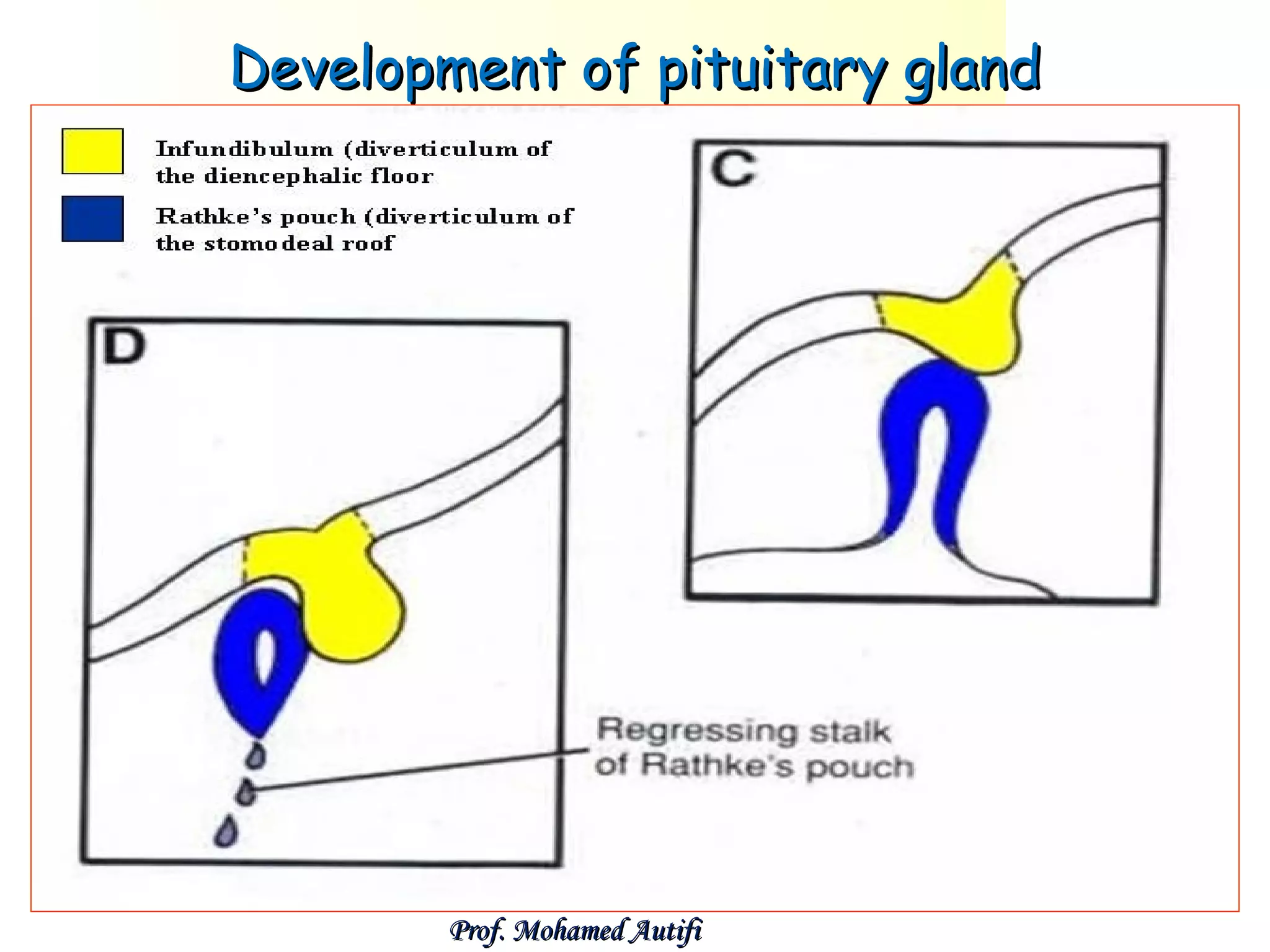
Development of the pituitary gland
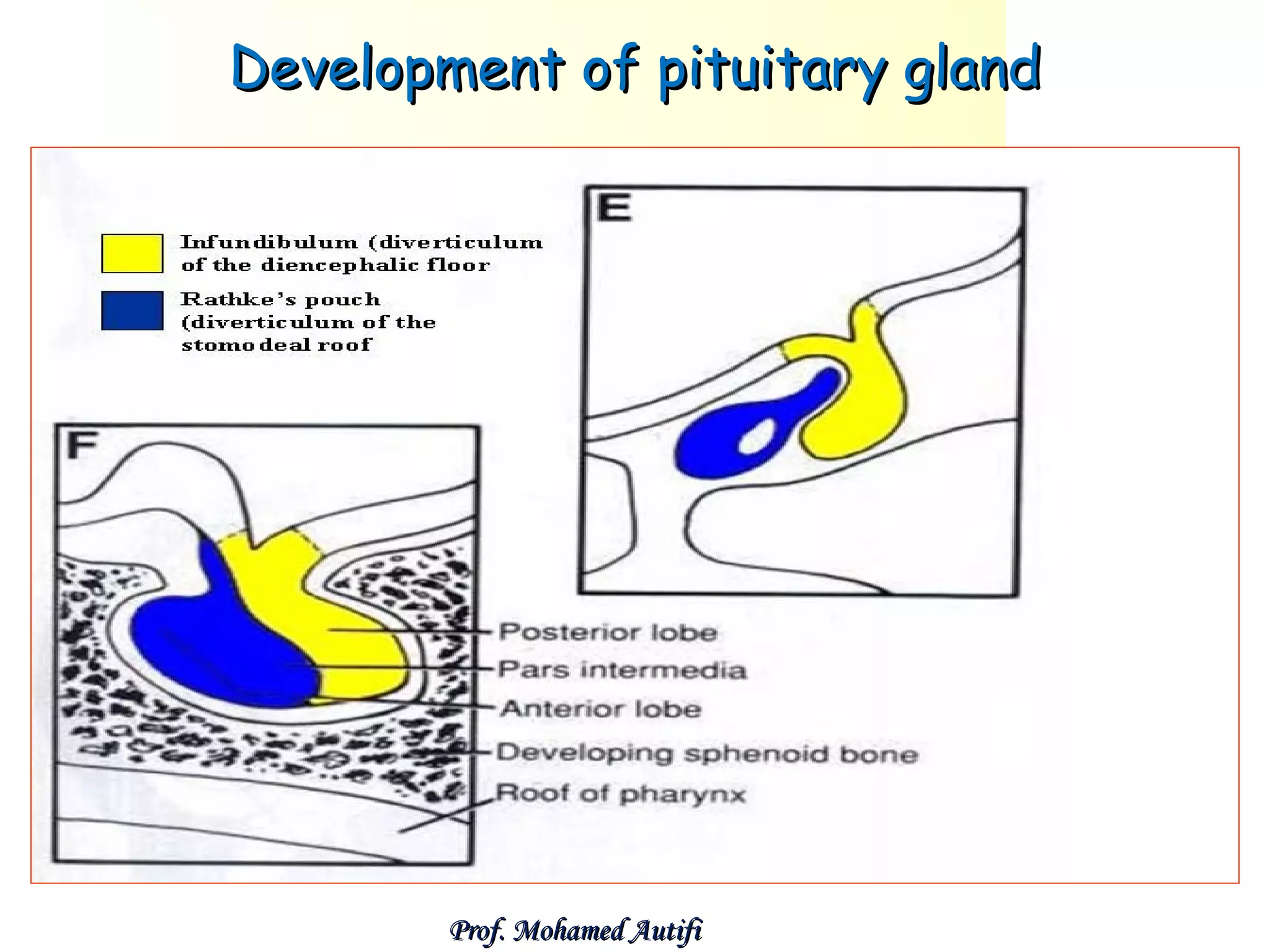
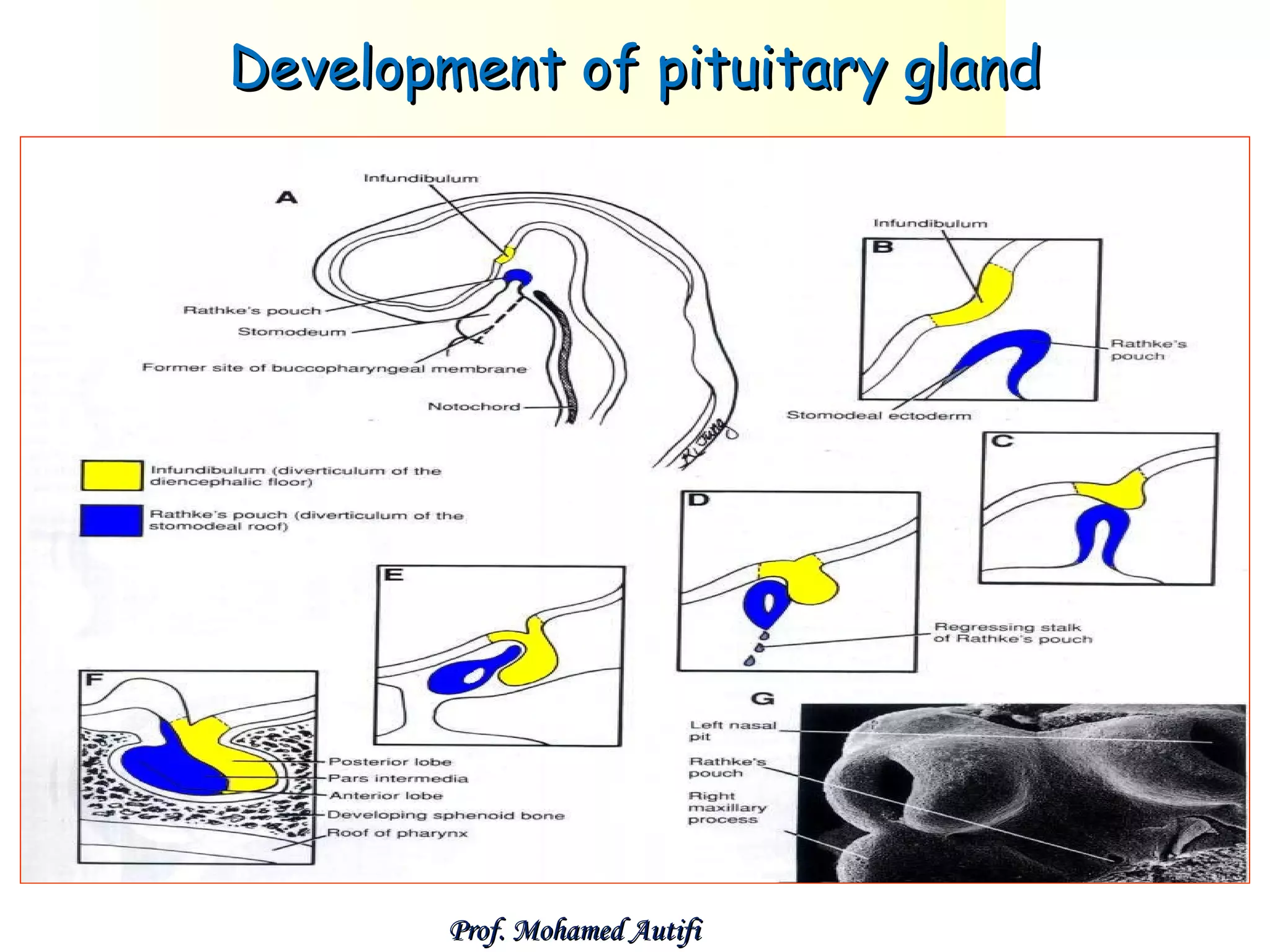
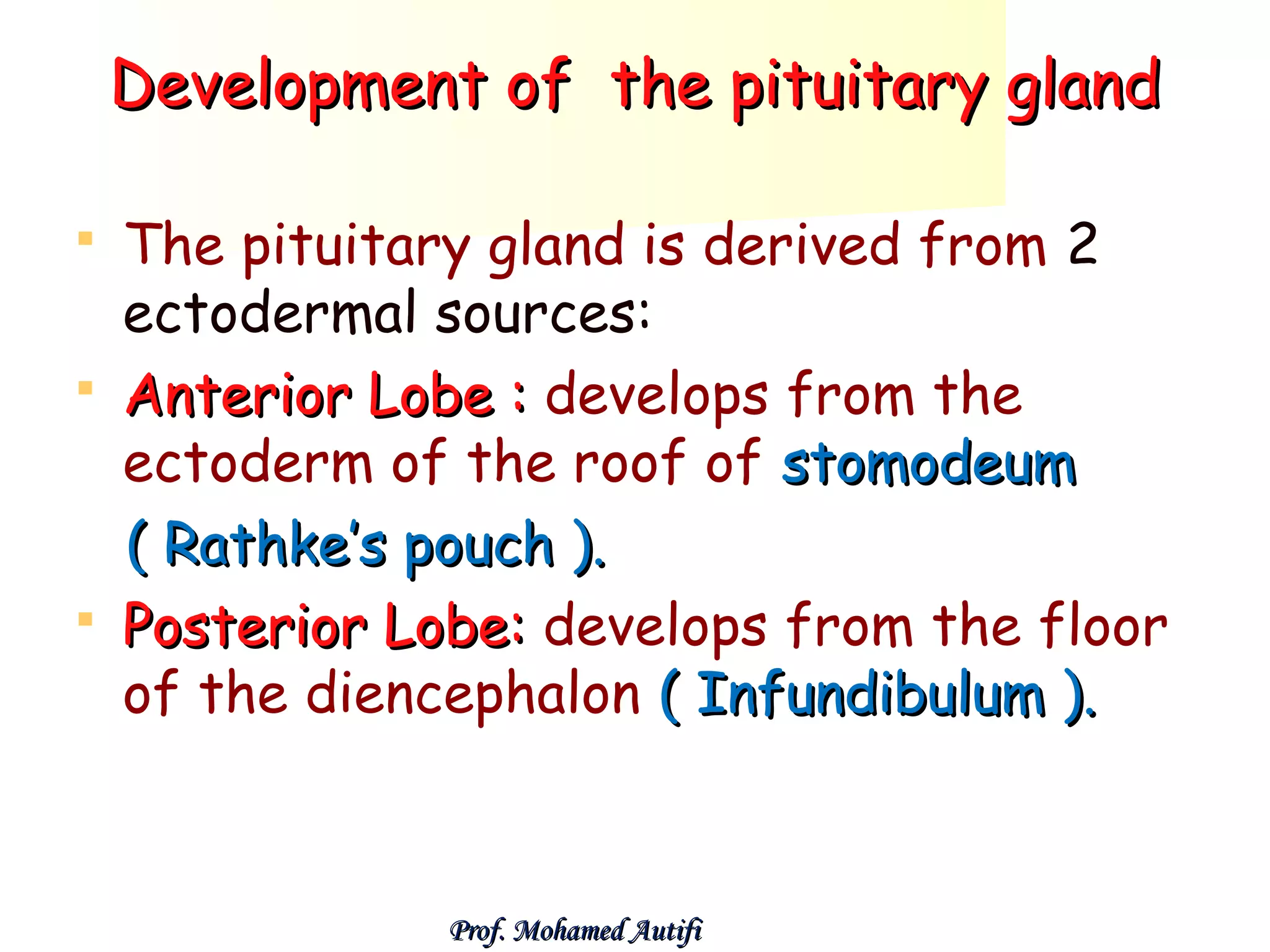
The pituitary gland is derived from 2
ectodermal sources:
 Anterior Lobe : develops from the
ectoderm of the roof of stomodeum
( Rathke’s pouch ).
 Posterior Lobe: develops from the floor
of the diencephalon ( Infundibulum ).


Prof. Mohamed Autifi
Development of pituitary gland

Prof. Mohamed Autifi
Development of pituitary gland

Prof. Mohamed Autifi
Development of pituitary gland

Prof. Mohamed Autifi
Development of pituitary gland

Prof. Mohamed Autifi
Congenital anomalies of pituitary
gland
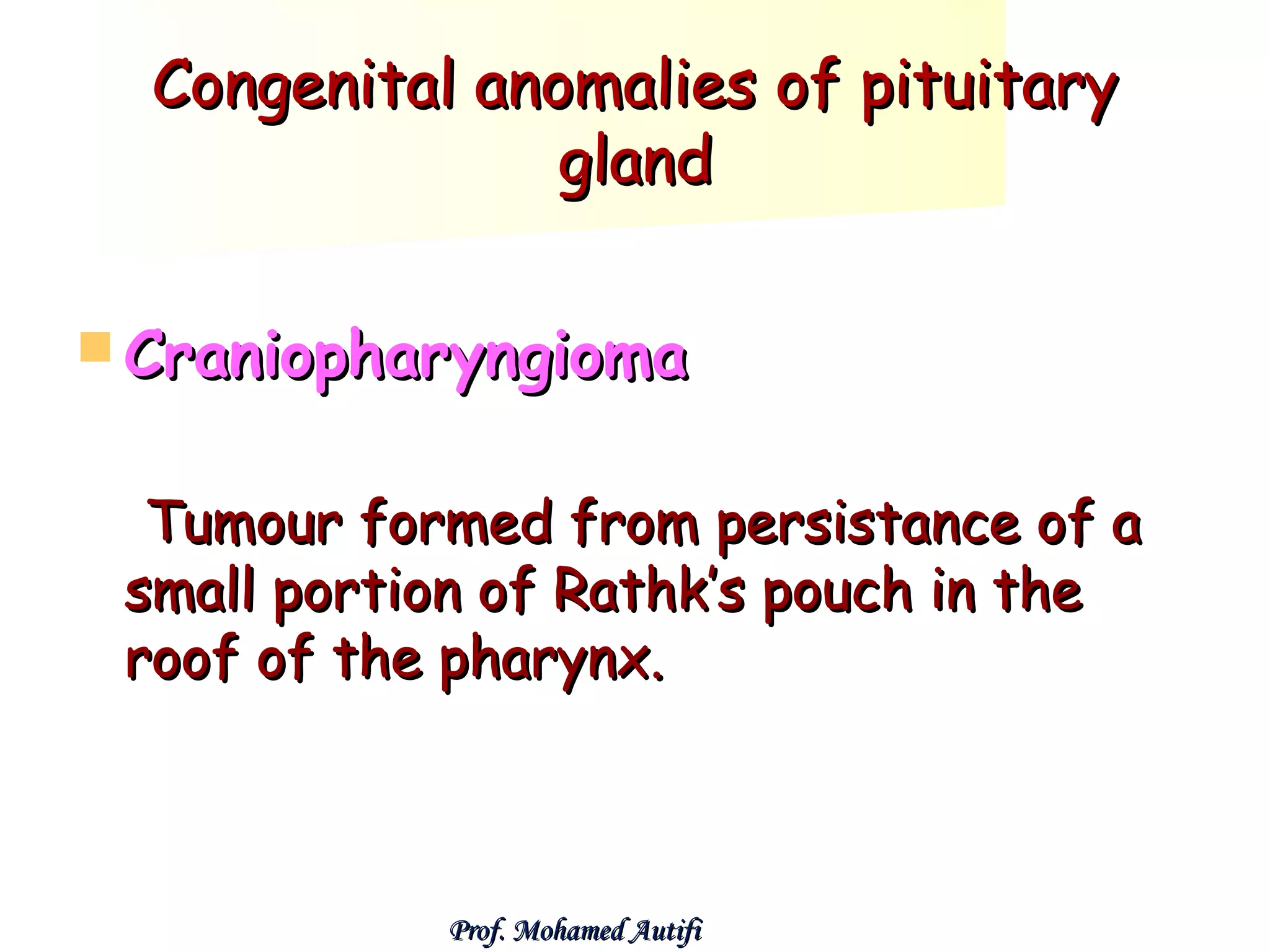
 Craniopharyngioma

Tumour formed from persistance of a
small portion of Rathk’s pouch in the
roof of the pharynx.

Prof. Mohamed Autifi
Thanks and best of luck

Prof. Mohamed Autifi

Development of the face, nose, palate

  • 1.
  • 2.
    Development of theface     The face develops from 5 mesenchymal prominences (swellings or processes) that appear in the 4th week. One Frontonasal prominence (formed by proliferation of mesenchyme and ectoderm ventral to the forebrain). Two maxillary swellings (from 1st pharyngeal arch). Two mandibular swellings (from 1st pharyngeal arch). Prof. Mohamed Autifi
  • 3.
    Development of theface  These 5 prominences surround the stomodeum (primitive mouth) , cranially , laterally and caudally. Prof. Mohamed Autifi
  • 4.
    Mouth: Primitive oral cavity:develops from: a)An ectodermal depression between frontonasal prominence and the first pharyngeal arch: the stomodeum. Its floor is closed by the buccopharyngeal membrane. b)An endormal part: is the cranial end of the pharynx. The buccal membrane degenerates during the 4 th week, i.e. the 2 parts continue together. Prof. Mohamed Autifi
  • 5.
    Lips & gingivae: Theydevelop as a linear ectodermal thickenings around the stomodeum  labiogingival laminae. They grow into mesenchyme, then degenerate forming labiogingival grooves separating lips from gingivae. A small area of laminae persists in median plane forming frenulum of the lip. Prof. Mohamed Autifi
  • 6.
    Salivary glands: Appear asepithelial buds from oral cavity. Parotid gland: The first to appear, early in 6th week, from oral ectoderm, near angle of stomodeum. It forms a tube, extends into cheek’s mesoderm. Its Proximal part forming the parotid duct; Its distal end breaks to form the glandular alveoli. Capsule & connective septae develop from surrounding mesoderm.  The duct opening is carried to open inside the cheek. Submandibular gland: Appear late in 6th week, from an endodermal bud in floor of stomodeum (alveolo- lingual groove). Develops in same way as parotid gland. Sublingual gland: appear in 8th week, from multiple endodermal buds in the alveolo-lingual groove. Prof. Mohamed Autifi
  • 7.
    I. Frontonasal process    Bilateralectodermal thickenings above the lateral angle of stomodeum form the nasal placodes. By the 5th weak, the nasal placodes are invaginated to form the nasal pits, thus the nasal placodes are divided into medial and lateral nasal folds (promeninces). The two medial nasal folds fuse to form median nasal fold. Prof. Mohamed Autifi
  • 8.
  • 9.
    Fate of thefrontonasal process The lateral nasal folds form the alae of the nose.  The nasal pits get deeper and they form the primitive nasal cavities.  The medain nasal fold forms: 1. Forehaed 2. Middle of the nose and nasal septum 3. Filtrum of the upper lip 4. Premaxilla  Prof. Mohamed Autifi
  • 10.
    II. Maxillary processes   Themaxillary process develops as mesodermal proliferation from the 1st pharyngeal arch. It grows ventrally and medially, compressing the medial nasal folds towards the middle line and converting them into one median nasal fold. Prof. Mohamed Autifi
  • 11.
    II. Maxillary processes   Themaxillary processes are separated from the lateral nasal folds by the nasolacrimal groove. The lower part of the groove will form the nasolacrimal duct while its upper part will form the lacrimal sac. Prof. Mohamed Autifi
  • 12.
    II. Maxillary processes A palatineshelf arises from the medial aspects of each maxillary process.  Both shelves are approximated towards each other and fuse together and with the premaxilla forming the hard and soft palate. Thus the nasal cavity becomes separated from the oral cavity. Prof. Mohamed Autifi
  • 13.
    Fate of maxillaryprocesses 1. Cheeks 2. Upper lip except the filtrum 3. Palate except the premaxilla Prof. Mohamed Autifi Frnotnasal process
  • 14.
    III. The mandibularprocesses  Develop from the mesenchyme of the 1st pharyngeal arch.  Fate : 1. Lower jaw 2. Lower lip 3. Floor of the mouth Prof. Mohamed Autifi
  • 15.
  • 16.
  • 17.
    In the 6thweek, the nasal pits deepen ➪ nasal sacs, grow dorsally, separated from oral cavity by oronasal membrane, which soon ruptures. Both cavities continue together via primitive choanae, dorsal to 1ry palate. Later, choanae lies bet nasal cavity & pharynx. Lateral wall develops 3 shelf-like projections: Superior, middle & inferior conchae Prof. Mohamed Autifi
  • 18.
    Development of Nasalcavity 28 day Prof. Mohamed Autifi
  • 19.
    Development of Nasalcavity 5 wk 6 wk Prof. Mohamed Autifi
  • 20.
    Development of Nasalcavity 7 wk 12 wk Prof. Mohamed Autifi
  • 21.
    In the roofof each cavity, the ectoderm shows thickened patch, olfactory epithelium, forming receptor cells, they are ciliated bipolar neurons. Their axons form the olfactory nerves. Paranasal air sinuses: -They develop after birth, except maxillary sinus which appears late in foetal life. -They develop as diverticula of lateral nasal walls, extend into their bones. -They reach mature size during puberty. Prof. Mohamed Autifi
  • 22.
  • 23.
    Medial growth ofthe two maxillary processes leading to fusion of the two medial nasal folds in midline ➪ intermaxillary segment ➪ philtrum of upper lip, 4 incisors & 1ry palate (premaxilla). Prof. Mohamed Autifi
  • 24.
    Early in 6thweek, Two medial outgrowths from maxillary processes called, palatine shelves, fuse along palatine raphe forming Secondary palate. It fuses with the 1ry palate at the incisive foramen ➪ definitive palate. Anterior part of definitive palate ➪ hard palate, while post part ➪ soft palate Prof. Mohamed Autifi
  • 25.
    Nasal septum develops fromfronto-nasal prominence & medial nasal folds; fuses with definitive palate. Prof. Mohamed Autifi
  • 26.
    Congenital anomalies 1. Anomaliesof the mouth :      Microstomia : small mouth opening Macrostomia : large mouth opening Agnathia : absence lower jaw Microstomia and single nostril Micrognathia : small lower jaw Anodontia : absence of the teeth 2. Anomalies of the nose :   Stenosis of nostrils Deviation of the nasal septum Prof. Mohamed Autifi Macrostomia
  • 27.
    3. Anomalies ofthe face and palate : 1.Fusion dermoid: Cystic swelling developed along line of fusion of face 2. Oblique facial cleft: Due to failure of fusion between maxillary & frontonasal processes (at nasolacrimal groove). May include cleft upper lip. Prof. Mohamed Autifi
  • 28.
    3. Cleft upperlip (harelip): Unilateral or bilateral. The former is most common anomaly of head & neck (1:1000). Due to failure of fusion of maxillary process with medial nasal fold. 4. Cleft lower lip: Usually central 5. Cleft uvula Median cleft of the lower lip Prof. Mohamed A. Autifi
  • 29.
    6. Cleft palate:(1:2500 births) a) Anteriorly: Anterior to incisive Foramen, includes lateral cleft lip, cleft upper jaw & cleft between 1ry & 2ry palates, unilateral (C), bilateral (D) b) Posteriorly: Behind incisive F, includes cleft of 2ry palate & cleft uvula (E) c) Antero-posteriorly: Combination, oblique/median (F) Prof. Mohamed Autifi
  • 30.
  • 31.
    Unilateral cleft lip andpalate Prof. Mohamed Autifi
  • 32.
  • 33.
    Bilateral cleft lip andpalate Prof. Mohamed Autifi
  • 34.
    Unilateral cleft lip andpalate Bilateral cleft lip and palate Prof. Mohamed Autifi
  • 35.
  • 36.
  • 37.
    Development of thepituitary gland The pituitary gland is derived from 2 ectodermal sources:  Anterior Lobe : develops from the ectoderm of the roof of stomodeum ( Rathke’s pouch ).  Posterior Lobe: develops from the floor of the diencephalon ( Infundibulum ).  Prof. Mohamed Autifi
  • 38.
    Development of pituitarygland Prof. Mohamed Autifi
  • 39.
    Development of pituitarygland Prof. Mohamed Autifi
  • 40.
    Development of pituitarygland Prof. Mohamed Autifi
  • 41.
    Development of pituitarygland Prof. Mohamed Autifi
  • 42.
    Congenital anomalies ofpituitary gland  Craniopharyngioma Tumour formed from persistance of a small portion of Rathk’s pouch in the roof of the pharynx. Prof. Mohamed Autifi
  • 43.
    Thanks and bestof luck Prof. Mohamed Autifi