Guided by :
Dr S. Prakasam      Presented by
Dr K.C. Ponnappa   Dr.Supratim tripathi
Development of face


We are the lucky ones amongst the millions of
those who could not make it.
Contents
• Introduction

• Theories of development

• Pharyngeal arches , pouches, grooves , clefts.

• Development of face

• Clinical aspects

• Conclusion

• References
Introduction
•   The embryonic period extends from the
    beginning of the fourth week till the end of the
    eighth week.

•   The trilaminar embryonic area differentiates as
    follows:

1] ectoderm providing protection,
2] endoderm providing nutrition ,
3] mesoderm forming skeletal tissue ,muscle and
    blood vascular system

•   The fourth week is characterized by the
    differentiation of the three germ layers and the
    folding of the embryo

•   In the second month the organs and tissues are
    laid down and the embryo has a distinct human
    appearance
Phases of development
1)Growth-this is the increase in the size by cell division


2)Morphogenesis-this is the development of form


3)Differentiation-includes the maturation of physiological processes

 Folding of the embryo:-
  The trilaminar germ disc is flattened and pear-shaped .The cells in
  the central part grow more rapidly than those at the
  periphery.Because of the lack of space ,the embryo undergoes head
  fold ,tail fold and lateral folds by the end of the third week .This
  converts the flattened germ disc into a cylindrical embryo.
Theories of development
•   The growth is strongly influenced by the genetic factors ,but it also can be
    significantly affected by the environment in the form of nutritional status, degree
    of physiological activity ,health or illness and a number of similar factors.

•   Three main theories in the recent years have attempted to explain the
    determinants of craniofacial growth:

(1)Bone ,like other tissues ,is the primary determinant of its own growth,

(2)Cartilage is the primary determinant of skeletal growth , while the bone responds
    secondarily and passively

(3)The soft tissue matrix in which the skeletal elements are embedded as the primary
    determinant of growth
Functional matrix theory of growth

• This theory was given by MOSS , in 1960.

• He theorizes that growth of the face occurs as the response to functional
  needs and neurotrophic influences and is mediated by the soft tissue in
  which the jaws are embedded.

• In this view the soft tissues grows and the bone and cartilage react.

• This phenomenon can be seen readily in humans in three experiments of
   nature:
a)Microcephaly ,

b)Hydrocephaly,

c)Size of the orbit.
Development of face
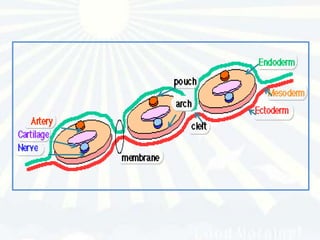
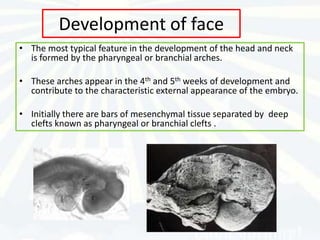
• The most typical feature in the development of the head and neck
  is formed by the pharyngeal or branchial arches.

• These arches appear in the 4th and 5th weeks of development and
  contribute to the characteristic external appearance of the embryo.

• Initially there are bars of mesenchymal tissue separated by deep
  clefts known as pharyngeal or branchial clefts .
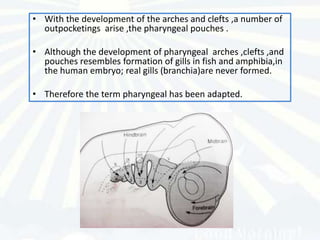
• With the development of the arches and clefts ,a number of
  outpocketings arise ,the pharyngeal pouches .

• Although the development of pharyngeal arches ,clefts ,and
  pouches resembles formation of gills in fish and amphibia,in
  the human embryo; real gills (branchia)are never formed.

• Therefore the term pharyngeal has been adapted.
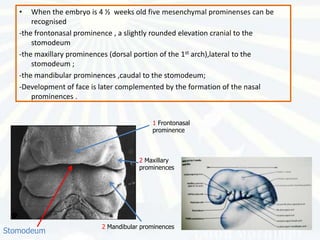
•   When the embryo is 4 ½ weeks old five mesenchymal prominenses can be
       recognised
   -the frontonasal prominence , a slightly rounded elevation cranial to the
       stomodeum
   -the maxillary prominences (dorsal portion of the 1st arch),lateral to the
       stomodeum ;
   -the mandibular prominences ,caudal to the stomodeum;
   -Development of face is later complemented by the formation of the nasal
       prominences .


                                           1 Frontonasal
                                           prominence


                                       2 Maxillary
                                       prominences


                           2 Mandibular prominences
Stomodeum
Pharyngeal arches
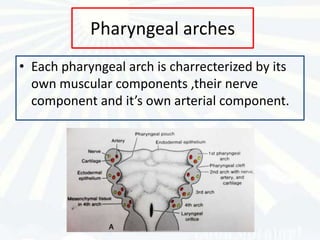
• Each pharyngeal arch is charrecterized by its
  own muscular components ,their nerve
  component and it’s own arterial component.
First pharyngeal arch
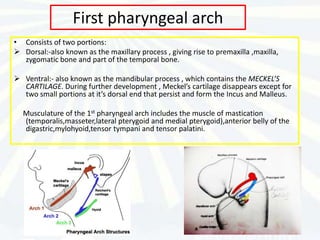
• Consists of two portions:
 Dorsal:-also known as the maxillary process , giving rise to premaxilla ,maxilla,
  zygomatic bone and part of the temporal bone.

 Ventral:- also known as the mandibular process , which contains the MECKEL’S
  CARTILAGE. During further development , Meckel’s cartilage disappears except for
  two small portions at it’s dorsal end that persist and form the Incus and Malleus.

  Musculature of the 1st pharyngeal arch includes the muscle of mastication
  (temporalis,masseter,lateral pterygoid and medial pterygoid),anterior belly of the
  digastric,mylohyoid,tensor tympani and tensor palatini.
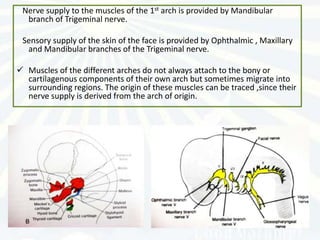
Nerve supply to the muscles of the 1st arch is provided by Mandibular
  branch of Trigeminal nerve.

 Sensory supply of the skin of the face is provided by Ophthalmic , Maxillary
  and Mandibular branches of the Trigeminal nerve.

 Muscles of the different arches do not always attach to the bony or
  cartilagenous components of their own arch but sometimes migrate into
  surrounding regions. The origin of these muscles can be traced ,since their
  nerve supply is derived from the arch of origin.
Second pharyngeal arch
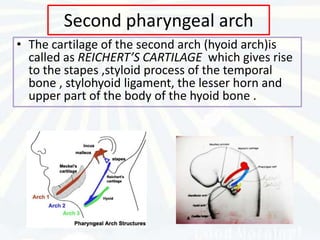
• The cartilage of the second arch (hyoid arch)is
  called as REICHERT’S CARTILAGE which gives rise
  to the stapes ,styloid process of the temporal
  bone , stylohyoid ligament, the lesser horn and
  upper part of the body of the hyoid bone .
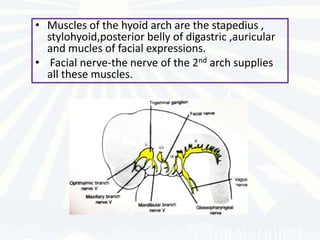
• Muscles of the hyoid arch are the stapedius ,
  stylohyoid,posterior belly of digastric ,auricular
  and mucles of facial expressions.
• Facial nerve-the nerve of the 2nd arch supplies
  all these muscles.
Third pharyngeal arch
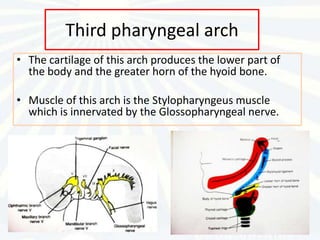
• The cartilage of this arch produces the lower part of
  the body and the greater horn of the hyoid bone.

• Muscle of this arch is the Stylopharyngeus muscle
  which is innervated by the Glossopharyngeal nerve.
Fourth and Sixth pharyngeal arches
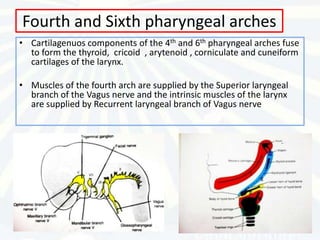
• Cartilagenuos components of the 4th and 6th pharyngeal arches fuse
  to form the thyroid, cricoid , arytenoid , corniculate and cuneiform
  cartilages of the larynx.

• Muscles of the fourth arch are supplied by the Superior laryngeal
  branch of the Vagus nerve and the intrinsic muscles of the larynx
  are supplied by Recurrent laryngeal branch of Vagus nerve
Pharyngeal pouches
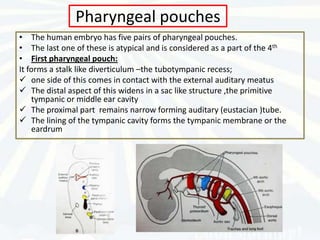
• The human embryo has five pairs of pharyngeal pouches.
• The last one of these is atypical and is considered as a part of the 4th
• First pharyngeal pouch:
It forms a stalk like diverticulum –the tubotympanic recess;
 one side of this comes in contact with the external auditary meatus
 The distal aspect of this widens in a sac like structure ,the primitive
    tympanic or middle ear cavity
 The proximal part remains narrow forming auditary (eustacian )tube.
 The lining of the tympanic cavity forms the tympanic membrane or the
    eardrum
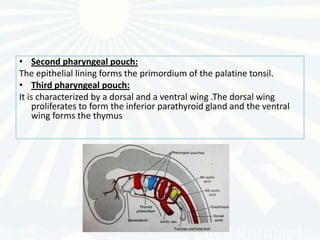
• Second pharyngeal pouch:
The epithelial lining forms the primordium of the palatine tonsil.
• Third pharyngeal pouch:
It is characterized by a dorsal and a ventral wing .The dorsal wing
    proliferates to form the inferior parathyroid gland and the ventral
    wing forms the thymus
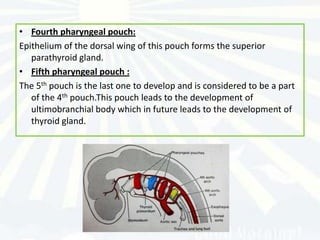
• Fourth pharyngeal pouch:
Epithelium of the dorsal wing of this pouch forms the superior
   parathyroid gland.
• Fifth pharyngeal pouch :
The 5th pouch is the last one to develop and is considered to be a part
   of the 4th pouch.This pouch leads to the development of
   ultimobranchial body which in future leads to the development of
   thyroid gland.
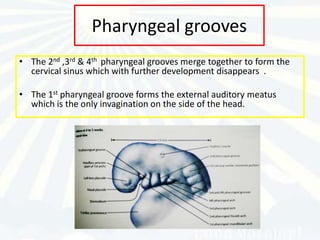
Pharyngeal grooves
• The 2nd ,3rd & 4th pharyngeal grooves merge together to form the
  cervical sinus which with further development disappears .

• The 1st pharyngeal groove forms the external auditory meatus
  which is the only invagination on the side of the head.
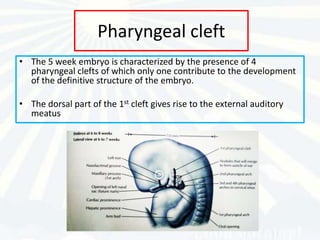
Pharyngeal cleft
• The 5 week embryo is characterized by the presence of 4
  pharyngeal clefts of which only one contribute to the development
  of the definitive structure of the embryo.

• The dorsal part of the 1st cleft gives rise to the external auditory
  meatus
Clinical correlates
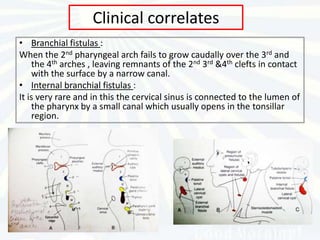
• Branchial fistulas :
When the 2nd pharyngeal arch fails to grow caudally over the 3rd and
    the 4th arches , leaving remnants of the 2nd 3rd &4th clefts in contact
    with the surface by a narrow canal.
• Internal branchial fistulas :
It is very rare and in this the cervical sinus is connected to the lumen of
    the pharynx by a small canal which usually opens in the tonsillar
    region.
Development of face
•   DEVELOPMENT OF MAXILLA
•   DEVELOPMENT OF MANDIBLE
•   DEVELOPMENT OF NOSE
•   DEVELOPMENT OF PALATE
•   DEVELOPMENT OF EAR
•   DEVELOPMENTOF EYE
•   DEVELOPMENT OF LIP
•   DEVELOPMENTOF TONGUE
Derivatives of Facial Components

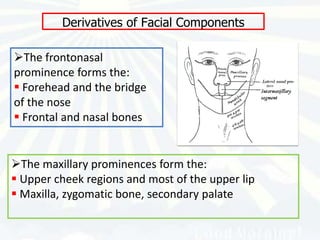
The frontonasal
prominence forms the:
 Forehead and the bridge
of the nose
 Frontal and nasal bones


The maxillary prominences form the:
 Upper cheek regions and most of the upper lip
 Maxilla, zygomatic bone, secondary palate
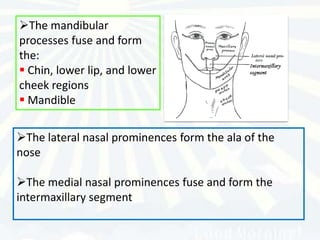
The mandibular
processes fuse and form
the:
 Chin, lower lip, and lower
cheek regions
 Mandible


The lateral nasal prominences form the ala of the
nose

The medial nasal prominences fuse and form the
intermaxillary segment
Chronological development of
         different parts of the head
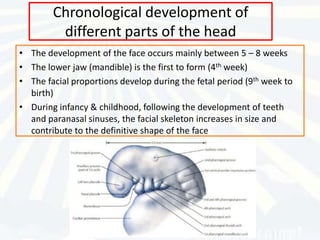
• The development of the face occurs mainly between 5 – 8 weeks
• The lower jaw (mandible) is the first to form (4th week)
• The facial proportions develop during the fetal period (9th week to
  birth)
• During infancy & childhood, following the development of teeth
  and paranasal sinuses, the facial skeleton increases in size and
  contribute to the definitive shape of the face
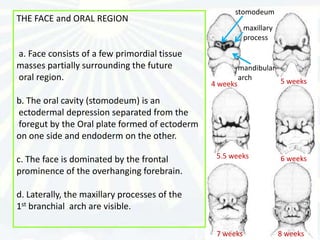
stomodeum
THE FACE and ORAL REGION
                                                          maxillary
                                                          process

a. Face consists of a few primordial tissue
masses partially surrounding the future                mandibular
oral region.                                           arch       5 weeks
                                               4 weeks

b. The oral cavity (stomodeum) is an
ectodermal depression separated from the
foregut by the Oral plate formed of ectoderm
on one side and endoderm on the other.

c. The face is dominated by the frontal         5.5 weeks             6 weeks
prominence of the overhanging forebrain.

d. Laterally, the maxillary processes of the
1st branchial arch are visible.

                                                7 weeks               8 weeks
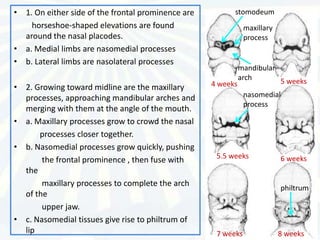
• 1. On either side of the frontal prominence are         stomodeum
    horseshoe-shaped elevations are found                      maxillary
  around the nasal placodes.                                   process
• a. Medial limbs are nasomedial processes
• b. Lateral limbs are nasolateral processes
                                                            mandibular
                                                            arch       5 weeks
• 2. Growing toward midline are the maxillary       4 weeks
  processes, approaching mandibular arches and                 nasomedial
                                                               process
  merging with them at the angle of the mouth.
• a. Maxillary processes grow to crowd the nasal
      processes closer together.
• b. Nasomedial processes grow quickly, pushing
                                                     5.5 weeks             6 weeks
       the frontal prominence , then fuse with
  the
       maxillary processes to complete the arch
                                                                           philtrum
  of the
       upper jaw.
• c. Nasomedial tissues give rise to philtrum of
  lip                                                7 weeks               8 weeks
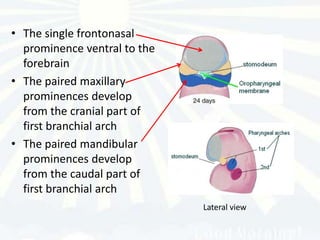
• The single frontonasal
  prominence ventral to the
  forebrain
• The paired maxillary
  prominences develop
  from the cranial part of
  first branchial arch
• The paired mandibular
  prominences develop
  from the caudal part of
  first branchial arch
                              Lateral view
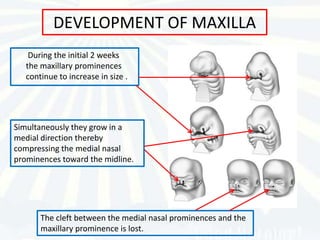
DEVELOPMENT OF MAXILLA
    During the initial 2 weeks
   the maxillary prominences
   continue to increase in size .


Simultaneously they grow in a
medial direction thereby
compressing the medial nasal
prominences toward the midline.


       The cleft between the medial nasal prominences and the
       maxillary prominence is lost.
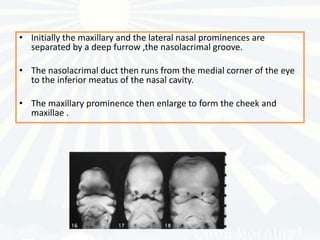
• Initially the maxillary and the lateral nasal prominences are
  separated by a deep furrow ,the nasolacrimal groove.

• The nasolacrimal duct then runs from the medial corner of the eye
  to the inferior meatus of the nasal cavity.

• The maxillary prominence then enlarge to form the cheek and
  maxillae .
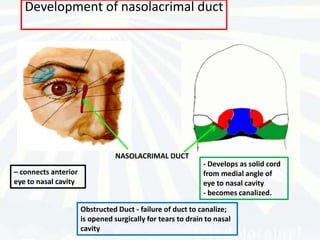
Development of nasolacrimal duct


                                 NASOLACRIMAL DUCT
                                                             - Develops as solid cord
– connects anterior                                          from medial angle of
eye to nasal cavity                                          eye to nasal cavity
                                                             - becomes canalized.

                      Obstructed Duct - failure of duct to canalize;
                      is opened surgically for tears to drain to nasal
                      cavity
DEVELOPMENT OF MANDIBLE

• “The Human Mandible Has No One Design For Life . Rather It
  Remodels Through The Stages Of Life ,From The Slim Arbiter
  Of Things To Come In The Infants ,Through The Powerful
  Dentate Machine And Even Weapon In The Full Flesh Of
  Maturity ,To The Pencil-thin Parcelain Like Problem That We
  Struggle To Repair In The Adversity Of Old Age.”
                            - E Poswillo,1988
• The first structure to develop in the region of the lower jaw is the mandibular
division of the trigeminal nerve.

• The prior presence of the nerve has been postulated as requisite for inducing
osteogenesis by the production of neurotropic hormones.

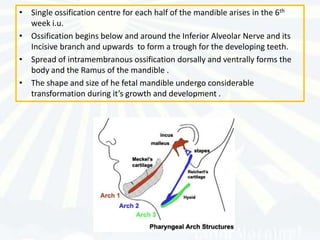
• MECKEL’S CARTILAGE ,of the first branchial arch is responsible for the formation of
mandible.
• Single ossification centre for each half of the mandible arises in the 6th
  week i.u.
• Ossification begins below and around the Inferior Alveolar Nerve and its
  Incisive branch and upwards to form a trough for the developing teeth.
• Spread of intramembranous ossification dorsally and ventrally forms the
  body and the Ramus of the mandible .
• The shape and size of he fetal mandible undergo considerable
  transformation during it’s growth and development .
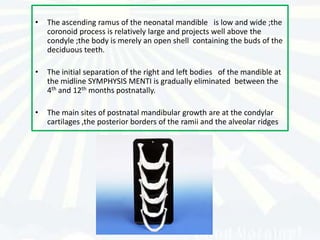
•   The ascending ramus of the neonatal mandible is low and wide ;the
    coronoid process is relatively large and projects well above the
    condyle ;the body is merely an open shell containing the buds of the
    deciduous teeth.

•   The initial separation of the right and left bodies of the mandible at
    the midline SYMPHYSIS MENTI is gradually eliminated between the
    4th and 12th months postnatally.

•   The main sites of postnatal mandibular growth are at the condylar
    cartilages ,the posterior borders of the ramii and the alveolar ridges
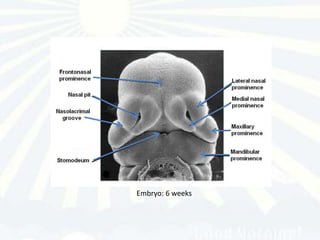
Development of nose
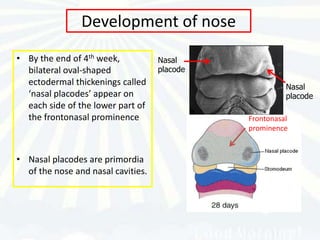
• By the end of 4th week,           Nasal
  bilateral oval-shaped             placode
  ectodermal thickenings called                         Nasal
  ‘nasal placodes’ appear on                            placode
  each side of the lower part of
  the frontonasal prominence                  Frontonasal
                                              prominence


• Nasal placodes are primordia
  of the nose and nasal cavities.
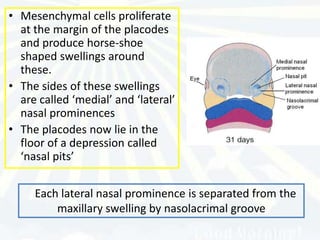
• Mesenchymal cells proliferate
  at the margin of the placodes
  and produce horse-shoe
  shaped swellings around
  these.
• The sides of these swellings
  are called ‘medial’ and ‘lateral’
  nasal prominences
• The placodes now lie in the
  floor of a depression called
  ‘nasal pits’

     Each lateral nasal prominence is separated from the
         maxillary swelling by nasolacrimal groove
Embryo: 6 weeks
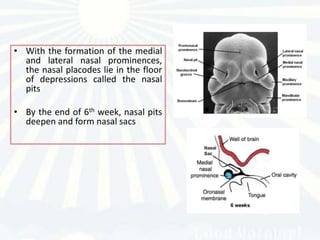
• With the formation of the medial
  and lateral nasal prominences,
  the nasal placodes lie in the floor
  of depressions called the nasal
  pits

• By the end of 6th week, nasal pits
  deepen and form nasal sacs
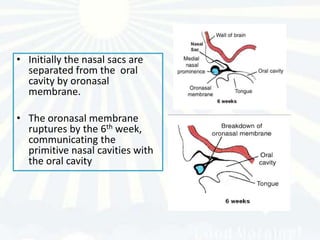
• Initially the nasal sacs are
  separated from the oral
  cavity by oronasal
  membrane.

• The oronasal membrane
  ruptures by the 6th week,
  communicating the
  primitive nasal cavities with
  the oral cavity
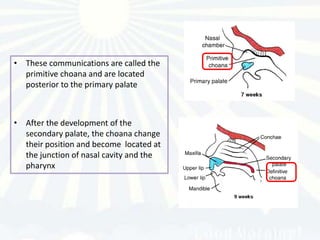
• These communications are called the
  primitive choana and are located
  posterior to the primary palate


• After the development of the
  secondary palate, the choana change
  their position and become located at
  the junction of nasal cavity and the
  pharynx
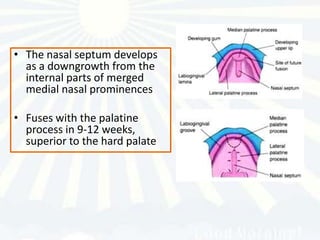
• The nasal septum develops
  as a downgrowth from the
  internal parts of merged
  medial nasal prominences

• Fuses with the palatine
  process in 9-12 weeks,
  superior to the hard palate
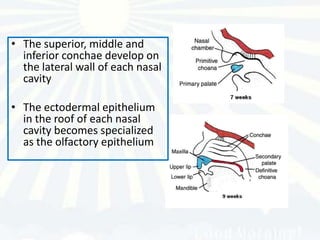
• The superior, middle and
  inferior conchae develop on
  the lateral wall of each nasal
  cavity

• The ectodermal epithelium
  in the roof of each nasal
  cavity becomes specialized
  as the olfactory epithelium
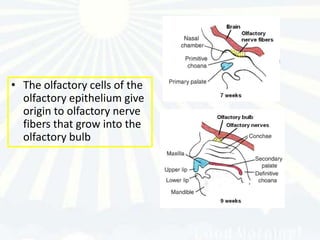
• The olfactory cells of the
  olfactory epithelium give
  origin to olfactory nerve
  fibers that grow into the
  olfactory bulb
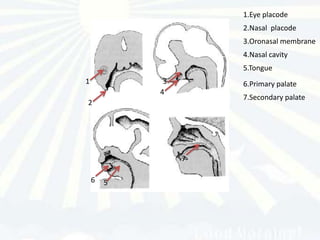
1.Eye placode
                     2.Nasal placode
                     3.Oronasal membrane
                     4.Nasal cavity
                     5.Tongue
1            3       6.Primary palate
            4
                     7.Secondary palate
2


                 7

    6   5
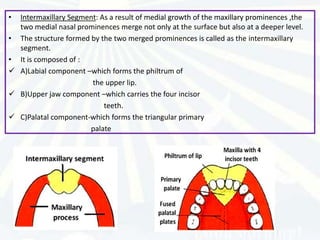
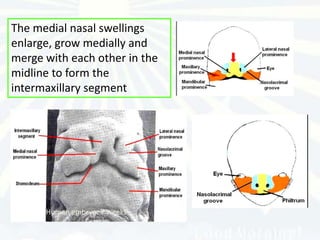
• Intermaxillary Segment: As a result of medial growth of the maxillary prominences ,the
  two medial nasal prominences merge not only at the surface but also at a deeper level.
• The structure formed by the two merged prominences is called as the intermaxillary
  segment.
• It is composed of :
 A)Labial component –which forms the philtrum of
                       the upper lip.
 B)Upper jaw component –which carries the four incisor
                           teeth.
 C)Palatal component-which forms the triangular primary
                       palate
The medial nasal swellings
enlarge, grow medially and
merge with each other in the
midline to form the
intermaxillary segment


      Human embryo: 7 weeks
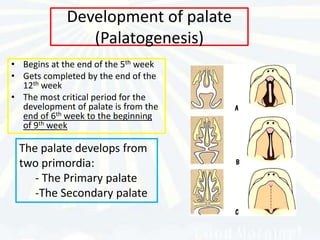
Development of palate
                (Palatogenesis)
• Begins at the end of the 5th week
• Gets completed by the end of the
  12th week
• The most critical period for the
  development of palate is from the
  end of 6th week to the beginning
  of 9th week

 The palate develops from
 two primordia:
    - The Primary palate
    -The Secondary palate
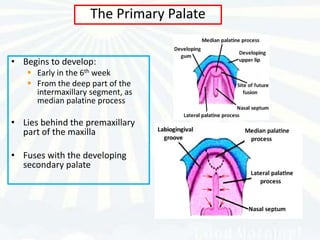
The Primary Palate


• Begins to develop:
    Early in the 6th week
    From the deep part of the
     intermaxillary segment, as
     median palatine process

• Lies behind the premaxillary
  part of the maxilla

• Fuses with the developing
  secondary palate
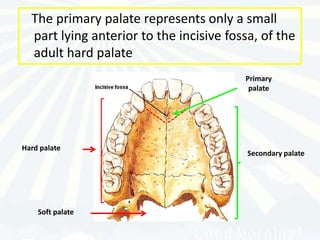
The primary palate represents only a small
  part lying anterior to the incisive fossa, of the
  adult hard palate
                                         Primary
                                          palate


Hard palate
                                          Secondary palate


    Soft palate
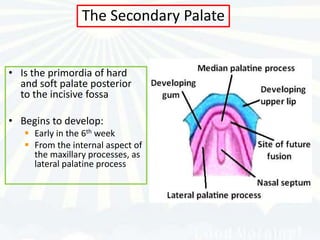
The Secondary Palate


• Is the primordia of hard
  and soft palate posterior
  to the incisive fossa

• Begins to develop:
    Early in the 6th week
    From the internal aspect of
     the maxillary processes, as
     lateral palatine process
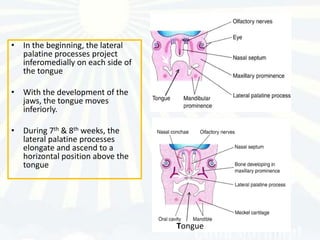
• In the beginning, the lateral
  palatine processes project
  inferomedially on each side of
  the tongue

• With the development of the
  jaws, the tongue moves
  inferiorly.

• During 7th & 8th weeks, the
  lateral palatine processes
  elongate and ascend to a
  horizontal position above the
  tongue


                                   Tongue
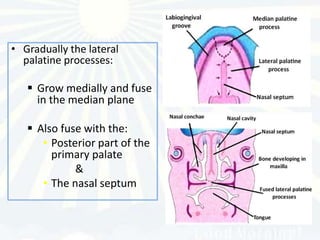
• Gradually the lateral
  palatine processes:

    Grow medially and fuse
     in the median plane

    Also fuse with the:
      • Posterior part of the
        primary palate
             &
      • The nasal septum
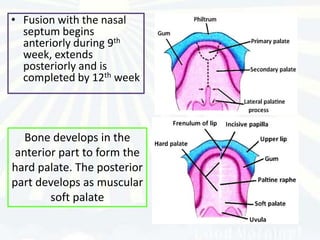
• Fusion with the nasal
  septum begins
  anteriorly during 9th
  week, extends
  posteriorly and is
  completed by 12th week


   Bone develops in the
 anterior part to form the
hard palate. The posterior
part develops as muscular
        soft palate
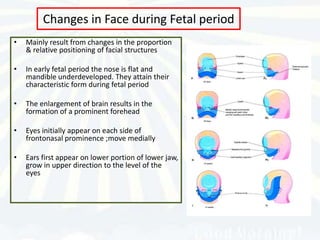
Changes in Face during Fetal period
•   Mainly result from changes in the proportion
    & relative positioning of facial structures

•   In early fetal period the nose is flat and
    mandible underdeveloped. They attain their
    characteristic form during fetal period

•   The enlargement of brain results in the
    formation of a prominent forehead

•   Eyes initially appear on each side of
    frontonasal prominence ;move medially

•   Ears first appear on lower portion of lower jaw,
    grow in upper direction to the level of the
    eyes
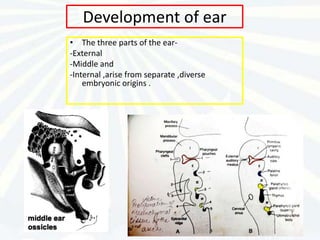
Development of ear
• The three parts of the ear-
-External
-Middle and
-Internal ,arise from separate ,diverse
    embryonic origins .
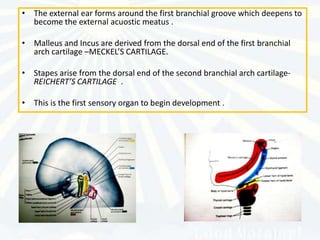
• The external ear forms around the first branchial groove which deepens to
  become the external acuostic meatus .

• Malleus and Incus are derived from the dorsal end of the first branchial
  arch cartilage –MECKEL’S CARTILAGE.

• Stapes arise from the dorsal end of the second branchial arch cartilage-
  REICHERT’S CARTILAGE .

• This is the first sensory organ to begin development .
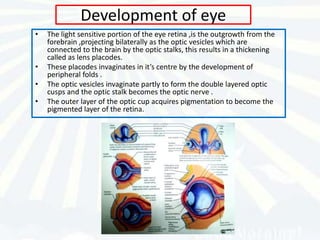
Development of eye
•   The light sensitive portion of the eye retina ,is the outgrowth from the
    forebrain ,projecting bilaterally as the optic vesicles which are
    connected to the brain by the optic stalks, this results in a thickening
    called as lens placodes.
•   These placodes invaginates in it’s centre by the development of
    peripheral folds .
•   The optic vesicles invaginate partly to form the double layered optic
    cusps and the optic stalk becomes the optic nerve .
•   The outer layer of the optic cup acquires pigmentation to become the
    pigmented layer of the retina.
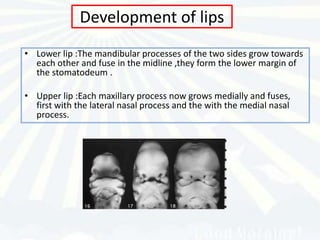
Development of lips
• Lower lip :The mandibular processes of the two sides grow towards
  each other and fuse in the midline ,they form the lower margin of
  the stomatodeum .

• Upper lip :Each maxillary process now grows medially and fuses,
  first with the lateral nasal process and the with the medial nasal
  process.
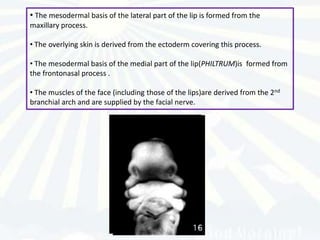
• The mesodermal basis of the lateral part of the lip is formed from the
maxillary process.

• The overlying skin is derived from the ectoderm covering this process.

• The mesodermal basis of the medial part of the lip(PHILTRUM)is formed from
the frontonasal process .

• The muscles of the face (including those of the lips)are derived from the 2nd
branchial arch and are supplied by the facial nerve.
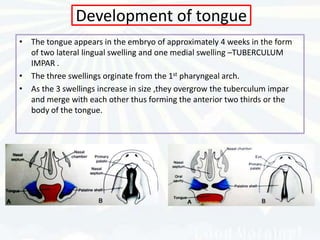
Development of tongue
• The tongue appears in the embryo of approximately 4 weeks in the form
  of two lateral lingual swelling and one medial swelling –TUBERCULUM
  IMPAR .
• The three swellings orginate from the 1st pharyngeal arch.
• As the 3 swellings increase in size ,they overgrow the tuberculum impar
  and merge with each other thus forming the anterior two thirds or the
  body of the tongue.
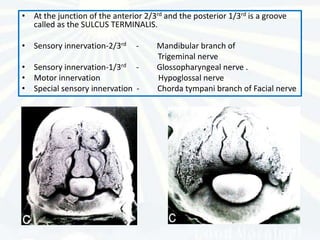
• At the junction of the anterior 2/3rd and the posterior 1/3rd is a groove
  called as the SULCUS TERMINALIS.

• Sensory innervation-2/3rd     -     Mandibular branch of
                                      Trigeminal nerve
• Sensory innervation-1/3rd -         Glossopharyngeal nerve .
• Motor innervation                   Hypoglossal nerve
• Special sensory innervation -       Chorda tympani branch of Facial nerve
•CLINICAL ASPECTS
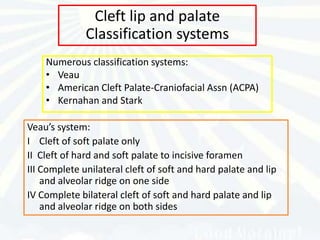
Cleft lip and palate
              Classification systems
    Numerous classification systems:
    • Veau
    • American Cleft Palate-Craniofacial Assn (ACPA)
    • Kernahan and Stark

Veau’s system:
I Cleft of soft palate only
II Cleft of hard and soft palate to incisive foramen
III Complete unilateral cleft of soft and hard palate and lip
    and alveolar ridge on one side
IV Complete bilateral cleft of soft and hard palate and lip
    and alveolar ridge on both sides
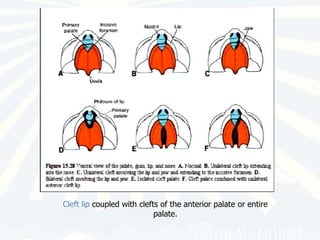
Cleft lip coupled with clefts of the anterior palate or entire
                            palate.
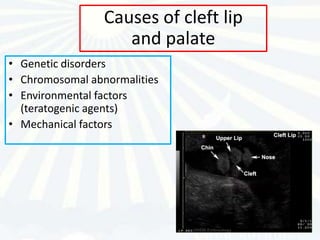
Causes of cleft lip
                    and palate
• Genetic disorders
• Chromosomal abnormalities
• Environmental factors
  (teratogenic agents)
• Mechanical factors
Chromosomal abnormalities
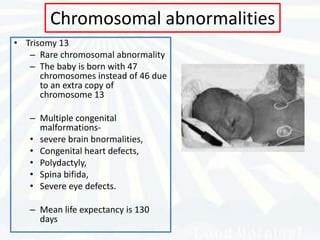
• Trisomy 13
   – Rare chromosomal abnormality
   – The baby is born with 47
      chromosomes instead of 46 due
      to an extra copy of
      chromosome 13

   – Multiple congenital
     malformations-
   • severe brain bnormalities,
   • Congenital heart defects,
   • Polydactyly,
   • Spina bifida,
   • Severe eye defects.

   – Mean life expectancy is 130
     days
Environmental factors


• Recognized teratogenic agent:
  – Alcohol overdose
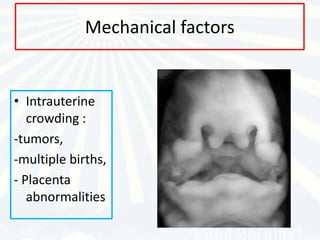
Mechanical factors


• Intrauterine
   crowding :
-tumors,
-multiple births,
- Placenta
   abnormalities
Incidence of cleft lip and palate
• 1:750 live births

• Clefts of lip is more frequent and is more
  severe in males

• Clefts of palate is more frequent in females
Facial clefting. A, Absence of the intermaxillary segment with hypotelorism. The maxillary
processes form the normal lateral thirds of the upper lips. The midline rectangular defect indicates the site of the
deficient intermaxillary segment with absent prolabium, incisors, and primary palate. There was consequent clefting
of the secondary palate. Absent intermaxillary segment with hypotelorism signifies a high likelihood of
holoprosencephaly. B, True midline cleft of the upper lip and philtrum with hypertelorism. The nose is normal. A
7-month-old girl with transethmoidal cephalocele and left optic nerve dysplasia (morning glory syndrome). True
midline cleft lip signifies the high likelikhood of midline craniofaciocerebral and optic dysraphysm. C and D,
Midline cleft lip is also found in association with Mohr syndrome (orofacial digital syndrome II [OFD II]). The
presence of reduplicated great toes bilaterally helps to identify OFD II and to distinguish it from OFD I.
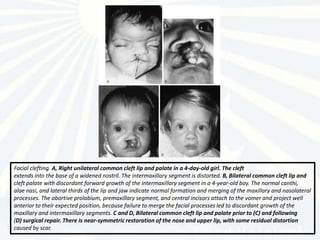
Facial clefting. A, Right unilateral common cleft lip and palate in a 4-day-old girl. The cleft
extends into the base of a widened nostril. The intermaxillary segment is distorted. B, Bilateral common cleft lip and
cleft palate with discordant forward growth of the intermaxillary segment in a 4-year-old boy. The normal canthi,
alae nasi, and lateral thirds of the lip and jaw indicate normal formation and merging of the maxillary and nasolateral
processes. The abortive prolabium, premaxillary segment, and central incisors attach to the vomer and project well
anterior to their expected position, because failure to merge the facial processes led to discordant growth of the
maxillary and intermaxillary segments. C and D, Bilateral common cleft lip and palate prior to (C) and following
(D) surgical repair. There is near-symmetric restoration of the nose and upper lip, with some residual distortion
caused by scar.
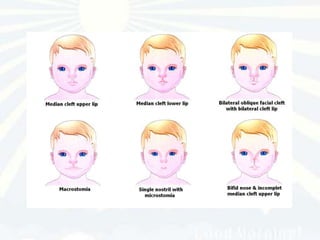
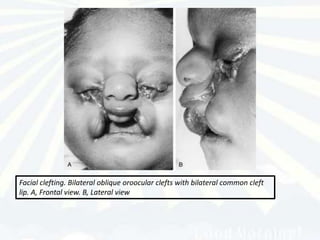
Facial clefting. Bilateral oblique oroocular clefts with bilateral common cleft
lip. A, Frontal view. B, Lateral view
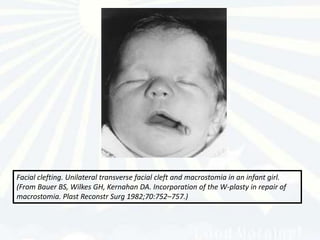
Facial clefting. Unilateral transverse facial cleft and macrostomia in an infant girl.
(From Bauer BS, Wilkes GH, Kernahan DA. Incorporation of the W-plasty in repair of
macrostomia. Plast Reconstr Surg 1982;70:752–757.)
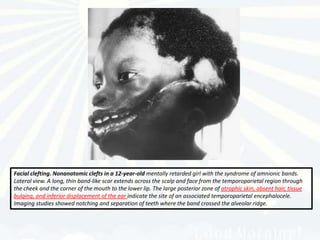
Facial clefting. Nonanatomic clefts in a 12-year-old mentally retarded girl with the syndrome of amnionic bands.
Lateral view. A long, thin band-like scar extends across the scalp and face from the temporoparietal region through
the cheek and the corner of the mouth to the lower lip. The large posterior zone of atrophic skin, absent hair, tissue
bulging, and inferior displacement of the ear indicate the site of an associated temporoparietal encephalocele.
Imaging studies showed notching and separation of teeth where the band crossed the alveolar ridge.
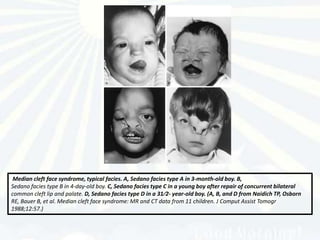
Median cleft face syndrome, typical facies. A, Sedano facies type A in 3-month-old boy. B,
Sedano facies type B in 4-day-old boy. C, Sedano facies type C in a young boy after repair of concurrent bilateral
common cleft lip and palate. D, Sedano facies type D in a 31⁄2- year-old boy. (A, B, and D from Naidich TP, Osborn
RE, Bauer B, et al. Median cleft face syndrome: MR and CT data from 11 children. J Comput Assist Tomogr
1988;12:57.)
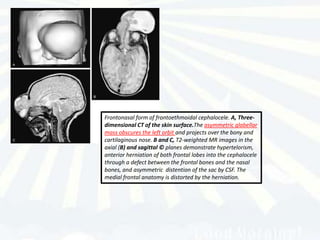
Frontonasal form of frontoethmoidal cephalocele. A, Three-
dimensional CT of the skin surface.The asymmetric glabellar
mass obscures the left orbit and projects over the bony and
cartilaginous nose. B and C, T2-weighted MR images in the
axial (B) and sagittal © planes demonstrate hypertelorism,
anterior herniation of both frontal lobes into the cephalocele
through a defect between the frontal bones and the nasal
bones, and asymmetric distention of the sac by CSF. The
medial frontal anatomy is distorted by the herniation.
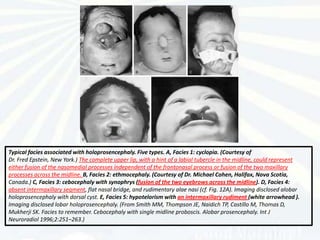
Typical facies associated with holoprosencephaly. Five types. A, Facies 1: cyclopia. (Courtesy of
Dr. Fred Epstein, New York.) The complete upper lip, with a hint of a labial tubercle in the midline, could represent
either fusion of the nasomedial processes independent of the frontonasal process or fusion of the two maxillary
processes across the midline. B, Facies 2: ethmocephaly. (Courtesy of Dr. Michael Cohen, Halifax, Nova Scotia,
Canada.) C, Facies 3: cebocephaly with synophrys (fusion of the two eyebrows across the midline). D, Facies 4:
absent intermaxillary segment, flat nasal bridge, and rudimentary alae nasi (cf. Fig. 12A). Imaging disclosed alobar
holoprosencephaly with dorsal cyst. E, Facies 5: hypotelorism with an intermaxillary rudiment (white arrowhead ).
Imaging disclosed lobar holoprosencephaly. (From Smith MM, Thompson JE, Naidich TP, Castillo M, Thomas D,
Mukherji SK. Facies to remember. Cebocephaly with single midline proboscis. Alobar prosencephaly. Int J
Neuroradiol 1996;2:251–263.)
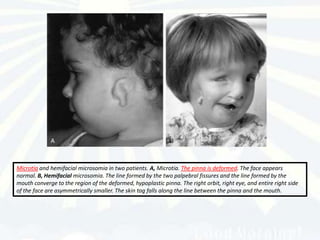
Microtia and hemifacial microsomia in two patients. A, Microtia. The pinna is deformed. The face appears
normal. B, Hemifacial microsomia. The line formed by the two palpebral fissures and the line formed by the
mouth converge to the region of the deformed, hypoplastic pinna. The right orbit, right eye, and entire right side
of the face are asymmetrically smaller. The skin tag falls along the line between the pinna and the mouth.
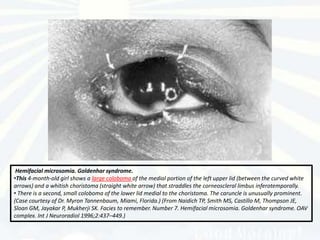
Hemifacial microsomia. Goldenhar syndrome.
•This 4-month-old girl shows a large coloboma of the medial portion of the left upper lid (between the curved white
arrows) and a whitish choristoma (straight white arrow) that straddles the corneoscleral limbus inferotemporally.
• There is a second, small coloboma of the lower lid medial to the choristoma. The caruncle is unusually prominent.
(Case courtesy of Dr. Myron Tannenbaum, Miami, Florida.) (From Naidich TP, Smith MS, Castillo M, Thompson JE,
Sloan GM, Jayakar P, Mukherji SK. Facies to remember. Number 7. Hemifacial microsomia. Goldenhar syndrome. OAV
complex. Int J Neuroradiol 1996;2:437–449.)
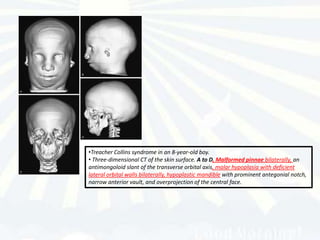
•Treacher Collins syndrome in an 8-year-old boy.
• Three-dimensional CT of the skin surface. A to D, Malformed pinnae bilaterally, an
antimongoloid slant of the transverse orbital axis, malar hypoplasia with deficient
lateral orbital walls bilaterally, hypoplastic mandible with prominent antegonial notch,
narrow anterior vault, and overprojection of the central face.
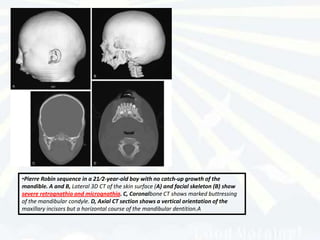
•Pierre Robin sequence in a 21⁄2-year-old boy with no catch-up growth of the
mandible. A and B, Lateral 3D CT of the skin surface (A) and facial skeleton (B) show
severe retrognathia and micrognathia. C, Coronalbone CT shows marked buttressing
of the mandibular condyle. D, Axial CT section shows a vertical orientation of the
maxillary incisors but a horizontal course of the mandibular dentition.A
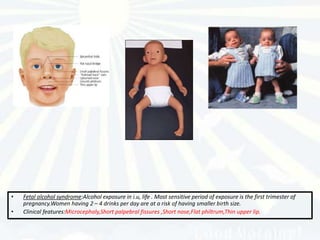
•   Fetal alcohol syndrome:Alcohol exposure in i.u, life . Most sensitive period of exposure is the first trimester of
    pregnancy.Women having 2 – 4 drinks per day are at a risk of having smaller birth size.
•   Clinical features:Microcephaly,Short palpebral fissures ,Short nose,Flat philtrum,Thin upper lip.
Management of clefts
• Surgical :
It consists of two stages:

a)1st stage-Lip closure within 12 weeks of age.

b)2nd stage-Palate closure within between 9 to 12 months of age.

•   Dental:
•   Missing teeth ;
•   Rotated teeth ;
•   Supernumeraray teeth;

• Audiological
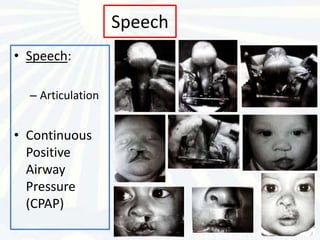
Speech
• Speech:

  – Articulation


• Continuous
  Positive
  Airway
  Pressure
  (CPAP)
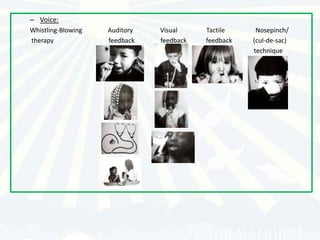
– Voice:
Whistling-Blowing   Auditory   Visual     Tactile     Nosepinch/
therapy             feedback   feedback   feedback   (cul-de-sac)
                                                     technique
Conclusion


What matters most is how you see yourself …
References
-Color atlas of embryology –Ulrich drews
-Langman’s medical embryology –Sadler
-Netter’s atlas of human embryology –Cochard
-Human embryology –Inderbeer singh
-Craniofacial embryology –Sperber
-Contemprary orthodontics –William profit
-Cleft lip and craniofacial anomalies –Ann kummer
-World wide web
Development of face

Development of face

  • 1.
    Guided by : DrS. Prakasam Presented by Dr K.C. Ponnappa Dr.Supratim tripathi
  • 2.
    Development of face Weare the lucky ones amongst the millions of those who could not make it.
  • 3.
    Contents • Introduction • Theoriesof development • Pharyngeal arches , pouches, grooves , clefts. • Development of face • Clinical aspects • Conclusion • References
  • 4.
    Introduction • The embryonic period extends from the beginning of the fourth week till the end of the eighth week. • The trilaminar embryonic area differentiates as follows: 1] ectoderm providing protection, 2] endoderm providing nutrition , 3] mesoderm forming skeletal tissue ,muscle and blood vascular system • The fourth week is characterized by the differentiation of the three germ layers and the folding of the embryo • In the second month the organs and tissues are laid down and the embryo has a distinct human appearance
  • 5.
    Phases of development 1)Growth-thisis the increase in the size by cell division 2)Morphogenesis-this is the development of form 3)Differentiation-includes the maturation of physiological processes  Folding of the embryo:- The trilaminar germ disc is flattened and pear-shaped .The cells in the central part grow more rapidly than those at the periphery.Because of the lack of space ,the embryo undergoes head fold ,tail fold and lateral folds by the end of the third week .This converts the flattened germ disc into a cylindrical embryo.
  • 6.
    Theories of development • The growth is strongly influenced by the genetic factors ,but it also can be significantly affected by the environment in the form of nutritional status, degree of physiological activity ,health or illness and a number of similar factors. • Three main theories in the recent years have attempted to explain the determinants of craniofacial growth: (1)Bone ,like other tissues ,is the primary determinant of its own growth, (2)Cartilage is the primary determinant of skeletal growth , while the bone responds secondarily and passively (3)The soft tissue matrix in which the skeletal elements are embedded as the primary determinant of growth
  • 7.
    Functional matrix theoryof growth • This theory was given by MOSS , in 1960. • He theorizes that growth of the face occurs as the response to functional needs and neurotrophic influences and is mediated by the soft tissue in which the jaws are embedded. • In this view the soft tissues grows and the bone and cartilage react. • This phenomenon can be seen readily in humans in three experiments of nature: a)Microcephaly , b)Hydrocephaly, c)Size of the orbit.
  • 9.
    Development of face •The most typical feature in the development of the head and neck is formed by the pharyngeal or branchial arches. • These arches appear in the 4th and 5th weeks of development and contribute to the characteristic external appearance of the embryo. • Initially there are bars of mesenchymal tissue separated by deep clefts known as pharyngeal or branchial clefts .
  • 10.
    • With thedevelopment of the arches and clefts ,a number of outpocketings arise ,the pharyngeal pouches . • Although the development of pharyngeal arches ,clefts ,and pouches resembles formation of gills in fish and amphibia,in the human embryo; real gills (branchia)are never formed. • Therefore the term pharyngeal has been adapted.
  • 11.
    When the embryo is 4 ½ weeks old five mesenchymal prominenses can be recognised -the frontonasal prominence , a slightly rounded elevation cranial to the stomodeum -the maxillary prominences (dorsal portion of the 1st arch),lateral to the stomodeum ; -the mandibular prominences ,caudal to the stomodeum; -Development of face is later complemented by the formation of the nasal prominences . 1 Frontonasal prominence 2 Maxillary prominences 2 Mandibular prominences Stomodeum
  • 12.
    Pharyngeal arches • Eachpharyngeal arch is charrecterized by its own muscular components ,their nerve component and it’s own arterial component.
  • 13.
    First pharyngeal arch •Consists of two portions:  Dorsal:-also known as the maxillary process , giving rise to premaxilla ,maxilla, zygomatic bone and part of the temporal bone.  Ventral:- also known as the mandibular process , which contains the MECKEL’S CARTILAGE. During further development , Meckel’s cartilage disappears except for two small portions at it’s dorsal end that persist and form the Incus and Malleus. Musculature of the 1st pharyngeal arch includes the muscle of mastication (temporalis,masseter,lateral pterygoid and medial pterygoid),anterior belly of the digastric,mylohyoid,tensor tympani and tensor palatini.
  • 14.
    Nerve supply tothe muscles of the 1st arch is provided by Mandibular branch of Trigeminal nerve. Sensory supply of the skin of the face is provided by Ophthalmic , Maxillary and Mandibular branches of the Trigeminal nerve.  Muscles of the different arches do not always attach to the bony or cartilagenous components of their own arch but sometimes migrate into surrounding regions. The origin of these muscles can be traced ,since their nerve supply is derived from the arch of origin.
  • 15.
    Second pharyngeal arch •The cartilage of the second arch (hyoid arch)is called as REICHERT’S CARTILAGE which gives rise to the stapes ,styloid process of the temporal bone , stylohyoid ligament, the lesser horn and upper part of the body of the hyoid bone .
  • 16.
    • Muscles ofthe hyoid arch are the stapedius , stylohyoid,posterior belly of digastric ,auricular and mucles of facial expressions. • Facial nerve-the nerve of the 2nd arch supplies all these muscles.
  • 17.
    Third pharyngeal arch •The cartilage of this arch produces the lower part of the body and the greater horn of the hyoid bone. • Muscle of this arch is the Stylopharyngeus muscle which is innervated by the Glossopharyngeal nerve.
  • 18.
    Fourth and Sixthpharyngeal arches • Cartilagenuos components of the 4th and 6th pharyngeal arches fuse to form the thyroid, cricoid , arytenoid , corniculate and cuneiform cartilages of the larynx. • Muscles of the fourth arch are supplied by the Superior laryngeal branch of the Vagus nerve and the intrinsic muscles of the larynx are supplied by Recurrent laryngeal branch of Vagus nerve
  • 19.
    Pharyngeal pouches • Thehuman embryo has five pairs of pharyngeal pouches. • The last one of these is atypical and is considered as a part of the 4th • First pharyngeal pouch: It forms a stalk like diverticulum –the tubotympanic recess;  one side of this comes in contact with the external auditary meatus  The distal aspect of this widens in a sac like structure ,the primitive tympanic or middle ear cavity  The proximal part remains narrow forming auditary (eustacian )tube.  The lining of the tympanic cavity forms the tympanic membrane or the eardrum
  • 20.
    • Second pharyngealpouch: The epithelial lining forms the primordium of the palatine tonsil. • Third pharyngeal pouch: It is characterized by a dorsal and a ventral wing .The dorsal wing proliferates to form the inferior parathyroid gland and the ventral wing forms the thymus
  • 21.
    • Fourth pharyngealpouch: Epithelium of the dorsal wing of this pouch forms the superior parathyroid gland. • Fifth pharyngeal pouch : The 5th pouch is the last one to develop and is considered to be a part of the 4th pouch.This pouch leads to the development of ultimobranchial body which in future leads to the development of thyroid gland.
  • 22.
    Pharyngeal grooves • The2nd ,3rd & 4th pharyngeal grooves merge together to form the cervical sinus which with further development disappears . • The 1st pharyngeal groove forms the external auditory meatus which is the only invagination on the side of the head.
  • 23.
    Pharyngeal cleft • The5 week embryo is characterized by the presence of 4 pharyngeal clefts of which only one contribute to the development of the definitive structure of the embryo. • The dorsal part of the 1st cleft gives rise to the external auditory meatus
  • 24.
    Clinical correlates • Branchialfistulas : When the 2nd pharyngeal arch fails to grow caudally over the 3rd and the 4th arches , leaving remnants of the 2nd 3rd &4th clefts in contact with the surface by a narrow canal. • Internal branchial fistulas : It is very rare and in this the cervical sinus is connected to the lumen of the pharynx by a small canal which usually opens in the tonsillar region.
  • 26.
    Development of face • DEVELOPMENT OF MAXILLA • DEVELOPMENT OF MANDIBLE • DEVELOPMENT OF NOSE • DEVELOPMENT OF PALATE • DEVELOPMENT OF EAR • DEVELOPMENTOF EYE • DEVELOPMENT OF LIP • DEVELOPMENTOF TONGUE
  • 27.
    Derivatives of FacialComponents The frontonasal prominence forms the:  Forehead and the bridge of the nose  Frontal and nasal bones The maxillary prominences form the:  Upper cheek regions and most of the upper lip  Maxilla, zygomatic bone, secondary palate
  • 28.
    The mandibular processes fuseand form the:  Chin, lower lip, and lower cheek regions  Mandible The lateral nasal prominences form the ala of the nose The medial nasal prominences fuse and form the intermaxillary segment
  • 29.
    Chronological development of different parts of the head • The development of the face occurs mainly between 5 – 8 weeks • The lower jaw (mandible) is the first to form (4th week) • The facial proportions develop during the fetal period (9th week to birth) • During infancy & childhood, following the development of teeth and paranasal sinuses, the facial skeleton increases in size and contribute to the definitive shape of the face
  • 30.
    stomodeum THE FACE andORAL REGION maxillary process a. Face consists of a few primordial tissue masses partially surrounding the future mandibular oral region. arch 5 weeks 4 weeks b. The oral cavity (stomodeum) is an ectodermal depression separated from the foregut by the Oral plate formed of ectoderm on one side and endoderm on the other. c. The face is dominated by the frontal 5.5 weeks 6 weeks prominence of the overhanging forebrain. d. Laterally, the maxillary processes of the 1st branchial arch are visible. 7 weeks 8 weeks
  • 31.
    • 1. Oneither side of the frontal prominence are stomodeum horseshoe-shaped elevations are found maxillary around the nasal placodes. process • a. Medial limbs are nasomedial processes • b. Lateral limbs are nasolateral processes mandibular arch 5 weeks • 2. Growing toward midline are the maxillary 4 weeks processes, approaching mandibular arches and nasomedial process merging with them at the angle of the mouth. • a. Maxillary processes grow to crowd the nasal processes closer together. • b. Nasomedial processes grow quickly, pushing 5.5 weeks 6 weeks the frontal prominence , then fuse with the maxillary processes to complete the arch philtrum of the upper jaw. • c. Nasomedial tissues give rise to philtrum of lip 7 weeks 8 weeks
  • 33.
    • The singlefrontonasal prominence ventral to the forebrain • The paired maxillary prominences develop from the cranial part of first branchial arch • The paired mandibular prominences develop from the caudal part of first branchial arch Lateral view
  • 34.
    DEVELOPMENT OF MAXILLA During the initial 2 weeks the maxillary prominences continue to increase in size . Simultaneously they grow in a medial direction thereby compressing the medial nasal prominences toward the midline. The cleft between the medial nasal prominences and the maxillary prominence is lost.
  • 35.
    • Initially themaxillary and the lateral nasal prominences are separated by a deep furrow ,the nasolacrimal groove. • The nasolacrimal duct then runs from the medial corner of the eye to the inferior meatus of the nasal cavity. • The maxillary prominence then enlarge to form the cheek and maxillae .
  • 36.
    Development of nasolacrimalduct NASOLACRIMAL DUCT - Develops as solid cord – connects anterior from medial angle of eye to nasal cavity eye to nasal cavity - becomes canalized. Obstructed Duct - failure of duct to canalize; is opened surgically for tears to drain to nasal cavity
  • 37.
    DEVELOPMENT OF MANDIBLE •“The Human Mandible Has No One Design For Life . Rather It Remodels Through The Stages Of Life ,From The Slim Arbiter Of Things To Come In The Infants ,Through The Powerful Dentate Machine And Even Weapon In The Full Flesh Of Maturity ,To The Pencil-thin Parcelain Like Problem That We Struggle To Repair In The Adversity Of Old Age.” - E Poswillo,1988 • The first structure to develop in the region of the lower jaw is the mandibular division of the trigeminal nerve. • The prior presence of the nerve has been postulated as requisite for inducing osteogenesis by the production of neurotropic hormones. • MECKEL’S CARTILAGE ,of the first branchial arch is responsible for the formation of mandible.
  • 38.
    • Single ossificationcentre for each half of the mandible arises in the 6th week i.u. • Ossification begins below and around the Inferior Alveolar Nerve and its Incisive branch and upwards to form a trough for the developing teeth. • Spread of intramembranous ossification dorsally and ventrally forms the body and the Ramus of the mandible . • The shape and size of he fetal mandible undergo considerable transformation during it’s growth and development .
  • 39.
    The ascending ramus of the neonatal mandible is low and wide ;the coronoid process is relatively large and projects well above the condyle ;the body is merely an open shell containing the buds of the deciduous teeth. • The initial separation of the right and left bodies of the mandible at the midline SYMPHYSIS MENTI is gradually eliminated between the 4th and 12th months postnatally. • The main sites of postnatal mandibular growth are at the condylar cartilages ,the posterior borders of the ramii and the alveolar ridges
  • 40.
    Development of nose •By the end of 4th week, Nasal bilateral oval-shaped placode ectodermal thickenings called Nasal ‘nasal placodes’ appear on placode each side of the lower part of the frontonasal prominence Frontonasal prominence • Nasal placodes are primordia of the nose and nasal cavities.
  • 41.
    • Mesenchymal cellsproliferate at the margin of the placodes and produce horse-shoe shaped swellings around these. • The sides of these swellings are called ‘medial’ and ‘lateral’ nasal prominences • The placodes now lie in the floor of a depression called ‘nasal pits’ Each lateral nasal prominence is separated from the maxillary swelling by nasolacrimal groove
  • 42.
  • 43.
    • With theformation of the medial and lateral nasal prominences, the nasal placodes lie in the floor of depressions called the nasal pits • By the end of 6th week, nasal pits deepen and form nasal sacs
  • 44.
    • Initially thenasal sacs are separated from the oral cavity by oronasal membrane. • The oronasal membrane ruptures by the 6th week, communicating the primitive nasal cavities with the oral cavity
  • 45.
    • These communicationsare called the primitive choana and are located posterior to the primary palate • After the development of the secondary palate, the choana change their position and become located at the junction of nasal cavity and the pharynx
  • 46.
    • The nasalseptum develops as a downgrowth from the internal parts of merged medial nasal prominences • Fuses with the palatine process in 9-12 weeks, superior to the hard palate
  • 47.
    • The superior,middle and inferior conchae develop on the lateral wall of each nasal cavity • The ectodermal epithelium in the roof of each nasal cavity becomes specialized as the olfactory epithelium
  • 48.
    • The olfactorycells of the olfactory epithelium give origin to olfactory nerve fibers that grow into the olfactory bulb
  • 49.
    1.Eye placode 2.Nasal placode 3.Oronasal membrane 4.Nasal cavity 5.Tongue 1 3 6.Primary palate 4 7.Secondary palate 2 7 6 5
  • 50.
    • Intermaxillary Segment:As a result of medial growth of the maxillary prominences ,the two medial nasal prominences merge not only at the surface but also at a deeper level. • The structure formed by the two merged prominences is called as the intermaxillary segment. • It is composed of :  A)Labial component –which forms the philtrum of the upper lip.  B)Upper jaw component –which carries the four incisor teeth.  C)Palatal component-which forms the triangular primary palate
  • 51.
    The medial nasalswellings enlarge, grow medially and merge with each other in the midline to form the intermaxillary segment Human embryo: 7 weeks
  • 52.
    Development of palate (Palatogenesis) • Begins at the end of the 5th week • Gets completed by the end of the 12th week • The most critical period for the development of palate is from the end of 6th week to the beginning of 9th week The palate develops from two primordia: - The Primary palate -The Secondary palate
  • 53.
    The Primary Palate •Begins to develop:  Early in the 6th week  From the deep part of the intermaxillary segment, as median palatine process • Lies behind the premaxillary part of the maxilla • Fuses with the developing secondary palate
  • 54.
    The primary palaterepresents only a small part lying anterior to the incisive fossa, of the adult hard palate Primary palate Hard palate Secondary palate Soft palate
  • 55.
    The Secondary Palate •Is the primordia of hard and soft palate posterior to the incisive fossa • Begins to develop:  Early in the 6th week  From the internal aspect of the maxillary processes, as lateral palatine process
  • 56.
    • In thebeginning, the lateral palatine processes project inferomedially on each side of the tongue • With the development of the jaws, the tongue moves inferiorly. • During 7th & 8th weeks, the lateral palatine processes elongate and ascend to a horizontal position above the tongue Tongue
  • 57.
    • Gradually thelateral palatine processes:  Grow medially and fuse in the median plane  Also fuse with the: • Posterior part of the primary palate & • The nasal septum
  • 58.
    • Fusion withthe nasal septum begins anteriorly during 9th week, extends posteriorly and is completed by 12th week Bone develops in the anterior part to form the hard palate. The posterior part develops as muscular soft palate
  • 60.
    Changes in Faceduring Fetal period • Mainly result from changes in the proportion & relative positioning of facial structures • In early fetal period the nose is flat and mandible underdeveloped. They attain their characteristic form during fetal period • The enlargement of brain results in the formation of a prominent forehead • Eyes initially appear on each side of frontonasal prominence ;move medially • Ears first appear on lower portion of lower jaw, grow in upper direction to the level of the eyes
  • 61.
    Development of ear •The three parts of the ear- -External -Middle and -Internal ,arise from separate ,diverse embryonic origins .
  • 62.
    • The externalear forms around the first branchial groove which deepens to become the external acuostic meatus . • Malleus and Incus are derived from the dorsal end of the first branchial arch cartilage –MECKEL’S CARTILAGE. • Stapes arise from the dorsal end of the second branchial arch cartilage- REICHERT’S CARTILAGE . • This is the first sensory organ to begin development .
  • 63.
    Development of eye • The light sensitive portion of the eye retina ,is the outgrowth from the forebrain ,projecting bilaterally as the optic vesicles which are connected to the brain by the optic stalks, this results in a thickening called as lens placodes. • These placodes invaginates in it’s centre by the development of peripheral folds . • The optic vesicles invaginate partly to form the double layered optic cusps and the optic stalk becomes the optic nerve . • The outer layer of the optic cup acquires pigmentation to become the pigmented layer of the retina.
  • 64.
    Development of lips •Lower lip :The mandibular processes of the two sides grow towards each other and fuse in the midline ,they form the lower margin of the stomatodeum . • Upper lip :Each maxillary process now grows medially and fuses, first with the lateral nasal process and the with the medial nasal process.
  • 65.
    • The mesodermalbasis of the lateral part of the lip is formed from the maxillary process. • The overlying skin is derived from the ectoderm covering this process. • The mesodermal basis of the medial part of the lip(PHILTRUM)is formed from the frontonasal process . • The muscles of the face (including those of the lips)are derived from the 2nd branchial arch and are supplied by the facial nerve.
  • 66.
    Development of tongue •The tongue appears in the embryo of approximately 4 weeks in the form of two lateral lingual swelling and one medial swelling –TUBERCULUM IMPAR . • The three swellings orginate from the 1st pharyngeal arch. • As the 3 swellings increase in size ,they overgrow the tuberculum impar and merge with each other thus forming the anterior two thirds or the body of the tongue.
  • 67.
    • At thejunction of the anterior 2/3rd and the posterior 1/3rd is a groove called as the SULCUS TERMINALIS. • Sensory innervation-2/3rd - Mandibular branch of Trigeminal nerve • Sensory innervation-1/3rd - Glossopharyngeal nerve . • Motor innervation Hypoglossal nerve • Special sensory innervation - Chorda tympani branch of Facial nerve
  • 69.
  • 70.
    Cleft lip andpalate Classification systems Numerous classification systems: • Veau • American Cleft Palate-Craniofacial Assn (ACPA) • Kernahan and Stark Veau’s system: I Cleft of soft palate only II Cleft of hard and soft palate to incisive foramen III Complete unilateral cleft of soft and hard palate and lip and alveolar ridge on one side IV Complete bilateral cleft of soft and hard palate and lip and alveolar ridge on both sides
  • 72.
    Cleft lip coupledwith clefts of the anterior palate or entire palate.
  • 73.
    Causes of cleftlip and palate • Genetic disorders • Chromosomal abnormalities • Environmental factors (teratogenic agents) • Mechanical factors
  • 74.
    Chromosomal abnormalities • Trisomy13 – Rare chromosomal abnormality – The baby is born with 47 chromosomes instead of 46 due to an extra copy of chromosome 13 – Multiple congenital malformations- • severe brain bnormalities, • Congenital heart defects, • Polydactyly, • Spina bifida, • Severe eye defects. – Mean life expectancy is 130 days
  • 75.
    Environmental factors • Recognizedteratogenic agent: – Alcohol overdose
  • 76.
    Mechanical factors • Intrauterine crowding : -tumors, -multiple births, - Placenta abnormalities
  • 77.
    Incidence of cleftlip and palate • 1:750 live births • Clefts of lip is more frequent and is more severe in males • Clefts of palate is more frequent in females
  • 78.
    Facial clefting. A,Absence of the intermaxillary segment with hypotelorism. The maxillary processes form the normal lateral thirds of the upper lips. The midline rectangular defect indicates the site of the deficient intermaxillary segment with absent prolabium, incisors, and primary palate. There was consequent clefting of the secondary palate. Absent intermaxillary segment with hypotelorism signifies a high likelihood of holoprosencephaly. B, True midline cleft of the upper lip and philtrum with hypertelorism. The nose is normal. A 7-month-old girl with transethmoidal cephalocele and left optic nerve dysplasia (morning glory syndrome). True midline cleft lip signifies the high likelikhood of midline craniofaciocerebral and optic dysraphysm. C and D, Midline cleft lip is also found in association with Mohr syndrome (orofacial digital syndrome II [OFD II]). The presence of reduplicated great toes bilaterally helps to identify OFD II and to distinguish it from OFD I.
  • 79.
    Facial clefting. A,Right unilateral common cleft lip and palate in a 4-day-old girl. The cleft extends into the base of a widened nostril. The intermaxillary segment is distorted. B, Bilateral common cleft lip and cleft palate with discordant forward growth of the intermaxillary segment in a 4-year-old boy. The normal canthi, alae nasi, and lateral thirds of the lip and jaw indicate normal formation and merging of the maxillary and nasolateral processes. The abortive prolabium, premaxillary segment, and central incisors attach to the vomer and project well anterior to their expected position, because failure to merge the facial processes led to discordant growth of the maxillary and intermaxillary segments. C and D, Bilateral common cleft lip and palate prior to (C) and following (D) surgical repair. There is near-symmetric restoration of the nose and upper lip, with some residual distortion caused by scar.
  • 80.
    Facial clefting. Bilateraloblique oroocular clefts with bilateral common cleft lip. A, Frontal view. B, Lateral view
  • 81.
    Facial clefting. Unilateraltransverse facial cleft and macrostomia in an infant girl. (From Bauer BS, Wilkes GH, Kernahan DA. Incorporation of the W-plasty in repair of macrostomia. Plast Reconstr Surg 1982;70:752–757.)
  • 82.
    Facial clefting. Nonanatomicclefts in a 12-year-old mentally retarded girl with the syndrome of amnionic bands. Lateral view. A long, thin band-like scar extends across the scalp and face from the temporoparietal region through the cheek and the corner of the mouth to the lower lip. The large posterior zone of atrophic skin, absent hair, tissue bulging, and inferior displacement of the ear indicate the site of an associated temporoparietal encephalocele. Imaging studies showed notching and separation of teeth where the band crossed the alveolar ridge.
  • 83.
    Median cleft facesyndrome, typical facies. A, Sedano facies type A in 3-month-old boy. B, Sedano facies type B in 4-day-old boy. C, Sedano facies type C in a young boy after repair of concurrent bilateral common cleft lip and palate. D, Sedano facies type D in a 31⁄2- year-old boy. (A, B, and D from Naidich TP, Osborn RE, Bauer B, et al. Median cleft face syndrome: MR and CT data from 11 children. J Comput Assist Tomogr 1988;12:57.)
  • 84.
    Frontonasal form offrontoethmoidal cephalocele. A, Three- dimensional CT of the skin surface.The asymmetric glabellar mass obscures the left orbit and projects over the bony and cartilaginous nose. B and C, T2-weighted MR images in the axial (B) and sagittal © planes demonstrate hypertelorism, anterior herniation of both frontal lobes into the cephalocele through a defect between the frontal bones and the nasal bones, and asymmetric distention of the sac by CSF. The medial frontal anatomy is distorted by the herniation.
  • 85.
    Typical facies associatedwith holoprosencephaly. Five types. A, Facies 1: cyclopia. (Courtesy of Dr. Fred Epstein, New York.) The complete upper lip, with a hint of a labial tubercle in the midline, could represent either fusion of the nasomedial processes independent of the frontonasal process or fusion of the two maxillary processes across the midline. B, Facies 2: ethmocephaly. (Courtesy of Dr. Michael Cohen, Halifax, Nova Scotia, Canada.) C, Facies 3: cebocephaly with synophrys (fusion of the two eyebrows across the midline). D, Facies 4: absent intermaxillary segment, flat nasal bridge, and rudimentary alae nasi (cf. Fig. 12A). Imaging disclosed alobar holoprosencephaly with dorsal cyst. E, Facies 5: hypotelorism with an intermaxillary rudiment (white arrowhead ). Imaging disclosed lobar holoprosencephaly. (From Smith MM, Thompson JE, Naidich TP, Castillo M, Thomas D, Mukherji SK. Facies to remember. Cebocephaly with single midline proboscis. Alobar prosencephaly. Int J Neuroradiol 1996;2:251–263.)
  • 86.
    Microtia and hemifacialmicrosomia in two patients. A, Microtia. The pinna is deformed. The face appears normal. B, Hemifacial microsomia. The line formed by the two palpebral fissures and the line formed by the mouth converge to the region of the deformed, hypoplastic pinna. The right orbit, right eye, and entire right side of the face are asymmetrically smaller. The skin tag falls along the line between the pinna and the mouth.
  • 87.
    Hemifacial microsomia. Goldenharsyndrome. •This 4-month-old girl shows a large coloboma of the medial portion of the left upper lid (between the curved white arrows) and a whitish choristoma (straight white arrow) that straddles the corneoscleral limbus inferotemporally. • There is a second, small coloboma of the lower lid medial to the choristoma. The caruncle is unusually prominent. (Case courtesy of Dr. Myron Tannenbaum, Miami, Florida.) (From Naidich TP, Smith MS, Castillo M, Thompson JE, Sloan GM, Jayakar P, Mukherji SK. Facies to remember. Number 7. Hemifacial microsomia. Goldenhar syndrome. OAV complex. Int J Neuroradiol 1996;2:437–449.)
  • 88.
    •Treacher Collins syndromein an 8-year-old boy. • Three-dimensional CT of the skin surface. A to D, Malformed pinnae bilaterally, an antimongoloid slant of the transverse orbital axis, malar hypoplasia with deficient lateral orbital walls bilaterally, hypoplastic mandible with prominent antegonial notch, narrow anterior vault, and overprojection of the central face.
  • 89.
    •Pierre Robin sequencein a 21⁄2-year-old boy with no catch-up growth of the mandible. A and B, Lateral 3D CT of the skin surface (A) and facial skeleton (B) show severe retrognathia and micrognathia. C, Coronalbone CT shows marked buttressing of the mandibular condyle. D, Axial CT section shows a vertical orientation of the maxillary incisors but a horizontal course of the mandibular dentition.A
  • 90.
    Fetal alcohol syndrome:Alcohol exposure in i.u, life . Most sensitive period of exposure is the first trimester of pregnancy.Women having 2 – 4 drinks per day are at a risk of having smaller birth size. • Clinical features:Microcephaly,Short palpebral fissures ,Short nose,Flat philtrum,Thin upper lip.
  • 92.
    Management of clefts •Surgical : It consists of two stages: a)1st stage-Lip closure within 12 weeks of age. b)2nd stage-Palate closure within between 9 to 12 months of age. • Dental: • Missing teeth ; • Rotated teeth ; • Supernumeraray teeth; • Audiological
  • 93.
    Speech • Speech: – Articulation • Continuous Positive Airway Pressure (CPAP)
  • 94.
    – Voice: Whistling-Blowing Auditory Visual Tactile Nosepinch/ therapy feedback feedback feedback (cul-de-sac) technique
  • 95.
    Conclusion What matters mostis how you see yourself …
  • 96.
    References -Color atlas ofembryology –Ulrich drews -Langman’s medical embryology –Sadler -Netter’s atlas of human embryology –Cochard -Human embryology –Inderbeer singh -Craniofacial embryology –Sperber -Contemprary orthodontics –William profit -Cleft lip and craniofacial anomalies –Ann kummer -World wide web