4-1
Administration of Economic
Development
DPA 314
Development
Concepts
2
3
Seers (1969) marked the change
needed in setting development
objectives. The goal of
development during the period was
thus not limited to economic growth
but to concentrate on the reduction
of poverty, inequality and
unemployment.
4
5
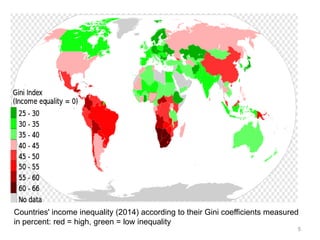
Countries' income inequality (2014) according to their Gini coefficients measured
in percent: red = high, green = low inequality
6
In the 1990s, economists
increasingly recognized that it
was the quality of life that
determines whether people are
from developing countries or not.
Diseases, malnourishment and
death that happen in the
everyday lives of those from the
developing countries changed
the view of development goals
dramatically
7
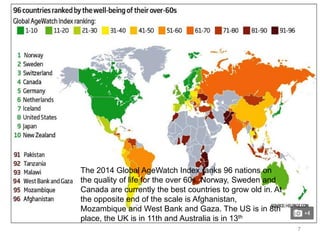
The 2014 Global AgeWatch Index ranks 96 nations on
the quality of life for the over 60s. Norway, Sweden and
Canada are currently the best countries to grow old in. At
the opposite end of the scale is Afghanistan,
Mozambique and West Bank and Gaza. The US is in 8th
place, the UK is in 11th and Australia is in 13th
8
By then, like many scholars around the world,
Stiglitz (1998) contributed to shift the development
goals set by governments in developing countries
to wider objectives, including improvements in
income distribution, environment, health and
education. A broader perspective of development
goals is hence necessary as reflected in the World
Bank’s Development Report (1991, p. 4) as “to
improve the quality of life. Especially, in the world’s
poor countries, a better quality of life generally calls
for higher incomes— but it involves much more.
It encompasses as ends in themselves
better education, higher standards of health
and nutrition, less poverty, a cleaner
environment, more equality of opportunity,
greater individual freedom, and a richer
cultural life.”
9
The capability approach is a
framework pioneered and
advocated primarily by Amartya
Sen and Martha Nussbaum
(1985). It arose from the need to
measure progress in development,
and the dissatisfaction with
existing methods in the field of
economy (Robeyns 2011).
10
Sen’s (1985, 1992, 1999) work
perhaps has brought about the broadest
perspective of development goals.
According to Sen (1985), the
ultimate goal of development is to
enhance human capabilities, which is
defined as “the freedom that a person
has in terms of the choice of
functionings, given his personal features
(conversion of characteristics into
functionings) and his command over
commodities.
11
Higher income is necessary
but not sufficient in terms of
quality of life. Under his
approach, goals of economic
development change from
promotion of growth to
promotion of well-being (Sen
1985, p. 13).
12
These changes in the definition of
development goals posed the need to
construct alternative composite indices to
reflect quality of life. These indices should
take into account not only money
indicators but also non-monetary
indicators to reflect the development levels
achieved. There have been attempts to
build indicators that measure the standard
of living and quality of life, which focus on
the quantitative and qualitative aspects:
health, education, environment and
material well-being (Berenger and Verdier-
Chouchane 2007).
13
The Human Rights
approaches come closer to the
philosophy behind the capability
approach. They aim to secure
the freedoms that are central for
human beings (Alexander
2004). The Universal
Declaration of Human Rights is
a good example of this
approach in practice
14
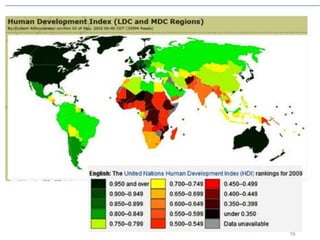
Using Sen’s (1985) approach,
the Human Development Index
(HDI) has been published
annually since 1990 by the
United Nations Development
Programme as an attempt to
provide an aggregate measure
of life expectancy, education and
income (Elkan 1995)
15
* Life expectancy at birth, as an index
of population health and longevity
* Knowledge and education, as
measured by the adult literacy rate
(with two-thirds weighting) and the
combined primary, secondary, and
tertiary gross enrollment ratio (with one-
third weighting).
* Standard of living, as measured by the
natural logarithm of gross domestic
product per capita at purchasing power
parity
The HDI combines three dimensions:
16
17
Increasingly, academics and societies realize the
effects of human actions on the environment. On the
way to achieve rapid economic growth, countries
around the world have been exploiting their natural
resource reserves at alarming rates. Although early
economists included the natural environment in their
economic analysis, environmentalism only drew
international attention in the 1960s (Pearce and
Turner 1990).
Sustainable Development Concept
The relationship between development and
environment has given birth to the sustainable
development concept. The central idea of
sustainable development is that global ecosystems
and humanity itself can be threatened by neglecting
the environment.
18
Environmental economists are
concerned that the long-term neglect of the
environmental assets is likely to jeopardize
the durability of economic growth
(Thampapillai 2002).
Sustainable development therefore
“involves maximizing the net benefits of
economic development, subject to
maintaining the services and quality of
natural resources over time” (Pearce and
Turner 1990, p. 24). Its concern is about
balancing the objectives of economic
growth and attending to environmental
considerations.
19
In a broader sense, sustainable
development is defined by the Brundtland
Commission, formally the World
Commission on Environment and
Development, as “progress that meets the
needs of the present without
compromising the ability of future
generations to meet their own needs”
(World Commission on Environment and
Development 1987, p. 8). Although this
standard definition brings the term
“sustainable development” into common
use, it has created ambiguity in application
(Redclift 1992; Daly 1996; Payne and
Raiborn 2001).
20
Although this standard definition
brings the term “sustainable
development” into common use, it
has created ambiguity in application
(Redclift 1992; Daly 1996; Payne
and Raiborn 2001). Much of the
debate around the definition seeks to
answer the two questions “What
should be sustained” and “What
should be developed” (Kates et al.
2008)
21
Today, sustainable
development aims to improve the
quality of life in a comprehensive
manner, including economic
prosperity, social equity and
environmental protection.
Economic, social, environmental
and cultural aspects must be
integrated in a harmonious manner
to enhance the intergenerational
well-being (World Bank 2003).
22
The Millennium Development Goals Eight
Millennium Development Goals (MDGs) were
adopted by member countries of the United
Nations in September 2000. The MDGs were
developed to address the most pressing problems
in developing countries, including poverty and
hunger, primary universal education, gender
equality, child health, maternal health, HIV/AIDS,
environmental sustainability and global
partnership. Member countries of the United
Nations have committed themselves to end
poverty and achieve other development goals by
2015. Quantitative targets of these goals were then
assigned based on rates of international
development achievements (United Nations 2011).
The Millennium Development Goals
23
However, the MDGs were criticized for failing
to include other critical objectives of
development, such as improving legal and
human rights of the poor, slowing global
warming and leveraging the contributions of
the private sector. Critics also argued that the
MDG targets were not ambitious enough and
were not prioritized (Todaro and Smith 2009).
24
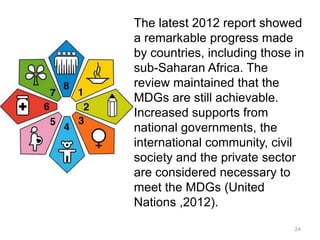
The latest 2012 report showed
a remarkable progress made
by countries, including those in
sub-Saharan Africa. The
review maintained that the
MDGs are still achievable.
Increased supports from
national governments, the
international community, civil
society and the private sector
are considered necessary to
meet the MDGs (United
Nations ,2012).
25
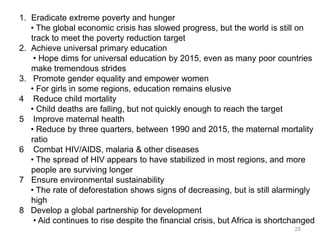
1. Eradicate extreme poverty and hunger
• The global economic crisis has slowed progress, but the world is still on
track to meet the poverty reduction target
2. Achieve universal primary education
• Hope dims for universal education by 2015, even as many poor countries
make tremendous strides
3. Promote gender equality and empower women
• For girls in some regions, education remains elusive
4 Reduce child mortality
• Child deaths are falling, but not quickly enough to reach the target
5 Improve maternal health
• Reduce by three quarters, between 1990 and 2015, the maternal mortality
ratio
6 Combat HIV/AIDS, malaria & other diseases
• The spread of HIV appears to have stabilized in most regions, and more
people are surviving longer
7 Ensure environmental sustainability
• The rate of deforestation shows signs of decreasing, but is still alarmingly
high
8 Develop a global partnership for development
• Aid continues to rise despite the financial crisis, but Africa is shortchanged
26

Development Concepts

  • 1.
  • 2.
  • 3.
    3 Seers (1969) markedthe change needed in setting development objectives. The goal of development during the period was thus not limited to economic growth but to concentrate on the reduction of poverty, inequality and unemployment.
  • 4.
  • 5.
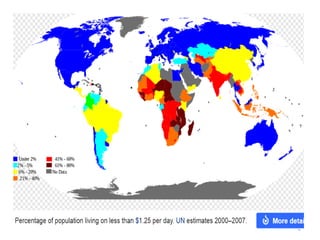
    5 Countries' income inequality(2014) according to their Gini coefficients measured in percent: red = high, green = low inequality
  • 6.
    6 In the 1990s,economists increasingly recognized that it was the quality of life that determines whether people are from developing countries or not. Diseases, malnourishment and death that happen in the everyday lives of those from the developing countries changed the view of development goals dramatically
  • 7.
    7 The 2014 GlobalAgeWatch Index ranks 96 nations on the quality of life for the over 60s. Norway, Sweden and Canada are currently the best countries to grow old in. At the opposite end of the scale is Afghanistan, Mozambique and West Bank and Gaza. The US is in 8th place, the UK is in 11th and Australia is in 13th
  • 8.
    8 By then, likemany scholars around the world, Stiglitz (1998) contributed to shift the development goals set by governments in developing countries to wider objectives, including improvements in income distribution, environment, health and education. A broader perspective of development goals is hence necessary as reflected in the World Bank’s Development Report (1991, p. 4) as “to improve the quality of life. Especially, in the world’s poor countries, a better quality of life generally calls for higher incomes— but it involves much more. It encompasses as ends in themselves better education, higher standards of health and nutrition, less poverty, a cleaner environment, more equality of opportunity, greater individual freedom, and a richer cultural life.”
  • 9.
    9 The capability approachis a framework pioneered and advocated primarily by Amartya Sen and Martha Nussbaum (1985). It arose from the need to measure progress in development, and the dissatisfaction with existing methods in the field of economy (Robeyns 2011).
  • 10.
    10 Sen’s (1985, 1992,1999) work perhaps has brought about the broadest perspective of development goals. According to Sen (1985), the ultimate goal of development is to enhance human capabilities, which is defined as “the freedom that a person has in terms of the choice of functionings, given his personal features (conversion of characteristics into functionings) and his command over commodities.
  • 11.
    11 Higher income isnecessary but not sufficient in terms of quality of life. Under his approach, goals of economic development change from promotion of growth to promotion of well-being (Sen 1985, p. 13).
  • 12.
    12 These changes inthe definition of development goals posed the need to construct alternative composite indices to reflect quality of life. These indices should take into account not only money indicators but also non-monetary indicators to reflect the development levels achieved. There have been attempts to build indicators that measure the standard of living and quality of life, which focus on the quantitative and qualitative aspects: health, education, environment and material well-being (Berenger and Verdier- Chouchane 2007).
  • 13.
    13 The Human Rights approachescome closer to the philosophy behind the capability approach. They aim to secure the freedoms that are central for human beings (Alexander 2004). The Universal Declaration of Human Rights is a good example of this approach in practice
  • 14.
    14 Using Sen’s (1985)approach, the Human Development Index (HDI) has been published annually since 1990 by the United Nations Development Programme as an attempt to provide an aggregate measure of life expectancy, education and income (Elkan 1995)
  • 15.
    15 * Life expectancyat birth, as an index of population health and longevity * Knowledge and education, as measured by the adult literacy rate (with two-thirds weighting) and the combined primary, secondary, and tertiary gross enrollment ratio (with one- third weighting). * Standard of living, as measured by the natural logarithm of gross domestic product per capita at purchasing power parity The HDI combines three dimensions:
  • 16.
  • 17.
    17 Increasingly, academics andsocieties realize the effects of human actions on the environment. On the way to achieve rapid economic growth, countries around the world have been exploiting their natural resource reserves at alarming rates. Although early economists included the natural environment in their economic analysis, environmentalism only drew international attention in the 1960s (Pearce and Turner 1990). Sustainable Development Concept The relationship between development and environment has given birth to the sustainable development concept. The central idea of sustainable development is that global ecosystems and humanity itself can be threatened by neglecting the environment.
  • 18.
    18 Environmental economists are concernedthat the long-term neglect of the environmental assets is likely to jeopardize the durability of economic growth (Thampapillai 2002). Sustainable development therefore “involves maximizing the net benefits of economic development, subject to maintaining the services and quality of natural resources over time” (Pearce and Turner 1990, p. 24). Its concern is about balancing the objectives of economic growth and attending to environmental considerations.
  • 19.
    19 In a broadersense, sustainable development is defined by the Brundtland Commission, formally the World Commission on Environment and Development, as “progress that meets the needs of the present without compromising the ability of future generations to meet their own needs” (World Commission on Environment and Development 1987, p. 8). Although this standard definition brings the term “sustainable development” into common use, it has created ambiguity in application (Redclift 1992; Daly 1996; Payne and Raiborn 2001).
  • 20.
    20 Although this standarddefinition brings the term “sustainable development” into common use, it has created ambiguity in application (Redclift 1992; Daly 1996; Payne and Raiborn 2001). Much of the debate around the definition seeks to answer the two questions “What should be sustained” and “What should be developed” (Kates et al. 2008)
  • 21.
    21 Today, sustainable development aimsto improve the quality of life in a comprehensive manner, including economic prosperity, social equity and environmental protection. Economic, social, environmental and cultural aspects must be integrated in a harmonious manner to enhance the intergenerational well-being (World Bank 2003).
  • 22.
    22 The Millennium DevelopmentGoals Eight Millennium Development Goals (MDGs) were adopted by member countries of the United Nations in September 2000. The MDGs were developed to address the most pressing problems in developing countries, including poverty and hunger, primary universal education, gender equality, child health, maternal health, HIV/AIDS, environmental sustainability and global partnership. Member countries of the United Nations have committed themselves to end poverty and achieve other development goals by 2015. Quantitative targets of these goals were then assigned based on rates of international development achievements (United Nations 2011). The Millennium Development Goals
  • 23.
    23 However, the MDGswere criticized for failing to include other critical objectives of development, such as improving legal and human rights of the poor, slowing global warming and leveraging the contributions of the private sector. Critics also argued that the MDG targets were not ambitious enough and were not prioritized (Todaro and Smith 2009).
  • 24.
    24 The latest 2012report showed a remarkable progress made by countries, including those in sub-Saharan Africa. The review maintained that the MDGs are still achievable. Increased supports from national governments, the international community, civil society and the private sector are considered necessary to meet the MDGs (United Nations ,2012).
  • 25.
    25 1. Eradicate extremepoverty and hunger • The global economic crisis has slowed progress, but the world is still on track to meet the poverty reduction target 2. Achieve universal primary education • Hope dims for universal education by 2015, even as many poor countries make tremendous strides 3. Promote gender equality and empower women • For girls in some regions, education remains elusive 4 Reduce child mortality • Child deaths are falling, but not quickly enough to reach the target 5 Improve maternal health • Reduce by three quarters, between 1990 and 2015, the maternal mortality ratio 6 Combat HIV/AIDS, malaria & other diseases • The spread of HIV appears to have stabilized in most regions, and more people are surviving longer 7 Ensure environmental sustainability • The rate of deforestation shows signs of decreasing, but is still alarmingly high 8 Develop a global partnership for development • Aid continues to rise despite the financial crisis, but Africa is shortchanged
  • 26.