Comilla Model
Md.Musfiq-Al-Mahadi
B.Sc.Ag(Hons)
Ms. In Agext
PGD in ICT
Bangladesh Agricultural University
Introduction
The Comilla Models of Rural Development are
widely known in the development world.
This model evolved out of a series of experimental
or pilot projects designed and conducted by the
Bangladesh Academy for Rural Development
(BARD).
The models were the outcome of a search for
innovation in rural development in a low-income
and densely populated agrarian society.
The academy decided to introduce pilot projects
within a few months of its inception in May 1959.
Historical background
It was a rural development programme launched
in 1959 by the Pakistan Academy for Rural
Development.
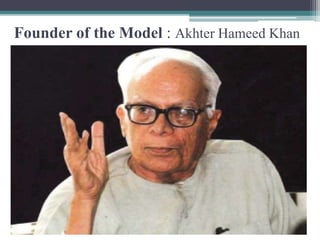
It was founded byAkhter Hameed Khan, the
Cooperative pioneer who was responsible for
developing and launching the programme.
It was Khan's reply to the failure of Village
Agricultural and Industrial Development (V-
AID) programme, launched in 1953 in East and
West Pakistan with technical assistance from the
US government.
Founder of the Model : Akhter Hameed Khan
Objectives
There were two-fold objectives behind the
introduction of these projects:
To provide a real-life learning situation
for the trainees at the Academy, and
To devise development model(s) of
programmes/institutions which could be
replicated elsewhere in the country.
Genesis of the Model
Several steps were involved in the evolution of the
Comilla Model-
The first step was to make use of the existent training-
cum-research institution, i.e. BARD.
The second step was the affiliation of a laboratory area, a
whole thana, to this institution.
The third step was a thorough study of the laboratory
area and intensive consultation with the villagers on
their problems and their views about the solution of
those problems.
The fourth step was close collaboration with the
planning commission at the national level .
The fifth was continuous evaluation and documentation
of the pilot projects.
The sixth step was to assist the government agencies in
the multiplication of the model.
Assumption
The problems of rural development should be
approached from the villagers' point of view.
The villagers are capable of bringing about
changes in their conditions.
Agricultural development should be made an
essential step
The village should be considered as a basic
development unit.
training, research and demonstration are
essential in promoting rural development
Salient Feature
Institutionalization of the whole process .
Involvement of both public and private sectors .
Development of a cadre of institutional leaders.
Development of three basic infrastructures
(administrative, physical and organizational).
Priority on decentralized and coordinated rural
administration .
Comprehensive development by integrating and
coordinating various complementary rural
development services and projects.
Education, organization and discipline .
The heavy emphasis on economic and technological
factors for building a progressive society.
Development of a stable and progressive agriculture .
Components of the Model
 Decentralization and coordinated rural
administration
 Organizing the farm and non-farm population
through a new system of rural co-operatives
 Co-operative processing and marketing
 Poultry and cattle development
 Agricultural mechanization and irrigation
 Building rural infrastructures though local level
planning
 Rural education
 Women’s development
 Family planning
 Health and nutrition and so on.
Implementation
Establishment of a training and development
centre.
A road-drainage, embankment works program.
A decentralized, small scale irrigation program
A two-tiered cooperative system, with primary
cooperatives operating in the villages, and
federations operating at thana level.
Effectiveness of The Model
• It has replaced the old colonial approach – ‘development
through officers’.
• It has solved some critical problems like low agricultural
productivity, food deficit, rural unemployment etc.
• Innovative methods – (a) the farmers can be organized for
production, (b) investment can be made in rural area, (c)
leadership can be developed in rural areas, (d) large scale
adoption of technological innovations can take place in
rural communities, (e) the rural people and government
can work as partners, and (f) a bottom-up planning can be
introduced.
• The models have evolved a combination of training
knowledge-communications systems
Difficulties
For various reasons the Comilla Model was unable to
achieve its goal. It had particular troubles with
government relations and efforts to build strong
cooperative institutions. According to Dr Khan:…
in actual practice, the four programs suffered
from-
• Distortion
• Mismanagement
• Corruption and
• Subversion.
Criticism
 The programs do not aim at any radical change in the
structure of the govt. authority or land tenure in rural
areas.
It is no where near the goal of sufficient capital
accumulation for achieving financial self-reliance.
 The programs have not brought any significant direct
benefits to the landless and near landless.
The benefits of technology diffusion have largely gone
up the large landholders.
 Comilla cooperatives are dominated by better-off
farmers, they are also the bigger defaulters.
Over the longer period real wages to the rural areas
have declined.
 There has been breakdown in the organisation
discipline and so on.
Conclusion
Although Comilla Model fails to achieve its goal
for many reasons, it paves the way of rural
development in our country. Many non-
government organizations like Grameen Bank,
BRAC had been initiated by following the foot-
print of this model of development. Both GOs
and NGOs should come forward to utilize this
model for the development of our rural areas.

Comilla model

  • 1.
    Comilla Model Md.Musfiq-Al-Mahadi B.Sc.Ag(Hons) Ms. InAgext PGD in ICT Bangladesh Agricultural University
  • 2.
    Introduction The Comilla Modelsof Rural Development are widely known in the development world. This model evolved out of a series of experimental or pilot projects designed and conducted by the Bangladesh Academy for Rural Development (BARD). The models were the outcome of a search for innovation in rural development in a low-income and densely populated agrarian society. The academy decided to introduce pilot projects within a few months of its inception in May 1959.
  • 3.
    Historical background It wasa rural development programme launched in 1959 by the Pakistan Academy for Rural Development. It was founded byAkhter Hameed Khan, the Cooperative pioneer who was responsible for developing and launching the programme. It was Khan's reply to the failure of Village Agricultural and Industrial Development (V- AID) programme, launched in 1953 in East and West Pakistan with technical assistance from the US government.
  • 4.
    Founder of theModel : Akhter Hameed Khan
  • 5.
    Objectives There were two-foldobjectives behind the introduction of these projects: To provide a real-life learning situation for the trainees at the Academy, and To devise development model(s) of programmes/institutions which could be replicated elsewhere in the country.
  • 6.
    Genesis of theModel Several steps were involved in the evolution of the Comilla Model- The first step was to make use of the existent training- cum-research institution, i.e. BARD. The second step was the affiliation of a laboratory area, a whole thana, to this institution. The third step was a thorough study of the laboratory area and intensive consultation with the villagers on their problems and their views about the solution of those problems. The fourth step was close collaboration with the planning commission at the national level . The fifth was continuous evaluation and documentation of the pilot projects. The sixth step was to assist the government agencies in the multiplication of the model.
  • 7.
    Assumption The problems ofrural development should be approached from the villagers' point of view. The villagers are capable of bringing about changes in their conditions. Agricultural development should be made an essential step The village should be considered as a basic development unit. training, research and demonstration are essential in promoting rural development
  • 8.
    Salient Feature Institutionalization ofthe whole process . Involvement of both public and private sectors . Development of a cadre of institutional leaders. Development of three basic infrastructures (administrative, physical and organizational). Priority on decentralized and coordinated rural administration . Comprehensive development by integrating and coordinating various complementary rural development services and projects. Education, organization and discipline . The heavy emphasis on economic and technological factors for building a progressive society. Development of a stable and progressive agriculture .
  • 9.
    Components of theModel  Decentralization and coordinated rural administration  Organizing the farm and non-farm population through a new system of rural co-operatives  Co-operative processing and marketing  Poultry and cattle development  Agricultural mechanization and irrigation  Building rural infrastructures though local level planning  Rural education  Women’s development  Family planning  Health and nutrition and so on.
  • 10.
    Implementation Establishment of atraining and development centre. A road-drainage, embankment works program. A decentralized, small scale irrigation program A two-tiered cooperative system, with primary cooperatives operating in the villages, and federations operating at thana level.
  • 11.
    Effectiveness of TheModel • It has replaced the old colonial approach – ‘development through officers’. • It has solved some critical problems like low agricultural productivity, food deficit, rural unemployment etc. • Innovative methods – (a) the farmers can be organized for production, (b) investment can be made in rural area, (c) leadership can be developed in rural areas, (d) large scale adoption of technological innovations can take place in rural communities, (e) the rural people and government can work as partners, and (f) a bottom-up planning can be introduced. • The models have evolved a combination of training knowledge-communications systems
  • 12.
    Difficulties For various reasonsthe Comilla Model was unable to achieve its goal. It had particular troubles with government relations and efforts to build strong cooperative institutions. According to Dr Khan:… in actual practice, the four programs suffered from- • Distortion • Mismanagement • Corruption and • Subversion.
  • 13.
    Criticism  The programsdo not aim at any radical change in the structure of the govt. authority or land tenure in rural areas. It is no where near the goal of sufficient capital accumulation for achieving financial self-reliance.  The programs have not brought any significant direct benefits to the landless and near landless. The benefits of technology diffusion have largely gone up the large landholders.  Comilla cooperatives are dominated by better-off farmers, they are also the bigger defaulters. Over the longer period real wages to the rural areas have declined.  There has been breakdown in the organisation discipline and so on.
  • 14.
    Conclusion Although Comilla Modelfails to achieve its goal for many reasons, it paves the way of rural development in our country. Many non- government organizations like Grameen Bank, BRAC had been initiated by following the foot- print of this model of development. Both GOs and NGOs should come forward to utilize this model for the development of our rural areas.