undp.org/uspc


                   Matthew Taylor – Public Affairs Specialist


           www.undp.org/uspc

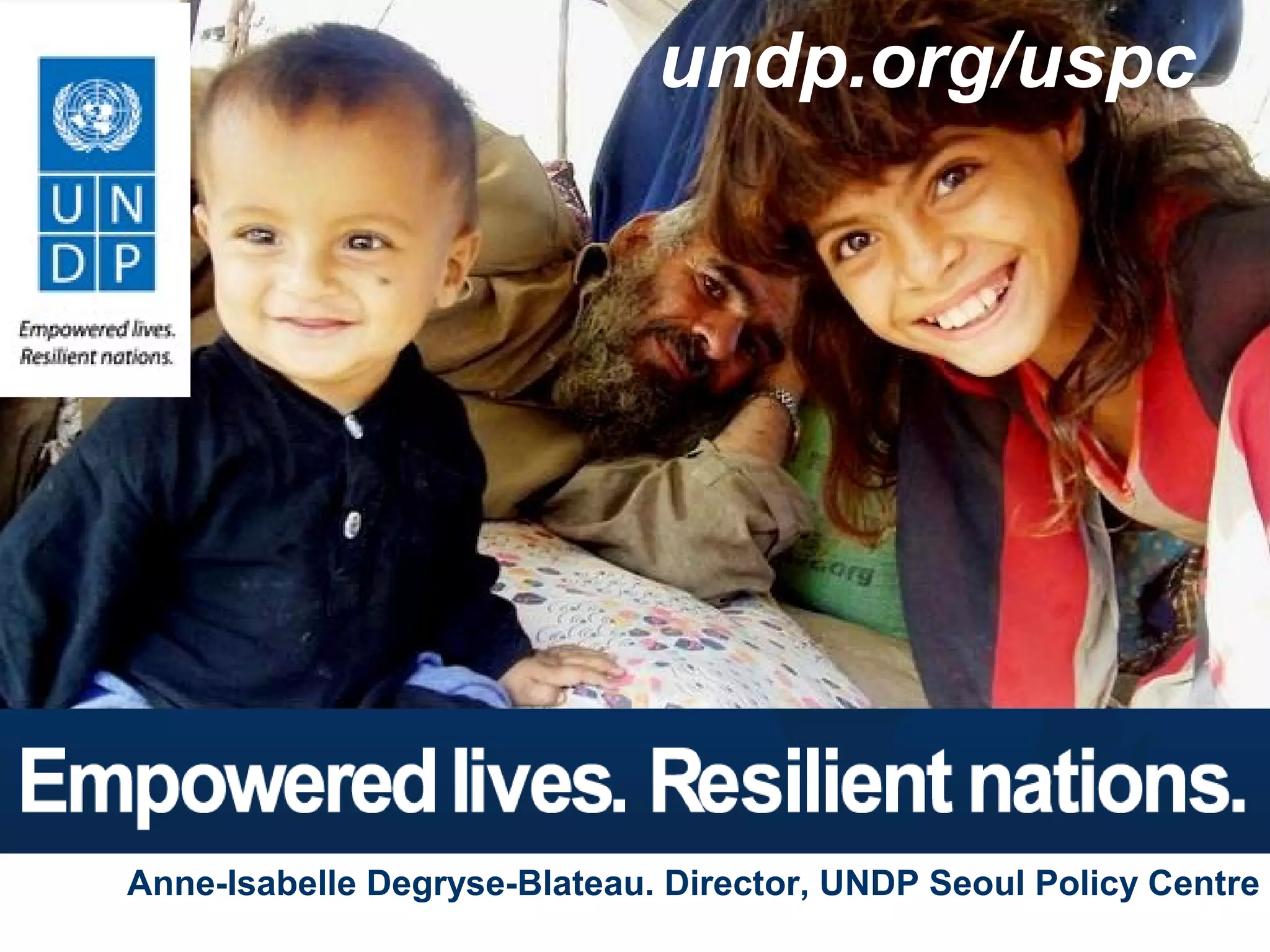
Anne-Isabelle Degryse-Blateau. Director, UNDP Seoul Policy Centre
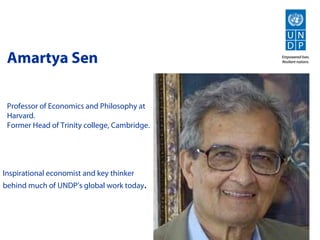
Amartya Sen

 Professor of Economics and Philosophy at
 Harvard.
 Former Head of Trinity college, Cambridge.


Inspirational economist and key thinker
behind much of UNDP’s global work today.
Amartya Sen’s key messages

•    Putting people at the center of the development debate v development
    economics mainstream,
•   income poverty (GDP- Income per capita ) : not the single most important factor in
    assessing the level of development.

•   Studies of different population groups :’there are multiple factors defining what rich
    and what poor means” : health, education, roof on your head, participation in
    decision making..
•   Introduced the notion of “capabilities” and peoples’ welfare

•   1999 Enhancing peoples choices - “Development as freedom”
•   In a world of sheer abundance, some people cannot realize their capabilities & living
    in a state of 'unfreedom',
•   people’s choices determine their well being ..
•   freedoms constitute not only the means but the end in development.

                    Participation, capacity to claim rights
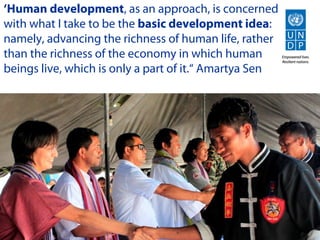
‘Human development, as an approach, is concerned
with what I take to be the basic development idea:
namely, advancing the richness of human life, rather
than the richness of the economy in which human
beings live, which is only a part of it.“ Amartya Sen
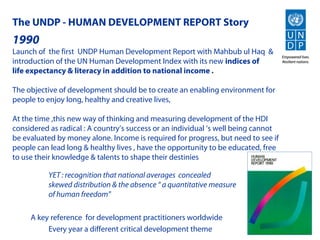
The UNDP - HUMAN DEVELOPMENT REPORT Story
1990
Launch of the first UNDP Human Development Report with Mahbub ul Haq &
introduction of the UN Human Development Index with its new indices of
life expectancy & literacy in addition to national income .

The objective of development should be to create an enabling environment for
people to enjoy long, healthy and creative lives,

At the time ,this new way of thinking and measuring development of the HDI
considered as radical : A country’s success or an individual ‘s well being cannot
be evaluated by money alone. Income is required for progress, but need to see if
people can lead long & healthy lives , have the opportunity to be educated, free
to use their knowledge & talents to shape their destinies

          YET : recognition that national averages concealed
          skewed distribution & the absence “ a quantitative measure
          of human freedom”

     A key reference for development practitioners worldwide
          Every year a different critical development theme
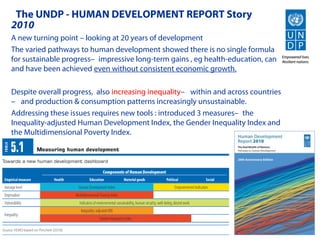
The UNDP - HUMAN DEVELOPMENT REPORT Story
2010
A new turning point – looking at 20 years of development
The varied pathways to human development showed there is no single formula
for sustainable progress—impressive long-term gains , eg health-education, can
and have been achieved even without consistent economic growth.

Despite overall progress, also increasing inequality— within and across countries
— and production & consumption patterns increasingly unsustainable.
Addressing these issues requires new tools : introduced 3 measures—the
Inequality-adjusted Human Development Index, the Gender Inequality Index and
the Multidimensional Poverty Index.
UNDP
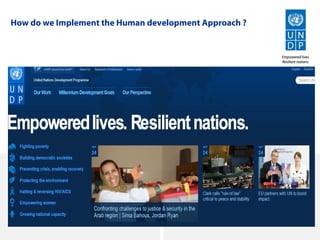
How do we Implement the Human development Approach ?
?
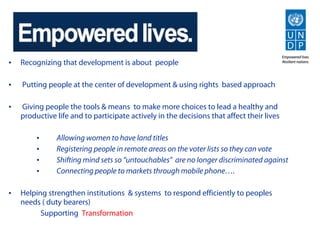
•   Recognizing that development is about people

•   Putting people at the center of development & using rights based approach

•   Giving people the tools & means to make more choices to lead a healthy and
    productive life and to participate actively in the decisions that affect their lives

         •     Allowing women to have land titles
         •     Registering people in remote areas on the voter lists so they can vote
         •     Shifting mind sets so “untouchables” are no longer discriminated against
         •     Connecting people to markets through mobile phone….

•   Helping strengthen institutions & systems to respond efficiently to peoples
    needs ( duty bearers)
          Supporting Transformation
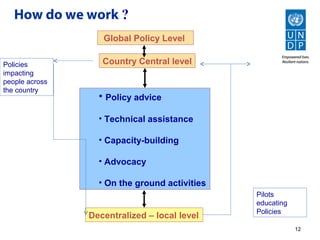
How do we work ?
                   Global Policy Level

Policies           Country Central level
impacting
people across
the country
                  • Policy advice

                  • Technical assistance

                  • Capacity-building

                  • Advocacy

                  • On the ground activities
                                               Pilots
                                               educating
                                               Policies
                Decentralized – local level
                                                           12
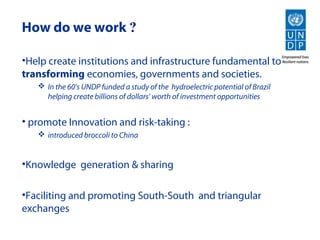
How do we work ?

•Help create institutions and infrastructure fundamental to
transforming economies, governments and societies.
    In the 60’s UNDP funded a study of the hydroelectric potential of Brazil
     helping create billions of dollars’ worth of investment opportunities


• promote Innovation and risk-taking :
    introduced broccoli to China


•Knowledge generation & sharing

•Faciliting and promoting South-South and triangular
exchanges
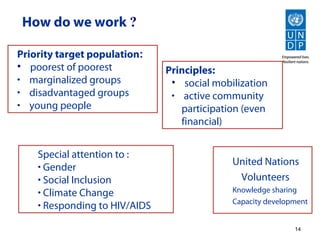
How do we work ?

Priority target population:
• poorest of poorest           Principles:
• marginalized groups           • social mobilization
• disadvantaged groups          • active community
• young people                    participation (even
                                  financial)


    Special attention to :
    • Gender                                 United Nations
    • Social Inclusion                        Volunteers
    • Climate Change                         Knowledge sharing
    • Responding to HIV/AIDS                 Capacity development


                                                             14
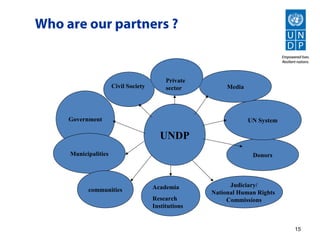
Who are our partners ?


                                           Private
                      Civil Society        sector         Media


     Government                                                   UN System

                                        UNDP
     Municipalities                                                Donors


                                      Academia             Judiciary/
           communities                               National Human Rights
                                      Research            Commissions
                                      Institutions


                                                                              15
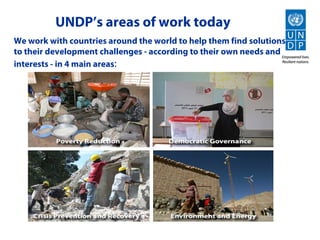
UNDP’s areas of work today
We work with countries around the world to help them find solutions
to their development challenges - according to their own needs and
interests - in 4 main areas:
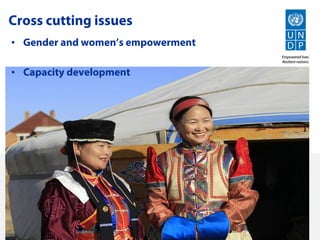
Cross cutting issues
• Gender and women’s empowerment

• Capacity development
Shocks can put countries human development back by years/
    decades
•   If Haiti was as prepared for its 2010 7.0-magnitude quake as Japan was with its
    much larger 9.0 quake, the number of casualties could have been reduced from
    200,000 to in the tens of thousands.

•   One flood in Pakistan resulted in 10 years of lost development

•   The 1998 and 2008 financial crisis rocked economies around the world and full
    recovery has not yet happened. Many jobs lost have not bee reinstated..

•   Oil price crisis impacted nations by driving prices of all oil related activities and
    products sharply up affected the poor countries importing food as prices of food
    also dramatically rose…

Shocks , crisis, new challenges eg CC will continue affecting world
To protect human development progress UNDP helps countries build resilience
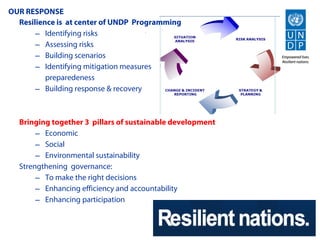
OUR RESPONSE
  Resilience is at center of UNDP Programming
       – Identifying risks
       – Assessing risks
       – Building scenarios
       – Identifying mitigation measures
          preparedeness
       – Building response & recovery


  Bringing together 3 pillars of sustainable development
       – Economic
       – Social
       – Environmental sustainability
  Strengthening governance:
       – To make the right decisions
       – Enhancing efficiency and accountability
       – Enhancing participation
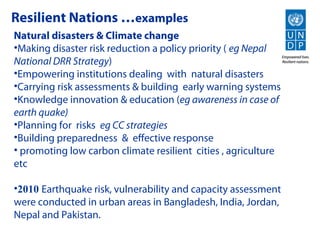
Resilient Nations …examples
Natural disasters & Climate change
•Making disaster risk reduction a policy priority ( eg Nepal
National DRR Strategy)
•Empowering institutions dealing with natural disasters
•Carrying risk assessments & building early warning systems
•Knowledge innovation & education (eg awareness in case of
earth quake)
•Planning for risks eg CC strategies
•Building preparedness & effective response
• promoting low carbon climate resilient cities , agriculture
etc

•2010 Earthquake risk, vulnerability and capacity assessment
were conducted in urban areas in Bangladesh, India, Jordan,
Nepal and Pakistan.
Crisis Prevention and Recovery

In 2010, UNDP implemented crisis prevention and recovery programmes in 86
countries;
•Created 8 million work days through cash-for-work initiatives

•In Cambodia, UNDP and the Mine Action Centre cleared more than 6 million
square metres of mines-affected areas and destroyed over 7,000 landmines.


Responding to increasingly complex development
dynamics

•Increasing # middle income countries : needs are more sophisticated & issues
more complex

•Helping mitigating risks and maximizing opportunities from an ever globalizing
world.
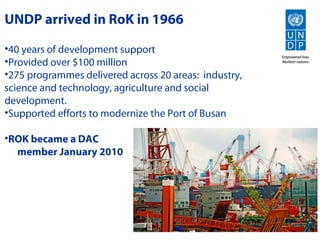
UNDP arrived in RoK in 1966
•40 years of development support
•Provided over $100 million
•275 programmes delivered across 20 areas: industry,
science and technology, agriculture and social
development.
•Supported efforts to modernize the Port of Busan

•ROK became a DAC
  member January 2010
• Began work in January 2011.

• Part of the UN global development and knowledge network.

• Key role : serve as a bridge between developing country policy
  makers and Korea’s development experience

• Supports Korea’s efforts to boost global development agenda
  (eg post-2015, post-Busan)
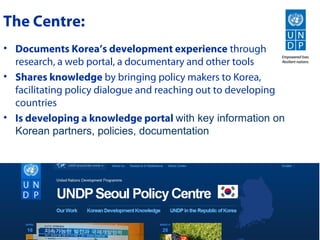
The Centre:
• Documents Korea’s development experience through
  research, a web portal, a documentary and other tools
• Shares knowledge by bringing policy makers to Korea,
  facilitating policy dialogue and reaching out to developing
  countries
• Is developing a knowledge portal with key information on
  Korean partners, policies, documentation
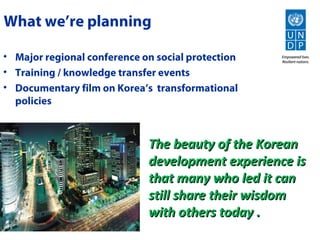
What we’re planning

• Major regional conference on social protection
• Training / knowledge transfer events
• Documentary film on Korea’s transformational
  policies


                             The beauty of the Korean
                             development experience is
                             that many who led it can
                             still share their wisdom
                             with others today .
Amartya Sen : “Twenty years after the appearance of the first
Human Development Report, there is much to celebrate in what
has been achieved. But we also have to be alive to ways of
improving the assessment of old adversities and of recognizing
—and responding to—new threats that endanger human well-
being and freedom.“ 2010 HDR
Giving people choices.         Protecting human
                               development.
 our clients are nations, our measure of success are people
Stay tuned!
      Today’s Photos:
      •Facebook.com/UNDPSPC
      •Twitter: @UNDPSPC
      •undp.org/uspc

Empowered lives. Resilient nations.

  • 1.
    undp.org/uspc Matthew Taylor – Public Affairs Specialist www.undp.org/uspc Anne-Isabelle Degryse-Blateau. Director, UNDP Seoul Policy Centre
  • 2.
    Amartya Sen Professorof Economics and Philosophy at Harvard. Former Head of Trinity college, Cambridge. Inspirational economist and key thinker behind much of UNDP’s global work today.
  • 3.
    Amartya Sen’s keymessages • Putting people at the center of the development debate v development economics mainstream, • income poverty (GDP- Income per capita ) : not the single most important factor in assessing the level of development. • Studies of different population groups :’there are multiple factors defining what rich and what poor means” : health, education, roof on your head, participation in decision making.. • Introduced the notion of “capabilities” and peoples’ welfare • 1999 Enhancing peoples choices - “Development as freedom” • In a world of sheer abundance, some people cannot realize their capabilities & living in a state of 'unfreedom', • people’s choices determine their well being .. • freedoms constitute not only the means but the end in development. Participation, capacity to claim rights
  • 4.
    ‘Human development, asan approach, is concerned with what I take to be the basic development idea: namely, advancing the richness of human life, rather than the richness of the economy in which human beings live, which is only a part of it.“ Amartya Sen
  • 5.
    The UNDP -HUMAN DEVELOPMENT REPORT Story 1990 Launch of the first UNDP Human Development Report with Mahbub ul Haq & introduction of the UN Human Development Index with its new indices of life expectancy & literacy in addition to national income . The objective of development should be to create an enabling environment for people to enjoy long, healthy and creative lives, At the time ,this new way of thinking and measuring development of the HDI considered as radical : A country’s success or an individual ‘s well being cannot be evaluated by money alone. Income is required for progress, but need to see if people can lead long & healthy lives , have the opportunity to be educated, free to use their knowledge & talents to shape their destinies YET : recognition that national averages concealed skewed distribution & the absence “ a quantitative measure of human freedom” A key reference for development practitioners worldwide Every year a different critical development theme
  • 6.
    The UNDP -HUMAN DEVELOPMENT REPORT Story 2010 A new turning point – looking at 20 years of development The varied pathways to human development showed there is no single formula for sustainable progress—impressive long-term gains , eg health-education, can and have been achieved even without consistent economic growth. Despite overall progress, also increasing inequality— within and across countries — and production & consumption patterns increasingly unsustainable. Addressing these issues requires new tools : introduced 3 measures—the Inequality-adjusted Human Development Index, the Gender Inequality Index and the Multidimensional Poverty Index.
  • 8.
  • 9.
    How do weImplement the Human development Approach ?
  • 10.
  • 11.
    Recognizing that development is about people • Putting people at the center of development & using rights based approach • Giving people the tools & means to make more choices to lead a healthy and productive life and to participate actively in the decisions that affect their lives • Allowing women to have land titles • Registering people in remote areas on the voter lists so they can vote • Shifting mind sets so “untouchables” are no longer discriminated against • Connecting people to markets through mobile phone…. • Helping strengthen institutions & systems to respond efficiently to peoples needs ( duty bearers) Supporting Transformation
  • 12.
    How do wework ? Global Policy Level Policies Country Central level impacting people across the country • Policy advice • Technical assistance • Capacity-building • Advocacy • On the ground activities Pilots educating Policies Decentralized – local level 12
  • 13.
    How do wework ? •Help create institutions and infrastructure fundamental to transforming economies, governments and societies.  In the 60’s UNDP funded a study of the hydroelectric potential of Brazil helping create billions of dollars’ worth of investment opportunities • promote Innovation and risk-taking :  introduced broccoli to China •Knowledge generation & sharing •Faciliting and promoting South-South and triangular exchanges
  • 14.
    How do wework ? Priority target population: • poorest of poorest Principles: • marginalized groups • social mobilization • disadvantaged groups • active community • young people participation (even financial) Special attention to : • Gender United Nations • Social Inclusion Volunteers • Climate Change Knowledge sharing • Responding to HIV/AIDS Capacity development 14
  • 15.
    Who are ourpartners ? Private Civil Society sector Media Government UN System UNDP Municipalities Donors Academia Judiciary/ communities National Human Rights Research Commissions Institutions 15
  • 16.
    UNDP’s areas ofwork today We work with countries around the world to help them find solutions to their development challenges - according to their own needs and interests - in 4 main areas:
  • 17.
    Cross cutting issues •Gender and women’s empowerment • Capacity development
  • 19.
    Shocks can putcountries human development back by years/ decades • If Haiti was as prepared for its 2010 7.0-magnitude quake as Japan was with its much larger 9.0 quake, the number of casualties could have been reduced from 200,000 to in the tens of thousands. • One flood in Pakistan resulted in 10 years of lost development • The 1998 and 2008 financial crisis rocked economies around the world and full recovery has not yet happened. Many jobs lost have not bee reinstated.. • Oil price crisis impacted nations by driving prices of all oil related activities and products sharply up affected the poor countries importing food as prices of food also dramatically rose… Shocks , crisis, new challenges eg CC will continue affecting world To protect human development progress UNDP helps countries build resilience
  • 20.
    OUR RESPONSE Resilience is at center of UNDP Programming – Identifying risks – Assessing risks – Building scenarios – Identifying mitigation measures preparedeness – Building response & recovery Bringing together 3 pillars of sustainable development – Economic – Social – Environmental sustainability Strengthening governance: – To make the right decisions – Enhancing efficiency and accountability – Enhancing participation
  • 21.
    Resilient Nations …examples Naturaldisasters & Climate change •Making disaster risk reduction a policy priority ( eg Nepal National DRR Strategy) •Empowering institutions dealing with natural disasters •Carrying risk assessments & building early warning systems •Knowledge innovation & education (eg awareness in case of earth quake) •Planning for risks eg CC strategies •Building preparedness & effective response • promoting low carbon climate resilient cities , agriculture etc •2010 Earthquake risk, vulnerability and capacity assessment were conducted in urban areas in Bangladesh, India, Jordan, Nepal and Pakistan.
  • 22.
    Crisis Prevention andRecovery In 2010, UNDP implemented crisis prevention and recovery programmes in 86 countries; •Created 8 million work days through cash-for-work initiatives •In Cambodia, UNDP and the Mine Action Centre cleared more than 6 million square metres of mines-affected areas and destroyed over 7,000 landmines. Responding to increasingly complex development dynamics •Increasing # middle income countries : needs are more sophisticated & issues more complex •Helping mitigating risks and maximizing opportunities from an ever globalizing world.
  • 23.
    UNDP arrived inRoK in 1966 •40 years of development support •Provided over $100 million •275 programmes delivered across 20 areas: industry, science and technology, agriculture and social development. •Supported efforts to modernize the Port of Busan •ROK became a DAC member January 2010
  • 24.
    • Began workin January 2011. • Part of the UN global development and knowledge network. • Key role : serve as a bridge between developing country policy makers and Korea’s development experience • Supports Korea’s efforts to boost global development agenda (eg post-2015, post-Busan)
  • 25.
    The Centre: • DocumentsKorea’s development experience through research, a web portal, a documentary and other tools • Shares knowledge by bringing policy makers to Korea, facilitating policy dialogue and reaching out to developing countries • Is developing a knowledge portal with key information on Korean partners, policies, documentation
  • 26.
    What we’re planning •Major regional conference on social protection • Training / knowledge transfer events • Documentary film on Korea’s transformational policies The beauty of the Korean development experience is that many who led it can still share their wisdom with others today .
  • 27.
    Amartya Sen :“Twenty years after the appearance of the first Human Development Report, there is much to celebrate in what has been achieved. But we also have to be alive to ways of improving the assessment of old adversities and of recognizing —and responding to—new threats that endanger human well- being and freedom.“ 2010 HDR
  • 28.
    Giving people choices. Protecting human development. our clients are nations, our measure of success are people
  • 29.
    Stay tuned! Today’s Photos: •Facebook.com/UNDPSPC •Twitter: @UNDPSPC •undp.org/uspc

Editor's Notes

  • #4 Eg study on african american pop : hv better salaries that in less developed countries , yet their standard of living is worse…actual purchasing power is less Jews in ghettos lots of money but no rights
  • #6 Gabon huge GDP?capita Hugh NIC compared with GDP in europe..but how people liove completely different and lag wsay behing in terms of HD MPI many poepole graduating fgorm 1 USD /day ,live in richer countries ut uinequalities are growings. Envt degrsting , social fabric desintegrating , need opt sacrifice to get increased revenues
  • #7 . Most people today are healthier, live longer, are more educated and have more access to goods and services. Even in countries facing adverse economic conditions, people’s health and education have greatly improved. And there has been progress not only in improving health and education and raising income, but also in expanding people’s power to select leaders, influence public decisions and share knowledge Gabon huge GDP?capita Hugh NIC compared with GDP in europe..but how people liove completely different and lag wsay behing in terms of HD MPI many poepole graduating fgorm 1 USD /day ,live in richer countries ut uinequalities are growings. Envt degrsting , social fabric desintegrating , need opt sacrifice to get increased revenues DGDP is an average and Poverty line is about basic income Does not reflect : structural differences within income earners limitations some people face in different dimensions of their life Geographical disparities wi counties Gender , ethnic ,disparities & different forms of social exclusion egHIV/AIDS When there is inequality in the distribution of health, education and income, the HDI of an average person in a society is less than the aggregate HDI; the lower the IHDI (and the greater the difference between it and the HDI), the greater the inequality. Countries with less human development tend to have greater inequality in more dimensions—and thus larger losses in human development The disadvantages facing women and girls are a major source of inequality. All too often, women and girls are discriminated against in health, education and the labour market—with negative repercussions for their freedoms complements money-based measures by considering multiple deprivations and their overlap. The index identifies deprivations across the same three dimensions as the HDI and shows the number of people who are poor (suffering a given number of deprivations) and the number of deprivations with which poor households typically contend It can be deconstructed by region, ethnicity and other groupings as well as by dimension, making it an apt tool for policymakers Different types of HDR : Global – regional, country , thematic Eg1st Africa HDR – food securityDifferent types of HDR : Global – regional, country , thematic Eg1st Africa HDR – food security
  • #12 Choices may be difficult : priviledge over millions – find any kind of job to survive
  • #13 Supporting the High Level Panel on post 2015 with DESA inc’ facilitating national consultations Support to Rio+20 earlier this year and implementing its commitments Supporting development related knowledge exchange the G20 and other international fora Providing a joint secretariat with the OECD for the Global Partnership for Effective Development Cooperation agreed at Busan
  • #21 strengthen development gains in post-crisis countries by addressing the underlying causes of violence; reinforcing governance and the rule of law; supporting livelihoods; and by using short-term employment schemes that allow local people to rebuild critical infrastructure following disaster. fostering partnerships and sharing ways to promote participation, accountability and effectiveness at all levels. We aim to build effective and capable states that are accountable and transparent, inclusive and responsive — from elections to participation of women and the poor making growth and trade benefit everyone in developing countries. Stregies on natual resources extraction – for the future- price volatility increases risks Conflict prevention by addressing potential destabilizers – mediation – adressing sources of tentions Ghana – set up a Ntl Peace Council porvided ways ot resolve/ mediate conflicts related ot land- porperty issues land ownership was one of thoirny issues- tribekl cheifs, traditional ownership