ECONOMIC DEVELOPMENT
Presenting by:-
Vikram Sharma
Diksha Raghav
Anant Kumar Pandey
Md Zulquarnain
Md Safdar Aziz
Pooja Naagar
Sakshi Saini
Bhawna Sharma
Manoj Kumar
Under the Guidance of:- Sakshi Jindal
Divya Mam Aakash Parashar
Roopance Jain
Rameeza Khan
PRESENTATION OUTLINE
 INTRODUCTION
 CONCEPT OF ECONOMIC DEVELOPMENT
 MAIN ELEMENTS OF ECONOMIC DEVELOPMENT
 FEATURES OF SUSTAINABLE DEVELOPMENT
 CONDITIONS OF SUSTAINABLE DEVELOPMENT
 SIGNIFICANCE OF SUSTAINABLE DEVELOPMENT
 DIFFERENCE B/W EG,ED & SD
 DETERMINANTS OF ECONOMIC DEVELOPMENT
 ECONOMIC DETERMINANTS
 NON-ECONOMIC DETERMINANTS
INTRODUCTION
CONCEPT OF ECONOMIC
DEVELOPMENT
 Although Adam Smith had examined the problem of economic
development two hundred years ago, yet it is only for the last 10-15
years that economists took great interest in the study of the problems
of underdeveloped countries.
 Actually Economic Development refers to that process by which per
capita income and economic welfare of country increase overtime.
ECONOMIC DEVELOPMENT IN INDIA
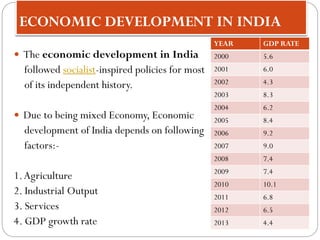
 The economic development in India
followed socialist-inspired policies for most
of its independent history.
 Due to being mixed Economy, Economic
development of India depends on following
factors:-
1.Agriculture
2. Industrial Output
3. Services
4. GDP growth rate
YEAR GDP RATE
2000 5.6
2001 6.0
2002 4.3
2003 8.3
2004 6.2
2005 8.4
2006 9.2
2007 9.0
2008 7.4
2009 7.4
2010 10.1
2011 6.8
2012 6.5
2013 4.4
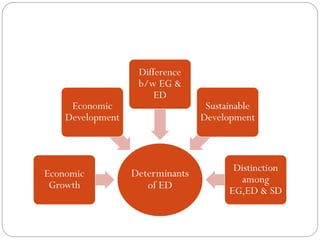
Determinants
of ED
Economic
Growth
Economic
Development
Difference
b/w EG &
ED
Sustainable
Development
Distinction
among
EG,ED & SD
ECONOMIC GROWTH
 Economic growth refer to quantitative changes.
 It is a process of growth in the national & per capita income.
 Acc. to Mc Connell “Economic Growth may be defined as an
increase in the Economy’s real gross national product or real
national income.”
 Acc. to his defn. the production of Larger amount of Goods &
Services signifies growth.
 Acc. to Samuelson “It is a process whereby per capita real income
increases.
Per Capita income = National Income
Population
MAIN ELEMENTS OF ECONOMIC
DEVELOPMENT
 Economic Development is a Process.
 Economic Development is increase in Real Per Capita income.
 It is a Long Period Concept.
 Absence of Rise in Poverty and Ineqality.
DIFFERENCE b/w ED AND EG
ECONOMIC GROWTH ECONOMIC DEVELOPMENT
 SINGLE DIMENSIONAL
 QUANTITATIVE
 CONTINUOUS AND
STEADY CHANGE
 USED FOR DEVELOPED
ECONOMIES.
 MULTI DIMENSIONAL
 QUALITATIVE
 SPONTANEOUS &
DISCONTINUOUS
CHANGE
 USED FOR
DEVELOPING
ECONOMIES.
SUSTAINABLE DEVELOPMENT
 There is a new concept of Economic Development
known as Sustainable Development.
 Actually, Sustainable Development is that process of economic
development which aims at maintaining the quality of life of both
present and future generations without harming natural resources and
environment.
FEATURES OF SUSTAINABLE
DEVELOPMENT
 Efficient use of Natural Resources.
 No Reduction in the Quality of Life of the future generation.
 No Increase in Pollution.
 Does not limit Development.
CONDITIONS OF SUSTAINABLE
DEVELOPMENT
Economic development
Conservation of Natural Capital Stock.
Reduction in Industrial Pollution.
Reduction in Agricultural pollution.
Comprehensive Rural Development.
SIGNIFICANCE OF SUSTAINABLE
DEVELOPMENT
 Raising the standard of living of the existing Population.
 Checking any harm to the living standard of the future generation.
 Protecting the people against Pollution of their quality of their life and
health.
 Conserving environment which is so much necessary for sustainable
development.
DIFFERENCE B/W EG,ED & SD
ECONOMIC GROWTH ECONOMIC
DEVELOPMENT
SUSTAINABLE
DEVELOPMENT
Refers to long term increase in
real per capita income.
Refers to long term increase in
real per capita income
And economic welfare.
Per capita income,economic
welfare & economic welfare of
future generation.
Used for Developed Economies. Used for underdeveloped
Economies.
Used for both type of
Economies.
It ignores the distribution of
Income.
It does not ignore Distribution of
Income.
Doesn’t ignore Distribution of
Income of Present and Future
Generation.
Ignores Protection of
Environment & Checking of
Pollution.
No Special attention to
enviromental protection &
Checking of pollution.
Special Emphasis on
Environmental & Checking of
Pollution.
Exploits to a large extent the
stock of natural Capital.
It exploits the Stock of natural
Capital.
Makes rational utilization of
Stock of natural Capital to
Safeguard the future Genrns.
DETERMINANTS OF ECONOMIC
DEVELOPMENT
Economic
Development
Economic
Determinants
Non- Economic
Determinants
ECONOMIC DETERMINANTS
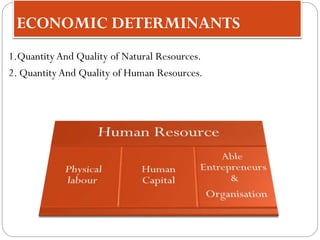
1.Quantity And Quality of Natural Resources.
2. Quantity And Quality of Human Resources.
ECONOMIC DETERMINANTS CONT..
3).Physical Capital Resources
Increase in Real Saving
Mobilisation of Savings or Resources
Investment
ECONOMIC DETERMINANTS CONT..
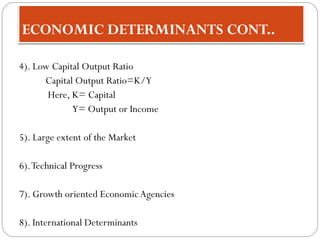
4). Low Capital Output Ratio
Capital Output Ratio=K/Y
Here, K= Capital
Y= Output or Income
5). Large extent of the Market
6).Technical Progress
7). Growth oriented EconomicAgencies
8). International Determinants
NON-ECONOMIC DETERMINANTS
 Social Deteminants
 Political Determinants
 Religious Determinants
 Freedom from Corruption
 Law and Order Situation
 Aspiration of Development
Thanx
For your
Participation
&
Co-ordination

Economic development

  • 1.
    ECONOMIC DEVELOPMENT Presenting by:- VikramSharma Diksha Raghav Anant Kumar Pandey Md Zulquarnain Md Safdar Aziz Pooja Naagar Sakshi Saini Bhawna Sharma Manoj Kumar Under the Guidance of:- Sakshi Jindal Divya Mam Aakash Parashar Roopance Jain Rameeza Khan
  • 2.
    PRESENTATION OUTLINE  INTRODUCTION CONCEPT OF ECONOMIC DEVELOPMENT  MAIN ELEMENTS OF ECONOMIC DEVELOPMENT  FEATURES OF SUSTAINABLE DEVELOPMENT  CONDITIONS OF SUSTAINABLE DEVELOPMENT  SIGNIFICANCE OF SUSTAINABLE DEVELOPMENT  DIFFERENCE B/W EG,ED & SD  DETERMINANTS OF ECONOMIC DEVELOPMENT  ECONOMIC DETERMINANTS  NON-ECONOMIC DETERMINANTS
  • 3.
  • 4.
    CONCEPT OF ECONOMIC DEVELOPMENT Although Adam Smith had examined the problem of economic development two hundred years ago, yet it is only for the last 10-15 years that economists took great interest in the study of the problems of underdeveloped countries.  Actually Economic Development refers to that process by which per capita income and economic welfare of country increase overtime.
  • 5.
    ECONOMIC DEVELOPMENT ININDIA  The economic development in India followed socialist-inspired policies for most of its independent history.  Due to being mixed Economy, Economic development of India depends on following factors:- 1.Agriculture 2. Industrial Output 3. Services 4. GDP growth rate YEAR GDP RATE 2000 5.6 2001 6.0 2002 4.3 2003 8.3 2004 6.2 2005 8.4 2006 9.2 2007 9.0 2008 7.4 2009 7.4 2010 10.1 2011 6.8 2012 6.5 2013 4.4
  • 6.
    Determinants of ED Economic Growth Economic Development Difference b/w EG& ED Sustainable Development Distinction among EG,ED & SD
  • 7.
    ECONOMIC GROWTH  Economicgrowth refer to quantitative changes.  It is a process of growth in the national & per capita income.  Acc. to Mc Connell “Economic Growth may be defined as an increase in the Economy’s real gross national product or real national income.”  Acc. to his defn. the production of Larger amount of Goods & Services signifies growth.  Acc. to Samuelson “It is a process whereby per capita real income increases. Per Capita income = National Income Population
  • 8.
    MAIN ELEMENTS OFECONOMIC DEVELOPMENT  Economic Development is a Process.  Economic Development is increase in Real Per Capita income.  It is a Long Period Concept.  Absence of Rise in Poverty and Ineqality.
  • 9.
    DIFFERENCE b/w EDAND EG ECONOMIC GROWTH ECONOMIC DEVELOPMENT  SINGLE DIMENSIONAL  QUANTITATIVE  CONTINUOUS AND STEADY CHANGE  USED FOR DEVELOPED ECONOMIES.  MULTI DIMENSIONAL  QUALITATIVE  SPONTANEOUS & DISCONTINUOUS CHANGE  USED FOR DEVELOPING ECONOMIES.
  • 10.
    SUSTAINABLE DEVELOPMENT  Thereis a new concept of Economic Development known as Sustainable Development.  Actually, Sustainable Development is that process of economic development which aims at maintaining the quality of life of both present and future generations without harming natural resources and environment.
  • 11.
    FEATURES OF SUSTAINABLE DEVELOPMENT Efficient use of Natural Resources.  No Reduction in the Quality of Life of the future generation.  No Increase in Pollution.  Does not limit Development.
  • 12.
    CONDITIONS OF SUSTAINABLE DEVELOPMENT Economicdevelopment Conservation of Natural Capital Stock. Reduction in Industrial Pollution. Reduction in Agricultural pollution. Comprehensive Rural Development.
  • 13.
    SIGNIFICANCE OF SUSTAINABLE DEVELOPMENT Raising the standard of living of the existing Population.  Checking any harm to the living standard of the future generation.  Protecting the people against Pollution of their quality of their life and health.  Conserving environment which is so much necessary for sustainable development.
  • 14.
    DIFFERENCE B/W EG,ED& SD ECONOMIC GROWTH ECONOMIC DEVELOPMENT SUSTAINABLE DEVELOPMENT Refers to long term increase in real per capita income. Refers to long term increase in real per capita income And economic welfare. Per capita income,economic welfare & economic welfare of future generation. Used for Developed Economies. Used for underdeveloped Economies. Used for both type of Economies. It ignores the distribution of Income. It does not ignore Distribution of Income. Doesn’t ignore Distribution of Income of Present and Future Generation. Ignores Protection of Environment & Checking of Pollution. No Special attention to enviromental protection & Checking of pollution. Special Emphasis on Environmental & Checking of Pollution. Exploits to a large extent the stock of natural Capital. It exploits the Stock of natural Capital. Makes rational utilization of Stock of natural Capital to Safeguard the future Genrns.
  • 15.
  • 16.
    ECONOMIC DETERMINANTS 1.Quantity AndQuality of Natural Resources. 2. Quantity And Quality of Human Resources.
  • 17.
    ECONOMIC DETERMINANTS CONT.. 3).PhysicalCapital Resources Increase in Real Saving Mobilisation of Savings or Resources Investment
  • 18.
    ECONOMIC DETERMINANTS CONT.. 4).Low Capital Output Ratio Capital Output Ratio=K/Y Here, K= Capital Y= Output or Income 5). Large extent of the Market 6).Technical Progress 7). Growth oriented EconomicAgencies 8). International Determinants
  • 19.
    NON-ECONOMIC DETERMINANTS  SocialDeteminants  Political Determinants  Religious Determinants  Freedom from Corruption  Law and Order Situation  Aspiration of Development
  • 20.