How does Inquiry Based Learning affect students’ capabilities? Graham Jones School of Health and Related Research [email_address]
Structure Acknowledgments What are capabilities? Capabilities in practice : Nussbaum, Alkire (How) are they relevant to (higher) education and pedagogy (Walker and her categorisations)? This case study: IBL and capabilities Methods  Findings Conclusions
Acknowledgements Dave Phillips Sarah Barnes Jenny Owen Sabine Little CILASS MPH students
What are capabilities? - Sen Nobel laureate, Amartya Sen first used the word ‘capability’ in its present meaning in 1979 to refer to an approach to well-being in terms of  freedoms : to choose among various alternatives including: ‘being happy; achieving self-respect; taking part in the life of the community’.  Capabilities are to do with the freedom to pursue valuable ‘doings’ and ‘beings’ in order to flourish as a human being. Central to this approach is the notion of a  capability set  which refers to the alternative combinations of things a person is able to do or be.
Capabilities: some aspects Central to Human development approach and provides philosophical and theoretical underpinnings to United Nation Human Development reports, and Human development Index Both a (the?) goal of “Development”, and the means of achieving it (Sen, 1999)  Provides a broad enough evaluative space for understanding and investigating “all” human development Inherently inter-disciplinary with potential applications in political philosophy, welfare economics, development studies, health, education etc etc Distinguishes  between capability (opportunity) and functioning (achievement, or realisation)
So what are capabilities? - Nussbuam Sen never says:  It’s the freedom to choose between them that’s important Important to leave room for reasoned public debate Nussbaum  proposes a defined list of capabilities as the basis for fundamental political principles (“such as might be embodied in a nation’s constitution)” (Nussbaum, 2004) The “moral entitlement of every human being” Abstract but capable of local translation and deliberation  Derived from  a (her) conception of the dignity of the human being, and of a life that is worthy of that dignity
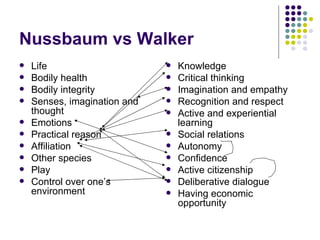
Nussbaum’s list - 1 Life : being able to live to the end of a normal human life. Bodily health : being able to have good health, including reproductive health. Bodily integrity : being able to move freely, secure against assault; having opportunities for sexual satisfaction and choice in reproduction. Senses, imagination and thought : freedom of use and expression of all three. Emotions : not to be blighted by fear, anxiety, abuse or neglect.
Nussbaum’s list - 2 Practical reason : being able to engage in critical reflection – including the use of conscience.  Affiliation : to be able to interact, show compassion etc. to have friendships.  Other species : concern for animals, plants and the world of nature. Play : being able to laugh and enjoy recreation. Control over one’s environment : political and material Freedom of assembly and speech. Being able to live one’s life:  choice over childbearing, sexuality, speech and employment
Alkire Nussbaum is inherently philosophical, but you can identify “dimensions” of human development (the primary colours of values) Desire to operationalise capabilities in social realities of poor people Rose growing versus literacy versus goat herding in rural Pakistan Uses a participatory practical reasoning approach,  that covers all the dimensions Puts the focus on how you arrive at capabilities (“facilitators wore simple clothing”)
So why are they interesting? Education as extension of human capabilities Go beyond instrumental views of education – “get that job”  Focus on what people are actually able to be and to do (not abstract rights) Rooted in Aristotelian notions of human flourishing - virtue Inherently inter-disciplinary Connects the world of education to the “real world” – the same evaluative space
Walker’s use of capabilities Uses the notion of ‘functional capabilities’ to capture the importance in education of both capability (opportunity) and functioning (achievement) In depth interviews and focus groups with students, 3 rd  year undergraduate South African history, and “Protection of the environment” modules Analysed using Alkire’s methods for identifying and measuring valued opportunities and achievements  Output: Vague and thick (discipline specific?)
Walker’s functional capabilities (thin version) Knowledge Social relations Critical thinking Imagination and empathy Recognition and respect Active and experiential learning Autonomy Confidence Active citizenship Deliberative dialogue Having economic opportunity
Some issues with Walker Are they “complete”? Are they “orthogonal”? What are the contexts or domains (the educational world, the “real” world)? How exactly did she arrive at her list? How do they relate to other lists?
Nussbaum vs Walker Life  Bodily health  Bodily integrity Senses, imagination and thought  Emotions  Practical reason Affiliation  Other species Play Control over one’s environment Knowledge Critical thinking Imagination and empathy Recognition and respect Active and experiential learning Social relations  Autonomy Confidence Active citizenship Deliberative dialogue Having economic opportunity
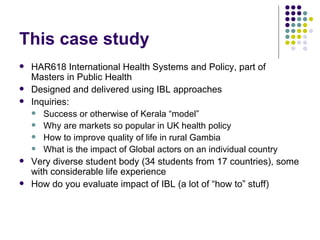
This case study HAR618 International Health Systems and Policy, part of Masters in Public Health Designed and delivered using IBL approaches Inquiries:  Success or otherwise of Kerala “model” Why are markets so popular in UK health policy How to improve quality of life in rural Gambia What is the impact of Global actors on an individual country Very diverse student body (34 students from 17 countries), some with considerable life experience How do you evaluate impact of IBL (a lot of “how to” stuff)
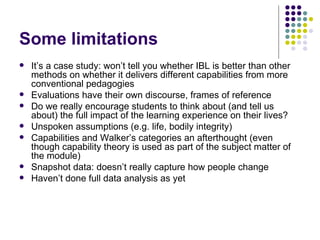
Some limitations It’s a case study: won’t tell you whether IBL is better than other methods on whether it delivers different capabilities from more conventional pedagogies Evaluations have their own discourse, frames of reference Do we really encourage students to think about (and tell us about) the full impact of the learning experience on their lives? Unspoken assumptions (e.g. life, bodily integrity) Capabilities and Walker’s categories an afterthought (even though capability theory is used as part of the subject matter of the module) Snapshot data: doesn’t really capture how people change Haven’t done full data analysis as yet
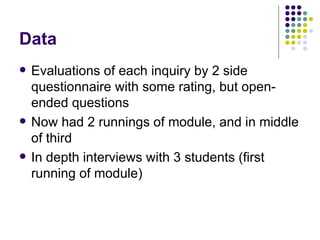
Data Evaluations of each inquiry by 2 side questionnaire with some rating, but open-ended questions Now had 2 runnings of module, and in middle of third In depth interviews with 3 students (first running of module)
Data analysis All comments coded using Walker’s categories Those that didn’t fit, analysed further and new categories established
“ Difficult at first but very rewarding”
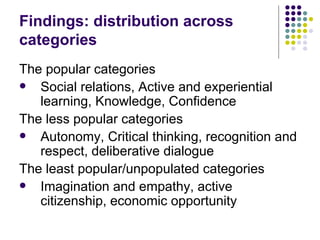
Findings: distribution across categories The popular categories  Social relations, Active and experiential learning ,  Knowledge, Confidence The less popular categories Autonomy, Critical thinking, recognition and respect, deliberative dialogue The least popular/unpopulated categories Imagination and empathy, active citizenship, economic opportunity
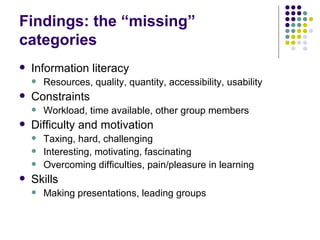
Findings: the “missing” categories Information literacy Resources, quality, quantity, accessibility, usability Constraints Workload, time available, other group members  Difficulty and motivation Taxing, hard, challenging Interesting, motivating, fascinating Overcoming difficulties, pain/pleasure in learning Skills Making presentations, leading groups
Some results IBL fairly well attuned to some elements on the Walker list e.g. active and experiential learning We’re dominated by preset learning outcome, rather than negotiated capability There is some exercise of capability in “module choice” and programme choice
Reflections on findings: power Very little explicit mention, but some indirect references e.g. views ignored by other group members Implicit in Social Relations? The category that dare not speak its name? Freirian (Brechtian) pedagogies?
Reflections on findings Are all capabilities born equal?  What is the relative importance of different capabilities? Do different students value different capabilities ? Students implicitly undertake a difficulty/workload/capability calculus Is this where Valuing of educational capabilities takes place? Can we make this explicit? Importance of motivation (and trust in educational process?) How much does education change students views on their valued capabilities (better informed choices?)
Reflections on findings: Walker Does her collapse of functioning and capabilities into functional capabilities just muddy the water ? Is active and experiential learning really a capability? Are the categories too imprecise, too inter-related? Are the capabilities identified designed for success in the educational world or the real world?
Reflections on findings: negative capabilities (“negative” questions: what did you least like?)
Does IBL increase student capability? Yes Almost by definition (“active and experiential learning”) IBL involves greater student choice Some positive evidence for changes in capabilities Students educational capabilities or their life-chance capabilities? Some evidence that it can change students perceptions of capabilities, and students engage in capability trade-offs
Does capability offer a good evaluative approach for IBL? Positives Pedagogies and policies can be in  same framework Interdisciplinary, but can be made context/discipline/sensitive Can be participative and negotiated Can connect educational world and real world Negatives Difficult to pin down Does it really offer something new?
Some talking points The indirect affects of capabilities : economic opportunity has a lot of by-products! Qualification or capability? Social construction of capabilities: interdependence of learning e.g. lecturers determining group allocation to maximise diversity, and avoid cliques Do students and lecturers value different capabilities? How much should we/can we negotiate the capabilities? Capturing the dynamism of good learning processes
Some key references Alkire, S. 2002.  Valuing freedoms . Oxford: Oxford University Press  Nussbaum, Martha. 2003. Capabilities as fundamental entitlements: Sen and social justice.  Feminist Economics , 9, 33–59. Robeyns, I. 2006 Three models of education: Rights, capabilities and human capital.  Theory and Research in Education , 4 (1) 69-84. Sen, Amartya. 1993. Capability and well-being. In Martha Nussbaum and Amartya Sen (eds),  The Quality of Life . Oxford: Clarendon Press. Sen, Amartya. 1999.  Development as Freedom . New York: Knopf. E. Unterhalter and L. Terzi (2005, ongoing), Capability and Thematic Group Bibliographic Database, http://k1.ioe.ac.uk/schools/efps/elaine/Capability-and-Education.pdf M. Walker(2005),  Higher Education Pedagogies: A Capability Approach  (Open University Press) Walker, M. (2008). A human capabilities framework for evaluating student learning.  Teaching in Higher Education , 13 (4), 477-487.  Walker, M.  (2008) Human capability, mild perfectionism and thickened educational praxis,  Pedagogy, Culture & Society , 16(2),149 — 162
“ In the early morning I pick flowers. When I do this, I feel I have done sawab – holy work. Inner peace comes ” Dadi Taja, rose cultivator

How Does Inquiry Based Learning Affect Students?

  • 1.
    How does InquiryBased Learning affect students’ capabilities? Graham Jones School of Health and Related Research [email_address]
  • 2.
    Structure Acknowledgments Whatare capabilities? Capabilities in practice : Nussbaum, Alkire (How) are they relevant to (higher) education and pedagogy (Walker and her categorisations)? This case study: IBL and capabilities Methods Findings Conclusions
  • 3.
    Acknowledgements Dave PhillipsSarah Barnes Jenny Owen Sabine Little CILASS MPH students
  • 4.
    What are capabilities?- Sen Nobel laureate, Amartya Sen first used the word ‘capability’ in its present meaning in 1979 to refer to an approach to well-being in terms of freedoms : to choose among various alternatives including: ‘being happy; achieving self-respect; taking part in the life of the community’. Capabilities are to do with the freedom to pursue valuable ‘doings’ and ‘beings’ in order to flourish as a human being. Central to this approach is the notion of a capability set which refers to the alternative combinations of things a person is able to do or be.
  • 5.
    Capabilities: some aspectsCentral to Human development approach and provides philosophical and theoretical underpinnings to United Nation Human Development reports, and Human development Index Both a (the?) goal of “Development”, and the means of achieving it (Sen, 1999) Provides a broad enough evaluative space for understanding and investigating “all” human development Inherently inter-disciplinary with potential applications in political philosophy, welfare economics, development studies, health, education etc etc Distinguishes between capability (opportunity) and functioning (achievement, or realisation)
  • 6.
    So what arecapabilities? - Nussbuam Sen never says: It’s the freedom to choose between them that’s important Important to leave room for reasoned public debate Nussbaum proposes a defined list of capabilities as the basis for fundamental political principles (“such as might be embodied in a nation’s constitution)” (Nussbaum, 2004) The “moral entitlement of every human being” Abstract but capable of local translation and deliberation Derived from a (her) conception of the dignity of the human being, and of a life that is worthy of that dignity
  • 7.
    Nussbaum’s list -1 Life : being able to live to the end of a normal human life. Bodily health : being able to have good health, including reproductive health. Bodily integrity : being able to move freely, secure against assault; having opportunities for sexual satisfaction and choice in reproduction. Senses, imagination and thought : freedom of use and expression of all three. Emotions : not to be blighted by fear, anxiety, abuse or neglect.
  • 8.
    Nussbaum’s list -2 Practical reason : being able to engage in critical reflection – including the use of conscience. Affiliation : to be able to interact, show compassion etc. to have friendships. Other species : concern for animals, plants and the world of nature. Play : being able to laugh and enjoy recreation. Control over one’s environment : political and material Freedom of assembly and speech. Being able to live one’s life: choice over childbearing, sexuality, speech and employment
  • 9.
    Alkire Nussbaum isinherently philosophical, but you can identify “dimensions” of human development (the primary colours of values) Desire to operationalise capabilities in social realities of poor people Rose growing versus literacy versus goat herding in rural Pakistan Uses a participatory practical reasoning approach, that covers all the dimensions Puts the focus on how you arrive at capabilities (“facilitators wore simple clothing”)
  • 10.
    So why arethey interesting? Education as extension of human capabilities Go beyond instrumental views of education – “get that job” Focus on what people are actually able to be and to do (not abstract rights) Rooted in Aristotelian notions of human flourishing - virtue Inherently inter-disciplinary Connects the world of education to the “real world” – the same evaluative space
  • 11.
    Walker’s use ofcapabilities Uses the notion of ‘functional capabilities’ to capture the importance in education of both capability (opportunity) and functioning (achievement) In depth interviews and focus groups with students, 3 rd year undergraduate South African history, and “Protection of the environment” modules Analysed using Alkire’s methods for identifying and measuring valued opportunities and achievements Output: Vague and thick (discipline specific?)
  • 12.
    Walker’s functional capabilities(thin version) Knowledge Social relations Critical thinking Imagination and empathy Recognition and respect Active and experiential learning Autonomy Confidence Active citizenship Deliberative dialogue Having economic opportunity
  • 13.
    Some issues withWalker Are they “complete”? Are they “orthogonal”? What are the contexts or domains (the educational world, the “real” world)? How exactly did she arrive at her list? How do they relate to other lists?
  • 14.
    Nussbaum vs WalkerLife Bodily health Bodily integrity Senses, imagination and thought Emotions Practical reason Affiliation Other species Play Control over one’s environment Knowledge Critical thinking Imagination and empathy Recognition and respect Active and experiential learning Social relations Autonomy Confidence Active citizenship Deliberative dialogue Having economic opportunity
  • 15.
    This case studyHAR618 International Health Systems and Policy, part of Masters in Public Health Designed and delivered using IBL approaches Inquiries: Success or otherwise of Kerala “model” Why are markets so popular in UK health policy How to improve quality of life in rural Gambia What is the impact of Global actors on an individual country Very diverse student body (34 students from 17 countries), some with considerable life experience How do you evaluate impact of IBL (a lot of “how to” stuff)
  • 16.
    Some limitations It’sa case study: won’t tell you whether IBL is better than other methods on whether it delivers different capabilities from more conventional pedagogies Evaluations have their own discourse, frames of reference Do we really encourage students to think about (and tell us about) the full impact of the learning experience on their lives? Unspoken assumptions (e.g. life, bodily integrity) Capabilities and Walker’s categories an afterthought (even though capability theory is used as part of the subject matter of the module) Snapshot data: doesn’t really capture how people change Haven’t done full data analysis as yet
  • 17.
    Data Evaluations ofeach inquiry by 2 side questionnaire with some rating, but open-ended questions Now had 2 runnings of module, and in middle of third In depth interviews with 3 students (first running of module)
  • 18.
    Data analysis Allcomments coded using Walker’s categories Those that didn’t fit, analysed further and new categories established
  • 19.
    “ Difficult atfirst but very rewarding”
  • 20.
    Findings: distribution acrosscategories The popular categories Social relations, Active and experiential learning , Knowledge, Confidence The less popular categories Autonomy, Critical thinking, recognition and respect, deliberative dialogue The least popular/unpopulated categories Imagination and empathy, active citizenship, economic opportunity
  • 21.
    Findings: the “missing”categories Information literacy Resources, quality, quantity, accessibility, usability Constraints Workload, time available, other group members Difficulty and motivation Taxing, hard, challenging Interesting, motivating, fascinating Overcoming difficulties, pain/pleasure in learning Skills Making presentations, leading groups
  • 22.
    Some results IBLfairly well attuned to some elements on the Walker list e.g. active and experiential learning We’re dominated by preset learning outcome, rather than negotiated capability There is some exercise of capability in “module choice” and programme choice
  • 23.
    Reflections on findings:power Very little explicit mention, but some indirect references e.g. views ignored by other group members Implicit in Social Relations? The category that dare not speak its name? Freirian (Brechtian) pedagogies?
  • 24.
    Reflections on findingsAre all capabilities born equal? What is the relative importance of different capabilities? Do different students value different capabilities ? Students implicitly undertake a difficulty/workload/capability calculus Is this where Valuing of educational capabilities takes place? Can we make this explicit? Importance of motivation (and trust in educational process?) How much does education change students views on their valued capabilities (better informed choices?)
  • 25.
    Reflections on findings:Walker Does her collapse of functioning and capabilities into functional capabilities just muddy the water ? Is active and experiential learning really a capability? Are the categories too imprecise, too inter-related? Are the capabilities identified designed for success in the educational world or the real world?
  • 26.
    Reflections on findings:negative capabilities (“negative” questions: what did you least like?)
  • 27.
    Does IBL increasestudent capability? Yes Almost by definition (“active and experiential learning”) IBL involves greater student choice Some positive evidence for changes in capabilities Students educational capabilities or their life-chance capabilities? Some evidence that it can change students perceptions of capabilities, and students engage in capability trade-offs
  • 28.
    Does capability offera good evaluative approach for IBL? Positives Pedagogies and policies can be in same framework Interdisciplinary, but can be made context/discipline/sensitive Can be participative and negotiated Can connect educational world and real world Negatives Difficult to pin down Does it really offer something new?
  • 29.
    Some talking pointsThe indirect affects of capabilities : economic opportunity has a lot of by-products! Qualification or capability? Social construction of capabilities: interdependence of learning e.g. lecturers determining group allocation to maximise diversity, and avoid cliques Do students and lecturers value different capabilities? How much should we/can we negotiate the capabilities? Capturing the dynamism of good learning processes
  • 30.
    Some key referencesAlkire, S. 2002. Valuing freedoms . Oxford: Oxford University Press Nussbaum, Martha. 2003. Capabilities as fundamental entitlements: Sen and social justice. Feminist Economics , 9, 33–59. Robeyns, I. 2006 Three models of education: Rights, capabilities and human capital. Theory and Research in Education , 4 (1) 69-84. Sen, Amartya. 1993. Capability and well-being. In Martha Nussbaum and Amartya Sen (eds), The Quality of Life . Oxford: Clarendon Press. Sen, Amartya. 1999. Development as Freedom . New York: Knopf. E. Unterhalter and L. Terzi (2005, ongoing), Capability and Thematic Group Bibliographic Database, http://k1.ioe.ac.uk/schools/efps/elaine/Capability-and-Education.pdf M. Walker(2005), Higher Education Pedagogies: A Capability Approach (Open University Press) Walker, M. (2008). A human capabilities framework for evaluating student learning. Teaching in Higher Education , 13 (4), 477-487. Walker, M. (2008) Human capability, mild perfectionism and thickened educational praxis, Pedagogy, Culture & Society , 16(2),149 — 162
  • 31.
    “ In theearly morning I pick flowers. When I do this, I feel I have done sawab – holy work. Inner peace comes ” Dadi Taja, rose cultivator