Industrial Relations System
Industrial Relations
Prepared By
Kindly restrict the use of slides for personal purpose.
Please seek permission to reproduce the same in public forms and presentations.
Manu Melwin Joy
Assistant Professor
Ilahia School of Management Studies
Kerala, India.
Phone – 9744551114
Mail – manu_melwinjoy@yahoo.com
Industrial Relations System
• An industrial relations
system consists of the
whole gamut of
relationships between
employees and employees
and employers which are
managed by the means of
conflict and cooperation.
Industrial Relations System
• A sound industrial relations
system is one in which
relationships between
management and employees
(and their representatives) on
the one hand, and between them
and the State on the other, are
more harmonious and
cooperative than conflicting, and
creates an environment
conducive to economic efficiency
and the motivation, productivity
and development of the
employee and generates
employee loyalty and mutual
trust.
Industrial Relations System
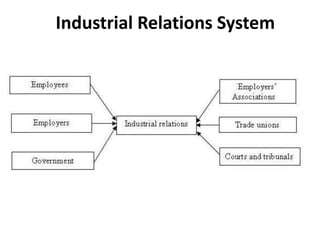
Actors in the IR system
• Actors in the IR
system: Three main parties
are directly involved in
industrial relations:
– Employers.
– Employees.
– Government.
Actors in the IR system
• Employers: Employers
possess certain rights vis-à-
vis labors. They have the
right to hire and fire them.
Management can also
affect workers’ interests by
exercising their right to
relocate, close or merge the
factory or to introduce
technological changes.
Actors in the IR system
• Employees: Workers seek to
improve the terms and
conditions of their
employment. They exchange
views with management and
voice their grievances. They
also want to share decision
making powers of
management. Workers
generally unite to form
unions against the
management and get support
from these unions.
Actors in the IR system
• Government: The central
and state government
influences and regulates
industrial relations through
laws, rules, agreements,
awards of court ad the like.
It also includes third parties
and labor and tribunal
courts.
Industrial Relations Systems  - Industrial Relations

Industrial Relations Systems - Industrial Relations

  • 1.
  • 2.
    Prepared By Kindly restrictthe use of slides for personal purpose. Please seek permission to reproduce the same in public forms and presentations. Manu Melwin Joy Assistant Professor Ilahia School of Management Studies Kerala, India. Phone – 9744551114 Mail – manu_melwinjoy@yahoo.com
  • 3.
    Industrial Relations System •An industrial relations system consists of the whole gamut of relationships between employees and employees and employers which are managed by the means of conflict and cooperation.
  • 4.
    Industrial Relations System •A sound industrial relations system is one in which relationships between management and employees (and their representatives) on the one hand, and between them and the State on the other, are more harmonious and cooperative than conflicting, and creates an environment conducive to economic efficiency and the motivation, productivity and development of the employee and generates employee loyalty and mutual trust.
  • 5.
  • 6.
    Actors in theIR system • Actors in the IR system: Three main parties are directly involved in industrial relations: – Employers. – Employees. – Government.
  • 7.
    Actors in theIR system • Employers: Employers possess certain rights vis-à- vis labors. They have the right to hire and fire them. Management can also affect workers’ interests by exercising their right to relocate, close or merge the factory or to introduce technological changes.
  • 8.
    Actors in theIR system • Employees: Workers seek to improve the terms and conditions of their employment. They exchange views with management and voice their grievances. They also want to share decision making powers of management. Workers generally unite to form unions against the management and get support from these unions.
  • 9.
    Actors in theIR system • Government: The central and state government influences and regulates industrial relations through laws, rules, agreements, awards of court ad the like. It also includes third parties and labor and tribunal courts.