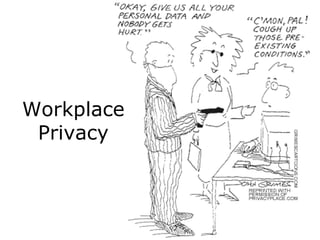
Workplace Privacy
Brief Outline Introduction and Context Legislation: Federal, Provincial Two Case Studies Electronic Privacy—Does it Exist? The Scary Truth About Big Brother When to Reveal Your Secrets
Privacy Exercise Turn to your neighbour and tell them something privately…
Context of Discussion Ontario Public Libraries Remember—this is  very  different in the USA!
Canadian Charter of  Rights and Freedoms 2.Everyone has the following fundamental freedoms: freedom of conscience and religion; freedom of thought, belief, opinion and  expression, including freedom of the press and other media of communication; freedom of peaceful assembly; freedom of association Department of Justice Canada. (1982).  Canadian Charter of Rights and Freedoms.  Retrieved February  22, 2008 from  http://laws.justice.gc.ca/en/charter/#libertes
Privacy Legislation Map of Privacy Legislation in Canada
Freedom of Information  and Protection of Privacy Act (FIPPA) FIPPA applies to Ontario’s  provincial  ministries and  most  provincial agencies, boards, and commissions, as well as community colleges, universities and Local Health Integration Networks (LHINs). FIPPA requires   that the government   protect the privacy of an individual’s personal information existing in government records.  It gives individuals the right to request access  to government information, including general  records and records containing their own  personal information. Information & Privacy Commissioner/Ontario. (2007).  A mini guide to the Freedom of Information  and Protection of Privacy Act.  Retrieved February 22, 2008, from  http://www.ipc.on.ca/images/Resources/up-1mini_p_e.pdf.
Municipal Freedom of Information and Protection of Privacy Act (MFIPPA) Applies to municipalities ,  local boards, agencies, and commissions This may include information held by a school board, board of health, public utility, police commission, or PUBLIC LIBRARY BOARDS!!!!! Requires that  local  government organizations protect the privacy of an individual’s personal information existing in government records Gives individuals the right to request access to municipal government information,   including most general records and records  containing their own personal information   Information & Privacy Commissioner/Ontario. (1998).  A mini guide to the Municipal Freedom of  Information and Protection of Privacy Act.  Retrieved February 22, 2008, from  http://www.ipc.on.ca/images/Resources/up-mini_m_e.pdf.
Privacy Protection FIPPA & MFIPPA create a privacy protection scheme which the government must follow to protect an individual’s right to privacy This includes rules regarding the collection, retention, use, disclosure, and disposal of personal information in its custody or control Under FIPPA and MFIPPA,  personal information  means recorded information about an individual  This may include the individual’s name,  address, sex, age, education, medical, or  employment history—and any other information about the individual Information & Privacy Commissioner/Ontario. (2006).  Your privacy rights.  Retrieved February 22, 2008, from http://www.ipc.on.ca/index.asp?navid=12.
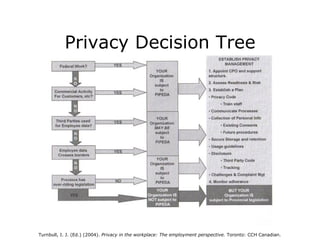
Privacy Decision Tree Turnbull, I. J. (Ed.) (2004).  Privacy in the workplace: The employment perspective.  Toronto: CCH Canadian.
CSA Model Code—  10 Privacy Principles Accountability Identifying Purposes Consent Limiting Collection Limiting Use, Disclosure, and Retention Accuracy Safeguards Openness Individual Access Challenging Compliance
Privacy and Libraries Ontario Public Libraries Act Contains few specific references to privacy issues (MFIPPA cited twice)  Canadian Library Association (CLA)  Code of Ethics Members of the CLA have the individual  & collective responsibility to “protect  the privacy and dignity of library  users and staff” Government of Ontario.   (1990).  The public libraries act.  Retrieved February 26, 2008, from  http://www.e-laws.gov.on.ca/html/statutes/english/elaws_statutes_90p44_e.htm.
Case Studies Small and Rural: the County of Brant Public Library Big and Urban: the Toronto Public Library
County of Brant Public Library Privacy Policies Policy adheres to the Municipal Freedom of Information and Protection of Privacy Act States that every employee has the right to access his or her own information States that “no document is to be removed from an employee’s file or be photocopied without approval of the librarian” Also specifies that “reasonable measures”  must be put in place to prevent un- authorized access to employee records County of Brant Public Library Personnel Policy. Rev. September 20, 2005.
Toronto Public Library Privacy Policies Written policy covers collection, use, disclosure of staff information per MFIPPA States information will be retained for 7 years after retirement or resignation  Staff members have the right to view their records upon request TPL policy does not outline its  responsibility to protect its employees’  privacy Has separate policy on use of video  surveillance Toronto Public Library Access to Information and Protection of Privacy Policy. Rev. March 26, 2007
Current Issues Electronic privacy—does it exist? Types of electronic surveillance The dangers of Web 2.0
Big Brother  is  Watching You According to a 2005 American Management Association survey of employers: 76 percent monitor workers' website connections  55 percent retain and review email messages 51 percent of employers monitor employee telephone use (including tracking the amount of time spent on the phone as well as the specific numbers called) Testing workers for drug use has become “ routine” Pfeffer, J. (2006).  It's time to start trusting the workforce.  Business 2.0 Magazine 7 (11).
Big Brother is Monitoring… Email Website Activity IM Chat Telephones Surveillance Cameras Your Body
Social Networking Privacy of Social Networks
Web 2. Uh-Oh Facebook & MySpace—the employer’s new fact-checkers 77% of executive recruiters used web search engines to research candidates 35% said they had ruled candidates out of the running on that basis Check out the Information & Privacy Commissioner’s tipsheet on How to Protect Facebook Privacy  (find the link in the Resources we posted  on the LIS 671 Sharepoint site) Information & Privacy Commissioner/Ontario. (2006).  Reference check: Is your boss watching? Privacy  and your Facebook profile.  Retrieved February 22, 2008, from http://www.ipc.on.ca.
Personal Searches An employer may have an implied right to conduct searches (i.e., through a collective agreement, or by condition of employment by virtue of past practice) A search can only be justified where the employer has a “real and substantial” suspicion of wrongdoing  or  pursuant  to a clear provision in a collective  agreement Klein, K. & Gates, V. (2005).  Privacy in employment: Control of personal information in the workplace.  Toronto: Thomson Carswell.
Effect on Employees Constant employee monitoring (e.g., of email) may lead to employee psychological and physical health problems, increased boredom, high tension, extreme anxiety, depression, anger, severe fatigue, and musculoskeletal problems Since 2004, turnover due to low morale has increased: turnover of executives, salespeople, and production employees has nearly  doubled, while turnover of professional  and technical personnel has jumped  about 70 percent Klein, K. & Gates, V. (2005).  Privacy in employment: Control of personal information in the workplace.  Toronto: Tomson Carswell.   Pfeffer, J. (2006).  It's time to start trusting the workforce.  Business 2.0 Magazine, 7 (11).
Do You Have to Tell? You may be required to disclose an illness if: Your employee benefit plan requires you to submit claims through your employer rather than directly to the company Your employer has an absenteeism policy that requires you to provide a medical certificate if you miss more than a specified  number of days of work You are requesting accommodation Canadian Mental Health Association. (2007).  Mental health works: Talking to your employer.  Retrieved  February 21, 2008 from http://www.mentalhealthworks.ca/employees/talking_to_your_employer.asp
Consider Before Telling Are you comfortable with your employer, manager/supervisor, and co-workers?  What are your circumstances within the company? (Are you particularly valuable?)  Are there accommodation or disability policies in place?  Has anyone else disclosed an illness/personal issue? Did they receive accommodation?  How stressful is it for you to hide your  problem?  Canadian Mental Health Association. (2007).  Mental health works: Talking to your employer.  Retrieved  February 21, 2008 from http://www.mentalhealthworks.ca/employees/talking_to_your_employer.asp
Disclosing Information Always keep in mind the five W’s of protecting your privacy when asked to disclose your personal information:  Who  wants it and  who  will have access to it?  What  will it be used for?  When  will your information be used &   when  will it be discarded? Where  will your information be stored? Why  do they want it?  Information & Privacy Commissioner/Ontario. (2006).  Protecting your privacy.  Retrieved  February 22, 2008, from  http://www.ipc.on.ca/index.asp?navid=14.
Government Services Canada Office of the Privacy  Commissioner of Canada Ontario Access & Privacy Office IPC

Workplace Privacy Presentation

  • 1.
  • 2.
    Brief Outline Introductionand Context Legislation: Federal, Provincial Two Case Studies Electronic Privacy—Does it Exist? The Scary Truth About Big Brother When to Reveal Your Secrets
  • 3.
    Privacy Exercise Turnto your neighbour and tell them something privately…
  • 4.
    Context of DiscussionOntario Public Libraries Remember—this is very different in the USA!
  • 5.
    Canadian Charter of Rights and Freedoms 2.Everyone has the following fundamental freedoms: freedom of conscience and religion; freedom of thought, belief, opinion and expression, including freedom of the press and other media of communication; freedom of peaceful assembly; freedom of association Department of Justice Canada. (1982). Canadian Charter of Rights and Freedoms. Retrieved February 22, 2008 from http://laws.justice.gc.ca/en/charter/#libertes
  • 6.
    Privacy Legislation Mapof Privacy Legislation in Canada
  • 7.
    Freedom of Information and Protection of Privacy Act (FIPPA) FIPPA applies to Ontario’s provincial ministries and most provincial agencies, boards, and commissions, as well as community colleges, universities and Local Health Integration Networks (LHINs). FIPPA requires that the government protect the privacy of an individual’s personal information existing in government records. It gives individuals the right to request access to government information, including general records and records containing their own personal information. Information & Privacy Commissioner/Ontario. (2007). A mini guide to the Freedom of Information and Protection of Privacy Act. Retrieved February 22, 2008, from http://www.ipc.on.ca/images/Resources/up-1mini_p_e.pdf.
  • 8.
    Municipal Freedom ofInformation and Protection of Privacy Act (MFIPPA) Applies to municipalities , local boards, agencies, and commissions This may include information held by a school board, board of health, public utility, police commission, or PUBLIC LIBRARY BOARDS!!!!! Requires that local government organizations protect the privacy of an individual’s personal information existing in government records Gives individuals the right to request access to municipal government information, including most general records and records containing their own personal information Information & Privacy Commissioner/Ontario. (1998). A mini guide to the Municipal Freedom of Information and Protection of Privacy Act. Retrieved February 22, 2008, from http://www.ipc.on.ca/images/Resources/up-mini_m_e.pdf.
  • 9.
    Privacy Protection FIPPA& MFIPPA create a privacy protection scheme which the government must follow to protect an individual’s right to privacy This includes rules regarding the collection, retention, use, disclosure, and disposal of personal information in its custody or control Under FIPPA and MFIPPA, personal information means recorded information about an individual This may include the individual’s name, address, sex, age, education, medical, or employment history—and any other information about the individual Information & Privacy Commissioner/Ontario. (2006). Your privacy rights. Retrieved February 22, 2008, from http://www.ipc.on.ca/index.asp?navid=12.
  • 10.
    Privacy Decision TreeTurnbull, I. J. (Ed.) (2004). Privacy in the workplace: The employment perspective. Toronto: CCH Canadian.
  • 11.
    CSA Model Code— 10 Privacy Principles Accountability Identifying Purposes Consent Limiting Collection Limiting Use, Disclosure, and Retention Accuracy Safeguards Openness Individual Access Challenging Compliance
  • 12.
    Privacy and LibrariesOntario Public Libraries Act Contains few specific references to privacy issues (MFIPPA cited twice) Canadian Library Association (CLA) Code of Ethics Members of the CLA have the individual & collective responsibility to “protect the privacy and dignity of library users and staff” Government of Ontario. (1990). The public libraries act. Retrieved February 26, 2008, from http://www.e-laws.gov.on.ca/html/statutes/english/elaws_statutes_90p44_e.htm.
  • 13.
    Case Studies Smalland Rural: the County of Brant Public Library Big and Urban: the Toronto Public Library
  • 14.
    County of BrantPublic Library Privacy Policies Policy adheres to the Municipal Freedom of Information and Protection of Privacy Act States that every employee has the right to access his or her own information States that “no document is to be removed from an employee’s file or be photocopied without approval of the librarian” Also specifies that “reasonable measures” must be put in place to prevent un- authorized access to employee records County of Brant Public Library Personnel Policy. Rev. September 20, 2005.
  • 15.
    Toronto Public LibraryPrivacy Policies Written policy covers collection, use, disclosure of staff information per MFIPPA States information will be retained for 7 years after retirement or resignation Staff members have the right to view their records upon request TPL policy does not outline its responsibility to protect its employees’ privacy Has separate policy on use of video surveillance Toronto Public Library Access to Information and Protection of Privacy Policy. Rev. March 26, 2007
  • 16.
    Current Issues Electronicprivacy—does it exist? Types of electronic surveillance The dangers of Web 2.0
  • 17.
    Big Brother is Watching You According to a 2005 American Management Association survey of employers: 76 percent monitor workers' website connections 55 percent retain and review email messages 51 percent of employers monitor employee telephone use (including tracking the amount of time spent on the phone as well as the specific numbers called) Testing workers for drug use has become “ routine” Pfeffer, J. (2006). It's time to start trusting the workforce. Business 2.0 Magazine 7 (11).
  • 18.
    Big Brother isMonitoring… Email Website Activity IM Chat Telephones Surveillance Cameras Your Body
  • 19.
    Social Networking Privacyof Social Networks
  • 20.
    Web 2. Uh-OhFacebook & MySpace—the employer’s new fact-checkers 77% of executive recruiters used web search engines to research candidates 35% said they had ruled candidates out of the running on that basis Check out the Information & Privacy Commissioner’s tipsheet on How to Protect Facebook Privacy (find the link in the Resources we posted on the LIS 671 Sharepoint site) Information & Privacy Commissioner/Ontario. (2006). Reference check: Is your boss watching? Privacy and your Facebook profile. Retrieved February 22, 2008, from http://www.ipc.on.ca.
  • 21.
    Personal Searches Anemployer may have an implied right to conduct searches (i.e., through a collective agreement, or by condition of employment by virtue of past practice) A search can only be justified where the employer has a “real and substantial” suspicion of wrongdoing or pursuant to a clear provision in a collective agreement Klein, K. & Gates, V. (2005). Privacy in employment: Control of personal information in the workplace. Toronto: Thomson Carswell.
  • 22.
    Effect on EmployeesConstant employee monitoring (e.g., of email) may lead to employee psychological and physical health problems, increased boredom, high tension, extreme anxiety, depression, anger, severe fatigue, and musculoskeletal problems Since 2004, turnover due to low morale has increased: turnover of executives, salespeople, and production employees has nearly doubled, while turnover of professional and technical personnel has jumped about 70 percent Klein, K. & Gates, V. (2005). Privacy in employment: Control of personal information in the workplace. Toronto: Tomson Carswell. Pfeffer, J. (2006). It's time to start trusting the workforce. Business 2.0 Magazine, 7 (11).
  • 23.
    Do You Haveto Tell? You may be required to disclose an illness if: Your employee benefit plan requires you to submit claims through your employer rather than directly to the company Your employer has an absenteeism policy that requires you to provide a medical certificate if you miss more than a specified number of days of work You are requesting accommodation Canadian Mental Health Association. (2007). Mental health works: Talking to your employer. Retrieved February 21, 2008 from http://www.mentalhealthworks.ca/employees/talking_to_your_employer.asp
  • 24.
    Consider Before TellingAre you comfortable with your employer, manager/supervisor, and co-workers? What are your circumstances within the company? (Are you particularly valuable?) Are there accommodation or disability policies in place? Has anyone else disclosed an illness/personal issue? Did they receive accommodation? How stressful is it for you to hide your problem? Canadian Mental Health Association. (2007). Mental health works: Talking to your employer. Retrieved February 21, 2008 from http://www.mentalhealthworks.ca/employees/talking_to_your_employer.asp
  • 25.
    Disclosing Information Alwayskeep in mind the five W’s of protecting your privacy when asked to disclose your personal information: Who wants it and who will have access to it? What will it be used for? When will your information be used & when will it be discarded? Where will your information be stored? Why do they want it? Information & Privacy Commissioner/Ontario. (2006). Protecting your privacy. Retrieved February 22, 2008, from http://www.ipc.on.ca/index.asp?navid=14.
  • 26.
    Government Services CanadaOffice of the Privacy Commissioner of Canada Ontario Access & Privacy Office IPC