 Human resource management (HRM or simply
HR) is the management of human resources. It is
designed to maximize employee performance in
service of an employer's strategic objectives. HR is
primarily concerned with the management of people
within organizations, focusing on policies and on
systems
 Human Resource Information System (HRIS)
 HR Audit
 IHRM Practices
 Cross Cultural and diversity management
 Work Life integration
 Human Resource Outsourcing
 HRIS can be briefly defined as integrated systems used to
gather, store and analyze information regarding an
organization’s human resources.
 HRIS is not limited to the computer hardware and software
applications that comprise the technical part of the system:
it also includes the people, policies, procedures and data
required to manage the HR function.
 Large and small businesses are utilizing HRIS
 Personal computers have made HRIS available
and affordable for any sized firm
 HRIS has evolved from simple record-keeping to
complex analytical tools to assist management
decision making
 HR Professionals
 Reporting and compliance
 Payroll and compensation analysis
 Benefits administration
 Applicant tracking, skills inventory
 Functional Managers
 Performance management and appraisal
 Recruitment and resume processing
 Team and project management
 Training and skills testing
 Management development
 Individual Employees
 Self-service benefit options
 Career planning
 Training and development
 Increased Efficiency –
more transactions with fewer resources
 Increased Effectiveness –
more accurate information and simplification of
processes
 Human Resource Audit or HR Audit is the process of
examining policies, procedures, documentation,
systems, and practices with respect to an
organization's HR functions.
 To assess the effectiveness of the Human Resources
function to ensure regulatory compliance.
 To look for potentially serious problems.
 To find areas needing improvement .
 To document processes for use in merger, reorganization or
inspection.
 To address compliance issues .
 Create an HR business plan
 Streamline HR work process
 Monitor compliance with established regulations and
procedures
 Develop user friendly HR systems
 International Human Resource Management Practices
 Simple definition – the process of managing people in
international setting
 Someone defined it as “the HRM issues and problems
arising from internationalization of business and the
HRM strategies, policies and practices which firm
pursue in response to internationalization process
 HRM is the management of HR in business operations
in atleast two nations
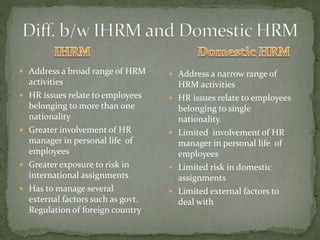
 Address a broad range of HRM
activities
 HR issues relate to employees
belonging to more than one
nationality
 Greater involvement of HR
manager in personal life of
employees
 Greater exposure to risk in
international assignments
 Has to manage several
external factors such as govt.
Regulation of foreign country
 Address a narrow range of
HRM activities
 HR issues relate to employees
belonging to single
nationality.
 Limited involvement of HR
manager in personal life of
employees
 Limited risk in domestic
assignments
 Limited external factors to
deal with
 International Staffing
 Pre-departure training for international assignment
 Repatriation
 Performance management in international
assignments
 Compensation issues in international assignments
 Culture is relative that guide the behavior of people in
a society or community and that are passed on from
one generation to the next
 Language
 Nationality
 Sex
 Education
 Profession
 Ethnic group
 Religion
 Social class
 Corporate culture
 Family
 Values
 Norms
 Attitudes
 Customs
“Cross culture management involves managing work
teams in way that considers the differences in cultures,
practices and preferences of consumers in a global or
international business context”. CCM is a fairly new field
that is based on theories and research from:
 Cross Culture Psychology
 International Business
 Organizational Behaviour
 Human Resources
 Anthropology(study of human’s aspect of society)
Cross Culture Management seeks to
 Understand how national cultures affect management
practices
 Identify the similarities and differences across cultures
in various management practices and organizational
contexts
 Increase effectiveness in global management
Diversity management is the strategy of using best
practices with proven results to find and create a diverse
and inclusive workplace.
Best Practices Include:
 Employee resource groups
 Diversity councils
 Mentoring and sponsorships
 Supplier diversity
1. Define your terms - define diversity for your
organization as there is no one-size-fits-all solution
2. Be realistic - when setting goals, involve everyone who has
a responsibility for diversity
3. Build in metrics- Diversity management should measure
progress toward specific, quantifiable long and short term
goals
4. Setup a system
5. Educate-Everyone needs to be trained
6. Assemble your resources
7. Demonstrate CEO support
 Work-life integration is an outcome of people
exercising control & choice in their life to meet life’s
challenges
 This can be managing work responsibilities alongside
their personal & family needs.
 The areas of a person’s life which require integration
will change based on the individual’s life stages
 A person in his or her 20s may be balancing career
development and social activities
 In 30s, when a person gets married & starts a family,
family & job responsibilities become competing
challenges
 Work & life stressors will continue to increase, as
expectations & choices compel us to seek for what is a
“good life’’.
 Our core values & life goals become the skill-set that
enables us in work-life balancing and in living & work
efficiently and effectively.
 When organization take cognizance of this work-life
imperative and designs a conducive work environment
it motivates the employees to work more efficiently
and productively.
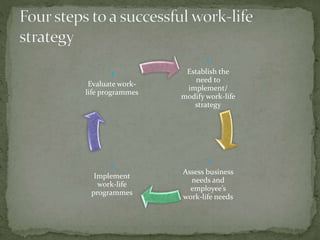
1
Establish the
need to
implement/
modify work-life
strategy
2
Assess business
needs and
employee’s
work-life needs
3
Implement
work-life
programmes
4
Evaluate work-
life programmes
 Organizations implement work-life programmes for
one or more of the following reasons:
 Attract and/or retain talent
 Raise morale
 Increase productivity
 Save on real estate and overhead expenses
 Reduce healthcare costs
 Provide work flexibility in response to changing
employee needs
 Increase commitment
 Combat burnout
 Be an employer of choice
 Stay ahead of the competition
 Business needs include corporate values, objectives
and operational standards that cannot be
compromised for any reason.
 If a business revolves around customer-facing services
(e.g in a retail outlet) it may be possible to implement
flexi-time with some creative scheduling
 Develop a communication plan – Successful
implementation of work-life programmes hinges on proper
communication of the programmes to employees
 Employees needs to be aware of work-life programmes to
reap its benefits, thereby improving employee engagement
& turnover.
 Senior management support – Support from senior
management for work-life strategy, will make employees
feel comfortable in supporting, participating and using the
work-life programmes.
 Measuring the effectiveness of work-life programmer
allows us to determine whether we have met the
objectives
 Utilization rate of the work-life programmes
 Absenteeism
 Employee job satisfaction, engagement, ect.
 Turnover rate
 Feedback from employees about the work-life
programme in meeting their needs
 Feedback from exit interviews
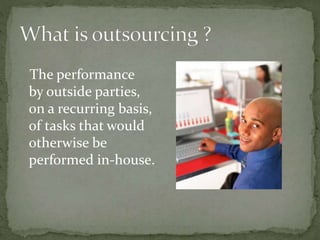
The performance
by outside parties,
on a recurring basis,
of tasks that would
otherwise be
performed in-house.
 58% of companies outsource some HR function
 91% of companies with $1 billion+ annual revenues
are now considering HRO
 HRO grew 28% from second half of 2004 to first half
of 2005
 Allow HR to focus on core competencies
 Creates strategic opportunities for HR
professionals
 Improve quality, efficiency, and effectiveness
 Relief from administrative burdens
 Reduce operating costs
 Access to outside HR expertise
 Greater diversity of HR services
 Leverage vendor investments in technology rarely
available to HR organization
 Limit fiduciary, audit, and litigation risks and
liabilities
 Upgrade level of customer service
 Ease time pressure demands
 “Better, faster, cheaper”
 Over promise and under deliver
 Nonperformance of key function
 Cost
 Loss of institutional knowledge
 Difficulty managing vendor relationship
 Change in provider’s business or financial stability
 Lack of fit with company culture
 Organizational resistance or unreadiness
Arun Gupta
Deepak VPR
Deepak Singh
Gokul AKR
Himanshu Maheshwari
Pramesh Jain
Shubham Rana

Emerging trends in HRM

  • 2.
     Human resourcemanagement (HRM or simply HR) is the management of human resources. It is designed to maximize employee performance in service of an employer's strategic objectives. HR is primarily concerned with the management of people within organizations, focusing on policies and on systems
  • 3.
     Human ResourceInformation System (HRIS)  HR Audit  IHRM Practices  Cross Cultural and diversity management  Work Life integration  Human Resource Outsourcing
  • 5.
     HRIS canbe briefly defined as integrated systems used to gather, store and analyze information regarding an organization’s human resources.  HRIS is not limited to the computer hardware and software applications that comprise the technical part of the system: it also includes the people, policies, procedures and data required to manage the HR function.
  • 6.
     Large andsmall businesses are utilizing HRIS  Personal computers have made HRIS available and affordable for any sized firm  HRIS has evolved from simple record-keeping to complex analytical tools to assist management decision making
  • 7.
     HR Professionals Reporting and compliance  Payroll and compensation analysis  Benefits administration  Applicant tracking, skills inventory  Functional Managers  Performance management and appraisal  Recruitment and resume processing  Team and project management  Training and skills testing  Management development
  • 8.
     Individual Employees Self-service benefit options  Career planning  Training and development
  • 9.
     Increased Efficiency– more transactions with fewer resources  Increased Effectiveness – more accurate information and simplification of processes
  • 11.
     Human ResourceAudit or HR Audit is the process of examining policies, procedures, documentation, systems, and practices with respect to an organization's HR functions.
  • 12.
     To assessthe effectiveness of the Human Resources function to ensure regulatory compliance.  To look for potentially serious problems.  To find areas needing improvement .  To document processes for use in merger, reorganization or inspection.  To address compliance issues .
  • 13.
     Create anHR business plan  Streamline HR work process  Monitor compliance with established regulations and procedures  Develop user friendly HR systems
  • 15.
     International HumanResource Management Practices  Simple definition – the process of managing people in international setting  Someone defined it as “the HRM issues and problems arising from internationalization of business and the HRM strategies, policies and practices which firm pursue in response to internationalization process  HRM is the management of HR in business operations in atleast two nations
  • 16.
     Address abroad range of HRM activities  HR issues relate to employees belonging to more than one nationality  Greater involvement of HR manager in personal life of employees  Greater exposure to risk in international assignments  Has to manage several external factors such as govt. Regulation of foreign country  Address a narrow range of HRM activities  HR issues relate to employees belonging to single nationality.  Limited involvement of HR manager in personal life of employees  Limited risk in domestic assignments  Limited external factors to deal with
  • 17.
     International Staffing Pre-departure training for international assignment  Repatriation  Performance management in international assignments  Compensation issues in international assignments
  • 19.
     Culture isrelative that guide the behavior of people in a society or community and that are passed on from one generation to the next
  • 20.
     Language  Nationality Sex  Education  Profession  Ethnic group  Religion  Social class  Corporate culture  Family  Values  Norms  Attitudes  Customs
  • 21.
    “Cross culture managementinvolves managing work teams in way that considers the differences in cultures, practices and preferences of consumers in a global or international business context”. CCM is a fairly new field that is based on theories and research from:  Cross Culture Psychology  International Business  Organizational Behaviour  Human Resources  Anthropology(study of human’s aspect of society)
  • 22.
    Cross Culture Managementseeks to  Understand how national cultures affect management practices  Identify the similarities and differences across cultures in various management practices and organizational contexts  Increase effectiveness in global management
  • 23.
    Diversity management isthe strategy of using best practices with proven results to find and create a diverse and inclusive workplace. Best Practices Include:  Employee resource groups  Diversity councils  Mentoring and sponsorships  Supplier diversity
  • 24.
    1. Define yourterms - define diversity for your organization as there is no one-size-fits-all solution 2. Be realistic - when setting goals, involve everyone who has a responsibility for diversity 3. Build in metrics- Diversity management should measure progress toward specific, quantifiable long and short term goals 4. Setup a system 5. Educate-Everyone needs to be trained 6. Assemble your resources 7. Demonstrate CEO support
  • 26.
     Work-life integrationis an outcome of people exercising control & choice in their life to meet life’s challenges  This can be managing work responsibilities alongside their personal & family needs.  The areas of a person’s life which require integration will change based on the individual’s life stages  A person in his or her 20s may be balancing career development and social activities
  • 27.
     In 30s,when a person gets married & starts a family, family & job responsibilities become competing challenges
  • 28.
     Work &life stressors will continue to increase, as expectations & choices compel us to seek for what is a “good life’’.  Our core values & life goals become the skill-set that enables us in work-life balancing and in living & work efficiently and effectively.  When organization take cognizance of this work-life imperative and designs a conducive work environment it motivates the employees to work more efficiently and productively.
  • 29.
    1 Establish the need to implement/ modifywork-life strategy 2 Assess business needs and employee’s work-life needs 3 Implement work-life programmes 4 Evaluate work- life programmes
  • 30.
     Organizations implementwork-life programmes for one or more of the following reasons:  Attract and/or retain talent  Raise morale  Increase productivity  Save on real estate and overhead expenses  Reduce healthcare costs  Provide work flexibility in response to changing employee needs
  • 31.
     Increase commitment Combat burnout  Be an employer of choice  Stay ahead of the competition
  • 32.
     Business needsinclude corporate values, objectives and operational standards that cannot be compromised for any reason.  If a business revolves around customer-facing services (e.g in a retail outlet) it may be possible to implement flexi-time with some creative scheduling
  • 33.
     Develop acommunication plan – Successful implementation of work-life programmes hinges on proper communication of the programmes to employees  Employees needs to be aware of work-life programmes to reap its benefits, thereby improving employee engagement & turnover.  Senior management support – Support from senior management for work-life strategy, will make employees feel comfortable in supporting, participating and using the work-life programmes.
  • 34.
     Measuring theeffectiveness of work-life programmer allows us to determine whether we have met the objectives  Utilization rate of the work-life programmes  Absenteeism  Employee job satisfaction, engagement, ect.  Turnover rate  Feedback from employees about the work-life programme in meeting their needs  Feedback from exit interviews
  • 36.
    The performance by outsideparties, on a recurring basis, of tasks that would otherwise be performed in-house.
  • 37.
     58% ofcompanies outsource some HR function  91% of companies with $1 billion+ annual revenues are now considering HRO  HRO grew 28% from second half of 2004 to first half of 2005
  • 38.
     Allow HRto focus on core competencies  Creates strategic opportunities for HR professionals  Improve quality, efficiency, and effectiveness  Relief from administrative burdens  Reduce operating costs
  • 39.
     Access tooutside HR expertise  Greater diversity of HR services  Leverage vendor investments in technology rarely available to HR organization  Limit fiduciary, audit, and litigation risks and liabilities  Upgrade level of customer service  Ease time pressure demands  “Better, faster, cheaper”
  • 40.
     Over promiseand under deliver  Nonperformance of key function  Cost  Loss of institutional knowledge  Difficulty managing vendor relationship  Change in provider’s business or financial stability  Lack of fit with company culture  Organizational resistance or unreadiness
  • 42.
    Arun Gupta Deepak VPR DeepakSingh Gokul AKR Himanshu Maheshwari Pramesh Jain Shubham Rana