Denison (1996) suggested that
‘Culture’ refers to the deep structure
of organizations, which is rooted in
the values, beliefs and assumptions
held by organizational members.
In contrast,
‘Climate’ refers to those aspects of
the environment that are consciously
perceived by organizational members.
HRD in the organizational context is a
process by which the employees of an
organization are helped in a continuous,
planned way to:
 (a) acquire or sharpen capabilities
required to perform various functions
associated with their present or
expected future roles;
 (b) develop their general capabilities
as individuals and discover and exploit
their own inner potentials for their own
and/or organizational development
processes; and
 (c) develop an organizational culture in
which supervisor-subordinate
relationships, team work and
collaboration among sub units are strong
and contribute to the professional well-
being, motivation and pride of
employees
HRD mechanisms measure the extent
to which HRD mechanisms are implemented
seriously. These mechanisms include
Performance appraisal
Potential appraisal
Career planning
Performance rewards
Feedback and counselling
Training
Employee welfare for quality work-life and
Job rotation.
Organizational or corporate culture
is the pattern of values, norms,
beliefs, attitudes and assumptions
that may not have been articulated
but shape the ways in which people in
organizations behave and things get
done.
‘Values’ refer to what is believed to
be important about how people and
organizations behave.
‘Norms’ are the unwritten rules of
behaviour.
Characteristics of culture, Furnham and Gunter (1993)
• It is difficult to define.
• It is multi-dimensional, with many
different components at different
levels.
• It is not particularly dynamic and
ever-changing.
• It takes time to establish and
therefore time to change a corporate
culture.
Significance of culture, Furnham and Gunter (1993)
Culture represents the ‘social glue’ and
generates a ‘we-feeling’, thus counteracting
processes of differentiations that are an
unavoidable part of organizational life.
Organizational culture offers a shared
system of meanings which is the basis for
communications and mutual understanding.
If these functions are not fulfilled in a
satisfactory way, culture may significantly
reduce the efficiency of an organization.
The values and norms that are the basis of
culture are formed in following ways;
•over a period of time,
•by the leaders in the organization,
•is formed around critical incidents,
•develops from the need to maintain
effective working relationships among
organization members,
•is influenced by the organization’s
environment.
Culture is learnt over a period of time,
there are two ways in which this learning
takes place.
•THE TRAUMA MODEL, in which members of
the organization learn to cope with some
threat by the erection of defence
mechanisms.
•THE POSITIVE REINFORCEMENT MODEL,
where things that seem to work become
embedded and entrenched.
The components of culture
▶Values
▶Norms
▶Artefacts
▶Management style
Areas in which values may be expressed
– explicitly or implicitly
• Care and consideration for people.
• Competence.
• Competitiveness.
• Customer service.
• Innovation.
• Performance.
• Quality.
• Teamwork.
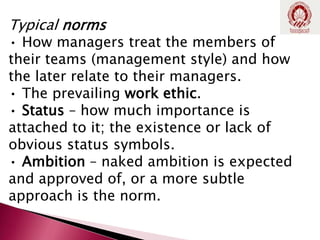
Typical norms
• How managers treat the members of
their teams (management style) and how
the later relate to their managers.
• The prevailing work ethic.
• Status – how much importance is
attached to it; the existence or lack of
obvious status symbols.
• Ambition – naked ambition is expected
and approved of, or a more subtle
approach is the norm.
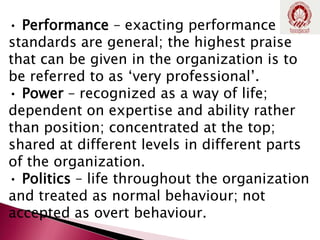
• Performance – exacting performance
standards are general; the highest praise
that can be given in the organization is to
be referred to as ‘very professional’.
• Power – recognized as a way of life;
dependent on expertise and ability rather
than position; concentrated at the top;
shared at different levels in different parts
of the organization.
• Politics – life throughout the organization
and treated as normal behaviour; not
accepted as overt behaviour.
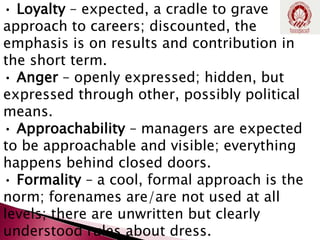
• Loyalty – expected, a cradle to grave
approach to careers; discounted, the
emphasis is on results and contribution in
the short term.
• Anger – openly expressed; hidden, but
expressed through other, possibly political
means.
• Approachability – managers are expected
to be approachable and visible; everything
happens behind closed doors.
• Formality – a cool, formal approach is the
norm; forenames are/are not used at all
levels; there are unwritten but clearly
understood rules about dress.
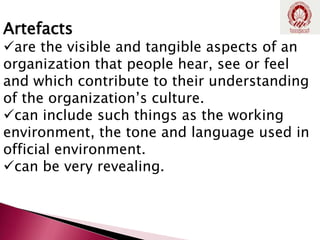
Artefacts
are the visible and tangible aspects of an
organization that people hear, see or feel
and which contribute to their understanding
of the organization’s culture.
can include such things as the working
environment, the tone and language used in
official environment.
can be very revealing.
Management style
is the approach managers use to deal with
people. It is also called ‘leadership
Style’, it consists of the following
extremes:
• Charismatic/non-charismatic.
• Autocratic/democratic.
• Enabler/controller.
• Transactional/transformational.
Classifications of organizational
culture
• Power-oriented – competitive, responsive
to personality rather than expertise.
• People-oriented – consensual,
management control rejected.
• Task-oriented – focus on competency,
dynamic.
• Role-oriented – focus on legality,
legitimacy and bureaucracy.
Supporting and changing cultures
• It may not be possible to define an
ideal culture or to prescribe how it can be
developed.
• But embedded cultures exert considerable
influence on OB and therefore performance.
• If there is an appropriate and effective
culture, it would be desirable to take steps
to support or reinforce it.
• If the culture is inappropriate, attempts
should be made to determine what needs to
be changed and to develop and implement
plans for change.
HRD climate is the perception that
the employees have about the
policies, procedures, practices,
and conditions which exist in the
working environment.
HRD Climate has three dimensions
of (T.V. Rao and E. Abraham) –
General climate,
OCTAPAC culture and
Implementation of HRD mechanisms
The general climate deals with the
importance given to human resources
development in general by the top
management and line managers.
The OCTAPAC items deal with the extent
to which are
Openness
Confrontation
Trust
Autonomy
Pro-activity
Authenticity and
Collaboration
valued and promoted in the organization.
Openness is there when employees
feel free to discuss their ideas, activities
and feelings with each other.
Confrontation is bringing out problems
and issues in open with a view to solving
them rather than hiding them for fear of
hurting or getting hurt.
Trust is taking people at their face
value and believing what they say.
Autonomy is giving freedom to let
people work independently with
responsibility.
Pro-activity is encouraging employees to
take an initiative and risks.
Authenticity is the tendency on the part of
people to do what they say.
Collaboration is to accept
interdependencies to be helpful to each
other and work as teams
HRD climate is characterised by the
tendencies such as
•Treating employees as the most important
resources
•Perceiving that developing employees is the
job of every manager
•Believing in the capability of employees
•Communicating openly
•Encouraging risk taking and
experimentation
•Making efforts to help employees
recognize their strengths and
weaknesses
•Creating a general climate of trust
•Collaboration and autonomy
supportive personnel policies, and
•Supportive HRD practices
An optimal level of development
climate is essential for facilitating
HRD activities
Organizations with
obetter learning
otraining and development systems
oreward and recognition and
oinformation systems
promotes a favourable HRD climate.
HRD culture & climate

HRD culture & climate

  • 2.
    Denison (1996) suggestedthat ‘Culture’ refers to the deep structure of organizations, which is rooted in the values, beliefs and assumptions held by organizational members. In contrast, ‘Climate’ refers to those aspects of the environment that are consciously perceived by organizational members.
  • 3.
    HRD in theorganizational context is a process by which the employees of an organization are helped in a continuous, planned way to:  (a) acquire or sharpen capabilities required to perform various functions associated with their present or expected future roles;
  • 4.
     (b) developtheir general capabilities as individuals and discover and exploit their own inner potentials for their own and/or organizational development processes; and  (c) develop an organizational culture in which supervisor-subordinate relationships, team work and collaboration among sub units are strong and contribute to the professional well- being, motivation and pride of employees
  • 5.
    HRD mechanisms measurethe extent to which HRD mechanisms are implemented seriously. These mechanisms include Performance appraisal Potential appraisal Career planning Performance rewards Feedback and counselling Training Employee welfare for quality work-life and Job rotation.
  • 6.
    Organizational or corporateculture is the pattern of values, norms, beliefs, attitudes and assumptions that may not have been articulated but shape the ways in which people in organizations behave and things get done. ‘Values’ refer to what is believed to be important about how people and organizations behave. ‘Norms’ are the unwritten rules of behaviour.
  • 7.
    Characteristics of culture,Furnham and Gunter (1993) • It is difficult to define. • It is multi-dimensional, with many different components at different levels. • It is not particularly dynamic and ever-changing. • It takes time to establish and therefore time to change a corporate culture.
  • 8.
    Significance of culture,Furnham and Gunter (1993) Culture represents the ‘social glue’ and generates a ‘we-feeling’, thus counteracting processes of differentiations that are an unavoidable part of organizational life. Organizational culture offers a shared system of meanings which is the basis for communications and mutual understanding. If these functions are not fulfilled in a satisfactory way, culture may significantly reduce the efficiency of an organization.
  • 9.
    The values andnorms that are the basis of culture are formed in following ways; •over a period of time, •by the leaders in the organization, •is formed around critical incidents, •develops from the need to maintain effective working relationships among organization members, •is influenced by the organization’s environment.
  • 10.
    Culture is learntover a period of time, there are two ways in which this learning takes place. •THE TRAUMA MODEL, in which members of the organization learn to cope with some threat by the erection of defence mechanisms. •THE POSITIVE REINFORCEMENT MODEL, where things that seem to work become embedded and entrenched.
  • 11.
    The components ofculture ▶Values ▶Norms ▶Artefacts ▶Management style
  • 12.
    Areas in whichvalues may be expressed – explicitly or implicitly • Care and consideration for people. • Competence. • Competitiveness. • Customer service. • Innovation. • Performance. • Quality. • Teamwork.
  • 13.
    Typical norms • Howmanagers treat the members of their teams (management style) and how the later relate to their managers. • The prevailing work ethic. • Status – how much importance is attached to it; the existence or lack of obvious status symbols. • Ambition – naked ambition is expected and approved of, or a more subtle approach is the norm.
  • 14.
    • Performance –exacting performance standards are general; the highest praise that can be given in the organization is to be referred to as ‘very professional’. • Power – recognized as a way of life; dependent on expertise and ability rather than position; concentrated at the top; shared at different levels in different parts of the organization. • Politics – life throughout the organization and treated as normal behaviour; not accepted as overt behaviour.
  • 15.
    • Loyalty –expected, a cradle to grave approach to careers; discounted, the emphasis is on results and contribution in the short term. • Anger – openly expressed; hidden, but expressed through other, possibly political means. • Approachability – managers are expected to be approachable and visible; everything happens behind closed doors. • Formality – a cool, formal approach is the norm; forenames are/are not used at all levels; there are unwritten but clearly understood rules about dress.
  • 16.
    Artefacts are the visibleand tangible aspects of an organization that people hear, see or feel and which contribute to their understanding of the organization’s culture. can include such things as the working environment, the tone and language used in official environment. can be very revealing.
  • 17.
    Management style is theapproach managers use to deal with people. It is also called ‘leadership Style’, it consists of the following extremes: • Charismatic/non-charismatic. • Autocratic/democratic. • Enabler/controller. • Transactional/transformational.
  • 18.
    Classifications of organizational culture •Power-oriented – competitive, responsive to personality rather than expertise. • People-oriented – consensual, management control rejected. • Task-oriented – focus on competency, dynamic. • Role-oriented – focus on legality, legitimacy and bureaucracy.
  • 19.
    Supporting and changingcultures • It may not be possible to define an ideal culture or to prescribe how it can be developed. • But embedded cultures exert considerable influence on OB and therefore performance. • If there is an appropriate and effective culture, it would be desirable to take steps to support or reinforce it. • If the culture is inappropriate, attempts should be made to determine what needs to be changed and to develop and implement plans for change.
  • 20.
    HRD climate isthe perception that the employees have about the policies, procedures, practices, and conditions which exist in the working environment.
  • 21.
    HRD Climate hasthree dimensions of (T.V. Rao and E. Abraham) – General climate, OCTAPAC culture and Implementation of HRD mechanisms The general climate deals with the importance given to human resources development in general by the top management and line managers.
  • 22.
    The OCTAPAC itemsdeal with the extent to which are Openness Confrontation Trust Autonomy Pro-activity Authenticity and Collaboration valued and promoted in the organization.
  • 23.
    Openness is therewhen employees feel free to discuss their ideas, activities and feelings with each other. Confrontation is bringing out problems and issues in open with a view to solving them rather than hiding them for fear of hurting or getting hurt. Trust is taking people at their face value and believing what they say.
  • 24.
    Autonomy is givingfreedom to let people work independently with responsibility. Pro-activity is encouraging employees to take an initiative and risks. Authenticity is the tendency on the part of people to do what they say. Collaboration is to accept interdependencies to be helpful to each other and work as teams
  • 25.
    HRD climate ischaracterised by the tendencies such as •Treating employees as the most important resources •Perceiving that developing employees is the job of every manager •Believing in the capability of employees •Communicating openly •Encouraging risk taking and experimentation
  • 26.
    •Making efforts tohelp employees recognize their strengths and weaknesses •Creating a general climate of trust •Collaboration and autonomy supportive personnel policies, and •Supportive HRD practices An optimal level of development climate is essential for facilitating HRD activities
  • 27.
    Organizations with obetter learning otrainingand development systems oreward and recognition and oinformation systems promotes a favourable HRD climate.