HRIS Needs Analysis and
cost estimations
 “Failing to plan is planning to fail.”
(Alge & Upright 2009, p.80)
 “Use the right tool for the job,” the old saying goes, “and to
use the right tool you have to know what job you’re trying to
do.”
(Meade 2003, p.84)
2
Do you need one?
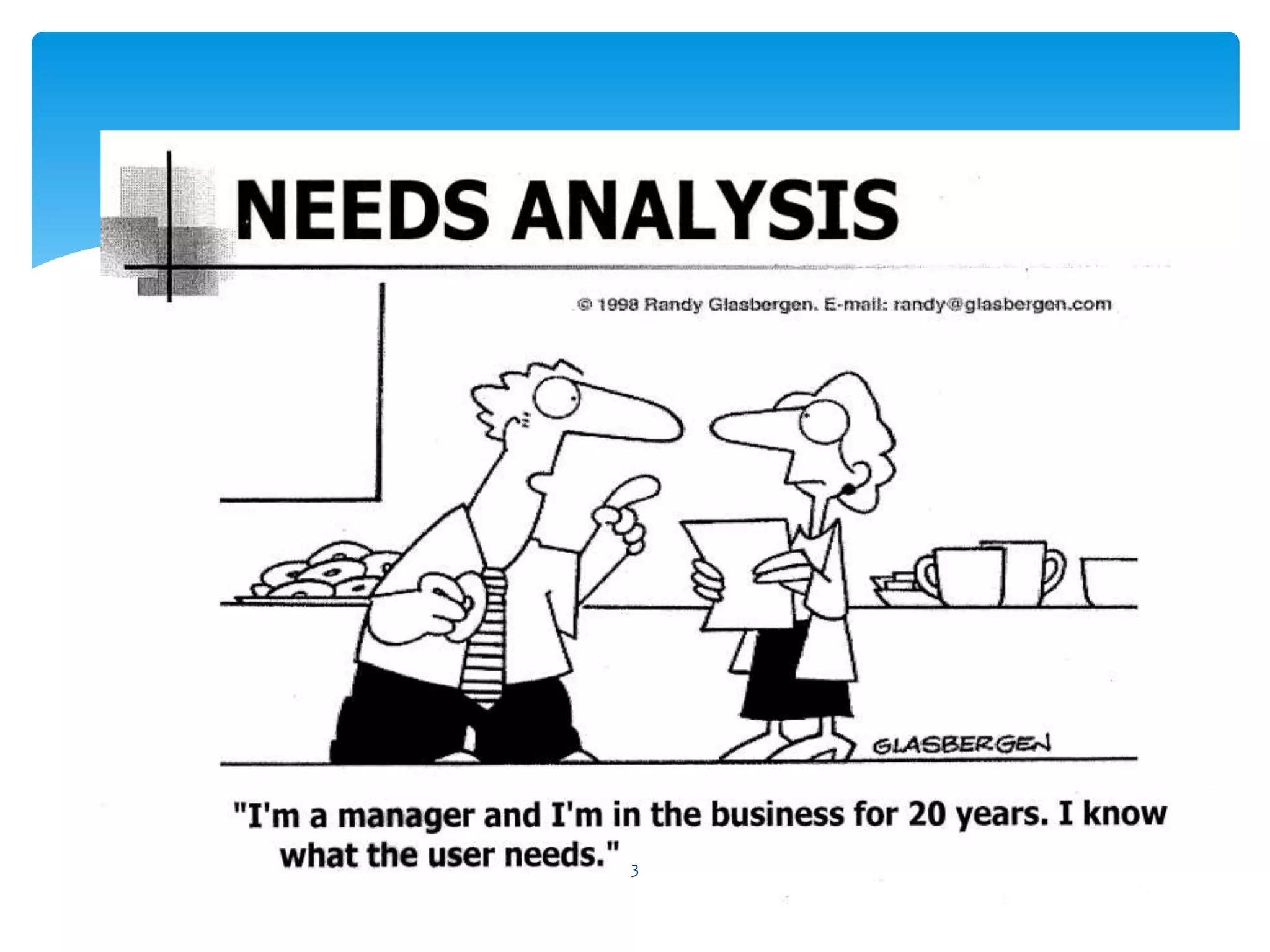
3
 Australian Defence Force
 ADF some time ago flagged its intention to replace
the HR systems with a wider solution. In December
2009, chief information officer Greg Farr told
ZDNet.com.au that the department expected to
ditch the "far from perfect" HR systems in 2009 in a
tender worth around $400 million. (LeMay
2009)
 http://www.abc.net.au/pm/content/2010/s2815919.h
tm
4
Payroll implementation
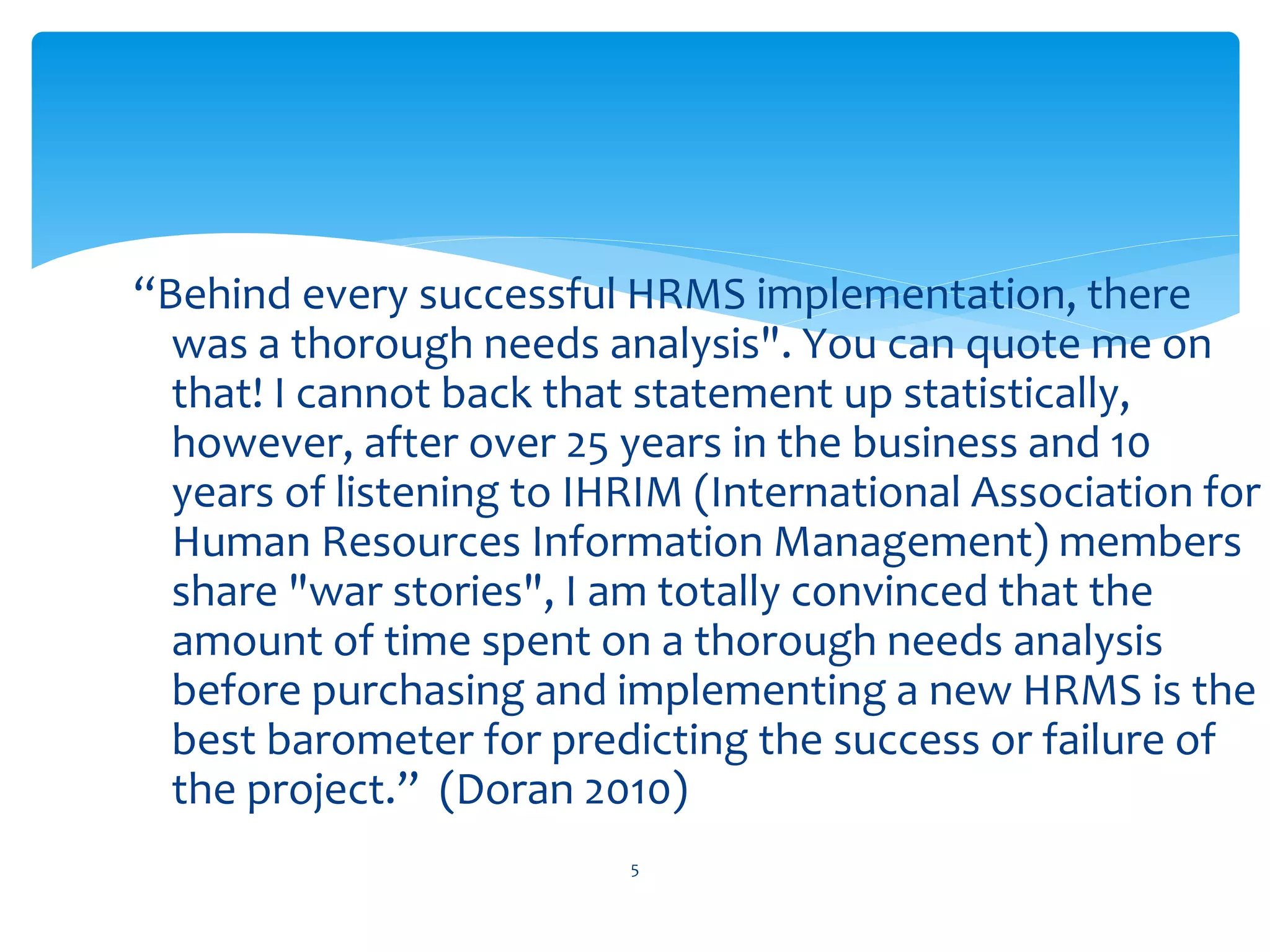
“Behind every successful HRMS implementation, there
was a thorough needs analysis". You can quote me on
that! I cannot back that statement up statistically,
however, after over 25 years in the business and 10
years of listening to IHRIM (International Association for
Human Resources Information Management) members
share "war stories", I am totally convinced that the
amount of time spent on a thorough needs analysis
before purchasing and implementing a new HRMS is the
best barometer for predicting the success or failure of
the project.” (Doran 2010)
5
Michael J. Kavanagh, Mohan Thite, and Richard D. Johnson - Human
Resource Information Systems: Basics, Applications, and Future
Directions, 2e © 2012 SAGE Publications, Inc.
6
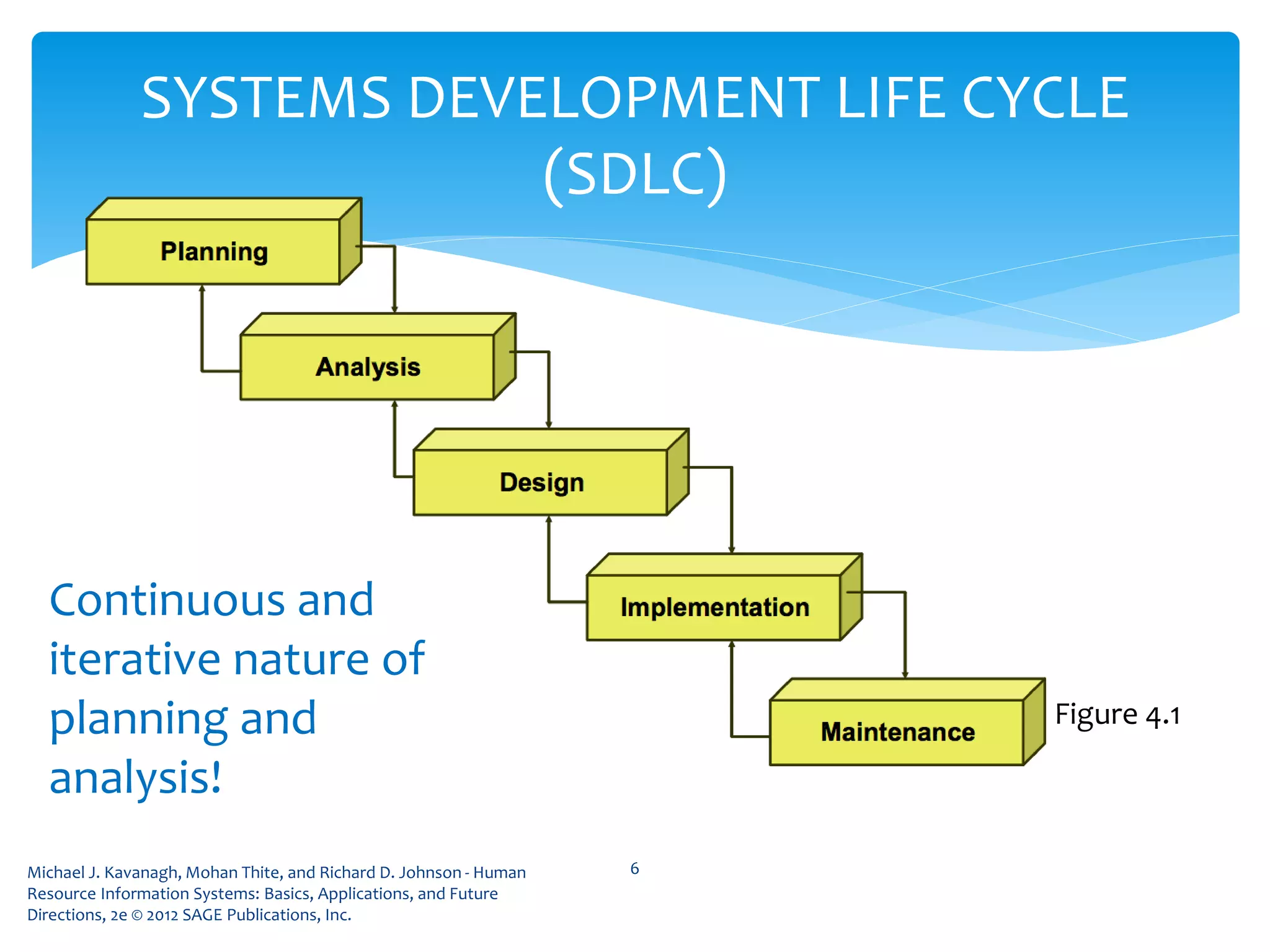
SYSTEMS DEVELOPMENT LIFE CYCLE
(SDLC)
Continuous and
iterative nature of
planning and
analysis!
Figure 4.1
Michael J. Kavanagh, Mohan Thite, and Richard D. Johnson - Human Resource Information Systems: Basics,
Applications, and Future Directions, 2e © 2012 SAGE Publications, Inc.
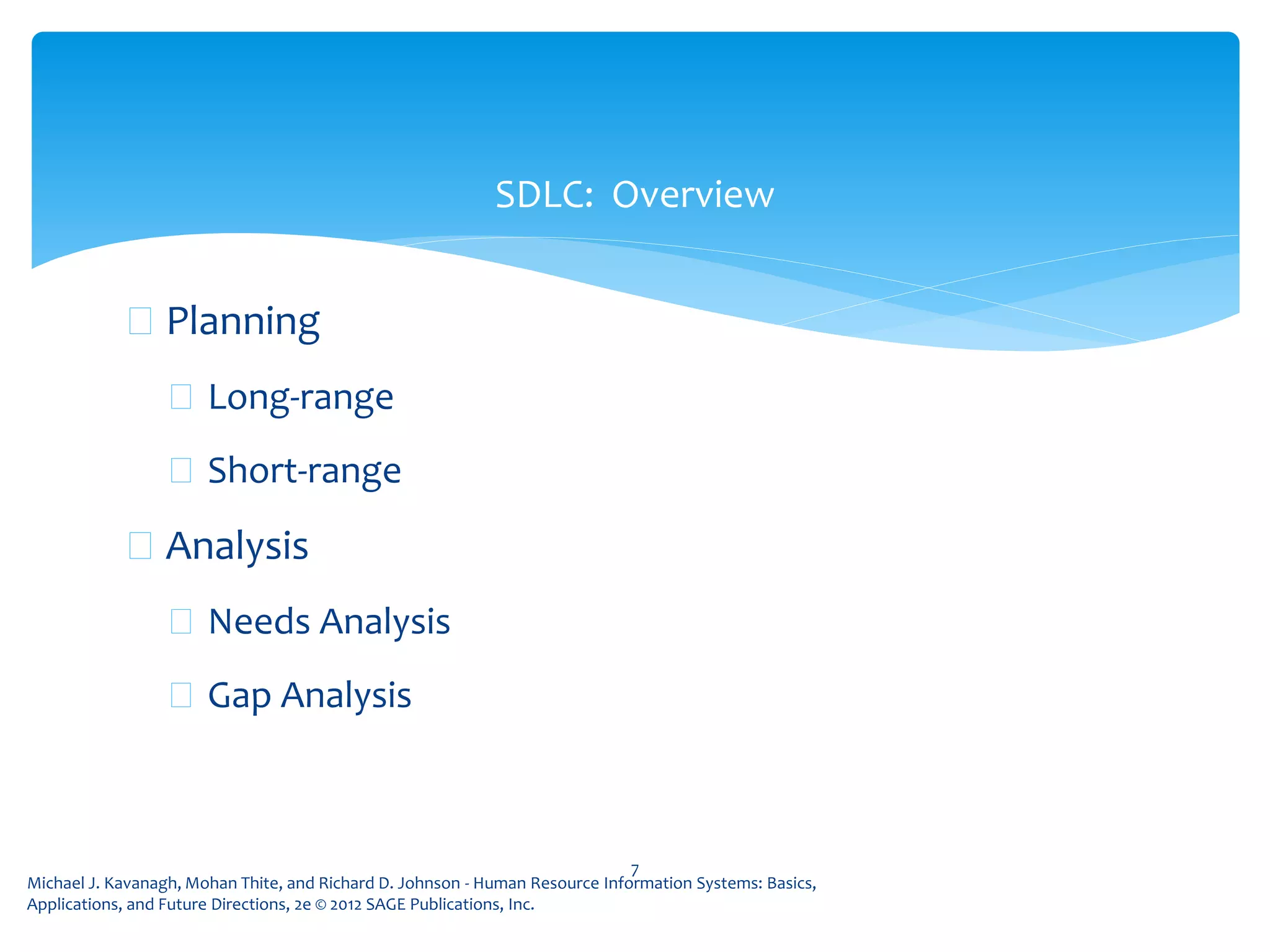
 Planning
 Long-range
 Short-range
 Analysis
 Needs Analysis
 Gap Analysis
7
SDLC: Overview
Michael J. Kavanagh, Mohan Thite, and Richard D. Johnson - Human
Resource Information Systems: Basics, Applications, and Future
Directions, 2e © 2012 SAGE Publications, Inc.
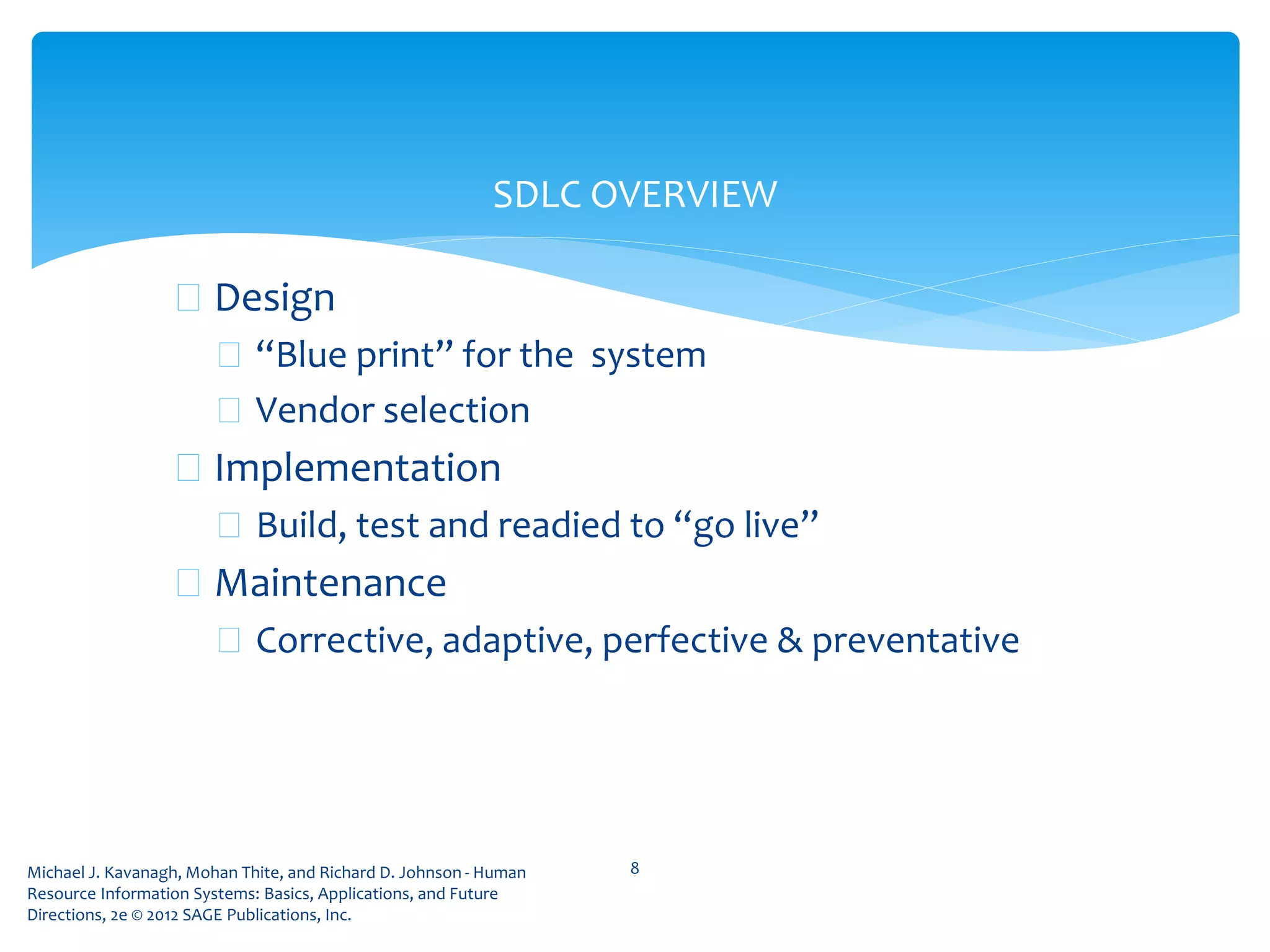
 Design
 “Blue print” for the system
 Vendor selection
 Implementation
 Build, test and readied to “go live”
 Maintenance
 Corrective, adaptive, perfective & preventative
8
SDLC OVERVIEW
Michael J. Kavanagh, Mohan Thite, and Richard D. Johnson - Human
Resource Information Systems: Basics, Applications, and Future
Directions, 2e © 2012 SAGE Publications, Inc.
 Needs: long-range planning
 Strategic
 “Big picture”
 Phase containment
 Needs: short range planning
 Operational
 Specific projects and programs
9
SDLC: Planning
Michael J. Kavanagh, Mohan Thite, and Richard D. Johnson - Human
Resource Information Systems: Basics, Applications, and Future
Directions, 2e © 2012 SAGE Publications, Inc.
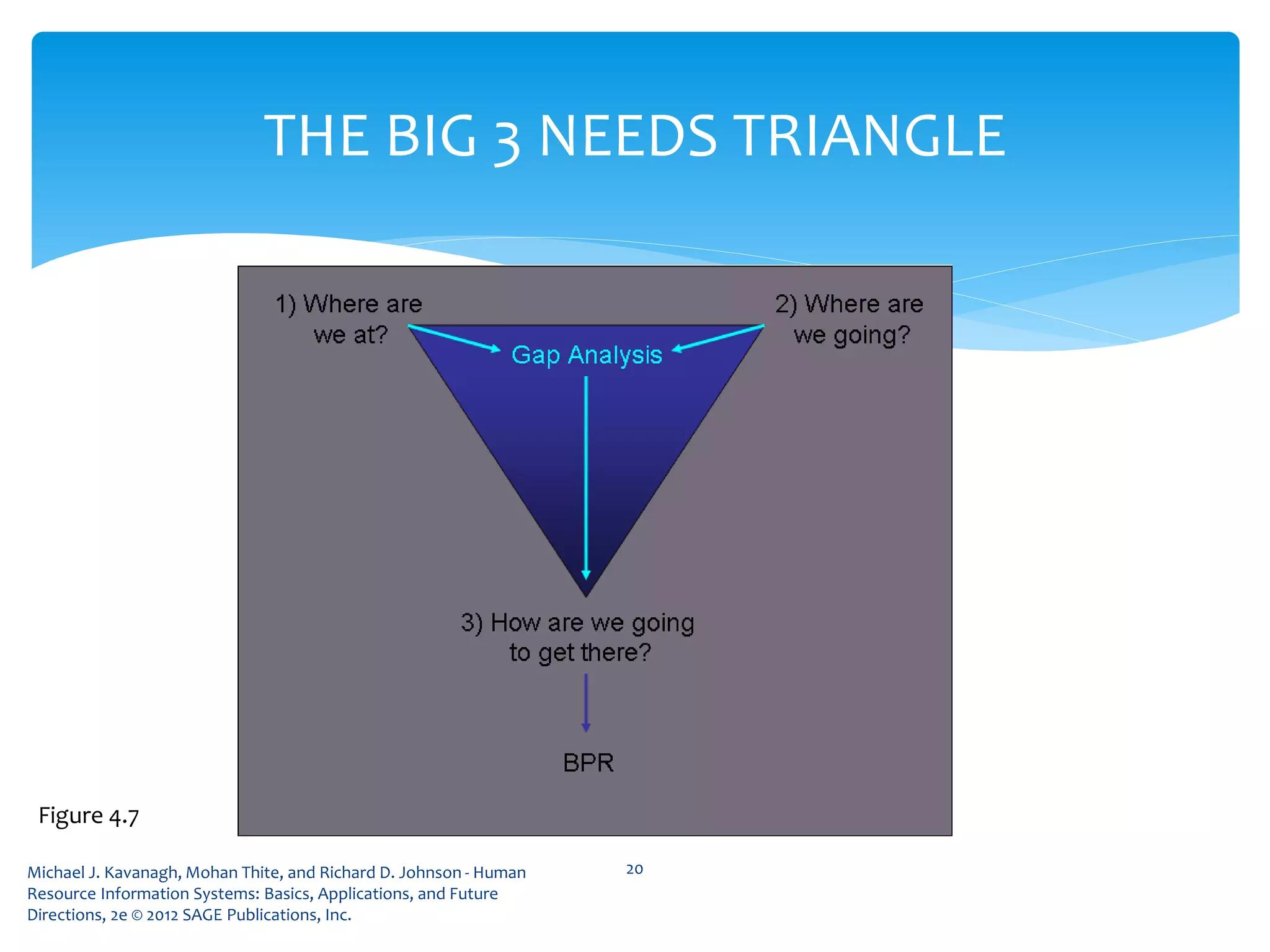
 Where are we now?
 Where are we going?
 How are we going to get there?
Revise and revisit these questions
On a regular basis!
10
THE BIG 3
Michael J. Kavanagh, Mohan Thite, and Richard D. Johnson - Human
Resource Information Systems: Basics, Applications, and Future
Directions, 2e © 2012 SAGE Publications, Inc.
 Dissect and document current capabilities
 Identify and prioritize needs
 Conduct A gap analysis
 Review the feasibility analysis
 Determine usefulness of gap analysis in developing
RFP for vendors
11
ANALYSIS
Michael J. Kavanagh, Mohan Thite, and Richard D. Johnson - Human
Resource Information Systems: Basics, Applications, and Future
Directions, 2e © 2012 SAGE Publications, Inc.
 Current analysis
 Use combination of methods:
 Interviews
 Focus groups
 Surveys and online tools
 Organizational archives
12
ANALYSIS: WHERE ARE WE NOW?
Michael J. Kavanagh, Mohan Thite, and Richard D. Johnson - Human
Resource Information Systems: Basics, Applications, and Future
Directions, 2e © 2012 SAGE Publications, Inc.
 Who to ask:
 HR functional experts
 Job experts
 Technical experts
 End users
 Top management
 Consultants and other business partners
13
ANALYSIS: WHERE ARE WE NOW?
Michael J. Kavanagh, Mohan Thite, and Richard D. Johnson - Human
Resource Information Systems: Basics, Applications, and Future
Directions, 2e © 2012 SAGE Publications, Inc.
 Heart of the needs analysis
 Business requirements definition
 Point at which organization determines and documents its
current and future needs
 Often used interchangeably with needs analysis
 Prioritize business and system needs
14
ANALYSIS: WHERE WE NEED TO GO
 Where are we going?
 Strategic vision:
 To transform the University’s way of doing business into a
flexible and user-centric portfolio of applications that
integrates all Purdue enterprise data, information and
processes
 Helped identify needs in detail and select best
system
 Resulted in SAP-HCM
15
Purdue University
16
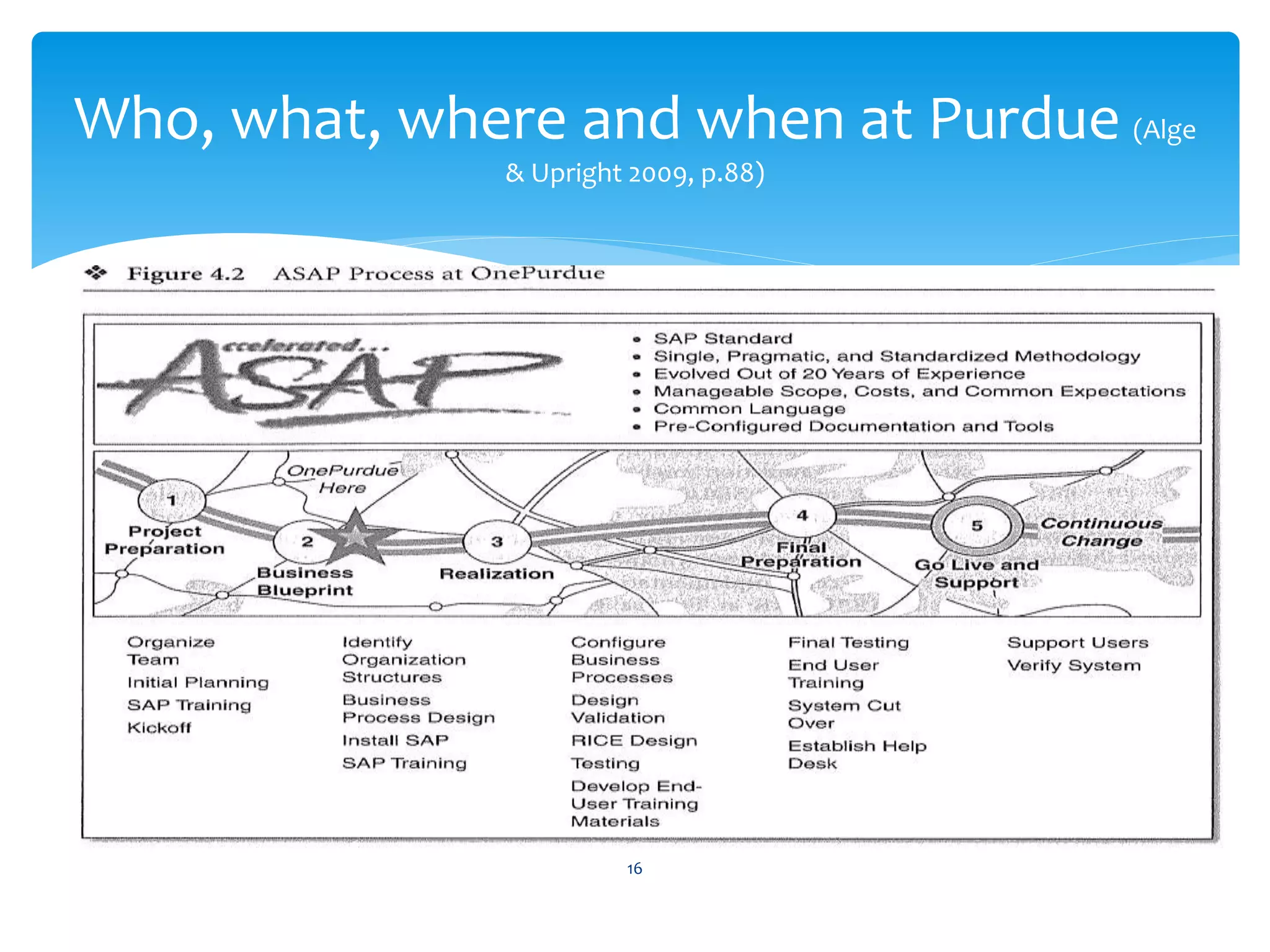
Who, what, where and when at Purdue (Alge
& Upright 2009, p.88)
Michael J. Kavanagh, Mohan Thite, and Richard D. Johnson - Human
Resource Information Systems: Basics, Applications, and Future
Directions, 2e © 2012 SAGE Publications, Inc.
 http://www.erp.com/attachments/4074_Accelerated%
20SAP%20Implementations.pdf
17
Michael J. Kavanagh, Mohan Thite, and Richard D. Johnson - Human
Resource Information Systems: Basics, Applications, and Future
Directions, 2e © 2012 SAGE Publications, Inc.
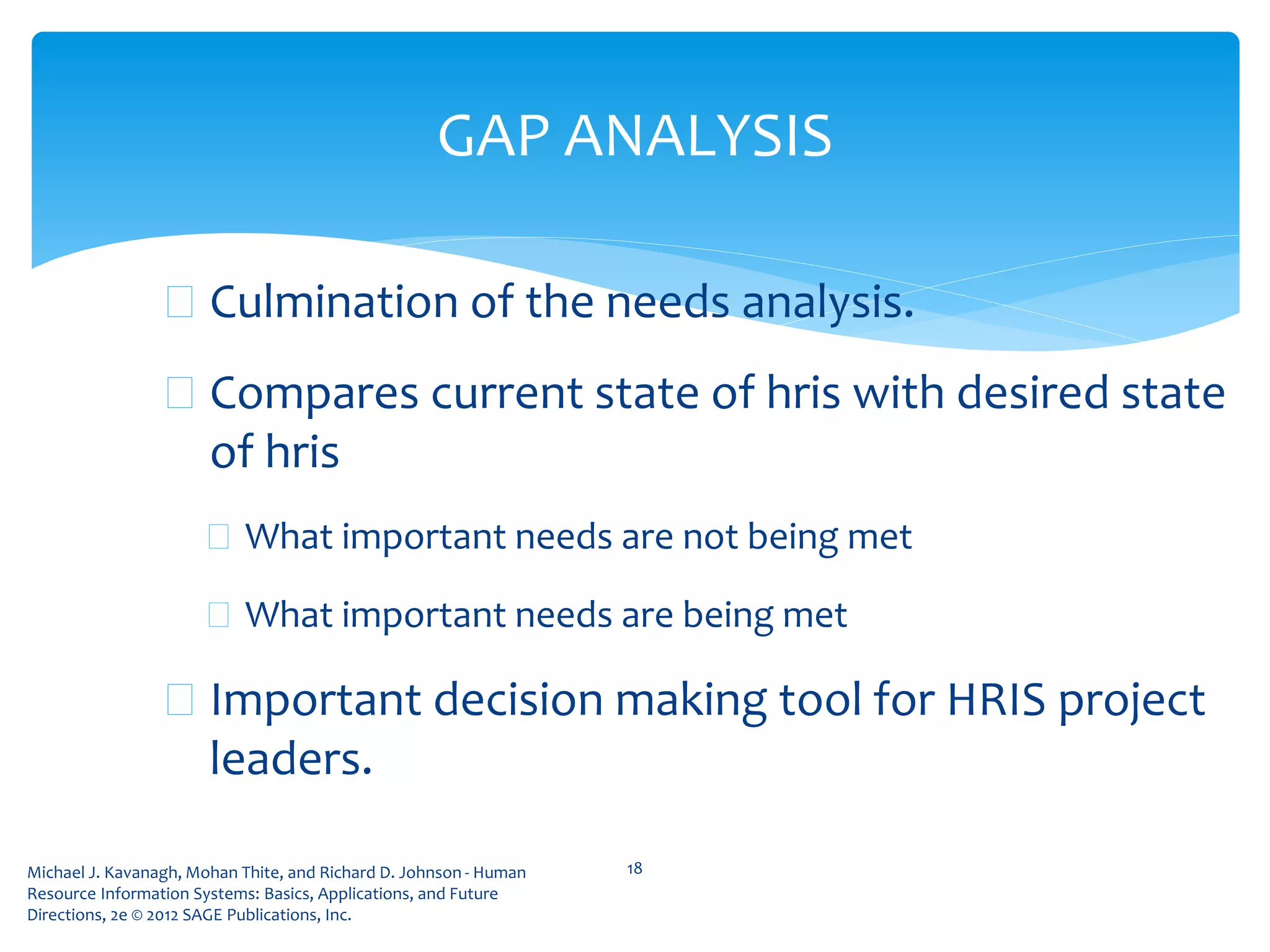
 Culmination of the needs analysis.
 Compares current state of hris with desired state
of hris
 What important needs are not being met
 What important needs are being met
 Important decision making tool for HRIS project
leaders.
18
GAP ANALYSIS
Michael J. Kavanagh, Mohan Thite, and Richard D. Johnson - Human Resource Information Systems: Basics,
Applications, and Future Directions, 2e © 2012 SAGE Publications, Inc.
19
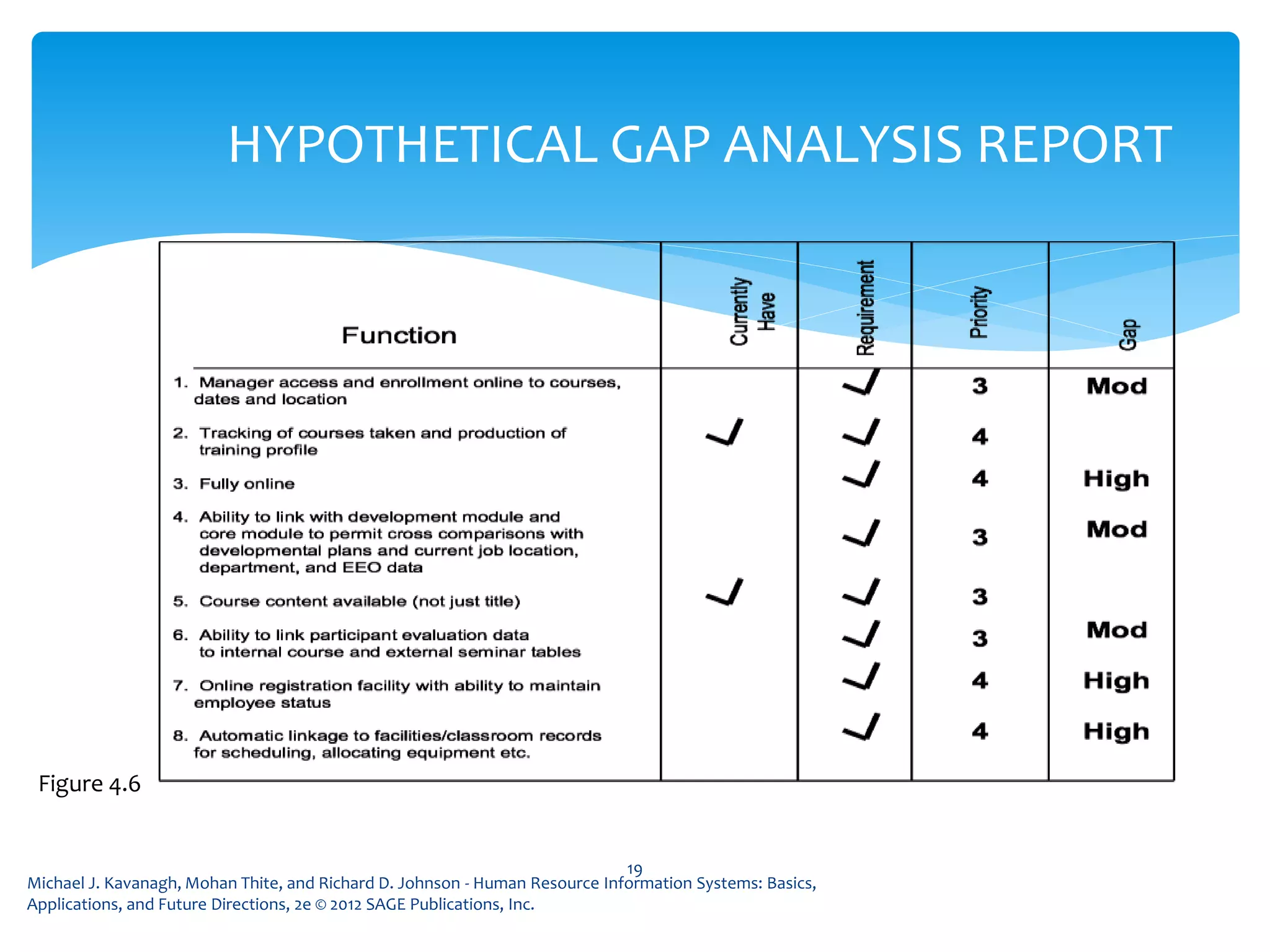
HYPOTHETICAL GAP ANALYSIS REPORT
Figure 4.6
Michael J. Kavanagh, Mohan Thite, and Richard D. Johnson - Human
Resource Information Systems: Basics, Applications, and Future
Directions, 2e © 2012 SAGE Publications, Inc.
20
THE BIG 3 NEEDS TRIANGLE
Figure 4.7
Michael J. Kavanagh, Mohan Thite, and Richard D. Johnson - Human
Resource Information Systems: Basics, Applications, and Future
Directions, 2e © 2012 SAGE Publications, Inc.
 Who should determine what our needs are going
forward?
 How can we ensure that all of our needs are identified?
 How do we limit the scope to the things we truly need?
 Is it feasible at this point to implement a system that
can meet our critical needs?
21
NEEDS ANALYSIS: CRITICAL QUESTIONS
 Basically a Project Management activity
 Stipulate objectives, activities, time-frame, costs,
required resources and staff, information
collection methodology
 Will help encourage management of project
viability
22
Develop a NA Plan
 Typically, 2 reports emerge from the NA process
 Long, technical, operational document, to guide
system development or selection/purchase
 Summary version, to trigger action from top
management
23
Develop the HRIS Strategy
Finally, a critical review of the whole process
 As a guideline for any future modifications, or
for a new purchase in future years
 an analysis of which activities worked well
and which didn’t
 a phase possibly ignored by many
organisations (many don’t even do NA’s!)
 Discuss alternatives
24
Evaluate the NA Effort
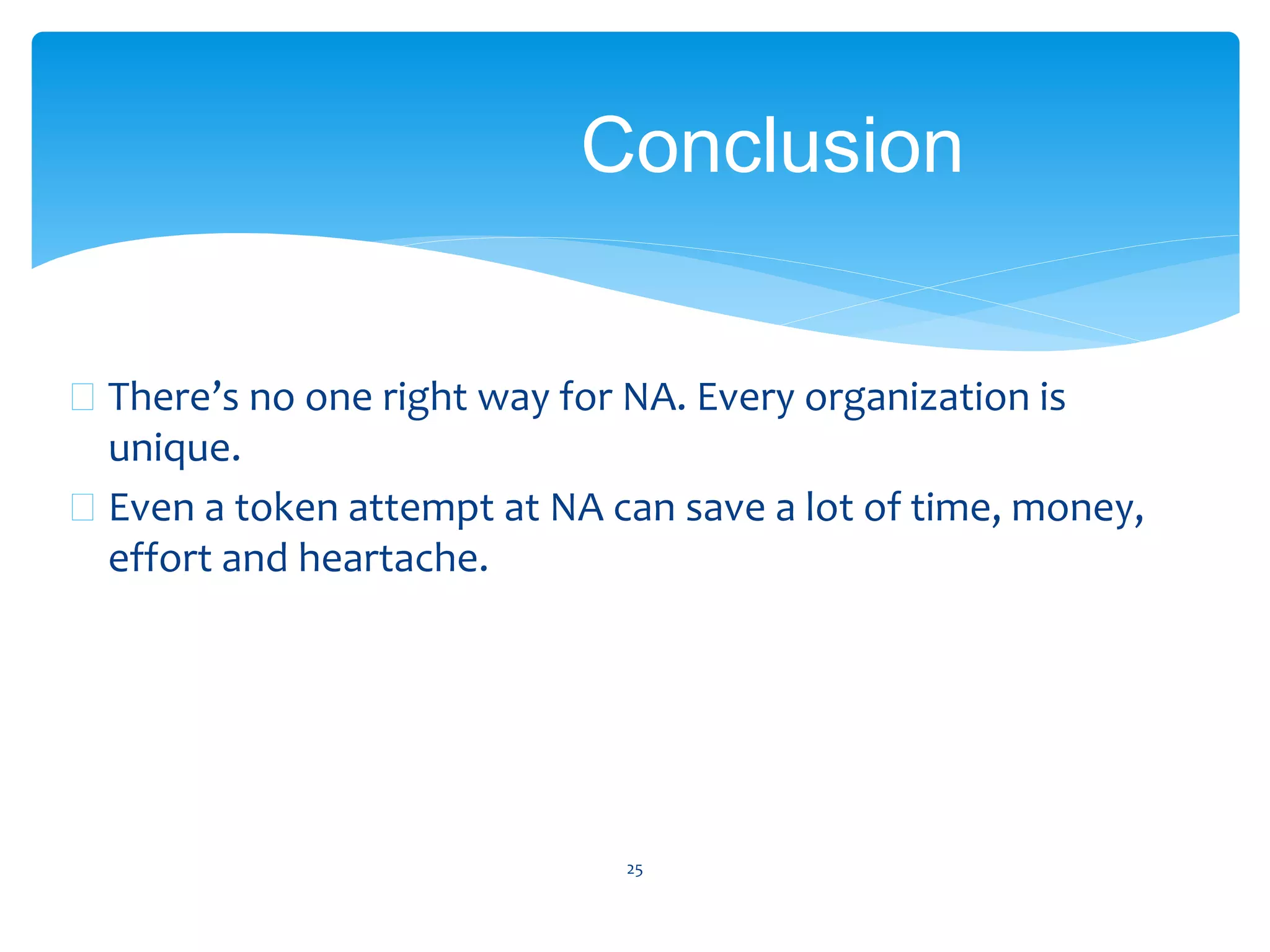
 There’s no one right way for NA. Every organization is
unique.
 Even a token attempt at NA can save a lot of time, money,
effort and heartache.
25
Conclusion
Lect part 2
Cost Justifying HRIS
Investments
Michael J. Kavanagh, Mohan Thite, and Richard D. Johnson - Human Resource Information Systems: Basics,
Applications, and Future Directions, 2e © 2012 SAGE Publications, Inc.
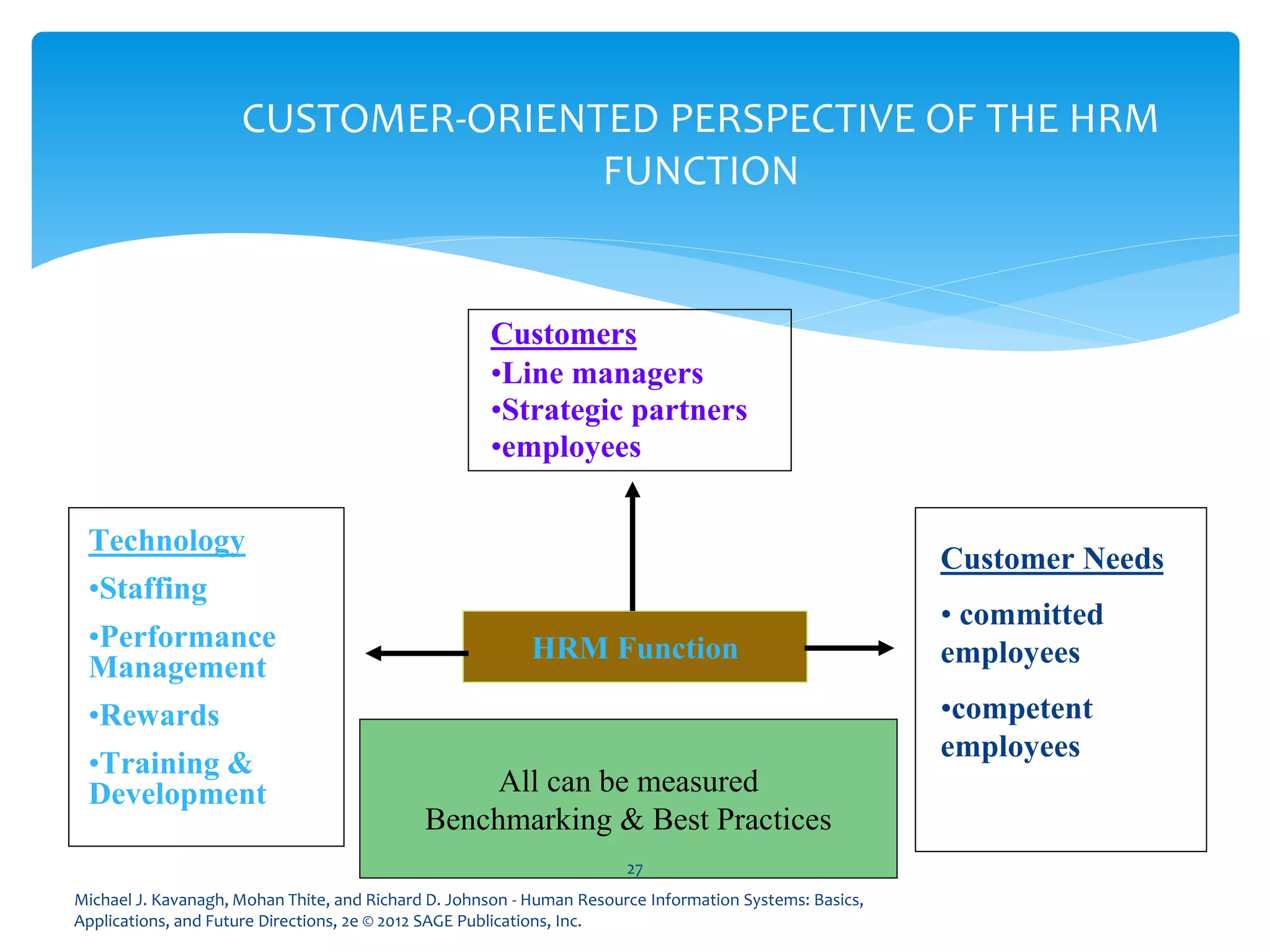
CUSTOMER-ORIENTED PERSPECTIVE OF THE HRM
FUNCTION
Customers
•Line managers
•Strategic partners
•employees
HRM Function
Technology
•Staffing
•Performance
Management
•Rewards
•Training &
Development
Customer Needs
• committed
employees
•competent
employees
All can be measured
Benchmarking & Best Practices
27
Michael J. Kavanagh, Mohan Thite, and Richard D. Johnson - Human
Resource Information Systems: Basics, Applications, and Future
Directions, 2e © 2012 SAGE Publications, Inc.
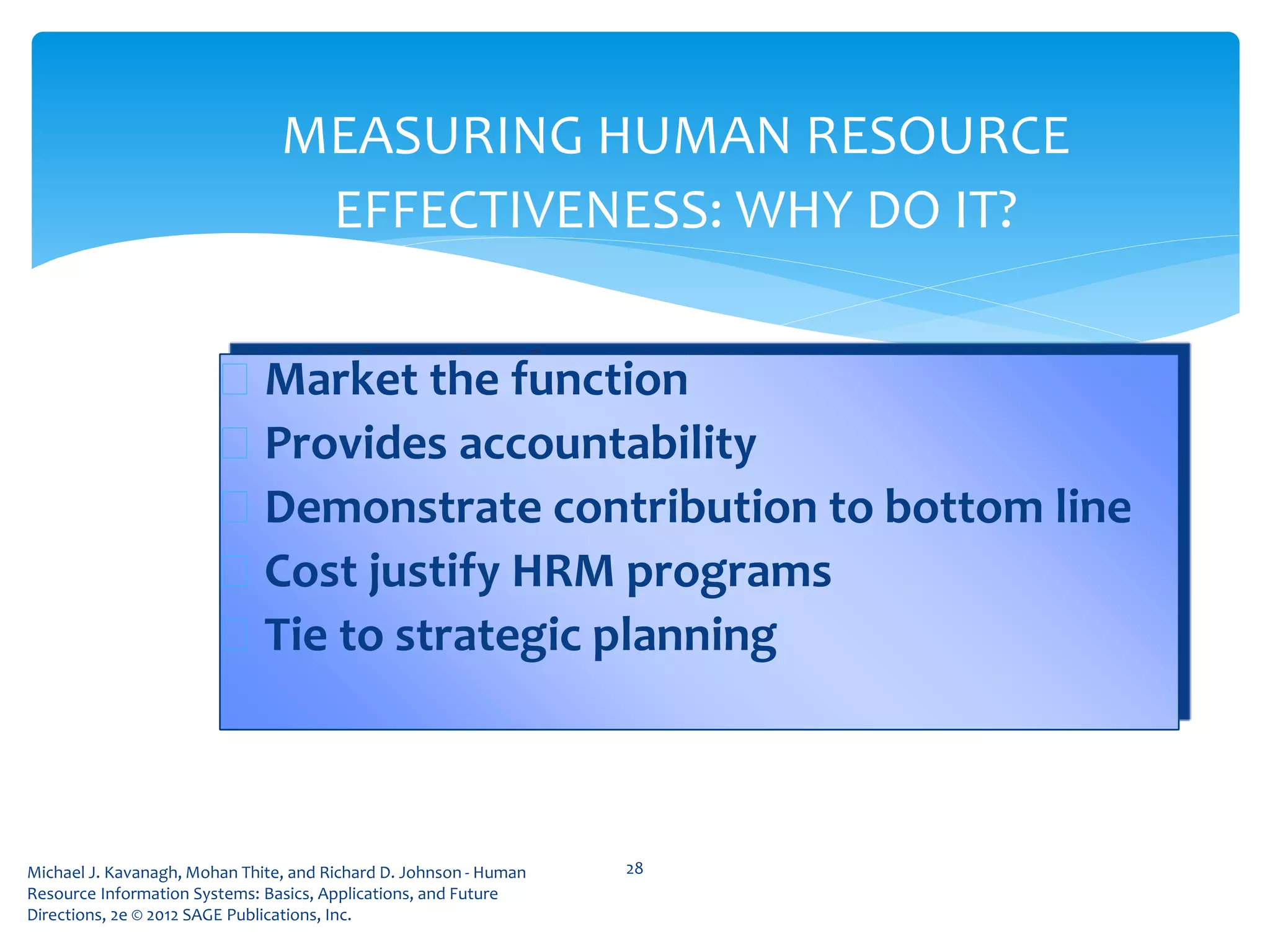
MEASURING HUMAN RESOURCE
EFFECTIVENESS: WHY DO IT?
 Market the function
 Provides accountability
 Demonstrate contribution to bottom line
 Cost justify HRM programs
 Tie to strategic planning
28
Michael J. Kavanagh, Mohan Thite, and Richard D. Johnson - Human
Resource Information Systems: Basics, Applications, and Future
Directions, 2e © 2012 SAGE Publications, Inc.
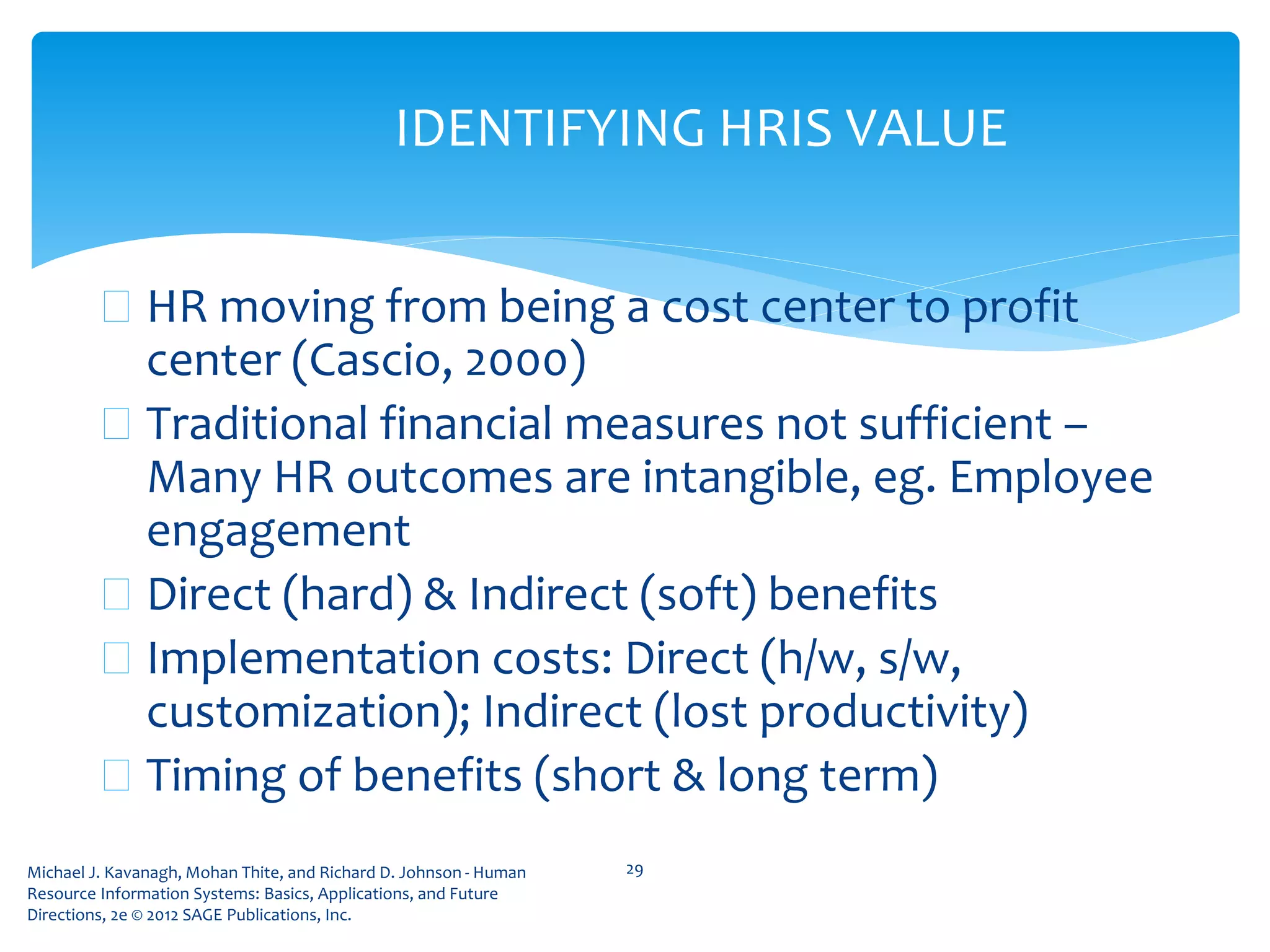
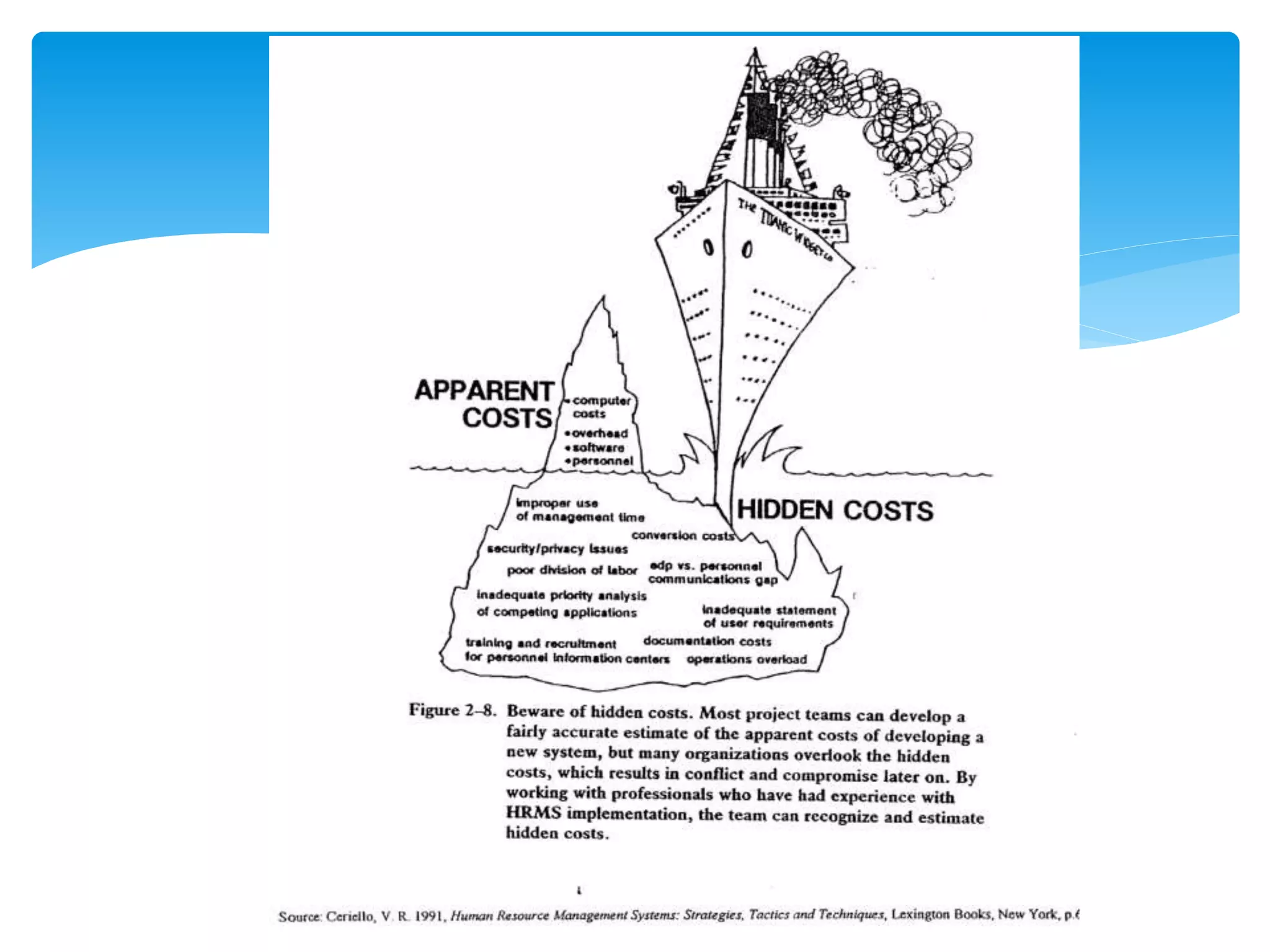
IDENTIFYING HRIS VALUE
 HR moving from being a cost center to profit
center (Cascio, 2000)
 Traditional financial measures not sufficient –
Many HR outcomes are intangible, eg. Employee
engagement
 Direct (hard) & Indirect (soft) benefits
 Implementation costs: Direct (h/w, s/w,
customization); Indirect (lost productivity)
 Timing of benefits (short & long term)
29
Michael J. Kavanagh, Mohan Thite, and Richard D. Johnson - Human Resource Information Systems: Basics,
Applications, and Future Directions, 2e © 2012 SAGE Publications, Inc.
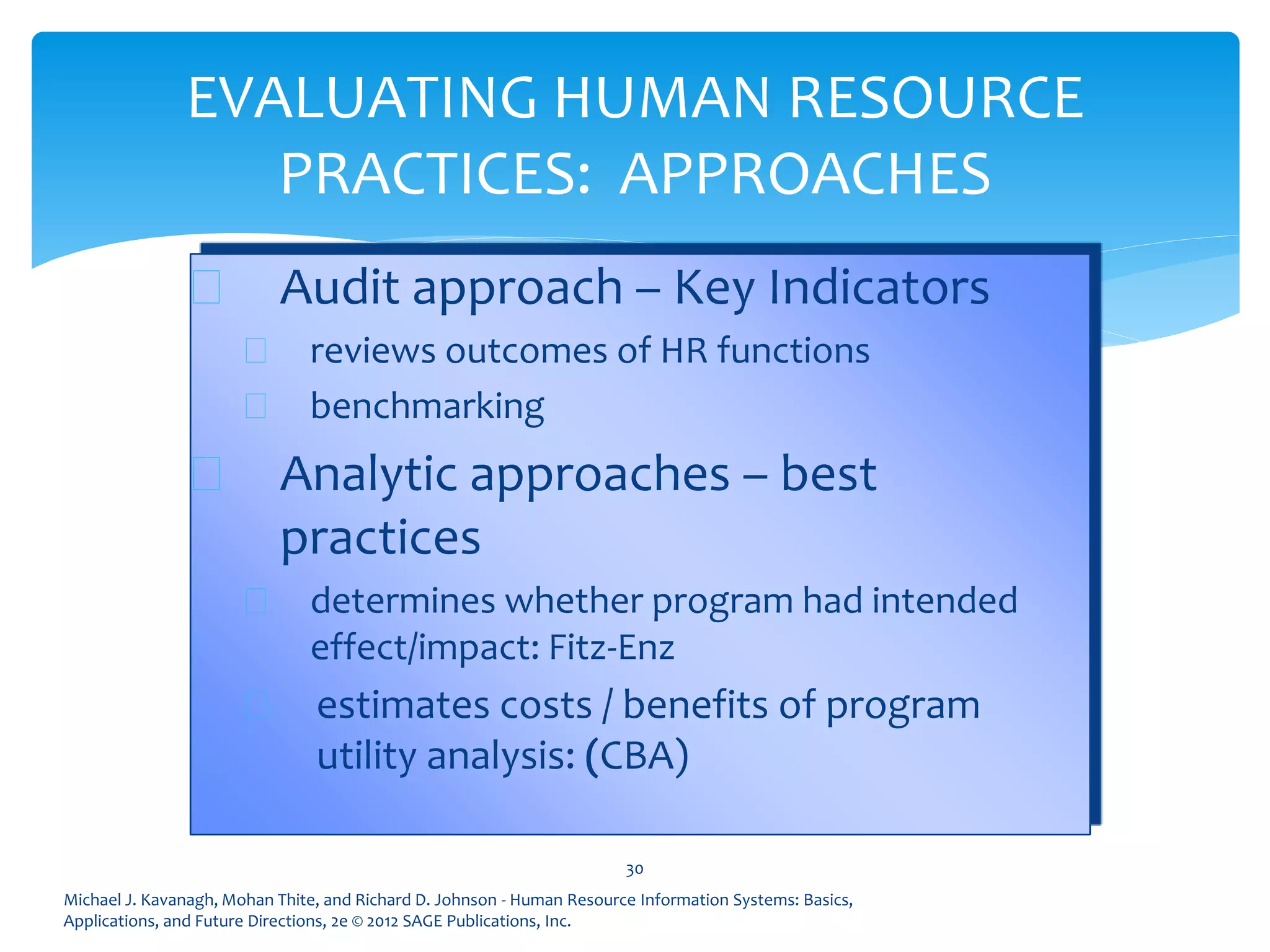
EVALUATING HUMAN RESOURCE
PRACTICES: APPROACHES
 Audit approach – Key Indicators
 reviews outcomes of HR functions
 benchmarking
 Analytic approaches – best
practices
 determines whether program had intended
effect/impact: Fitz-Enz
 estimates costs / benefits of program
utility analysis: (CBA)
30
Michael J. Kavanagh, Mohan Thite, and Richard D. Johnson - Human Resource Information Systems: Basics,
Applications, and Future Directions, 2e © 2012 SAGE Publications, Inc.
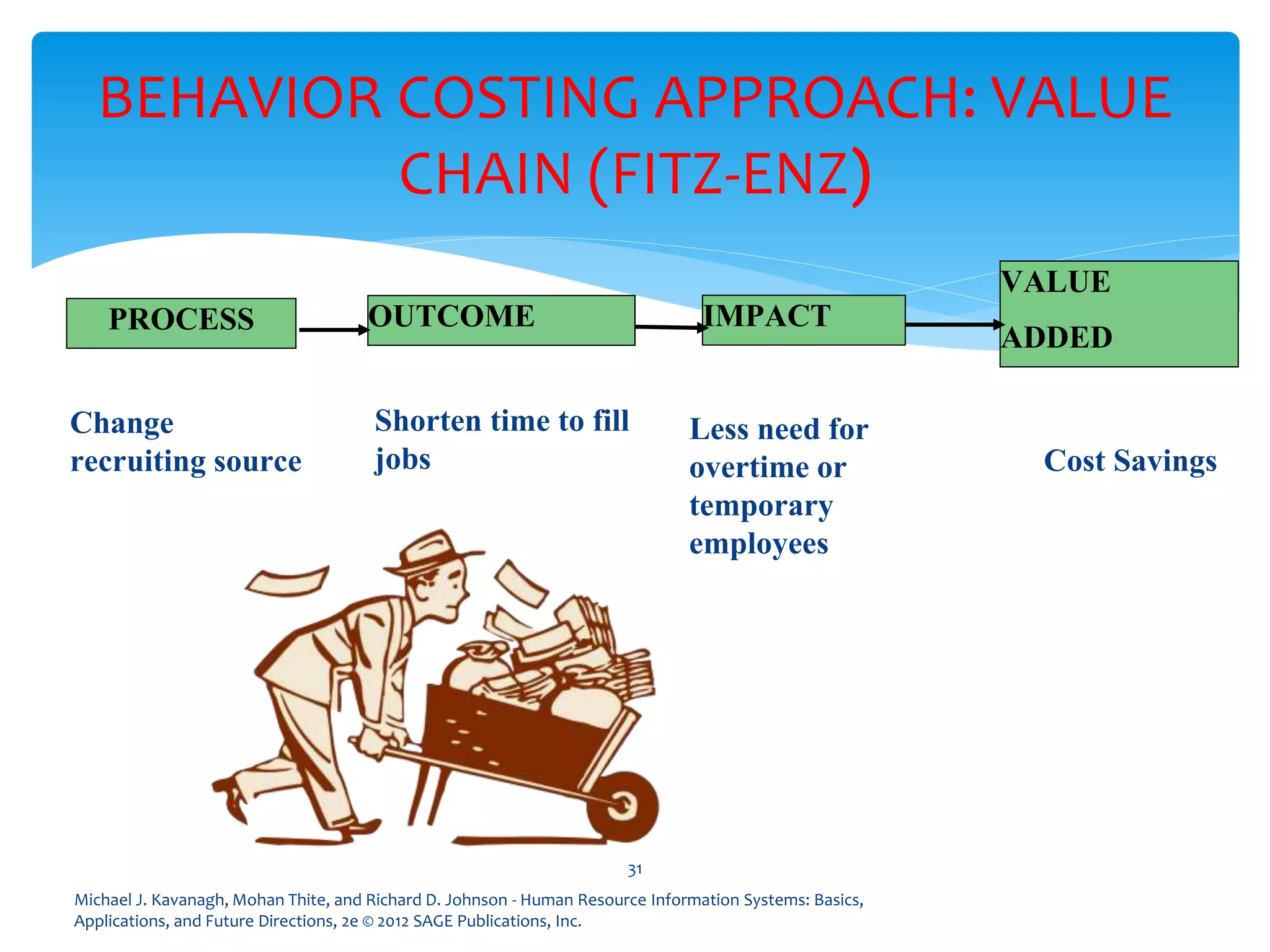
BEHAVIOR COSTING APPROACH: VALUE
CHAIN (FITZ-ENZ)
PROCESS
Change
recruiting source
OUTCOME IMPACT
VALUE
ADDED
Shorten time to fill
jobs
Less need for
overtime or
temporary
employees
Cost Savings
31
Michael J. Kavanagh, Mohan Thite, and Richard D. Johnson - Human
Resource Information Systems: Basics, Applications, and Future
Directions, 2e © 2012 SAGE Publications, Inc.
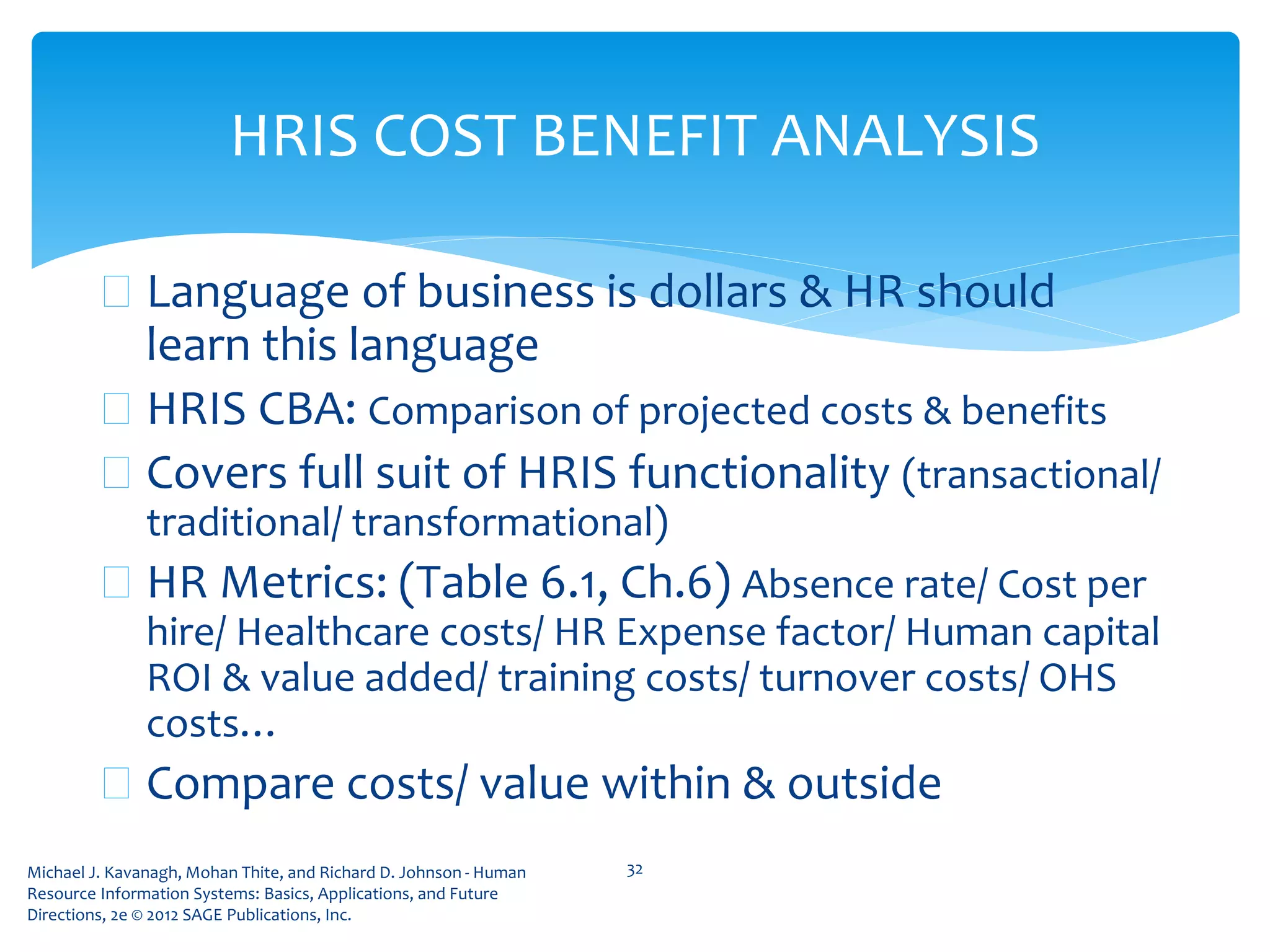
HRIS COST BENEFIT ANALYSIS
 Language of business is dollars & HR should
learn this language
 HRIS CBA: Comparison of projected costs & benefits
 Covers full suit of HRIS functionality (transactional/
traditional/ transformational)
 HR Metrics: (Table 6.1, Ch.6) Absence rate/ Cost per
hire/ Healthcare costs/ HR Expense factor/ Human capital
ROI & value added/ training costs/ turnover costs/ OHS
costs…
 Compare costs/ value within & outside
32
Michael J. Kavanagh, Mohan Thite, and Richard D. Johnson - Human
Resource Information Systems: Basics, Applications, and Future
Directions, 2e © 2012 SAGE Publications, Inc.
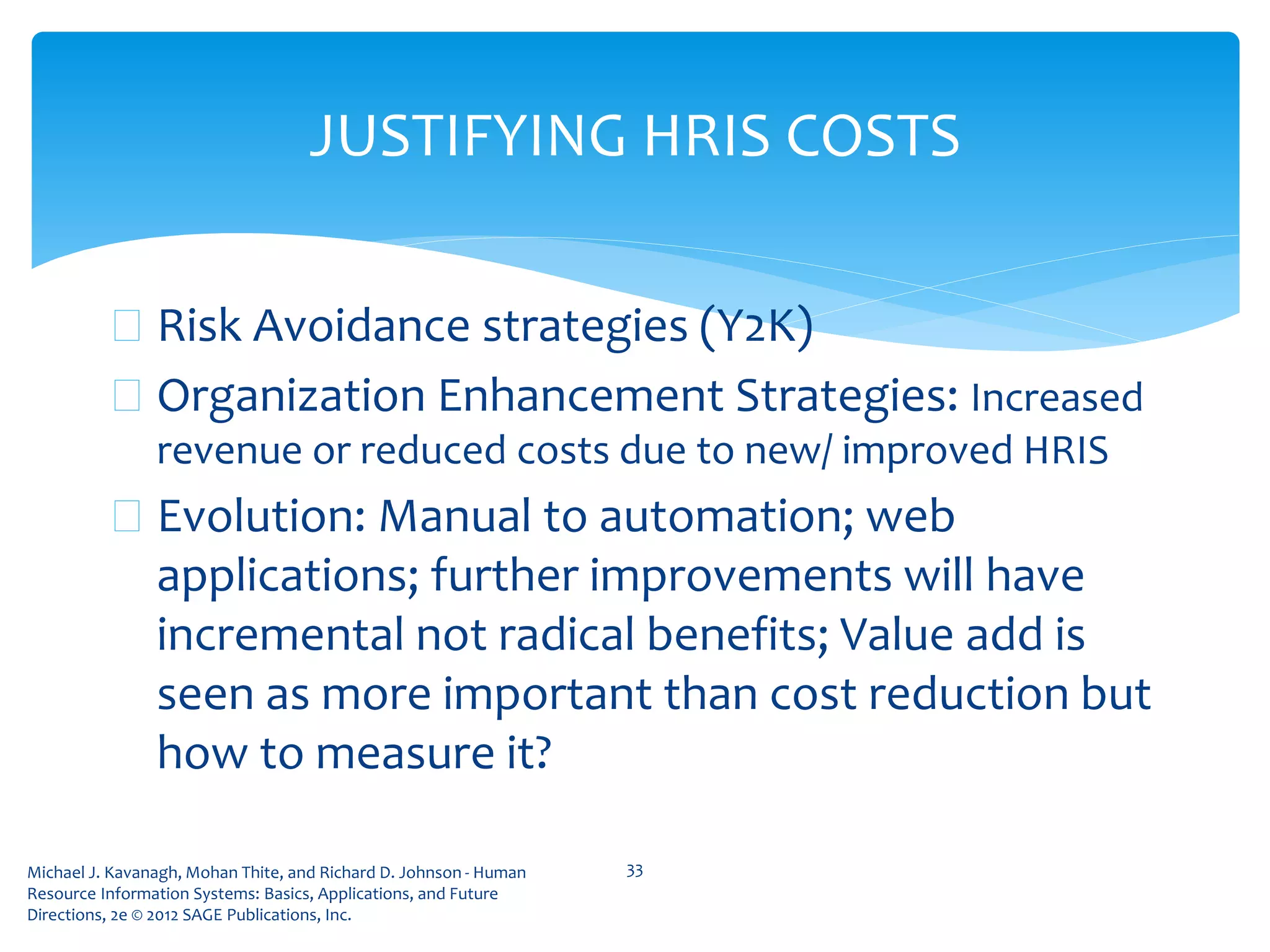
JUSTIFYING HRIS COSTS
 Risk Avoidance strategies (Y2K)
 Organization Enhancement Strategies: Increased
revenue or reduced costs due to new/ improved HRIS
 Evolution: Manual to automation; web
applications; further improvements will have
incremental not radical benefits; Value add is
seen as more important than cost reduction but
how to measure it?
33
Michael J. Kavanagh, Mohan Thite, and Richard D. Johnson - Human
Resource Information Systems: Basics, Applications, and Future
Directions, 2e © 2012 SAGE Publications, Inc.
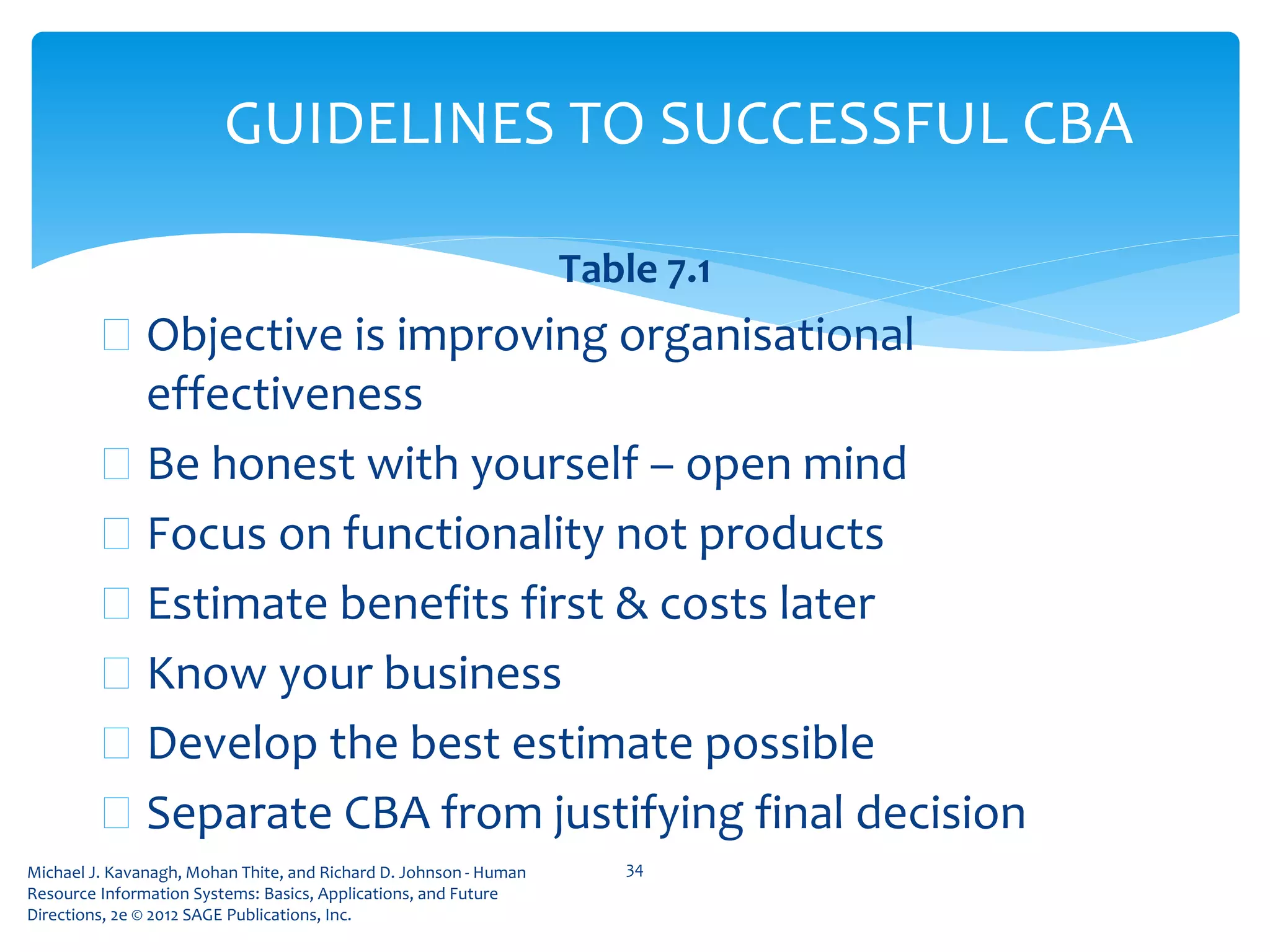
GUIDELINES TO SUCCESSFUL CBA
Table 7.1
 Objective is improving organisational
effectiveness
 Be honest with yourself – open mind
 Focus on functionality not products
 Estimate benefits first & costs later
 Know your business
 Develop the best estimate possible
 Separate CBA from justifying final decision
34
Michael J. Kavanagh, Mohan Thite, and Richard D. Johnson - Human
Resource Information Systems: Basics, Applications, and Future
Directions, 2e © 2012 SAGE Publications, Inc.
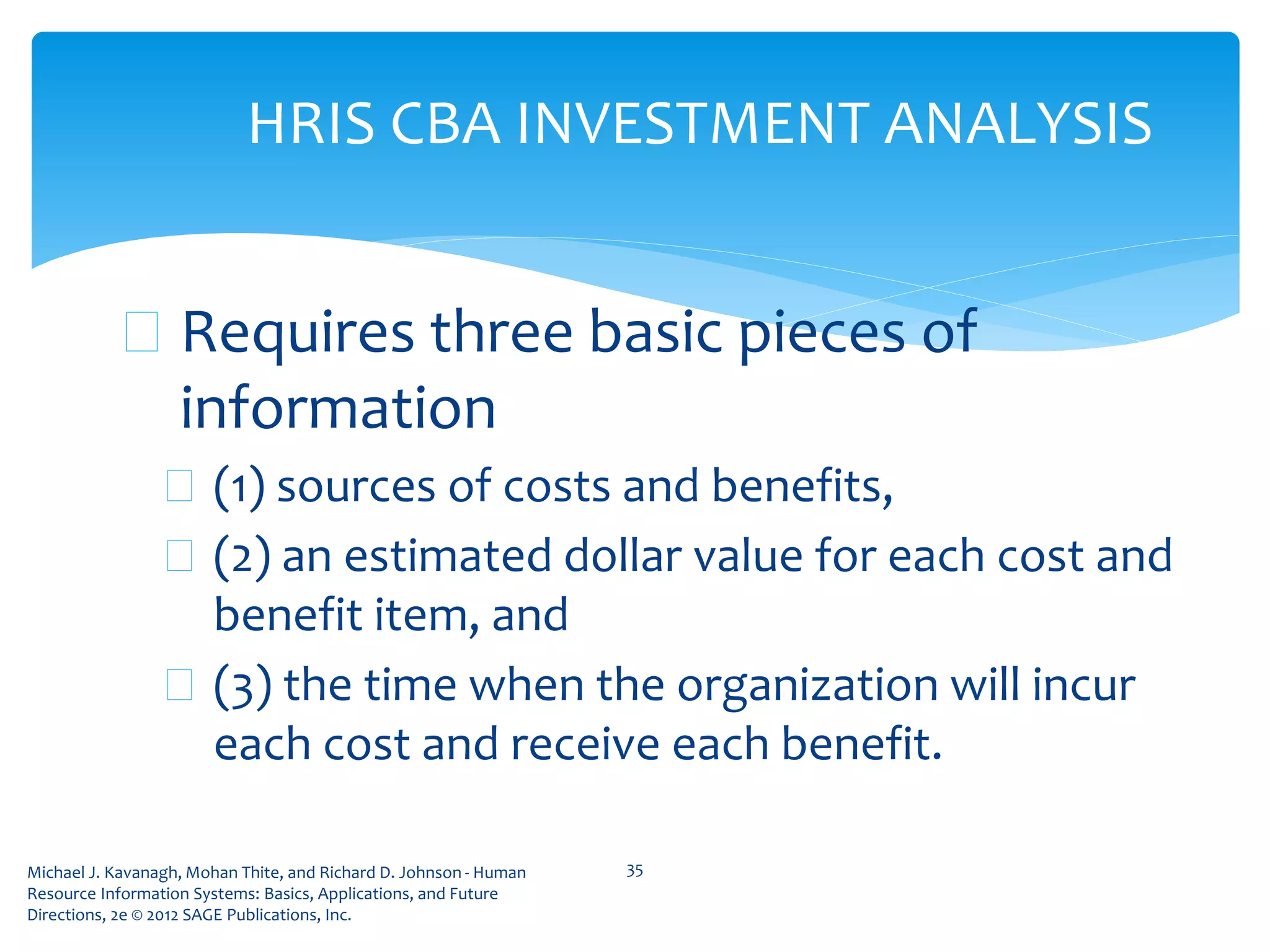
HRIS CBA INVESTMENT ANALYSIS
 Requires three basic pieces of
information
 (1) sources of costs and benefits,
 (2) an estimated dollar value for each cost and
benefit item, and
 (3) the time when the organization will incur
each cost and receive each benefit.
35
Michael J. Kavanagh, Mohan Thite, and Richard D. Johnson - Human Resource Information Systems: Basics,
Applications, and Future Directions, 2e © 2012 SAGE Publications, Inc.
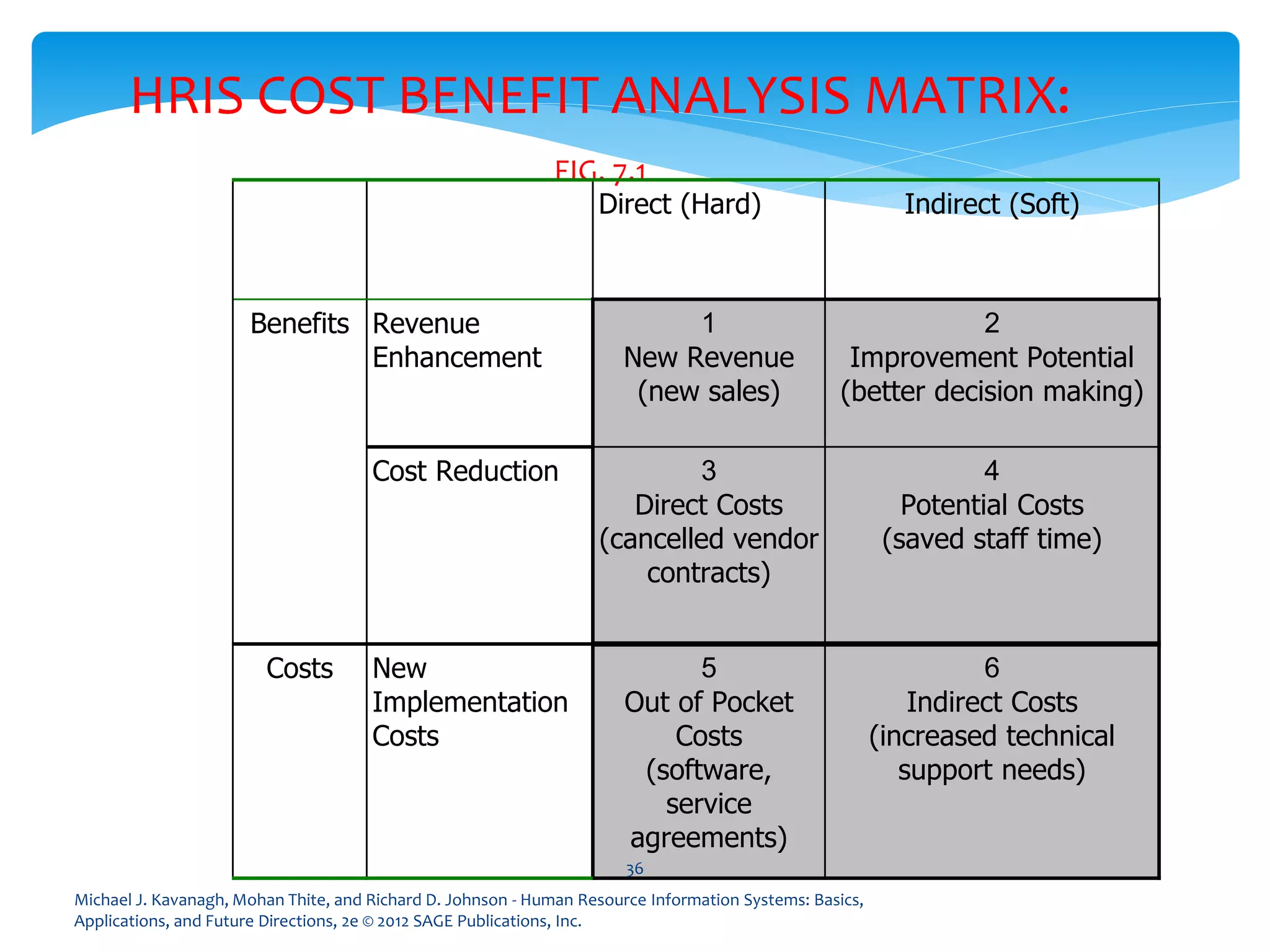
HRIS COST BENEFIT ANALYSIS MATRIX:
FIG. 7.1
Direct (Hard) Indirect (Soft)
Benefits Revenue
Enhancement
1
New Revenue
(new sales)
2
Improvement Potential
(better decision making)
Cost Reduction 3
Direct Costs
(cancelled vendor
contracts)
4
Potential Costs
(saved staff time)
Costs New
Implementation
Costs
5
Out of Pocket
Costs
(software,
service
agreements)
6
Indirect Costs
(increased technical
support needs)
36
Michael J. Kavanagh, Mohan Thite, and Richard D. Johnson - Human
Resource Information Systems: Basics, Applications, and Future
Directions, 2e © 2012 SAGE Publications, Inc.
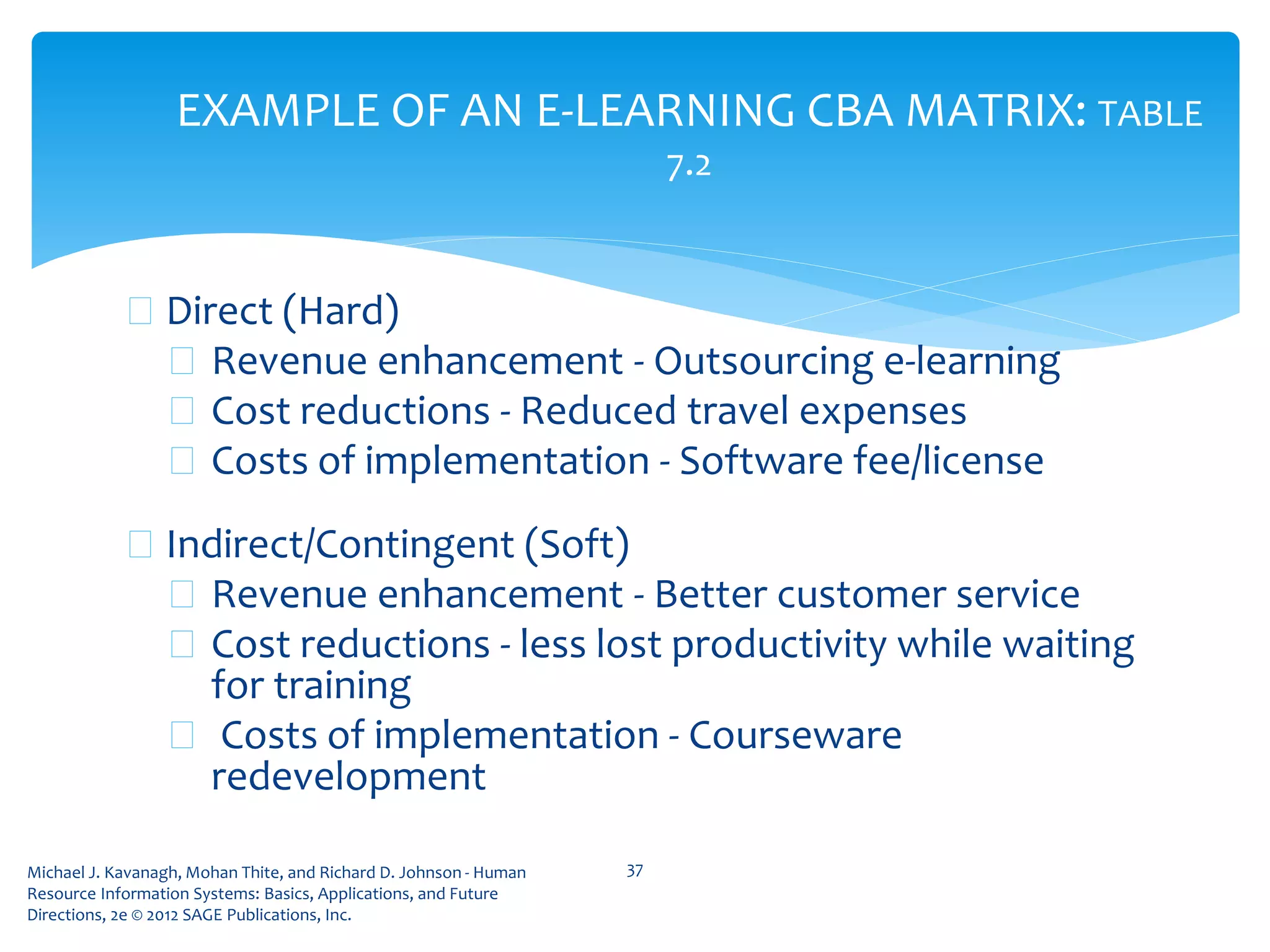
EXAMPLE OF AN E-LEARNING CBA MATRIX: TABLE
7.2
 Direct (Hard)
 Revenue enhancement - Outsourcing e-learning
 Cost reductions - Reduced travel expenses
 Costs of implementation - Software fee/license
 Indirect/Contingent (Soft)
 Revenue enhancement - Better customer service
 Cost reductions - less lost productivity while waiting
for training
 Costs of implementation - Courseware
redevelopment
37
Michael J. Kavanagh, Mohan Thite, and Richard D. Johnson - Human
Resource Information Systems: Basics, Applications, and Future
Directions, 2e © 2012 SAGE Publications, Inc.
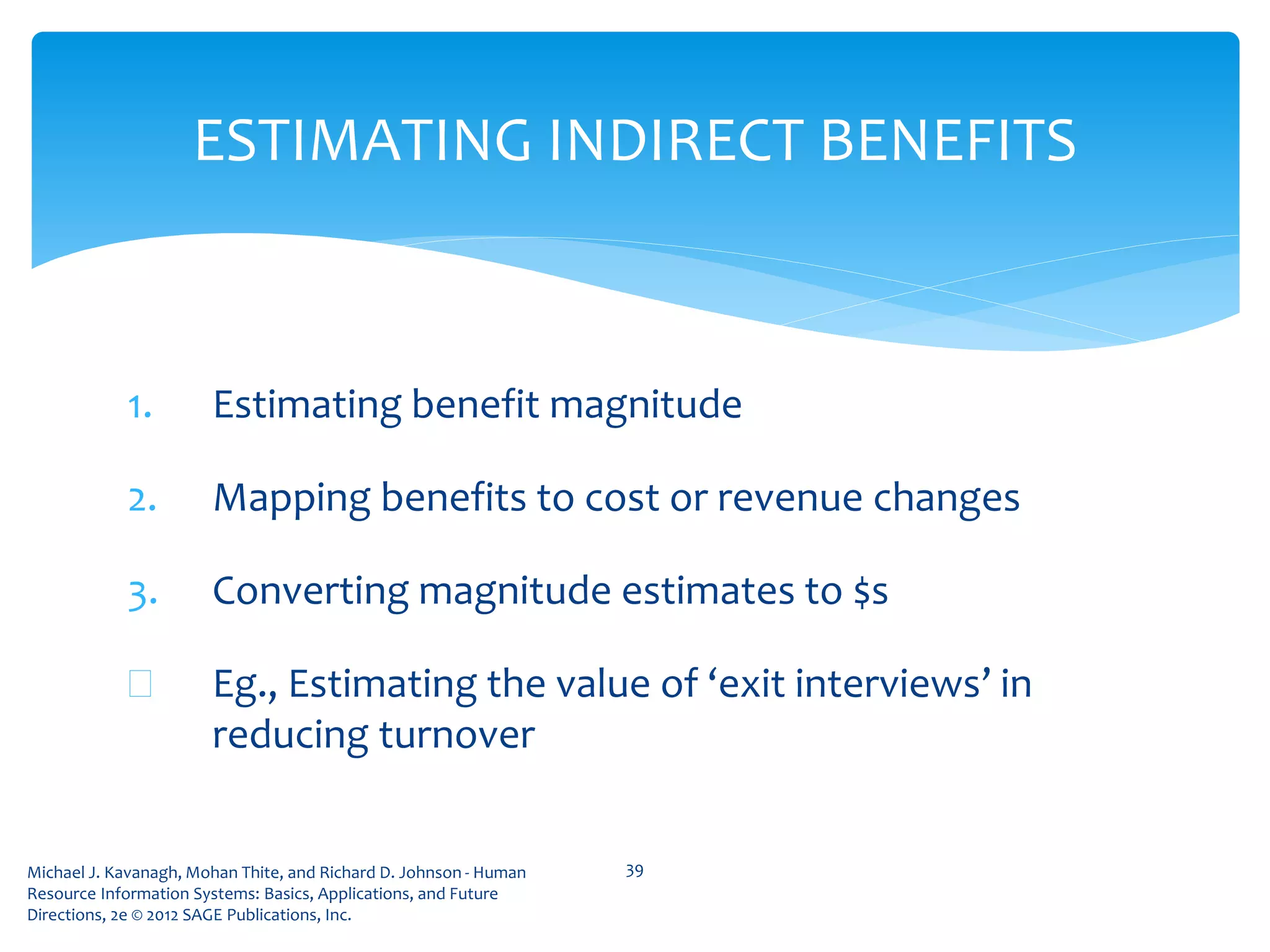
ESTIMATING INDIRECT BENEFITS
1. Estimating benefit magnitude
2. Mapping benefits to cost or revenue changes
3. Converting magnitude estimates to $s
 Eg., Estimating the value of ‘exit interviews’ in
reducing turnover
39
Michael J. Kavanagh, Mohan Thite, and Richard D. Johnson - Human
Resource Information Systems: Basics, Applications, and Future
Directions, 2e © 2012 SAGE Publications, Inc.
APPROACHES TO ESTIMATING BENEFITS:
TABLE 7.3
 Direct Estimation
 Most appropriate for risk avoidance (eg., costs reduced by
employee self-service )
 Benchmarking
 Build on others’ experience (eg., PeopleSoft implementation
costs in other organizations)
 Internal Assessment
 Analysis based on specific internal assessments of actual costs
and likely benefits (e.g., activity-based costing)
 Mix and match
 Using combinations of these approaches
40
Michael J. Kavanagh, Mohan Thite, and Richard D. Johnson - Human
Resource Information Systems: Basics, Applications, and Future
Directions, 2e © 2012 SAGE Publications, Inc.
GENERAL CATEGORIES OF COSTS OF
HUMAN BEHAVIOR IN ORGANIZATIONS
 Turnover
 Absenteeism and sick leave
 Effects of Smoking in Work Place
 EAP & Wellness programs
 Employee attitudes
 Labor contract costing
 Recruiting
 Selection
 Job Performance
 Training
 Career Development
41
Michael J. Kavanagh, Mohan Thite, and Richard D. Johnson - Human
Resource Information Systems: Basics, Applications, and Future
Directions, 2e © 2012 SAGE Publications, Inc.
COSTING THE EFFECTS OF SMOKING
 Incremental absenteeism
 Incremental medical care
 Incremental morbidity and premature morbidity
 Incremental insurance
 Incremental on-the-job time lost
 Property damage and depreciation: burns & odors
 Reduced maintenance
 Involuntary smoking – 2nd hand smoke
42
Michael J. Kavanagh, Mohan Thite, and Richard D. Johnson - Human
Resource Information Systems: Basics, Applications, and Future
Directions, 2e © 2012 SAGE Publications, Inc.
COSTING EMPLOYEE TURNOVER
 3 components of costing employee
turnover
 Separation costs
 Replacement costs
 Training costs
43
Michael J. Kavanagh, Mohan Thite, and Richard D. Johnson - Human
Resource Information Systems: Basics, Applications, and Future
Directions, 2e © 2012 SAGE Publications, Inc.
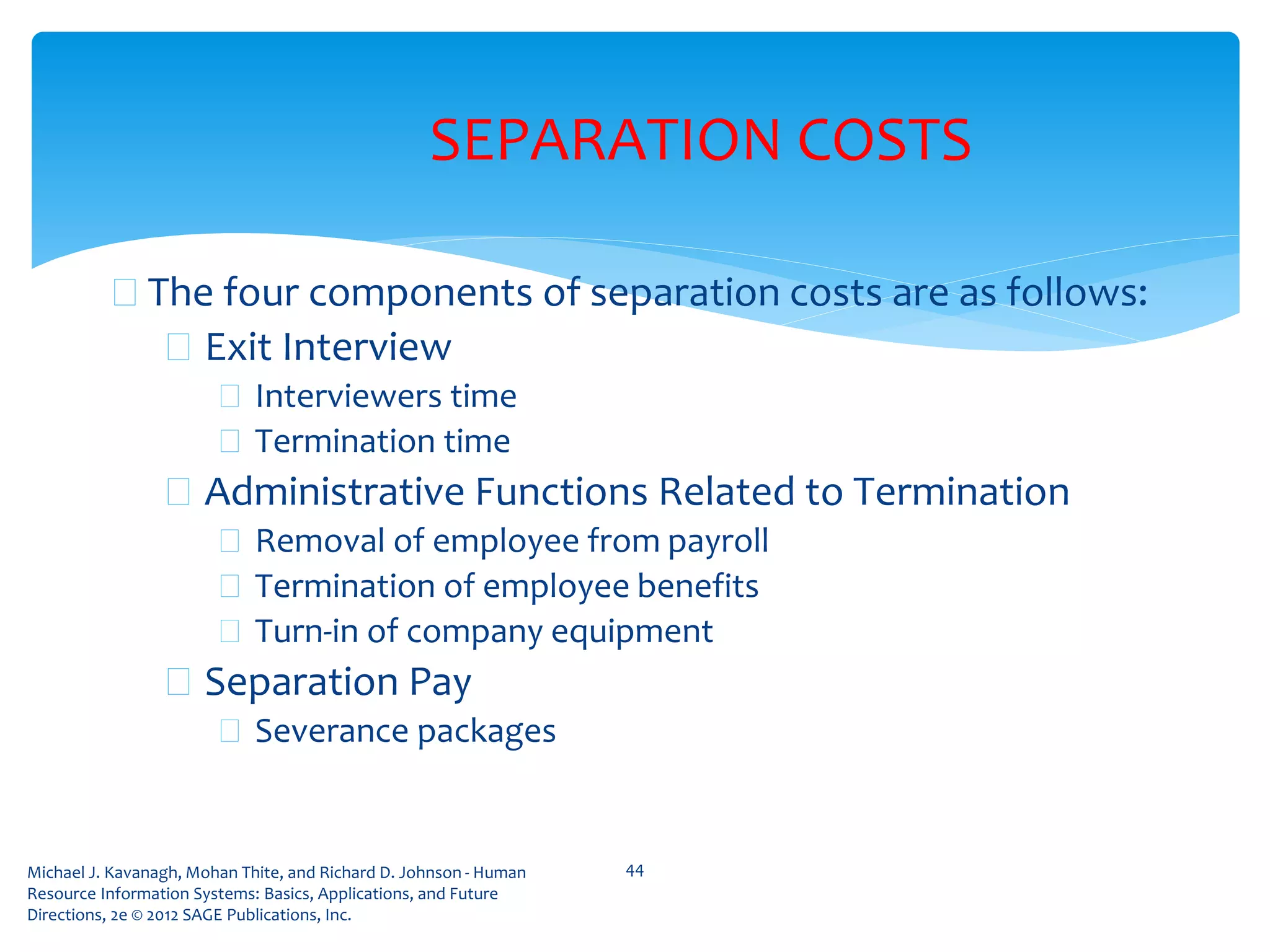
SEPARATION COSTS
 The four components of separation costs are as follows:
 Exit Interview
 Interviewers time
 Termination time
 Administrative Functions Related to Termination
 Removal of employee from payroll
 Termination of employee benefits
 Turn-in of company equipment
 Separation Pay
 Severance packages
44
Michael J. Kavanagh, Mohan Thite, and Richard D. Johnson - Human
Resource Information Systems: Basics, Applications, and Future
Directions, 2e © 2012 SAGE Publications, Inc.
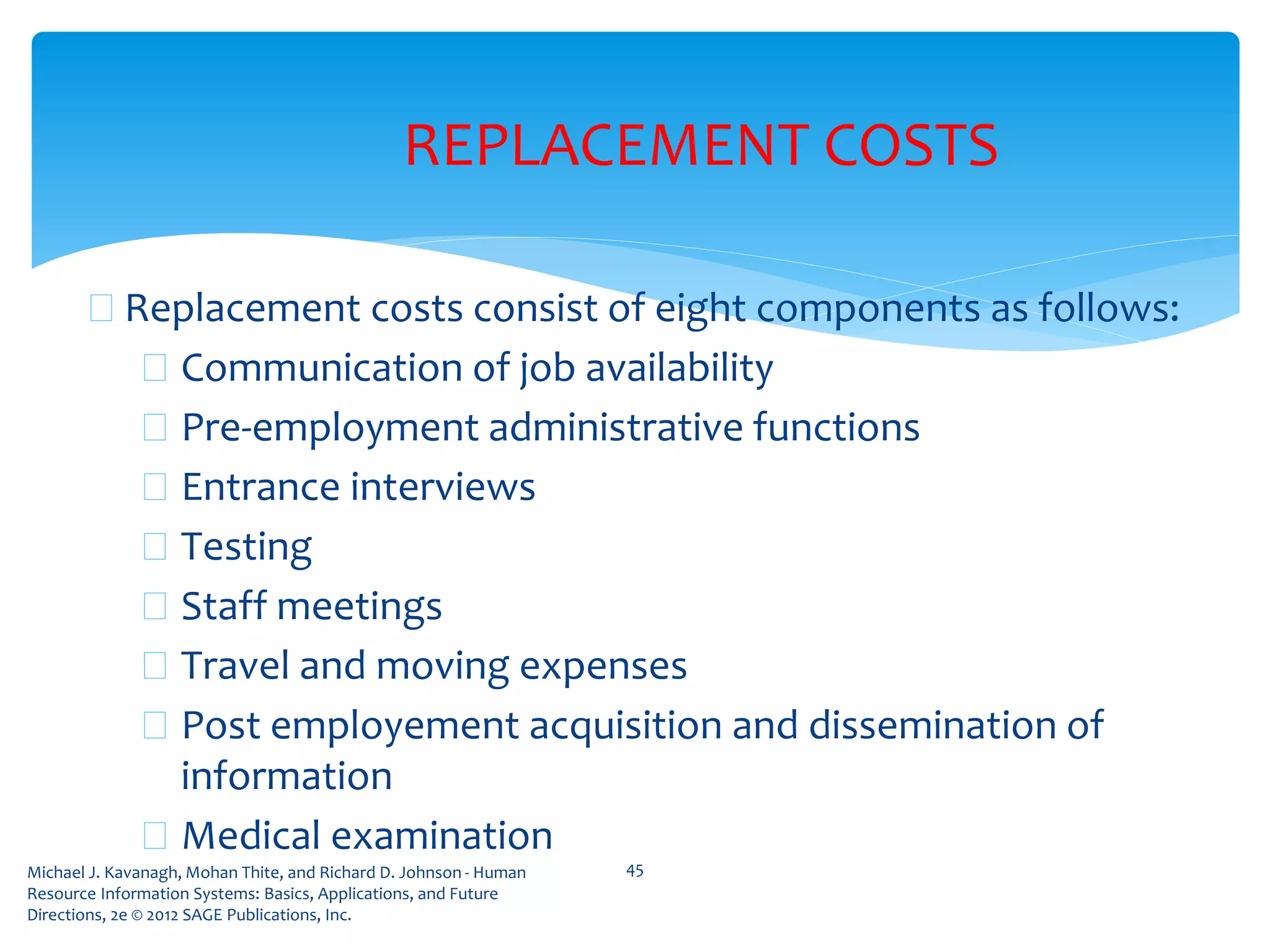
REPLACEMENT COSTS
 Replacement costs consist of eight components as follows:
 Communication of job availability
 Pre-employment administrative functions
 Entrance interviews
 Testing
 Staff meetings
 Travel and moving expenses
 Post employement acquisition and dissemination of
information
 Medical examination
45
Michael J. Kavanagh, Mohan Thite, and Richard D. Johnson - Human
Resource Information Systems: Basics, Applications, and Future
Directions, 2e © 2012 SAGE Publications, Inc.
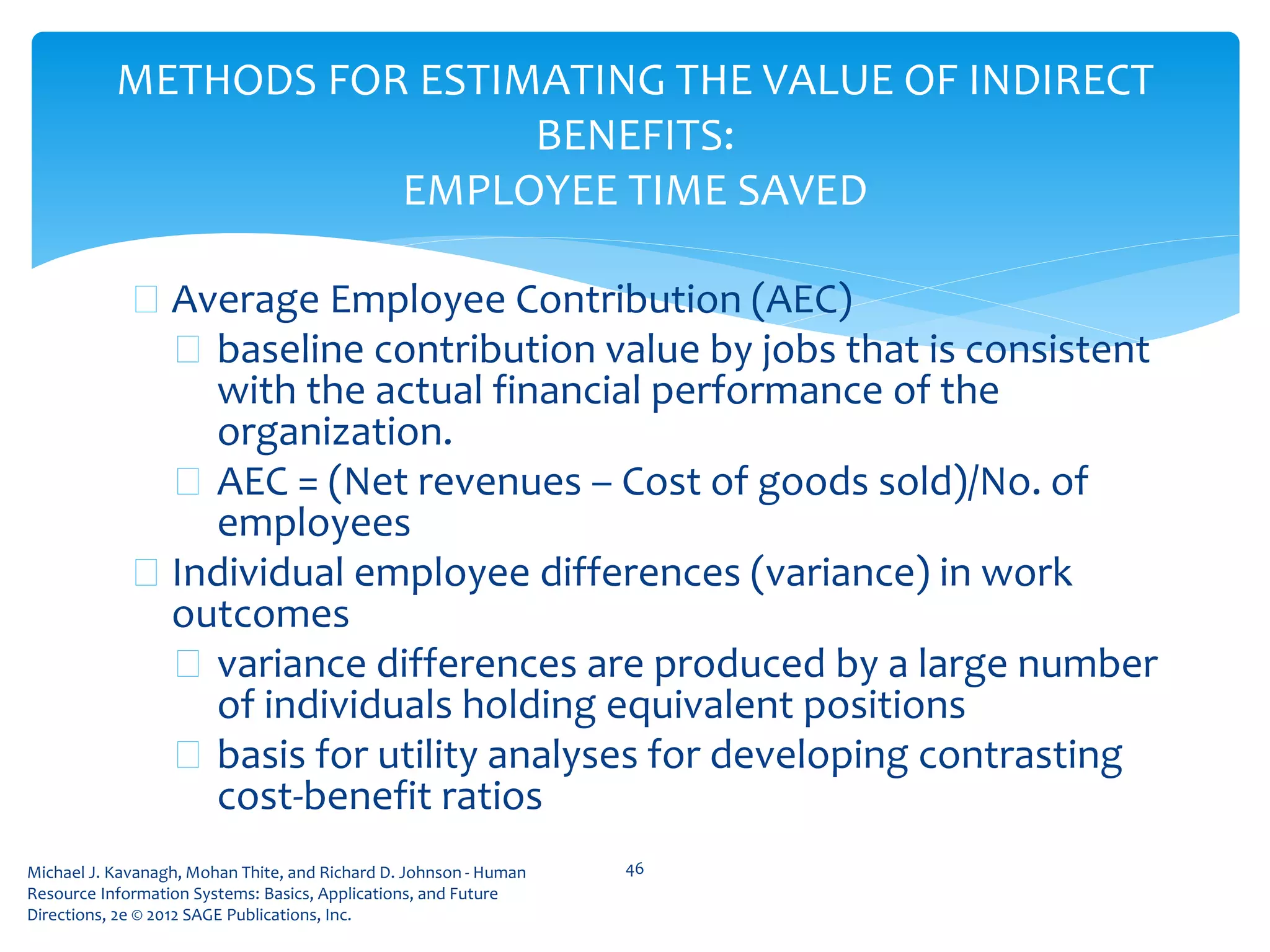
METHODS FOR ESTIMATING THE VALUE OF INDIRECT
BENEFITS:
EMPLOYEE TIME SAVED
 Average Employee Contribution (AEC)
 baseline contribution value by jobs that is consistent
with the actual financial performance of the
organization.
 AEC = (Net revenues – Cost of goods sold)/No. of
employees
 Individual employee differences (variance) in work
outcomes
 variance differences are produced by a large number
of individuals holding equivalent positions
 basis for utility analyses for developing contrasting
cost-benefit ratios
46
Michael J. Kavanagh, Mohan Thite, and Richard D. Johnson - Human
Resource Information Systems: Basics, Applications, and Future
Directions, 2e © 2012 SAGE Publications, Inc.
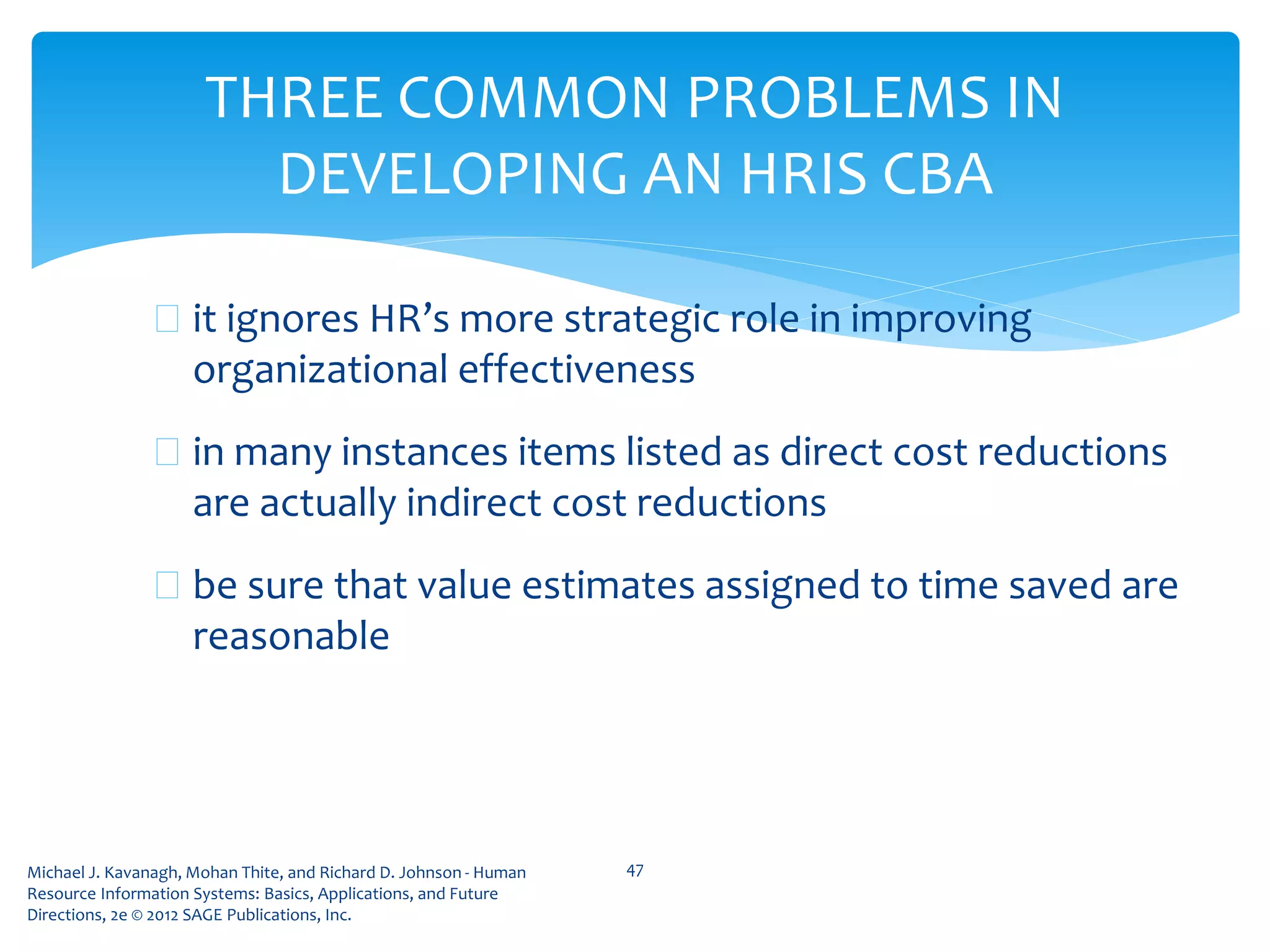
THREE COMMON PROBLEMS IN
DEVELOPING AN HRIS CBA
 it ignores HR’s more strategic role in improving
organizational effectiveness
 in many instances items listed as direct cost reductions
are actually indirect cost reductions
 be sure that value estimates assigned to time saved are
reasonable
47

HR Needs Analysis and Cost Estimation

  • 1.
    HRIS Needs Analysisand cost estimations
  • 2.
     “Failing toplan is planning to fail.” (Alge & Upright 2009, p.80)  “Use the right tool for the job,” the old saying goes, “and to use the right tool you have to know what job you’re trying to do.” (Meade 2003, p.84) 2 Do you need one?
  • 3.
  • 4.
     Australian DefenceForce  ADF some time ago flagged its intention to replace the HR systems with a wider solution. In December 2009, chief information officer Greg Farr told ZDNet.com.au that the department expected to ditch the "far from perfect" HR systems in 2009 in a tender worth around $400 million. (LeMay 2009)  http://www.abc.net.au/pm/content/2010/s2815919.h tm 4 Payroll implementation
  • 5.
    “Behind every successfulHRMS implementation, there was a thorough needs analysis". You can quote me on that! I cannot back that statement up statistically, however, after over 25 years in the business and 10 years of listening to IHRIM (International Association for Human Resources Information Management) members share "war stories", I am totally convinced that the amount of time spent on a thorough needs analysis before purchasing and implementing a new HRMS is the best barometer for predicting the success or failure of the project.” (Doran 2010) 5
  • 6.
    Michael J. Kavanagh,Mohan Thite, and Richard D. Johnson - Human Resource Information Systems: Basics, Applications, and Future Directions, 2e © 2012 SAGE Publications, Inc. 6 SYSTEMS DEVELOPMENT LIFE CYCLE (SDLC) Continuous and iterative nature of planning and analysis! Figure 4.1
  • 7.
    Michael J. Kavanagh,Mohan Thite, and Richard D. Johnson - Human Resource Information Systems: Basics, Applications, and Future Directions, 2e © 2012 SAGE Publications, Inc.  Planning  Long-range  Short-range  Analysis  Needs Analysis  Gap Analysis 7 SDLC: Overview
  • 8.
    Michael J. Kavanagh,Mohan Thite, and Richard D. Johnson - Human Resource Information Systems: Basics, Applications, and Future Directions, 2e © 2012 SAGE Publications, Inc.  Design  “Blue print” for the system  Vendor selection  Implementation  Build, test and readied to “go live”  Maintenance  Corrective, adaptive, perfective & preventative 8 SDLC OVERVIEW
  • 9.
    Michael J. Kavanagh,Mohan Thite, and Richard D. Johnson - Human Resource Information Systems: Basics, Applications, and Future Directions, 2e © 2012 SAGE Publications, Inc.  Needs: long-range planning  Strategic  “Big picture”  Phase containment  Needs: short range planning  Operational  Specific projects and programs 9 SDLC: Planning
  • 10.
    Michael J. Kavanagh,Mohan Thite, and Richard D. Johnson - Human Resource Information Systems: Basics, Applications, and Future Directions, 2e © 2012 SAGE Publications, Inc.  Where are we now?  Where are we going?  How are we going to get there? Revise and revisit these questions On a regular basis! 10 THE BIG 3
  • 11.
    Michael J. Kavanagh,Mohan Thite, and Richard D. Johnson - Human Resource Information Systems: Basics, Applications, and Future Directions, 2e © 2012 SAGE Publications, Inc.  Dissect and document current capabilities  Identify and prioritize needs  Conduct A gap analysis  Review the feasibility analysis  Determine usefulness of gap analysis in developing RFP for vendors 11 ANALYSIS
  • 12.
    Michael J. Kavanagh,Mohan Thite, and Richard D. Johnson - Human Resource Information Systems: Basics, Applications, and Future Directions, 2e © 2012 SAGE Publications, Inc.  Current analysis  Use combination of methods:  Interviews  Focus groups  Surveys and online tools  Organizational archives 12 ANALYSIS: WHERE ARE WE NOW?
  • 13.
    Michael J. Kavanagh,Mohan Thite, and Richard D. Johnson - Human Resource Information Systems: Basics, Applications, and Future Directions, 2e © 2012 SAGE Publications, Inc.  Who to ask:  HR functional experts  Job experts  Technical experts  End users  Top management  Consultants and other business partners 13 ANALYSIS: WHERE ARE WE NOW?
  • 14.
    Michael J. Kavanagh,Mohan Thite, and Richard D. Johnson - Human Resource Information Systems: Basics, Applications, and Future Directions, 2e © 2012 SAGE Publications, Inc.  Heart of the needs analysis  Business requirements definition  Point at which organization determines and documents its current and future needs  Often used interchangeably with needs analysis  Prioritize business and system needs 14 ANALYSIS: WHERE WE NEED TO GO
  • 15.
     Where arewe going?  Strategic vision:  To transform the University’s way of doing business into a flexible and user-centric portfolio of applications that integrates all Purdue enterprise data, information and processes  Helped identify needs in detail and select best system  Resulted in SAP-HCM 15 Purdue University
  • 16.
    16 Who, what, whereand when at Purdue (Alge & Upright 2009, p.88)
  • 17.
    Michael J. Kavanagh,Mohan Thite, and Richard D. Johnson - Human Resource Information Systems: Basics, Applications, and Future Directions, 2e © 2012 SAGE Publications, Inc.  http://www.erp.com/attachments/4074_Accelerated% 20SAP%20Implementations.pdf 17
  • 18.
    Michael J. Kavanagh,Mohan Thite, and Richard D. Johnson - Human Resource Information Systems: Basics, Applications, and Future Directions, 2e © 2012 SAGE Publications, Inc.  Culmination of the needs analysis.  Compares current state of hris with desired state of hris  What important needs are not being met  What important needs are being met  Important decision making tool for HRIS project leaders. 18 GAP ANALYSIS
  • 19.
    Michael J. Kavanagh,Mohan Thite, and Richard D. Johnson - Human Resource Information Systems: Basics, Applications, and Future Directions, 2e © 2012 SAGE Publications, Inc. 19 HYPOTHETICAL GAP ANALYSIS REPORT Figure 4.6
  • 20.
    Michael J. Kavanagh,Mohan Thite, and Richard D. Johnson - Human Resource Information Systems: Basics, Applications, and Future Directions, 2e © 2012 SAGE Publications, Inc. 20 THE BIG 3 NEEDS TRIANGLE Figure 4.7
  • 21.
    Michael J. Kavanagh,Mohan Thite, and Richard D. Johnson - Human Resource Information Systems: Basics, Applications, and Future Directions, 2e © 2012 SAGE Publications, Inc.  Who should determine what our needs are going forward?  How can we ensure that all of our needs are identified?  How do we limit the scope to the things we truly need?  Is it feasible at this point to implement a system that can meet our critical needs? 21 NEEDS ANALYSIS: CRITICAL QUESTIONS
  • 22.
     Basically aProject Management activity  Stipulate objectives, activities, time-frame, costs, required resources and staff, information collection methodology  Will help encourage management of project viability 22 Develop a NA Plan
  • 23.
     Typically, 2reports emerge from the NA process  Long, technical, operational document, to guide system development or selection/purchase  Summary version, to trigger action from top management 23 Develop the HRIS Strategy
  • 24.
    Finally, a criticalreview of the whole process  As a guideline for any future modifications, or for a new purchase in future years  an analysis of which activities worked well and which didn’t  a phase possibly ignored by many organisations (many don’t even do NA’s!)  Discuss alternatives 24 Evaluate the NA Effort
  • 25.
     There’s noone right way for NA. Every organization is unique.  Even a token attempt at NA can save a lot of time, money, effort and heartache. 25 Conclusion
  • 26.
    Lect part 2 CostJustifying HRIS Investments
  • 27.
    Michael J. Kavanagh,Mohan Thite, and Richard D. Johnson - Human Resource Information Systems: Basics, Applications, and Future Directions, 2e © 2012 SAGE Publications, Inc. CUSTOMER-ORIENTED PERSPECTIVE OF THE HRM FUNCTION Customers •Line managers •Strategic partners •employees HRM Function Technology •Staffing •Performance Management •Rewards •Training & Development Customer Needs • committed employees •competent employees All can be measured Benchmarking & Best Practices 27
  • 28.
    Michael J. Kavanagh,Mohan Thite, and Richard D. Johnson - Human Resource Information Systems: Basics, Applications, and Future Directions, 2e © 2012 SAGE Publications, Inc. MEASURING HUMAN RESOURCE EFFECTIVENESS: WHY DO IT?  Market the function  Provides accountability  Demonstrate contribution to bottom line  Cost justify HRM programs  Tie to strategic planning 28
  • 29.
    Michael J. Kavanagh,Mohan Thite, and Richard D. Johnson - Human Resource Information Systems: Basics, Applications, and Future Directions, 2e © 2012 SAGE Publications, Inc. IDENTIFYING HRIS VALUE  HR moving from being a cost center to profit center (Cascio, 2000)  Traditional financial measures not sufficient – Many HR outcomes are intangible, eg. Employee engagement  Direct (hard) & Indirect (soft) benefits  Implementation costs: Direct (h/w, s/w, customization); Indirect (lost productivity)  Timing of benefits (short & long term) 29
  • 30.
    Michael J. Kavanagh,Mohan Thite, and Richard D. Johnson - Human Resource Information Systems: Basics, Applications, and Future Directions, 2e © 2012 SAGE Publications, Inc. EVALUATING HUMAN RESOURCE PRACTICES: APPROACHES  Audit approach – Key Indicators  reviews outcomes of HR functions  benchmarking  Analytic approaches – best practices  determines whether program had intended effect/impact: Fitz-Enz  estimates costs / benefits of program utility analysis: (CBA) 30
  • 31.
    Michael J. Kavanagh,Mohan Thite, and Richard D. Johnson - Human Resource Information Systems: Basics, Applications, and Future Directions, 2e © 2012 SAGE Publications, Inc. BEHAVIOR COSTING APPROACH: VALUE CHAIN (FITZ-ENZ) PROCESS Change recruiting source OUTCOME IMPACT VALUE ADDED Shorten time to fill jobs Less need for overtime or temporary employees Cost Savings 31
  • 32.
    Michael J. Kavanagh,Mohan Thite, and Richard D. Johnson - Human Resource Information Systems: Basics, Applications, and Future Directions, 2e © 2012 SAGE Publications, Inc. HRIS COST BENEFIT ANALYSIS  Language of business is dollars & HR should learn this language  HRIS CBA: Comparison of projected costs & benefits  Covers full suit of HRIS functionality (transactional/ traditional/ transformational)  HR Metrics: (Table 6.1, Ch.6) Absence rate/ Cost per hire/ Healthcare costs/ HR Expense factor/ Human capital ROI & value added/ training costs/ turnover costs/ OHS costs…  Compare costs/ value within & outside 32
  • 33.
    Michael J. Kavanagh,Mohan Thite, and Richard D. Johnson - Human Resource Information Systems: Basics, Applications, and Future Directions, 2e © 2012 SAGE Publications, Inc. JUSTIFYING HRIS COSTS  Risk Avoidance strategies (Y2K)  Organization Enhancement Strategies: Increased revenue or reduced costs due to new/ improved HRIS  Evolution: Manual to automation; web applications; further improvements will have incremental not radical benefits; Value add is seen as more important than cost reduction but how to measure it? 33
  • 34.
    Michael J. Kavanagh,Mohan Thite, and Richard D. Johnson - Human Resource Information Systems: Basics, Applications, and Future Directions, 2e © 2012 SAGE Publications, Inc. GUIDELINES TO SUCCESSFUL CBA Table 7.1  Objective is improving organisational effectiveness  Be honest with yourself – open mind  Focus on functionality not products  Estimate benefits first & costs later  Know your business  Develop the best estimate possible  Separate CBA from justifying final decision 34
  • 35.
    Michael J. Kavanagh,Mohan Thite, and Richard D. Johnson - Human Resource Information Systems: Basics, Applications, and Future Directions, 2e © 2012 SAGE Publications, Inc. HRIS CBA INVESTMENT ANALYSIS  Requires three basic pieces of information  (1) sources of costs and benefits,  (2) an estimated dollar value for each cost and benefit item, and  (3) the time when the organization will incur each cost and receive each benefit. 35
  • 36.
    Michael J. Kavanagh,Mohan Thite, and Richard D. Johnson - Human Resource Information Systems: Basics, Applications, and Future Directions, 2e © 2012 SAGE Publications, Inc. HRIS COST BENEFIT ANALYSIS MATRIX: FIG. 7.1 Direct (Hard) Indirect (Soft) Benefits Revenue Enhancement 1 New Revenue (new sales) 2 Improvement Potential (better decision making) Cost Reduction 3 Direct Costs (cancelled vendor contracts) 4 Potential Costs (saved staff time) Costs New Implementation Costs 5 Out of Pocket Costs (software, service agreements) 6 Indirect Costs (increased technical support needs) 36
  • 37.
    Michael J. Kavanagh,Mohan Thite, and Richard D. Johnson - Human Resource Information Systems: Basics, Applications, and Future Directions, 2e © 2012 SAGE Publications, Inc. EXAMPLE OF AN E-LEARNING CBA MATRIX: TABLE 7.2  Direct (Hard)  Revenue enhancement - Outsourcing e-learning  Cost reductions - Reduced travel expenses  Costs of implementation - Software fee/license  Indirect/Contingent (Soft)  Revenue enhancement - Better customer service  Cost reductions - less lost productivity while waiting for training  Costs of implementation - Courseware redevelopment 37
  • 39.
    Michael J. Kavanagh,Mohan Thite, and Richard D. Johnson - Human Resource Information Systems: Basics, Applications, and Future Directions, 2e © 2012 SAGE Publications, Inc. ESTIMATING INDIRECT BENEFITS 1. Estimating benefit magnitude 2. Mapping benefits to cost or revenue changes 3. Converting magnitude estimates to $s  Eg., Estimating the value of ‘exit interviews’ in reducing turnover 39
  • 40.
    Michael J. Kavanagh,Mohan Thite, and Richard D. Johnson - Human Resource Information Systems: Basics, Applications, and Future Directions, 2e © 2012 SAGE Publications, Inc. APPROACHES TO ESTIMATING BENEFITS: TABLE 7.3  Direct Estimation  Most appropriate for risk avoidance (eg., costs reduced by employee self-service )  Benchmarking  Build on others’ experience (eg., PeopleSoft implementation costs in other organizations)  Internal Assessment  Analysis based on specific internal assessments of actual costs and likely benefits (e.g., activity-based costing)  Mix and match  Using combinations of these approaches 40
  • 41.
    Michael J. Kavanagh,Mohan Thite, and Richard D. Johnson - Human Resource Information Systems: Basics, Applications, and Future Directions, 2e © 2012 SAGE Publications, Inc. GENERAL CATEGORIES OF COSTS OF HUMAN BEHAVIOR IN ORGANIZATIONS  Turnover  Absenteeism and sick leave  Effects of Smoking in Work Place  EAP & Wellness programs  Employee attitudes  Labor contract costing  Recruiting  Selection  Job Performance  Training  Career Development 41
  • 42.
    Michael J. Kavanagh,Mohan Thite, and Richard D. Johnson - Human Resource Information Systems: Basics, Applications, and Future Directions, 2e © 2012 SAGE Publications, Inc. COSTING THE EFFECTS OF SMOKING  Incremental absenteeism  Incremental medical care  Incremental morbidity and premature morbidity  Incremental insurance  Incremental on-the-job time lost  Property damage and depreciation: burns & odors  Reduced maintenance  Involuntary smoking – 2nd hand smoke 42
  • 43.
    Michael J. Kavanagh,Mohan Thite, and Richard D. Johnson - Human Resource Information Systems: Basics, Applications, and Future Directions, 2e © 2012 SAGE Publications, Inc. COSTING EMPLOYEE TURNOVER  3 components of costing employee turnover  Separation costs  Replacement costs  Training costs 43
  • 44.
    Michael J. Kavanagh,Mohan Thite, and Richard D. Johnson - Human Resource Information Systems: Basics, Applications, and Future Directions, 2e © 2012 SAGE Publications, Inc. SEPARATION COSTS  The four components of separation costs are as follows:  Exit Interview  Interviewers time  Termination time  Administrative Functions Related to Termination  Removal of employee from payroll  Termination of employee benefits  Turn-in of company equipment  Separation Pay  Severance packages 44
  • 45.
    Michael J. Kavanagh,Mohan Thite, and Richard D. Johnson - Human Resource Information Systems: Basics, Applications, and Future Directions, 2e © 2012 SAGE Publications, Inc. REPLACEMENT COSTS  Replacement costs consist of eight components as follows:  Communication of job availability  Pre-employment administrative functions  Entrance interviews  Testing  Staff meetings  Travel and moving expenses  Post employement acquisition and dissemination of information  Medical examination 45
  • 46.
    Michael J. Kavanagh,Mohan Thite, and Richard D. Johnson - Human Resource Information Systems: Basics, Applications, and Future Directions, 2e © 2012 SAGE Publications, Inc. METHODS FOR ESTIMATING THE VALUE OF INDIRECT BENEFITS: EMPLOYEE TIME SAVED  Average Employee Contribution (AEC)  baseline contribution value by jobs that is consistent with the actual financial performance of the organization.  AEC = (Net revenues – Cost of goods sold)/No. of employees  Individual employee differences (variance) in work outcomes  variance differences are produced by a large number of individuals holding equivalent positions  basis for utility analyses for developing contrasting cost-benefit ratios 46
  • 47.
    Michael J. Kavanagh,Mohan Thite, and Richard D. Johnson - Human Resource Information Systems: Basics, Applications, and Future Directions, 2e © 2012 SAGE Publications, Inc. THREE COMMON PROBLEMS IN DEVELOPING AN HRIS CBA  it ignores HR’s more strategic role in improving organizational effectiveness  in many instances items listed as direct cost reductions are actually indirect cost reductions  be sure that value estimates assigned to time saved are reasonable 47

Editor's Notes

  • #39 Despite the age of this source, much of the illustration is relevant. Emphasises how important it is to carry out a thorough CBA.