 HRA is a process of identifying, measuring and communicating information
about human resources in order to facilitate effective management within an
organization.
 Is the activity of knowing the cost invested for employees towards their :
 Recruitment & Selection
 Training & development
 Payment of salaries &
 Other benefits
and knowing their contribution to organization towards it's profitability.
 To monitor effectively the use of human resources by the management.
 To have an analysis of the human asset
 It facilitates valuation of human resources, recording the valuation in the
books of account and disclosure of the information in the financial
statement.
 It is to help the organization in decision making of:
 Direct Recruitment Vs promotion.
 Transfer Vs. Retention.
 Retrenchment Vs. Retention
 Decision on reallocation of plants, closing down existing units and
developing overseas subsidiaries etc.
 Standard Cost Method: It involves determining the total cost of
recruiting and hiring each employee, as well as the cost of any
training or development.
 Replacement Cost Method: It values an employee in terms of the
amount it would cost the company to replace him.
 Opportunity Cost Method: It assigns value to an employee based on
what each department would be willing to pay him.
 Economic Value Method: It estimate the total inflow of cash - total
cost involved in the employee
 Helps the management in the employment, locating and
utilization of human resources.
 Helps in deciding the transfers, promotion, training and
retrenchment of human resources.
 Provides a basis for planning of physical assets (human
resources).
 It helps employees in improving their performance and
bargaining power.
 It helps in locating the real cause for low return on investment
 HR audit is a way to diagnose problems in a company’s
HR department.
 HR audit can be done through self-assessment,
internally, or can be done by hiring a professional audit
company, to undertake an audit.
 HR audit and the subsequent HR audit report will
pinpoint where there are weaknesses or risks in the HR
department and help address these.
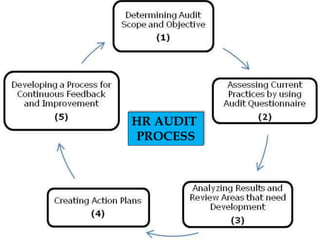
HR AUDIT
PROCESS
 The company’s recruitment process
 Benefits and compensation processes
 Contracts and employee handbooks
 How employee performances are evaluated
 Training and education programmes
 HR strategy
 Hiring and firing practices
 Exit procedures
 Provides verifiable data on the HRM functions
 Clarifies the HR functions
 Indentifies critical HR problems
 Improves the status of HR functions
 Helps review and improves the HRIS

HR ACCOUNTING & HR AUDIT.pptx

  • 2.
     HRA isa process of identifying, measuring and communicating information about human resources in order to facilitate effective management within an organization.  Is the activity of knowing the cost invested for employees towards their :  Recruitment & Selection  Training & development  Payment of salaries &  Other benefits and knowing their contribution to organization towards it's profitability.
  • 3.
     To monitoreffectively the use of human resources by the management.  To have an analysis of the human asset  It facilitates valuation of human resources, recording the valuation in the books of account and disclosure of the information in the financial statement.  It is to help the organization in decision making of:  Direct Recruitment Vs promotion.  Transfer Vs. Retention.  Retrenchment Vs. Retention  Decision on reallocation of plants, closing down existing units and developing overseas subsidiaries etc.
  • 4.
     Standard CostMethod: It involves determining the total cost of recruiting and hiring each employee, as well as the cost of any training or development.  Replacement Cost Method: It values an employee in terms of the amount it would cost the company to replace him.  Opportunity Cost Method: It assigns value to an employee based on what each department would be willing to pay him.  Economic Value Method: It estimate the total inflow of cash - total cost involved in the employee
  • 5.
     Helps themanagement in the employment, locating and utilization of human resources.  Helps in deciding the transfers, promotion, training and retrenchment of human resources.  Provides a basis for planning of physical assets (human resources).  It helps employees in improving their performance and bargaining power.  It helps in locating the real cause for low return on investment
  • 6.
     HR auditis a way to diagnose problems in a company’s HR department.  HR audit can be done through self-assessment, internally, or can be done by hiring a professional audit company, to undertake an audit.  HR audit and the subsequent HR audit report will pinpoint where there are weaknesses or risks in the HR department and help address these.
  • 7.
  • 8.
     The company’srecruitment process  Benefits and compensation processes  Contracts and employee handbooks  How employee performances are evaluated  Training and education programmes  HR strategy  Hiring and firing practices  Exit procedures
  • 9.
     Provides verifiabledata on the HRM functions  Clarifies the HR functions  Indentifies critical HR problems  Improves the status of HR functions  Helps review and improves the HRIS