Jentsch • Jordan

Design
Toolbox
practical
understanding
of design,
its process and
methods

for
Hello

Note: These is both
the edited slide
deck as well as the
documentation of a
3-week design class
from October 2013
tell

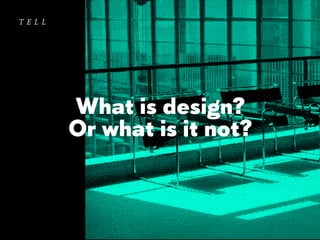
What is design?
tell

What is design?
Or what is it not?
defined

“ Design is not for philosophy
it’s for life.
”
— Issey Miyake, Fashion Designer
defined

“ To design is

to devise courses of action aimed at
changing existing situations
into preferred ones
— Herbert Simon, nobel laureate

”
defined

“ To design is

to plan, to order, to relate and to control.
— Emil Ruder, Swiss typographer

”
model
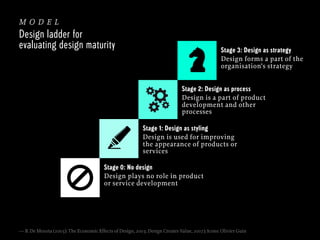
Design ladder for
evaluating design maturity

Stage 3: Design as strategy
Design forms a part of the
organisation’s strategy
Stage 2: Design as process
Design is a part of product
development and other
processes
Stage 1: Design as styling
Design is used for improving
the appearance of products or
services

Stage 0: No design
Design plays no role in product
or service development

— B. De Mozota (2003): The Economic Effects of Design, 2003; Design Creates Value, 2007); Icons: Olivier Guin
model
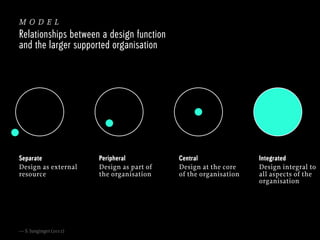
Relationships between a design function
and the larger supported organisation

Separate
Design as external
resource

— S. Junginger (2012)

Peripheral
Design as part of
the organisation

Central
Design at the core
of the organisation

Integrated
Design integral to
all aspects of the
organisation
model
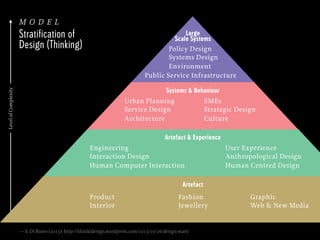
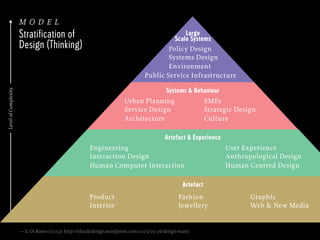
Stratification of
Design (Thinking)

Large
Scale Systems
Policy Design
Systems Design
Environment
Public Service Infrastructure

Level of Complexity

Systems & Behaviour
Urban Planning
Service Design
Architecture

SMEs
Strategic Design
Culture

Artefact & Experience
Engineering
Interaction Design
Human Computer Interaction

User Experience
Anthropological Design
Human Centred Design

Artefact
Product
Interior

Fashion
Jewellery

— S. Di Russo (2013): http://ithinkidesign.wordpress.com/2013/03/26/design-wars/

Graphic
Web & New Media
model
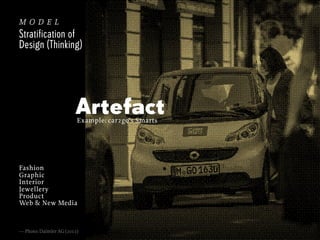
Stratification of
Design (Thinking)

Artefact
Example: car2go’s Smarts

Fashion
Graphic
Interior
Jewellery
Product
Web & New Media

— Photo: Daimler AG (2012)
model
Stratification of
Design (Thinking)

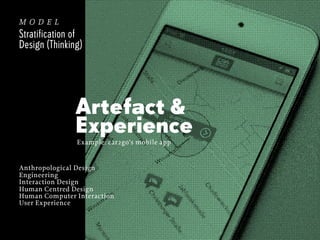
Artefact &
Experience
Example: car2go’s mobile app

Anthropological Design
Engineering
Interaction Design
Human Centred Design
Human Computer Interaction
User Experience
model
Stratification of
Design (Thinking)

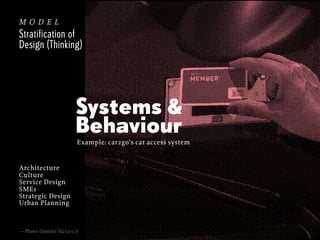
Systems &
Behaviour
Example: car2go’s car access system

Architecture
Culture
Service Design
SMEs
Strategic Design
Urban Planning

— Photo: Daimler AG (2012)
model
Stratification of
Design (Thinking)

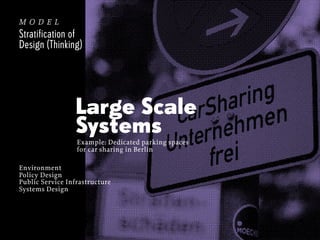
Large Scale
Systems
Example: Dedicated parking spaces
for car sharing in Berlin
Environment
Policy Design
Public Service Infrastructure
Systems Design
defined

“ Design is a creative activity whose aim is
to establish the multi-faceted qualities of
objects, processes, services, and their
systems in whole life cycles.

”

— The International Council Societies of Industrial Design (icsid)

— Icsid (2006): Definition of Design. http://www.icsid.org/about/about/articles31.htm
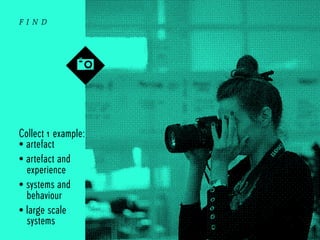
find

Collect 1 example:
• artefact
• artefact and
experience
• systems and
behaviour
• large scale
systems
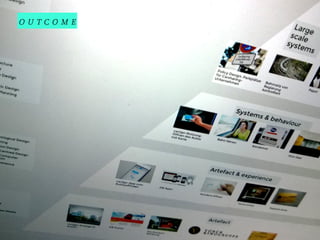
outcome
tell

What’s the role of
the designer?
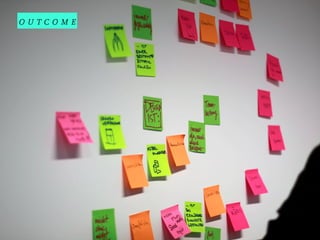
outcome
outcome
model
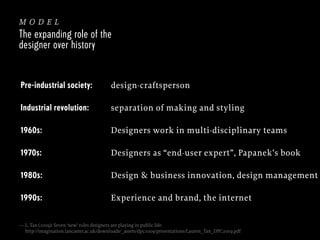
The expanding role of the
designer over history

Pre-industrial society:

design-craftsperson

Industrial revolution:

separation of making and styling

1960s:

Designers work in multi-disciplinary teams

1970s:

Designers as “end-user expert”, Papanek’s book

1980s:

Design & business innovation, design management

1990s:

Experience and brand, the internet

— L. Tan (2009): Seven ‘new’ roles designers are playing in public life:
http://imagination.lancaster.ac.uk/downloads/_assets/dpc2009/presentations/Lauren_Tan_DPC2009.pdf
model
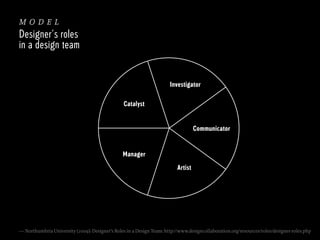
Designer’s roles
in a design team

Investigator
Catalyst

Communicator

Manager
Artist

— Northumbria University (2009): Designer’s Roles in a Design Team: http://www.designcollaboration.org/resources/roles/designer-roles.php
model
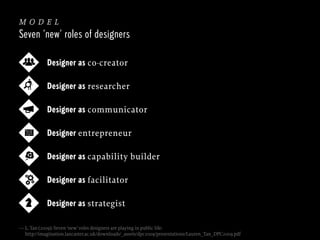
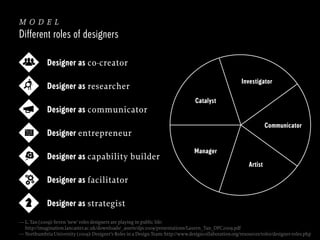
Seven ‘new’ roles of designers
Designer as co-creator
Designer as researcher
Designer as communicator
Designer entrepreneur
Designer as capability builder
Designer as facilitator
Designer as strategist
— L. Tan (2009): Seven ‘new’ roles designers are playing in public life:
http://imagination.lancaster.ac.uk/downloads/_assets/dpc2009/presentations/Lauren_Tan_DPC2009.pdf
tell

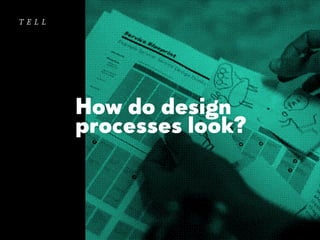
How do design
processes look?
model
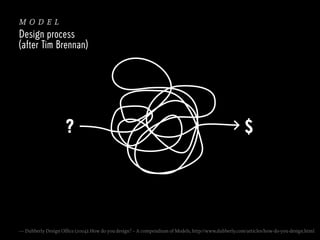
Design process
(after Tim Brennan)

?

$

— Dubberly Design Office (2004): How do you design? – A compendium of Models, http://www.dubberly.com/articles/how-do-you-design.html
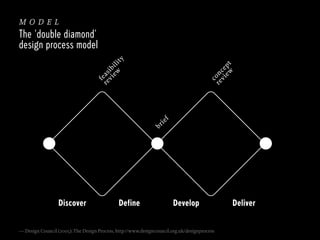
br

ie

f

c
re on
vi ce
ew pt

f
re eas
vi ib
ew ili

ty

model
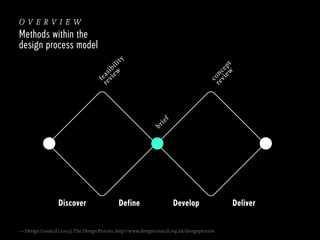
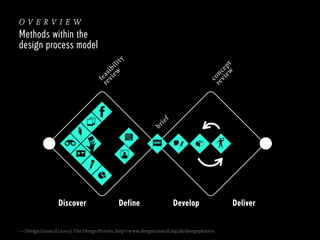
The ‘double diamond’
design process model

Discover

Define

Develop

— Design Council (2005): The Design Process, http://www.designcouncil.org.uk/designprocess

Deliver
model
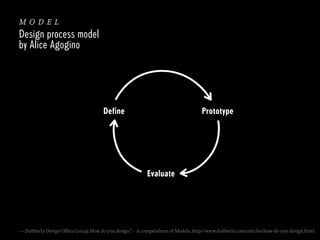
Design process model
by Alice Agogino

Define

Prototype

Evaluate

— Dubberly Design Office (2004): How do you design? – A compendium of Models, http://www.dubberly.com/articles/how-do-you-design.html
model
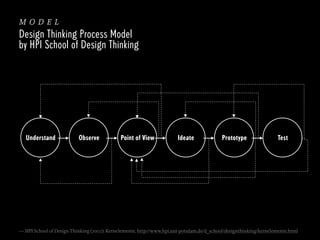
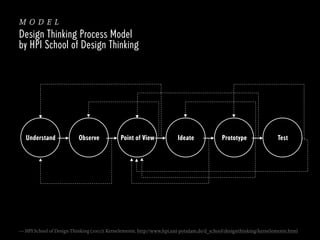
Design Thinking Process Model
by HPI School of Design Thinking

Understand

Observe

Point of View

Ideate

Prototype

Test

— HPI School of Design Thinking (2007): Kernelemente, http://www.hpi.uni-potsdam.de/d_school/designthinking/kernelemente.html
model
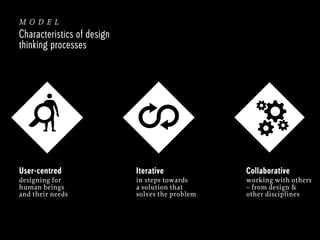
Characteristics of design
thinking processes

User-centred

Iterative

Collaborative

designing for
human beings
and their needs

in steps towards
a solution that
solves the problem

working with others
– from design &
other disciplines
model
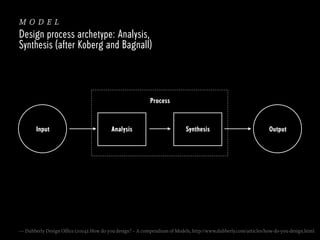
Design process archetype: Analysis,
Synthesis (after Koberg and Bagnall)

Process

Input

Analysis

Synthesis

Output

— Dubberly Design Office (2004): How do you design? – A compendium of Models, http://www.dubberly.com/articles/how-do-you-design.html
model
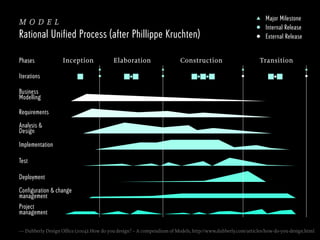
Rational Unified Process (after Phillippe Kruchten)
Phases

Inception

Elaboration

Construction

Major Milestone
Internal Release
External Release

Transition

Iterations
Business
Modelling
Requirements
Analysis &
Design
Implementation
Test
Deployment
Configuration & change
management
Project
management
— Dubberly Design Office (2004): How do you design? – A compendium of Models, http://www.dubberly.com/articles/how-do-you-design.html
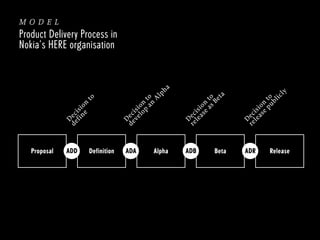
Proposal
ADD
Definition

to

ADA
Alpha
ADB
Beta

D
re ec
le isi
as o
e nt
pu o
bl
ic
l

D
re ec
le isi
as o
e nt
as o
Be
ta

ha

y

D
de ec
ve isi
lo on
p t
an o
A
lp

D
de ec
fi isi
ne o
n

model
Product Delivery Process in
Nokia’s HERE organisation

ADR
Release
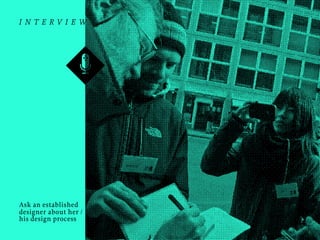
interview

Ask an established
designer about her /
his design process
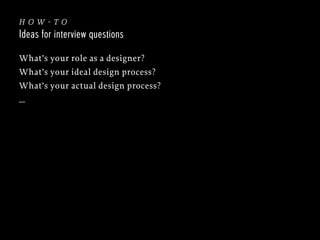
how-to
Ideas for interview questions
What’s your role as a designer?
What’s your ideal design process?
What’s your actual design process?
…
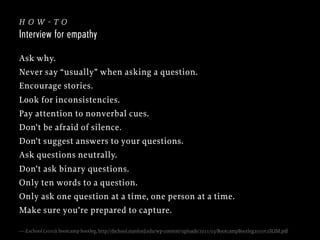
how-to
Interview for empathy
Ask why.
Never say “usually” when asking a question.
Encourage stories.
Look for inconsistencies.
Pay attention to nonverbal cues.
Don’t be afraid of silence.
Don’t suggest answers to your questions.
Ask questions neutrally.
Don’t ask binary questions.
Only ten words to a question.
Only ask one question at a time, one person at a time.
Make sure you’re prepared to capture.
— d.school (2010): bootcamp bootleg, http://dschool.stanford.edu/wp-content/uploads/2011/03/BootcampBootleg2010v2SLIM.pdf
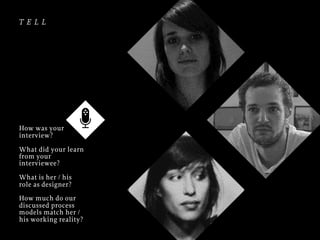
tell

How was your
interview?
What did your learn
from your
interviewee?
What is her / his
role as designer?
How much do our
discussed process
models match her /
his working reality?
outcome
outcome
outcome
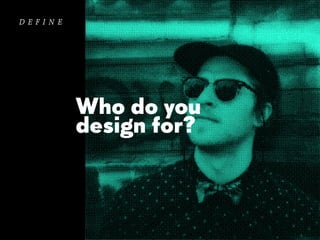
define

Who do you
design for?
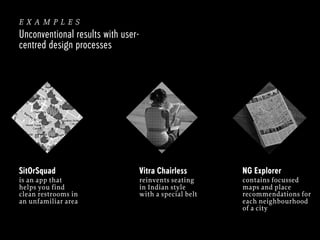
examples
Unconventional results with usercentred design processes

SitOrSquad

Vitra Chairless

NG Explorer

is an app that
helps you find
clean restrooms in
an unfamiliar area

reinvents seating
in Indian style
with a special belt

contains focussed
maps and place
recommendations for
each neighbourhood
of a city
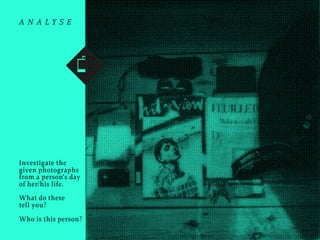
analyse

Investigate the
given photographs
from a person’s day
of her/his life.
What do these
tell you?
Who is this person?
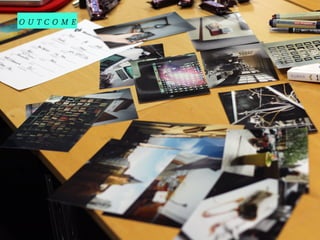
outcome
outcome
outcome
methods
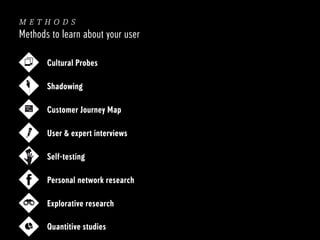
Methods to learn about your user
Cultural Probes
Shadowing
Customer Journey Map
User & expert interviews
Self-testing
Personal network research
Explorative research
Quantitive studies
method
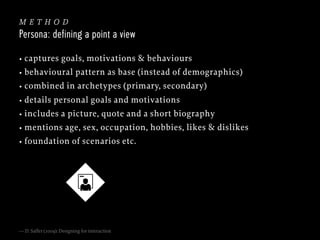
Persona: defining a point a view
• captures goals, motivations & behaviours
• behavioural pattern as base (instead of demographics)
• combined in archetypes (primary, secondary)
• details personal goals and motivations
• includes a picture, quote and a short biography
• mentions age, sex, occupation, hobbies, likes & dislikes
• foundation of scenarios etc.

— D. Saffer (2009): Designing for interaction
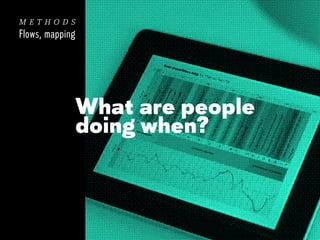
methods
Flows, mapping

What are people
doing when?
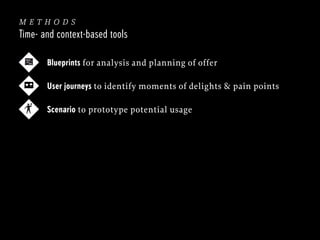
methods
Time- and context-based tools
Blueprints for analysis and planning of offer
User journeys to identify moments of delights & pain points
Scenario to prototype potential usage
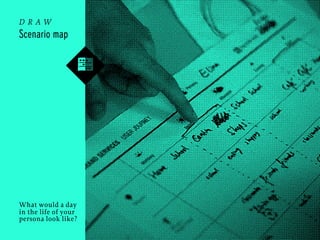
d r aw
Scenario map

What would a day
in the life of your
persona look like?
d r aw
Scenario map on the topic of

News and their
consumption
for one of the following personas
meet
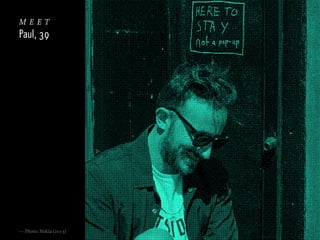
Paul, 39

— Photo: Nokia (2013)
meet
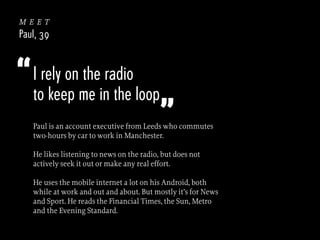
Paul, 39

“ I rely on the radio

to keep me in the loop

”

Paul is an account executive from Leeds who commutes
two-hours by car to work in Manchester.
He likes listening to news on the radio, but does not
actively seek it out or make any real effort.
He uses the mobile internet a lot on his Android, both
while at work and out and about. But mostly it’s for News
and Sport. He reads the Financial Times, the Sun, Metro
and the Evening Standard.
meet
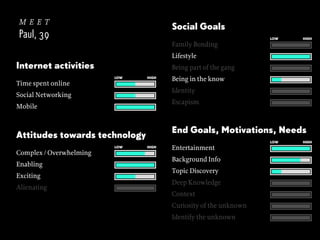
Paul, 39

Social Goals
Family Bonding
Being part of the gang
LOW

HIGH

Escapism

Mobile

End Goals, Motivations, Needs

Attitudes towards technology
Enabling
Exciting
Alienating

Being in the know
Identity

Social Networking

Complex / Overwhelming

HIGH

Lifestyle

Internet activities
Time spent online

LOW

LOW

HIGH

Entertainment
Background Info
Topic Discovery
Deep Knowledge
Context
Curiosity of the unknown
Identify the unknown

LOW

HIGH
meet
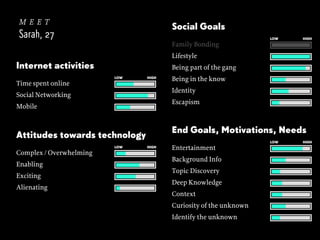
Sarah, 27

— Photo: Nokia (2013)
meet
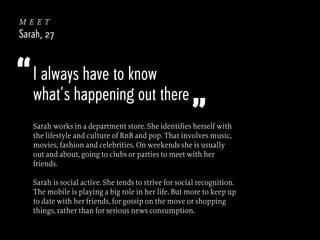
Sarah, 27

“ I always have to know

what’s happening out there

”

Sarah works in a department store. She identifies herself with
the lifestyle and culture of RnB and pop. That involves music,
movies, fashion and celebrities. On weekends she is usually
out and about, going to clubs or parties to meet with her
friends.
Sarah is social active. She tends to strive for social recognition.
The mobile is playing a big role in her life. But more to keep up
to date with her friends, for gossip on the move or shopping
things, rather than for serious news consumption.
meet
Sarah, 27

Social Goals
Family Bonding
Being part of the gang
LOW

HIGH

Escapism

Mobile

End Goals, Motivations, Needs

Attitudes towards technology
Enabling
Exciting
Alienating

Being in the know
Identity

Social Networking

Complex / Overwhelming

HIGH

Lifestyle

Internet activities
Time spent online

LOW

LOW

HIGH

Entertainment
Background Info
Topic Discovery
Deep Knowledge
Context
Curiosity of the unknown
Identify the unknown

LOW

HIGH
br

ie

f

c
re on
vi ce
ew pt

f
re eas
vi ib
ew ili

ty

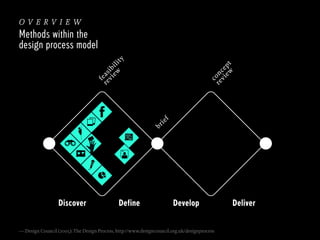
overview
Methods within the
design process model

Discover

Define

Develop

— Design Council (2005): The Design Process, http://www.designcouncil.org.uk/designprocess

Deliver
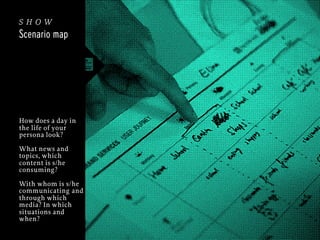
show
Scenario map

How does a day in
the life of your
persona look?
What news and
topics, which
content is s/he
consuming?
With whom is s/he
communicating and
through which
media? In which
situations and
when?
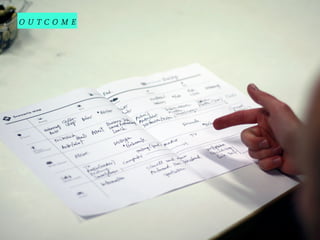
outcome
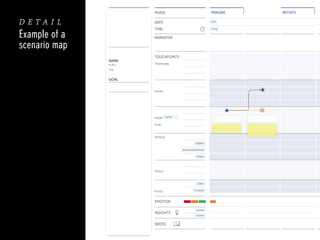
PHASE
DATE

DAY

TIME

detail
Example of a
scenario map

IMAGINE

TIME

NARRATIVE

NAME
PLACE

-

INITIATE

-

-

TOUCHPOINTS
TRADITIONAL

Title

Map (paper)
Handwritten
Printed material

GOAL

Laptop / Desktop
DIGITAL

Tablet
Satnav
In-car computer
App

PHONE Lumia
Model:

Message

-

-

-

Voice
Web

PHYSICAL

-

Signage
Displays
Automated terminal
Tickets
In person

PEOPLE

Colleagues

-

Static
PLACES

In-transit

EMOTION
INSIGHTS

-

Situation

-

Question
-

NEEDS
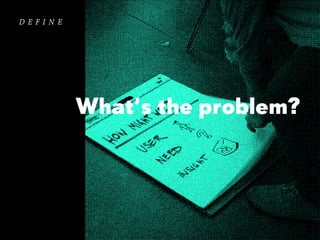
define

What’s the problem?
br

ie

f

c
re on
vi ce
ew pt

f
re eas
vi ib
ew ili

ty

overview
Methods within the
design process model

Discover

Define

Develop

— Design Council (2005): The Design Process, http://www.designcouncil.org.uk/designprocess

Deliver
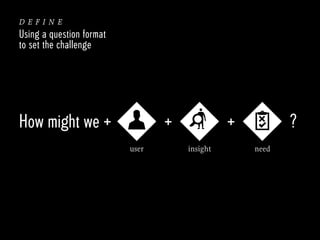
define
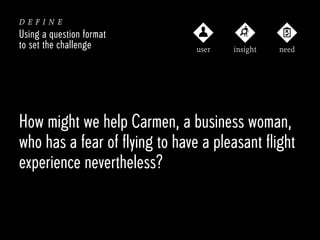
Using a question format
to set the challenge

How might we +

+
user

+
insight

?
need
define
Using a question format
to set the challenge

user

insight

need

How might we help Carmen, a business woman,
who has a fear of flying to have a pleasant flight
experience nevertheless?
define
Using a question format
to set the challenge
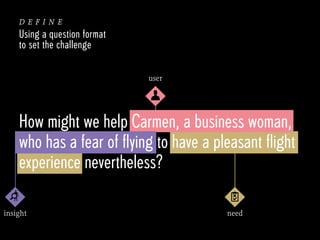
user

How might we help Carmen, a business woman,
who has a fear of flying to have a pleasant flight
experience nevertheless?
insight

need
examples
Reverse engineered
challenge questions

user

insight

need

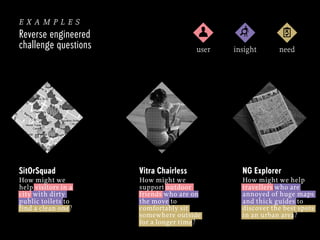
SitOrSquad

Vitra Chairless

NG Explorer

How might we
help visitors in a
city with dirty
public toilets to
find a clean one?

How might we
support outdoor
friends who are on
the move to
comfortably sit
somewhere outside
for a longer time?

How might we help
travellers who are
annoyed of huge maps
and thick guides to
discover the best spots
in an urban area?
outcome
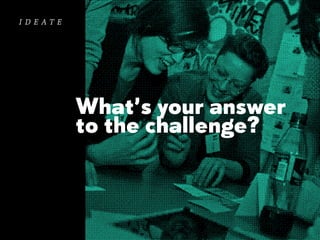
ideate

What’s your answer
to the challenge?
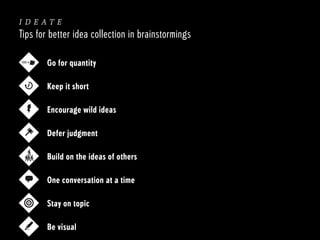
ideate
Tips for better idea collection in brainstormings
100 ×

Go for quantity
Keep it short
Encourage wild ideas
Defer judgment
Build on the ideas of others
One conversation at a time
Stay on topic
Be visual
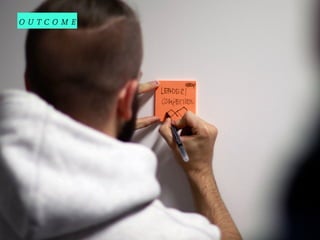
outcome
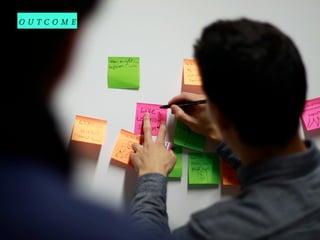
outcome
outcome
prototype

How to make your
idea tangible?
prototype

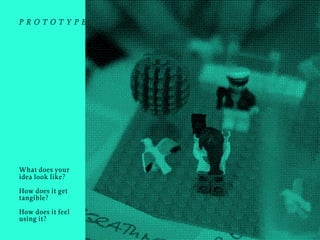
What does your
idea look like?
How does it get
tangible?
How does it feel
using it?
prototype
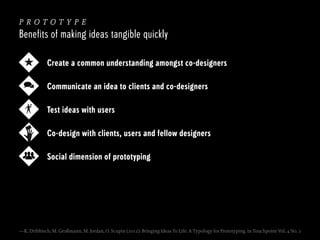
Benefits of making ideas tangible quickly
Create a common understanding amongst co-designers
Communicate an idea to clients and co-designers
Test ideas with users
Co-design with clients, users and fellow designers
Social dimension of prototyping

—K. Dribbisch, M. Großmann, M. Jordan, O. Scupin (2012): Bringing Ideas To Life: A Typology for Prototyping. in Touchpoint Vol. 4 No. 2
prototype
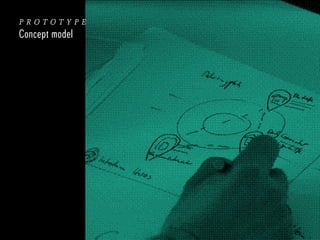
Concept model
prototype
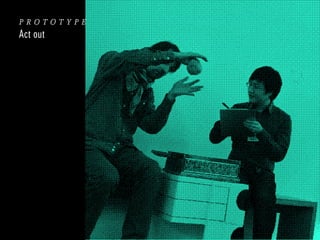
Act out
prototype
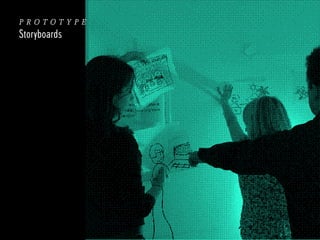
Storyboards
prototype
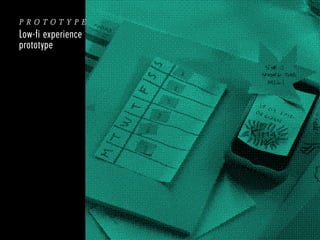
Low-fi experience
prototype
prototype
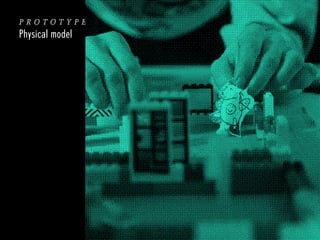
Physical model
br

ie

f

c
re on
vi ce
ew pt

f
re eas
vi ib
ew ili

ty

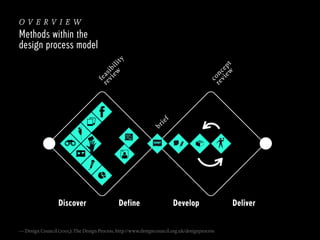
overview
Methods within the
design process model

HMW?

Discover

Define

Develop

— Design Council (2005): The Design Process, http://www.designcouncil.org.uk/designprocess

Deliver
test

How to know
if it’s any good?
collect
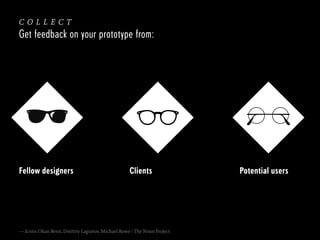
Get feedback on your prototype from:

Fellow designers

Clients

— Icons: Okan Benn, Dmitriy Lagunov, Michael Rowe / The Noun Project

Potential users
note
Collect your feedback for the other group

What’s good?

— Icons: Jakob Schneider

What to improve?
outcome
outcome
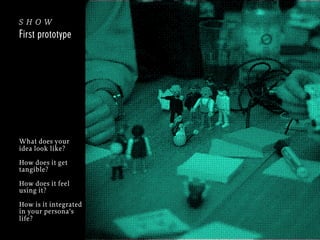
show
First prototype

What does your
idea look like?
How does it get
tangible?
How does it feel
using it?
How is it integrated
in your persona’s
life?
outcome
outcome
outcome
test
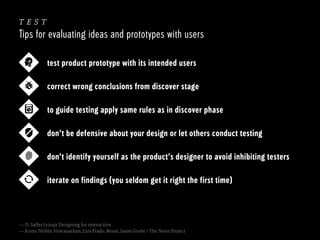
Tips for evaluating ideas and prototypes with users
test product prototype with its intended users
correct wrong conclusions from discover stage
to guide testing apply same rules as in discover phase
don’t be defensive about your design or let others conduct testing
don’t identify yourself as the product’s designer to avoid inhibiting testers
iterate on findings (you seldom get it right the first time)

— D. Saffer (2009): Designing for interaction
— Icons: Nithin Viswanathan, Luis Prado, Benni, Jason Grube / The Noun Project
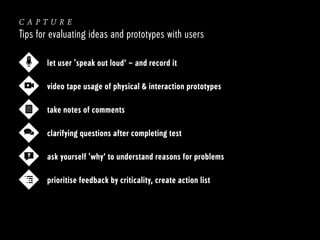
capture
Tips for evaluating ideas and prototypes with users
let user ‘speak out loud’ – and record it
video tape usage of physical & interaction prototypes
take notes of comments
clarifying questions after completing test
?

ask yourself ‘why’ to understand reasons for problems
prioritise feedback by criticality, create action list
outcome
outcome
outcome
prototype

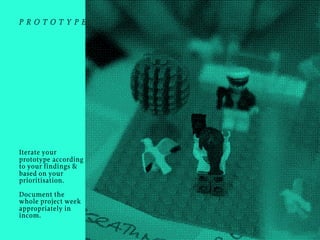
Iterate your
prototype according
to your findings &
based on your
prioritisation.
Document the
whole project week
appropriately in
incom.
show
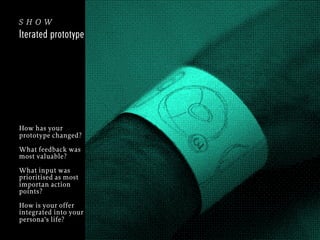
Iterated prototype

How has your
prototype changed?
What feedback was
most valuable?
What input was
prioritised as most
importan action
points?
How is your offer
integrated into your
persona’s life?
outcome
outcome
pitch

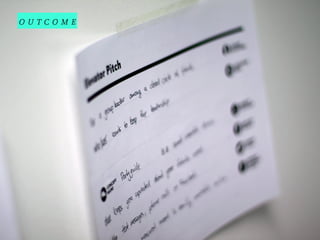
Use the Elevator
Pitch template to
communicate your
concept.
Tell within two
sentences: Who is
your customer?
What is her need?
What is the offer’s
key benefit and
differentiator?
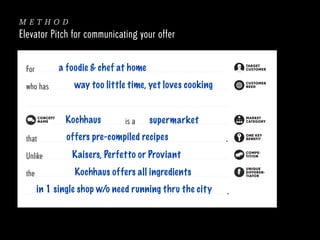
method
Elevator Pitch for communicating your offer
a foodie & chef at home

For
who has

CONCEPT
NAME

that
Unlike
the

TARGET
CUSTOMER

way too little time, yet loves cooking

Kochhaus

is a

CUSTOMER
NEED

supermarket

offers pre-compiled recipes

MARKET
CATEGORY

.

Kaisers, Perfetto or Proviant

COMPETITION
UNIQUE
DIFFERENTIATOR

Kochhaus offers all ingredients
in 1 single shop w/o need running thru the city

ONE KEY
BENEFIT

.
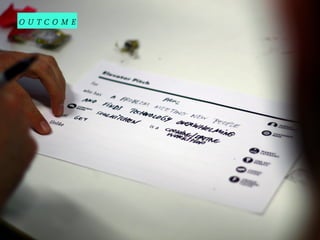
outcome
outcome
outcome
Sum-up
model
Stratification of
Design (Thinking)

Large
Scale Systems
Policy Design
Systems Design
Environment
Public Service Infrastructure

Level of Complexity

Systems & Behaviour
Urban Planning
Service Design
Architecture

SMEs
Strategic Design
Culture

Artefact & Experience
Engineering
Interaction Design
Human Computer Interaction

User Experience
Anthropological Design
Human Centred Design

Artefact
Product
Interior

Fashion
Jewellery

— S. Di Russo (2013): http://ithinkidesign.wordpress.com/2013/03/26/design-wars/

Graphic
Web & New Media
model
Different roles of designers
Designer as co-creator
Investigator

Designer as researcher
Catalyst

Designer as communicator
Communicator

Designer entrepreneur
Designer as capability builder

Manager
Artist

Designer as facilitator
Designer as strategist
— L. Tan (2009): Seven ‘new’ roles designers are playing in public life:
http://imagination.lancaster.ac.uk/downloads/_assets/dpc2009/presentations/Lauren_Tan_DPC2009.pdf
— Northumbria University (2009): Designer’s Roles in a Design Team: http://www.designcollaboration.org/resources/roles/designer-roles.php
model
Design Thinking Process Model
by HPI School of Design Thinking

Understand

Observe

Point of View

Ideate

Prototype

Test

— HPI School of Design Thinking (2007): Kernelemente, http://www.hpi.uni-potsdam.de/d_school/designthinking/kernelemente.html
br

ie

f

c
re on
vi ce
ew pt

f
re eas
vi ib
ew ili

ty

overview
Methods within the
design process model

HMW?

Discover

Define

Develop

— Design Council (2005): The Design Process, http://www.designcouncil.org.uk/designprocess

Deliver
model
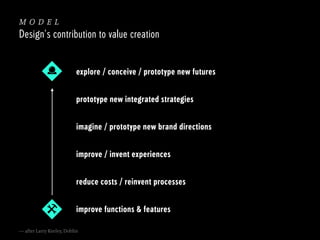
Design’s contribution to value creation
explore / conceive / prototype new futures
prototype new integrated strategies
imagine / prototype new brand directions
improve / invent experiences
reduce costs / reinvent processes
improve functions & features
— after Larry Keeley, Doblin
map

How is it
sustainable?
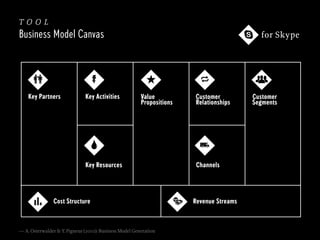
tool
Business Model Canvas

Key Partners

Key Activities

for Skype

Value
Propositions

Key Resources

Cost Structure

— A. Osterwalder & Y. Pigneur (2010): Business Model Generation

Customer
Relationships

Channels

Revenue Streams

Customer
Segments
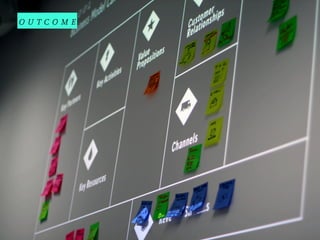
outcome
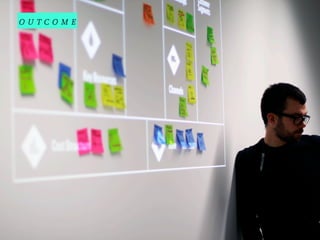
outcome
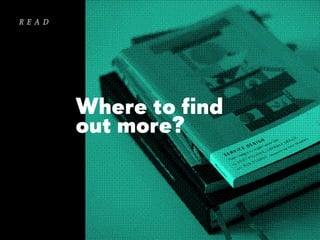
read

Where to find
out more?
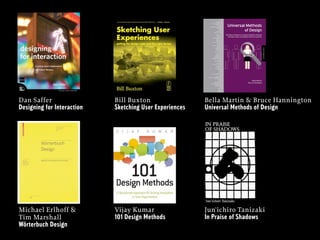
Dan Saffer
Designing for Interaction

Bill Buxton
Sketching User Experiences

Bella Martin & Bruce Hannington
Universal Methods of Design

Michael Erlhoff &
Tim Marshall
Wörterbuch Design

Vijay Kumar
101 Design Methods

Jun'ichiro Tanizaki
In Praise of Shadows
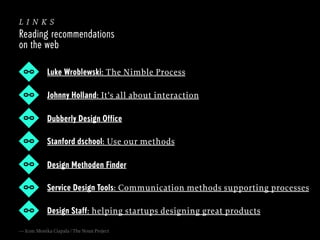
links
Reading recommendations
on the web
Luke Wroblewski: The Nimble Process
Johnny Holland: It’s all about interaction
Dubberly Design Office
Stanford dschool: Use our methods
Design Methoden Finder
Service Design Tools: Communication methods supporting processes
Design Staff: helping startups designing great products
— Icon: Monika Ciapala / The Noun Project
Thank you

Hannes Jentsch
@kaffeetrinken
Martin Jordan
@martin_jordan

Design Toolbox — teaching design, its processes & methods

  • 1.
  • 2.
    Hello Note: These isboth the edited slide deck as well as the documentation of a 3-week design class from October 2013
  • 3.
  • 4.
    tell What is design? Orwhat is it not?
  • 5.
    defined “ Design isnot for philosophy it’s for life. ” — Issey Miyake, Fashion Designer
  • 6.
    defined “ To designis to devise courses of action aimed at changing existing situations into preferred ones — Herbert Simon, nobel laureate ”
  • 7.
    defined “ To designis to plan, to order, to relate and to control. — Emil Ruder, Swiss typographer ”
  • 8.
    model Design ladder for evaluatingdesign maturity Stage 3: Design as strategy Design forms a part of the organisation’s strategy Stage 2: Design as process Design is a part of product development and other processes Stage 1: Design as styling Design is used for improving the appearance of products or services Stage 0: No design Design plays no role in product or service development — B. De Mozota (2003): The Economic Effects of Design, 2003; Design Creates Value, 2007); Icons: Olivier Guin
  • 9.
    model Relationships between adesign function and the larger supported organisation Separate Design as external resource — S. Junginger (2012) Peripheral Design as part of the organisation Central Design at the core of the organisation Integrated Design integral to all aspects of the organisation
  • 10.
    model Stratification of Design (Thinking) Large ScaleSystems Policy Design Systems Design Environment Public Service Infrastructure Level of Complexity Systems & Behaviour Urban Planning Service Design Architecture SMEs Strategic Design Culture Artefact & Experience Engineering Interaction Design Human Computer Interaction User Experience Anthropological Design Human Centred Design Artefact Product Interior Fashion Jewellery — S. Di Russo (2013): http://ithinkidesign.wordpress.com/2013/03/26/design-wars/ Graphic Web & New Media
  • 11.
    model Stratification of Design (Thinking) Artefact Example:car2go’s Smarts Fashion Graphic Interior Jewellery Product Web & New Media — Photo: Daimler AG (2012)
  • 12.
    model Stratification of Design (Thinking) Artefact& Experience Example: car2go’s mobile app Anthropological Design Engineering Interaction Design Human Centred Design Human Computer Interaction User Experience
  • 13.
    model Stratification of Design (Thinking) Systems& Behaviour Example: car2go’s car access system Architecture Culture Service Design SMEs Strategic Design Urban Planning — Photo: Daimler AG (2012)
  • 14.
    model Stratification of Design (Thinking) LargeScale Systems Example: Dedicated parking spaces for car sharing in Berlin Environment Policy Design Public Service Infrastructure Systems Design
  • 15.
    defined “ Design isa creative activity whose aim is to establish the multi-faceted qualities of objects, processes, services, and their systems in whole life cycles. ” — The International Council Societies of Industrial Design (icsid) — Icsid (2006): Definition of Design. http://www.icsid.org/about/about/articles31.htm
  • 16.
    find Collect 1 example: •artefact • artefact and experience • systems and behaviour • large scale systems
  • 17.
  • 18.
    tell What’s the roleof the designer?
  • 19.
  • 20.
  • 21.
    model The expanding roleof the designer over history Pre-industrial society: design-craftsperson Industrial revolution: separation of making and styling 1960s: Designers work in multi-disciplinary teams 1970s: Designers as “end-user expert”, Papanek’s book 1980s: Design & business innovation, design management 1990s: Experience and brand, the internet — L. Tan (2009): Seven ‘new’ roles designers are playing in public life: http://imagination.lancaster.ac.uk/downloads/_assets/dpc2009/presentations/Lauren_Tan_DPC2009.pdf
  • 22.
    model Designer’s roles in adesign team Investigator Catalyst Communicator Manager Artist — Northumbria University (2009): Designer’s Roles in a Design Team: http://www.designcollaboration.org/resources/roles/designer-roles.php
  • 23.
    model Seven ‘new’ rolesof designers Designer as co-creator Designer as researcher Designer as communicator Designer entrepreneur Designer as capability builder Designer as facilitator Designer as strategist — L. Tan (2009): Seven ‘new’ roles designers are playing in public life: http://imagination.lancaster.ac.uk/downloads/_assets/dpc2009/presentations/Lauren_Tan_DPC2009.pdf
  • 24.
  • 25.
    model Design process (after TimBrennan) ? $ — Dubberly Design Office (2004): How do you design? – A compendium of Models, http://www.dubberly.com/articles/how-do-you-design.html
  • 26.
    br ie f c re on vi ce ewpt f re eas vi ib ew ili ty model The ‘double diamond’ design process model Discover Define Develop — Design Council (2005): The Design Process, http://www.designcouncil.org.uk/designprocess Deliver
  • 27.
    model Design process model byAlice Agogino Define Prototype Evaluate — Dubberly Design Office (2004): How do you design? – A compendium of Models, http://www.dubberly.com/articles/how-do-you-design.html
  • 28.
    model Design Thinking ProcessModel by HPI School of Design Thinking Understand Observe Point of View Ideate Prototype Test — HPI School of Design Thinking (2007): Kernelemente, http://www.hpi.uni-potsdam.de/d_school/designthinking/kernelemente.html
  • 29.
    model Characteristics of design thinkingprocesses User-centred Iterative Collaborative designing for human beings and their needs in steps towards a solution that solves the problem working with others – from design & other disciplines
  • 30.
    model Design process archetype:Analysis, Synthesis (after Koberg and Bagnall) Process Input Analysis Synthesis Output — Dubberly Design Office (2004): How do you design? – A compendium of Models, http://www.dubberly.com/articles/how-do-you-design.html
  • 31.
    model Rational Unified Process(after Phillippe Kruchten) Phases Inception Elaboration Construction Major Milestone Internal Release External Release Transition Iterations Business Modelling Requirements Analysis & Design Implementation Test Deployment Configuration & change management Project management — Dubberly Design Office (2004): How do you design? – A compendium of Models, http://www.dubberly.com/articles/how-do-you-design.html
  • 32.
    Proposal ADD Definition to ADA Alpha ADB Beta D re ec le isi aso e nt pu o bl ic l D re ec le isi as o e nt as o Be ta ha y D de ec ve isi lo on p t an o A lp D de ec fi isi ne o n model Product Delivery Process in Nokia’s HERE organisation ADR Release
  • 33.
    interview Ask an established designerabout her / his design process
  • 34.
    how-to Ideas for interviewquestions What’s your role as a designer? What’s your ideal design process? What’s your actual design process? …
  • 35.
    how-to Interview for empathy Askwhy. Never say “usually” when asking a question. Encourage stories. Look for inconsistencies. Pay attention to nonverbal cues. Don’t be afraid of silence. Don’t suggest answers to your questions. Ask questions neutrally. Don’t ask binary questions. Only ten words to a question. Only ask one question at a time, one person at a time. Make sure you’re prepared to capture. — d.school (2010): bootcamp bootleg, http://dschool.stanford.edu/wp-content/uploads/2011/03/BootcampBootleg2010v2SLIM.pdf
  • 36.
    tell How was your interview? Whatdid your learn from your interviewee? What is her / his role as designer? How much do our discussed process models match her / his working reality?
  • 37.
  • 38.
  • 39.
  • 40.
  • 41.
    examples Unconventional results withusercentred design processes SitOrSquad Vitra Chairless NG Explorer is an app that helps you find clean restrooms in an unfamiliar area reinvents seating in Indian style with a special belt contains focussed maps and place recommendations for each neighbourhood of a city
  • 42.
    analyse Investigate the given photographs froma person’s day of her/his life. What do these tell you? Who is this person?
  • 43.
  • 44.
  • 45.
  • 46.
    methods Methods to learnabout your user Cultural Probes Shadowing Customer Journey Map User & expert interviews Self-testing Personal network research Explorative research Quantitive studies
  • 47.
    method Persona: defining apoint a view • captures goals, motivations & behaviours • behavioural pattern as base (instead of demographics) • combined in archetypes (primary, secondary) • details personal goals and motivations • includes a picture, quote and a short biography • mentions age, sex, occupation, hobbies, likes & dislikes • foundation of scenarios etc. — D. Saffer (2009): Designing for interaction
  • 48.
  • 49.
    methods Time- and context-basedtools Blueprints for analysis and planning of offer User journeys to identify moments of delights & pain points Scenario to prototype potential usage
  • 50.
    d r aw Scenariomap What would a day in the life of your persona look like?
  • 51.
    d r aw Scenariomap on the topic of News and their consumption for one of the following personas
  • 52.
  • 53.
    meet Paul, 39 “ Irely on the radio to keep me in the loop ” Paul is an account executive from Leeds who commutes two-hours by car to work in Manchester. He likes listening to news on the radio, but does not actively seek it out or make any real effort. He uses the mobile internet a lot on his Android, both while at work and out and about. But mostly it’s for News and Sport. He reads the Financial Times, the Sun, Metro and the Evening Standard.
  • 54.
    meet Paul, 39 Social Goals FamilyBonding Being part of the gang LOW HIGH Escapism Mobile End Goals, Motivations, Needs Attitudes towards technology Enabling Exciting Alienating Being in the know Identity Social Networking Complex / Overwhelming HIGH Lifestyle Internet activities Time spent online LOW LOW HIGH Entertainment Background Info Topic Discovery Deep Knowledge Context Curiosity of the unknown Identify the unknown LOW HIGH
  • 55.
  • 56.
    meet Sarah, 27 “ Ialways have to know what’s happening out there ” Sarah works in a department store. She identifies herself with the lifestyle and culture of RnB and pop. That involves music, movies, fashion and celebrities. On weekends she is usually out and about, going to clubs or parties to meet with her friends. Sarah is social active. She tends to strive for social recognition. The mobile is playing a big role in her life. But more to keep up to date with her friends, for gossip on the move or shopping things, rather than for serious news consumption.
  • 57.
    meet Sarah, 27 Social Goals FamilyBonding Being part of the gang LOW HIGH Escapism Mobile End Goals, Motivations, Needs Attitudes towards technology Enabling Exciting Alienating Being in the know Identity Social Networking Complex / Overwhelming HIGH Lifestyle Internet activities Time spent online LOW LOW HIGH Entertainment Background Info Topic Discovery Deep Knowledge Context Curiosity of the unknown Identify the unknown LOW HIGH
  • 58.
    br ie f c re on vi ce ewpt f re eas vi ib ew ili ty overview Methods within the design process model Discover Define Develop — Design Council (2005): The Design Process, http://www.designcouncil.org.uk/designprocess Deliver
  • 59.
    show Scenario map How doesa day in the life of your persona look? What news and topics, which content is s/he consuming? With whom is s/he communicating and through which media? In which situations and when?
  • 60.
  • 61.
    PHASE DATE DAY TIME detail Example of a scenariomap IMAGINE TIME NARRATIVE NAME PLACE - INITIATE - - TOUCHPOINTS TRADITIONAL Title Map (paper) Handwritten Printed material GOAL Laptop / Desktop DIGITAL Tablet Satnav In-car computer App PHONE Lumia Model: Message - - - Voice Web PHYSICAL - Signage Displays Automated terminal Tickets In person PEOPLE Colleagues - Static PLACES In-transit EMOTION INSIGHTS - Situation - Question - NEEDS
  • 62.
  • 63.
    br ie f c re on vi ce ewpt f re eas vi ib ew ili ty overview Methods within the design process model Discover Define Develop — Design Council (2005): The Design Process, http://www.designcouncil.org.uk/designprocess Deliver
  • 64.
    define Using a questionformat to set the challenge How might we + + user + insight ? need
  • 65.
    define Using a questionformat to set the challenge user insight need How might we help Carmen, a business woman, who has a fear of flying to have a pleasant flight experience nevertheless?
  • 66.
    define Using a questionformat to set the challenge user How might we help Carmen, a business woman, who has a fear of flying to have a pleasant flight experience nevertheless? insight need
  • 67.
    examples Reverse engineered challenge questions user insight need SitOrSquad VitraChairless NG Explorer How might we help visitors in a city with dirty public toilets to find a clean one? How might we support outdoor friends who are on the move to comfortably sit somewhere outside for a longer time? How might we help travellers who are annoyed of huge maps and thick guides to discover the best spots in an urban area?
  • 68.
  • 69.
  • 70.
    ideate Tips for betteridea collection in brainstormings 100 × Go for quantity Keep it short Encourage wild ideas Defer judgment Build on the ideas of others One conversation at a time Stay on topic Be visual
  • 71.
  • 72.
  • 73.
  • 74.
    prototype How to makeyour idea tangible?
  • 75.
    prototype What does your idealook like? How does it get tangible? How does it feel using it?
  • 76.
    prototype Benefits of makingideas tangible quickly Create a common understanding amongst co-designers Communicate an idea to clients and co-designers Test ideas with users Co-design with clients, users and fellow designers Social dimension of prototyping —K. Dribbisch, M. Großmann, M. Jordan, O. Scupin (2012): Bringing Ideas To Life: A Typology for Prototyping. in Touchpoint Vol. 4 No. 2
  • 77.
  • 78.
  • 79.
  • 80.
  • 81.
  • 82.
    br ie f c re on vi ce ewpt f re eas vi ib ew ili ty overview Methods within the design process model HMW? Discover Define Develop — Design Council (2005): The Design Process, http://www.designcouncil.org.uk/designprocess Deliver
  • 83.
    test How to know ifit’s any good?
  • 84.
    collect Get feedback onyour prototype from: Fellow designers Clients — Icons: Okan Benn, Dmitriy Lagunov, Michael Rowe / The Noun Project Potential users
  • 85.
    note Collect your feedbackfor the other group What’s good? — Icons: Jakob Schneider What to improve?
  • 86.
  • 87.
  • 88.
    show First prototype What doesyour idea look like? How does it get tangible? How does it feel using it? How is it integrated in your persona’s life?
  • 89.
  • 90.
  • 91.
  • 92.
    test Tips for evaluatingideas and prototypes with users test product prototype with its intended users correct wrong conclusions from discover stage to guide testing apply same rules as in discover phase don’t be defensive about your design or let others conduct testing don’t identify yourself as the product’s designer to avoid inhibiting testers iterate on findings (you seldom get it right the first time) — D. Saffer (2009): Designing for interaction — Icons: Nithin Viswanathan, Luis Prado, Benni, Jason Grube / The Noun Project
  • 93.
    capture Tips for evaluatingideas and prototypes with users let user ‘speak out loud’ – and record it video tape usage of physical & interaction prototypes take notes of comments clarifying questions after completing test ? ask yourself ‘why’ to understand reasons for problems prioritise feedback by criticality, create action list
  • 94.
  • 95.
  • 96.
  • 97.
    prototype Iterate your prototype according toyour findings & based on your prioritisation. Document the whole project week appropriately in incom.
  • 98.
    show Iterated prototype How hasyour prototype changed? What feedback was most valuable? What input was prioritised as most importan action points? How is your offer integrated into your persona’s life?
  • 99.
  • 100.
  • 101.
    pitch Use the Elevator Pitchtemplate to communicate your concept. Tell within two sentences: Who is your customer? What is her need? What is the offer’s key benefit and differentiator?
  • 102.
    method Elevator Pitch forcommunicating your offer a foodie & chef at home For who has CONCEPT NAME that Unlike the TARGET CUSTOMER way too little time, yet loves cooking Kochhaus is a CUSTOMER NEED supermarket offers pre-compiled recipes MARKET CATEGORY . Kaisers, Perfetto or Proviant COMPETITION UNIQUE DIFFERENTIATOR Kochhaus offers all ingredients in 1 single shop w/o need running thru the city ONE KEY BENEFIT .
  • 103.
  • 104.
  • 105.
  • 106.
  • 107.
    model Stratification of Design (Thinking) Large ScaleSystems Policy Design Systems Design Environment Public Service Infrastructure Level of Complexity Systems & Behaviour Urban Planning Service Design Architecture SMEs Strategic Design Culture Artefact & Experience Engineering Interaction Design Human Computer Interaction User Experience Anthropological Design Human Centred Design Artefact Product Interior Fashion Jewellery — S. Di Russo (2013): http://ithinkidesign.wordpress.com/2013/03/26/design-wars/ Graphic Web & New Media
  • 108.
    model Different roles ofdesigners Designer as co-creator Investigator Designer as researcher Catalyst Designer as communicator Communicator Designer entrepreneur Designer as capability builder Manager Artist Designer as facilitator Designer as strategist — L. Tan (2009): Seven ‘new’ roles designers are playing in public life: http://imagination.lancaster.ac.uk/downloads/_assets/dpc2009/presentations/Lauren_Tan_DPC2009.pdf — Northumbria University (2009): Designer’s Roles in a Design Team: http://www.designcollaboration.org/resources/roles/designer-roles.php
  • 109.
    model Design Thinking ProcessModel by HPI School of Design Thinking Understand Observe Point of View Ideate Prototype Test — HPI School of Design Thinking (2007): Kernelemente, http://www.hpi.uni-potsdam.de/d_school/designthinking/kernelemente.html
  • 110.
    br ie f c re on vi ce ewpt f re eas vi ib ew ili ty overview Methods within the design process model HMW? Discover Define Develop — Design Council (2005): The Design Process, http://www.designcouncil.org.uk/designprocess Deliver
  • 111.
    model Design’s contribution tovalue creation explore / conceive / prototype new futures prototype new integrated strategies imagine / prototype new brand directions improve / invent experiences reduce costs / reinvent processes improve functions & features — after Larry Keeley, Doblin
  • 112.
  • 113.
    tool Business Model Canvas KeyPartners Key Activities for Skype Value Propositions Key Resources Cost Structure — A. Osterwalder & Y. Pigneur (2010): Business Model Generation Customer Relationships Channels Revenue Streams Customer Segments
  • 114.
  • 115.
  • 116.
  • 117.
    Dan Saffer Designing forInteraction Bill Buxton Sketching User Experiences Bella Martin & Bruce Hannington Universal Methods of Design Michael Erlhoff & Tim Marshall Wörterbuch Design Vijay Kumar 101 Design Methods Jun'ichiro Tanizaki In Praise of Shadows
  • 118.
    links Reading recommendations on theweb Luke Wroblewski: The Nimble Process Johnny Holland: It’s all about interaction Dubberly Design Office Stanford dschool: Use our methods Design Methoden Finder Service Design Tools: Communication methods supporting processes Design Staff: helping startups designing great products — Icon: Monika Ciapala / The Noun Project
  • 119.