2
3
By 2020, UX will overtake price and
product as the key brand differentiator."
4
“
5
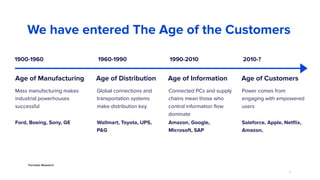
Age of Manufacturing Age of Distribution Age of Information Age of Customers
1900-1960 1960-1990 1990-2010 2010-?
Mass manufacturing makes
industrial powerhouses
successful
Global connections and
transportation systems
make distribution key
Connected PCs and supply
chains mean those who
control information flow
dominate
Power comes from
engaging with empowered
users
Ford, Boeing, Sony, GE Wallmart, Toyota, UPS,
P&G
Amazon, Google,
Microsoft, SAP
Saleforce, Apple, Netflix,
Amazon,
Forrester Research
We have entered The Age of the Customers
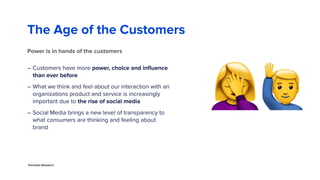
The Age of the Customers
– Customers have more power, choice and influence
than ever before
– What we think and feel about our interaction with an
organizations product and service is increasingly
important due to the rise of social media
– Social Media brings a new level of transparency to
what consumers are thinking and feeling about
brand
6
Power is in hands of the customers
!"
Forrester Research
People will forget what you said, people will forget what
you did, but people will never forget how you made
them feel.”
7
“
Maya Angelou
8
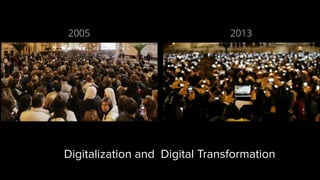
Digitalization and Digital Transformation
Digital Business Transformation: It is about
doing things differently – creating new
business by using digital technologies
It is not just about automating or inserting technology into an existing process (digitalization) to
optimize the current value chain, but modifying the business model, changing the value chain and
surely creating a new supply of products and services
9
"
10
11
https://youtu.be/ZUG9qYTJMsI
12
13
14
15
16
17
Design
18
De$ign
19
How we as designer can help in
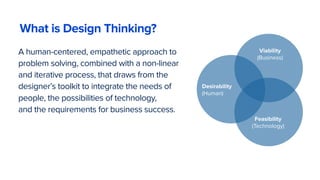
A human-centered, empathetic approach to
problem solving, combined with a non-linear
and iterative process, that draws from the
designer’s toolkit to integrate the needs of
people, the possibilities of technology,

and the requirements for business success.
What is Design Thinking?
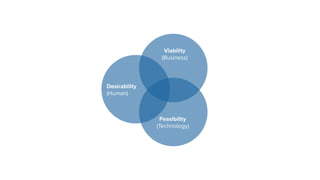
Desirability
(Human)
Viability
(Business)
Feasibility
(Technology)
– A mindset
– Collaborative process
– Prototyping and testing
– A set of methods and tools
21
What is Design Thinking?
– Empathy
– Creative Confidence
– Iterate, Iterate, Iterate
– Learn From Failure
– Optimism
22
Mindset
🤓
Empathy is the capacity to understand
or feel what another person is
experiencing from within the other
person's frame of reference, i.e., the
capacity to place oneself in another's
position.
💏
Mindset
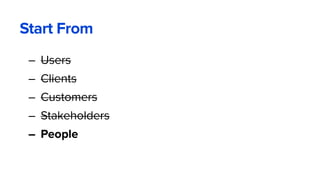
– Users
– Clients
– Customers
– Stakeholders
– People
Start From
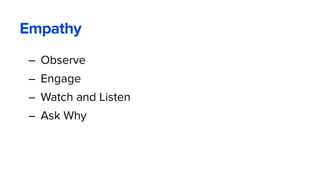
– Observe
– Engage
– Watch and Listen
– Ask Why
Empathy
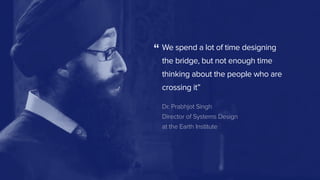
We spend a lot of time designing

the bridge, but not enough time
thinking about the people who are
crossing it”
Dr. Prabhjot Singh
Director of Systems Design
at the Earth Institute
“
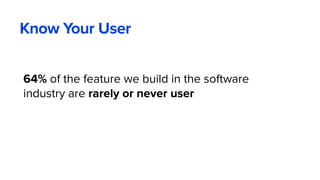
64% of the feature we build in the software
industry are rarely or never user
Know Your User
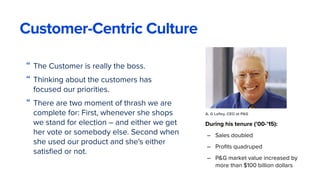
“ The Customer is really the boss.
“ Thinking about the customers has
focused our priorities.
“ There are two moment of thrash we are
complete for: First, whenever she shops
we stand for election – and either we get
her vote or somebody else. Second when
she used our product and she's either
satisfied or not.
During his tenure (’00-’15):
– Sales doubled
– Profits quadruped
– P&G market value increased by
more than $100 billion dollars
A. G Lafley, CEO at P&G
Customer-Centric Culture
29
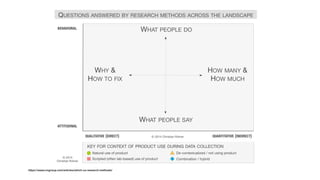
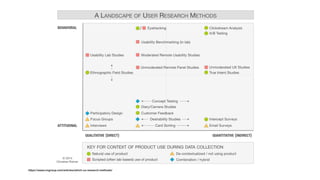
https://www.nngroup.com/articles/which-ux-research-methods/
33
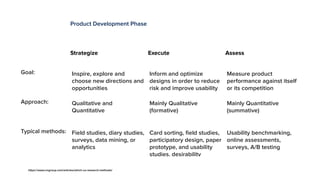
Product Development Phase
Strategize Execute Assess
Goal: Inspire, explore and
choose new directions and
opportunities
Inform and optimize
designs in order to reduce
risk and improve usability
Measure product
performance against itself
or its competition
Approach: Qualitative and
Quantitative
Mainly Qualitative
(formative)
Mainly Quantitative
(summative)
Typical methods: Field studies, diary studies,
surveys, data mining, or
analytics
Card sorting, field studies,
participatory design, paper
prototype, and usability
studies, desirability
studies, customer emails
Usability benchmarking,
online assessments,
surveys, A/B testing
https://www.nngroup.com/articles/which-ux-research-methods/
Collaboration
35
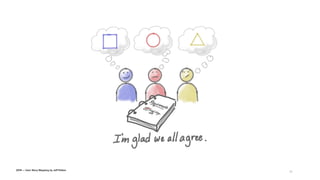
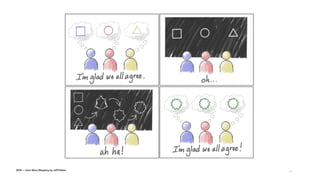
Most problems are too complex for one
person. Multiple perspectives, skills,
disciplines, experience and knowledge is
key
36
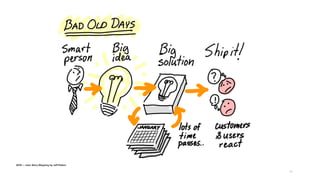
2014 — User Story Mapping by Jeff Patton
37
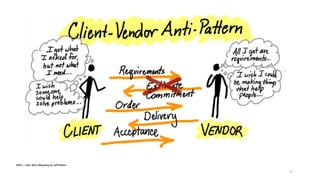
2014 — User Story Mapping by Jeff Patton
38
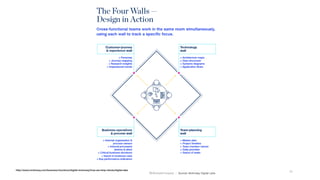
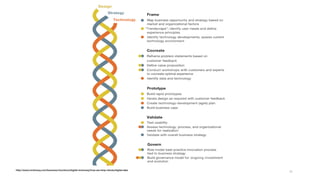
http://www.mckinsey.com/business-functions/digital-mckinsey/how-we-help-clients/digital-labs
39
http://www.mckinsey.com/business-functions/digital-mckinsey/how-we-help-clients/digital-labs
40
Desirability
(Human)
Viability
(Business)
Feasibility
(Technology)
41
Prototypes
43
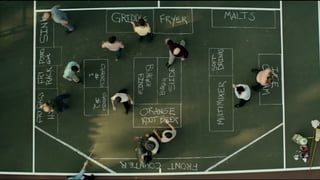
The cheapest artifact to test an
assumption
In 1978, James Dyson became frustrated with
his vacuum cleaner’s diminishing performance.
44
Five years and 5,127 prototypes later, he had
invented the world’s first bagless vacuum cleaner.
45
46
47
48
Prototype driven culture
– Build anything that allows the idea to be experienced
– Let your building inform your thinking
– Be comfortable with things that are rough
– Fail early and often in order to succeed sooner
– Ask the right questions
Process and Tools
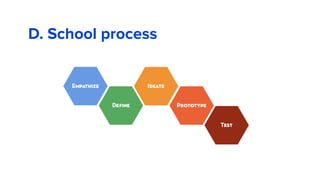
D. School process
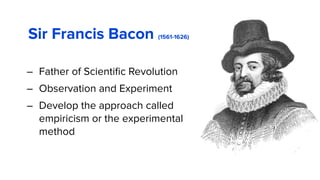
Sir Francis Bacon (1561-1626)
– Father of Scientific Revolution
– Observation and Experiment
– Develop the approach called
empiricism or the experimental
method
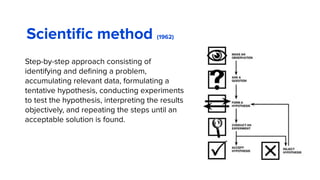
Scientific method (1962)
Step-by-step approach consisting of
identifying and defining a problem,
accumulating relevant data, formulating a
tentative hypothesis, conducting experiments
to test the hypothesis, interpreting the results
objectively, and repeating the steps until an
acceptable solution is found.
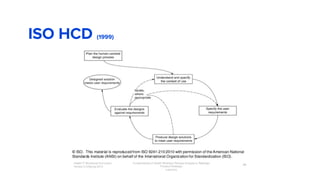
ISO HCD (1999)
55
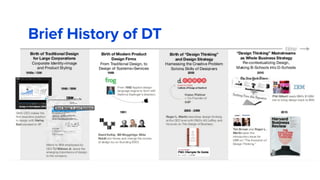
Brief History of DT
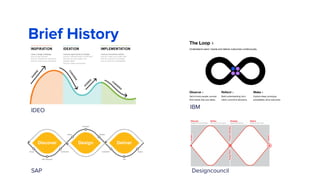
Brief History
IDEO
IBM
SAP Designcouncil
Adding the word ‘thinking’ to ‘design’ was a brilliant
move. David Kelley and Tim Brown, the founders of
IDEO who popularized the term, were smart to take
advantage of the unfamiliarity of the phrase.
57
Design Thinking Process is Just
Design Process
Jared Spool
As design professionals, we shouldn’t let
ourselves think there’s any magic in
Design Thinking. Our teams, stakeholders,
and executives can believe in it, but we
shouldn’t.
58
🎩
No Magic
Jared Spool
How sell DT
– Know your client
– Know your proposition
How to Sell
61
Is there a DT in outsourcing?
62
N 😭😭😭!
Is there a DT in outsourcing?
63
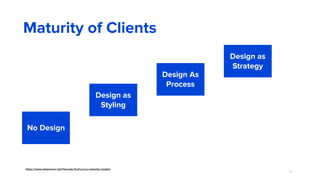
https://www.slideshare.net/Hienadz.Drahun/ux-maturity-models
No Design
Design as
Styling
Design As
Process
Design as
Strategy
Maturity of Clients
64
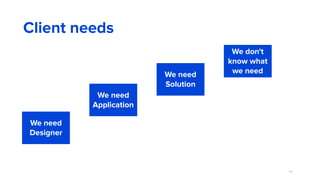
We need
Designer
We need
Application
We need
Solution
We don't
know what
we need
Client needs
65
🐶
Some clients just want pretty pictures
66
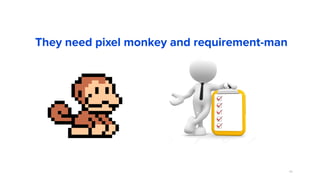
They need pixel monkey and requirement-man
67
Other clients need that you solve
their problems
🕶
68
But they don’t need Design Thinking
😿
69
Sell benefits and results first and
only then process
🤝
Know your proposition
71
😱😱😱
Design Thinking ≠ Design Sprint ≠ Workshops
Know your proposition
72
,
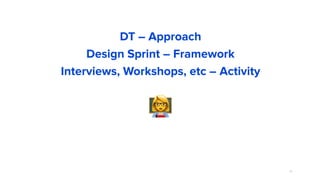
DT – Approach
Design Sprint – Framework
Interviews, Workshops, etc – Activity
73
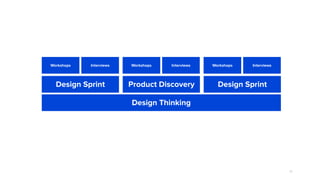
Design Thinking
Design Sprint Product Discovery Design Sprint
Workshops Interviews Workshops Interviews Workshops Interviews
74
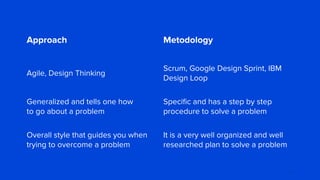
Approach Metodology
Agile, Design Thinking
Scrum, Google Design Sprint, IBM
Design Loop
Generalized and tells one how
to go about a problem
Specific and has a step by step
procedure to solve a problem
Overall style that guides you when
trying to overcome a problem
It is a very well organized and well
researched plan to solve a problem
75
76
We will do Design Thinking, Google
Sprints, Lean UX, Interviews, Test and
Workshops.
😫
77
😀
We will do workshops with stakeholders
and users. These activities are part of our
Design Sprint based on Design Thinking
Approach.
As Result of these workshops we will have shared
understanding of business and user needs…
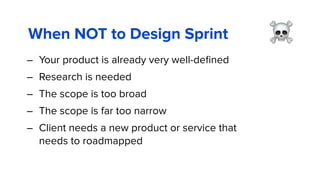
When NOT to Design Sprint
– Your product is already very well-defined
– Research is needed
– The scope is too broad
– The scope is far too narrow
– Client needs a new product or service that
needs to roadmapped
☠
79
Design Sprints doesn't work on
Discovery
80
Product Discovery!!!
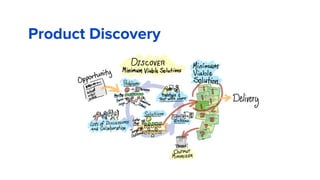
A product discovery is about ensuring that the right product
is built for the right audience
There is no single process or toolkit that serves
every single case. There is a wide variety of
activities and tools that people customize to
serve their needs.
81
The Traditional Way
– A long list of ideas is collected from senior leadership
– A group of people prioritizes and funds those ideas,
initiatives, or projects
– Funded projects get assigned resources and a PM/BA
starts gathering requirements
– The PM/BA interviews key stakeholders to understand
what they need, documenting what they find
– The requirements go to engineering for delivery
83
2014 — User Story Mapping by Jeff Patton
84
2014 — User Story Mapping by Jeff Patton
Product Discovery
How long discovery takes
Every service is different, but depending on the size and
complexity of your service, your discovery should usually
take between 2 and 8 weeks.
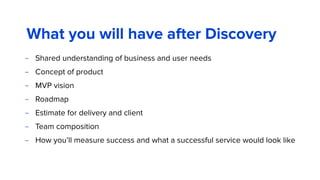
What you will have after Discovery
– Shared understanding of business and user needs
– Concept of product
– MVP vision
– Roadmap
– Estimate for delivery and client
– Team composition
– How you’ll measure success and what a successful service would look like
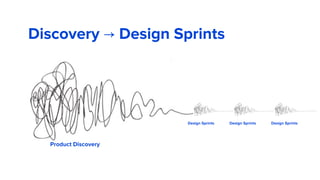
Discovery → Design Sprints
Product Discovery
Design Sprints Design Sprints Design Sprints
Workshops
Before Workshops
– Agenda
– Users
– Rider
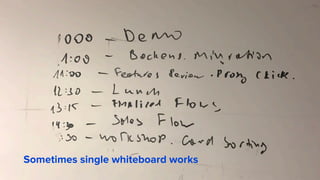
Sometimes single whiteboard works
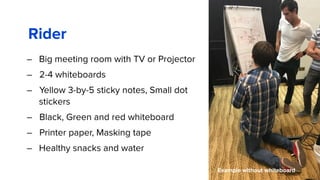
Rider
– Big meeting room with TV or Projector
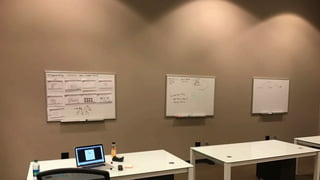
– 2-4 whiteboards
– Yellow 3-by-5 sticky notes, Small dot
stickers
– Black, Green and red whiteboard
– Printer paper, Masking tape
– Healthy snacks and water
Example without whiteboard
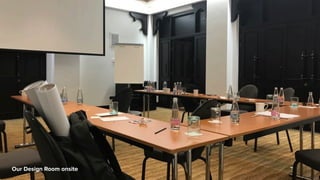
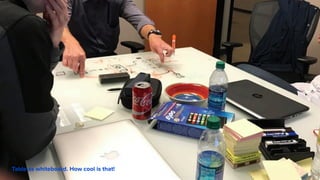
Our Design Room onsite
Table as whiteboard. How cool is that!
Workshop
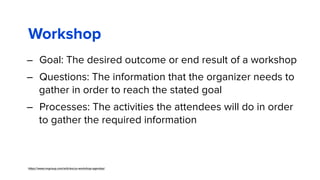
– Goal: The desired outcome or end result of a workshop
– Questions: The information that the organizer needs to
gather in order to reach the stated goal 
– Processes: The activities the attendees will do in order
to gather the required information
https://www.nngroup.com/articles/ux-workshop-agendas/
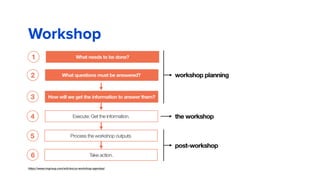
Workshop
https://www.nngroup.com/articles/ux-workshop-agendas/
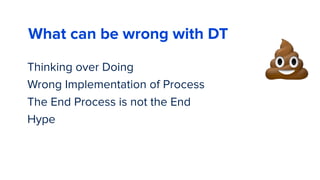
Thinking over Doing
Wrong Implementation of Process
The End Process is not the End
Hype
99
💩
What can be wrong with DT
Questions
100
101
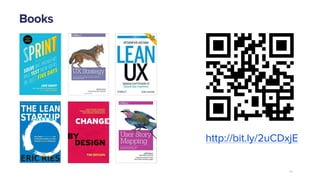
Books
http://bit.ly/2uCDxjE
102

WTF is Design Thinking

  • 2.
  • 3.
  • 4.
    By 2020, UXwill overtake price and product as the key brand differentiator." 4 “
  • 5.
    5 Age of ManufacturingAge of Distribution Age of Information Age of Customers 1900-1960 1960-1990 1990-2010 2010-? Mass manufacturing makes industrial powerhouses successful Global connections and transportation systems make distribution key Connected PCs and supply chains mean those who control information flow dominate Power comes from engaging with empowered users Ford, Boeing, Sony, GE Wallmart, Toyota, UPS, P&G Amazon, Google, Microsoft, SAP Saleforce, Apple, Netflix, Amazon, Forrester Research We have entered The Age of the Customers
  • 6.
    The Age ofthe Customers – Customers have more power, choice and influence than ever before – What we think and feel about our interaction with an organizations product and service is increasingly important due to the rise of social media – Social Media brings a new level of transparency to what consumers are thinking and feeling about brand 6 Power is in hands of the customers !" Forrester Research
  • 7.
    People will forgetwhat you said, people will forget what you did, but people will never forget how you made them feel.” 7 “ Maya Angelou
  • 8.
  • 9.
    Digital Business Transformation:It is about doing things differently – creating new business by using digital technologies It is not just about automating or inserting technology into an existing process (digitalization) to optimize the current value chain, but modifying the business model, changing the value chain and surely creating a new supply of products and services 9 "
  • 10.
  • 11.
  • 12.
  • 13.
  • 14.
  • 15.
  • 16.
  • 17.
  • 18.
  • 19.
    19 How we asdesigner can help in
  • 20.
    A human-centered, empatheticapproach to problem solving, combined with a non-linear and iterative process, that draws from the designer’s toolkit to integrate the needs of people, the possibilities of technology,
 and the requirements for business success. What is Design Thinking? Desirability (Human) Viability (Business) Feasibility (Technology)
  • 21.
    – A mindset –Collaborative process – Prototyping and testing – A set of methods and tools 21 What is Design Thinking?
  • 22.
    – Empathy – CreativeConfidence – Iterate, Iterate, Iterate – Learn From Failure – Optimism 22 Mindset 🤓
  • 23.
    Empathy is thecapacity to understand or feel what another person is experiencing from within the other person's frame of reference, i.e., the capacity to place oneself in another's position. 💏 Mindset
  • 24.
    – Users – Clients –Customers – Stakeholders – People Start From
  • 25.
    – Observe – Engage –Watch and Listen – Ask Why Empathy
  • 26.
    We spend alot of time designing
 the bridge, but not enough time thinking about the people who are crossing it” Dr. Prabhjot Singh Director of Systems Design at the Earth Institute “
  • 27.
    64% of thefeature we build in the software industry are rarely or never user Know Your User
  • 28.
    “ The Customeris really the boss. “ Thinking about the customers has focused our priorities. “ There are two moment of thrash we are complete for: First, whenever she shops we stand for election – and either we get her vote or somebody else. Second when she used our product and she's either satisfied or not. During his tenure (’00-’15): – Sales doubled – Profits quadruped – P&G market value increased by more than $100 billion dollars A. G Lafley, CEO at P&G Customer-Centric Culture
  • 29.
  • 31.
  • 32.
  • 33.
    33 Product Development Phase StrategizeExecute Assess Goal: Inspire, explore and choose new directions and opportunities Inform and optimize designs in order to reduce risk and improve usability Measure product performance against itself or its competition Approach: Qualitative and Quantitative Mainly Qualitative (formative) Mainly Quantitative (summative) Typical methods: Field studies, diary studies, surveys, data mining, or analytics Card sorting, field studies, participatory design, paper prototype, and usability studies, desirability studies, customer emails Usability benchmarking, online assessments, surveys, A/B testing https://www.nngroup.com/articles/which-ux-research-methods/
  • 34.
  • 35.
    35 Most problems aretoo complex for one person. Multiple perspectives, skills, disciplines, experience and knowledge is key
  • 36.
    36 2014 — UserStory Mapping by Jeff Patton
  • 37.
    37 2014 — UserStory Mapping by Jeff Patton
  • 38.
  • 39.
  • 40.
  • 41.
  • 42.
  • 43.
    43 The cheapest artifactto test an assumption
  • 44.
    In 1978, JamesDyson became frustrated with his vacuum cleaner’s diminishing performance. 44
  • 45.
    Five years and5,127 prototypes later, he had invented the world’s first bagless vacuum cleaner. 45
  • 46.
  • 47.
  • 48.
  • 49.
    Prototype driven culture –Build anything that allows the idea to be experienced – Let your building inform your thinking – Be comfortable with things that are rough – Fail early and often in order to succeed sooner – Ask the right questions
  • 50.
  • 51.
  • 52.
    Sir Francis Bacon(1561-1626) – Father of Scientific Revolution – Observation and Experiment – Develop the approach called empiricism or the experimental method
  • 53.
    Scientific method (1962) Step-by-stepapproach consisting of identifying and defining a problem, accumulating relevant data, formulating a tentative hypothesis, conducting experiments to test the hypothesis, interpreting the results objectively, and repeating the steps until an acceptable solution is found.
  • 54.
  • 55.
  • 56.
  • 57.
    Adding the word‘thinking’ to ‘design’ was a brilliant move. David Kelley and Tim Brown, the founders of IDEO who popularized the term, were smart to take advantage of the unfamiliarity of the phrase. 57 Design Thinking Process is Just Design Process Jared Spool
  • 58.
    As design professionals,we shouldn’t let ourselves think there’s any magic in Design Thinking. Our teams, stakeholders, and executives can believe in it, but we shouldn’t. 58 🎩 No Magic Jared Spool
  • 59.
  • 60.
    – Know yourclient – Know your proposition How to Sell
  • 61.
    61 Is there aDT in outsourcing?
  • 62.
    62 N 😭😭😭! Is therea DT in outsourcing?
  • 63.
  • 64.
    64 We need Designer We need Application Weneed Solution We don't know what we need Client needs
  • 65.
    65 🐶 Some clients justwant pretty pictures
  • 66.
    66 They need pixelmonkey and requirement-man
  • 67.
    67 Other clients needthat you solve their problems 🕶
  • 68.
    68 But they don’tneed Design Thinking 😿
  • 69.
    69 Sell benefits andresults first and only then process 🤝
  • 70.
  • 71.
    71 😱😱😱 Design Thinking ≠Design Sprint ≠ Workshops Know your proposition
  • 72.
    72 , DT – Approach DesignSprint – Framework Interviews, Workshops, etc – Activity
  • 73.
    73 Design Thinking Design SprintProduct Discovery Design Sprint Workshops Interviews Workshops Interviews Workshops Interviews
  • 74.
    74 Approach Metodology Agile, DesignThinking Scrum, Google Design Sprint, IBM Design Loop Generalized and tells one how to go about a problem Specific and has a step by step procedure to solve a problem Overall style that guides you when trying to overcome a problem It is a very well organized and well researched plan to solve a problem
  • 75.
  • 76.
    76 We will doDesign Thinking, Google Sprints, Lean UX, Interviews, Test and Workshops. 😫
  • 77.
    77 😀 We will doworkshops with stakeholders and users. These activities are part of our Design Sprint based on Design Thinking Approach. As Result of these workshops we will have shared understanding of business and user needs…
  • 78.
    When NOT toDesign Sprint – Your product is already very well-defined – Research is needed – The scope is too broad – The scope is far too narrow – Client needs a new product or service that needs to roadmapped ☠
  • 79.
    79 Design Sprints doesn'twork on Discovery
  • 80.
    80 Product Discovery!!! A productdiscovery is about ensuring that the right product is built for the right audience
  • 81.
    There is nosingle process or toolkit that serves every single case. There is a wide variety of activities and tools that people customize to serve their needs. 81
  • 82.
    The Traditional Way –A long list of ideas is collected from senior leadership – A group of people prioritizes and funds those ideas, initiatives, or projects – Funded projects get assigned resources and a PM/BA starts gathering requirements – The PM/BA interviews key stakeholders to understand what they need, documenting what they find – The requirements go to engineering for delivery
  • 83.
    83 2014 — UserStory Mapping by Jeff Patton
  • 84.
    84 2014 — UserStory Mapping by Jeff Patton
  • 85.
  • 86.
    How long discoverytakes Every service is different, but depending on the size and complexity of your service, your discovery should usually take between 2 and 8 weeks.
  • 87.
    What you willhave after Discovery – Shared understanding of business and user needs – Concept of product – MVP vision – Roadmap – Estimate for delivery and client – Team composition – How you’ll measure success and what a successful service would look like
  • 88.
    Discovery → DesignSprints Product Discovery Design Sprints Design Sprints Design Sprints
  • 89.
  • 90.
  • 92.
  • 93.
    Rider – Big meetingroom with TV or Projector – 2-4 whiteboards – Yellow 3-by-5 sticky notes, Small dot stickers – Black, Green and red whiteboard – Printer paper, Masking tape – Healthy snacks and water Example without whiteboard
  • 94.
  • 96.
    Table as whiteboard.How cool is that!
  • 97.
    Workshop – Goal: Thedesired outcome or end result of a workshop – Questions: The information that the organizer needs to gather in order to reach the stated goal  – Processes: The activities the attendees will do in order to gather the required information https://www.nngroup.com/articles/ux-workshop-agendas/
  • 98.
  • 99.
    Thinking over Doing WrongImplementation of Process The End Process is not the End Hype 99 💩 What can be wrong with DT
  • 100.
  • 101.
  • 102.