Masih Anwar
Shella Bakke
Matthew Eldred
Karen He
Breaking the traditional project management process
IDEO Product Development
Overview of IDEO
Based out of Silicon Valley since 1991, IDEO uses Design Thinking methodologies
coupled with engineering to create aesthetically appealing products with ease of
use
 Prototyping is IDEO’s philosophy to go through multiple iterations and focus on small parts
of the prototype.
 Extremely challenging to create devices involving compact and complex design such as
automotive components, medical instruments, and small computing devices
 Clients: Apple, AT&T, Samsung, Philips, Amtrak, Steelcase, Baxter International, NEC Corp.
 Design Centers: Boston, Chicago, San Francisco, London, Palo Alto, Grand Rapids, New
York, Milan, Tel Aviv, Tokyo. DCs run independently for local business but best practice
exchanges.
 Monitoring & Controlling
Processes
 Initiating Processes
 Planning Processes
 Executing Processes
 Monitoring and Controlling
Processes
 Closing Processes
PMBOK
 IDEO’s Innovation Process
 Phase 0: Understand & Observe
 Phase 1: Visualize & Realize
 Phase 2: Evaluate & Refine
 Phase 3: Implement & Detailed
Engineering
 Phase 4: Implement &
Manufacturing Liaison
IDEO
Project Phases: IDEO versus PMBOK
 Closely tied to prototyping – took place throughout Phases 1 and 2 of the
project
 Brainstorming Principles
 Stay focused on topic
 Encourage wild ideas
 Defer judgment to avoid interrupting flow of ideas
 Build on the ideas of others
 Hold only one conversation at a time
 Go for quantity!
 Be visual
 Other office initiatives designed to inspire creativity:
 Monday ‘Show & Tells’
 ‘Tech Box’ to inspire innovators by having them play with ~300 objects including switches,
buttons, archery bows, etc.
Brainstormers at IDEO
Used as a way to communicate
Prototypes ensured everyone was imagining the same design
Could be simple or sophisticated
Depends upon project status
Rough, Rapid, Right!
The goal of prototyping was to get one specific aspect of
design correct
Prototypes at IDEO
Project roles were very transient
Roles assigned by team leaders and played out by team
members
Project teams formed for the life of a project and then
disbanded
No permanent job titles or assignments
Leaders emerged on basis of personal excitement about a
project
Engineers and designers did not feel forced into management
Project Roles at IDEO
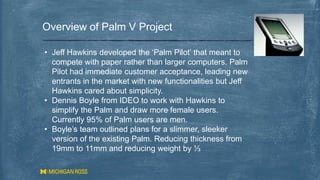
Overview of Palm V Project
• Jeff Hawkins developed the ‘Palm Pilot’ that meant to
compete with paper rather than larger computers. Palm
Pilot had immediate customer acceptance, leading new
entrants in the market with new functionalities but Jeff
Hawkins cared about simplicity.
• Dennis Boyle from IDEO to work with Hawkins to
simplify the Palm and draw more female users.
Currently 95% of Palm users are men.
• Boyle’s team outlined plans for a slimmer, sleeker
version of the existing Palm. Reducing thickness from
19mm to 11mm and reducing weight by ⅓
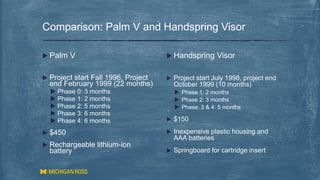
Comparison: Palm V and Handspring Visor
 Project start July 1998, project end
October 1999 (10 months)
 Phase 1: 2 months
 Phase 2: 3 months
 Phase: 3 & 4: 5 months
 $150
 Inexpensive plastic housing and
AAA batteries
 Springboard for cartridge insert
 Handspring Visor
 Project start Fall 1996, Project
end February 1999 (22 months)
 Phase 0: 3 months
 Phase 1: 2 months
 Phase 2: 5 months
 Phase 3: 6 months
 Phase 4: 6 months
 $450
 Rechargeable lithium-ion
battery
 Palm V
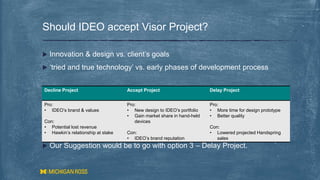
 Innovation & design vs. client’s goals
 ‘tried and true technology’ vs. early phases of development process
 Our Suggestion would be to go with option 3 – Delay Project.
Should IDEO accept Visor Project?
Decline Project Accept Project Delay Project
Pro:
• IDEO’s brand & values
Con:
• Potential lost revenue
• Hawkin’s relationship at stake
Pro:
• New design to IDEO’s portfolio
• Gain market share in hand-held
devices
Con:
• IDEO’s brand reputation
Pro:
• More time for design prototype
• Better quality
Con:
• Lowered projected Handspring
sales
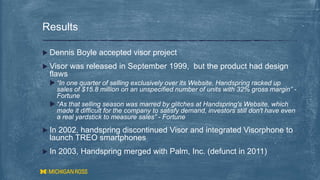
 Dennis Boyle accepted visor project
 Visor was released in September 1999, but the product had design
flaws
 “In one quarter of selling exclusively over its Website, Handspring racked up
sales of $15.8 million on an unspecified number of units with 32% gross margin” -
Fortune
 “As that selling season was marred by glitches at Handspring's Website, which
made it difficult for the company to satisfy demand, investors still don't have even
a real yardstick to measure sales” - Fortune
 In 2002, handspring discontinued Visor and integrated Visorphone to
launch TREO smartphones
 In 2003, Handspring merged with Palm, Inc. (defunct in 2011)
Results
Questions & Discussion
Appendix
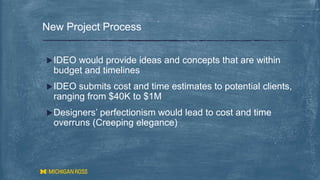
New Project Process
IDEO would provide ideas and concepts that are within
budget and timelines
IDEO submits cost and time estimates to potential clients,
ranging from $40K to $1M
Designers’ perfectionism would lead to cost and time
overruns (Creeping elegance)
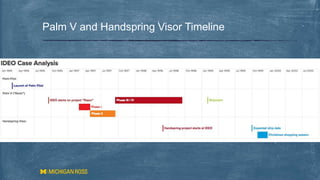
Palm V and Handspring Visor Timeline
 “We are at a critical point where rapid change is forcing us to
look not just to new ways of solving problems but to new
problems to solve.” -Tim Brown CEO
 “Opportunity to work on amazing challenges. Flexibility to shape
your work and career. Amazing colleagues and culture.” –
Anonymous Employee “Glassdoor”
 “ One can’t help but wonder if these design flaws could have
been avoided, had IDEO been able to spend more time early on
during the product development” – Anonymous researcher
Reviews about IDEO

IDEO Product Development Presentation Team 4_Final

  • 1.
    Masih Anwar Shella Bakke MatthewEldred Karen He Breaking the traditional project management process IDEO Product Development
  • 2.
    Overview of IDEO Basedout of Silicon Valley since 1991, IDEO uses Design Thinking methodologies coupled with engineering to create aesthetically appealing products with ease of use  Prototyping is IDEO’s philosophy to go through multiple iterations and focus on small parts of the prototype.  Extremely challenging to create devices involving compact and complex design such as automotive components, medical instruments, and small computing devices  Clients: Apple, AT&T, Samsung, Philips, Amtrak, Steelcase, Baxter International, NEC Corp.  Design Centers: Boston, Chicago, San Francisco, London, Palo Alto, Grand Rapids, New York, Milan, Tel Aviv, Tokyo. DCs run independently for local business but best practice exchanges.
  • 3.
     Monitoring &Controlling Processes  Initiating Processes  Planning Processes  Executing Processes  Monitoring and Controlling Processes  Closing Processes PMBOK  IDEO’s Innovation Process  Phase 0: Understand & Observe  Phase 1: Visualize & Realize  Phase 2: Evaluate & Refine  Phase 3: Implement & Detailed Engineering  Phase 4: Implement & Manufacturing Liaison IDEO Project Phases: IDEO versus PMBOK
  • 4.
     Closely tiedto prototyping – took place throughout Phases 1 and 2 of the project  Brainstorming Principles  Stay focused on topic  Encourage wild ideas  Defer judgment to avoid interrupting flow of ideas  Build on the ideas of others  Hold only one conversation at a time  Go for quantity!  Be visual  Other office initiatives designed to inspire creativity:  Monday ‘Show & Tells’  ‘Tech Box’ to inspire innovators by having them play with ~300 objects including switches, buttons, archery bows, etc. Brainstormers at IDEO
  • 5.
    Used as away to communicate Prototypes ensured everyone was imagining the same design Could be simple or sophisticated Depends upon project status Rough, Rapid, Right! The goal of prototyping was to get one specific aspect of design correct Prototypes at IDEO
  • 6.
    Project roles werevery transient Roles assigned by team leaders and played out by team members Project teams formed for the life of a project and then disbanded No permanent job titles or assignments Leaders emerged on basis of personal excitement about a project Engineers and designers did not feel forced into management Project Roles at IDEO
  • 7.
    Overview of PalmV Project • Jeff Hawkins developed the ‘Palm Pilot’ that meant to compete with paper rather than larger computers. Palm Pilot had immediate customer acceptance, leading new entrants in the market with new functionalities but Jeff Hawkins cared about simplicity. • Dennis Boyle from IDEO to work with Hawkins to simplify the Palm and draw more female users. Currently 95% of Palm users are men. • Boyle’s team outlined plans for a slimmer, sleeker version of the existing Palm. Reducing thickness from 19mm to 11mm and reducing weight by ⅓
  • 8.
    Comparison: Palm Vand Handspring Visor  Project start July 1998, project end October 1999 (10 months)  Phase 1: 2 months  Phase 2: 3 months  Phase: 3 & 4: 5 months  $150  Inexpensive plastic housing and AAA batteries  Springboard for cartridge insert  Handspring Visor  Project start Fall 1996, Project end February 1999 (22 months)  Phase 0: 3 months  Phase 1: 2 months  Phase 2: 5 months  Phase 3: 6 months  Phase 4: 6 months  $450  Rechargeable lithium-ion battery  Palm V
  • 9.
     Innovation &design vs. client’s goals  ‘tried and true technology’ vs. early phases of development process  Our Suggestion would be to go with option 3 – Delay Project. Should IDEO accept Visor Project? Decline Project Accept Project Delay Project Pro: • IDEO’s brand & values Con: • Potential lost revenue • Hawkin’s relationship at stake Pro: • New design to IDEO’s portfolio • Gain market share in hand-held devices Con: • IDEO’s brand reputation Pro: • More time for design prototype • Better quality Con: • Lowered projected Handspring sales
  • 10.
     Dennis Boyleaccepted visor project  Visor was released in September 1999, but the product had design flaws  “In one quarter of selling exclusively over its Website, Handspring racked up sales of $15.8 million on an unspecified number of units with 32% gross margin” - Fortune  “As that selling season was marred by glitches at Handspring's Website, which made it difficult for the company to satisfy demand, investors still don't have even a real yardstick to measure sales” - Fortune  In 2002, handspring discontinued Visor and integrated Visorphone to launch TREO smartphones  In 2003, Handspring merged with Palm, Inc. (defunct in 2011) Results
  • 11.
  • 12.
  • 13.
    New Project Process IDEOwould provide ideas and concepts that are within budget and timelines IDEO submits cost and time estimates to potential clients, ranging from $40K to $1M Designers’ perfectionism would lead to cost and time overruns (Creeping elegance)
  • 14.
    Palm V andHandspring Visor Timeline
  • 15.
     “We areat a critical point where rapid change is forcing us to look not just to new ways of solving problems but to new problems to solve.” -Tim Brown CEO  “Opportunity to work on amazing challenges. Flexibility to shape your work and career. Amazing colleagues and culture.” – Anonymous Employee “Glassdoor”  “ One can’t help but wonder if these design flaws could have been avoided, had IDEO been able to spend more time early on during the product development” – Anonymous researcher Reviews about IDEO

Editor's Notes

  • #3 Based out of Silicon Valley since 1991, IDEO is a company that uses Design Thinking practices that combines engineering and design to create aesthetically appealing products that are usable. Hardest places to to practice concurrent engineering were in devices involving compact and complex design such as automotive components, medical instruments, and small computing devices Clients: Apple, AT&T, Samsung, Philips, Amtrak, Steelcase, Baxter International, NEC Corp. Design Centers: Boston, Chicago, San Francisco, London, Palo Alto, Grand Rapids, New York, Milan, Tel Aviv, Tokyo. DCs run independently for local business but best practice exchanges. Prototyping is IDEO’s philosophy to go through multiple iterations and focus on small parts of the prototype.
  • #4 Phase 0 - Understand & Observe. Understand the client’s business and find the feasibility of product. Discover marketplace and users Phase 1 - Visualize & Realize. Choosing product direction based on ideas, technologies, and market perceptions. Coordinate with client and have a 3-dimensional prototype to show client what their development strategy is Phase 2 - Evaluating & Refining. Enhance design prototypes through testing functional prototypes with usability, aesthetics, and ergonomics Phase 3 - Implement & Detailed Engineering. Final product that can be manufactured. The fully functional design model, tooling databases and technical documentation is delivered to client Phase 4 - Implement & Manufacturing Liaison. Coordinate with client to ensure smooth product release to manufacturing as product moves from shop floor to clients factory lines. PMBOK Initiating Processes Group: processes performed to define a new project or a new phase of a project. This includes initial defined scope and committed financial resources. Internal and external stakeholders are identified. It is focused on business need. A decision is made whether project should be continued, delayed or discontinued. Planning Process Group: Processes performed to establish the total scope of the effort. This may require repeated feedback loops for additional analysis and significant changes occurring throughout the project lifecycle trigger a need to revisit one or more of the planning processes and possibly some of the initiating processes. Executing Process Group: Coordinating people and resources, managing stakeholder expectations, integrating and performing activities of the project in accordance with project management plan. A large portion of the project’s budget will be expended in performing the Executing Process Group processes Monitoring and Controlling Process Group: Track, Review and Orchestrate the progress and performance of the project. Identify any areas in which changes to the plan is required. Key benefit for this process Group is that project performance is measured and analyzed at regular intervals, appropriate events or exception condition to identify variances from the project management plan Closing Process Group: Process that conclude all activities across all Project Management Process Groups, which verifies that the defined processes are completed within all of the Process Groups to close the project or a project phase and formally establishes that the project is complete
  • #9 Phase 0 - Understand phase lasted 10-12 weeks. Little data on user preferences so Boyle’s team did own research by providing Palms to different people to use the Palm and got people talking about the problems concerning the product’s susceptibility to breaking after being dropped, rigidity of the case, placement of the batter, memory doors and location of the stylus holder. Phase 1 - Visualize & Realize. Only 3-4 designers and engineers were involved but at the height of activity about 12 were involved. Diverse team from Taiwan, Netherlands, Israel with female design engineers to get insight into attracting female users. Female design engineers found the need to make the new product more curvy, with tapering edges. IDEO team met with Palm client every week to receive constant feedback and prototype was necessary no matter how big or small it is so that even smallest detail would be considered. This project’s code name was “Razor” because they wanted to create a razor thin Palm. But they faced two issues if they wanted to create a very thin product. They needed to work with reluctant battery makers to make thinner rechargeable lithium ion batteries. The team also concerned of using the anodized aluminium for creating the thin casing where US manufacturers do not have experience in creating and hard to communicate with Asian manufacturers to create the complex casing. Phase 2 - Evaluation and Refinement. Used computer aided design (CAD) to create accurate industrial models of the proposed product. Designers and Engineers saw how users would interface with the product and how much they would have to recharge. Then they would have choose solutions, vendors and sources. Phase 3 - Implementation. 3-5 models built to test how sturdy it is and each model would cost $30,000. They kept refining the product and the Palm team grew, and meetings increased, emails increased and IDEO’s responsibilities shifted away. They also faced the challenge in how to put together the 11 mm Palm without any screws, which is using industrial glue but all the experts from 3Com who can do that have left. Phase 4 - Manufacturing liaison. 5,000 units per day and each day’s loss of a product line’s output would cost the company a few hundred thousand dollars. There still issues that manufacturers had on hand and hundreds of personnel were involved in manufacturing sites from Utah, Japan, Singapore and dozens of vendors from Hong Kong, Taiwan, California, Texas.
  • #11 http://archive.fortune.com/magazines/fortune/fortune_archive/2000/05/15/279788/index.htm Fear of failure – reputation could be damaged by taking on a product that has such tight cost and time constraints Philosophy & Culture - IDEO had created a supportive culture for creativity and innovation.  Informality & free ideations would not be possible as the project would have to be kept secret from other IDEO employees. Conflict of interest - within IDEO Unique methodology – not a mainstream design company, design process consisted of intense prototyping & brainstorming.
  • #14 To an outsider, the entire process could appear messy. IDEO would provide ideas and concepts that are within budget and timelines IDEO submits cost and time estimates to potential clients, ranging from $40K to $1M Designers’ perfectionism would lead to cost and time overruns (Creeping elegance). As a result, IDEO required frequent meetings