


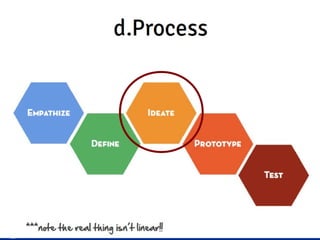

Design Thinking
Innovation & Entrepreneurship
SSE MBA in Executive Format
Robin Teigland
robin.teigland@hhs.se
December 2016
2
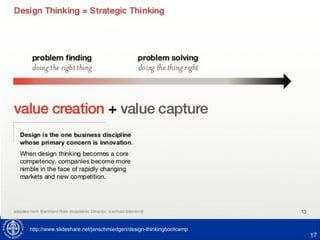
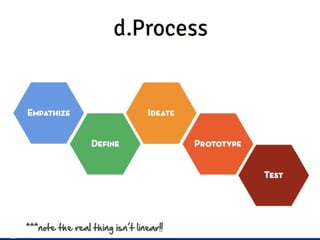
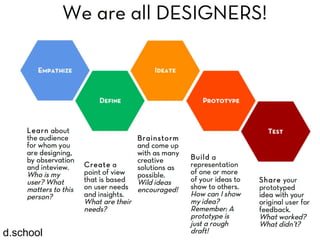
http://www.slideshare.net/janschmiedgen/design-thinkingbootcamp
3
https://www.youtube.com/watch?v=fGaVFRzTTP4
4
5
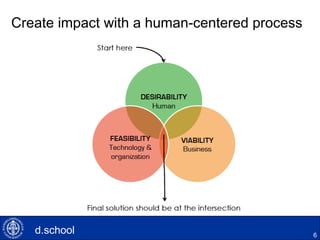
Create impact with a human-centered process
6
d.school
7
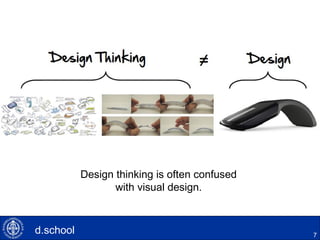
Design thinking is often confused
with visual design.
d.school
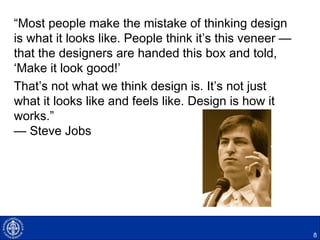
“Most people make the mistake of thinking design
is what it looks like. People think it’s this veneer —
that the designers are handed this box and told,
‘Make it look good!’
That’s not what we think design is. It’s not just
what it looks like and feels like. Design is how it
works.”
— Steve Jobs
8
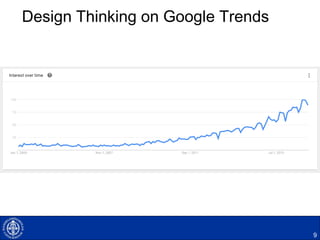
Design Thinking on Google Trends
9
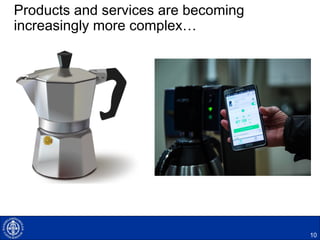
Products and services are becoming
increasingly more complex…
10
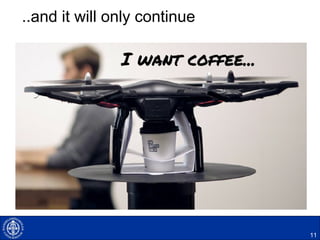
..and it will only continue
11
Picture f
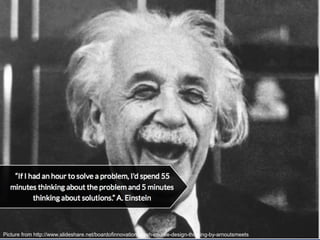
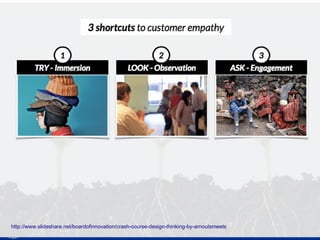
14Picture from http://www.slideshare.net/boardofinnovation/crash-course-design-thinking-by-arnoutsmeets
15
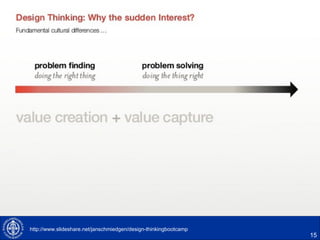
http://www.slideshare.net/janschmiedgen/design-thinkingbootcamp
16
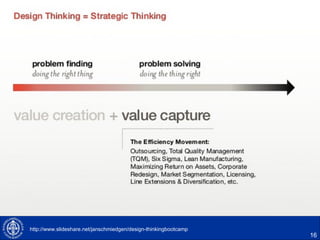
http://www.slideshare.net/janschmiedgen/design-thinkingbootcamp
17
http://www.slideshare.net/janschmiedgen/design-thinkingbootcamp
18
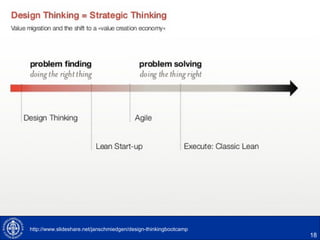
http://www.slideshare.net/janschmiedgen/design-thinkingbootcamp
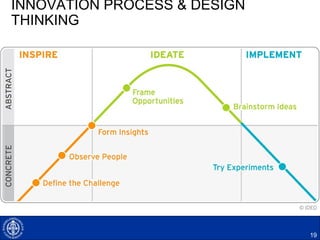
INNOVATION PROCESS & DESIGN
THINKING
19
20
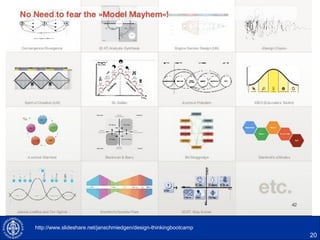
http://www.slideshare.net/janschmiedgen/design-thinkingbootcamp
23
24d.school
25
28
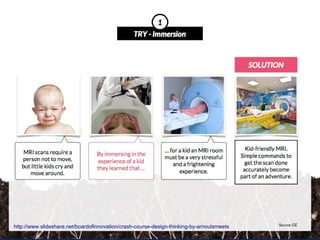
http://www.slideshare.net/boardofinnovation/crash-course-design-thinking-by-arnoutsmeets
29
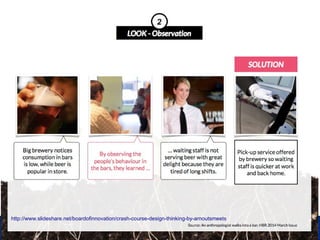
http://www.slideshare.net/boardofinnovation/crash-course-design-thinking-by-arnoutsmeets
 Explore exploit continum
30
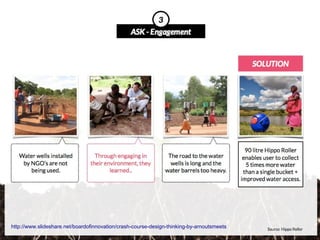
http://www.slideshare.net/boardofinnovation/crash-course-design-thinking-by-arnoutsmeets
 Explore exploit continum
31
http://www.slideshare.net/boardofinnovation/crash-course-design-thinking-by-arnoutsmeets
32
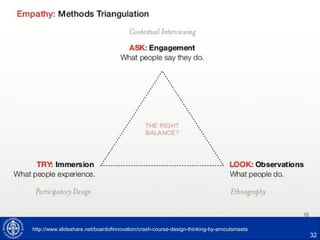
http://www.slideshare.net/boardofinnovation/crash-course-design-thinking-by-arnoutsmeets
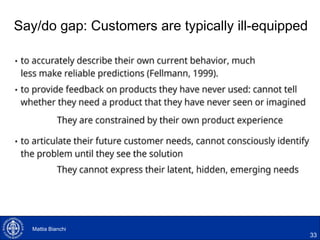
Say/do gap: Customers are typically ill-equipped
33
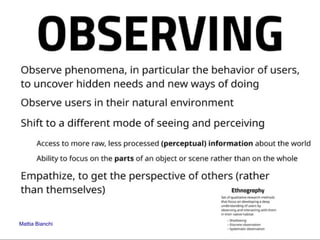
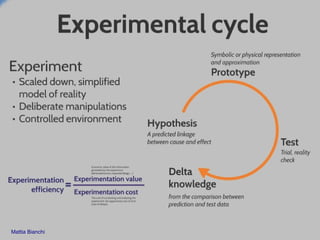
Mattia Bianchi
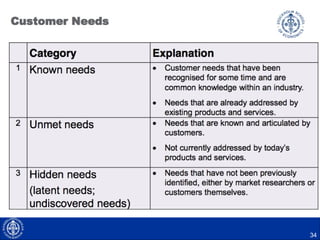
34
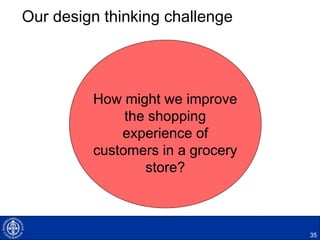
Our design thinking challenge
35
How might we improve
the shopping
experience of
customers in a grocery
store?
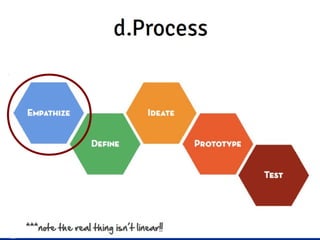
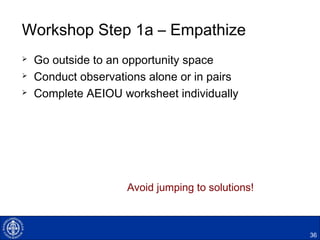
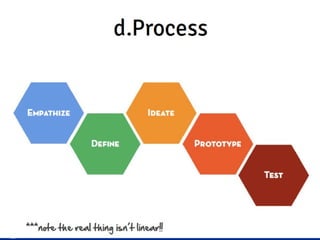
Workshop Step 1a – Empathize
 Go outside to an opportunity space
 Conduct observations alone or in pairs
 Complete AEIOU worksheet individually
36
Avoid jumping to solutions!
37
Mattia Bianchi
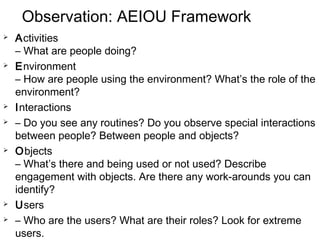
Observation: AEIOU Framework
 Activities
– What are people doing?
 Environment
– How are people using the environment? What’s the role of the
environment?
 Interactions
 – Do you see any routines? Do you observe special interactions
between people? Between people and objects?
 Objects
– What’s there and being used or not used? Describe
engagement with objects. Are there any work-arounds you can
identify?
 Users
 – Who are the users? What are their roles? Look for extreme
users. 38
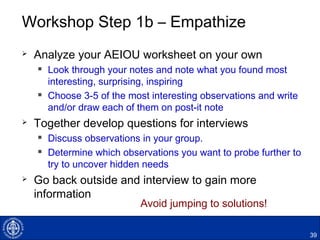
Workshop Step 1b – Empathize
 Analyze your AEIOU worksheet on your own
 Look through your notes and note what you found most
interesting, surprising, inspiring
 Choose 3-5 of the most interesting observations and write
and/or draw each of them on post-it note
 Together develop questions for interviews
 Discuss observations in your group.
 Determine which observations you want to probe further to
try to uncover hidden needs
 Go back outside and interview to gain more
information
39
Avoid jumping to solutions!
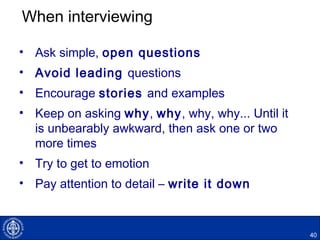
When interviewing
40
• Ask simple, open questions
• Avoid leading questions
• Encourage stories and examples
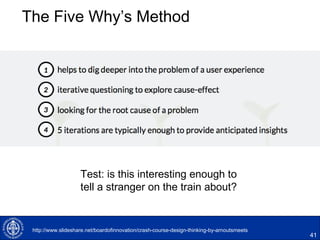
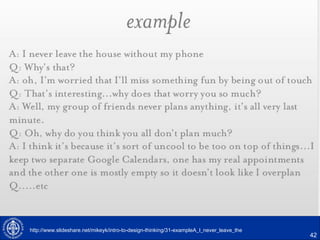
• Keep on asking why, why, why, why... Until it
is unbearably awkward, then ask one or two
more times
• Try to get to emotion
• Pay attention to detail – write it down
The Five Why’s Method
41
Test: is this interesting enough to
tell a stranger on the train about?
http://www.slideshare.net/boardofinnovation/crash-course-design-thinking-by-arnoutsmeets
42
http://www.slideshare.net/mikeyk/intro-to-design-thinking/31-exampleA_I_never_leave_the
43
44
45
http://www.slideshare.net/Pietel/the-role-of-design-thinking?qid=3ac58b35-7039-462b-9b01-7598253a8e57&v=&b=&from_search=1
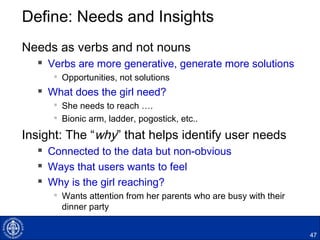
What does this girl need?
46
Define: Needs and Insights
Needs as verbs and not nouns
 Verbs are more generative, generate more solutions

Opportunities, not solutions
 What does the girl need?

She needs to reach ….

Bionic arm, ladder, pogostick, etc..
Insight: The “why” that helps identify user needs
 Connected to the data but non-obvious
 Ways that users wants to feel
 Why is the girl reaching?

Wants attention from her parents who are busy with their
dinner party
47
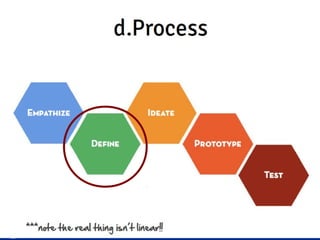
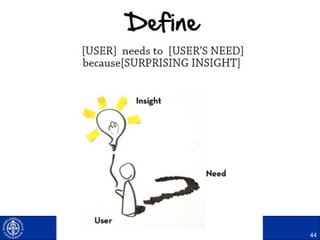
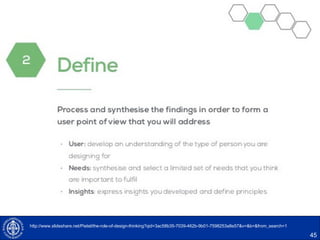
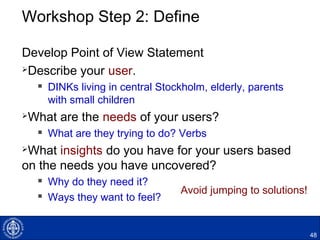
Workshop Step 2: Define
Develop Point of View Statement
Describe your user.
 DINKs living in central Stockholm, elderly, parents
with small children
What are the needs of your users?
 What are they trying to do? Verbs
What insights do you have for your users based
on the needs you have uncovered?
 Why do they need it?
 Ways they want to feel?
48
Avoid jumping to solutions!
49
50
52
53
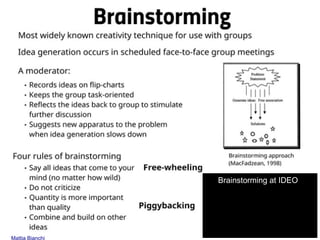
Brainstorming at IDEO
Mattia Bianchi
54Mattia Bianchi
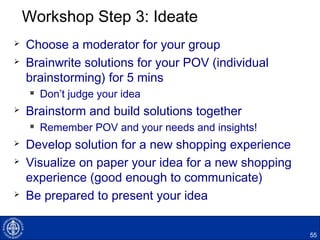
Workshop Step 3: Ideate
 Choose a moderator for your group
 Brainwrite solutions for your POV (individual
brainstorming) for 5 mins
 Don’t judge your idea
 Brainstorm and build solutions together
 Remember POV and your needs and insights!
 Develop solution for a new shopping experience
 Visualize on paper your idea for a new shopping
experience (good enough to communicate)
 Be prepared to present your idea
55
56
58
http://www.slideshare.net/janschmiedgen/design-thinkingbootcamp
59Mattia Bianchi
60Mattia Bianchi
61
Mattia Bianchi
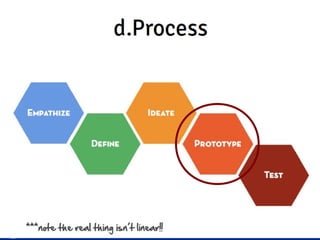
Workshop Step 4: Prototyping
 Build a prototype of your shopping experience
 Feel free to improve on your idea as you work
 Be prepared to present your idea to the group
62
63
Workshop Step 5: Test
 Go outside and test your prototype with
strangers
 Encourage them to talk about how they experience it
and feel
 Listen to what they say
 Complete the Experience Prototyping Exercise
worksheet
 Be prepared to present to the group
65
66
67
 http://www.mckinsey.com/insights/business_tec
hnology/an_interview_with_citrixs_catherine_cou
rage
68

Design Thinking for Exec MBA

Editor's Notes

  • #2 9:00-9:45 Intro & theory 9:45-10:15 WS Empathize observe 10:15-10:20 Interview  10:20-10:50 WS Empathize interview 10:50-11:10 Define Theory 11:10-11:30 WS Define POV 11:30-11:35 ideate Theory 11:35-12:00 WS ideate 13:00-13:15 share feedback & prototype theory 13:15-13:45 WS prototype 13:45-14:15 WS test 14:15-14:45 discussion Even number of groups
  • #3 https://docsend.com/view/p8jxsqr Creative confidence – problems as opportunities, failing to learn, How many of you think you are creative? 45 seconds to draw your neighbor How did it feel? Told that we could not draw when younger – so think not creative But creativity is not about ability to draw or make something artistic, but creative in process Ability to take on challenge uncertainty More important than ability to draw
  • #4 https://www.youtube.com/watch?v=fGaVFRzTTP4
  • #5 http://thisisdesignthinking.net/2014/12/changing-experiences-through-empathy-ge-healthcares-adventure-series/
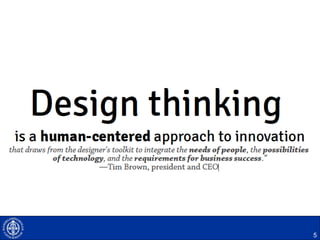
  • #6 “Design thinking can be described as a discipline that uses the designer’s sensibility and methods to match people’s needs with what is technologically feasible and what a viable business strategy can convert into customer value and market opportunity.”– Tim Brown CEO, IDEO 2. Waag design challenge - design a new shopping cart. a. 30 minutes to do target group, problem, idea in 7 groups paper and markers, and can go outside and ask people, or use internet have 3 mins to present your idea to group and then have a feedback group who gives input on what you like and how can you make it better (move clockwise) b. 30 mins to build prototype of the idea of the group that you gave feedback to. Can improve the idea when build, present to group, and tell group especially next team who will test it what you want to know about the product c. 30 mins to go outside and ask people what they think of idea/prototype of other group d. report to group feedback on idea – what did you learn, what was good, what was bad, did you get any insights? e. feedback on session – what like, surprised you, what was it like to share your idea to another group? Ethical/CSR/health/privacy issues?
  • #12 https://www.linkedin.com/pulse/i-want-coffee-challenge-internet-things-pete-chapman
  • #22 eanne M. Liedtka, Professor of Business Administration, and Timothy Ogilvie, CEO of Peer Insight.
  • #39 Quirky workarounds Behaviors that people do over and over again throughout the day Dynamics & interactions between people
  • #47 Human physical and emotional necessities Opportunities and not solutions Needs = verbs Girl’s parents having dinner party.. She needs her parents to pay attention to her. Do on your own – What trying to do – needs – verbs In ways that they want to feel - insights
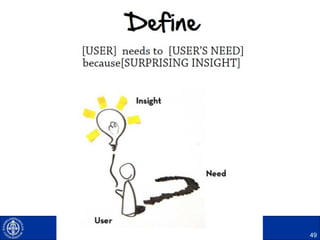
  • #49 Who is your user What do they need What is the insight?
  • #54 Do not select
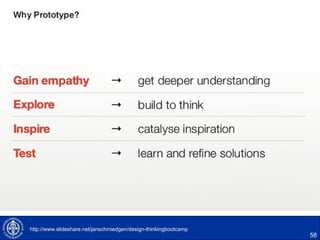
  • #57 We prototype to learn rather than to “test” a theoretically finished offering. We want the process to be simple and fast so that we can “
  • #58 We prototype to learn rather than to “test” a theoretically finished offering. We want the process to be simple and fast so that we can “