Crash Course in Design Thinking

Cathleen Galas
Universidad Nacional de Quilmes
Buenos Aires, Argentina
November 8 ,2013
Design
is Inquiry
Pay attention to the
source of innovation that
is
YOU
• Enable you to work more
human
• More iterative
• More innovative
• FAST PACED
• It’s going to feel
like I’m not
giving you
QUITE ENOUGH
time to do what
I’m asking you
to do
TRY to…
• Trust me
• Lean into the
process

• Have a bit of fun
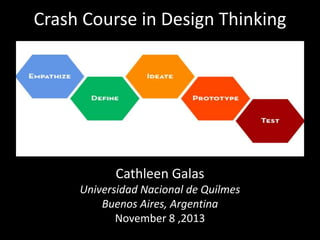
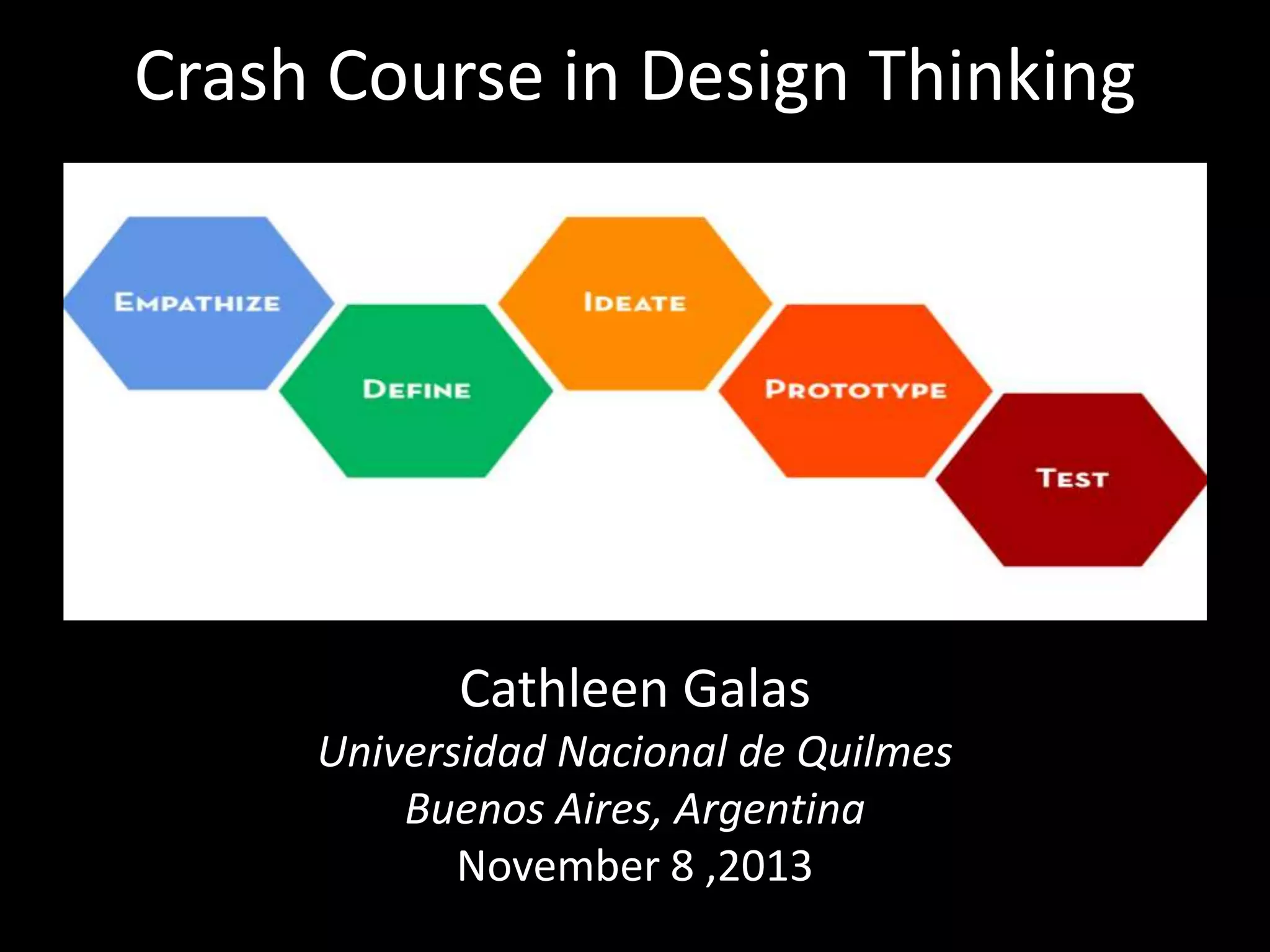
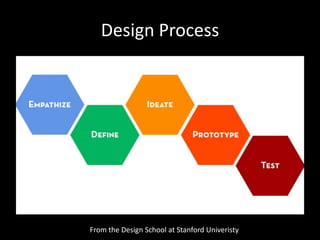
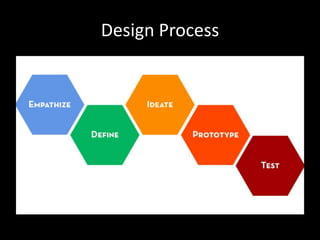
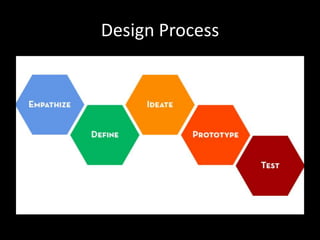
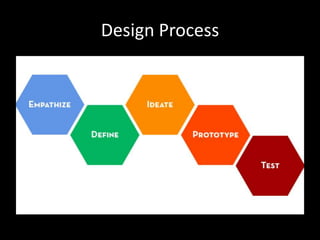
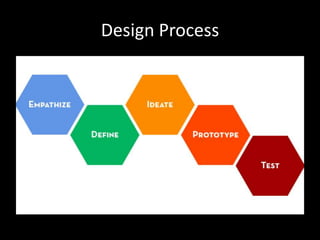
Design Process

From the Design School at Stanford Univeristy
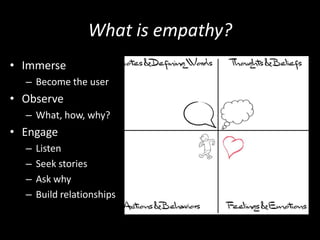
What is empathy?
• Immerse
– Become the user

• Observe
– What, how, why?

• Engage
–
–
–
–

Listen
Seek stories
Ask why
Build relationships
Design Process
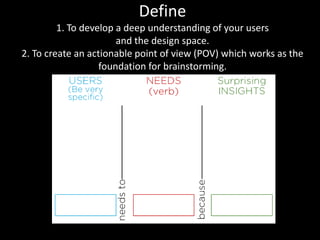
Define
1. To develop a deep understanding of your users
and the design space.
2. To create an actionable point of view (POV) which works as the
foundation for brainstorming.
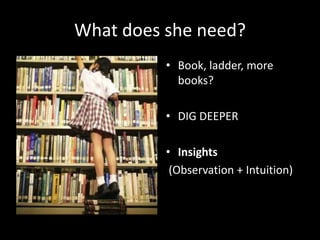
What does she need?
• Book, ladder, more
books?
• DIG DEEPER
• Insights
(Observation + Intuition)
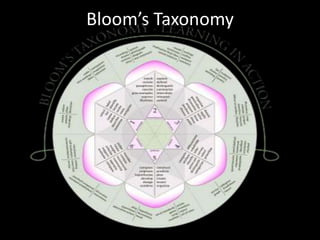
Bloom’s Taxonomy
Ideate
Brainstorming
One conversation at a time
Go for quantity
Headline!
Build on other’s ideas
Encourage wild ideas
Be visual
Stay on topic
Defer judgement: NO BLOCKING!
http://dschool.stanford.edu/wp-content/themes/dschool/methodcards/brainstorm-rules.pdf
Design Process
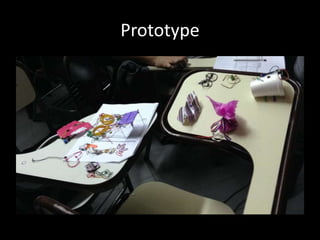
Prototype
Design Process
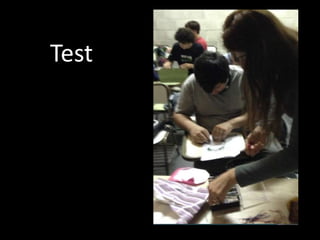
Test
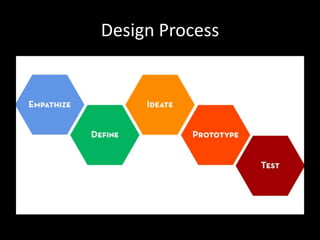
Design Process
Redesign the
gift giving
experience
for your
partner
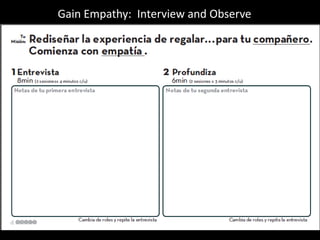
Gain Empathy: Interview and Observe
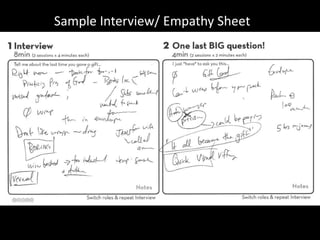
Sample Interview/ Empathy Sheet
Empathy Interviews
• A interviews B
• 4 minutes

• B interviews A
• 4 minutes
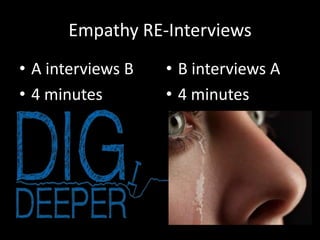
Empathy RE-Interviews
• A interviews B
• 4 minutes

• B interviews A
• 4 minutes
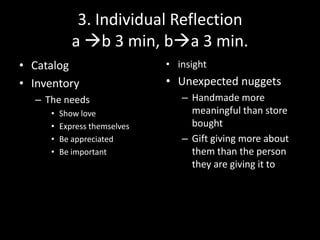
3. Individual Reflection
a b 3 min, ba 3 min.
• Catalog
• Inventory
– The needs
•
•
•
•

Show love
Express themselves
Be appreciated
Be important

• insight

• Unexpected nuggets
– Handmade more
meaningful than store
bought
– Gift giving more about
them than the person
they are giving it to
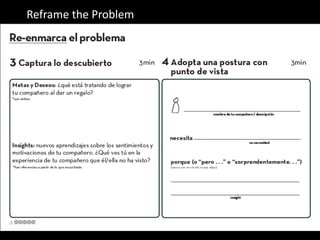
Reframe the Problem
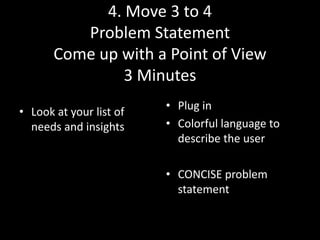
4. Move 3 to 4
Problem Statement
Come up with a Point of View
3 Minutes
• Look at your list of
needs and insights

• Plug in
• Colorful language to
describe the user

• CONCISE problem
statement
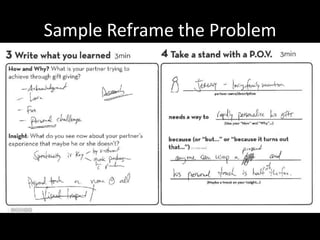
Sample Reframe the Problem
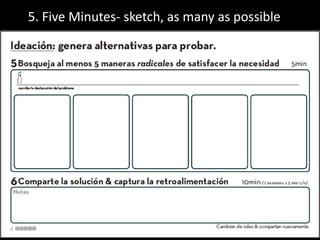
5. Five Minutes- sketch, as many as possible
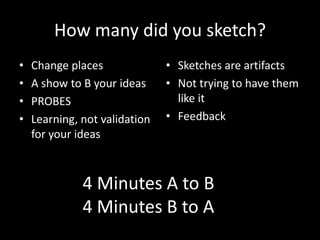
How many did you sketch?
•
•
•
•

Change places
A show to B your ideas
PROBES
Learning, not validation
for your ideas

• Sketches are artifacts
• Not trying to have them
like it
• Feedback

4 Minutes A to B
4 Minutes B to A
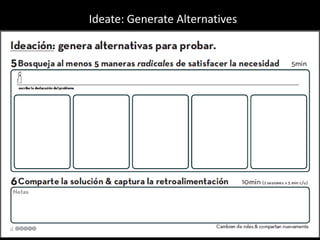
Ideate: Generate Alternatives
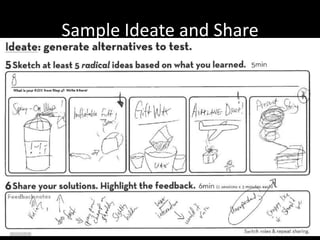
Sample Ideate and Share
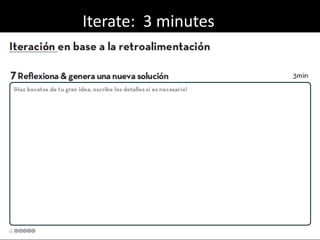
Iterate: 3 minutes
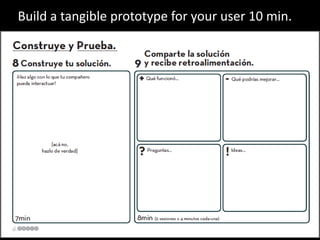
Build a tangible prototype for your user 10 min.
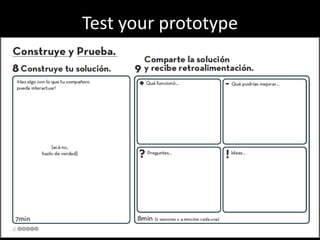
Test your prototype
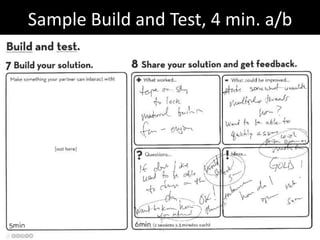
Sample Build and Test, 4 min. a/b
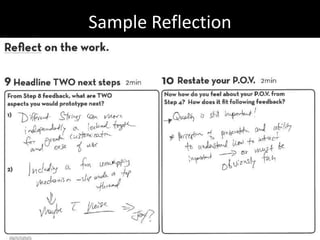
Reflect
• 1. What are two ideas you would prototype
next?
• 2. How do you feel about your point of view
from step 4? Look back at your POV. Does it
still fit following the feedback you got from
your partner?
Sample Reflection
Reflection & Takeaways
All prototypes in center of room
Even in an hour …….
Quick exposure to
DESIGN THINKING
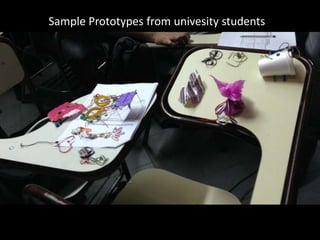
Sample Prototypes from univesity students
Design Process/Innovation
• Focusing on your user
• The goal is to focus on yourself and your
ability to innovate
• Different than the way you usually work?
• Innovation requires a different way of working
Work Design Team Style
•
•
•
•
•

Be human-centered
Prototyping in everything you do
Get ideas OUT OF YOUR HEAD!
Test what works and what doesn’t
Be more collaborative—have more diverse
teams
• Have a bias toward ACTION! Get up and try
things out!!
Discussion
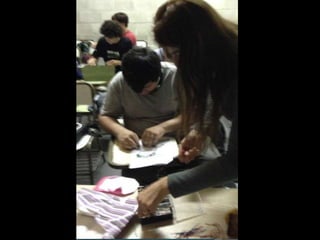
• How did engaging with a real
person and testing a prototype
with a real person change the
direction your prototype took?
Discussion 2
• What was it like showing
unfinished work to another
human being? This may be
unfamiliar to a lot of us. What
was it like?
Discussion 3
• How did the pace feel? These were
quick, iterative cycles. How did that
feel relative to how you normally
work?
Design Thinking
• Iterative
• Self-directed
• Directed by your ideas about what you should
explore more
• Based on what you learn, it informs what you
should do next
Partner Problem
•
•
•
•
•
•

Think
What would you do with your partner now?
Gain more empathy?
Redefine problem?
Ideate more solutions?
Craft a new prototype?

• If you could take one principle, what would
you infuse into your work tomorrow?
Design Process
Congrats on completing experience!
• Put what you’ve learned to work as soon as
possible
• Have a heart for this creative way of
working, teach others
• Forever consider yourself a student of
INNOVATION and continue to invest in
yourself
Thanks to the D. School,
Stanford University,
Palo Alto, California
for the Gift Giving Project.
This is a 90 minute project that goes through
the full design cycle.

https://dschool.stanford.edu/groups/designresources/wiki/ed894/

University quilmes, design process, nov 13 final

Editor's Notes

  • #2 One hour—design challengeShow up as a studentTake eye off other challengesPay attention to source of innovation that is you
  • #11 1. Users: Try to segment your empathy into as many specific users as possible. One specific story could result in many different types of users dependent on how you view them. For example in the challenge we found empathy for at the D.Thinking Hawaii Boot camp, it focused on visitors to Hawai’i. The user wouldn’t just be “A tourist to Hawai’i” but more specifically could be: A strong family oriented grandfather, A seasoned world traveler, A reminiscing  couple traveling back to Hawai’i, etc.  Write down users in the designated column.2. Needs: One thing to note is that you should try to stay away from highlighting nouns in this section. The reason being is that typically if a need is a noun, it suggests a preloaded solution. Needs need to be connected with some deeper emotion which can inspire a brand new solution.
  • #12 hy she is reaching for those books in the first place. Maybe her need is “acknowledgement from her student peers that she is a hard worker”, maybe her need is “a strong voice in this world driven by knowledge and education” or maybe its even “more social time with her father through reading books together”. You can feel how much more powerful that inspires you as a designer. Pull these types of needs out of your empathy.
  • #13 educators set for students (learning objectives). Bloom's taxonomy divides educational objectives into three "domains": Cognitive, Affective, and Psychomotor (sometimes loosely described as knowing/head, feeling/heart and doing/hands respectively). Within the domains, learning at the higher levels is dependent on having attained prerequisite knowledge and skills at lower levels.[7] A goal of Bloom's taxonomy is to motivate educators to focus on all three domains, creating a more holistic form of education.Focus on all three in software design
  • #24 PROBE ON THE AREASSEEk motives—emotions-get your partner to cryKey thing about design—not using excel to analyze—need the emotion—whats up with your mom—Getting to the motivations
  • #25 Get to the emotion
  • #26 CIRCLE VERBSCIRCLe emotions
  • #27 3 minutes
  • #30 Don’t use numbers or lettersDRAW sketches– new directions– going for QUANTITTYNot QUALITYOut of the box--if you can break record of 37 in 5 minutes
  • #31 Poll-quantity– 3, raise hands, 4 raise hands, 5, 6,7, 8, 9,,10, 11Everybody stand up and switch seats with partners
  • #32 Don’t use numbers or letters
  • #34 Incorporate what you’ve learned about your userSome ideas tanked, some were cool—pull into one single solution sketch
  • #41 Feel like you weren’t done
  • #49 Think for a moment about what you would do if you had it to do over again.