Three iterations of an  innovation “funnel” March 31, 2011 © 2011 NetCentrics.  All Rights Reserved.
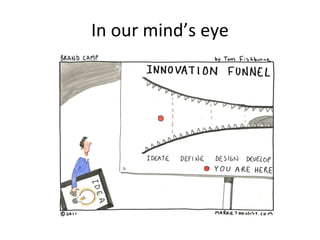
In our mind’s eye
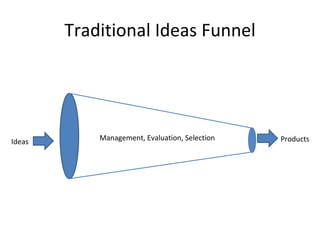
Traditional “funnels” Traditionally, we’ve thought about innovation as a funnel of ideas In its first iteration, the funnel concerned how we managed ideas internally.  The concept of the funnel was analogous to a “sales funnel” – lots of ideas enter the funnel, a few exit as new products, the rest are weeded out.
Traditional Ideas Funnel Ideas Management, Evaluation, Selection Products
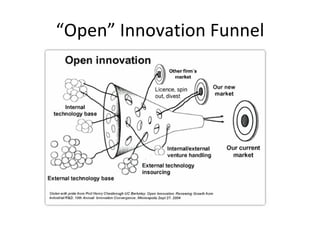
“ Open” Innovation Henry Chesbrough and others modified the funnel with “open” concepts “ Open” innovation changed the funnel, introducing the concept that the corporate boundary was “porous”. Ideas can enter from external sources and can leave directed to external recipients.
“ Open” Innovation Funnel
Third Evolution of the “funnel” Over time our thinking is shifting – what’s really important is filling the funnel with the best concepts to solve customer or consumer problems. Those “concepts” aren’t always ideas, and they aren’t always ours
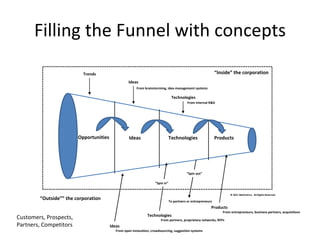
Filling the Funnel with concepts Opportunities Ideas Technologies Products “ Inside” the corporation Trends Ideas Technologies From internal R&D From brainstorming, idea management systems Ideas Technologies Products From open innovation, crowdsourcing, suggestion systems From partners, proprietary networks, RFPs From entrepreneurs, business partners, acquisitions “ Outside”” the corporation To partners or entrepreneurs “ Spin out” “ Spin in” Customers, Prospects, Partners, Competitors © 2011 NetCentrics.  All Rights Reserved.
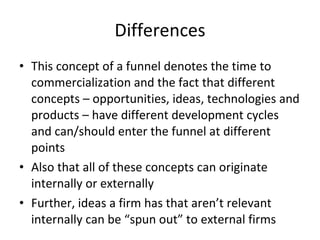
Differences This concept of a funnel denotes the time to commercialization and the fact that different concepts – opportunities, ideas, technologies and products – have different development cycles and can/should enter the funnel at different points Also that all of these concepts can originate internally or externally Further, ideas a firm has that aren’t relevant internally can be “spun out” to external firms
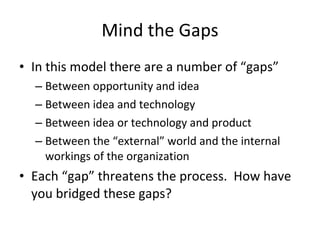
Mind the Gaps In this model there are a number of “gaps” Between opportunity and idea Between idea and technology Between idea or technology and product Between the “external” world and the internal workings of the organization Each “gap” threatens the process.  How have you bridged these gaps?
Key Takeaway The key point isn’t to fill the funnel with ideas, but to recognize the innovation funnel as a continuum which can effectively manage: Opportunities and turn them into ideas Ideas and turn them into technologies/products Technologies and turn them into products Products, which can be commercialized All of these concepts should be part of an innovation “funnel”, planned and managed effectively “end to end” with all gaps carefully considered.

Innovation funnel version 3.0

  • 1.
    Three iterations ofan innovation “funnel” March 31, 2011 © 2011 NetCentrics. All Rights Reserved.
  • 2.
  • 3.
    Traditional “funnels” Traditionally,we’ve thought about innovation as a funnel of ideas In its first iteration, the funnel concerned how we managed ideas internally. The concept of the funnel was analogous to a “sales funnel” – lots of ideas enter the funnel, a few exit as new products, the rest are weeded out.
  • 4.
    Traditional Ideas FunnelIdeas Management, Evaluation, Selection Products
  • 5.
    “ Open” InnovationHenry Chesbrough and others modified the funnel with “open” concepts “ Open” innovation changed the funnel, introducing the concept that the corporate boundary was “porous”. Ideas can enter from external sources and can leave directed to external recipients.
  • 6.
  • 7.
    Third Evolution ofthe “funnel” Over time our thinking is shifting – what’s really important is filling the funnel with the best concepts to solve customer or consumer problems. Those “concepts” aren’t always ideas, and they aren’t always ours
  • 8.
    Filling the Funnelwith concepts Opportunities Ideas Technologies Products “ Inside” the corporation Trends Ideas Technologies From internal R&D From brainstorming, idea management systems Ideas Technologies Products From open innovation, crowdsourcing, suggestion systems From partners, proprietary networks, RFPs From entrepreneurs, business partners, acquisitions “ Outside”” the corporation To partners or entrepreneurs “ Spin out” “ Spin in” Customers, Prospects, Partners, Competitors © 2011 NetCentrics. All Rights Reserved.
  • 9.
    Differences This conceptof a funnel denotes the time to commercialization and the fact that different concepts – opportunities, ideas, technologies and products – have different development cycles and can/should enter the funnel at different points Also that all of these concepts can originate internally or externally Further, ideas a firm has that aren’t relevant internally can be “spun out” to external firms
  • 10.
    Mind the GapsIn this model there are a number of “gaps” Between opportunity and idea Between idea and technology Between idea or technology and product Between the “external” world and the internal workings of the organization Each “gap” threatens the process. How have you bridged these gaps?
  • 11.
    Key Takeaway Thekey point isn’t to fill the funnel with ideas, but to recognize the innovation funnel as a continuum which can effectively manage: Opportunities and turn them into ideas Ideas and turn them into technologies/products Technologies and turn them into products Products, which can be commercialized All of these concepts should be part of an innovation “funnel”, planned and managed effectively “end to end” with all gaps carefully considered.

Editor's Notes

  • #3 We all know the metaphor of an innovation funnel. Tom Fishburne’s cartoon reminds us that funnels often resemble places where ideas are eaten, consumed and disappear, Rather than places where ideas are nurtured and prepared for market. In this presentation I want to suggest that we expand our thinking about innovation funnels, considering them as more than simply places where ideas are matured, and start thinking about innovation funnels as bridges between opportunities and solutions. Innovation funnels can be much more robust, and much more powerful, than what we give them credit for. Let’s look at the evolution of the innovation funnel and see where the innovation funnel is going as a business process.
  • #4 Innovators adopted the idea of an innovation funnel from the concept of a sales funnel. Sales managers use sales funnels to understand the progression a prospect makes from first contact, through qualification and hopefully a closed sale. Typically, many prospects enter the funnel but few sales are completed as the sales funnel “qualifies” the prospects to ensure they have the decision making capability and funds, and the firm has products and services that meet their needs. Similarly, an innovation funnel collects many ideas and vets them to ensure that the ideas can achieve a specific need or goal and can be converted into a new product or service. This is the vetting process that an innovation funnel provides.
  • #5 In the first iteration of the funnel, most organizations thought of the funnel as existing totally within the bounds of the organization, so all ideas were generated internally and the funnel represented the aggregate ideas of the organization. No external ideas entered and the funnel was merely a method to validate and vet internal ideas.
  • #6 Chesbrough changed this concept with his book Open Innovation. His ideas suggested that there were far more ideas, far more possibilities in the “rest of the world” and firms should accept ideas from external partners as well as develop ideas internally. This concept changed the thinking of the funnel – to include ideas originating outside the organization and ideas “spinning out” to other organizations.
  • #8 We at OVO believe the funnel is still too narrowly defined. Often we’ll hear our clients talking about filling the funnel with ideas, whether those ideas are developed internally or externally. This definition of the funnel as an idea management device is too narrow. The funnel is meant to bridge the gap between opportunities and customer solutions – therefore, the funnel should represent opportunities, ideas, technologies and even products that can be developed internally or introduced by external partners. Ideas, after all, are just the kernal for technologies or products, so extending the funnel to include technologies and products seems only natural.
  • #9 This funnel reflects the work that innovation should do – solve a customer’s problem or need by identifying the opportunity and developing or attracting ideas, technologies and products that may address the need or opportunity. Note that we’ve included both “spin in” concepts for ideas, technologies and products, allowing partners and third parties to submit these solutions, as well as “spin out” which allows a firm to spin out ideas or technologies to partners who can commercialize them more effectively. If we define innovation as the ability to identify customer unmet needs or emerging opportunities or threats, then more than ideas belong in the funnel. A funnel should incorporate ideas, technologies and even products that the firm or its partner creates that will satisfy the need or address the opportunity.
  • #10 This iteration or evolution of the innovation funnel fully embraces the “open” concepts of Chesbrough and extends the concept of what’s in the funnel much further – including technologies and even products. Whether the firm develops new products from ideas or technologies or “spins in” a product from a smaller partner or entrepreneur, all of these approaches should be part of the innovation funnel if our definition for innovation holds.
  • #11 Note as well there are a number of gaps in any innovation funnel. Each transition stage is a potential gap. Can an opportunity help define and scope ideas? Can good ideas suggest new technologies or products? Can good ideas and technologies leap the product development gap to become new products and services? The innovation funnel in the abstract often hides or simplifies these gaps, which in the real world are one of the primary barriers for innovation. The workd within any of these phases (opportunity/idea/technology/product) is relatively well understood; the gaps are poorly defined and often ad-hoc.