Filling Coastal Data Gaps –
Let’s Do It Ourselves!
Innovation Cycle #7
Robin Teigland, Chalmers Univ of Technology
robin.teigland@chalmers.se
March 9, 2023
http://www.oceandatafactory.se/
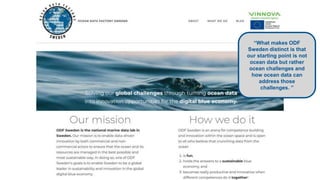
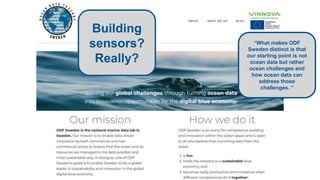
“What makes ODF
Sweden distinct is that
our starting point is not
ocean data but rather
ocean challenges and
how ocean data can
address those
challenges. ”
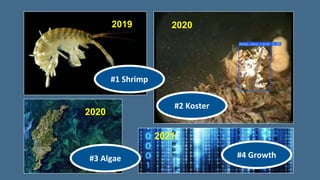
#1 Shrimp
#2 Koster
#3 Algae #4 Growth
2019 2020
2020
2021
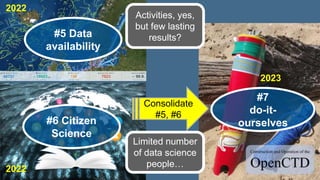
#5 Data
availability
#6 Citizen
Science
#7
do-it-
ourselves
Consolidate
#5, #6
2022
2022
2023
Activities, yes,
but few lasting
results?
Limited number
of data science
people…
“What makes ODF
Sweden distinct is that
our starting point is not
ocean data but rather
ocean challenges and
how ocean data can
address those
challenges. ”
Building
sensors?
Really?
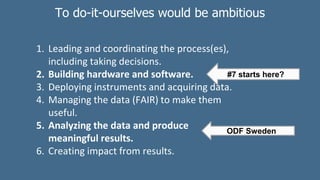
1. Leading and coordinating the process(es),
including taking decisions.
2. Building hardware and software.
3. Deploying instruments and acquiring data.
4. Managing the data (FAIR) to make them
useful.
5. Analyzing the data and produce
meaningful results.
6. Creating impact from results.
ODF Sweden
#7 starts here?
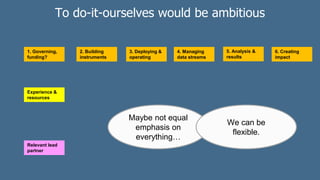
To do-it-ourselves would be ambitious
Maybe not equal
emphasis on
everything…
2. Building
instruments
4. Managing
data streams
3. Deploying &
operating
5. Analysis &
results
1. Governing,
funding?
6. Creating
impact
Experience &
resources
Relevant lead
partner
We can be
flexible.
To do-it-ourselves would be ambitious
Leading in a Digital World
Course TEK765 - Spring 2023
Professor Robin Teigland
PhD Candidate Ida Heathcote-Fumador
Entrepreneurship & Strategy Division
“Coastal Data Gap Do-it-ourselves”
Digital Innovation Challenge
Mar – Jun 2023
+
Chalmers BSc/MSc
in Industrial
Economics
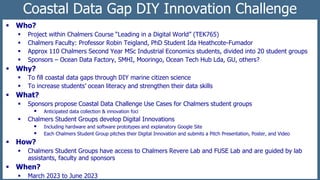
Coastal Data Gap DIY Innovation Challenge
 Who?
 Project within Chalmers Course “Leading in a Digital World” (TEK765)
 Chalmers Faculty: Professor Robin Teigland, PhD Student Ida Heathcote-Fumador
 Approx 110 Chalmers Second Year MSc Industrial Economics students, divided into 20 student groups
 Sponsors – Ocean Data Factory, SMHI, Mooringo, Ocean Tech Hub Lda, GU, others?
 Why?
 To fill coastal data gaps through DIY marine citizen science
 To increase students’ ocean literacy and strengthen their data skills
 What?
 Sponsors propose Coastal Data Challenge Use Cases for Chalmers student groups
 Anticipated data collection & innovation foci
 Chalmers Student Groups develop Digital Innovations
 Including hardware and software prototypes and explanatory Google Site
 Each Chalmers Student Group pitches their Digital Innovation and submits a Pitch Presentation, Poster, and Video
 How?
 Chalmers Student Groups have access to Chalmers Revere Lab and FUSE Lab and are guided by lab
assistants, faculty and sponsors
 When?
 March 2023 to June 2023
Digital Innovation Challenges during previous years
2019 Lysekil Municipality
2020 City of Gothenburg
202 Akademiska Hus
2022 IKEA
2023 IKEA
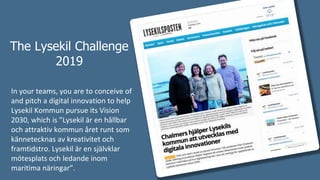
The Lysekil Challenge
2019
In your teams, you are to conceive of
and pitch a digital innovation to help
Lysekil Kommun pursue its Vision
2030, which is ”Lysekil är en hållbar
och attraktiv kommun året runt som
kännetecknas av kreativitet och
framtidstro. Lysekil är en självklar
mötesplats och ledande inom
maritima näringar”.
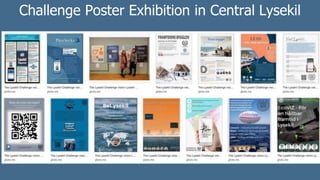
Challenge Poster Exhibition in Central Lysekil
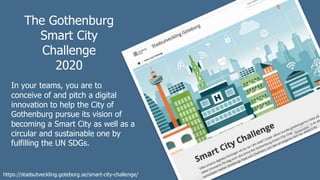
The Gothenburg
Smart City
Challenge
2020
In your teams, you are to
conceive of and pitch a digital
innovation to help the City of
Gothenburg pursue its vision of
becoming a Smart City as well as a
circular and sustainable one by
fulfilling the UN SDGs.
https://stadsutveckling.goteborg.se/smart-city-challenge/
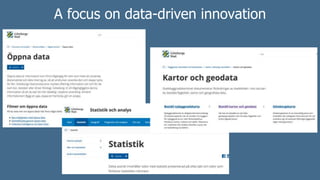
A focus on data-driven innovation
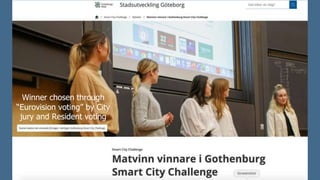
Winner chosen through
“Eurovision voting” by City
jury and Resident voting
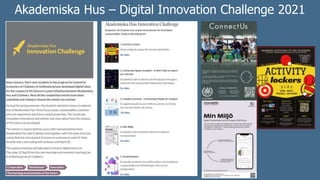
Akademiska Hus – Digital Innovation Challenge 2021
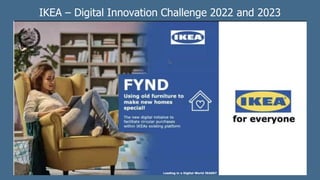
IKEA – Digital Innovation Challenge 2022 and 2023
“Coastal Data Gaps Do-it-ourselves”
Digital Innovation Challenge
Mar – Jun 2023
+
Chalmers BSc/MSc
in Industrial
Economics
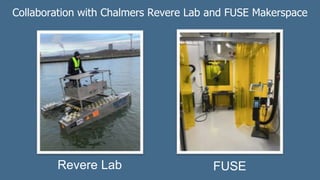
Collaboration with Chalmers Revere Lab and FUSE Makerspace
Revere Lab FUSE
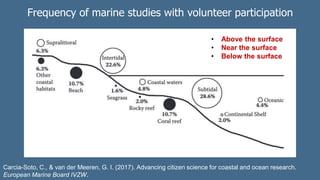
Frequency of marine studies with volunteer participation
Carcia-Soto, C., & van der Meeren, G. I. (2017). Advancing citizen science for coastal and ocean research.
European Marine Board IVZW.
• Above the surface
• Near the surface
• Below the surface
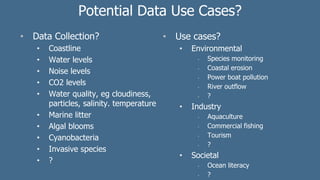
Potential Data Use Cases?
• Data Collection?
• Coastline
• Water levels
• Noise levels
• CO2 levels
• Water quality, eg cloudiness,
particles, salinity. temperature
• Marine litter
• Algal blooms
• Cyanobacteria
• Invasive species
• ?
• Use cases?
• Environmental
• Species monitoring
• Coastal erosion
• Power boat pollution
• River outflow
• ?
• Industry
• Aquaculture
• Commercial fishing
• Tourism
• ?
• Societal
• Ocean literacy
• ?
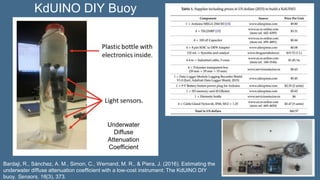
KdUINO DIY Buoy
Underwater
Diffuse
Attenuation
Coefficient
Bardaji, R., Sánchez, A. M., Simon, C., Wernand, M. R., & Piera, J. (2016). Estimating the
underwater diffuse attenuation coefficient with a low-cost instrument: The KdUINO DIY
buoy. Sensors, 16(3), 373.
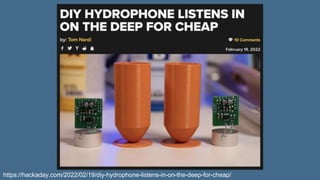
https://hackaday.com/2022/02/19/diy-hydrophone-listens-in-on-the-deep-for-cheap/
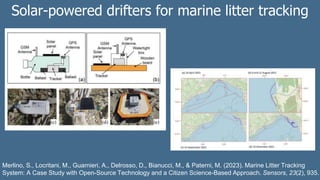
Merlino, S., Locritani, M., Guarnieri, A., Delrosso, D., Bianucci, M., & Paterni, M. (2023). Marine Litter Tracking
System: A Case Study with Open-Source Technology and a Citizen Science-Based Approach. Sensors, 23(2), 935.
Solar-powered drifters for marine litter tracking
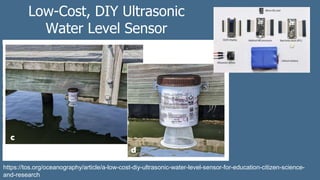
Low-Cost, DIY Ultrasonic
Water Level Sensor
https://tos.org/oceanography/article/a-low-cost-diy-ultrasonic-water-level-sensor-for-education-citizen-science-
and-research
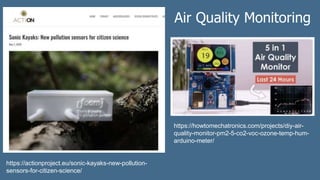
https://actionproject.eu/sonic-kayaks-new-pollution-
sensors-for-citizen-science/
https://howtomechatronics.com/projects/diy-air-
quality-monitor-pm2-5-co2-voc-ozone-temp-hum-
arduino-meter/
Air Quality Monitoring
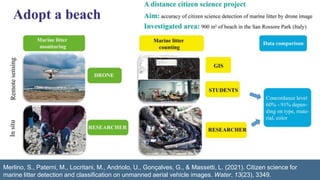
Merlino, S., Paterni, M., Locritani, M., Andriolo, U., Gonçalves, G., & Massetti, L. (2021). Citizen science for
marine litter detection and classification on unmanned aerial vehicle images. Water, 13(23), 3349.
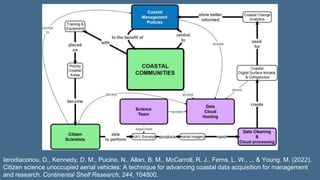
Ierodiaconou, D., Kennedy, D. M., Pucino, N., Allan, B. M., McCarroll, R. J., Ferns, L. W., ... & Young, M. (2022).
Citizen science unoccupied aerial vehicles: A technique for advancing coastal data acquisition for management
and research. Continental Shelf Research, 244, 104800.
“Coastal Data Gap Do-it-ourselves”
Digital Innovation Challenge
Mar – Jun 2023
+
Chalmers BSc/MSc
in Industrial
Economics

Leading in a Digital World_MCS_Overview.pptx

  • 1.
    Filling Coastal DataGaps – Let’s Do It Ourselves! Innovation Cycle #7 Robin Teigland, Chalmers Univ of Technology robin.teigland@chalmers.se March 9, 2023 http://www.oceandatafactory.se/
  • 2.
    “What makes ODF Swedendistinct is that our starting point is not ocean data but rather ocean challenges and how ocean data can address those challenges. ”
  • 3.
    #1 Shrimp #2 Koster #3Algae #4 Growth 2019 2020 2020 2021
  • 4.
    #5 Data availability #6 Citizen Science #7 do-it- ourselves Consolidate #5,#6 2022 2022 2023 Activities, yes, but few lasting results? Limited number of data science people…
  • 5.
    “What makes ODF Swedendistinct is that our starting point is not ocean data but rather ocean challenges and how ocean data can address those challenges. ” Building sensors? Really?
  • 6.
    1. Leading andcoordinating the process(es), including taking decisions. 2. Building hardware and software. 3. Deploying instruments and acquiring data. 4. Managing the data (FAIR) to make them useful. 5. Analyzing the data and produce meaningful results. 6. Creating impact from results. ODF Sweden #7 starts here? To do-it-ourselves would be ambitious
  • 7.
    Maybe not equal emphasison everything… 2. Building instruments 4. Managing data streams 3. Deploying & operating 5. Analysis & results 1. Governing, funding? 6. Creating impact Experience & resources Relevant lead partner We can be flexible. To do-it-ourselves would be ambitious
  • 8.
    Leading in aDigital World Course TEK765 - Spring 2023 Professor Robin Teigland PhD Candidate Ida Heathcote-Fumador Entrepreneurship & Strategy Division
  • 9.
    “Coastal Data GapDo-it-ourselves” Digital Innovation Challenge Mar – Jun 2023 + Chalmers BSc/MSc in Industrial Economics
  • 10.
    Coastal Data GapDIY Innovation Challenge  Who?  Project within Chalmers Course “Leading in a Digital World” (TEK765)  Chalmers Faculty: Professor Robin Teigland, PhD Student Ida Heathcote-Fumador  Approx 110 Chalmers Second Year MSc Industrial Economics students, divided into 20 student groups  Sponsors – Ocean Data Factory, SMHI, Mooringo, Ocean Tech Hub Lda, GU, others?  Why?  To fill coastal data gaps through DIY marine citizen science  To increase students’ ocean literacy and strengthen their data skills  What?  Sponsors propose Coastal Data Challenge Use Cases for Chalmers student groups  Anticipated data collection & innovation foci  Chalmers Student Groups develop Digital Innovations  Including hardware and software prototypes and explanatory Google Site  Each Chalmers Student Group pitches their Digital Innovation and submits a Pitch Presentation, Poster, and Video  How?  Chalmers Student Groups have access to Chalmers Revere Lab and FUSE Lab and are guided by lab assistants, faculty and sponsors  When?  March 2023 to June 2023
  • 11.
    Digital Innovation Challengesduring previous years 2019 Lysekil Municipality 2020 City of Gothenburg 202 Akademiska Hus 2022 IKEA 2023 IKEA
  • 12.
    The Lysekil Challenge 2019 Inyour teams, you are to conceive of and pitch a digital innovation to help Lysekil Kommun pursue its Vision 2030, which is ”Lysekil är en hållbar och attraktiv kommun året runt som kännetecknas av kreativitet och framtidstro. Lysekil är en självklar mötesplats och ledande inom maritima näringar”.
  • 13.
    Challenge Poster Exhibitionin Central Lysekil
  • 14.
    The Gothenburg Smart City Challenge 2020 Inyour teams, you are to conceive of and pitch a digital innovation to help the City of Gothenburg pursue its vision of becoming a Smart City as well as a circular and sustainable one by fulfilling the UN SDGs. https://stadsutveckling.goteborg.se/smart-city-challenge/
  • 15.
    A focus ondata-driven innovation
  • 16.
    Winner chosen through “Eurovisionvoting” by City jury and Resident voting
  • 17.
    Akademiska Hus –Digital Innovation Challenge 2021
  • 18.
    IKEA – DigitalInnovation Challenge 2022 and 2023
  • 19.
    “Coastal Data GapsDo-it-ourselves” Digital Innovation Challenge Mar – Jun 2023 + Chalmers BSc/MSc in Industrial Economics
  • 20.
    Collaboration with ChalmersRevere Lab and FUSE Makerspace Revere Lab FUSE
  • 21.
    Frequency of marinestudies with volunteer participation Carcia-Soto, C., & van der Meeren, G. I. (2017). Advancing citizen science for coastal and ocean research. European Marine Board IVZW. • Above the surface • Near the surface • Below the surface
  • 22.
    Potential Data UseCases? • Data Collection? • Coastline • Water levels • Noise levels • CO2 levels • Water quality, eg cloudiness, particles, salinity. temperature • Marine litter • Algal blooms • Cyanobacteria • Invasive species • ? • Use cases? • Environmental • Species monitoring • Coastal erosion • Power boat pollution • River outflow • ? • Industry • Aquaculture • Commercial fishing • Tourism • ? • Societal • Ocean literacy • ?
  • 23.
    KdUINO DIY Buoy Underwater Diffuse Attenuation Coefficient Bardaji,R., Sánchez, A. M., Simon, C., Wernand, M. R., & Piera, J. (2016). Estimating the underwater diffuse attenuation coefficient with a low-cost instrument: The KdUINO DIY buoy. Sensors, 16(3), 373.
  • 24.
  • 26.
    Merlino, S., Locritani,M., Guarnieri, A., Delrosso, D., Bianucci, M., & Paterni, M. (2023). Marine Litter Tracking System: A Case Study with Open-Source Technology and a Citizen Science-Based Approach. Sensors, 23(2), 935. Solar-powered drifters for marine litter tracking
  • 27.
    Low-Cost, DIY Ultrasonic WaterLevel Sensor https://tos.org/oceanography/article/a-low-cost-diy-ultrasonic-water-level-sensor-for-education-citizen-science- and-research
  • 29.
  • 30.
    Merlino, S., Paterni,M., Locritani, M., Andriolo, U., Gonçalves, G., & Massetti, L. (2021). Citizen science for marine litter detection and classification on unmanned aerial vehicle images. Water, 13(23), 3349.
  • 31.
    Ierodiaconou, D., Kennedy,D. M., Pucino, N., Allan, B. M., McCarroll, R. J., Ferns, L. W., ... & Young, M. (2022). Citizen science unoccupied aerial vehicles: A technique for advancing coastal data acquisition for management and research. Continental Shelf Research, 244, 104800.
  • 32.
    “Coastal Data GapDo-it-ourselves” Digital Innovation Challenge Mar – Jun 2023 + Chalmers BSc/MSc in Industrial Economics