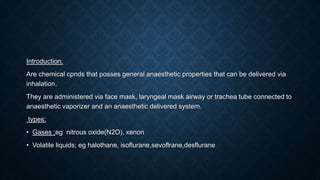
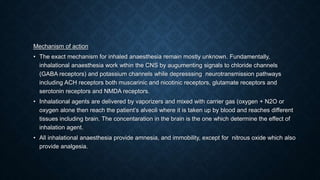
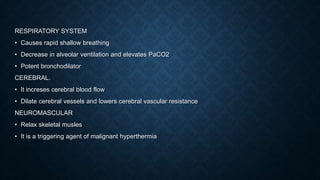
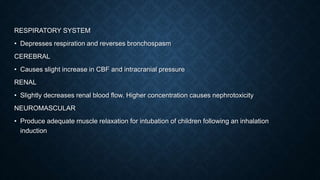
Inhalational agents are chemicals that produce general anesthesia when inhaled. They include nitrous oxide, halothane, isoflurane, desflurane, and sevoflurane. These agents work in the central nervous system by augmenting GABA and potassium channels while depressing other neurotransmitter pathways. They provide amnesia, immobility, and some provide analgesia as well. Each agent has different effects on organ systems like the cardiovascular, respiratory, renal, and hepatic systems. The potency of agents is determined by their minimum alveolar concentration needed to prevent movement in response to stimuli. Characteristics of an ideal agent and properties of individual agents are discussed.














![CASE_PRESENTATION_ON_subdural_hematoma(SDH)[1 FINAL PPT]-1.pptx](https://cdn.slidesharecdn.com/ss_thumbnails/casepresentationonsubduralhematomasdh1finalppt-1-260129172522-d405d375-thumbnail.jpg?width=640&height=640&fit=bounds)