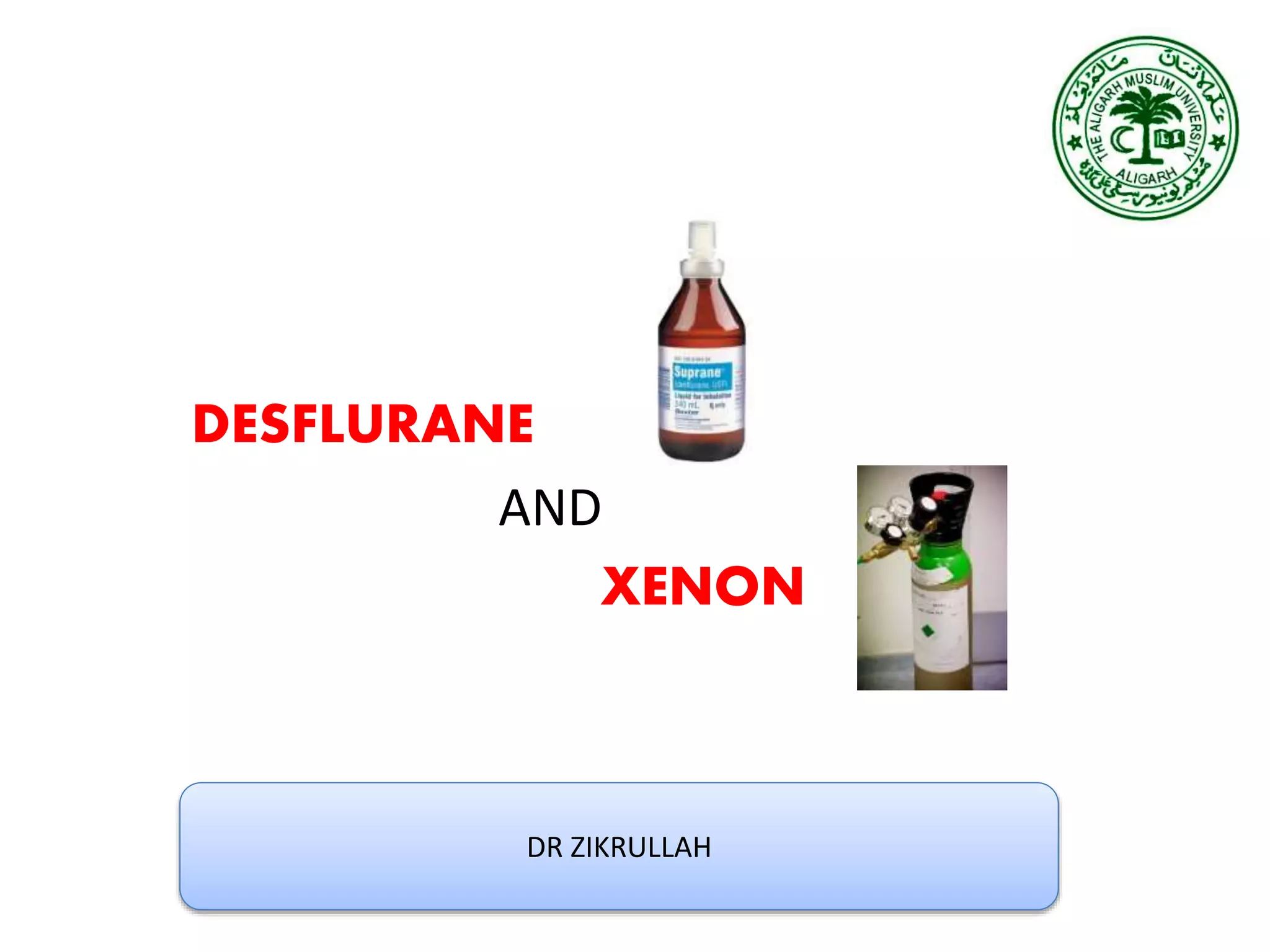
DESFLURANE
AND
XENON
DR ZIKRULLAH
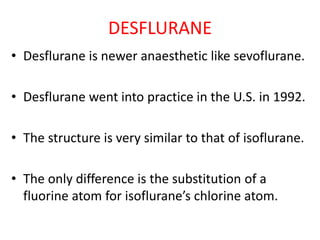
DESFLURANE
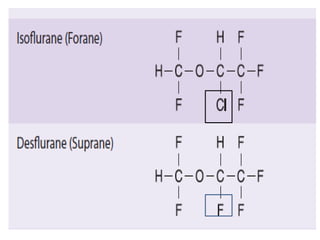
• Desflurane is newer anaesthetic like sevoflurane.
• Desflurane went into practice in the U.S. in 1992.
• The structure is very similar to that of isoflurane.
• The only difference is the substitution of a
fluorine atom for isoflurane’s chlorine atom.
• The low solubility in blood and body tissues causes a
very rapid induction and emergence of anaesthesia.
• Alveolar concentration approaches the inspired
concentration much more rapidly than the other
volatile agents, giving the anaesthesiologist tighter
control over anaesthetic levels.
• Wakeup times are approximately 50% less than those
observed following isoflurane.
• Desflurane is roughly one-fourth as potent as the other
volatile agents, it is 17 times more potent than nitrous
oxide.
PHYSICAL PROPERTIES
• This volatile anesthetic is a nonflammable
fluorinated methyl ethyl ether (difference
di-ethyl ether)
• Molecular weight-168
• Boiling point (° C)-22.8
• Vapor pressure (mmHg)-664
• Oil/gas partition coefficient at 37° C -19
• Blood/gas partition coefficient at 37° C -0.45
• MAC-immobility (% atm /mm Hg) -6.0/45.6
• High vapour pressure, an ultra-short duration
of action, and moderate potency are the most
characteristic features of desflurane.
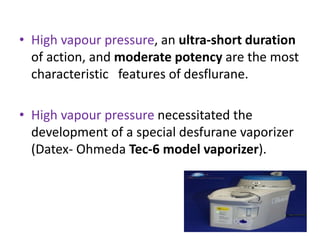
• High vapour pressure necessitated the
development of a special desfurane vaporizer
(Datex- Ohmeda Tec-6 model vaporizer).
Desflurane Vaporizer : Tec 6
• electrically powered, heated, pressurized
• Output concentration: 0% to 18% (separate
safety feature for
concentrations > 12%)
• Fresh gas flow range: 0.2 to 10 L/min
• Accuracy: 0.5% absolute or 15% relative,
whichever is greater (similar to other
Tec-type vaporizers)
Weiskopf RB et al. Br J Anaesth. 1994;72:474-479; Yasuda N
et al. Anesth Analg. 1991;72:316-324; Tec 6 Vaporizer
[product brochure]. Liberty Corner, NJ: Ohmeda
Pharmaceutical Products Division Inc; 1995.
Desflurane Vaporizer
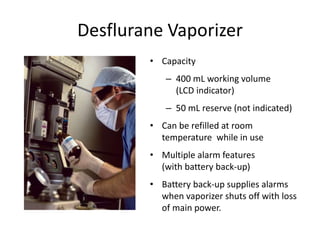
• Capacity
– 400 mL working volume
(LCD indicator)
– 50 mL reserve (not indicated)
• Can be refilled at room
temperature while in use
• Multiple alarm features
(with battery back-up)
• Battery back-up supplies alarms
when vaporizer shuts off with loss
of main power.
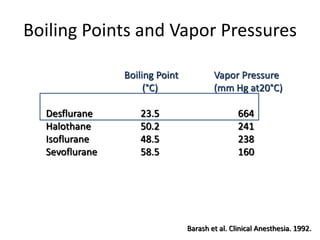
Boiling Points and Vapor Pressures
Boiling Point Vapor Pressure
(°C) (mm Hg at20°C)
Desflurane 23.5 664
Halothane 50.2 241
Isoflurane 48.5 238
Sevoflurane 58.5 160
Barash et al. Clinical Anesthesia. 1992.
Effects on Organ Systems
Effects on CNS
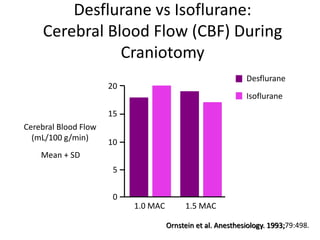
• It directly vasodilates the cerebral vasculature, increasing
CBF, cerebral blood volume, and intracranial pressure at
normo-tension and normocapnia.
• Cerebral oxygen consumption is decreased during
desflurane anesthesia.
• Marked decline in CMRO 2, tends to cause cerebral
vasoconstriction and moderate increase in CBF.
• Thus, during periods of desflurane-induced hypotension
(MAP = 60 mm Hg), CBF is adequate to maintain aerobic
metabolism despite a low CPP.
Desflurane vs Isoflurane:
Cerebral Blood Flow (CBF) During
Craniotomy
Ornstein et al. Anesthesiology. 1993;79:498.
Cerebral Blood Flow
(mL/100 g/min)
Desflurane
Isoflurane
Mean + SD
1.5 MAC1.0 MAC
20
15
10
5
0
Effect on CVS
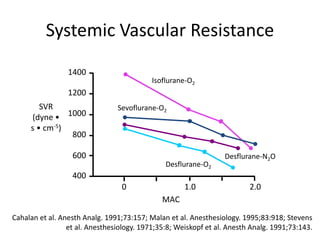
• Increasing the dose is associated with a decline in SVR
that leads to a fall in arterial BP.
• CO remains relatively unchanged or slightly depressed
at 1–2 MAC.
• There is a moderate rise in HR, CVP, and pulmonary
artery pressure BUT not at low doses.
• Rapid ↑ in desflurane concentration lead to transient but
sometimes worrisome elevations in HR, BP, and
catecholamine levels that are more pronounced than
occur with isoflurane, particularly in patients with
cardiovascular disease.
• These cardiovascular responses to rapidly ↑ desflurane
concentration can be attenuated by fentanyl, esmolol, or
clonidine.
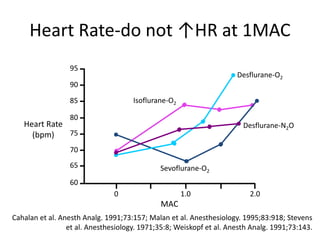
Heart Rate-do not ↑HR at 1MAC
Cahalan et al. Anesth Analg. 1991;73:157; Malan et al. Anesthesiology. 1995;83:918; Stevens
et al. Anesthesiology. 1971;35:8; Weiskopf et al. Anesth Analg. 1991;73:143.
95
85
75
65
60
70
80
90
0 1.0 2.0
Heart Rate
(bpm)
MAC
Isoflurane-O2
Sevoflurane-O2
Desflurane-O2
Desflurane-N2O
Cahalan et al. Anesth Analg. 1991;73:157; Malan et al. Anesthesiology. 1995;83:918; Stevens
et al. Anesthesiology. 1971;35:8; Weiskopf et al. Anesth Analg. 1991;73:143.
Systemic Vascular Resistance
1400
1200
1000
800
600
400
SVR
(dyne •
s • cm-5)
MAC
1.00 2.0
Isoflurane-O2
Sevoflurane-O2
Desflurane-O2
Desflurane-N2O
Effect on RESPIRATORY SYSTEM
• It causes ↓ in tidal volume and an ↑ in
respiratory rate.
• There is an overall decrease in alveolar
ventilation that causes a rise in resting PaCo2.
• Depresses the ventilatory response to increasing
PaCo2.
• Pungency and airway irritation during desflurane
induction can be manifested by salivation,
breath-holding, coughing, and laryngospasm.
• Airway resistance may increase in children with
reactive airway susceptibility.
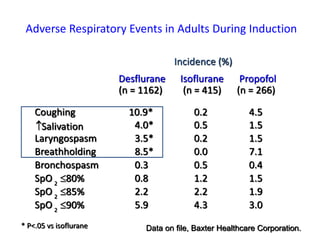
Adverse Respiratory Events in Adults During Induction
Data on file, Baxter Healthcare Corporation.
Desflurane Isoflurane Propofol
(n = 1162) (n = 415) (n = 266)
Coughing 10.9* 0.2 4.5
Salivation 4.0* 0.5 1.5
Laryngospasm 3.5* 0.2 1.5
Breathholding 8.5* 0.0 7.1
Bronchospasm 0.3 0.5 0.4
SpO 2
80% 0.8 1.2 1.5
SpO 2
85% 2.2 2.2 1.9
SpO 2
90% 5.9 4.3 3.0
Incidence (%)
* P<.05 vs isoflurane
Effect on Neuromuscular
• Desflurane is associated with a dose-
dependent ↓ in the response to TOF and
tetanic peripheral nerve stimulation.
• Desflurane potentiates NDMB agents to the
same extent as isoflurane.
Effect on RENAL
• There is no evidence of any significant
nephrotoxic effects caused by exposure to
desflurane.
• As CO declines, decreases in urine output and
glomerular filtration should be expected with
desflurane and all other anesthetics.
Effect on HEPATIC
• Hepatic function tests are generally
unaffected by desfurane, assuming that organ
perfusion is maintained perioperatively.
• It undergoes minimal metabolism, therefore
the risk of anesthetic- induced hepatitis is
minimal.
Biotransformation & Toxicity
• Desflurane undergoes minimal metabolism in
humans.
• Serum and urine inorganic fluoride levels
following desflurane anesthesia are essentially
unchanged from preanesthetic levels.
• There is insignificant percutaneous loss.
• Desflurane, more than other volatile anesthetics, is
degraded by desiccated CO2 absorbent (particularly
barium hydroxide lime, but also sodium and potassium
hydroxide) into potentially clinically significant levels
of Carbon mono oxide (CO).
• The factors that determine the amount of CO produced
include : the chemical makeup of CO2 adsorbent
(KOH > NaOH >> Ba(OH)2, Ca(OH)2), dryness of the
adsorbent material, the concentration of volatile
agent, and its chemical structure.
• Desflurane > enflurane > isoflurane
Contraindications
• Desflurane shares many of the
contraindications of other modern volatile
anesthetics:
 severe hypovolemia
 malignant hyperthermia
 intracranial hypertension.
Clinically Relevant Properties
• More rapid control of the anesthetic state, especially
at low flows
• More rapid return of cognitive function
• Better quality of recovery
• Less critical to anticipate end of surgery
• More rapid awakening .Only drug FAST-IN, FAST–OUT
• May permit earlier discharge from PACU
Avramov et al; Beaussier et al; Bennett et al;
Ghouri et al; Loan et al; Tsai et al; Yasuda et al.
1. Hargasser et al; 2. Avramov et al; 3. Bennett et al; 4. Eger et al; 5.
Yasuda et al; 6. Juvin et al; 7. Weiskopf et al.
Desflurane: Advantages in Fast-Track
Anesthesia
• Precise control of agent concentration1,2,3
• Rapid elimination and recovery regardless
of anesthetic duration or flow rates4,5,6
• Safe to use with fresh gas low flow rates4
• Inexpensive at low flows4
• Best used at 1 MAC or lower to minimize
cardiorespiratory effects7
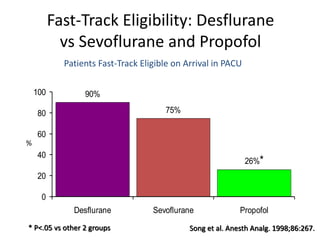
Fast-Track Eligibility: Desflurane
vs Sevoflurane and Propofol
26%*
75%
90%
0
20
40
60
80
100
Desflurane Sevoflurane Propofol
Patients Fast-Track Eligible on Arrival in PACU
Song et al. Anesth Analg. 1998;86:267.* P<.05 vs other 2 groups
%
XENON
• Xenon derives its name from the Greek word for
“stranger” and exists naturally as 9 isotopes, the most
abundant of which is Xe 132.
• Xenon was first discovered in 1898 by British chemists
Sir William Ramsay and Morris W. Trave.
• Commercially, xenon is used in many ways, including in
lasers, high-intensity lamps, flash bulbs, x-ray tubes, and
medicine.
• The noble gas -- xenon was first shown to produce
general anesthesia in 1951.
• Cullen and Gross concluded that xenon was capable of
producing complete anesthesia.
• It is most comparable to N2O, but superior in a number
of ways.
• Xenon is a naturally occurring element that comprises
0.0000086%, or 0.05 parts per million, of air.
• it is isolated by distillation of liquefied air, liquefied
nitrogen, and oxygen.
• Xenon is entirely unreactive in the biosphere therefore,
• it is the only inhaled anesthetic that is not an
environmental pollutant.
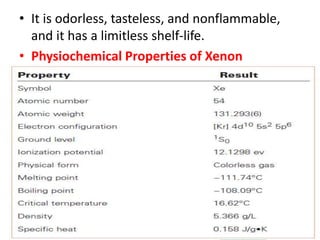
• It is odorless, tasteless, and nonflammable,
and it has a limitless shelf-life.
• Physiochemical Properties of Xenon
• Xenon has many of the properties of an ideal
inhalational agent, including the fact that:
• it is odorless, nonpungent, nontoxic,
nonexplosive , environmentally friendly, and
unlikely to undergo biotransformation due to its
stability.
• Xenon has a rapid onset of action, analgesic
properties, a lack of arrythmogenicity, the ability
to maintain cerebral autoregulatory mechanisms
and cardiovascular stability, and a quick
emergence profile.
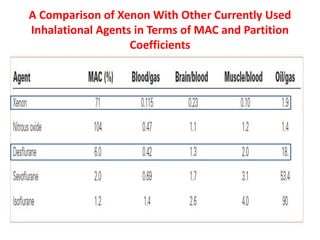
A Comparison of Xenon With Other Currently Used
Inhalational Agents in Terms of MAC and Partition
Coefficients
• Xenon has rapid induction and emergence
times based on its low blood-gas partition
coefficient (.115) .
• only nitrous oxide and desflurane, with B/G of
0.47 and 0.42, respectively, even come close
to xenon in terms of speed of onset.
Advantage of XENON
• Analgesic Properties of Xenon:
• Analgesic properties of xenon are consistent with its
ability to inhibit NMDA receptors.
• Xenon seems to be active at the level of the spinal
cord, particularly in the dorsal horn.
• In 1998, Petersen-Felix et al study suggested that
xenon has an analgesic potency 1.5 times that of
nitrous oxide.
• Cardiovascular Stability : xenon has more favorable
hemodynamic, neurohumoral, and anti -nociceptive
properties than does nitrous oxide.
• Xenon was found to decrease mean arterial pressure,
cardiac output, and systemic vascular resistance less
than nitrous oxide.
• Investigators found that during xenon anesthesia,
plasma adrenaline concentrations were reduced not
only at concentrations of 1 MAC but also at
subanesthetic concentrations.
• Neuroprotective Qualities:Excessive stimulation of
NMDA receptors leads to excess calcium entry into
cells, which triggers a biochemical cascade resulting
in cell death.
• It is interesting that xenon seems unique in that it
has the ability to protect against NMDA agonism-
induced neuronal injury in a dose-dependent
manner without associated NMDA antagonism-
induced neurotoxic effects.
Disadvantages
• COST : At more than $15 per liter in the gas form,
xenon is greater than 100-fold more expensive
than N2O and is far more expensive per patient
than either desflurane or sevoflurane, which are
currently the most expensive volatile
anesthetics.
• Xenon has a MAC-immobility of 0.61 atm, and
even with a strict closed-circuit technique,
greater than 10 L is needed to anesthetize a
typical patient.
• Xenon gas has a much higher density (5.9 g/L)
than either N2O (1.5 g/L) or air (1.0 g/L),
resulting in increased flow resistance and
work of breathing.
• Compared with propofol infusion, xenon
anesthesia results in approximately twofold
the incidence of nausea and vomiting.
“Currently, xenon remains an
experimental anesthetic, with current
research focusing on its potential as a
clinical neuroprotectant and
development of technologies to reduce
its cost”.
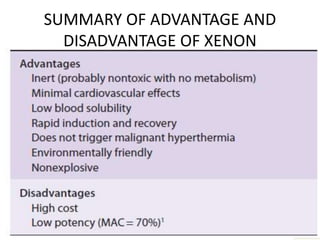
SUMMARY OF ADVANTAGE AND
DISADVANTAGE OF XENON
THANK YOU

DESFLURANE AND XENON

  • 1.
  • 2.
    DESFLURANE • Desflurane isnewer anaesthetic like sevoflurane. • Desflurane went into practice in the U.S. in 1992. • The structure is very similar to that of isoflurane. • The only difference is the substitution of a fluorine atom for isoflurane’s chlorine atom.
  • 4.
    • The lowsolubility in blood and body tissues causes a very rapid induction and emergence of anaesthesia. • Alveolar concentration approaches the inspired concentration much more rapidly than the other volatile agents, giving the anaesthesiologist tighter control over anaesthetic levels. • Wakeup times are approximately 50% less than those observed following isoflurane. • Desflurane is roughly one-fourth as potent as the other volatile agents, it is 17 times more potent than nitrous oxide.
  • 5.
    PHYSICAL PROPERTIES • Thisvolatile anesthetic is a nonflammable fluorinated methyl ethyl ether (difference di-ethyl ether) • Molecular weight-168 • Boiling point (° C)-22.8 • Vapor pressure (mmHg)-664 • Oil/gas partition coefficient at 37° C -19 • Blood/gas partition coefficient at 37° C -0.45 • MAC-immobility (% atm /mm Hg) -6.0/45.6
  • 6.
    • High vapourpressure, an ultra-short duration of action, and moderate potency are the most characteristic features of desflurane. • High vapour pressure necessitated the development of a special desfurane vaporizer (Datex- Ohmeda Tec-6 model vaporizer).
  • 7.
    Desflurane Vaporizer :Tec 6 • electrically powered, heated, pressurized • Output concentration: 0% to 18% (separate safety feature for concentrations > 12%) • Fresh gas flow range: 0.2 to 10 L/min • Accuracy: 0.5% absolute or 15% relative, whichever is greater (similar to other Tec-type vaporizers) Weiskopf RB et al. Br J Anaesth. 1994;72:474-479; Yasuda N et al. Anesth Analg. 1991;72:316-324; Tec 6 Vaporizer [product brochure]. Liberty Corner, NJ: Ohmeda Pharmaceutical Products Division Inc; 1995.
  • 8.
    Desflurane Vaporizer • Capacity –400 mL working volume (LCD indicator) – 50 mL reserve (not indicated) • Can be refilled at room temperature while in use • Multiple alarm features (with battery back-up) • Battery back-up supplies alarms when vaporizer shuts off with loss of main power.
  • 9.
    Boiling Points andVapor Pressures Boiling Point Vapor Pressure (°C) (mm Hg at20°C) Desflurane 23.5 664 Halothane 50.2 241 Isoflurane 48.5 238 Sevoflurane 58.5 160 Barash et al. Clinical Anesthesia. 1992.
  • 10.
  • 11.
    Effects on CNS •It directly vasodilates the cerebral vasculature, increasing CBF, cerebral blood volume, and intracranial pressure at normo-tension and normocapnia. • Cerebral oxygen consumption is decreased during desflurane anesthesia. • Marked decline in CMRO 2, tends to cause cerebral vasoconstriction and moderate increase in CBF. • Thus, during periods of desflurane-induced hypotension (MAP = 60 mm Hg), CBF is adequate to maintain aerobic metabolism despite a low CPP.
  • 12.
    Desflurane vs Isoflurane: CerebralBlood Flow (CBF) During Craniotomy Ornstein et al. Anesthesiology. 1993;79:498. Cerebral Blood Flow (mL/100 g/min) Desflurane Isoflurane Mean + SD 1.5 MAC1.0 MAC 20 15 10 5 0
  • 13.
    Effect on CVS •Increasing the dose is associated with a decline in SVR that leads to a fall in arterial BP. • CO remains relatively unchanged or slightly depressed at 1–2 MAC. • There is a moderate rise in HR, CVP, and pulmonary artery pressure BUT not at low doses. • Rapid ↑ in desflurane concentration lead to transient but sometimes worrisome elevations in HR, BP, and catecholamine levels that are more pronounced than occur with isoflurane, particularly in patients with cardiovascular disease. • These cardiovascular responses to rapidly ↑ desflurane concentration can be attenuated by fentanyl, esmolol, or clonidine.
  • 14.
    Heart Rate-do not↑HR at 1MAC Cahalan et al. Anesth Analg. 1991;73:157; Malan et al. Anesthesiology. 1995;83:918; Stevens et al. Anesthesiology. 1971;35:8; Weiskopf et al. Anesth Analg. 1991;73:143. 95 85 75 65 60 70 80 90 0 1.0 2.0 Heart Rate (bpm) MAC Isoflurane-O2 Sevoflurane-O2 Desflurane-O2 Desflurane-N2O
  • 15.
    Cahalan et al.Anesth Analg. 1991;73:157; Malan et al. Anesthesiology. 1995;83:918; Stevens et al. Anesthesiology. 1971;35:8; Weiskopf et al. Anesth Analg. 1991;73:143. Systemic Vascular Resistance 1400 1200 1000 800 600 400 SVR (dyne • s • cm-5) MAC 1.00 2.0 Isoflurane-O2 Sevoflurane-O2 Desflurane-O2 Desflurane-N2O
  • 16.
    Effect on RESPIRATORYSYSTEM • It causes ↓ in tidal volume and an ↑ in respiratory rate. • There is an overall decrease in alveolar ventilation that causes a rise in resting PaCo2. • Depresses the ventilatory response to increasing PaCo2. • Pungency and airway irritation during desflurane induction can be manifested by salivation, breath-holding, coughing, and laryngospasm. • Airway resistance may increase in children with reactive airway susceptibility.
  • 17.
    Adverse Respiratory Eventsin Adults During Induction Data on file, Baxter Healthcare Corporation. Desflurane Isoflurane Propofol (n = 1162) (n = 415) (n = 266) Coughing 10.9* 0.2 4.5 Salivation 4.0* 0.5 1.5 Laryngospasm 3.5* 0.2 1.5 Breathholding 8.5* 0.0 7.1 Bronchospasm 0.3 0.5 0.4 SpO 2 80% 0.8 1.2 1.5 SpO 2 85% 2.2 2.2 1.9 SpO 2 90% 5.9 4.3 3.0 Incidence (%) * P<.05 vs isoflurane
  • 18.
    Effect on Neuromuscular •Desflurane is associated with a dose- dependent ↓ in the response to TOF and tetanic peripheral nerve stimulation. • Desflurane potentiates NDMB agents to the same extent as isoflurane.
  • 19.
    Effect on RENAL •There is no evidence of any significant nephrotoxic effects caused by exposure to desflurane. • As CO declines, decreases in urine output and glomerular filtration should be expected with desflurane and all other anesthetics.
  • 20.
    Effect on HEPATIC •Hepatic function tests are generally unaffected by desfurane, assuming that organ perfusion is maintained perioperatively. • It undergoes minimal metabolism, therefore the risk of anesthetic- induced hepatitis is minimal.
  • 21.
    Biotransformation & Toxicity •Desflurane undergoes minimal metabolism in humans. • Serum and urine inorganic fluoride levels following desflurane anesthesia are essentially unchanged from preanesthetic levels. • There is insignificant percutaneous loss.
  • 22.
    • Desflurane, morethan other volatile anesthetics, is degraded by desiccated CO2 absorbent (particularly barium hydroxide lime, but also sodium and potassium hydroxide) into potentially clinically significant levels of Carbon mono oxide (CO). • The factors that determine the amount of CO produced include : the chemical makeup of CO2 adsorbent (KOH > NaOH >> Ba(OH)2, Ca(OH)2), dryness of the adsorbent material, the concentration of volatile agent, and its chemical structure. • Desflurane > enflurane > isoflurane
  • 23.
    Contraindications • Desflurane sharesmany of the contraindications of other modern volatile anesthetics:  severe hypovolemia  malignant hyperthermia  intracranial hypertension.
  • 24.
    Clinically Relevant Properties •More rapid control of the anesthetic state, especially at low flows • More rapid return of cognitive function • Better quality of recovery • Less critical to anticipate end of surgery • More rapid awakening .Only drug FAST-IN, FAST–OUT • May permit earlier discharge from PACU Avramov et al; Beaussier et al; Bennett et al; Ghouri et al; Loan et al; Tsai et al; Yasuda et al.
  • 25.
    1. Hargasser etal; 2. Avramov et al; 3. Bennett et al; 4. Eger et al; 5. Yasuda et al; 6. Juvin et al; 7. Weiskopf et al. Desflurane: Advantages in Fast-Track Anesthesia • Precise control of agent concentration1,2,3 • Rapid elimination and recovery regardless of anesthetic duration or flow rates4,5,6 • Safe to use with fresh gas low flow rates4 • Inexpensive at low flows4 • Best used at 1 MAC or lower to minimize cardiorespiratory effects7
  • 26.
    Fast-Track Eligibility: Desflurane vsSevoflurane and Propofol 26%* 75% 90% 0 20 40 60 80 100 Desflurane Sevoflurane Propofol Patients Fast-Track Eligible on Arrival in PACU Song et al. Anesth Analg. 1998;86:267.* P<.05 vs other 2 groups %
  • 27.
    XENON • Xenon derivesits name from the Greek word for “stranger” and exists naturally as 9 isotopes, the most abundant of which is Xe 132. • Xenon was first discovered in 1898 by British chemists Sir William Ramsay and Morris W. Trave. • Commercially, xenon is used in many ways, including in lasers, high-intensity lamps, flash bulbs, x-ray tubes, and medicine. • The noble gas -- xenon was first shown to produce general anesthesia in 1951. • Cullen and Gross concluded that xenon was capable of producing complete anesthesia.
  • 28.
    • It ismost comparable to N2O, but superior in a number of ways. • Xenon is a naturally occurring element that comprises 0.0000086%, or 0.05 parts per million, of air. • it is isolated by distillation of liquefied air, liquefied nitrogen, and oxygen. • Xenon is entirely unreactive in the biosphere therefore, • it is the only inhaled anesthetic that is not an environmental pollutant.
  • 29.
    • It isodorless, tasteless, and nonflammable, and it has a limitless shelf-life. • Physiochemical Properties of Xenon
  • 30.
    • Xenon hasmany of the properties of an ideal inhalational agent, including the fact that: • it is odorless, nonpungent, nontoxic, nonexplosive , environmentally friendly, and unlikely to undergo biotransformation due to its stability. • Xenon has a rapid onset of action, analgesic properties, a lack of arrythmogenicity, the ability to maintain cerebral autoregulatory mechanisms and cardiovascular stability, and a quick emergence profile.
  • 31.
    A Comparison ofXenon With Other Currently Used Inhalational Agents in Terms of MAC and Partition Coefficients
  • 32.
    • Xenon hasrapid induction and emergence times based on its low blood-gas partition coefficient (.115) . • only nitrous oxide and desflurane, with B/G of 0.47 and 0.42, respectively, even come close to xenon in terms of speed of onset.
  • 33.
    Advantage of XENON •Analgesic Properties of Xenon: • Analgesic properties of xenon are consistent with its ability to inhibit NMDA receptors. • Xenon seems to be active at the level of the spinal cord, particularly in the dorsal horn. • In 1998, Petersen-Felix et al study suggested that xenon has an analgesic potency 1.5 times that of nitrous oxide. • Cardiovascular Stability : xenon has more favorable hemodynamic, neurohumoral, and anti -nociceptive properties than does nitrous oxide.
  • 34.
    • Xenon wasfound to decrease mean arterial pressure, cardiac output, and systemic vascular resistance less than nitrous oxide. • Investigators found that during xenon anesthesia, plasma adrenaline concentrations were reduced not only at concentrations of 1 MAC but also at subanesthetic concentrations. • Neuroprotective Qualities:Excessive stimulation of NMDA receptors leads to excess calcium entry into cells, which triggers a biochemical cascade resulting in cell death. • It is interesting that xenon seems unique in that it has the ability to protect against NMDA agonism- induced neuronal injury in a dose-dependent manner without associated NMDA antagonism- induced neurotoxic effects.
  • 35.
    Disadvantages • COST :At more than $15 per liter in the gas form, xenon is greater than 100-fold more expensive than N2O and is far more expensive per patient than either desflurane or sevoflurane, which are currently the most expensive volatile anesthetics. • Xenon has a MAC-immobility of 0.61 atm, and even with a strict closed-circuit technique, greater than 10 L is needed to anesthetize a typical patient.
  • 36.
    • Xenon gashas a much higher density (5.9 g/L) than either N2O (1.5 g/L) or air (1.0 g/L), resulting in increased flow resistance and work of breathing. • Compared with propofol infusion, xenon anesthesia results in approximately twofold the incidence of nausea and vomiting.
  • 37.
    “Currently, xenon remainsan experimental anesthetic, with current research focusing on its potential as a clinical neuroprotectant and development of technologies to reduce its cost”.
  • 38.
    SUMMARY OF ADVANTAGEAND DISADVANTAGE OF XENON
  • 39.